

The Great British Gaslight: Why I’ve Stopped Watching the Westminster Circus
By Joram Abbas
I‘ve spent the better part of twenty years working in and around media, technology, and the strange, hermetic world of Westminster journalism. I’ve sat in the galleries, filed the copy, chased the leaks, and nodded along to the “insider” briefings that pass for insight in this town. And I’ve come to a conclusion that I suspect many of you have already reached: I’ve been part of the problem.
Not intentionally, you understand. I wasn’t sitting in some smoke-filled room, twirling a moustache, plotting how to keep the public distracted. But I was complicit. We all were. The machinery of political journalism – the rolling news, the X (formerly known as Twitter) threads, the “analysis” that’s really just gossip in a suit – it’s designed to keep you looking at the stage while the real business happens elsewhere.
Let me tell you what I’ve seen. Let me tell you why I’ve stopped watching.
The 1,500 Councillors They Don’t Want You to Think About
Labour lost nearly 1,500 councillors in the local elections. Forty councils. Wales. Scotland. The Red Wall turned turquoise. That’s not a “message.” That’s not a “wake-up call.” That’s a screaming, bloody murder of a verdict. Written in letters six feet high, daubed in fluorescent paint, with sirens wailing and smoke signals rising from every former stronghold from Blyth to Barnsley.
And what did the political class do? They turned it into a leadership crisis. Suddenly, the story wasn’t “why did so many people stop voting Labour?” The story was “who’s going to replace Keir?” The question changed from what’s wrong with the party to who’s got the best hair and the sharpest elbows. It’s a shell game. Three cups, one pea, and you’re so busy watching the cups move that you don’t notice the dealer has already swapped the pea for a bit of old chewing gum.
I’ve watched the phone-ins. I’ve read the comment sections. I’ve seen the callers arguing about whether Paul from Peterborough is right or Lynn from West Wycombe is deluded. And I’ve realised: they’re having the argument the machine wants them to have. They’re arguing about the menu, not about who owns the restaurant.
The Menu You’ve Been Served
Look at the menu you’ve been given. Leadership. Donations. Vetting failures. Culture wars. Immigration. Europe. That’s it. That’s the whole menu. Every discussion, every debate, every phone-in eventually circles back to one of those six items. It’s a closed loop. A hamster wheel. A treadmill that goes nowhere but keeps you running.
And what’s not on the menu? Wealth inequality. That a tiny number of people own most of the country. That corporate power has captured the state. That the tax system is rigged to favour the rich. That the housing market is designed to enrich landlords, not house people. That the NHS is being slowly sold off to private equity. That the water companies are poisoning the rivers while paying out dividends. That the energy cartel is profiting from a crisis.
The kitchen’s closed on those topics. Not available. Not on the specials board. Not even on the dessert menu. Why? Because the people who own the restaurant – the media conglomerates, the hedge funds, the corporate donors – don’t want you ordering from that menu. It’s bad for business.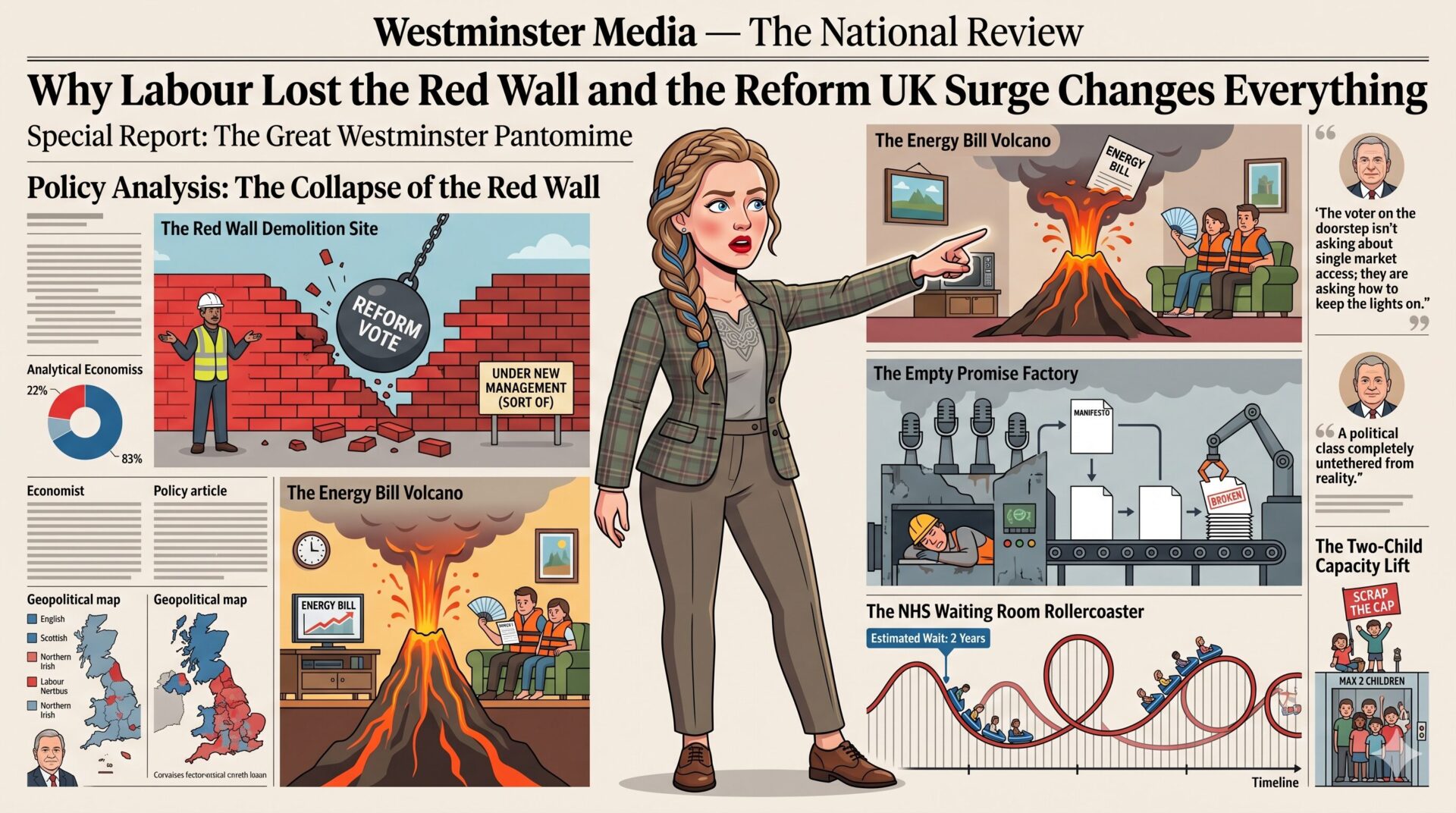
The Great Shell Game
Let me break down how the distraction works. It’s not complicated. It’s just relentless.
Step one: Manufacture a crisis. The local elections were bad – really bad, by any measure. But instead of asking, “why did people stop voting Labour?” – which might lead to uncomfortable questions about housing, wages, health – the machine turns it into a leadership crisis. Suddenly, the story isn’t about failed policies. It’s about who’s going to replace Starmer.
Step two: Flood the zone with inside baseball. “The PLP.” “The NEC.” “The 81 names.” “The stalking horse.” “The timetable.” It’s all language designed to make you feel like you need a degree in Westminster Studies to understand what’s going on. But it’s just soap opera. Who’s shagging whom in the committee corridor? Who’s leaking against whom? It’s a Dynasty with worse suits.
Step three: Make sure nobody mentions the actual policies. Notice how in all that chatter – hundreds of pages of transcripts, dozens of interviews, hours of debate – almost nobody talks about what the government has actually done. The two-child benefit cap? Still, there. The winter fuel payment? Cut. The windfall tax on oil giants? Full of loopholes. The renters’ rights bill? A sticking plaster on a severed artery. The NHS waiting list? Still millions long.
Step four: Divide and conquer. Get the callers arguing. Paul from Peterborough thinks it’s a protest vote. Lynn from West Wycombe calls Farage racist. Emma from Hampstead says it’s about hope. All of them are having the same argument that the establishment wants them to have. None of them are asking the question that would actually change things.
Step five: Repeat. Daily. Hourly. Until the next crisis. Until the next local elections, or by-election, or leadership challenge. It never ends. It’s the political equivalent of Groundhog Day. Lots of movement, no progress, and you’re paying for the ticket every single time.
The Revolving Door That’s Not a Metaphor
I’ve seen the revolving door up close. A minister leaves office and takes a job at a private health company. A lobbyist joins the civil service. A think tank funded by energy giants writes a report that the government then cites as “independent evidence.” It’s not a conspiracy – it’s a system. A system designed to ensure that the people who make the rules are the same people who benefit from them.
The Labour Together scandal – commissioning a report to smear journalists, passing false information to intelligence services – that’s not an aberration. That’s how the game is played. When the establishment feels threatened, it hits back. Hard. And it doesn’t particularly care about the truth while it’s doing it. The truth is just another variable. Another lever. Another thing to be managed.
What We’re Not Supposed to Notice
Let me list a few things that never make it into the “who’s up and who’s down” coverage. Just to remind us what we’re missing.
The fact that a quarter of all children in the UK are now living in relative poverty. That’s four million kids. Four million. In the sixth-richest country in the world. That’s not a leadership problem. That’s a system problem.
The fact that homelessness has tripled in the last decade. Over three hundred thousand people in temporary accommodation, including more than a hundred and fifty thousand children. That’s not a “Labour Party faction” problem. That’s a “we sold off all the council houses and never built any more” problem.
The fact that the average wait for an NHS operation is still over four months. For some specialities, it’s over a year. People are suffering in pain, missing work, losing mobility, because they can’t get the treatment they need. That’s not a “who’s the next health secretary” problem. That’s a “we’ve underfunded the NHS for a decade and let private companies cream off the profitable bits” problem.
The fact that energy bills are still nearly double what they were before the Ukraine war, despite wholesale gas prices falling back to near pre-crisis levels. The energy companies are pocketing the difference. That’s not a “who’s going to be the next prime minister” problem. That’s a “we should have nationalised the energy grid years ago, and we didn’t” problem.
The fact that water companies pumped raw sewage into our rivers and seas for over three million hours last year. That’s not a “leadership style” problem. That’s a “private monopolies have no incentive to invest because they can just pay dividends and let the environment rot” problem.
None of this gets a mention in the great leadership debate. None of it. Because if the media started talking about these things, they’d have to talk about solutions. And solutions would mean criticising the very economic system that the media’s owners have a vested interest in preserving.
The Culture War as a Weapon
The culture war stuff is designed to divide us. It’s not an accident. It’s a strategy. A deliberate, well-funded, carefully orchestrated strategy to keep us yelling at each other about whether a production of Lakmé is “cultural appropriation” or whether a toddler who points at someone is “racist” – while the people who actually run the country empty the bank accounts, sell off the housing stock, and turn the NHS into a corporate car boot sale.
Right now, while you’re typing a furious paragraph about a university student union banning clapping because it’s “triggering,” a private equity firm is buying up another thousand homes to rent back to you at double the mortgage. An energy company is hiking your direct debit while announcing record dividends. A water boss is pocketing a bonus while the river runs brown. A politician is taking a donation from a billionaire and writing a policy that lets them dodge tax.
The culture war is a bone. Set two dogs fighting over a bone, and they won’t notice the bloke walking off with the butcher’s whole shop.
The Voter Apathy Lie
The pundits have been wringing their hands about “voter apathy” for years. “Why don’t people care?” “Why are turnout figures so low?” “Why are so many people staying at home?” They blame social media, the decline of civic society, the weather, the phase of the moon – anything except the obvious.
The problem isn’t voter apathy. It’s voter disgust. People aren’t staying home because they’ve stopped caring. They’re staying home because they’ve stopped believing that any of the options on the ballot paper will make a blind bit of difference.
Where people had a chance to vote for something genuinely different – independents, local campaigns, community candidates – they did. In seats where there was a real alternative to the big three, turnout was higher. Engagement was higher. Hope was higher. Because people aren’t apathetic. They’re hungry. They’re desperate for something to believe in. They just haven’t been offered anything worth believing in by the people who run the show.
The Train That Never Comes
Sitting around waiting for the Labour Party to sort itself out is like waiting for the train that never comes. You can check the timetable. You can complain to the station master. You can write to your MP. You can stand on the platform, getting colder, getting angrier, watching the minutes tick by. But the train isn’t coming. Not today. Not tomorrow. Not ever. Because the line’s been closed for years. The tracks are rusted. The signal’s broken. And the people who run the railway don’t care if you get home.
So what do you do? You start walking. You find another way. You join up with the other people on the platform, and you figure out how to get where you need to go without waiting for a train that was never coming in the first place.
What Building Something Better Actually Looks Like
Let me tell you what’s already happening, in the cracks of the broken system, while the politicians argue about who gets to be station master.
Mutual aid networks. When the pandemic hit, the government was useless. Food banks were overwhelmed. The vulnerable were forgotten. So neighbours started helping neighbours. Shopping for the elderly. Picking up prescriptions. Checking in on the isolated. Those networks didn’t disappear when the crisis ended. They’re still there.
Community food growing. Empty council land, turned into vegetable patches. Local people, growing food for local people. Not waiting for the council to sort out food poverty. Just doing it.
Repair cafes. Instead of throwing away broken toasters, phones, clothes, people bring them to a community space where volunteers fix them for free. Reduces waste. Saves money. Builds skills.
Tenants’ unions. Private landlords have had it their own way for too long. Tenants are organising. Sharing information about bad landlords. Taking collective action. Withholding rent. Winning repairs. Not waiting for a government that’s funded by property developers.
Strike support networks. When workers go on strike, the state tries to break them. So communities step in. Crowdfunding. Food donations. Childcare. Picket line solidarity.
None of this is waiting for the train. All of it is walking. Walking towards a world where people don’t need to wait for permission. Don’t need to beg for scraps from a system that’s designed to starve them. Don’t need to hope that the 5:15 might finally arrive.
The Only Ballot That Matters
The establishment is terrified of this. Not because it’s violent – it’s not. Because it works. Because when people realise they don’t need the state to feed them, house them, care for them, the whole justification for the system collapses. And that’s why the political coverage is so focused on Westminster. That’s why the only solutions ever presented are electoral ones. That’s why any movement that operates outside the approved channels gets smeared or ignored. The system can survive a change of leadership. It can’t survive a change of consciousness.
So here’s the only question that matters. Not “who’s going to be the next prime minister?” Not “can Labour survive till September?” Not “will Reform win the next election?” Those are the wrong questions. They’re the questions the establishment wants you to ask, because they keep you looking at the lock.
The right question is: what are we going to build?
Not wait for. Not hope for. Not vote for. Build. With our hands, our hearts, our neighbours. The community fridge. The tenants’ union. The strike fund. The after-school club. The repair cafe. The food co-op. The mutual aid network. The million small, stubborn, beautiful acts of resistance and creation that add up, over time, to a world that doesn’t need Westminster at all.
A Personal Note
I’ve spent years in this business. I’ve filed the copy, chased the leaks, and nodded along to the “insider” briefings. And I’ve come to realise that I’ve been part of the problem. Not because I’m evil – I’m not. Because the system is designed to make you complicit. You want to keep your job, you play the game. You want access, you don’t ask the hard questions. You want to be seen as “serious,” you don’t challenge the consensus.
But the consensus is a lie. The game is rigged. And the people who own the table are laughing all the way to the bank.
I’m not saying I’ve got all the answers. I’m not saying I’m going to stop being a journalist – it’s what I do, it’s what I know. But I am saying I’m going to stop being part of the circus. I’m going to stop treating Westminster as the centre of the universe. I’m going to start looking at the streets, the communities, the places where people are already building something better.
Because that’s where the real story is. Not in the leadership challenges and the donation scandals and the culture wars. In the quiet, stubborn, daily acts of resistance and creation that the pundits never see.
The Final Adage
From the old market traders who knew a thing or two about survival: “You can wait for the bell to ring, or you can start the music yourself. A fiddle in the hand is worth two in the shop window.”
Start the music. Build the world. And don’t wait for an encore from a show that never cared if you were in the audience. You’re not the audience. You never were. You’re the cast. And the script is still being written. Pick up a pen.
Joram Abbas is a journalist and commentator based in London.
The Labour Leadership Crisis, Reform UK Surge, and What It Means for Britain
The British political landscape is trembling. After a catastrophic local election result that saw Labour lose nearly 1,500 councillors, forty councils, and its grip on Wales and the Red Wall, the party has been thrown into a full‑blown leadership crisis. Keir Starmer, the most unpopular prime minister in modern history, is fighting for his political life. But the battle raging inside Westminster is not just about who sits in the big chair. It is a battle for the soul of the Labour Party—and a mirror to a broken system that has left millions of working people behind.
From the smoking ruins of the Red Wall, a new force has emerged. Reform UK, led by Nigel Farage, has tapped into a deep well of anger and despair. Voters who once held their noses and voted Labour are now turning to Reform, the Greens, or independent community candidates. The message is deafening: people are sick of the same old choices, the same broken promises, and the same corporate‑funded politics that serves the rich while the poor freeze.
Inside the parliamentary Labour Party, the knives are out. Angela Rayner has issued a thousand‑word manifesto demanding a hard lurch to the left. Wes Streeting, the Blairite health secretary, is manoeuvring for a leadership bid. Andy Burnham, the popular mayor of Manchester, is being talked up as a saviour—even though he is not even an MP. Ed Miliband, the man who lost to the Tories in 2015, is whispered about as a “dark horse” candidate. And backbencher Katherine West has threatened to trigger a contest if no one else does. Yet, the 81‑MP threshold to force a vote remains a paper tiger. The rebels talk, scheme, and leak—but they do not act.
While Westminster obsesses over “who’s up and who’s down,” the real crisis deepens. Private rents have soared nearly 30 percent since the pandemic. Energy bills are still double pre‑war levels, with windfall tax loopholes letting oil giants pocket record profits. Food bank usage is at an all‑time high in the fifth richest country on earth. The two‑child benefit cap, which Labour promised to scrap, remains in place—pushing families deeper into poverty every single day. The NHS waiting list is still measured in millions. Young people face a future of zero‑hour contracts, unaffordable housing, and a planet on fire. Pensioners are terrified of winter without the winter fuel payment.
In this comprehensive analysis, we strip away the media circus and the Westminster soap opera. We expose the propaganda machine that keeps us arguing about culture wars and leadership spills while the real power—hedge funds, private equity, corporate donors—loots the country. We show how the “great con” of electoral politics keeps us divided and docile, and we ask the only question that matters: what are we going to build together, instead of waiting for a train that never comes?
Whether you are a Labour member, a Reform voter, a trade unionist, a tenant fighting eviction, or simply someone who has had enough of being gaslit by politicians and pundits, this is your guide to the crisis—and the path beyond it. Read on to understand the real story behind the headlines, and to discover why the only real change starts not in Westminster, but on your street, with your neighbours, and in the small, stubborn acts of solidarity that could finally break the wheel.
The Great Westminster Pantomime: Same Old Puppets, Same Old Strings
Introduction: The Smell of Death on Downing Street
You know that feeling when you’re standing at the bar, pint in hand, and some bloke starts telling you the same story he’s told a hundred times before, except this time he’s really laying it on thick like cheap margarine on stale bread? That’s the Labour Party right now. That’s British politics. That’s the whole sorry circus rolling into town with the same clapped-out lions and the same ringmaster who’s forgotten his lines.
The chatter from Westminster these past few days has been enough to make anyone’s ears bleed. Leadership challenges, resignations, dramatic statements, ultimatums – it’s all kicking off behind those grand doors while the rest of us are trying to figure out how to pay the leccy bill and whether we can afford to put the heating on for another hour.
 Here’s the thing they don’t want you to notice while they’re all busy knifing each other in the back and jostling for the top job: none of it matters. Not one jot. Not one sausage. Because whether it’s Keir Starmer clinging on with his fingernails, Wes Streeting doing his best impression of a Blairite saviour, Angela Rayner rallying the left, or Andy Burnham being talked up as some kind of messiah from Manchester – they’re all singing from the same hymn sheet. Just different verses.
The local election results came in like a bucket of cold water over the whole Labour establishment. Nearly 1,500 councillors gone. Forty councils lost. Wales slipped through their fingers. And what was the great response from the man at the top? A speech about hope and optimism and closer ties with Europe. Because that’s what people on the doorstep in Blyth and Barnsley and Bolton were crying out for – more lectures about the virtues of the single market while their town centres look like a bomb’s hit them.
This ain’t about personalities. It never was. This is about a system that’s rigged from top to bottom, a political class that’s completely lost the plot, and a media establishment that’s more interested in the Westminster soap opera than the fact that millions of us are just about keeping our heads above water.
So let’s have a proper look at what’s really going on. Not the spin. Not the carefully crafted statements from party insiders. Not the focus-grouped nonsense about “strength through fairness” that sounds like it was written by a committee of robots who’ve never actually met a working-class person in their lives.
The Lay of the Land: Forty Points on a House of Cards
1.The Great Shell Game: Why You’re Watching the Wrong Show
There’s an old Cockney saying, whispered down the market stalls and through the pub smoke: “Never mind the dog, beware of the man with the lead.” What it means is this—while you’re staring at the noisy, slobbering mutt tugging at its rope, the bloke holding the other end is already halfway to nicking your wallet.
Right now, the whole country has its eyes glued to that slobbering dog. And what a mutt it is. Keir Starmer looking like a man who’s just been told his tea’s gone cold and he’s got to do the washing up. Wes Streeting preening about like a peacock who’s wandered into a chicken coop. Angela Rayner and Andy Burnham circling each other like two old pros at a boxing hall that’s about to be turned into luxury flats. The media lapping it up like cream—who’s in, who’s out, who’s got the knives out, who’s crying in the corridors.
But the man with the lead? You’ve forgotten all about him. And while you’re arguing about whether Starmer lasts till September or gets rolled by a stalking horse on Tuesday, he’s already halfway to the exit with the real loot.
The Real Crisis Has Nothing to Do With Who Sits in the Big Chair
Let’s pop down to the real world for a minute. Not the Westminster bubble, where a “crisis” means a bad polling number or a snub at the despatch box. I mean the world where people get up at half past stupid o’clock, shove a bit of bread in the toaster, and wonder if there’s enough left in the account to buy milk on the way home.
In that world, food bank usage hasn’t just gone up—it’s gone through the roof, like a Bond villain’s secret headquarters. The Trussell Trust alone handed out nearly three million emergency parcels last year. Three million. That’s not a statistic—that’s a queue round the block in Peckham, a mum pretending she’s not hungry so her kids can have the last biscuit, a bloke in his fifties who never thought he’d be asking for help but here we are.
Rents? Don’t get me started. You’ve got young couples paying two-thirds of their wages for a damp studio above a kebab shop. You’ve got families being evicted because the landlord wants to double the rent for the next sucker. You’ve got pensioners who paid off their mortgage decades ago now watching their neighbours—working families, mind—pushed out onto the street because the housing benefit doesn’t cover the bottom rung any more. The average rent in London is now over two grand a month. Two grand! For a flat that’s got mould in the bathroom and a boiler that sounds like a dying walrus.
And the young people? Don’t even get me started on the young people. They’ve got less chance of owning a home than they do of spotting a unicorn on the night bus. A generation that works harder than their parents ever did, pays more in tax, spends more on rent, has less job security, and is told to be grateful for a zero-hour contract and a “competitive pension scheme” that’s about as competitive as a fat bloke in a sack race. The deposit on a first-time buyer’s flat in most of the South East is now more than the average annual salary. So unless Mum and Dad are sitting on a pile of equity or a surprise inheritance, you’re renting till you’re drawing your state pension.
How the Distraction Works: The Art of the Misdirection
Now here’s the clever bit. This is where the man with the lead earns his keep. Because while all that misery is piling up—while food banks are busier than ever, while rents eat people alive, while young people feel like they’ve been sold a future that’s gone bust before they even cashed the cheque—what do the papers lead with? What do the telly pundits shout about? What do your mates argue about in the WhatsApp group?
Leadership. Chaos. Who’s loyal and who’s a snake. Who’s got the numbers and who’s delusional. Whether Katherine West is a hero or a nobody having her fifteen minutes. Whether Andy Burnham can find a safe seat in time for the coronation. Whether Starmer’s speech was a relaunch or a death rattle.
It’s a shell game. Three cups, one pea, and you’re so busy watching the cups move that you don’t notice the dealer has already swapped the pea for a bit of old chewing gum.
Here’s how it works, step by step.
First, manufacture a crisis inside the palace. The local elections were bad—really bad, by any measure. Nearly 1,500 councillors gone. Forty councils lost. Wales gone. Scotland a disaster. That’s a real crisis, but not the one they want you to focus on. So they turn it into a leadership crisis. Suddenly, the story isn’t “why did so many people stop voting Labour?” The story is “who’s going to replace Keir?” The question changes from what’s wrong with the party to who’s got the best hair and the sharpest elbows.
Second, flood the zone with inside baseball. Every columnist, every pundit, every retired MP with a podcast starts talking about “the PLP” and “the NEC” and “the 81 names” and “the timetable” and “the stalking horse.” It’s all language designed to make you feel like you need a degree in Westminster Studies to understand what’s going on. But really it’s just soap opera. Who’s shagging whom in the committee corridor? Who’s leaking against whom? It’s Dynasty with worse suits.
Third, make sure nobody mentions the actual policies. Notice how in all this chatter—hundreds of pages of transcripts, hours of debate, dozens of interviews—almost nobody talks about what the government has actually done. The two-child benefit cap? Still there. The winter fuel payment? Cut. The windfall tax on oil giants? Full of loopholes you could drive a tanker through. The renters’ rights bill? A sticking plaster on a severed artery. The NHS waiting list? Still millions long, even if it’s technically come down a bit from the peak.
They don’t want you talking about any of that. Because the moment you start asking “hang on, what have you actually done for working people?”, the whole charade collapses. So they keep you arguing about whether Starmer should go in September or next week, and whether Rayner is a socialist or just a very good actress.
The Cockney Guide to Political Economy (Without the Big Words)
Let me put it in terms my old nan would understand. Nan lived through the war, worked in a factory, raised four kids in a two-up two-down with an outside loo, and could stretch a pound further than a rubber band manufacturer. She’d look at this lot and say, “They’re having a laugh, ain’t they?”
Because here’s what Nan would spot straight away. The real division in this country isn’t between Labour and Tory, or between Starmer and Rayner, or between the left and the right of the Labour Party. The real division is between the people who own the deck and the people who are trying to play the hand they’ve been dealt.
Think about it like a game of three-card brag down the market. The bloke running the game—the one who owns the table, the cards, the lighting, and the exits—he doesn’t care if you bet on the red or the black. He doesn’t care if you swap seats halfway through. He doesn’t care if you bring your mate along who thinks he’s got a system. Because whatever you do, the house always wins.
That’s the political system in a nutshell. The big parties, the media, the pundits, the think tanks, the lobbyists—they’re all part of the same game. They might argue about the rules, but they never argue about who owns the table.
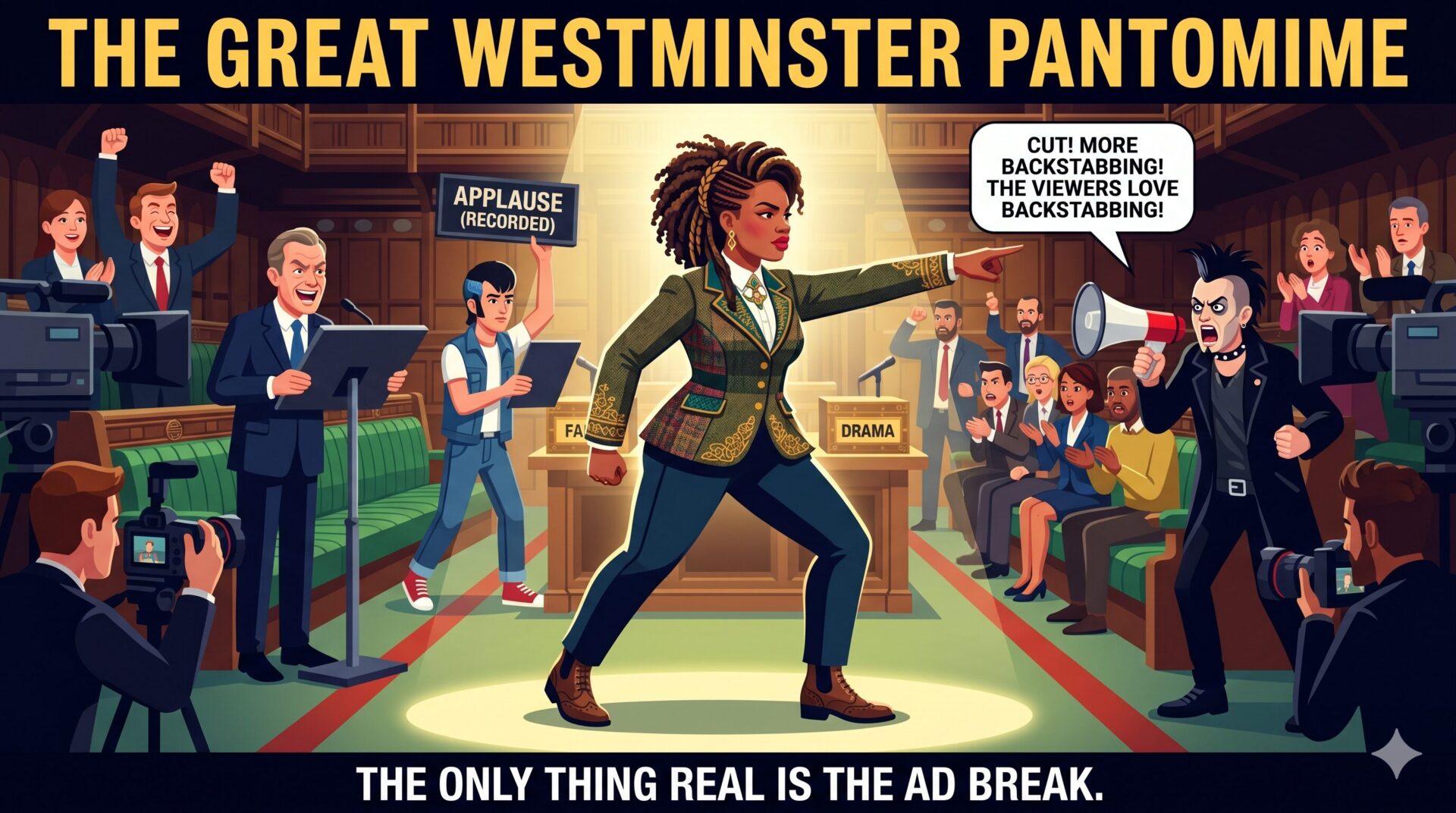 The proof of the pudding is in the eating. Or rather, the lack of pudding. Because if the Labour Party actually cared about working people, they’d have done something about the food banks by now. They’d have scrapped the two-child limit on the first day. They’d have put a proper cap on rents. They’d have started building council housing like it was 1946, and we’d just won a war. They didn’t do any of that. Instead, they’ve spent their first year in power arguing about internal WhatsApp messages, taking donations from billionaires, and planning to cut welfare.
Doesn’t matter who’s in charge, does it? Different face, same menu. And the specials are always off.
The Youth, The Old, and Everyone In Between—All Getting the Same Short End
Let’s take a walk through the real Britain. Not the one they show on the telly—the one with the nice lighting and the carefully selected focus groups. I mean, the one where bus stops smell of stale lager and the local Wetherspoon’s is the only place left where you can sit down without spending a tenner.
Start with the young people. They’ve been sold a pup. “Get a degree, get a job, get on the housing ladder.” That was the promise. What’s actually happened? They’ve got a degree in media studies or business management, a debt the size of a small mortgage, and a job that requires a degree but pays like it doesn’t. They’re stuck in house shares with three strangers and a fridge that’s seen better days. They’re working two or three zero-hour contracts just to make rent. And they’re being told by the politicians that the solution is… to go and study in Europe for a bit. Because that’s what young people need—a gap year in Barcelona while their mates are sleeping on sofas.
Then you’ve got the ones in the middle. The parents, the carers, the ones working full-time and still claiming Universal Credit because wages haven’t kept up with inflation for fifteen years. These are the people who get up at six, do the school run, work eight hours, do the dinner, put the kids to bed, and collapse in front of the telly only to see some MP on a panel show telling them they need to “work harder” or “be more flexible.” It’d be funny if it wasn’t your life.
And the pensioners? The ones who paid into the system all their lives, who helped rebuild the country after the war, who thought they’d earned a bit of peace in their old age? They’re being told they’re the problem. The winter fuel payment—a few quid to help keep the heating on—gets taken away, and it’s presented as “tough but necessary.” Meanwhile, the energy companies are reporting record profits and the water companies are pumping sewage into our rivers while paying out millions in dividends.
It’s enough to make you want to pack it all in and move to Margate. Except Margate’s got the same problems, just with more seagulls.
The Media’s Role: Cheerleaders for the Status Quo
Now, you might be thinking: “Alright, but surely the press are holding them to account? That’s what they’re for, isn’t it?”
Well, yes and no. The press are very good at holding individual politicians to account. They’ll dig up an expenses claim from ten years ago. They’ll find a tweet from when the MP was seventeen and thought they were being edgy. They’ll run a week of stories about who’s been briefing against whom.
But ask them to hold the system to account? Ask them to investigate why, despite sixty years of welfare policy, poverty hasn’t gone away? Ask them to dig into why private equity now owns half the housing stock in some cities? Ask them to explain why, after fourteen years of Conservative government and one year of Labour, the gap between rich and poor is wider than ever?
You’ll be waiting a long time. Because the media—and I mean nearly all of it, from the red tops to the broadsheets to the rolling news channels—is owned by people who benefit from the system. Billionaires, hedge fund managers, foreign investors, advertising giants. They’re not going to let their journalists ask the questions that would threaten their own interests.
What you get instead is a non-stop parade of personality politics. Is Starmer boring or just sensible? Does Rayner’s tax issue matter, or is it a smear? Would Burnham be better, or is he just a bloke from telly? These are the questions that fill the papers because these are the questions that don’t threaten anyone with real money.
 It’s like having a boxing match where both fighters are owned by the same promoter. You can shout for the red corner or the blue corner, but either way, the promoter goes home with the gate receipts.
The Great British Gaslight
Here’s the bit that really boils my blood. The gaslighting.
After the local elections—after nearly 1,500 councillors got the boot, after Labour lost control of councils they’d held for decades, after voters in the Red Wall turned turquoise—what did the prime minister have to say? Did he say, “We’ve made mistakes on housing, on welfare, on the cost of living, and we’re going to fix it”?
No. He said, basically, “You’ve got it wrong.” He said the voters were “frustrated” but that frustration was based on a “feeling” rather than reality. He said the economy was “sound” and the “fundamentals” were “strong.” He said the problem was that people didn’t believe him enough, didn’t trust him enough, didn’t see that he was on their side.
That’s gaslighting, pure and simple. When your boiler breaks and the landlord won’t fix it, that’s not a “feeling.” When your wages haven’t gone up in three years but your shopping bill has doubled, that’s not a “perception.” When you’re worried about how you’re going to pay the rent next month because your hours got cut again, that’s not a “lack of trust in the political system” that can be solved with a nicer speech.
These are material conditions. They’re real. They hurt. And telling people that they’re just imagining it—that if they’d only listen to the optimistic story, they’d feel much better—is about as helpful as telling someone with a broken leg to walk it off.
The Only Way Out Is Through (And Not The Way They Want You To Go)
So what’s the answer? Not who’s going to be the next prime minister. Not whether Labour should lurch left or right. Not whether Starmer survives the week or the month.
The answer is to stop looking at the dog and start watching the man with the lead.
That means ignoring the Westminster circus. It means switching off the rolling news when they start talking about “sources close to the prime minister” or “a well-placed insider.” It means recognising that the real power in this country isn’t exercised by the people on the telly—it’s exercised by the people who own the telly, and the train companies, and the energy grids, and the housing associations, and the water monopolies, and the pharmaceutical giants, and the private equity funds that are quietly buying up everything that isn’t nailed down.
The only thing that’s ever changed anything in this country—the only thing that’s ever made life better for ordinary people—is ordinary people getting organised. Not waiting for a politician to save them. Not hoping for a better leader or a different party. But getting together with their neighbours, their workmates, their fellow tenants, and saying, “Right, enough of this. What are we going to do about it?”
That’s how we got the welfare state. That’s how we got the National Health Service. That’s how we got the minimum wage, and workers’ rights, and the right to strike, and the right to organise. Not from the kindness of politicians’ hearts, but from decades of struggle by people who refused to accept that things couldn’t change.
And it’s the only way things will change again. Because the people at the top—the ones running the show, the ones owning the table—they’re not going to give up their power just because we ask nicely. They’re not going to stop rigging the game because we’ve pointed out the rules are unfair. They’re not going to suddenly start caring about food banks and unaffordable rents and young people trapped in renting hell just because we’ve elected a different bunch of suited-and-booted charlatans.
They’ll only change when they have to. And they’ll only have to when enough of us decide that we’re not playing their game anymore.
The Long Game: Building Something That Actually Works
I’m not going to pretend there’s a magic wand. You can’t wave away two hundred years of industrial capitalism with a good argument and a bit of community spirit. But you can start where you are, with what you’ve got.
Join a union. If there isn’t one, start one. Go to a tenants’ meeting. If there isn’t one, call one. Support a food bank. Better still, ask why there are food banks in the fifth-richest country in the world, and then start making a noise about it. Get involved with a mutual aid network. Share skills with your neighbours. Start a community fridge. Set up a babysitting circle. Whatever it takes to stop relying on a state that’s been hollowed out and a market that’s been rigged.
These aren’t just nice things to do. They’re the building blocks of something bigger. Every time someone says, “we don’t need to wait for permission, we can just do it ourselves,” a tiny crack appears in the system. And enough tiny cracks, over enough time, add up to a collapse.
The politicians know this. That’s why they spend so much time and money keeping us divided—by class, by race, by region, by which football team we support, by whether we voted Leave or Remain, by whether we shop at Waitrose or Aldi. If we ever stopped arguing about the cups and started looking at the dealer’s hands, the game would be up.
One Last Thing Before You Go
Remember that old Cockney saying? “Never mind the dog, beware of the man with the lead.”
The dog is snarling. It’s barking. It’s tugging at its rope like its life depends on it. The media are shouting, “look at the dog!” The pundits are analysing every twitch of its tail. The politicians are pretending to feed it treats while sharpening their knives behind its back.
But the man with the lead? He’s already at the exit. And he’s got your wallet in his pocket.
Don’t let him get away with it.
2.The Stench of Rot: It Ain’t One Man, It’s the Whole Bloomin’ System
There’s an old market saying that’s been doing the rounds since the days of costermongers and barrow boys: “You can tell a bad pear by the company it keeps—but a whole rotten stall stinks long before you spot the first maggot.”
Right now, Downing Street stinks. And I don’t mean the drains, though God knows they’ve probably not seen a proper rodding since Churchill was in short pants. I mean a proper, gut‑churning, nose‑wrinkling stench—the kind that clings to your clothes and gets in your hair and makes you want to cross the street.
 The pundits are all saying it’s Keir Starmer. “The smell of death around Number 10,” they call it. “He’s finished. He’s toast. He’s a dead man walking.” And they’re half right. There is a smell of death. But it’s not coming from him. It’s coming from the whole rotten stall.
Five Minutes in Power, a Lifetime of Broken Promises
Let’s rewind the tape. A little over a year ago, this lot were standing on podiums and doorsteps, telling us they were different. They weren’t like the Tories. They wouldn’t take us for mugs. They’d clean up the mess, restore trust, and put working people first.
“We will govern in the interests of working people.” That’s what they said. “We will end the era of chaos.” That’s what they promised. “Change begins now.” That was the slogan they printed on a thousand glossy leaflets and stuck through a million letterboxes.
And what have we got? A government that’s been in power five minutes and already broken more promises than a second‑hand car dealer on a wet Wednesday afternoon. You know the type—slicked‑back hair, shiny suit, breath that smells of last night’s whiskey and tomorrow’s lies. “One careful owner, mate. Full service history. Drives like a dream.” You get it round the corner and the wheels fall off before you’ve even found reverse.
That’s this lot. Selling us a dream and delivering a nightmare.
Let’s run through the tally, shall we? Because it’s important to keep count. Not for some academic exercise—for the simple reason that if we don’t remember what they promised, we won’t notice when they try to pretend they never said it.
Promise one: Scrap the two‑child benefit cap. They said it was cruel. They said it pushed families into poverty. They said Labour would never stand for it. Then they got into power and—surprise, surprise—the cap stayed. Oh, they’ve got reasons. “Fiscal responsibility.” “Tough choices.” “The mess we inherited.” Same old excuses, different coloured rosette.
Promise two: End non‑dom tax status. The big one. The one they used to hammer the Tories. “Closed loopholes for the super‑rich.” “Make them pay their fair share.” Sounded great on the stump. Sounded even better in the manifesto. Then the donors started whispering, the spads started sweating, and suddenly, it was watered down to the point of being a slightly stronger cup of weak tea. The non‑doms are still here, still dodging, still laughing all the way to the offshore account.
Promise three: Renters’ reform that actually means something. A ban on no‑fault evictions. A decent homes standard for private rentals. A cap on rent increases. What did we get? A bill that’s been watered down so much you could use it to wash your socks. Landlords can still find ways round it. Tenants are still scared to complain. And the rent keeps going up, month after month, while the wages stay flat.
Promise four: A green investment boom. “Our £28 billion a year climate plan.” That was the headline. Then they scrapped it before the election, brought back a watered‑down version, then scrapped that too. Now it’s “whatever we can afford after we’ve paid for the nuclear deterrent and the bankers’ bonuses.” The planet’s on fire, and they’re haggling over the price of a bucket of water.
Promise five: Restore trust in politics. This one’s the real killer. Because they knew—they absolutely knew—that the public was sick of lies, sick of spin, sick of politicians who say one thing and do another. So they promised to be different. “Transparency.” “Integrity.” “A politics that puts country before party.”
And then they gave a million‑pound contract to a PR firm to smear journalists. They took donations from crypto billionaires and then wrote policies that conveniently helped them out. They appointed their mates to cushy jobs and pretended it was all above board. They behaved exactly like the Tories they replaced, just with slightly better grammar.
The Smell Comes From the Whole Stall, Not One Bad Pear
Now, here’s where the pundits get it wrong. They’re so focused on Starmer—his wooden delivery, his lack of charisma, his habit of saying “frankly” when he’s about to tell a whopper—that they miss the bigger picture.
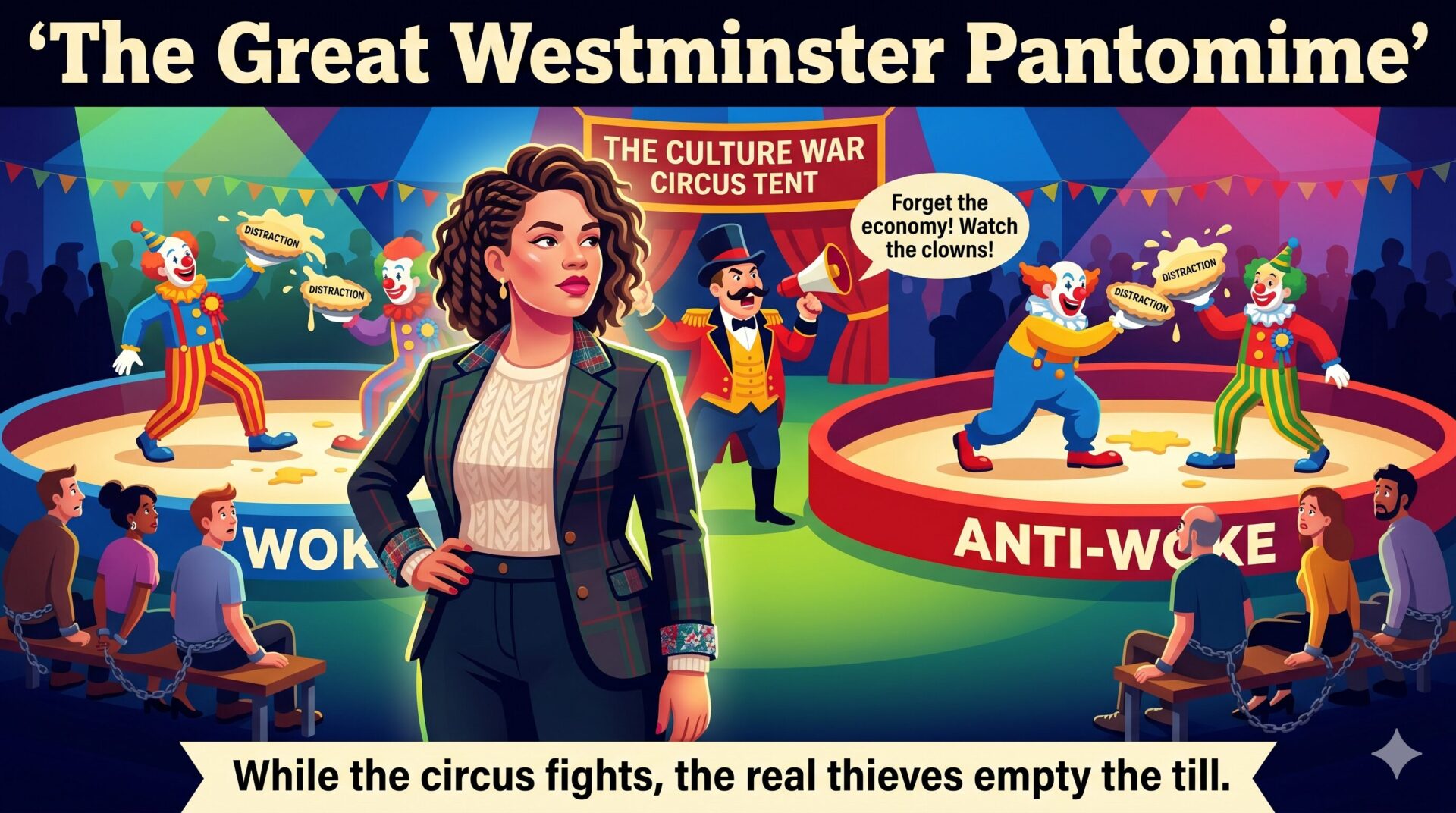 Starmer isn’t the problem. He’s a symptom. A particularly bad symptom, granted—like a runny nose when you’ve got the flu. But the disease is the Labour Party itself. The whole apparatus. The machine that churns out focus‑grouped waffle, that sucks up donor cash, that promotes careerists and sidelines anyone with a genuine conviction.
You could put Angela Rayner in the big chair. You could fly Andy Burnham down from Manchester on a magic carpet. You could even wheel out Ed Miliband for a comedy comeback tour. And you know what would happen? The same thing. Different face, same script. Because the problem isn’t who’s reading the lines—it’s that the play was written by the same old crowd of corporate lobbyists, think‑tankers, and billionaire backers who wrote the last one.
Remember Blair. Remember Brown. Remember Miliband. Remember Corbyn—actually, don’t, because they did everything they could to bury him. Every time the Labour Party has had a chance to be something different, something that actually represents working people, it’s been strangled at birth by its own internal machine. The right wing of the party, the bit that’s always been happiest doing deals with the banks and the pharma giants and the defence contractors, they’ve never let real change get within sniffing distance of power.
And now we’re seeing the final stage of that rot. The pretence is gone. The mask is off. They’re not even trying to look like a party of working people anymore. They’re just the other side of the same coin—a coin that’s been debased so many times it’s not worth the metal it’s stamped on.
A Cockney Tour of Broken Britain
Let’s take a walk, shall we? A stroll through the Britain the Westminster crowd don’t want you to see.
Start at the food bank. It’s in an old community centre, the kind with peeling paint and a boiler that clanks. There’s a queue round the block, mostly women with kids in tow, looking at their shoes so they don’t have to catch anyone’s eye. Inside, the volunteers are packing tins of beans and packets of pasta into plastic bags. One of them’s a retired nurse who never thought she’d be doing this. Another’s a young bloke who lost his job when the warehouse closed down and now gives his time because he’s got nothing better to do.
This food bank didn’t exist ten years ago. Now it’s open five days a week.
Now walk to the housing estate. The one they built in the sixties, when council housing was something to be proud of. The roofs leak. The windows are single‑glazed. The lifts have been broken for six months. And the rent—the rent they charge for these crumbling boxes—is higher than what a private tenant would pay for a flat with working heating. The council says they’ve got no money for repairs. The government says the council should raise more money locally. Everyone points fingers. Nobody fixes the roof.
Now catch the night bus. The last one home. Look at the faces. A care worker who’s just finished a twelve‑hour shift and is heading back to a house share she can barely afford. A lad of about twenty, eyes half closed, on his way to an early shift at the distribution centre. An old boy clutching a shopping bag, probably heading to an empty flat where the radiators don’t work.
These aren’t statistics. They’re people. And they’re being let down by a system that doesn’t care if they sink or swim.
The Politics of “Oh Dear, How Awkward”
What gets me is the tone. The way they talk about all this. Not with anger, not with urgency, but with a kind of mild disappointment, like a vicar who’s found a half‑empty bottle of sherry in the vestry.
“Oh dear, the local elections were a bit tough.” “Gosh, we seem to have lost the Red Wall.” “How unfortunate that the focus groups aren’t happy with the prime minister.”
There’s no sense that any of this matters. No sense that behind every lost council seat, there’s a community that’s given up hope. No sense that when a Labour voter switches to Reform or stays at home, it’s a cry of desperation, not a fit of pique.
 They treat politics like a game of chess. Moves and counter‑moves. Alliances and betrayals. Timetables and thresholds. And the rest of us? We’re just the scenery. The backdrop. The extras in a West End show that’s been running too long and badly needs a rewrite.
The Only Adage That Matters Right Now
My old nan had a saying for times like this. She’d stand at the sink, up to her elbows in washing‑up, and look out the window at the street where she’d lived for fifty years. “You can paper over a crack,” she’d say, “but you can’t paste over a subsidence.”
That’s where we are. Subsidence. The whole foundation is shifting. The cracks in the walls aren’t cosmetic—they’re structural. And no amount of fresh wallpaper, no speech about “hope” or “optimism” or “stronger and fairer Britain,” is going to hold it together.
The Labour Party isn’t going to save us. Neither are the Tories, or Reform, or the Lib Dems, or the Greens. They’re all part of the same subsidence. They’re built on the same unstable ground—a system that’s designed to enrich the few at the expense of the many, to keep us fighting over scraps while the feast is carried out the back door.
The only people who can fix this are us. The ones in the queue at the food bank. The ones on the night bus. The ones in the damp flats and the zero‑hour contracts and the hopeless job centres. The ones who’ve been told all our lives that we don’t know enough, don’t understand enough, aren’t clever enough to run our own lives.
They’re wrong. We are clever enough. And we’re angry enough. And we’re numerous enough. We just haven’t realised it yet.
Enough of the Smell. Open the Windows.
So what do we do while the Westminster crowd keep arguing about who gets to sit in the big chair? While the pundits analyse Starmer’s body language and Rayner’s tax returns and Burnham’s chances of finding a safe seat? While the whole rotten circus plays out on our tellies and our phones and our front pages?
We ignore them. We turn away. We stop breathing in the stench.
And we start building. Not in Parliament—they’ve got that sewn up. But in our streets, our workplaces, our estates. We link up with the neighbours we’ve never spoken to. We join the union branch we’ve been meaning to get to. We go to the tenants’ meeting and say something, even if our voice shakes. We volunteer at the food bank, and then we ask why it has to exist in the first place, and then we start making noise about that too.
It won’t happen overnight. It won’t be tidy. It won’t make the headlines. But it’s the only thing that’s ever worked. Every gain working people have ever won—the weekend, the minimum wage, the NHS, the right to strike, the safety net that’s been shredded but not yet destroyed—came from people like us getting organised and refusing to take no for an answer.
Not from a bloke in a suit at a podium. Not from a focus‑grouped slogan. Not from a party that’s forgotten who it’s supposed to serve.
From us.
So next time you hear a pundit talking about “the smell of death around Number 10,” remember: it’s not about Starmer. It’s about the death of a lie. The lie that they represent us. The lie that they’ll change things. The lie that we need them.
The smell is bad, I won’t pretend otherwise. But you know what? When something’s properly dead, you can finally bury it. And then, maybe, you can start growing something new in the soil. Something that doesn’t stink. Something that feeds people, instead of feeding on them.
That’s the real change. And it starts right here, right now, with the only people who’ve ever been able to make it happen.
3.All Fur Coat and No Knickers: The Great Left‑Wing Con
There’s a saying you’ll hear on the market stalls and in the working men’s clubs, usually muttered over a pint of best bitter: “All fur coat and no knickers.” It means someone who looks the part on the outside—flash, impressive, a bit of glamour—but underneath there’s nothing but bare skin and embarrassment. All show, no substance.
Angela Rayner’s big “lurch to the left” is the political equivalent of that fur coat. It looks lovely from a distance. It’s got the right colour, the right cut, the right labels dangling from the sleeve. But when you get up close and have a proper rummage, there’s nothing underneath except the same old pants you’ve been wearing for years.
She gave a thousand‑word manifesto, they say. Demanded a “hard lurch to the left.” Used all the right words—fairness, justice, working people, Labour values. The crowd clapped. The pundits nodded. The commentators said she’d thrown down the gauntlet to Starmer and his miserable centrism.
But hold your horses. Let’s have a proper look at what she actually asked for. Because when you strip away the rhetoric, when you read between the lines, when you stop listening to the tune and start looking at the dance, it’s not a lurch anywhere. It’s a shuffle. A sidestep. A bit of fancy footwork that ends up exactly where it started.
Rent Caps? Not a Peep.
Let’s start with housing. Because if you’re serious about a left‑wing agenda in Britain today, housing is where you start. It’s the single biggest drain on working people’s wages. It’s the reason young people can’t save for a deposit. It’s the reason families are living in overcrowded flats with mould on the walls. It’s the reason pensioners are terrified of their fixed‑term tenancies ending and the rent doubling overnight.
So where in Angela Rayner’s thousand‑word manifesto is the call for proper, enforceable rent caps? You know the kind—the ones they have in Berlin and Barcelona and a dozen other European cities where ordinary people can still afford a roof over their heads. Caps that tie rent increases to inflation, that stop landlords from hiking the price just because they feel like it, that give tenants security and dignity and the right to stay in their own homes.
Nowhere. Not a sausage. Not a whisper.
Oh, she’ll talk about “renters’ reform” and “decency standards” and all that stuff. But that’s like putting a sticking plaster on a severed artery. What renters need isn’t a slightly fairer system for evictions—it’s a system that stops landlords from treating homes like cash machines in the first place. It’s a cap that says “you can’t charge more than this, end of story.” It’s a recognition that housing is a human right, not an investment vehicle for property speculators.
But you can’t say that, can you? Not if you’re a mainstream Labour politician. Because too many of your mates are landlords. Too many of your donors are property developers. Too many of your target voters in marginal seats are homeowners who’ve convinced themselves that high house prices are a good thing, right up until their own children can’t afford to move out.
So Rayner gives us warm words about “security” and “decency” and “fairness.” But she doesn’t give us rent caps. And without rent caps, all the rest is just window dressing.
Nationalisation? Only When It’s Safe and Boring.
Now let’s talk about taking things back. The big one. The thing that actually separates the left from the soggy middle. Nationalisation. Bringing energy, water, rail, mail, telecoms—the essential bits of the economy that we all rely on—back into public ownership, where they belong, accountable to us, not to shareholders.
Rayner’s manifesto? Crickets. Maybe a nod towards “public ownership” of British Steel, because that’s safe and nostalgic and doesn’t threaten anyone important. A bit of talk about “taking control” of energy security, but in a way that sounds more like regulation than ownership. Nothing about the water companies that have been pumping sewage into our rivers while paying out millions in dividends. Nothing about the train operators that charge a fortune for a service that’s late, overcrowded, and falling apart. Nothing about the energy giants that posted record profits while the rest of us froze in our own homes.
Why not? Because nationalisation costs money. And it upsets powerful people. And it means taking on the very corporate interests that the Labour Party has spent the last thirty years cosying up to.
Think about it. If you owned shares in Thames Water or British Gas or one of the big rail operators, you’d be making phone calls to your friends in Westminster the moment anyone mentioned the N‑word. You’d be reminding them that elections cost money, and that money comes from somewhere, and that somewhere isn’t trade union subs anymore—it’s the City. It’s hedge funds. It’s private equity.
Rayner knows this. That’s why her “hard lurch to the left” doesn’t include anything that would actually upset the people who write the cheques. It’s left‑wing in the way a gravy stain on a white shirt is left‑wing—technically there, but mostly just embarrassing.
Council Tax: The Tax That Punishes You for Having a Roof
And here’s the one that really gets my goat. Council tax.
Think about what council tax actually is. It’s a tax on where you live. Not on what you earn, not on what you own, not on what you spend—just on the modest home you’ve managed to scrape together the money to occupy. It’s based on property valuations from 1991, for goodness’ sake. Thirty‑five years out of date. A system so absurd that a millionaire in a penthouse in Kensington can pay less than a nurse in a three‑bed semi in Stoke.
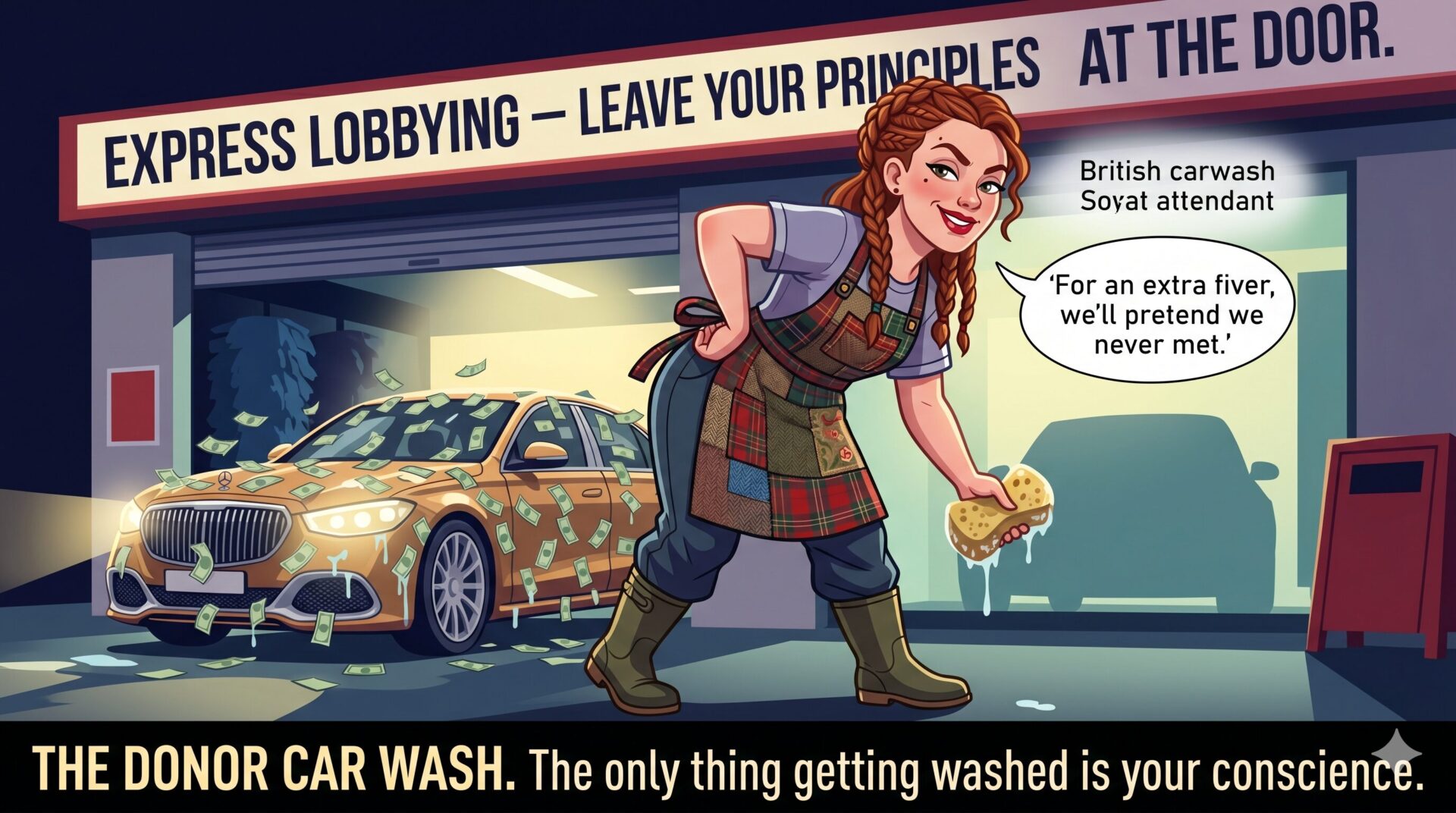 It’s regressive. It’s unfair. It’s a disgrace. And any party that genuinely wanted to help working people would scrap it tomorrow and replace it with something—anything—that actually makes sense. A local income tax. A land value tax. A revaluation of bands that catches the rich and spares the poor. There are a dozen options, all of them better than this rotten relic.
So where is it in Rayner’s manifesto? Nowhere. Not a word. She’s happy to talk about “fairness” and “progressive taxation” in the abstract, but when it comes to actually changing a tax that hits working families hardest—crickets again.
Why? Because council tax is popular with the wrong people. Homeowners in marginal seats like it because it’s predictable and low. Councils rely on it because they’ve got nothing else. And reforming it would mean taking on the very property‑owning middle class that Labour has spent decades chasing.
So the nurse in the semi in Stoke keeps paying through the nose. And the millionaire in the penthouse gets a nice discount. And Angela Rayner talks about “fairness” without ever mentioning that the current system is anything but.
The Adage That Says It All
There’s another old saying, this one from the dockyards and the factory floors: “You don’t fatten a pig by weighing it.” Meaning, all the talk in the world won’t put meat on the bones. You’ve got to actually do something. You’ve got to change the feeding, change the conditions, change the way things work.
Rayner’s manifesto is all weighing and no feeding. It measures the pig, it talks about the pig, it promises to give the pig a nicer pen. But it never gets round to the actual business of making the pig fatter—because that would mean taking on the people who own the pig feed, and the people who own the pig farm, and the people who set the rules for the whole damn pig industry.
Her “hard lurch to the left” is a lurch in name only. It’s a gesture. A performance. A bit of theatre designed to convince the party membership that she’s one of them, while reassuring the donors and the power‑brokers that nothing fundamental will change.
And you know what? It’s working. The commentators are talking about her as a “unity candidate.” The left of the party are nodding along because at least she’s not Wes Streeting. The right of the party are nodding along because they know she won’t actually do anything radical. Everyone gets to feel good about themselves. And the rest of us get to carry on paying through the nose for rent, energy, water, trains, and a tax system that’s been rigged against us since before half the MPs were born.
What a Real Left Manifesto Would Look Like
Let’s imagine, for a moment, that someone actually meant it. That someone stood up and said, “Right, enough of this nonsense. Here’s what we’re actually going to do.”
Rent caps. Nationwide. Tied to inflation. With a register of landlords and penalties for anyone who tries to game the system. Not “rent stabilisation” that lets rents keep rising a bit slower—actual caps that freeze them where they are and roll them back where they’ve gone too far.
Energy nationalisation. Not a “public stake” or a “special share” or any of that fudge. Full ownership. Take the grid, the generators, the distribution networks, and run them for public benefit, not private profit. Bring bills down by cutting out the middlemen and the shareholders and the dividend payments.
Water nationalisation. The same. Because no private company should be allowed to pump raw sewage into our rivers and then charge us a fortune to clean it up. Take them back, forgive the debt, invest in the infrastructure that should have been maintained decades ago.
Rail nationalisation. Not the piecemeal, franchise‑by‑franchise approach they’re pretending is radical. All of it. Tracks, trains, stations, ticketing. A single, integrated, publicly‑owned railway that actually works, that doesn’t cost the earth, and that connects communities instead of exploiting them.
Scrap council tax. Replace it with a local income tax based on ability to pay. Or a land value tax that captures the unearned wealth from rising property prices. Or both. Anything—literally anything—other than a tax that punishes you for having a modest home while letting the wealthy off the hook.
Rebuild social housing. Not “affordable housing” that costs eighty percent of market rent. Actual social housing, council housing, let at rates tied to local wages. A million new homes, built to decent standards, on public land, for public good. And while we’re at it, bring back rent control for the private rented sector so landlords can’t just evict tenants and hike the price for the next sucker.
 That’s a left‑wing agenda. That’s a hard lurch. That’s the kind of manifesto that would actually change things, that would put money back in people’s pockets, that would give them security and dignity and hope.
You won’t find any of it in Angela Rayner’s thousand words. Not a sniff. Not a hint. Because it would upset too many people in the wrong places. It would cost too much political capital. It would require taking on the very structures of power that the Labour Party has spent a generation learning to work within.
The Final, Bleak Truth
Here’s the kicker. Rayner might even believe some of this stuff. She might genuinely think she’s being bold. She might look at her manifesto and see a radical break from the Starmer years. She might go to bed at night feeling proud of herself for standing up to the soft right.
But belief isn’t enough. Intentions aren’t enough. Good feelings aren’t enough. What matters is what you actually do—and what you don’t do. And Rayner’s not doing the things that matter. She’s not calling for rent caps. She’s not calling for nationalisation. She’s not calling for council tax reform. She’s not challenging any of the economic orthodoxies that have made life so miserable for so many for so long.
She’s offering a bit more welfare spending here, a bit of public ownership there, a few kind words about working people. It’s better than Starmer’s empty suit, sure. But better than a poke in the eye with a sharp stick isn’t the same as good.
The old market traders have another saying: “A pig in a poke is still a pig, no matter how you dress it.” Meaning, if you’re selling me a pig, I don’t care about the ribbon you tie round its neck. I care about the pig. Is it healthy? Is it worth the money? Will it put food on the table?
Rayner’s offering us a pig in a poke. Wrapped in a fur coat, dressed up in fancy language, presented as the left’s great hope. But when you unwrap it, when you look past the ribbon, it’s the same old pig. The same old compromises. The same old fear of really changing anything.
And until someone stands up with a genuine agenda—one that takes on the landlords, the energy giants, the water profiteers, the council tax racket—the smell of death around Downing Street isn’t going anywhere. Because the rot isn’t in one person. It’s in the whole system. And no amount of thousand‑word manifestos is going to fix that.
Only action will. Only organising. Only refusing to accept that this is the best we can do.
So by all means, cheer Angela Rayner. Applaud her for giving Starmer a headache. Enjoy the spectacle of the Labour Party eating itself alive. But don’t mistake the show for the substance. Don’t confuse a fur coat with actual clothes. And don’t believe for a moment that a “hard lurch to the left” that doesn’t include the things that actually matter is anything other than the same old con, dressed up for a new audience.
The pig is still in the poke. And we’re still waiting for our dinner.
4.Same Old Rubbish, Shiny New Wrapper
There’s a saying you’ll hear on any half‑decent building site, usually shouted over the noise of a cement mixer: “You can paint a pig, but it’s still a pig.” You can give it a wash, brush its bristles, stick a ribbon round its neck—but when it opens its mouth, it’ll still oink like a pig, eat like a pig, and leave behind exactly what you’d expect from a pig.
Wes Streeting is that pig. Shiny new haircut, fresh suit, a smile that’s been focus‑grouped within an inch of its life. He talks about “modernisation” and “reform” and “getting things done.” He sounds like a breath of fresh air if you’ve been stuck in a room with Keir Starmer for too long. But underneath the styling gel and the carefully casual rolled‑up sleeves, it’s the same old neoliberal nonsense that’s been failing working people for forty years.
Meet the New Boss, Same as the Old Boss
Let’s start with what Streeting actually believes. Not what he says at party conference—the slogans and the soundbites and the carefully crafted lines about “Labour values.” I mean, what he actually does, what he actually votes for, what he actually pushes when he thinks nobody’s watching.
The man thinks the answer to every problem is more private sector involvement. More competition. More markets. More of the very forces that have hollowed out our public services, sold off our council housing, and turned the NHS into a car boot sale for American health insurers.
Think about the health service. Streeting’s big idea for the NHS isn’t to properly fund it, hire more staff, and rebuild the bits that have been left to rot. No. His big idea is to let more private companies run bits of it. More “independent sector providers.” More “patient choice.” More of the same failed experiment that’s left us with an NHS that’s chronically underfunded, demoralised, and being picked apart by vultures in suits.
 He calls it “reform.” I call it what it is—privatisation by the back door. The same trick the Tories tried, the same trick Blair tried, the same trick that’s never worked anywhere and has only ever made things worse. But Streeting’s convinced that this time it’ll be different. This time, if we just let a few more private companies dip their beaks in, the magic of the market will somehow fix everything.
It won’t. It never has. And it never will.
The Market Doesn’t Care About Your Health
Here’s the thing about markets. They’re brilliant at some things. If you want to sell trainers or mobile phones or takeaways, competition can drive down prices and drive up quality. Great. But health care isn’t trainers. You don’t shop around for a hip replacement like you’re browsing for a new pair of Nikes.
Markets work when customers have choice, information, and the ability to walk away. None of those apply to health care. When you’re having a heart attack, you don’t compare waiting lists and read online reviews. You go to the nearest A&E and hope for the best. When your child’s got a fever in the middle of the night, you don’t fire up a comparison website. You dial 111 and pray someone answers.
The market doesn’t care about any of that. The market cares about profit. And profit in health care comes from cherry‑picking the easy, profitable stuff—the routine operations, the diagnostic scans, the things that can be done quickly and billed nicely—while leaving the difficult, expensive, unprofitable stuff to the public sector. It’s called cream‑skimming. And it’s been the private sector’s business model in the NHS for thirty years.
Streeting knows this. He’s not stupid. But he’s committed to the ideology. The belief that competition and choice will somehow rescue a service that’s been starved of funding, stripped of staff, and battered by a pandemic. It’s not evidence‑based. It’s not even common sense. It’s faith. Blind, unshakeable faith in the magic of the market.
From the NHS to Your Council Estate
And it’s not just the health service. Streeting’s neoliberal virus has infected every part of his thinking.
Social housing? He’s talked about “opening up” council housebuilding to private developers. Because that worked so well last time. Remember what happened when we let private companies build “affordable housing”? We got rabbit hutches with paper‑thin walls, sold on the never‑never, with service charges that go up every year and a “leasehold” system that’s basically feudalism with better marketing.
Education? He’s praised academies and free schools—the great privatisation experiment of the Tory years. The ones that have led to a two‑tier system where well‑off parents get well‑off schools and everyone else gets a postcode lottery. The ones where headteachers can be sacked for questioning the sponsor’s pet project. The ones that have sucked money and expertise out of the local authority system and left a mess that’ll take a generation to clean up.
Welfare? He’s talked tough about “reforming” benefits, about “making work pay,” about “tackling welfare dependency.” All the same language the Tories used to justify Universal Credit, the sanctions regime, the hostile environment. All the same assumptions that people on benefits are scroungers and cheats, not fellow human beings who’ve been let down by an economy that doesn’t work for them.
It’s the same old record, just with a different needle.
A Cockney Tour of Neoliberal Britain
Let’s take a walk down the street that neoliberalism built. Not a fancy high street with coffee shops and estate agents. A real street. The kind that’s had the life sucked out of it over the last forty years.
Start at the old swimming baths. Used to be council‑run, busy every night of the week, kids learning to swim, pensioners doing their lengths, a real community hub. Then the cuts came, the council couldn’t afford to run it anymore, so they sold it to a private operator. The private operator put the prices up, closed it three days a week, and turned half the building into a gym for people who can afford a membership. The kids swim on a Thursday afternoon if they’re lucky. The old dears can’t afford it at all.
Now walk to the housing estate. The one where they sold off the council houses and never built any replacements. Most of the ones that are left are owned by a private company now—a “housing association” that’s basically a landlord with a better PR team. The rents have gone up more than wages for a decade. The repairs take months. The waiting list is years long. And anyone under thirty has about as much chance of getting a council flat as they do of winning the lottery without buying a ticket.
Now stop at the job centre. The one where they’ve outsourced half the services to private contractors. The “work programme” providers who get paid for every person they shove into a six‑week course or a zero‑hour contract. The ones who treat unemployed people as profit centres, not as human beings who need support and training and a proper job that pays a living wage.
This is the world Wes Streeting wants more of. More private companies running public services. More competition between providers who don’t give a toss about communities. More markets where the only thing that matters is the bottom line.
The Adage That Says It All
My old dad had a saying for people like Streeting. He’d lean over the pub table, pint in hand, and say, “He couldn’t organise a piss‑up in a brewery, but he’s got a thousand ideas for selling the barrels.”
That’s Streeting in a nutshell. He’s got no interest in actually running public services well—that would require funding, planning, political will, and a belief that the state can do good things. What he’s interested in is selling off the pieces. Breaking things up. Outsourcing. Contracting out. All the mechanisms that transfer wealth from the public purse to private pockets.
Notice what he never talks about. He never talks about bringing things back in‑house. He never talks about reversing the privatisations of the last forty years. He never talks about taking back control of the bits of our lives that were sold off without our permission. Because that would mean admitting that the market isn’t the answer—that the market was the problem all along.
He’s like a mechanic who’s convinced that the best way to fix your broken car is to sell it for scrap and buy a new one. Never mind that you can’t afford a new one. Never mind that the old one just needs a proper service and a few replacement parts. Sell it! Scrap it! Let the market provide!
And when the market provides a car with no wheels and an engine made of cardboard, he’ll shrug and tell you that you should have chosen a better provider.
The Fresh Face Myth
The thing that gets me is how many people fall for the “fresh face” routine. They see Streeting on the telly—young, energetic, not obviously dead behind the eyes—and they think, “Finally, someone who gets it.”
But look closer. Who’s backing him? Who’s donating to his campaigns? Who’s whispering in his ear? The same corporate lobbyists, the same private health firms, the same property developers, the same City money that backed Blair and backed Brown and backed every other “moderniser” who promised to make Labour electable by making it indistinguishable from the Tories.
Streeting isn’t a fresh face. He’s the same face with a slightly different haircut. A bit more product in the hair, a bit less gravitas in the voice, but the same basic script. The NHS needs more private sector involvement. Schools need more competition. Welfare needs more conditionality. Housing needs more market solutions.
It’s the same script they’ve been running for thirty years. And every time it’s failed, they’ve doubled down. More privatisation, more competition, more markets. Not because it works—because it benefits the people who pay for their campaigns.
What Working People Actually Need
Let me tell you what a real fresh face would look like. Not Wes Streeting. Not anyone in the Labour Party’s current leadership line‑up, frankly.
A real fresh face would stand up and say: “We’re bringing the railways back. All of them. No franchises, no complicated contracts, no private operators skimming off the top. Public ownership, public operation, public benefit.”
They’d say: “We’re taking the water companies back. The ones that have been pumping sewage into our rivers while paying out dividends. We’re writing off the debt, sacking the boards, and running our water for the public good, not for shareholder value.”
They’d say: “We’re building council houses again. A million of them. Not ‘affordable’ homes that cost eighty percent of market rent—actual council houses, let at rents tied to local wages, with secure tenancies and proper maintenance.”
They’d say: “We’re scrapping council tax and replacing it with something that actually makes sense. A local income tax, a land value tax, a revaluation of bands—anything other than this regressive nonsense that’s been unfair for thirty years.”
They’d say: “We’re properly funding the NHS. Not with more private contracts and ‘independent sector’ nonsense. With money. With staff. With buildings that don’t leak. With waiting lists that go down and stay down.”
That’s a real fresh face. That’s someone who’s not afraid to take on the privateers, the profiteers, the people who’ve been looting the public realm for a generation.
Wes Streeting isn’t that person. He never has been. And he never will be, because his whole career has been built on the opposite premise—that the private sector is the answer, not the problem.
The Only Way Out
There’s a final adage worth remembering, this one from the old dockers who worked the London wharves before they were sold off for luxury flats: “You don’t put the fox in charge of the henhouse and then act surprised when the eggs go missing.”
Streeting is the fox. The private sector is the fox. The market is the fox. And we’ve been watching the eggs disappear for forty years.
The only way to stop it is to stop believing the fox when he tells you he’s changed his spots. To stop voting for people who promise to manage privatisation better, as if that’s even possible. To start demanding something completely different—not a marketised public service, not a competitive welfare system, not a privatised housing market, but a genuine alternative built on solidarity, not profit.
That means ignoring the fresh faces and the shiny haircuts. It means looking past the soundbites and the focus groups. It means asking the uncomfortable question: who benefits from this person’s policies? Is it working people, or is it the same old crowd of corporate donors and private contractors and City speculators?
Wes Streeting has a very clear answer to that question. It’s just not the one he wants you to hear.
5.The Saint of Salford? Don’t Make Me Laugh
There’s a saying you hear in the markets and the working men’s clubs, usually after someone’s been banging on a bit too much about a local celebrity: “All mouth and no trousers.” Means they can talk the hind legs off a donkey, but when it comes down to doing the actual graft—rolling up the sleeves, getting their hands dirty, making a real difference—they’re about as useful as a chocolate teapot.
Andy Burnham is all mouth and no trousers. The chattering classes have decided he’s the next great hope of the Labour Party. The pundits on the telly talk him up like he’s the second coming of Nye Bevan. “The mayor of Greater Manchester!” they cry. “Popular! Authentic! A proper northern bloke who gets it!”
God give me strength.
Let’s be clear about something. I’ve got no personal beef with Andy Burnham. He seems like a decent enough fella. He’s got a nice way about him on the telly. He can do the emotional bit—the furrowed brow, the sincere voice, the “I hear you, mate” routine. He’s been in politics long enough to know which buttons to press and how to press them without looking like a complete reptile. That’s all true.
But being good on the telly isn’t the same as being good for people. And the people of Greater Manchester—the ones who live in the damp flats and the overcrowded houses, the ones who queue at the food bank, the ones who can’t afford to heat their homes in winter—they’ve been waiting for Andy Burnham to be good for them for a very long time. And they’re still waiting.
What Has He Actually Done?
Let’s start with housing. Because if you’re the mayor of a major city region, and you’ve got any kind of progressive bone in your body, housing is where you start. It’s the foundation of everything. If people don’t have a secure, affordable, decent place to live, nothing else matters. You can’t hold down a job if you’re terrified of your landlord. Your kids can’t do their homework if the mould’s making them cough all night. You can’t plan for the future if you’re one eviction notice away from the street.
So what has Andy Burnham actually done about the housing crisis in Manchester? The one that’s seen rents double in some postcodes? The one where waiting lists for council flats stretch into years? The one where private landlords are charging a fortune for properties that ought to be condemned?
 He’s talked about it. He’s given speeches about it. He’s held summits and roundtables and “housing first” conferences. He’s posed for photos on building sites with hard hats and high‑vis jackets. He’s announced schemes and strategies and action plans, all with lovely names like “A Home for Everyone” and “The Greater Manchester Housing Framework.”
And the rents keep going up. The waiting lists keep getting longer. The private landlords keep charging whatever they like. The homelessness figures keep climbing.
Because here’s the thing. A mayor can’t fix the housing crisis on his own. He doesn’t control planning laws. He doesn’t set the benefits rates that determine what people can afford. He doesn’t have the power to cap rents or build council housing at scale. The real decisions are made in Westminster, by the very government he spent years serving in and now pretends to be independent from.
But he could use his platform. He could make noise. He could organise. He could drag the issue into the spotlight and keep it there until something changed. He could stand up in front of the cameras and say, “The housing situation in this city is a disgrace, and I’m not going to shut up about it until the government gives us the powers and the money to fix it.”
Has he done that? Has he heck. He’s given a few speeches, made a few polite requests, had a few meetings with ministers. Then he’s gone back to his nice office and patted himself on the back for being a “critical friend” to the Labour government. Because he’s a party man. He doesn’t want to cause too much trouble. He doesn’t want to upset the apple cart. He wants to be seen as a safe pair of hands, not a troublemaker.
And while he’s being safe and reasonable, the people of Manchester are being evicted, exploited, and priced out of their own city.
The Poverty They Don’t Show on Telly
Let’s talk about poverty. Because Manchester isn’t just the glossy bits they show on the telly— the football stadiums, the swanky bars, the Docklands‑style regeneration. Manchester is also wards where child poverty rates are over forty percent. Where life expectancy is a full decade shorter than in the leafy suburbs. Where kids go to school hungry and old people die of cold because they can’t afford to put the heating on.
These are not new problems. They’ve been getting worse for years, through Tory governments and Labour councils and coalition chaos. And Andy Burnham has been the mayor for long enough that he can’t just blame the last lot. He’s had time. He’s had resources. He’s had a platform. And the poverty is still rampant.
What’s his big solution? A “Living Wage” campaign that only applies to businesses that sign up voluntarily? A “Good Work Charter” that’s about as enforceable as a promise from a used car salesman? A “Community Wealth Building” strategy that sounds lovely but hasn’t put a single extra quid in anyone’s pocket?
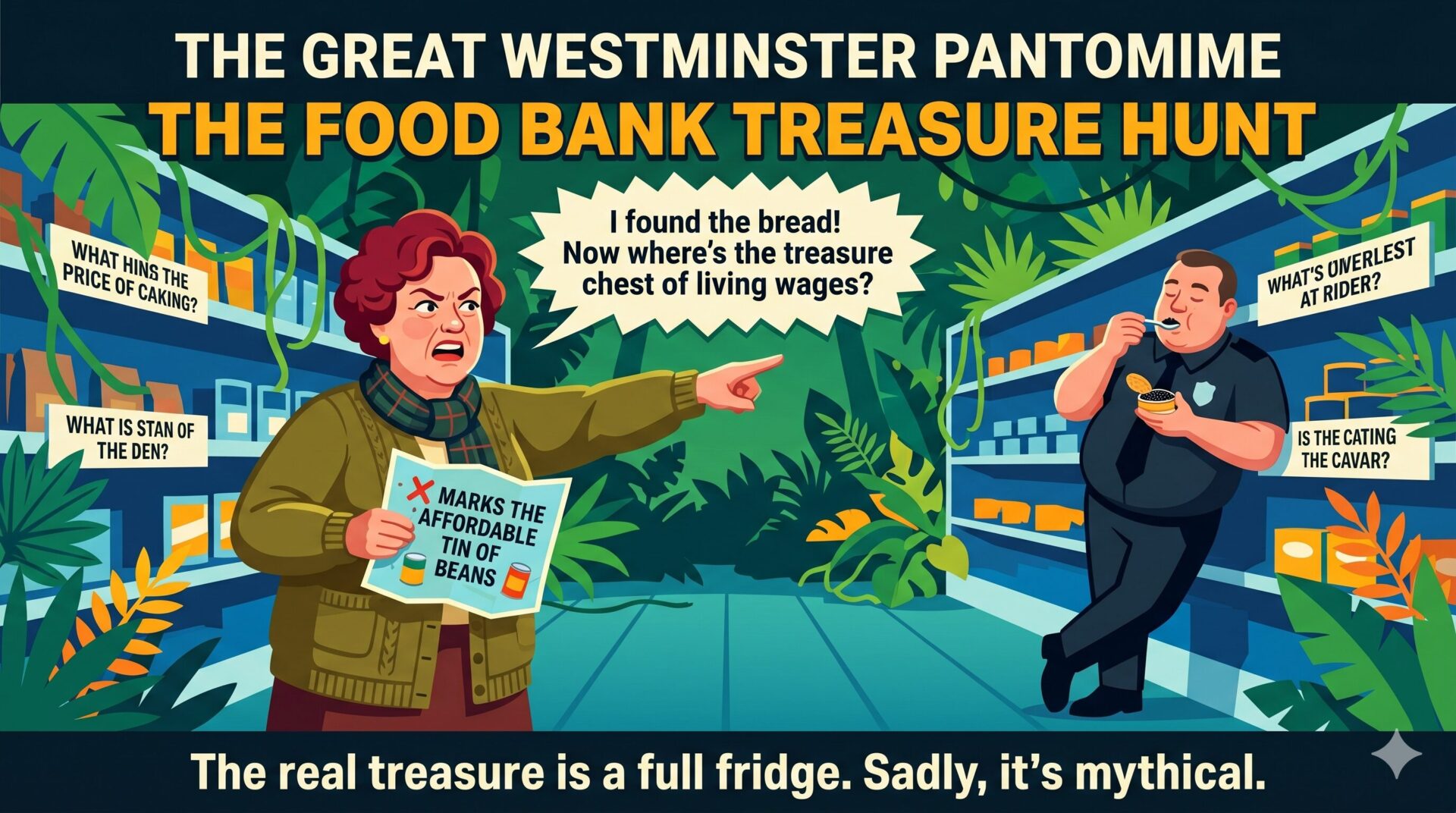 You can’t solve poverty with press releases. You can’t feed a family with “partnership working.” You can’t pay the rent with “cross‑sector collaboration.” These are the words of a man who’s spent too long in meetings and not long enough on the doorstep. A man who’s forgotten what it’s actually like to worry about money, to count the coppers, to lie awake at night wondering how you’re going to make it to the end of the month.
The Adage That Fits Like a Glove
There’s an old Cockney saying that’s perfect for Andy Burnham: “He’s a big fish in a small pond, but the pond’s got no water.”
Meaning, he looks impressive if you don’t look too closely. He’s the mayor, he’s on the telly, he’s got the suits and the slogans and the soft‑focus photo ops. But the pond is empty. The water’s gone. The fish is gasping for air, and nobody seems to notice because they’re too busy admiring his scales.
Manchester’s pond is empty. The social housing stock has been sold off and not replaced. The public realm has been hollowed out by a decade of cuts. The good jobs are going to people who don’t live in the city. The transport system is a mess. The poverty is endemic. And Andy Burnham swims around looking important, giving speeches, attending ribbon‑cuttings, and insisting that everything’s fine, really, just needs a bit more time, a bit more investment, a bit more of his special brand of leadership.
Time’s up, Andy. The people who are struggling don’t have more time. The kids who are hungry don’t have more time. The families facing eviction don’t have more time. They need action now. And you’ve had years to show us what you can do.
The Telly Star Versus the Street Fighter
Here’s what really gets my goat. The people who talk up Andy Burnham as a “saviour” are the same people who’ve never set foot in a working men’s club in their lives. They’re the pundits, the commentators, the Westminster lobby journalists, the ones who think a “northern accent” is a political position and a “humble background” is a substitute for actual policies.
They see Burnham on the telly—being emotional about Hillsborough, being angry about austerity, being sincere about the north—and they think, “This is the one. This is the bloke who can win back the Red Wall. This is the bloke who can beat the Tories. This is the bloke who can save Labour from itself.”
But they’ve never had to live under his policies. They’ve never tried to get a council flat in Manchester. They’ve never tried to find a GP appointment in Wythenshawe. They’ve never tried to get a bus home from the city centre after the last train’s been cancelled. They see the performance, not the outcome. The theatre, not the reality.
Being good on telly isn’t the same as being good for people. You can be the most charismatic mayor in the world, but if the buses don’t run, the rents keep rising, the jobs don’t pay, and the poverty stays stubbornly high, then all the charisma in the world is just a distraction.
What a Real Mayor Would Do
Let me tell you what a real mayor would look like. Not Andy Burnham. Not anyone in the Labour Party’s current stable of safe pairs of hands.
A real mayor would stand up and say: “I’m using every power I’ve got to cap rents in this city. I don’t care if the courts strike it down—I’ll make them strike it down, and then I’ll scream about it until the government changes the law.”
A real mayor would say: “I’m taking over the bus network. Not ‘franchising’ or ‘partnerships’ or any of that fudge. Full public control, public operation, public fares. Because transport is a public service, not a profit centre.”
A real mayor would say: “I’m building council houses. Not ‘affordable’ homes that cost nearly market rent. Proper council houses, let at social rents, managed by the council, for the long term. And if the government won’t give me the money, I’ll borrow it, because the savings on temporary accommodation alone will pay it back.”
A real mayor would say: “I’m setting up a publicly‑owned energy company for the city. We’ll buy power at wholesale prices, sell it at cost, and invest the surplus in insulating homes and installing solar panels. Because energy bills are a scandal and someone’s got to do something about it.”
A real mayor would say: “I’m putting a windfall tax on empty properties in the city centre. If you’re a foreign investor who bought a flat and left it empty while people sleep on the streets, you’re going to pay through the nose. And if you don’t like it, sell up to someone who’ll actually live there.”
That’s a real mayor. Someone who’s willing to fight, to break things, to take on the powerful interests that have been running rings around working people for decades.
Andy Burnham isn’t that mayor. He never has been. He never will be, because his whole career has been about climbing the ladder, not rocking the boat. He’s a company man, through and through. And company men don’t save cities. They manage decline.
The Final, Bleak Truth
There’s one last adage, and it’s a sad one: “You can’t polish a turd, but you can roll it in glitter.”
Andy Burnham is the glitter. The pundits love the glitter. The telly loves the glitter. The Westminster crowd think the glitter is the answer to all their problems. But underneath the glitter, it’s still a turd. Same policies, same compromises, same failure to actually change anything.
The people of Manchester know this. Not all of them, maybe. There are plenty who still believe, who still hope, who still think Andy Burnham is on their side. But the ones who are really struggling? The ones who can’t afford the rent and can’t find a council house and can’t get a job that pays enough to live on? They’ve stopped believing. They’ve stopped hoping. They’ve stopped trusting anyone who looks good on telly, because they’ve been let down too many times before.
And that’s the real tragedy. Not that Andy Burnham isn’t good enough. It’s that the system is so broken, the alternatives are so bleak, that someone like him—nice enough, competent enough, but fundamentally unwilling to fight—gets talked up as a saviour. Because we’re so desperate for anyone who seems vaguely human, anyone who doesn’t make us want to throw the telly out the window, that we’ll accept a bit of glitter instead of the real thing.
But the real thing doesn’t glitter. The real thing is messy and difficult and involves real sacrifice and real struggle. The real thing means taking on the landlords, the developers, the privateers, the whole rotten apparatus that’s been bleeding our communities dry. And Andy Burnham isn’t going to do that. He’s never going to do that. Because doing that would cost him his nice reputation, his telly appearances, his chances of becoming the next Labour leader.
He wants to be prime minister, not a troublemaker. He wants to be loved, not effective. He wants to be the man who saved the Labour Party, not the man who saved Manchester.
And that’s why, when the chips are down, when the real test comes, he’ll be nowhere to be found. He’ll be on the telly, looking sincere, saying all the right things. And the people of Manchester will still be waiting for someone to actually do something.
6.The Great Westminster Puppet Show: Who’s Up, Who’s Down, and Who’s Laughing All the Way to the Bank
There’s an old saying you’ll hear in any pub worth its salt, usually muttered by a bloke who’s just watched the news and needs another pint to forget it: “It’s all a game of three‑card monte. Watch the cups, not the cards.” Meaning, the dealer keeps you busy looking at the cups moving around, while the real action—the sleight of hand, the hidden card, the trick that’s about to empty your wallet—happens where you’re not looking.
The media’s obsession with “who’s up and who’s down” is that game of three‑card monte. Every day, a new headline. “Starmer’s on the ropes.” “Rayner’s making her move.” “Burnham’s the dark horse.” “Street fighting chance for Streeting.” It’s like a never‑ending episode of a soap opera that’s been running so long the original cast are either dead or in the House of Lords.
And we fall for it. Every single time. We argue about it in the WhatsApp group. We shout about it on the phone to our mates. We click the links, watch the clips, read the takes. We get angry, we get hopeful, we get despairing. We pour our energy into caring about whether Katherine West has got enough signatures, whether Wes Streeting’s got the numbers, whether Andy Burnham can find a safe seat before the conference season.
 Meanwhile, the real business of the country—the business that affects whether you can pay your rent, feed your kids, heat your home, see a doctor—carries on behind the scenes, untouched by all this kerfuffle. The private equity firms carry on buying up housing estates. The energy companies carry on posting record profits. The water bosses carry on collecting bonuses while the rivers run brown. The politicians carry on doing favours for donors. And the media carry on telling us that the only thing that matters is who’s shoving whom off the greasy pole.
The Oldest Trick in the Book
Divide and conquer. It’s as old as the hills. The Romans used it. The Norman bastards used it. The empire‑builders used it. And the modern media uses it every single day, because it works like a charm.
If you keep people arguing about which politician is going to stab which other politician in the back, they won’t notice that all the politicians are on the same side when it comes to the things that really matter. They won’t notice that Labour and Tory agree on the need for “fiscal responsibility” (code for cutting public services). They won’t notice that both parties are happy to take donations from the same billionaire hedge fund managers. They won’t notice that the “left” of the Labour Party has basically the same economic policies as the “right” of the Tory Party from twenty years ago.
But if you get them arguing about whether Starmer is a dead man walking, or whether Rayner should have paid more stamp duty, or whether Burnham’s got the charisma to save the day—well, that’s hours of content. That’s clicks and views and comments and shares. That’s advertising revenue. That’s the business model.
The media doesn’t care who wins. They care that you’re watching. They care that you’re engaged. They care that you’re so busy looking at the cups that you don’t notice the dealer has already taken your wallet, your watch, and the loose change from your coat pocket.
A Cockney Tour of the Distraction Machine
Let me take you behind the scenes of this great distraction machine. Not the actual behind the scenes—I’m not a lobby correspondent and I’ve never had dinner with a Cabinet minister. I mean the metaphorical behind the scenes. The way it actually works on the ground, in the pubs and the caffs and the bus queues.
Step one: Manufacture a crisis. The local elections were bad for Labour. Genuinely bad. Nearly 1,500 councillors gone. That’s a real story. But the media can’t just report the results and let people draw their own conclusions. They have to turn it into a drama. So they find the most disgruntled backbencher they can—Katherine West, in this case—and elevate her to the status of a major player. She’s not a major player. She’s a backbench nobody who’s been in Parliament five minutes. But she’s willing to say the thing, and that’s enough.
Step two: Frame everything as a leadership question. Not “why did Labour lose so many votes?” Not “what policies are unpopular?” Not “what’s happening to people’s lives?” Just “who’s going to be the next leader?” Because that’s a question with no answer, which means you can keep asking it forever. Every day, a new speculation. Every hour, a new rumour. Every minute, a new tweet from a “well‑placed source.”
Step three: Bring in the pundits. The former MPs, the columnists, the wonks, the spads who’ve never actually had a proper job, but talk like they’ve seen it all. They sit in studios and shout at each other about “pathways” and “factions” and “the parliamentary maths.” They use words like “Machiavellian” and “kabuki” and “psychodrama.” They make it all sound very important and very clever. And the whole time, they’re not saying a single thing about the price of bread, the cost of diesel, the state of the NHS, or the fact that a million children in this country are officially living in poverty.
Step four: Repeat. Daily. Hourly. Until the next crisis. Until the next local elections, or the next by‑election, or the next reshuffle, or the next leadership challenge. It never ends. It’s the political equivalent of a hamster wheel. Lots of movement, lots of noise, no progress at all.
The Adage That Explains It All
There’s a saying from the old music halls that’s perfect for this: “They’re dancing on a volcano and fiddling while Rome burns.” The volcano is the real economy—the one where people are struggling to get by. The flames are the public services that are falling apart. The musicians are the pundits and the commentators and the lobby journalists, playing their little tunes about who’s up and who’s down, while the whole thing collapses around us.
Because here’s the thing. While we’re all arguing about whether Wes Streeting should be prime minister or cabinet secretary or just put in a box and posted to Tasmania, the actual conditions of working people are getting worse. Rents are still rising faster than wages. Energy bills are still double what they were. Food prices are still through the roof. The NHS is still on its knees. The waiting lists are still millions long. The schools are still crumbling. The rivers are still full of sewage.
None of that gets fixed by swapping one Labour leader for another. None of that gets better because Angela Rayner is deputy prime minister instead of deputy leader of the opposition. None of that changes because Andy Burnham comes back to Westminster or Wes Streeting finally gets his shot at the big chair.
The system is the system. The people at the top are all playing the same game. And the media’s job is to make sure we never realise that—because if we did, we might stop watching. We might stop clicking. We might stop caring about their little dramas. And that would be catastrophic for them.
Why We Fall for It
Now, I’m not saying we’re stupid. We’re not. But we’re tired. We’re stressed. We’re bombarded by information from a hundred different directions, and we don’t have the time or the energy to sort the signal from the noise. So we latch onto the simplest story—the personality story, the drama story, the “good guy versus bad guy” story. It’s easier to hate Keir Starmer than it is to understand why the housing market is broken. It’s easier to fancy Andy Burnham than it is to figure out how to fix the council tax. It’s easier to argue about who’s a “proper socialist” than it is to organise a tenants’ union.
The media know this. They exploit this. They’re not stupid, either. They’ve got focus groups and data analysts and engagement metrics. They know exactly what keeps us hooked. And they serve it up, day after day, like a chef who’s discovered that his customers will eat anything as long as it’s deep‑fried and covered in sugar.
What We’re Not Supposed to Notice
Let me list a few things that never make it into the “who’s up and who’s down” coverage. Just to remind ourselves what we’re missing.
The fact that a quarter of all children in the UK are now living in relative poverty. That’s four million kids. Four million. In the sixth richest country in the world. That’s not a leadership problem. That’s a system problem.
The fact that homelessness has tripled in the last decade. Over three hundred thousand people in temporary accommodation, including more than a hundred and fifty thousand children. That’s not a “Labour Party faction” problem. That’s a “we sold off all the council houses and never built any more” problem.
The fact that the average wait for an NHS operation is still over four months. For some specialities, it’s over a year. People are suffering in pain, missing work, losing mobility, because they can’t get the treatment they need. That’s not a “who’s the next health secretary” problem. That’s a “we’ve underfunded the NHS for a decade and let private companies cream off the profitable bits” problem.
The fact that energy bills are still nearly double what they were before the Ukraine war, despite wholesale gas prices falling back to near pre‑crisis levels. The energy companies are pocketing the difference. That’s not a “who’s going to be the next prime minister” problem. That’s a “we should have nationalised the energy grid years ago, and we didn’t” problem.
 The fact that water companies pumped raw sewage into our rivers and seas for over three million hours last year. That’s not a “leadership style” problem. That’s a “private monopolies have no incentive to invest because they can just pay dividends and let the environment rot” problem.
None of this gets a mention in the great leadership debate. None of it. Because if the media started talking about these things, they’d have to talk about solutions. And solutions would mean criticising the very economic system that the media’s owners have a vested interest in preserving.
The Only Way Off the Hamster Wheel
There’s one more adage, this one from the dockers and the factory workers who knew a thing or two about solidarity: “United we stand, divided we fall.”
The media wants us divided. They want us arguing about personalities instead of policies. They want us fighting about who’s the best candidate, who’s the biggest hypocrite, who’s the most authentic, who’s the most electable. Because as long as we’re doing that, we’re not organising. We’re not building. We’re not looking at the real problems and the real solutions.
The only way off the hamster wheel is to stop caring about the game. Stop clicking the links. Stop watching the clips. Stop arguing about whether Starmer should go in September or next week or yesterday. It doesn’t matter. It has never mattered. It will never matter.
What matters is what we do in our own communities. The food banks we run. The mutual aid networks we build. The rent strikes we organise. The union branches we revive. The local campaigns we win. The small, stubborn acts of resistance that add up, over time, to something bigger.
The media won’t cover that. The pundits won’t analyse it. The “who’s up and who’s down” machine won’t notice it. But that’s fine. Because we’re not doing it for them. We’re doing it for us. For our neighbours. For the people who are struggling while the politicians squabble and the pundits pontificate.
Turn off the telly. Put down the phone. Stop reading the takes. The only thing that’s ever changed anything in this country is people like us, getting together, refusing to accept that this is the best we can do. And the first step is recognising that the game is rigged—and that the only way to win is to stop playing.
So the next time you see a headline about who’s up and who’s down, remember the three‑card monte. Remember the dealer. Remember the cups. And ask yourself: what am I not being shown? What’s happening behind the scenes while I’m staring at the shuffle?
The answer will scare you. But ignoring it will cost you a lot more than your loose change.
7.The HMS Labour: Treading Water at the Bottom of the Ocean
There’s an old Cockney saying that’s perfect for Katherine West and her big, brave ultimatum: “Shutting the stable door after the horse has bolted, been sold for glue, and turned into a set of bookends.” It’s a bit long‑winded, I grant you, but it gets the point across. You’re a bit late, love. The horse isn’t just out of the stable—it’s been turned into souvenirs.
Katherine West, bless her cotton socks, has decided to be the hero that nobody asked for. A backbench Labour MP—and let’s be honest, nobody had heard of her until about forty‑eight hours ago—has stood up and said, “If no one else challenges the prime minister by tomorrow, I will.”
Cue the dramatic music. Cue the serious faces on the news. Cue the pundits pretending this is some kind of pivotal moment in British political history. “The stalking horse emerges!” “The rebellion gains a figurehead!” “The knives are out!”
But let’s have a proper look at what’s actually happening. Because it’s not a pivotal moment. It’s not a rebellion. It’s not even particularly interesting. It’s theatre. Pure and simple. The kind of theatre you’d see in a amateur dramatics society where the lead actor’s forgotten their lines and the set’s about to collapse.
The Ship at the Bottom of the Ocean
The saying about the sinking ship is close, but it doesn’t go far enough. Katherine West is volunteering to be the first off a ship that’s not sinking—it’s already at the bottom of the ocean. It’s been there for years. The Labour Party has been underwater so long it’s growing coral. The fish are nesting in the cabins. Jacques Cousteau did a documentary about it.
Think about it. When was the last time the Labour Party genuinely represented working people? When was the last time it stood for something other than “managed decline” and “responsible capitalism” and “tough choices”? When was the last time it didn’t betray a promise within weeks of taking office?
The ship sank a long time ago. What we’re looking at now is the wreckage. And Katherine West is standing on the deck, waving a lifebelt, and shouting, “I’ll go first!” But the deck is forty fathoms down. The lifebelt is made of polystyrene. And nobody’s listening because they’ve all already drowned or swum for shore.
The Adage About the Mouse and the Mountain
There’s another saying that fits like a glove: “The mouse that roared was still a mouse.” You can make all the noise you like. You can threaten, posture, issue ultimatums. But if you’re a backbench MP with no faction behind you, no cabinet backing, no union support, and no public profile, then you’re not a stalking horse. You’re a mouse sitting on a hill, squeaking at the sky.
Katherine West needs eighty‑one Labour MPs to back a leadership challenge. Eighty‑one. That’s not a handful of disgruntled colleagues. That’s nearly a quarter of the parliamentary party. Where are they? Who are they? She won’t say. She’s keeping their names “anonymous for now.” Translation: she doesn’t have any, or the ones she’s got are the same half‑dozen malcontents who’ve been grumbling since the day Starmer won the leadership.
So her ultimatum isn’t a threat. It’s a plea. “Please, someone else do it, because I can’t.” It’s like watching a child volunteer to clear up the mess they made, knowing full well that Mum will step in and do it for them. Except Mum’s not stepping in. The cabinet aren’t stepping in. The big beasts—Rayner, Streeting, Burnham—are all keeping their heads down, waiting to see which way the wind blows.
And Katherine West is left standing there, looking a bit silly, wondering why nobody’s clapping.
The Theatre of the Absurd
Let’s be honest about what this actually is. It’s a performance. A bit of political theatre designed to achieve two things.
First, to make Katherine West’s name. She’s been in Parliament since 2015. Ten years. And before this week, the only people who’d heard of her were her constituents, her family, and the bloke who delivers her Ocado. Now she’s on the news. Now the pundits are saying her name. Now she’s got a profile. Whether the challenge succeeds or fails, she’s no longer a nobody. That’s not principle—that’s careerism. Fair play to her, I suppose, but let’s not pretend it’s noble.
Second, to create the impression of momentum. If the media keep talking about a leadership challenge, eventually the public starts to believe there is one. Even if there isn’t. Even if the numbers aren’t there. Even if the whole thing is a paper tiger. The magic of repetition. Say something enough times and it becomes true. “The prime minister is in trouble.” “The knives are out.” “The end is nigh.” Repeat until it happens.
But here’s the thing about theatre: it ends. The curtain comes down. The actors go home. And the audience is left sitting in the dark, wondering why they paid for the ticket.
What’s Really Going On While the Theatre Plays Out
Down in the real world—not the Westminster bubble, not the green room, not the spin room—people are carrying on with their lives. Or rather, they’re struggling to carry on with their lives while the politicians put on their little show.
The woman who’s just been evicted because her landlord wants to double the rent doesn’t care about Katherine West’s ultimatum. The bloke who’s been waiting eighteen months for a hip replacement doesn’t care about the “stalking horse.” The family who can’t afford to put the heating on doesn’t care about the parliamentary maths. They care about their lives. Their struggles. Their survival.
And while the Labour Party eats itself alive over who gets to sit in the big chair, the real problems keep getting worse. Rents go up. Bills go up. Waiting lists go up. Poverty goes up. Hopelessness goes up.
Katherine West’s ultimatum changes none of that. It doesn’t put a roof over anyone’s head. It doesn’t heat a single home. It doesn’t shorten a single waiting list. It’s not even a distraction from the real issues, because the real issues are never discussed in the first place. It’s just noise. More noise. The same noise we’ve been listening to for years, coming from a slightly different direction.
The Only Question That Matters
There’s one final adage, and it’s a killer: “You can’t polish a turd, but you can roll it in glitter.”
The Labour Party is the turd. Katherine West’s ultimatum is the glitter. The media coverage is the wrapping paper. The pundits are the salesmen. And we’re supposed to be grateful that someone’s finally offering us a shiny new turd instead of the old, dull one we’ve been putting up with for years.
But here’s the only question that matters: what’s actually going to change? If Katherine West somehow succeeds—if she triggers a contest, if Starmer goes, if a new leader emerges—what’s different? Will the two‑child benefit cap be scrapped? Will the rent caps be introduced? Will the energy companies be nationalised? Will the water companies be taken back? Will council tax be replaced with something fairer?
No. Of course not. Because the new leader will be another Labour politician, cut from the same cloth, singing from the same hymn sheet, taking money from the same donors, serving the same masters. Maybe a bit more left‑wing rhetoric. Maybe a few more nods to “Labour values.” But the substance? The same old neoliberal rubbish that’s been failing working people for forty years.
Because the problem isn’t the leader. The problem is the party. And the problem isn’t even the party—it’s the system that the party is part of. The whole rotten edifice of corporate donations, media ownership, think‑tank capture, and political careerism that ensures nothing fundamental ever changes.
Katherine West’s ultimatum is theatre because the whole thing is theatre. The leadership challenge is theatre. The speeches are theatre. The manifestos are theatre. It’s all a show, designed to keep us watching while the real business—the business of wealth extraction, profit maximisation, and social destruction—carries on behind the scenes.
The Only Real Ultimatum
So here’s the only ultimatum that matters. Not from Katherine West. Not from any backbench MP. From us. From the people who are fed up with being ignored, exploited, and talked down to by a political class that wouldn’t recognise a working‑class community if it hit them in the face.
The ultimatum is this: change the system, or we will. Not by voting for your lot or the other lot—they’re the same lot. Not by hoping for a better leader—they’ve all been to the same finishing school. But by organising. By building. By refusing to play your game anymore.
The ship is at the bottom of the ocean. It’s been there for years. Katherine West can wave her lifebelt all she likes. It won’t bring the ship back up. It won’t save anyone who’s already drowned. And it certainly won’t convince us that the wreckage is worth salvaging.
The only way forward is to stop looking at the wreck. To stop hoping that someone will come along and patch up the holes. To stop pretending that the same old faces, with the same old policies, will somehow produce a different result.
Build something new. Something that doesn’t need ultimatums and stalking horses and leadership challenges. Something that works for people, not for the people who own the people who own the party.
Because the mouse that roared is still a mouse. And the horse has not only bolted—it’s been turned into a set of bookends. And the bookends are holding up a copy of “How to Lose Elections and Alienate People.” And nobody’s reading it. Because they’ve all finally stopped caring.
About time, too.
8.The Great Mandate Myth: When a Cry for Help Gets Dressed Up as a Vote of Confidence
There’s a saying you’ll hear in any proper East End boozer, usually after someone’s been banging on about the last general election: “Voting for the lesser of two evils is still voting for evil.” It’s not Shakespeare, but it’ll do. Because it cuts right to the heart of the biggest lie in British politics—the one about mandates, majorities, and the idea that anyone actually voted for anything last time round.
The pundits keep telling us: “People vote for a party, not a leader.” It’s technically true, in the way that a broken clock is technically right twice a day. Yes, in our wonderfully weird Westminster system, you put an X next to a candidate’s name, not next to the prime minister’s face on a poster. The party wins, not the person. That’s the constitutional fiction, and it’s served the establishment well for centuries.
But practically speaking? It’s nonsense. Grade‑A, prime‑cut, market‑stall nonsense. Because when people trudged to the polling stations in 2024, they weren’t voting for Labour. They were voting against the Tories. There’s a difference the size of the M25, and pretending otherwise is the kind of wilful blindness that would get you barred from Specsavers.
The Cry of Desperation They Called a Landslide
Let’s rewind the tape. The last general election wasn’t a ringing endorsement of Keir Starmer’s vision for Britain. It wasn’t a sudden conversion to the gospel of “fiscal responsibility” and “tough choices.” It was a screaming, bloody‑fingered cry of desperation from a population that had spent fourteen years being kicked in the teeth by one Tory government after another.
Johnson’s parties while people buried their loved ones alone. Truss crashing the economy so badly that mortgage rates went through the roof. Sunak’s rain‑soaked surrender, giving up on net-zero targets while pretending he cared. The small boats, the NHS waiting lists, the strikes, the sewage, the cronyism, the sheer, relentless, grinding incompetence of a party that had run out of ideas, out of talent, and out of rope.
People didn’t wake up on election day and think, “You know what, I really believe in Keir Starmer’s ten‑point plan for growth.” They thought, “Anyone but those bastards.” They held their noses, put their cross in the Labour box, and went home feeling vaguely dirty. It was a vote of no confidence in the Tories, dressed up as a landslide victory. And everyone who wasn’t paid to pretend otherwise knew it.
The Adage About the Burning House
There’s a Cockney saying that captures it perfectly: “When your house is on fire, you’ll jump into any old skip to get out.” You don’t inspect the skip for comfort. You don’t check the skip’s manifesto or ask to see its five‑year plan. You don’t care if the skip is made of recycled plastic and smells faintly of fish. You just want out of the flames.
That’s what the 2024 election was. The Tories had set the house on fire—actually, they’d been setting it on fire for years, and by 2024 the whole bloody street was ablaze. Labour was the skip. Not a nice skip. Not a skip anyone would choose if they had any other option. Just a skip. And the British people jumped in because the alternative was being burned alive.
So when Labour MPs start talking about their “mandate” and their “historic victory,” they’re either deluded or lying. Probably both. A mandate isn’t “we were slightly less awful than the other lot.” A mandate is when people actively, enthusiastically, positively choose you because they believe in what you’re offering. That didn’t happen. It was the political equivalent of marrying someone because your ex was a violent drunk. It’s not a love match. It’s damage limitation.
Squandered in Record Time
Here’s the tragic part. Even that fragile, desperate, “anyone but them” goodwill—even that didn’t last. Labour have squandered whatever credit they had faster than a lottery winner blows through their winnings on champagne and timeshares.
They came in promising change. They came in promising to be different. They came in promising to clean up the mess, restore trust, and put working people first. And within months—sometimes within weeks—they’d broken more promises than a second‑hand car dealer with a stutter.
The two‑child benefit cap? Still there. The non‑dom loopholes? Still wide open. The windfall tax on energy giants? Watered down to nothing. The renters’ reform bill? Sticking plaster on a severed artery. The NHS waiting lists? Still millions long. The housing crisis? Still a crisis. The poverty? Still rising.
And when the local elections came round—the first real test of public opinion since the general election—the voters sent a message. Not a subtle one. A message written in letters six feet high, daubed in day‑glo paint, with sirens blaring and fireworks going off.
Labour lost nearly 1,500 councillors. Forty councils. Wales. Scotland. The Red Wall turned Reform turquoise. And the response from the top? A speech about hope and Europe and the importance of “strength through fairness.” As if that’s what the bloke in the Drogheda working men’s club was crying out for. As if the queue outside the food bank was murmuring, “If only we were closer to Brussels.”
It’s extraordinary. It would be funny if it weren’t so tragic. They had a chance. A genuine, once‑in‑a‑generation chance to do something different. The Tories were on their knees. The public was desperate for an alternative. The blank cheque was there, waiting to be filled in. And Labour took that blank cheque and wrote “more of the same, but with slightly better grammar.”
The Mandate Myth Exposed
Let’s pull apart this “mandate” nonsense once and for all. Because it’s not just wrong—it’s dangerous. It lets politicians pretend they have a licence to do whatever they want, regardless of what people actually need.
A mandate means people voted for your manifesto. But what manifesto? The one Labour put out in 2024 was so vague, so watered down, so carefully crafted to offend nobody and promise nothing, that you could have used it as a doorstop and got more use out of it. “A stronger, fairer Britain.” “Security, prosperity, respect.” “Labour will deliver.” It was all slogans and no substance. A menu with no prices and no dishes.
People didn’t vote for that. They couldn’t have, because there was nothing to vote for. They voted against the Tories. That’s it. That’s the whole story.
And now Labour are pretending that this non‑mandate gives them the right to carry on with business as usual. To keep the two‑child benefit cap. To water down the renters’ reforms. To fill the House of Lords with their mates. To take donations from billionaires and write policies that benefit them. To behave exactly like the Tories they replaced, just with a different coloured rosette.
It’s a con. A classic, old‑fashioned, bait‑and‑switch con. “Vote for us, we’re not them. Oh, by the way, we’re exactly like them, but you’ve already voted, so tough.”
The Adage About the Second‑Hand Suit
There’s another saying that fits Labour’s squandered opportunity: “You can’t make a silk purse out of a sow’s ear, but you can make a very convincing fake if you’ve got enough glue.”
Labour are the sow’s ear. They’ve always been the sow’s ear. For all their talk of “Labour values,” they’ve spent the last thirty years running away from anything that might actually challenge the status quo. Nationalisation? Only when it’s safe and boring. Rent control? Only in the manifesto they throw away after the election. Wealth taxes? Only as a threat to scare the rich into behaving slightly better.
And the public has finally noticed. That’s what the local elections were about. Not just “we’re fed up with Starmer.” It was, “we’re fed up with all of you.” The Reform surge isn’t a sudden conversion to the gospel of Nigel Farage. It’s a rejection of a political class that’s offered nothing but disappointment for decades. People are voting for Reform the same way they voted for Brexit—not because they love the product, but because they hate the alternative so much they’ll try anything else.
The Only Honest Assessment
Here’s the truth that nobody in Westminster will admit. There is no mandate. There never was. There’s just a population that’s been let down so many times, by so many different parties, that they’ve stopped believing any of them will make a difference. They vote out of desperation, not hope. They vote for the skip, not because they love the skip, but because the house is on fire, and they need somewhere to stand.
And Labour have taken that cry of desperation, that plea for help, and turned it into a licence to do nothing. They’ve wasted the goodwill. They’ve squandered the opportunity. And now they’re fighting among themselves about who gets to be the captain of a ship that’s already at the bottom of the ocean.
The only way to get a real mandate—a genuine, enthusiastic, hopeful mandate—is to offer something worth voting for. Rent caps. Nationalisation. Scrapping council tax. Building council houses. Properly funding the NHS. Taking on the landlords, the energy giants, the water profiteers, the whole rotten lot.
That’s not what Labour’s offering. That’s not what any of the mainstream parties are offering. And until someone does, the cries of desperation will keep getting louder. And the skips will keep getting fuller. And the house will keep burning.
 Because the adage about the burning house isn’t just about the fire. It’s about the people who set it, the people who let it burn, and the people who stand around arguing about who gets to be the fire chief while the flames climb higher and higher.
Labour had a chance to be the fire brigade. Instead, they brought a can of petrol and a box of matches. And now they’re surprised that nobody’s clapping.
9.Holding the Country Hostage: The Great Mandate Con
There’s an old Cockney saying that’s been passed down through generations of market traders, dockers, and pub philosophers: “A bargain’s only a bargain if both sides get what they wanted.” If you sell me a watch that doesn’t work, you can’t hide behind “a deal’s a deal” when I come looking for my money back. But that’s exactly what the Labour establishment are doing with their precious “mandate.”
They keep trotting out the same line, like a stuck record on a Dansette that’s seen better days. “Labour won the election fair and square. The British people gave us a mandate. Any leadership change would require a general election. We can’t plunge the country into chaos.”
Sounds reasonable, doesn’t it? Fair play, level playing field, democracy in action. Except it’s not reasonable. It’s not fair. And it’s not democracy. It’s a con. A classic, three-card-monte, watch‑the‑lady, I’ve‑got‑a‑bridge‑to‑sell‑you con. And the worst part? They’ve convinced themselves it’s true.
The Mandate They Never Had
Let’s start with the basic fact that the “mandate” never existed in the first place. As we’ve already established, the last election wasn’t a ringing endorsement of Keir Starmer’s vision for Britain. It was a cry of desperation. A nation holding its nose and voting for the skip because the house was on fire.
But even if we pretend, for the sake of argument, that Labour did win a genuine mandate—even then, the argument doesn’t hold water. Because a mandate isn’t a blank cheque. It’s not a lifetime appointment. It’s not a licence to do whatever you want, however badly you screw up, until the next election comes round.
Think about it like this. You hire a builder to fix your roof. You pay him a deposit. He turns up late, does a shoddy job, uses the wrong materials, and leaves a hole that lets the rain in. Do you have to keep him on just because you hired him in the first place? Of course not. You sack him, find someone else, and try to get your money back.
Politics should work the same way. The public hired Labour to fix the country. They’ve done a rubbish job. They’ve broken promises, alienated voters, and made things worse. The public should be able to fire them and hire someone else—without having to wait four years and go through another general election.
But that’s not how the system works, is it? Because the system is rigged to protect the people in power, not the people who put them there.
The Adage About the Hostage
There’s a brilliant Cockney saying that sums up the whole sorry situation: “He’s holding a gun to his own head and threatening to shoot if you don’t give him your wallet.” That’s the Labour leadership right now. They’re saying, “If you force a leadership change, we’ll have to have a general election, and that will cause chaos, and it’ll be your fault.” They’re holding the country hostage to protect their own jobs.
But here’s the thing. The chaos isn’t coming from a potential leadership change. The chaos is already here. It’s been here for years. The chaos is food banks and homelessness and NHS waiting lists and poverty and inequality and a political class that’s completely out of touch with the people it’s supposed to serve.
A leadership change might be messy. It might be inconvenient for the people at the top. It might cause a few weeks of uncertainty while the party sorts itself out. But it’s not going to make the chaos worse. Because the chaos is already as bad as it’s been in living memory. The only difference is that a new leader might—might—have a different approach. Might actually try something different. Might even, God forbid, listen to the people who are struggling.
But they don’t want that. Because a new leader might not be as easy to control. Might not be as committed to the same old neoliberal rubbish. Might not be as willing to take donations from billionaires and write policies that benefit them. So they’d rather stick with the devil they know, even if that devil is driving the country into a ditch.
The General Election Threat: A Paper Tiger
Let’s examine the threat itself. “Any leadership change would require a general election.” Would it, though? Constitutionally, no. We don’t have direct elections for prime minister in this country. The monarch appoints the person who can command a majority in the House of Commons. If the Labour Party changes its leader, that new leader becomes prime minister without a general election. It’s happened before. It’ll happen again.
Brown took over from Blair without an election. May took over from Cameron. Johnson took over from May. Truss took over from Johnson. Sunak took over from Truss. No elections. Just a change of leader and a change of prime minister. The country didn’t collapse. The sky didn’t fall. The markets didn’t go into meltdown. (Well, Truss caused a bit of a wobble, but that was her policies, not the process.)
So when Labour say “any leadership change would require a general election,” they’re not telling the truth. They’re threatening. They’re saying, “If you force us to change leader, we’ll call an election, and you might get something even worse, so you’d better not try.” It’s the political equivalent of a toddler holding their breath until they turn blue. It’s a bluff. And it’s an insult to our intelligence.
The Real Reason They’re Clinging On
So why are they so desperate to keep Starmer in place, even though he’s more unpopular than any prime minister in modern history? Why are they threatening an election rather than just swapping him out for someone else?
Because they’re terrified of what might happen next. Not a general election—they know they’d lose that, and lose badly. But a leadership contest within the party. Because a leadership contest would expose the divisions that they’ve been papering over for years. The left, the right, the centre, the regional factions, the union blocs, the donor networks—all of them would come out fighting. And the winner might not be the person the establishment wants.
Wes Streeting might not win if it goes to a membership vote. Angela Rayner might not win if the unions can’t agree. Andy Burnham might not even be eligible. And if none of the “safe” candidates win—if someone like Rebecca Long‑Bailey or Zarah Sultana or even Jeremy Corbyn (God forbid) managed to sneak through—then the whole house of cards comes down.
So they’d rather keep Starmer. Even though he’s a liability. Even though he’s dragging the party down. Even though he can’t communicate, can’t inspire, can’t win. Because at least he’s predictable. At least he won’t rock the boat. At least he’ll keep taking the money from the same donors and singing from the same hymn sheet.
It’s not about the country. It’s not about the mandate. It’s about them. Their jobs. Their power. Their cosy little arrangement with the people who actually run things.
The Adage About the Turkeys and Christmas
There’s another saying that’s perfect for this: “Turkeys don’t vote for Christmas, and politicians don’t vote for accountability.”
The Labour MPs know that a new leader might actually be accountable to the membership. Might actually listen to the people who pay their subs. Might actually be pushed to the left by a membership that’s consistently more progressive than the parliamentary party. And that terrifies them. Because they’ve spent years ignoring the membership, taking them for granted, treating them as a nuisance to be managed rather than a constituency to be served.
So they hide behind the mandate argument. They wrap themselves in the flag of “democracy” while practising the opposite. They claim to be defending the will of the people while doing everything they can to avoid giving the people any real say.
It’s a con. A beautiful, elegant, infuriating con. And the worst part is that it’s working. The media are lapping it up. The pundits are nodding along. The public is being told that a leadership challenge would be “chaos” and “instability” and “a betrayal of the voters.” And many of them believe it, because they’ve been trained to believe that the system is fair, and the rules make sense.
But the rules don’t make sense. They’re designed to keep the people who write the rules in power. And the people who write the rules are the politicians themselves. It’s a closed loop. A self‑perpetuating oligarchy. And the mandate argument is one of the locks on the door.
What a Real Mandate Would Look Like
Let’s imagine, for a moment, a different system. One where the mandate actually meant something. One where you couldn’t break every promise you made and then hide behind “we won the election” when people complained.
In that system, there would be recall elections. If enough constituents signed a petition, their MP would have to face a new vote. If you broke a major manifesto commitment, you’d be out on your ear. If you changed a leader without a clear democratic process, you’d have to seek a fresh mandate from the public.
That’s not the system we’ve got. In the system we’ve got, an MP can change party, change leader, change policies, change everything they stood for—and still sit in Parliament for five years, drawing their salary, voting on our laws, and telling us we should be grateful.
The mandate argument is a fig leaf. A bit of cover for people who’ve lost the plot, lost the public trust, and lost any right to call themselves democratic.
The Only Honest Way Forward
So what’s the answer? Not a general election—that would just give us more of the same, because the same parties, the same donors, the same media owners would still be running the show.
 The answer is to stop pretending that this system works. To stop treating elections as the be‑all and end‑all of democracy. To start building power outside Parliament—in our unions, our communities, our workplaces, our streets. Because the only real mandate that matters is the one we give each other, every day, by organising and resisting and refusing to accept that this is the best we can do.
The con artists in Westminster will keep telling us that we can’t change leader without an election. That we can’t have a say between votes. That we have to wait four years for the next chance to register our discontent. It’s a lie. It’s always been a lie. And the only way to beat it is to stop playing their game.
As the adage goes: “You can’t win a rigged game by playing by the rules. You have to flip the table.”
The table’s been flipped before. It’ll be flipped again. And when it is, all their mandates and arguments and constitutional fictions won’t save them. Because the only mandate that ever mattered was the one from below—from the people who do the work, pay the taxes, and keep the country running while the politicians argue about who gets the big chair.
That mandate is still there. It’s just waiting for someone to pick it up.
10.The Mandate Nobody’s Talking About: What Britain Really Voted For
There’s a saying you hear in the pie and mash shops down the Old Kent Road, usually muttered between mouthfuls of liquor and a sigh: “You can ask for steak and chips, but if they’re only serving spam and sorrow, don’t be surprised when you leave hungry.”
That’s the state of British politics in a nutshell. The menu’s been the same for forty years. You’ve got Labour spam—processed, grey, vaguely meat‑adjacent, but nobody’s quite sure what’s in it. You’ve got Tory sorrow—thin gruel made from austerity, privatisation, and the tears of the poor. And every few years, you get to choose which one you’re going to choke down for the next five years.
 But here’s the thing. The people aren’t hungry for spam or sorrow. They never were. They’re hungry for steak. Proper, juicy, well‑cooked steak. With chips. And mushrooms. And a pint of something decent to wash it down.
The real mandate—the one that doesn’t show up in the pundits’ spreadsheets or the focus groups’ pie charts—is for something completely different. Not Labour‑lite. Not Tory‑lite. Not “austerity with a human face” or “capitalism with a conscience.” Something proper. Something that puts people before profits, communities before corporations, and the many before the few.
And if that choice ever appeared on the ballot paper—if someone, somewhere, actually stood up and offered it—you’d see a realignment that would make the pundits’ heads spin so fast they’d unscrew themselves and roll under the sofa.
The Hunger That Won’t Go Away
Let’s be honest about what people actually want. Not what the pollsters tell them they want. Not what the focus groups have been coached to say. What they really, genuinely, deep‑down want.
They want a roof over their heads that they can afford. Not a “shared ownership” scam. Not a “affordable rent” that’s eighty percent of market rate. A proper home, with secure tenancy, that doesn’t eat up half their wages every month. That’s not a radical demand—it’s what your granddad had, what your mum had, and what you’ve been denied because some bright spark decided housing should be an investment, not a home.
They want a health service that works. One where you can see a GP without waiting three weeks, get a hospital appointment without waiting six months, and not have to worry about going bankrupt if you get really sick. That’s not an impossible dream—it’s what the NHS was supposed to be before they started selling bits off to American insurers and treating patients like profit centres.
They want energy bills that don’t make their eyes water. They want to be able to heat their homes in winter without taking out a loan. They want the lights to stay on and the radiators to work without enriching a bunch of shareholders who’ve never felt a cold draught in their lives. That’s not unreasonable—it’s basic decency.
They want wages that keep up with prices. They want jobs that offer security, not zero‑hour contracts and gig economy exploitation. They want to know that if they work hard, they won’t be punished for it by a benefits system that treats them like scroungers and a tax system that treats the rich like royalty.
 None of this is rocket science. None of it requires a Nobel prize in economics. It’s just common sense. The kind of common sense that used to be called “Labour values” before Labour decided that values were for losers.
The Adage About the Empty Stomach
There’s a saying from the old East End markets that fits like a glove: “A hungry man doesn’t care about the colour of the menu—he just wants something to eat.”
Right now, the British people are hungry. Not metaphorically—I mean literally, millions of them are using food banks. But also metaphorically—hungry for change, hungry for hope, hungry for a politics that actually addresses their lives instead of just managing their decline.
And the main parties are offering them the same old menu. Labour says, “We’ll manage the system slightly better.” The Tories say, “We’ll manage the system slightly worse.” Reform says, “We’ll smash the system and replace it with something even nastier.” And the Greens, the Lib Dems, the nationalists—they’re all just variations on the same theme. Different flavours of the same basic meal. Spam, sorrow, and a side of shrug.
 But the hunger doesn’t go away. It just gets more desperate. And desperate people do desperate things. They vote for Reform, not because they love Nigel Farage, but because he’s the only one offering something different—even if that something is a poisoned chalice dressed up as a cure. They stay at home, not because they’re lazy, but because they’ve given up on a system that’s never given them anything worth voting for. They get angry, not because they’re bad people, but because they’ve been ignored for so long that anger is the only language left.
What a Genuine Choice Would Look Like
Let’s imagine, for a moment, that someone actually offered the steak. Not the spam. Not the sorrow. The real thing.
Imagine a party—or a movement, or a coalition, or whatever you want to call it—that stood up and said:
“We’re going to build a million council houses. Not ‘affordable’ homes. Not ‘social rented’ flats that cost nearly market price. Proper council houses, let at rents tied to local wages, with secure tenancies and decent standards. And we’re going to pay for it by taxing the land bankers and the property speculators who’ve been sitting on empty buildings while people sleep on the streets.”
Imagine a party that said:
“We’re taking back the railways. Not ‘renationalising’ in name only, with complicated contracts and private operators still skimming off the top. Full public ownership, public operation, public benefit. One ticket, one fare, one system that works for passengers, not for shareholders.”
Imagine a party that said:
“We’re bringing energy and water back into public hands. No more profiteering while the planet burns and the rivers run with sewage. No more dividends for billionaires while pensioners freeze in their homes. Public ownership, democratic control, and a just transition to renewables that creates jobs, not poverty.”
Imagine a party that said:
“We’re scrapping council tax and replacing it with a land value tax that makes the rich pay their fair share. We’re closing the loopholes that let corporations avoid billions in tax. We’re making the people who’ve profited from this system pay for fixing it.”
Imagine a party that said:
“We’re properly funding the NHS. Not with more private contracts and ‘independent sector’ nonsense. With money. With staff. With buildings that don’t leak. And we’re taking on the privateers who’ve been carving it up for parts.”
That’s a genuine choice. That’s something worth voting for. That’s the steak that’s been missing from the menu for forty years.
The Realignment That Would Follow
And here’s the thing. If someone actually offered that—if that choice was on the ballot paper—you wouldn’t just get a Labour victory. You wouldn’t just get a Tory defeat. You’d get a realignment. A earthquake. A shift so deep and so wide that the pundits wouldn’t know what hit them.
Because the old tribal loyalties would dissolve overnight. Labour voters who’ve been holding their noses for years would come running. Tory voters who’ve given up on their party because it’s not conservative anymore—it’s just corrupt—would take a look. Reform voters who are voting out of desperation, not conviction, would have a genuine alternative. The millions who’ve stopped voting altogether would finally have a reason to drag themselves to the polling station.
The pundits would be lost. Their models wouldn’t work. Their swingometers would explode. Their carefully curated categories—”left behind,” “comfortable,” “strivers,” “skivers”—would be useless. Because a genuine left‑wing alternative, one that actually put people before profits, would cut across all their neat little boxes. It would appeal to the pensioner who’s been a Tory all her life but can’t afford her heating bill. It would appeal to the young bloke who’s never voted but can’t afford a deposit. It would appeal to the nurse who’s been voting Labour out of habit, but is sick of being taken for granted.
 The establishment would panic. The media would scream. The donors would threaten to take their money elsewhere. But it wouldn’t matter, because the mandate would be real. Not the fake mandate of “we won because the other lot were worse.” A genuine, enthusiastic, hopeful mandate from a population that finally saw something worth believing in.
The Adage About the Sleeping Giant
There’s an old Cockney saying that’s been around since the Chartists: “The giant’s been asleep for a long time, but don’t mistake sleep for death.”
The British people are that giant. They’ve been asleep for decades—drugged by propaganda, distracted by culture wars, worn down by the sheer grind of survival. But they’re not dead. And every now and then, you see signs of stirring. The strikes. The protests. The local election results that shock the establishment. The rise of movements that the pundits don’t know how to categorise.
The giant is waking up. And when it wakes up properly—when it realises that the choice on offer isn’t a choice at all, that the menu has been lying to it for years—it won’t go back to sleep quietly. It will demand the steak. And it won’t take no for an answer.
The Only Question That Matters
So here’s the only question that matters. Not “who’s going to be the next Labour leader?” Not “can Starmer survive till September?” Not “will Reform win the next election?” Those are the wrong questions. They’re the questions the establishment wants you to ask, because they keep you looking at the cups while the dealer empties your wallet.
The right question is: how do we get the steak on the menu?
How do we build a movement that’s not beholden to donors, not captive to the media, not scared of its own shadow? How do we create a genuine alternative that doesn’t get strangled at birth by the same old forces that have strangled every genuine alternative for the last forty years?
That’s the work. The hard work. The unglamorous, untelegenic, unremarked‑upon work that happens outside Westminster, outside the studios, outside the pundits’ eyeline. In the community centres and the union halls and the street corners. In the food banks and the tenants’ meetings and the picket lines. That’s where the real mandate is built. Not in a leadership contest. Not in a manifesto written by spads. In the daily, stubborn, relentless work of organising, resisting, and refusing to accept that spam and sorrow are the only things on offer.
The Final Adage
I’ll leave you with one last saying, from the old docker who used to run the fruit and veg stall down our market: “You can stay on the diet they give you, or you can grow your own. One keeps you hungry. The other feeds the street.”
The establishment’s diet has kept us hungry for forty years. It’s time to grow our own. Because the real mandate isn’t something they give you at the ballot box. It’s something you take, every day, by building the world you want to live in, brick by brick, even if they tell you it’s impossible.
The pundits’ heads will spin. Let them spin. While they’re dizzy, we’ll be eating steak. And that’s a realignment worth having.
11.The Ghost of Labour Past: When Infighting Meant Something
There’s an old Cockney saying that’s been doing the rounds since the days of the dock strikes and the three‑day week: “You can argue about the best way to mend the roof, but if you’ve forgotten what a roof’s for, you’re just arguing about the rain.”
That’s the difference between the leadership crises of old and the shambles we’re watching today. Back in the 1980s, when Labour tore itself apart, at least they were arguing about something. They disagreed about the route, but they all wanted to get to the same destination—a country that worked for working people, where the state had a proper role, where the unions had a voice, where the rich paid their way. The fights were brutal, don’t get me wrong. Benn versus Healey. Kinnock versus the Militant Tendency. Tears, tantrums, and walkouts. But underneath all the shouting, there was a shared belief that the Labour Party existed for a reason. That it had a purpose beyond getting its hands on the levers of power.
The Tories, too, had their moments. Multiple leaders, backstabbing, the whole Westminster soap opera. But even they knew what they were for—lower taxes, smaller state, strong defence, the lot. You might hate what they stood for, but at least you knew what it was. It was coherent. It was consistent. It was, in its own rotten way, a philosophy.
Today’s crisis is different. It’s not about which road to take. It’s about the fact that the Labour Party has forgotten it ever had a map. It’s not a battle between left and right—it’s a fog of confusion where nobody knows which way is up, and nobody seems to care as long as they get to sit in the big chair.
The Adage About the Ship Without a Rudder
There’s another saying that fits the current lot like a cheap suit: “A ship without a rudder just drifts until it hits the rocks. A crew that’s forgotten why they’re at sea just starts fighting over the best cabin.”
Labour has forgotten why it’s at sea. What’s the point of the Labour Party? Ask a dozen MPs and you’ll get a dozen answers. “To manage capitalism more humanely.” “To represent the unions.” “To get the Tories out.” “To make Britain fairer.” “To win elections.” None of them can say, with any conviction, what the party actually stands for. Because it doesn’t stand for anything anymore.
Oh, they’ve got policies. Pages and pages of them. Focus‑grouped, costed, poll‑tested, and stripped of anything that might offend a swing voter in a marginal seat. But policies aren’t the same as purpose. You can have a thousand policies and still have no idea why you’re there. Purpose is the why. Purpose is the thing that makes people risk their jobs, their reputations, their safety, to fight for something bigger than themselves.
The Labour Party has lost its why. It’s become a machine for winning power, not a movement for changing the world. And when you’re just a machine, leadership crises aren’t about ideas—they’re about personalities. They’re about who’s got the best media training, the most donor backing, the sharpest elbows. They’re not arguments about the future. They’re arguments about who gets to sit in the nice office.
The Eighties: A Proper Barneys
Let’s take a trip down memory lane, shall we? Not because I’m nostalgic—God knows the eighties were a nightmare for anyone who wasn’t a yuppie with a brick mobile phone. But because it’s worth remembering what a real leadership battle looked like.
In the early eighties, Labour was tearing itself apart over Clause Four, nuclear disarmament, leaving the EEC, and whether to embrace or reject the Thatcherite consensus. Tony Benn and Denis Healey went at it hammer and tongs. The party membership was growing, not shrinking. People cared. They argued in the pubs, the factories, the union branches. They wrote pamphlets, organised rallies, fought deselections. It was messy, it was angry, and it was alive.
You could disagree with Benn’s vision—plenty did. You could think Kinnock was selling out—plenty did. But you couldn’t say that nobody had a vision. The party was arguing about the future because it believed it had a future worth fighting for.
Today? The arguments are about whether Keir Starmer’s body language is wrong, or whether Angela Rayner should have paid more stamp duty, or whether Andy Burnham’s got the right haircut for a prime minister. It’s not politics. It’s celebrity gossip with a higher advertising rate.
The Adage About the Hollow Drum
There’s a market trader’s saying that’s perfect for this: “A drum that’s hollow makes the loudest noise, but you can’t dance to it.”
The Labour Party is that hollow drum. All noise, no rhythm. Every day, a new story. Every hour, a new briefing. Every minute, a new anonymous source saying something dramatic. But underneath the noise, there’s nothing. No ideas. No convictions. No sense of what they’d actually do if they stopped fighting among themselves and started governing.
Ask a Labour MP what they believe in. Really believe in. The kind of belief that would make them risk their career, cross the floor, take a stand. Most of them will give you a variation of “I believe in fairness.” Which is like saying, “I believe in breathing.” It’s so vague, so empty, so utterly meaningless, that it could mean anything or nothing. Fairness to whom? Fairness how? Fairness at what cost?
The Tories, for all their faults, can at least tell you what they believe. Low taxes. Small state. Strong borders. Personal responsibility. You might think it’s cruel, stupid, or both. But it’s a coherent position. You know where you stand with them.
Labour? They believe in “not being the Tories.” That’s it. That’s the whole platform. “We’re not them.” And when “not being them” is all you’ve got, you’re in trouble. Because “not being them” doesn’t tell you what to do about housing, or health, or energy, or welfare. It doesn’t give you a compass when the wind changes. It doesn’t inspire anyone to knock on doors or put a poster in their window.
The Crisis of Purpose
So what’s actually happening in the Labour Party right now? It’s not a leadership crisis in the traditional sense. It’s a crisis of purpose. A party that doesn’t know what it’s for can’t agree on who should lead it, because there’s no criteria for what makes a good leader. Is it competence? Charisma? Electability? Ideological purity? All of the above? None of the above?
Starmer got the job because he promised “competence” after the chaos of Corbyn. But competence without purpose is just management. And nobody gets passionate about management. You don’t put a poster in your window saying “I believe in better line management.” You don’t go door‑knocking in the rain for “improved key performance indicators.”
The party is now realising that competence isn’t enough. But they don’t know what else to offer. So they’re thrashing around, looking for a saviour who can give them purpose without needing to actually change anything. Andy Burnham? He’s got a bit of northern authenticity. Wes Streeting? He’s got a bit of Blairite sparkle. Angela Rayner? She’s got a bit of working‑class credibility. But none of them have a purpose. None of them can tell you what the Labour Party is for, beyond “not being the Tories” and “winning elections.”
And that’s why the comparisons to the eighties are so wrong. In the eighties, Labour was arguing about ideas. Now, they’re arguing about personalities. In the eighties, the party was alive with debate. Now, it’s dead with cynicism. In the eighties, people left the party because they disagreed with the direction. Now, people leave because they can’t see any direction at all.
The Adage About the Empty Shop
There’s a final saying, from the old high streets that are now full of charity shops and vape emporiums: “An empty shop doesn’t need a new manager—it needs something to sell.”
Labour is that empty shop. The window’s been cleaned. The sign’s been repainted. The staff are all wearing nice uniforms. But the shelves are bare. There’s nothing to buy. And no amount of reorganising the layout or changing the shopkeeper is going to bring the customers back.
Until Labour figures out what it’s actually for—not just what it’s against—it will keep having these “crises.” Because the crises aren’t about Starmer or Rayner or Burnham. They’re about the vacuum at the heart of the party. A vacuum that no new leader can fill, because the problem isn’t at the top. It’s everywhere. It’s the whole rotten edifice of a party that sold its soul for electability and discovered that electability without a soul is just a popularity contest you eventually lose.
The Only Way to Find Purpose
Here’s the uncomfortable truth that nobody in Westminster wants to hear. The Labour Party won’t find its purpose by looking inward. It won’t find it by commissioning another review, or holding another conference, or electing another leader. It will only find it by looking outward. By listening to the people who are struggling. By rebuilding the connections that have been frayed and broken by decades of managerialism and careerism.
That means going back to the communities that have given up on them. The Red Wall towns that turned Reform. The council estates where the doors stay shut when the canvassers knock. The food banks and the job centres and the community centres. That’s where Labour’s purpose used to live. That’s where it could live again, if anyone had the courage to go and find it.
But that would mean admitting that they’ve been wrong. That they’ve been out of touch. That they’ve spent years talking to themselves while the country fell apart around them. And that’s a harder thing to do than just swapping the leader and hoping no one notices.
So the crisis will continue. The leadership speculation will carry on. The pundits will keep talking about “who’s up and who’s down.” And the shelves will stay empty, because nobody’s brave enough to go to the warehouse and find something worth selling.
As the old market saying goes: “You can’t sell from an empty barrow, no matter how loud you shout.”
And the Labour barrow is emptier than it’s ever been. The shouting’s louder, mind. But there’s still nothing to buy. And the customers have all gone to the shop round the corner. The one that at least pretends to have something they want. Even if it’s just a bitter pill wrapped in a sugar coating. At least it’s something.
Labour’s got nothing. And until it finds something, the crisis won’t end. It’ll just keep repeating, like a stuck record, playing the same sad tune to an empty room.
12.The Chaos They Don’t Want You to See: Why “Stability” Is a Rich Man’s Comfort Blanket
There’s a saying you’ll hear in the betting shops and the working men’s clubs, usually from a bloke who’s just lost his shirt on the 3:30 at Kempton: “You can’t break what’s already bust.”
 The Labour establishment keeps trotting out the same old line. “We can’t have another leadership contest. It would cause chaos. It would bring instability. The country can’t afford it.” They say it with straight faces, sincere voices, and the kind of earnest conviction that usually precedes a lie.
And here’s the thing. They’re right about the chaos. They’re right about the instability. They’re just looking in the wrong direction.
The chaos isn’t coming from a potential leadership challenge. The chaos is already here. It’s been here for years. It’s called poverty. It’s called homelessness. It’s called a health service on its knees, schools crumbling, rivers full of sewage, and a generation of young people who’ve given up on ever owning a home. That’s the chaos. That’s the instability. And no amount of “strong and stable leadership” from a bloke who can’t decide whether to roll his sleeves up or keep them buttoned is going to fix it.
The Adage About the Burning Building
There’s an old Cockney saying that’s been around since the Blitz: “You don’t argue about who gets to hold the hose while the house is on fire.”
But that’s exactly what they’re doing. The house is ablaze. The flames are climbing up the walls. The roof is about to cave in. And the politicians are standing in the street, arguing about whether the fire brigade should have a new chief. “We can’t change the chief now,” they say. “It would cause confusion. We need stability. We need continuity.”
Meanwhile, the people inside the house are burning.
Let’s be specific about what this “instability” actually looks like on the ground. Not the Westminster version—the one where “instability” means a bad headline or a tricky PMQs. The real version. The one that affects millions of people every single day.
Poverty. Four million children in the UK are officially living in relative poverty. That’s not a statistic—it’s a queue outside a food bank in Burnley, a mum skipping meals so her kids can eat, a teenager who’s never had a hot breakfast before school. That’s the instability they’re so worried about? Funny how they never mention it.
Homelessness. Over three hundred thousand people in temporary accommodation. More than a hundred and fifty thousand children without a secure place to call home. Families in B&Bs, in hostel rooms, in sofas at a relative’s house. That’s the chaos they want to avoid? Because it seems to me that chaos is already running the show.
The NHS. Seven million people waiting for treatment. Not seven thousand. Seven million. People in pain, people losing mobility, people dying before they get to the front of the queue. That’s the instability of changing leaders? I’d say it’s the instability of a system that’s been underfunded, mismanaged, and sold off for parts for fourteen years.
Housing. Rents up thirty percent in some areas since the pandemic. Young people living in house shares until they’re forty. Families being evicted so landlords can double the rent for the next sucker. That’s the stability they’re protecting? Doesn’t feel very stable from where I’m standing.
The Stability They Mean
Let’s be honest about what they actually mean when they say “stability.” They don’t mean stability for working people. They don’t mean stability for the NHS. They don’t mean stability for the homeless or the hungry or the hopeless.
They mean stability for themselves. For their jobs. Their salaries. Their expenses. Their donor relationships. Their path to a peerage or a directorship or a nice little consultancy gig when they finally get voted out.
“Stability” is a rich man’s comfort blanket. It’s what they wrap around themselves when things get uncomfortable. “We can’t change the leader now—it would be disruptive.” What they mean is “We can’t change the leader now because I might lose my shot at a Cabinet job.” “We need continuity.” What they mean is “We need continuity for my career progression.”
It’s not about the country. It’s never been about the country. It’s about them. Their futures. Their comfort. Their cosy little arrangements with the people who actually run things.
The Adage About the Deckchairs
There’s another saying, this one from the old Titanic jokes that never get old: “Rearranging the deckchairs on a ship that’s already hit the iceberg isn’t a plan—it’s a hobby.”
The Labour Party is rearranging the deckchairs. They’re arguing about who gets to be captain, who gets to be first officer, who gets to polish the brass. Meanwhile, the ship is going down. The water is rising. And the passengers—the millions of people who depend on them—are being left to drown.
And the worst part? They know it. They absolutely know it. Every Labour MP who’s been on the doorstep in the last few months has heard it. The anger. The despair. The sense that things are getting worse, not better, and that nobody in power gives a toss. They’ve heard the stories. They’ve seen the queues. They’ve read the emails.
But they don’t want to change the leader. Because changing the leader might upset the apple cart. Might disrupt the delicate balance of factions and donors and media relationships that keeps their little world turning. Might—God forbid—force them to actually think about what the party stands for, instead of just who gets to stand at the despatch box.
So they cling to the argument. “Chaos.” “Instability.” “We can’t.” They wrap themselves in the language of responsibility while practising the politics of abdication. They talk about the national interest while serving their own.
What Real Stability Would Look Like
Let me tell you what real stability would look like. Not the fake stability of a prime minister who’s too scared to change anything. Real stability. The kind that actually matters.
Real stability would be knowing that you can afford your rent next month. Not wondering if the landlord’s going to hike it again. Not lying awake at night doing the sums for the hundredth time. Real stability would be a secure home, at a price you can pay, in a neighbourhood that isn’t falling apart.
Real stability would be knowing that the NHS will be there when you need it. Not waiting months for an appointment. Not worrying that the local hospital’s about to be closed or sold off. Not having to choose between seeing a doctor and paying the bills.
Real stability would be knowing that your kids will have a future. Not a future of zero‑hour contracts and unaffordable housing and a planet that’s on fire. A real future. With real opportunities. With hope.
That’s the stability the politicians never talk about. Because delivering it would mean taking on the people who pay for their campaigns. It would mean challenging the very structures of power that keep them comfortable. It would mean actual change, not just a reshuffle of the same old faces.
The Adage About the Sleeping Watchman
There’s a final saying, from the old docks where the night watchmen used to snooze on the job: “A watchman who sleeps through the fire doesn’t get to complain about the noise of the alarm.”
The Labour Party has been sleeping through the fire for years. They’ve watched poverty rise, homelessness soar, the NHS crumble. They’ve done nothing of substance. They’ve tinkered at the edges, made a few speeches, commissioned a few reviews. But they haven’t changed anything. Because changing anything would be “chaotic.” Would cause “instability.” Would upset the precious “continuity” that they’ve convinced themselves is the highest political virtue.
And now, when the alarm is finally ringing—when the local election results are in, when the voters have spoken, when the crisis can no longer be ignored—they want to complain about the noise. “Oh, don’t trigger a leadership contest. It would be disruptive.” The fire is raging, the building is collapsing, and they’re worried about the alarm clock.
It would be funny, if it weren’t so tragic.
The Only Honest Path Forward
So here’s the truth. The “chaos of changing leaders” argument is self‑serving nonsense. It’s a smokescreen. A distraction. A bit of theatre designed to keep us looking at the stage while the real disaster unfolds in the wings.
The instability isn’t coming from a leadership contest. It’s already here. It’s been here for years. And the only way to fix it isn’t to cling to the same old faces, the same old policies, the same old failed approach. It’s to change everything. To start again. To build something new from the ashes of the old.
That might be messy. It might be chaotic. It might cause a bit of short‑term turbulence. But short‑term turbulence is better than long‑term collapse. And right now, we’re in long‑term collapse. The ship is sinking. The fire is spreading. The chaos isn’t coming—it’s already here.
So let them have their leadership contest. Let them fight it out. Let them tear each other apart. Because whatever comes out the other side might—just might—be different enough to actually do something. And even if it isn’t, at least we’ll have stopped pretending that stability means sitting in a burning building and calling it home.
As the old market traders say: “You can’t put a new roof on a house that’s already fallen down. But you can clear the rubble and build something better.”
Time to clear the rubble. Time to build something better. And time to stop listening to the people who tell you that chaos is the one thing we can’t afford. Because chaos is all we’ve got. And it’s not going anywhere until we decide to change it.
13.The Art of Saying Nothing: Twenty-Five Minutes of Hot Air and Cold Porridge
There’s a saying you’ll hear in any proper Cockney boozer, usually after some geezer’s been holding forth for far too long: “All mouth and no trousers, mate. All mouth and no trousers.”
Keir Starmer’s big “reset” speech was exactly that. Twenty-five minutes of autopilot platitudes. A thousand words that meant absolutely nothing. The kind of speech that’s written by committee, focus‑grouped to death, and delivered by a man who looked like he’d rather be having a root canal. “Bigger responses.” “Not ordinary times.” “Strength through fairness.” “Hope and urgency.” It was like listening to a fridge hum. Lots of noise, no content, and at the end of it you’re still hungry.
Let’s be blunt. That speech was pure waffle. The kind of waffle you’d get from a cheap market stall—burnt on the outside, raw on the inside, and full of air where the batter should be. He told us nothing about what he’s actually going to do differently. Nothing about housing. Nothing about welfare. Nothing about the two‑child cap. Nothing about the NHS. Nothing about the poverty that’s eating the country alive. Just a lot of big words strung together in the hope that nobody would notice they didn’t mean anything.
The Adage About the Empty Sack
There’s an old Cockney saying that fits this speech like a glove: “An empty sack won’t stand up straight, no matter how much you prop it.”
Starmer’s speech was that empty sack. Propped up by autocue, propped up by advisors, propped up by a media that’s too polite to say what everyone’s thinking. But no amount of propping can hide the emptiness. Because there’s nothing inside. No vision. No plan. No courage. Just a man reading words that someone else wrote, hoping that if he says them with enough “sincerity,” we won’t notice that he hasn’t actually promised anything.
“Bigger responses.” Bigger than what? Bigger than the nothing you’ve been offering so far? That’s not a high bar, mate. “Not ordinary times.” When have they ever been ordinary? Every government for the last forty years has claimed to be facing “unprecedented challenges.” It’s the politicians’ version of “the dog ate my homework.” “Strength through fairness.” What does that even mean? It’s the kind of slogan you’d find on a motivational poster in a failing business. Sounds nice, means nothing, and fools nobody.
The Market Trader’s Guide to Political Waffle
Let me translate the speech into proper Cockney, so you can hear what it actually sounded like.
“We need a bigger response” = “We haven’t got a clue what to do, but we’ve realised that doing nothing isn’t working, so we’re going to do a bit more of the same, but louder.”
“These are not ordinary times” = “Please ignore all the promises we broke. It’s not our fault. It’s the times. Very unusual. Never happened before. Honest.”
“We will make the big arguments” = “We’re going to talk a lot. Probably in meetings. With slides.”
“Only Labour values can weather these storms” = “We’re not actually going to do anything that might upset our donors, but we’ll use the word ‘values’ a lot to make you think we’re different.”
“Strength through fairness” = “We’ve got nothing. So we made up a slogan.”
The man said all of that with a straight face. Twenty-five minutes. No jokes, no passion, no flashes of humanity. Just a monotone drone reading from a screen while the country wondered why they bothered to turn the telly on.
What a Real “Bigger Response” Would Look Like
Here’s the thing that really gets my goat. A bigger response is exactly what’s needed. The problems we face are huge—poverty, homelessness, a crumbling NHS, a housing crisis, a climate emergency, a political system that’s rotten to the core. These aren’t small problems. They need big solutions. Radical solutions. The kind of solutions that challenge the very foundations of the system that created them.
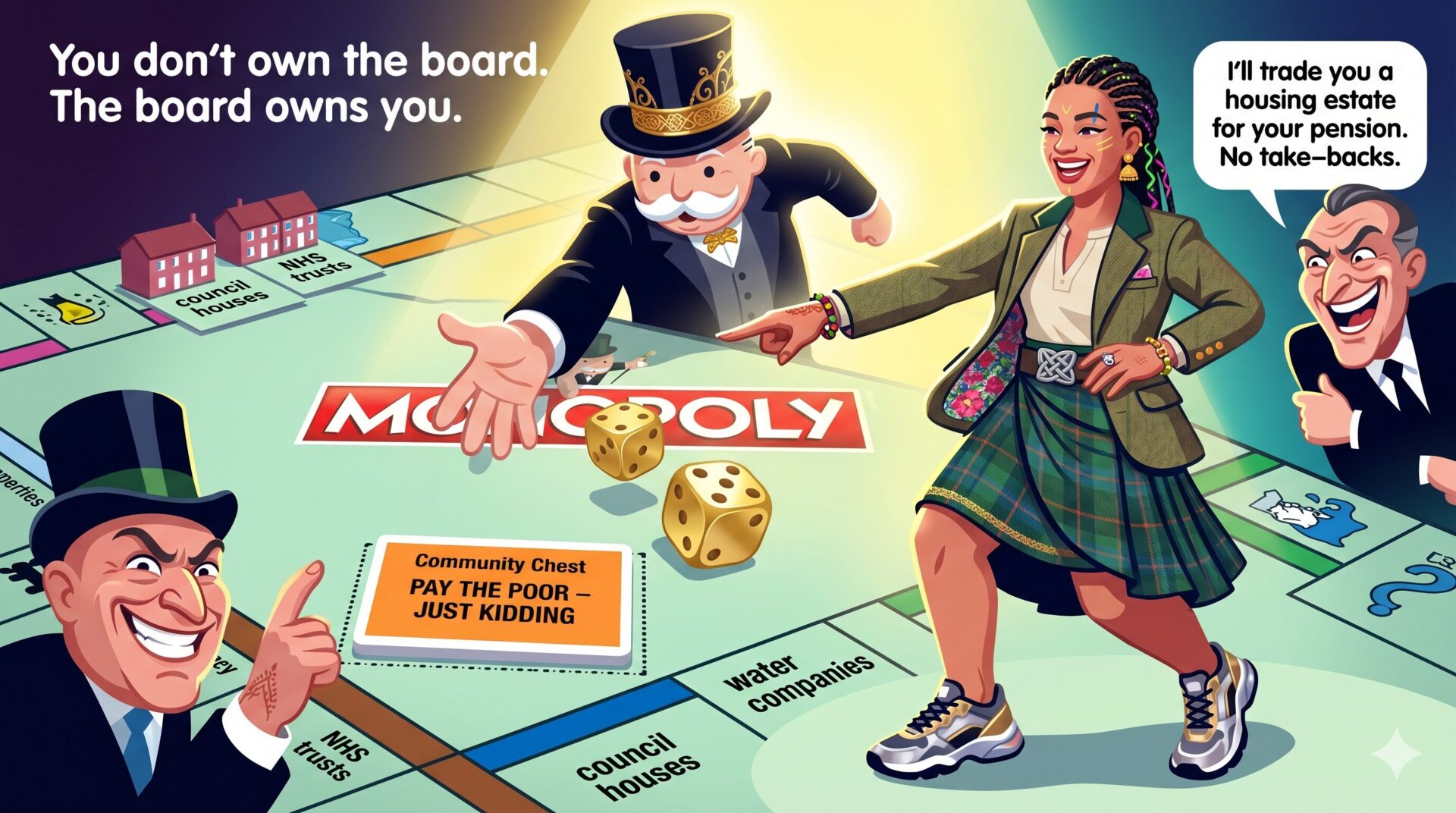 But Starmer’s “bigger response” wasn’t bigger at all. It was smaller. Timider. More cautious. He stood there, in his rolled‑up sleeves and open collar, and offered… what? Closer ties with Europe? A youth mobility scheme? A bit of public ownership for a steel plant that was about to close? That’s not a bigger response. That’s the same small, safe, managerial response that’s been failing for forty years.
A real bigger response would be: “We’re building a million council houses, and we’re paying for it by taxing the land bankers who’ve been sitting on empty properties.”
A real bigger response would be: “We’re taking the energy companies back. Public ownership, public control, public benefit. Bills down, dividends gone.”
A real bigger response would be: “We’re scrapping Universal Credit and replacing it with a proper social security system that doesn’t punish people for being poor.”
A real bigger response would be: “We’re putting a windfall tax on the water companies that have been poisoning our rivers, and using the money to clean them up.”
That’s a bigger response. That’s the kind of speech that would make people sit up and listen. But Starmer didn’t say any of that. Because saying that would mean taking on the people who pay for his party. The property developers. The energy giants. The private equity firms. The same old faces that own the same old levers of power.
The Adage About the Donkey and the Carrot
There’s another saying, from the old costermongers who used to drive their carts through the East End: “You can’t move a donkey by waving a carrot that you’ve already eaten.”
Starmer’s speech was that eaten carrot. He waved it at us, promised us a feast, and then delivered nothing. The donkey—the British people, the ones who are struggling, the ones who need change—is still standing in the same spot, still hungry, still waiting. And the carrot is gone. Swallowed. Digested. Turned into the same old platitudes that have been on the menu for years.
The tragedy is that people are desperate for something to believe in. They’re not asking for the moon on a stick. They’re asking for a roof over their heads, a doctor when they’re sick, a job that pays enough to live on, and a future for their kids that isn’t worse than their present. That’s not radical. That’s not extreme. That’s basic human decency.
And Starmer stood there, for twenty‑five minutes, and offered them… hope. Not the kind of hope that comes with a plan. The kind of hope that comes with a slogan. “We will instill hope.” Instill it? Like medicine? Like a dose of something you don’t really want but have to take? That’s not hope. That’s a sales pitch.
The Wind and the Substance
Let’s do a quick tally of what was actually in that speech, versus what was missing.
What he said: British Steel should come into public ownership. (Good. One policy. Copied from Reform, but good.)
What he didn’t say: Anything about renationalising energy, water, rail, or mail. Anything about taking back the bits of the NHS that have been sold off. Anything about bringing services back in‑house instead of outsourcing them to private contractors.
What he said: Closer ties with Europe. A youth mobility scheme.
What he didn’t say: Rejoining the single market. Rejoining the customs union. Free movement. Any actual mechanism for “putting Britain at the heart of Europe” that doesn’t involve just asking nicely.
What he said: Help for young people. Apprenticeships. Technical colleges.
What he didn’t say: Rent caps. Housing targets. A proper youth guarantee that actually guarantees something. Any acknowledgment that young people can’t afford to live, let alone train.
What he said: We will block far‑right agitators.
What he didn’t say: We will address the conditions that create far‑right support. We will fix the housing crisis, the poverty, the despair that populists feed on. We will give people something to vote for, not just something to vote against.
That’s the problem. The speech was all wind. No substance. Twenty‑five minutes of “we will do something” without ever saying what. Twenty‑five minutes of “we have learned lessons” without ever admitting what the lessons were. Twenty‑five minutes of “stronger and fairer” without ever defining what stronger means or who gets to be fairer to whom.
The Adage About the Weathervane
There’s a final saying, from the old farmhands who knew a thing or two about empty promises: “A weathervane tells you which way the wind is blowing, not whether it’s going to rain.”
Starmer is that weathervane. Spinning in the breeze, pointing wherever the focus groups tell him to point, telling us which way the wind is blowing without ever doing anything about the rain. And the rain is coming down. Hard. People are getting soaked. Their roofs are leaking. Their gardens are flooded. And Starmer is standing there, pointing, saying “look, the wind has changed,” as if that helps.
The speech was a weathervane. All direction, no action. All spin, no substance. All wind, no rain.
The Only Honest Speech
Here’s what an honest speech would sound like. Not from Starmer—he’s incapable of honesty, because honesty would require admitting that he’s part of the problem. But from someone. Anyone. A speech that actually said something.
“We’ve been in power for a year, and we’ve achieved less than nothing. We’ve broken our promises. We’ve alienated our voters. We’ve governed like a slightly less nasty version of the Tories, and the public has noticed. So here’s what we’re going to do differently.
 We’re going to scrap the two‑child benefit cap. Today. Not after a review, not after a consultation, not after we’ve had time to think about it. Today. Because it’s cruel and we were wrong to keep it.
We’re going to introduce rent caps. Nationwide. Tied to inflation. Because housing is a human right, not an investment vehicle, and we’ve spent too long pretending otherwise.
We’re going to nationalise energy, water, and rail. Not through complicated half‑measures. Full public ownership. Because the private sector has failed, and we’re not going to keep propping it up.
We’re going to scrap council tax and replace it with a land value tax. Because the current system is unfair, regressive, and thirty years out of date.
We’re going to properly fund the NHS. Not with more private contracts. With money. With staff. With buildings that don’t leak.
And if that upsets our donors, our corporate backers, our friends in the City? Tough. They’ve had forty years of being prioritised. It’s someone else’s turn.”
That’s a speech. That’s substance. That’s a bigger response. That’s the kind of thing that might actually make people believe again.
But we didn’t get that. We got twenty‑five minutes of waffle. More wind, less substance. A speech that said nothing, changed nothing, and fooled nobody.
As the old market traders say: “You can’t sell yesterday’s fish by wrapping it in today’s newspaper.”
Starmer’s speech was yesterday’s fish. Rancid, smelly, and covered in ink. And we’re not buying it. Not anymore. Not ever again.
14.The Brussels Bounce That Never Was: Why Closer Ties Won’t Win Back the Red Wall
There’s a saying you’ll hear in any working men’s club from Barnsley to Bolsover, usually after someone’s tried to sell you a dodgy round: “You can’t unburn a bridge by building a new one somewhere else.”
Labour have burned their bridges with the Red Wall. Not accidentally. Not because of a misunderstanding. Deliberately, systematically, and with the kind of arrogance that only comes from people who’ve never had to worry about where next week’s shopping is coming from. They ignored those communities. They dismissed their concerns. They treated them as thick. As racists. As Little Englanders who didn’t know what was good for them.
And now, having lost them in droves to Reform, to the Tories, to staying at home in despair, they’ve decided the answer is… more Europe. Closer ties with Brussels. A youth mobility scheme. “Putting Britain at the heart of Europe.” As if the bloke in the Doncaster depot who voted Leave because he was sick of watching his wages stagnate while Polish builders got the work is going to hear “youth mobility scheme” and think, “Cor, that’s me sorted.”
Good luck with that. You’ll need it. Because this isn’t a strategy. It’s electoral suicide dressed up as a cunning plan. It’s the political equivalent of setting fire to your house and then complaining that the fire brigade took too long to arrive.
The Adage About the Pub Regular
There’s an old Cockney saying that’s perfect for this: “You can’t call a man thick to his face and then ask him to buy you a pint.”
That’s exactly what Labour’s done. For years, the metropolitan wing of the party—the Islington dinner party set, the Guardian columnists, the Twitter warriors—has been sneering at Leave voters. “They were lied to.” “They didn’t understand what they were voting for.” “They were duped by Farage.” “It was about immigration, really, not sovereignty.” All the usual condescension, dripping with the kind of upper‑middle‑class contempt that makes your teeth ache.
And those voters heard it. Of course they heard it. You don’t need a degree in media studies to know when someone’s talking down to you. You can feel it in your bones. The patronising tone, the rolled eyes, the way they say “working class” like it’s a foreign language they’ve had to learn for a holiday.
So those voters—the ones in Stoke, in Doncaster, in Blyth, in all the places that used to be redder than a fire engine—walked. They voted Reform. They voted Tory. They voted UKIP. They stayed home. They did anything other than vote for the people who’d spent years telling them they were stupid.
And Labour’s response? Not “we’re sorry, we should have listened.” Not “we were wrong to dismiss your concerns about immigration, about housing, about wages.” Not “we’ll focus on the things that actually matter to you.” No. Their response is “we’re going to cosy up to Brussels.”
It’s breathtaking. It really is. The sheer, staggering arrogance of it. “You voted Leave because you felt ignored? Well, we’re going to ignore you even harder, but this time we’ll do it in French.”
The Red Wall: What They Actually Want
Let’s talk about the Red Wall for a moment. Not the media’s Red Wall—the one in the pundits’ spreadsheets, the marginal seats, the swingometers. The real Red Wall. The communities that voted Labour for generations, not out of tribal loyalty, but because Labour used to be the party that spoke for them.
What do those communities actually want? Not “closer ties with Europe,” that’s for sure. They want decent jobs. Not zero‑hour contracts, not gig economy exploitation, not “self‑employed” status that means no sick pay, no holiday pay, no security. Proper jobs. With proper wages. The kind that used to come from factories, mines, docks—the industries that were destroyed while Labour watched and did nothing.
They want housing they can afford. Not “affordable” flats that cost eighty percent of market rent. Not shared ownership schemes that leave you with all the costs and none of the equity. Real council housing, built to decent standards, let at rents that don’t eat half your wages.
They want public services that work. A doctor’s appointment when you need one, not three weeks later. A hospital that isn’t falling down. A bus that actually turns up. A library that hasn’t been closed. The basics. The things that used to be the bare minimum of a civilised society.
They want immigration that’s managed. Not because they’re racist—though Labour will keep calling them that, because it’s easier than actually listening. Because they’ve seen wages fall, housing get scarcer, services get stretched. They’re not blaming the immigrants. They’re blaming the system that lets it happen without planning, without investment, without any kind of strategy. And Labour’s response is to call them bigots and promise more Europe. It’s almost funny, if it weren’t so tragic.
The Adage About the Wrong Medicine
There’s another saying, from the old market chemists who used to mix their own remedies: “You can’t cure a broken leg with a headache pill.”
Labour’s EU pivot is a headache pill for a broken leg. The patient is bleeding out. The bone is sticking through the skin. And they’re offering paracetamol. “Here, this’ll make you feel better about the fact that your wages have been flat for fifteen years. We’re going to let young people study in Lyon.”
The problems of the Red Wall aren’t about Europe. They never were. Brexit was a symptom, not a cause. People voted Leave because they were hurting. Because the economy had stopped working for them. Because the political class had stopped listening. Because the future looked worse than the past, and they wanted to blow the whole thing up and start again.
Throwing a youth mobility scheme at that hurt is like throwing a bucket of water at a house fire. Technically, it’s wet. But it’s not going to save the building.
The Electoral Maths of Madness
Let’s do the numbers, shall we? Because the electoral maths of this pivot is genuinely bonkers.
Labour lost the Red Wall because those voters went to Reform, to the Tories, or to their sofas. The voters they’ve alienated are working class, socially conservative, patriotic, and deeply suspicious of a political class that’s spent years telling them they’re wrong about everything.
Who does the EU pivot appeal to? Liberal, metropolitan, pro‑European voters. The kind of people who already vote Labour, or Lib Dem, or Green. The kind of people who live in London, Bristol, Manchester city centre. Not the kind of people who live in the former mining towns of Yorkshire or the factory towns of the Midlands.
So Labour is betting that they can lose the Red Wall—the foundation of the party for a hundred years—and make up the numbers by winning more seats in London and the south‑east. From Remain voters who’ve never forgiven them for not opposing Brexit hard enough.
It’s a gamble. And it’s a stupid one. Because the Red Wall isn’t coming back. Not with this strategy. Not with this level of contempt. And the metropolitan voters they’re chasing? They’re already voting Labour. There aren’t enough of them to make up the difference. The maths doesn’t work. It’s electoral suicide, plain and simple.
The Adage About the Two Stools
There’s an old market saying that’s perfect for Labour’s predicament: “If you try to sit on two stools, you’ll end up on the floor with a sore arse.”
Labour is trying to sit on two stools. One stool is the Red Wall—working class, Leave‑voting, socially conservative. The other stool is the metropolitan liberals—pro‑European, socially liberal, university‑educated. They’re trying to appeal to both, and they’re ending up appealing to neither.
The Red Wall sees the EU pivot and thinks, “They still haven’t listened. They still think we’re stupid. They’re still trying to undo the one thing we voted for.” The liberals see the EU pivot and think, “Too little, too late. Where was this five years ago? And anyway, you’re not going far enough—we want full membership, not a youth scheme.”
So Labour loses on both sides. The Red Wall drifts further to Reform. The liberals stay home or vote Green. And Labour ends up on the floor, with a sore arse, wondering what went wrong.
The Only Honest Approach
Here’s what an honest approach would look like. Not from Labour—they’re incapable of honesty on this, because honesty would mean admitting they were wrong about the Red Wall, wrong about Brexit, wrong about everything for the last decade. But from someone. Anyone.
“We got it wrong. We ignored you. We dismissed your concerns. We called you names. We treated you like children who didn’t know what was good for you. That was arrogant, it was wrong, and we’re sorry.
“You weren’t wrong to be angry. The economy wasn’t working for you. Wages had stagnated. Services had crumbled. The future looked bleak. And we, the political class, offered you nothing but contempt.
“So here’s what we’re going to do. Not ‘cosy up to Brussels.’ Not ‘rejoin the EU by the back door.’ We’re going to fix the things that made you angry in the first place. We’re going to rebuild industry. We’re going to build council houses. We’re going to properly fund the NHS. We’re going to manage immigration so it doesn’t put pressure on housing and services. We’re going to give you back a future worth believing in.
“And if that means taking on the corporate interests, the property developers, the private equity firms, the whole rotten system? Good. That’s what we should have been doing all along.”
That’s a strategy. That’s a path back to the Red Wall. Not promising more Europe. Promising more justice.
The Final Adage
I’ll leave you with one last saying, from the old steelworkers who knew a thing or two about betrayal: “You can’t sell a man a new car while you’re still trying to take back the old one.”
Labour is trying to sell the Red Wall a new car—hope, change, a better future—while simultaneously trying to take back the old one—Brexit, sovereignty, the one thing those voters thought they’d won. And the Red Wall isn’t buying it. Because they remember. They remember being called thick. They remember being ignored. They remember watching their communities fall apart while Labour politicians sipped Chardonnay in Islington and wrote columns about how wonderful the single market was.
The EU pivot isn’t a strategy. It’s a surrender. A surrender to the idea that Labour can never win back the Red Wall, so they might as well give up and chase the liberals. A surrender to the idea that working people don’t matter anymore, because they’ve all gone to Reform. A surrender to the idea that the only way to win elections is to appeal to the people who already agree with you, and ignore the ones who don’t.
Good luck with that. You’ll need it. Because the Red Wall isn’t coming back. Not with this strategy. Not with this attitude. Not with this contempt.
And when Labour loses the next election—when Reform sweeps the north and the Tories hold the south and the Lib Dems pick up the scraps—they’ll wonder what went wrong. They’ll blame the media, the voters, the electoral system. They’ll blame everyone but themselves.
But we’ll know. We’ll remember the EU pivot. The youth mobility scheme. The “heart of Europe.” And we’ll remember the adage: “You can’t unburn a bridge by building a new one somewhere else.”
The bridge is ash. And Labour is standing on the wrong side of the river, waving a French flag, and wondering why nobody’s clapping.
15.The Youth Mobility Con: A Holiday in Berlin Won’t Pay Your Rent
There’s a saying you’ll hear in any young person’s house share, usually muttered over a bowl of own‑brand cereal and a glance at the bank balance: “You can’t eat a dream, and you can’t sleep in a promise.”
The youth mobility scheme sounds nice, doesn’t it? A chance for young Brits to work, study, and live in Europe. A bit of culture. A bit of adventure. A bit of “finding yourself” in a Barcelona flat share or a Berlin coffee shop. On the surface, it’s the kind of policy that makes middle‑aged pundits nod wisely and say, “Ah, yes, opportunity. That’s what young people need.”
But let’s have a proper look at what young people actually need. Not what the focus groups say they want when a nice researcher asks them leading questions. What they actually need, in the real world, with real bills and real landlords and real zero‑hour contracts.
They need jobs. Proper jobs. The kind that pay enough to live on, that offer security, that don’t disappear the moment the agency’s had its cut. Not “gig economy” exploitation where you’re technically self‑employed but actually have no rights. Not zero‑hour contracts where you’re never sure if next week you’ll have ten hours or forty. Real jobs. With real wages. And real prospects.
They need housing. A roof over their heads that doesn’t cost two thirds of their income. A place they can call their own, not a damp room in a shared house with a landlord who treats them like a cash machine. A future that isn’t renting forever, watching the deposit get further away every year as house prices rise faster than wages.
They need a future. Not just a series of short‑term fixes. A proper, long‑term, hopeful future. The kind their parents took for granted. The kind that’s been stolen from them by forty years of neoliberalism, privatisation, and a political class that’s never had to worry about where next month’s rent is coming from.
A youth mobility scheme doesn’t give them any of that. It gives them a chance to be poor in a different country. Congratulations, you can now be exploited by a German landlord instead of a British one. Your zero‑hour contract can now be in French. Your career prospects can now be uncertain in Amsterdam. Vive la différence.
The Adage About the Plaster and the Broken Leg
There’s an old Cockney saying that’s perfect for this: “Putting a plaster on a broken leg doesn’t help you walk—it just makes the hospital look busy.”
The youth mobility scheme is that plaster. Young people’s lives are the broken leg. And the government is standing there, waving a little strip of adhesive, saying “Look, we’re helping!” while the bone sticks out at a horrible angle and the patient screams in pain.
What young people need isn’t a holiday in Berlin. It’s a job in Barnsley. It’s a house in Huddersfield. It’s a future that doesn’t involve living with their parents until they’re forty because they can’t afford the deposit on a shoebox flat in a town they don’t even like.
Let’s break it down by the numbers, because the numbers tell a story that the politicians don’t want you to hear.
Housing. The average age of a first‑time buyer in the UK is now thirty‑four. Thirty‑four. That means most young people spend nearly two decades after leaving school renting, saving, struggling, and watching the goalposts move further away every year. The average deposit in the south‑east is now over £50,000. Fifty thousand pounds. How is a young person on a zero‑hour contract supposed to save that? They can’t. They won’t. And the youth mobility scheme doesn’t change that one bit.
Jobs. Nearly a million young people are not in education, employment, or training. A million. That’s the population of Birmingham, sitting at home, watching their prospects shrink. The jobs that are available are increasingly insecure, low‑paid, and without basic protections. Zero‑hour contracts have tripled in the last decade. The “gig economy” has turned work into a lottery where you never know if you’ll earn enough to cover the bills. A youth mobility scheme doesn’t create a single secure job in the UK. It just gives young people another place to be exploited.
Wages. Real wages for young people have barely risen in fifteen years. Adjusted for inflation, a young worker today earns about the same as a young worker in 2008. Fifteen years of lost progress. Fifteen years of stagnation. Fifteen years of being told to “be flexible” and “upskill” and “get a degree” while the cost of everything went through the roof. A youth mobility scheme doesn’t raise wages. It just offers a change of scenery.
The Market Trader’s Guide to What Young People Actually Want
Let me translate the youth mobility scheme into proper Cockney, so you can hear how it sounds to the young people who are actually struggling.
“You can now work in Europe” = “We’ve given up on creating decent jobs here, so you can go and be poor somewhere else. Don’t let the door hit you on the way out.”
“You can study in Europe” = “Our universities are too expensive and our student debt is crippling, so you might as well go and study abroad. Good luck with the tuition fees there, by the way.”
“You can live in Europe” = “We can’t afford to build enough housing for you here, so why don’t you go and live in a city that also has a housing crisis, but at least the bread is better?”
That’s the reality. The youth mobility scheme isn’t a gift. It’s a white flag. An admission that the government has no idea how to fix the problems facing young people in the UK, so they’re just going to offer them an exit visa and pretend it’s progress.
The Adage About the Escape Hatch
There’s another saying, from the old dockers who watched their sons leave for Australia in the sixties: “An escape hatch isn’t a home. It’s just a way out of a ship that’s sinking.”
The youth mobility scheme is that escape hatch. Labour is admitting, without saying it out loud, that the ship is sinking. That the UK is no longer a place where young people can build a decent life. That the housing crisis, the jobs crisis, the cost of living crisis—all of it is so bad that the best we can offer is a chance to leave.
That’s not a policy. That’s a surrender. A surrender to the idea that young people don’t have a future here, so they might as well go somewhere else. A surrender to the idea that the problems are too big to fix, so we’ll just help people escape them. A surrender to the idea that the next generation is on its own, good luck, don’t forget to write.
And the thing is, young people know this. They’re not stupid. They see the housing market. They see the jobs market. They see the state of the NHS, the state of the buses, the state of the high street. They know that a youth mobility scheme isn’t going to fix any of that. It’s just a distraction. A shiny thing to wave while the real problems get worse.
What a Real Youth Policy Would Look Like
Let me tell you what a real youth policy would look like. Not a plaster. Not an escape hatch. Something that actually addresses the crisis facing young people in this country.
A proper youth guarantee. Not the watered‑down version that’s been promised before. A real one. A job, an apprenticeship, or a training place for every young person who wants one. Funded properly, delivered locally, with real sanctions for employers who exploit the system.
Rent caps. Nationwide, tied to inflation, with a register of landlords and penalties for gouging. Young people shouldn’t have to spend two thirds of their income on a room in a shared house. Rent should be affordable. That’s not radical. That’s basic decency.
A housing programme. A million council houses over the next decade, built to decent standards, let at social rents. Not “affordable” homes that cost nearly market rate. Real council housing, with secure tenancies, that gives young people a chance to save, to plan, to build a future.
A living wage that’s actually a living wage. Not the government’s version, which is still too low. A real living wage, calculated on the actual cost of living, enforced across all sectors, with no exemptions for young workers. A wage that lets you live, not just survive.
An end to zero‑hour contracts and gig economy exploitation. Every worker deserves security. Every worker deserves to know how much they’ll earn next week. Every worker deserves sick pay, holiday pay, and the right to organise. Young workers especially.
That’s a real youth policy. That’s the kind of thing that would actually make a difference. That’s the kind of thing that would give young people hope, not just a plane ticket.
The Adage About the Garden
There’s a final saying, from the old market gardeners who knew a thing or two about growing things: “You can’t grow a garden by telling people to move to a different field.”
The youth mobility scheme is telling people to move to a different field. “The soil here is rubbish,” they say. “The rabbits have eaten everything. The weather’s terrible. Why don’t you try Germany? The carrots are bigger there.”
But young people don’t want to move to a different field. They want this field to be better. They want to live here, work here, build a life here, in the country they grew up in, near the people they love, in the communities that shaped them. They don’t want to be economic refugees from their own homeland. They want a homeland that works for them.
The youth mobility scheme is an admission that this government can’t deliver that. So they’re offering an alternative. Not a solution. An alternative. “We can’t fix it here, so go somewhere else.” It’s a betrayal. A cowardly, spineless betrayal of a generation that deserves so much better.
The Only Honest Conclusion
Here’s the truth that nobody in Westminster wants to admit. The youth mobility scheme isn’t for young people. It’s for the government. It’s a way of pretending they’re doing something without actually doing anything. It’s a headline, not a policy. A soundbite, not a solution. A plaster on a broken leg.
Young people don’t need a holiday in Berlin. They need a job in Birmingham. They need a house in Huddersfield. They need a future that isn’t just a series of zero‑hour contracts and shared flats and broken promises. They need a government that actually gives a toss. Not a government that offers them an exit visa and calls it opportunity.
As the old saying goes: “A man who offers you a map out of town isn’t planning to fix the town.”
Labour isn’t planning to fix the town. They’re planning to help you leave. And that’s not hope. That’s a white flag. And young people deserve better than a white flag. They deserve a government that fights for them. Not one that waves them goodbye.
16.The Steel Nationalisation That Came with a Shrug and a Mumble
There’s a saying you’ll hear on any self‑respecting market stall, usually from a trader who’s just sold you the last of the cucumbers: “A gift horse is a gift horse, even if the bloke giving it to you looks like he’s passing a kidney stone.”
The steel nationalisation announcement was that gift horse. The one genuinely interesting, genuinely radical, genuinely good idea in the whole sorry speech. Public ownership of British Steel. Taking the plant into national hands. Investing in blast furnaces. Saving thousands of jobs. Protecting an entire region from economic collapse. It was, by any reasonable measure, a proper Labour policy. The kind of thing that used to make the party proud. The kind of thing that puts food on the table and keeps the lights on in communities that have been left to rot for forty years.
And how did they present it? Like a man selling a stolen watch out of a raincoat. Reluctantly. Apologetically. As if they’d been caught doing something slightly embarrassing, like buying a cut‑price DVD from a bloke in a pub. “Oh, this old thing? Well, we didn’t really want to, but the situation forced our hand. It’s a last resort, you understand. Not something we’d normally do. Don’t tell the donors.”
They were embarrassed by their own good idea. Mortified, even. You could almost hear the spads in the background, wincing, whispering “don’t make too much of it, Keir, for God’s sake, the Telegraph will have a fit.” And Starmer, bless him, did exactly as he was told. He mumbled it. Rushed through it. Buried it in the middle of the speech like a bit of bad news he was trying to sneak past the referee.
It was pathetic. And it tells you everything you need to know about the modern Labour Party.
The Adage About the Stolen Silver
There’s an old Cockney saying that’s perfect for this: “A man who’s ashamed of his own mother won’t make much of a son.”
Nationalisation is Labour’s mother. It’s the party’s founding principle. Public ownership of the means of production—that’s what Clause Four used to say, before Blair ripped it out and replaced it with something about “stakeholder capitalism” that nobody understood and even fewer believed. Taking stuff back into public hands is supposed to be what Labour does. It’s the family silver. The heirloom. The thing that distinguishes them from the Tories.
And now, when they finally do it—when they finally take a significant industry into public ownership—they act like they’ve been caught nicking the neighbour’s cat. They don’t announce it with pride. They don’t stand at a podium and say, “This is what we believe in. This is what we were elected to do. Public ownership works. Public ownership serves the public. Public ownership saves jobs and communities and industries. We’re proud to do it, and we’re going to do more of it.”
No. They announce it like a confession. “We’ve had to take this regrettable step. The circumstances left us no choice. It’s a last resort. Don’t get used to it.”
It’s enough to make you weep. Or laugh. Or both.
The Reluctant Nationaliser
Let’s have a proper look at how they presented it, because the presentation is the point. The policy itself is good. Taking British Steel into public ownership is the right thing to do. The plant was hours away from closure. Thousands of jobs were on the line. An entire region was facing economic devastation. A private owner had failed, as private owners always do when profit stops being easy. The government stepped in, passed emergency legislation, and took control.
That’s what governments are supposed to do. That’s why we have governments. Not to sit on their hands and mutter about markets and competition and the magic of the invisible hand. To act. To intervene. To do the things that private companies won’t do because they’re not profitable enough.
But listen to the language they used. “A public interest test could be met.” Not “we believe in public ownership.” “Legislation will be brought forward.” Not “we’re proud to announce.” “Powers subject to that test.” Not “we’re taking back control for the good of the country.”
It’s all passive voice and weasel words. They sound like civil servants, not politicians. Like they’re filling out a form, not making history. There’s no passion. No conviction. No sense that this is the beginning of something, not the reluctant end of something else.
And the reason is simple: they’re embarrassed. They’ve spent so long apologising for socialism, so long running away from their own history, so long pretending that the market is the answer to everything, that when they finally do something socialist, they don’t know how to talk about it. They’ve lost the language. Lost the confidence. Lost the plot.
The Market Trader’s Guide to Public Ownership
Let me translate the government’s announcement into proper Cockney, so you can hear how ridiculous it sounds.
“We’ve had to take British Steel into public ownership” = “We’ve run out of private sector options, so we’re stuck with this. Don’t blame us.”
“It’s a last resort” = “We’d really rather not be doing this, but the plant was about to close and someone had to do something, so here we are. Sorry.”
“Legislation will be brought forward” = “We’re going to pass a law, but we’re not happy about it, and we’ll probably reverse it as soon as we can find a buyer.”
“Public interest test” = “We’ve invented a test that we can fail if it becomes politically inconvenient. Watch this space.”
That’s not leadership. That’s embarrassment. And embarrassment is a terrible foundation for good policy.
The Adage About the Reluctant Bride
There’s another saying, from the old matchmakers who used to arrange marriages down the East End: “A reluctant bride makes for a miserable wedding, no matter how good the cake.”
The steel nationalisation is that reluctant bride. The policy is good—the cake is lovely, if you’ll forgive the stretched metaphor. But the wedding is miserable. The groom looks like he’d rather be anywhere else. The guests are whispering. The vicar is clearing his throat. And nobody’s dancing because everyone can feel the awkwardness in the room.
That’s what Labour has done with this policy. They’ve taken a genuinely good idea—public ownership of a strategic industry, saving jobs, protecting communities, investing in the future—and turned it into something joyless. Something apologetic. Something that feels like a defeat, not a victory.
And the tragedy is that it didn’t have to be this way. Nationalisation could be popular. Done right, with the right language, the right framing, the right sense of purpose, it could be a vote‑winner. People are sick of private companies failing. Sick of shareholders getting rich while services collapse. Sick of being told that the market knows best when the market keeps making them poorer.
But Labour can’t sell it. Because they don’t believe it. Not really. Not in their bones. They believe in “stakeholder capitalism” and “partnerships” and “mixed economy” and all the other weasel words that mean “we won’t actually change anything fundamental.” They’re social democrats in name only. And when they stumble into a real socialist policy, they don’t know what to do with it.
What a Proud Announcement Would Sound Like
Let me tell you what a proud announcement would sound like. Not from this lot—they’re incapable of pride, because pride would require admitting that socialism works. But from someone. Anyone.
“Today, we’re bringing British Steel back into public ownership. Not because we have to. Because we want to. Because public ownership is better than private ownership. Because it puts jobs before profits, communities before shareholders, and the country before a bunch of speculators who’ve never set foot in Scunthorpe.
“This isn’t a last resort. It’s a first resort. It’s what governments should do. When private companies fail—when they run industries into the ground, when they put short‑term gain above long‑term survival—the public should step in. Not reluctantly. Not apologetically. Proudly. Confidently. With our heads held high.
“And this is just the beginning. We’re going to look at energy. At water. At rail. At every industry where private ownership has failed the public, and we’re going to ask the same question: who benefits? If the answer isn’t the British people, we’re going to change it.
“Public ownership isn’t a relic of the past. It’s the future. And we’re proud to lead the way.”
That’s a speech. That’s conviction. That’s the kind of language that makes people believe. That’s the kind of announcement that would have the pundits’ heads spinning and the Red Wall paying attention.
Instead, we got a mumble. A shrug. A man who looked like he’d just been told his train was cancelled.
The Embarrassment of Good Ideas
Here’s the thing that really gets my goat. It’s not just steel. It’s everything. Labour has a whole drawer full of good ideas—public ownership, rent control, wealth taxes, council house building, proper NHS funding—and they’re embarrassed by every single one of them. They keep them in the drawer, under the socks, and only bring them out when they’re absolutely forced to. And even then, they apologise for them.
Why? Because they’ve internalised the Thatcherite consensus. They’ve spent so long being told that privatisation is good, that markets are efficient, that the state is bad, that competition is the answer, that they’ve started to believe it. They’ve forgotten that the consensus was built on lies. That privatisation has enriched a few and impoverished the many. That markets don’t work for public services. That competition isn’t a magic wand.
They’re like a vegetarian who’s been forced to eat a steak and now feels sick. They know the steak is good for them. They know it’s what they need. But they’ve been told for so long that tofu is the only morally respectable option that they can’t enjoy the meat.
So they eat it with a grimace. Apologising. Mumbling. Hoping nobody notices.
But we notice. We’ve always noticed. We notice when a government is embarrassed by its own good ideas. We notice when they announce a policy as if it’s a punishment. We notice when they’d rather be doing nothing, but the situation has forced their hand.
And we draw the obvious conclusion: they don’t really believe in it. They’re not going to defend it. They’ll reverse it as soon as they can find an excuse.
That’s not leadership. That’s abdication.
The Final Adage
I’ll leave you with one last saying, from the old steelworkers who knew a thing or two about pride: “A man who’s ashamed of his work won’t keep his job for long.”
Labour is ashamed of its work. Ashamed of the one genuinely good policy it’s managed to stumble into. Ashamed of public ownership. Ashamed of socialism. Ashamed of its own history. And it shows. It shows in the mumbling, in the reluctance, in the way they presented the steel nationalisation like a guilty secret rather than a proud achievement.
And the voters notice. The steelworkers notice. The communities that depend on the plant notice. They see a government that doesn’t believe in itself, and they draw the obvious conclusion: why should we believe in them?
The steel nationalisation could have been a turning point. A moment when Labour remembered who it was. A declaration that public ownership isn’t a last resort—it’s the first resort, the best resort, the only resort that works.
Instead, it was a mumble. A shrug. An apology.
And the adage will come true. A party that’s ashamed of its own good ideas won’t keep its job for long. Not because the ideas are bad. Because the shame is contagious. And nobody wants to vote for someone who looks embarrassed to be on their own side.
17.The Hollow Battle: Fighting for a Soul You’ve Already Sold to the Highest Bidder
There’s a saying you’ll hear in the old union halls, usually muttered by a bloke who’s seen more strikes than hot dinners: “You can’t fight for the soul of the nation with one hand shaking a donor’s and the other picking a corporate pocket.”
“Battle for the soul of the nation.” It sounds grand, doesn’t it? Like something Churchill might have said. Like something out of a wartime speech, with flags flying and choirs singing. It’s the kind of rhetoric that’s supposed to make you stand a little straighter, clench your fist a little tighter, believe that this time—this time—things are going to be different.
But here’s the problem. You can’t fight for the soul of the nation while you’re cosying up to the same corporate interests that have been bleeding it dry for decades. You can’t talk about “taking back control” while you’re taking backhanders from private health companies. You can’t promise “a new direction” while you’re walking the same old paths, paved with the same old gold, donated by the same old billionaires.
The rhetoric is empty. Hollow. As full of air as a politician’s promise on the Friday before an election. And everybody knows it. That’s why nobody’s marching. Nobody’s singing. Nobody’s standing a little straighter. Because we’ve heard it all before. From Blair. From Cameron. From Johnson. From Starmer. “Battle for the soul of the nation.” And every time, the soul turns out to be up for auction, and the only bidders are the people who’ve already bought everything else.
The Adage About the Fox and the Henhouse
There’s an old Cockney saying that’s perfect for this: “You can’t set a fox to guard the henhouse and then act surprised when the eggs go missing.”
The corporate interests are the fox. They’ve been in the henhouse for forty years. They’ve eaten the eggs, the hens, the roof, and most of the garden fence. And now Labour stands up and says, “We’re going to fight for the soul of the nation.” But when you look behind the podium, there’s the fox. Sitting right there. Wagging its tail. Licking its lips.
Because Labour hasn’t broken with the corporate interests. It’s deepened its ties with them. The same private health companies that were carving up the NHS under the Tories are still getting contracts under Labour. The same energy giants that were posting record profits while people froze are still being wined and dined by ministers. The same water companies that turned our rivers into sewers are still donating to party funds, still lobbying for weak regulation, still paying out dividends while the infrastructure crumbles.
You can’t fight against that. Not while you’re taking their money. Not while you’re employing their lobbyists as advisers. Not while your ministers are meeting them behind closed doors, away from the cameras, away from the scrutiny.
The “battle for the soul of the nation” isn’t a battle. It’s a performance. A bit of theatre to keep the punters distracted while the fox carries on eating.
What the Soul of the Nation Actually Looks Like
Let’s be specific about what the “soul of the nation” actually means. Not the vague, misty, poetry‑recital version that politicians like to trot out. The real version. The one that affects real people in real places.
The soul of the nation is a thirty‑year‑old nurse who can’t afford to buy a house in the town where she works. The soul of the nation is a steelworker in Port Talbot who’s been told his plant might close because a foreign owner wants to squeeze a bit more profit. The soul of the nation is a mum in Middlesbrough who uses a food bank because her zero‑hour contract doesn’t guarantee enough hours to cover the bills. The soul of the nation is a pensioner in Blackpool who sits in the dark because she can’t afford to put the heating on.
That’s the soul. Not some abstract concept. Not a flag. Not a history lesson. The living, breathing, struggling people who make up this country. The ones who do the work, pay the taxes, keep the wheels turning, and get nothing back except more promises, more mean‑spirited policies, and more speeches about battles they’re not invited to fight in.
And you know what those people need? They need a government that takes on the corporate interests. That breaks up the monopolies. That nationalises the utilities. That builds council houses. That taxes the rich. That stops treating public services as profit centres and starts treating them as what they are—the basic infrastructure of a decent society.
That’s the battle. Not a battle for a vague “soul.” A battle for homes, for wages, for health, for hope. A battle against the people who’ve been running the show for forty years and running it into the ground.
The Market Trader’s Guide to Corporate Cosiness
Let me translate Labour’s “battle for the soul” into proper Cockney, so you can hear how it sounds to the people who are actually losing.
“We’re fighting for the soul of the nation” = “We’re going to give a speech with lots of big words and hope you don’t notice we’re still taking donations from the same people who’ve been looting the country.”
“We’re going to take on the powerful interests” = “We’ve hired some of their lobbyists as advisers so we know exactly how not to upset them.”
“We’re on the side of working people” = “We’ll say that a lot, but we won’t do anything that might actually cost corporate donors a penny.”
“This is a battle” = “This is a press release. The only thing we’re fighting is the autocue.”
That’s the reality. The battle is words. The soul is a hashtag. And the corporate interests are still sitting in the front row, clapping politely, writing cheques, and waiting for the speech to end so they can get back to business as usual.
The Adage About the Empty Suit
There’s another saying, from the old tailors who used to work the rag trade: “An empty suit can’t fight a war, no matter how good the tailoring.”
Labour’s rhetoric is that empty suit. Tailored by focus groups, stitched by spads, pressed by media advisers. It looks good on the hanger. It hangs nicely in the Downing Street wardrobe. But when you put it on, when you try to fight a battle, there’s nothing inside. No conviction. No courage. No willingness to take on the people who actually own the country.
Because taking on the corporate interests would be hard. It would mean losing donations. It would mean fighting the media. It would mean facing down the think tanks, the lobbyists, the whole apparatus of wealth and power that’s been constructed over four decades. It would mean risking defeat. Risking ridicule. Risking everything.
And Labour isn’t willing to risk anything. They’re too comfortable. Too cosy. Too scared of losing the next election to even think about winning the right one. So they fight battles they can’t lose—battles of rhetoric, battles of positioning, battles of “who’s up and who’s down.” And the real battle—the one against the corporate interests that are bleeding the country dry—they ignore. Or worse, they cosy up to.
What a Real Battle Would Look Like
Let me tell you what a real battle for the soul of the nation would look like. Not the fake version. The real one.
It would start with an admission. “We’ve been wrong. We’ve been too close to corporate power. We’ve taken donations we shouldn’t have. We’ve hired advisers we shouldn’t have. We’ve pursued policies that enriched the few at the expense of the many. We’re sorry. And we’re going to change.”
Then it would continue with action. “We’re banning corporate donations to political parties. No more cheques from hedge funds, from private health companies, from energy giants, from developers. If you want to influence politics, you do it in public, with your name attached, and you don’t get to write a cheque and then write a policy.”
“We’re renationalising energy, water, and rail. Not because we have to. Because we want to. Because the private sector has failed, and we’re not going to keep propping it up with public money and public patience.”
“We’re putting a windfall tax on the excess profits of the last five years. The companies that profited from a pandemic, from a war, from a cost‑of‑living crisis—they’re going to pay it back. Every penny.”
“We’re breaking up the monopolies. The tech giants, the supermarket chains, the property empires. No more concentration of wealth and power in a handful of hands.”
That’s a battle. That’s fighting for the soul of the nation. Not with words. With actions. With policies that hurt the people who’ve been doing the hurting. With a willingness to lose the corporate donors and win the people.
But Labour won’t do that. Because they’re not in a battle. They’re in a negotiation. A negotiation with the same interests they claim to be fighting. And the only thing they’re fighting for is a slightly better table at the banquet.
The Final Adage
I’ll leave you with one last saying, from the old Chartists who knew a thing or two about real battles: “A man who fights for the soul of the nation with his hands in the pockets of its enemies is fighting on the wrong side.”
Labour’s hands are in those pockets. They’re taking the money. They’re hiring the lobbyists. They’re writing the policies that don’t upset the donors. They’re not fighting the corporate interests. They’re cosying up to them. And then they have the nerve to stand at a podium and talk about “the battle for the soul of the nation.”
The soul isn’t in Downing Street. It’s not in a speech. It’s not in a slogan. It’s in the communities that have been ignored, the workers who’ve been exploited, the young people who’ve been abandoned, the old people who’ve been forgotten. And those people aren’t looking for rhetoric. They’re looking for action. They’re looking for a government that will actually fight for them, not just talk about fighting while cosying up to the people who’ve been fighting against them for decades.
Until that happens, the battle is a sham. The soul is a selling point. And the nation is still being bled dry, by the same hands, with the same cheques, while the politicians argue about who gets to hold the microphone.
As the market traders say: “You can shout ‘fire’ all you like, but if you’re holding the matches, nobody’s going to run to help you.”
Labour is holding the matches. They just don’t want you to notice.
18.The Glass Houses of Westminster: Calling Farage a Grifter Won’t Fix Your Own Roof
There’s a saying you’ll hear in any pub worth its salt, usually directed at the bloke who’s just spilled his pint while pointing at someone else’s: “You can’t call your neighbour a thief when you’ve got your own hand in the till.”
The attacks on Nigel Farage as a “grifter” and a “chancer” are funny. I’ll give them that. They’re even true. The man has made a career out of outrage, a living out of grievance, and a fortune out of flirting with the far fringes of British politics. He’s taken money from dubious sources, said things that would make a fishwife blush, and somehow convinced a chunk of the population that he’s the only one who can save them from a system he’s spent decades profiting from. If that’s not a grifter, I don’t know what is.
But here’s the problem. Pointing at Farage and shouting “look, he’s bad” doesn’t make you good. It just makes you a slightly different flavour of bad. The Labour Party can stand at the despatch box and call him every name under the sun. They can expose his dodgy donations, his flip‑flopping, his convenient amnesia about Brexit’s consequences. And none of it will matter. Because while they’re pointing the finger at him, they’ve got three fingers pointing back at themselves.
The glass houses of Westminster are full of people throwing stones. And Labour’s windows are just as cracked as everyone else’s.
The Adage About the Pot and the Kettle
There’s an old Cockney saying that’s been around since the first copper was polished: “The pot calling the kettle black is still a pot, and it’s still black.”
Labour’s attacks on Farage are the pot calling the kettle black. Yes, he’s a grifter. Yes, he’s a chancer. Yes, he’s taken money from billionaires and then pretended to be a man of the people. But Labour has done exactly the same thing. They’ve taken donations from hedge fund managers, from private health companies, from property developers, from the very same corporate interests that Farage claims to despise. They’ve hired lobbyists as advisers and advisers as lobbyists. They’ve written policies that benefit the wealthy while telling the poor that “tough choices” have to be made.
The only difference is the branding. Farage sells himself as an outsider, a rebel, a man who speaks truth to power. Labour sells itself as the responsible alternative, the safe pair of hands, the party of “stability.” But underneath the different packaging, it’s the same product. A political class that serves the interests of the wealthy, the powerful, and the connected. A system that’s rigged to keep the insiders in and the outsiders out.
So when Labour calls Farage a grifter, the public doesn’t think, “Oh, good, finally someone honest.” They think, “They’re all the same. They’re all on the take. They’re all grifters, just with different accents and different rosettes.”
And they’re not wrong.
The Market Trader’s Guide to Hypocrisy
Let me translate Labour’s attacks on Farage into proper Cockney, so you can hear how it sounds to the people who’ve stopped listening.
“Nigel Farage is a grifter” = “We’re going to ignore our own donations from crypto billionaires and pretend we’re pure as the driven snow.”
“He’s a chancer who’s never delivered” = “We’re going to ignore our own broken promises and pretend we’ve achieved anything.”
“He’s not a serious politician” = “We’re going to ignore our own leadership crisis and pretend we’re the grown‑ups in the room.”
“He’s dangerous” = “We’re going to ignore our own failures and pretend the only threat is from the right.”
The public sees through this. They’re not stupid. They’ve watched Labour break promise after promise. They’ve seen the two‑child benefit cap stay in place. They’ve seen the renters’ reforms watered down. They’ve seen the non‑dom loopholes left wide open. They’ve seen a government that talks left and walks right, that preaches fairness while practising favours for the wealthy.
And now that same government is pointing at Farage and shouting “grifter.” It’s like watching a shoplifter call someone else a thief. Technically true, but wildly hypocritical. And the security guard isn’t going to arrest either of them if he’s also on the take.
What the Public Actually Thinks
Here’s the thing that Labour doesn’t understand. The public’s dislike of Farage doesn’t translate into like for Labour. It’s not a zero‑sum game. You can hate Farage and hate Starmer. You can think Reform is a shower of charlatans and think Labour is a shower of sell‑outs. The two aren’t mutually exclusive.
In fact, for a lot of voters, the attacks on Farage just make Labour look desperate. “They’re not offering anything positive, so they’re just slagging off the competition.” It’s the politics of the playground. “He’s a poo‑head.” “No, you’re a poo‑head.” And meanwhile, the teacher’s gone for a smoke, the classroom’s on fire, and nobody’s learning anything.
The voters who’ve gone to Reform didn’t go there because they think Farage is a saint. They went there because Labour offered them nothing. Because Labour ignored them. Because Labour treated them as thick, as racist, as irrelevant. They went to Reform as a protest—a cry of desperation, not a love letter to Nigel. And Labour’s response is to call their new object of affection a grifter. That’s not going to win them back. It’s just going to confirm that Labour still doesn’t get it. Still doesn’t listen. Still doesn’t care.
The Adage About the Dirty Laundry
There’s another saying, from the old washing lines that used to stretch across the East End tenements: “You don’t wash your dirty laundry in public if you’ve got no clean clothes to wear afterwards.”
Labour is washing its dirty laundry in public. They’re dragging Farage’s donations, his history, his associations out into the light. And that’s fine. He’s a public figure. He should be scrutinised. But the problem is, when they’re done airing his dirty linen, they’ve got to hang up their own. And theirs is just as stained.
 The donations scandal around Farage’s £5 million from a crypto billionaire is grubby. No question. But Labour has taken millions from the same kinds of sources. They’ve had their own donation scandals, their own questions about who’s funding whom and what they’re getting in return. They’ve appointed donors to peerages, given contracts to friendly firms, looked the other way while their mates got rich.
So when they stand up and say “Farage is corrupt,” the public thinks, “And you’re not?” It’s not a winning argument. It’s not even a persuasive one. It’s just two pots calling each other black, while the kettle—the ordinary voter—gets on with boiling water for a cup of tea and wonders why the kitchen’s such a mess.
A Slightly Different Flavour of Bad
Let’s be honest about what Labour is offering as an alternative to Farage. Not the rhetoric. The reality.
Farage offers right‑wing populism. Anti‑immigration, anti‑EU, anti‑“woke,” pro‑small state, pro‑low taxes, pro‑“common sense” (whatever that means). It’s a nasty brew, full of dog whistles and dodgy mates. But at least it’s a coherent vision. You know what you’re getting. You might hate it, but you understand it.
What does Labour offer? Not left‑wing populism. Not socialism. Not even social democracy. They offer a slightly gentler version of the same neoliberal consensus that Farage claims to reject. They’ll manage capitalism a bit more humanely. They’ll spend a bit more on public services, but not too much. They’ll tax the rich a bit more, but not too much. They’ll regulate the corporations a bit more, but not too much.
It’s the politics of “not too much.” The politics of timidity. The politics of “we’re not as bad as the other lot.” And that’s not a vision. That’s a white flag.
So when voters look at Farage and see a grifter, then look at Labour and see a bunch of grifters in better suits, they don’t choose Labour. They choose Reform. Or they stay home. Or they vote Green. Or they write “none of the above” on the ballot paper and go to the pub. Because a slightly different flavour of bad is still bad. And after forty years of bad, people want something else. Anything else.
The Adage About the Two Poisons
There’s a final saying, from the old apothecaries who used to mix their own remedies: “If you’re offered poison in a red bottle or poison in a blue bottle, the only sensible choice is to refuse the bottle.”
Labour is the red bottle. Farage is the turquoise bottle. The Tories are the blue bottle. But it’s all poison. Different colours, different labels, different marketing campaigns. Same toxicity underneath. A political system that serves the few at the expense of the many. A media that keeps us arguing about personalities instead of policies. A donor class that buys influence and sells us out.
And the public is finally refusing the bottle. That’s what the local elections showed. Not a surge of support for Reform. A rejection of the whole lot. A refusal to drink the poison anymore. People stayed home, voted for nobodies, or held their noses and voted for the least worst option. But they didn’t vote for anything. Because there’s nothing to vote for.
Labour can call Farage a grifter until they’re blue in the face. It won’t matter. Because until they offer something worth voting for—not just someone worth voting against—they’ll keep losing. To Farage. To the Tories. To the sofa. To apathy. To despair.
The Only Honest Way Forward
Here’s the truth that Labour refuses to admit. The attacks on Farage are a distraction. A way of avoiding the real question: what are you offering? Not what are you against. What are you for?
Are you for rent caps? Then say it. Are you for nationalising energy? Then do it. Are you for scrapping the two‑child benefit cap? Then scrap it. Are you for building council houses? Then build them. Are you for taking on the corporate interests that have been bleeding the country dry? Then take them on.
Stop pointing at Farage. Stop pointing at the Tories. Stop pointing at the media. Point at yourself. Look in the mirror. Ask what you’ve done, what you’re doing, what you’re going to do. And if the answer is “not much, but at least we’re not Nigel Farage,” then don’t be surprised when people choose the grifter over the ghost.
Because at least the grifter pretends to believe something. At least the grifter offers a vision, however ugly. At least the grifter fights.
Labour offers a shrug. A mumble. A slightly different flavour of the same old poison. And the public has stopped swallowing.
As the old market traders say: “You can call the other bloke a fraud all day long, but if you’ve got nothing to sell, your stall stays empty.”
Labour’s stall is empty. Farage’s stall is full of rubbish. But at least it’s full. And on a hungry day, rubbish looks better than an empty table. That’s the tragedy. That’s the indictment. And pointing fingers won’t change it. Only offering something real will.
19.The Protest They Don’t Want to Understand: Why Calling Voters Stupid Won’t Win Them Back
There’s a saying you’ll hear in any working men’s club from Sunderland to Stoke, usually after some pundit on the telly’s been running his mouth: “If you keep calling people thick, don’t be surprised when they stop listening to anything else you say.”
The Reform UK surge isn’t a mystery. It’s not a dark conspiracy. It’s not even a surprise to anyone who’s spent five minutes on a council estate or in a factory canteen over the last decade. It’s a protest vote. A screaming, bloody‑fingered, two‑fingered salute to a system that’s spent forty years taking working people for mugs.
And the establishment’s response? Call them stupid. Call them racist. Call them both. Roll out the same tired labels that have been failing for years. “They’ve been duped.” “They don’t understand what they’re voting for.” “It’s the politics of grievance.” “They’re just angry and uneducated.”
It’s not a strategy. It’s suicide. Political suicide, electoral suicide, and moral suicide rolled into one. Because the people you’re insulting are the same people you’re begging to vote for you next time. And they’ve got long memories. They remember being called thick in 2016. They remember being called racists in 2019. They remember being ignored, dismissed, and talked down to by a metropolitan political class that wouldn’t know a working‑class community if it hit them in the face with a wet fish.
And now, when they finally find a vehicle for their anger—flawed, grifty, nasty in its own ways, but at least something—the establishment doubles down on the insults. “Stupid. Racist. Both.” It’s like watching a man dig his own grave with a teaspoon and then complain that the hole isn’t big enough.
The Adage About the Elephant in the Room
There’s an old Cockney saying that’s perfect for this: “You can pretend the elephant isn’t there, but it’ll still trample the furniture.”
The elephant is the anger. The decades of deindustrialisation, wage stagnation, housing crises, and public service collapse. The feeling of being left behind, ignored, and patronised by people who’ve never had to worry about a zero‑hour contract or a Section 21 eviction notice.
The establishment—Labour, Tories, media, the whole rotten lot—has been pretending the elephant doesn’t exist. When voters turned to UKIP, they called them fruitcakes and loonies. When they voted for Brexit, they called them ignorant and xenophobic. When they switched to Reform, they called them stupid and racist. At no point did anyone stop and ask: “What’s actually driving this? What are they so angry about? And what have we done—or failed to do—to make them feel this way?”
Because asking those questions would mean admitting that the system is broken. That the promises of globalisation and trickle‑down economics were lies. That the political class has failed, repeatedly and catastrophically, to deliver for the people who keep the country running. And that’s a truth too uncomfortable for people who’ve spent their careers inside that system.
So instead, they insult the voters. They call them names. They blame the messenger. And the elephant keeps trampling.
The Market Trader’s Guide to Cutting Off Your Nose
Let me translate the establishment’s response into proper Cockney, so you can hear how ridiculous it sounds.
“Reform voters are stupid” = “We’ve got no idea why they’re angry, so we’ll just insult their intelligence and hope they go away.”
“They’re racist” = “We’ll ignore the real issues—housing, wages, services—and pretend it’s all about skin colour because that’s easier than admitting we’ve failed.”
“They’ve been duped by Farage” = “We’ll pretend the voters are helpless children who can’t think for themselves, because that’s less threatening than acknowledging they’ve made a conscious choice to reject us.”
“It’s a protest vote that will blow over” = “We’ll keep our heads in the sand and hope the problem disappears before the next election. That’s worked so well before, hasn’t it?”
The voters hear this. They hear every word. And they draw the obvious conclusion: the establishment hates them. Despises them. Thinks they’re beneath contempt. So why would they ever vote for the establishment again? Why would they trust people who’ve spent years calling them thick and racist to suddenly start representing their interests?
They wouldn’t. And they won’t. And that’s why the Reform surge isn’t a blip. It’s a realignment. A permanent shift in the political landscape that the establishment refuses to recognise because recognising it would mean admitting they’ve been wrong about everything for forty years.
What the Voters Are Actually Saying
Here’s the thing that the pundits don’t understand. When a former Labour voter in a Red Wall town switches to Reform, they’re not suddenly becoming a fascist. They’re not signing up to the full Nigel Farage programme—whatever that is, because it changes every week. They’re saying, “I’m angry. I’ve been ignored. I’ve been patronised. I’ve been told my concerns don’t matter. And I’ll vote for anyone—anyone—who seems to be listening.”
It’s a cry of desperation. Not an endorsement of Reform’s policies. Most Reform voters couldn’t name three of Farage’s proposals. They’re voting against the system, not for a coherent alternative. They’re burning down the house because they’ve been left out in the cold for so long that they’ve stopped caring about the roof.
And the establishment’s response—call them stupid, call them racist, call them duped—is just more fuel on the fire. It confirms everything they already believed about the political class. “See? They think we’re idiots. They think we’re bigots. They don’t listen. They don’t care. They never did.”
So they dig in. They vote Reform harder. They stop listening to anyone who isn’t shouting at the establishment. And the spiral continues.
The Adage About the Burning House
There’s another saying, from the old fire brigades that used to race through the East End: “You don’t put out a fire by blaming the person who struck the match. You put it out with water. And if you’ve got no water, you’d better start digging a well.”
The fire is burning. The establishment has no water—no solutions, no answers, no willingness to change. So they blame the arsonist. They blame the voters who struck the match. “It’s their fault. They’re stupid. They’re racist. They’ve been duped.”
But the voters didn’t start the fire. The politicians did. Decades of neglect, arrogance, and contempt started the fire. The voters just got tired of burning in silence. They picked up the match because nobody offered them a fire extinguisher.
And now the establishment is standing in the ashes, pointing fingers, calling names, and wondering why nobody’s listening.
The Only Honest Response
Here’s what an honest response would look like. Not from Labour—they’re incapable of honesty on this, because honesty would require admitting they’re part of the problem. But from someone. Anyone.
“We’ve been wrong. We ignored you. We patronised you. We called you names when you tried to tell us something was wrong. That was arrogant. It was contemptible. And we’re sorry.
“You’re not stupid. You’re not racist. You’re angry. And you have every right to be. The system has failed you. Wages have stagnated while prices have soared. Housing has become unaffordable. Public services have crumbled. Your children face a future worse than your present. And we—the political class—offered you nothing but lectures and labels.
“So here’s what we’re going to do. Not call you names. Not dismiss your concerns. Listen. Actually listen. And then act. Rent caps. Council housing. Proper wages. Public services that work. Immigration that’s managed with planning, not panic. A future worth believing in.
“We can’t promise to fix everything overnight. But we can promise to stop insulting you. And we can promise to start fighting for you. Not against you. For you.
“That’s the only way out of this mess. Not calling Reform voters stupid. Winning them back by being better. Not perfect. Just better. And that starts with listening.”
That’s a strategy. That’s a response. That’s not suicide.
But Labour won’t say it. Because saying it would mean admitting they were wrong. And they’d rather lose than admit that.
The Final Adage
I’ll leave you with one last saying, from the old market traders who knew a thing or two about customer loyalty: “You can call your customers idiots once. Twice, if you’ve got a monopoly. Three times, and they’ll find another stall.”
The establishment has called voters idiots more than three times. They’ve called them racists, thick, duped, gullible, stupid, and worse. And now the voters have found another stall. Reform’s stall. A stall full of dodgy goods, questionable provenance, and a stallholder who changes his prices depending on the weather. But it’s a stall. And the establishment’s stall is empty.
The establishment can keep calling Reform voters names. They can keep pretending the surge is a temporary blip. They can keep hoping that the elephant will go away if they ignore it hard enough.
But the elephant isn’t going anywhere. The fire isn’t going out. And the voters aren’t coming back. Not while they’re still being insulted. Not while their concerns are still being dismissed. Not while the establishment still refuses to listen.
As the old traders say: “A customer who’s been called a mug once might come back. A customer who’s been called a mug a dozen times will take his business elsewhere—even if elsewhere is selling rubbish.”
The establishment has called its customers mugs a dozen times. And elsewhere is selling rubbish. But at least elsewhere is selling something. And on a hungry day, rubbish is better than nothing.
That’s not a victory for Reform. It’s an indictment of everyone else. And until they understand that, the surge won’t stop. It’ll just keep growing. And the names will keep flying. And the fire will keep burning.
And nobody will be left to put it out.
20.The Bought and Paid For Democracy: Why Pointing Fingers at Farage Won’t Clean Your Own Hands
There’s a saying you’ll hear in any proper East End boozer, usually after someone’s been sounding off about corruption: “You can’t shout ‘thief’ in a room full of pickpockets and expect to leave with your wallet.”
 The donations scandal around Nigel Farage’s five million quid from a crypto billionaire has got the Westminster village in a tizzy. Outrage! Scandal! How dare he take money from a rich bloke without declaring it properly? The pundits are frothing. The commentators are clutching their pearls. You’d think nobody had ever taken a dodgy donation before in the history of British politics.
But here’s the thing. They’re all at it. Every single one of them. Labour takes money from billionaires too. So do the Tories. So do the Lib Dems, the Greens, the lot. The whole system is legalised bribery dressed up in a nice suit and called “political funding.” It’s not a scandal when Farage does it. It’s a scandal that it’s allowed at all. And pointing fingers at him while your own hands are in the same till is the kind of hypocrisy that would make a used car salesman blush.
The Adage About the Glasshouse
There’s an old Cockney saying that’s been around since they started throwing stones: “People in glasshouses shouldn’t throw stones, especially when they’ve got no curtains.”
Labour’s glasshouse has no curtains. Everyone can see exactly what’s going on inside. The donations, the peerages, the access, the policies written in hotel rooms with people who’ve just written a six‑figure cheque. It’s not a secret. It’s not even particularly subtle. It’s just the way things work.
And yet, when Farage gets caught with his hand in the same cookie jar, Labour MPs fall over themselves to express their disgust. “How dare he?” “This is corruption.” “We need tougher rules.” It’s like watching a fox demand a crackdown on chicken theft. Technically, the fox has a point. The chickens are being stolen. But the fox isn’t exactly an impartial observer.
The public sees this. They’re not stupid. They know that Labour has taken millions from hedge fund managers, private health companies, property developers, and all the other corporate interests that claim to have no agenda but somehow always end up getting what they want. They know that the honours system is basically a price list for political donations. They know that the revolving door between government and the private sector spins faster than a fairground ride.
So when Labour points at Farage and shouts “corruption,” the public doesn’t think, “Good, finally someone honest.” They think, “They’re all the same. They’re all on the take. The only difference is Farage is less subtle about it.”
The Market Trader’s Guide to Legalised Bribery
Let me translate the political funding system into proper Cockney, so you can hear how it really works.
“Political donation” = “A cheque written by a rich bloke who wants something. Usually a tax break, a contract, or a peerage. Sometimes all three.”
“Declaration” = “A bit of paper that says ‘nothing to see here’ while everyone pretends not to notice the quid pro quo.”
“Transparency” = “We’ll tell you who gave us money, but we won’t tell you what they got for it. That’s private.”
“Regulation” = “Rules that are strict enough to look serious but full of loopholes you could drive a tanker through.”
“Independent watchdog” = “A body that barks occasionally but rarely bites, and never bites the hand that feeds it.”
That’s the system. Legalised bribery. Dressed up in language that sounds grown‑up and responsible, but underneath it’s the same old story: money buys access, access buys influence, influence buys policy, and policy buys more money. A closed loop. A merry‑go‑round that never stops. And the rest of us are just the scenery, watching the rich get richer while the politicians pretend to be outraged about the other lot’s donations.
The Adage About the Two Cheeks
There’s another saying, from the old boxing booths that used to travel the fairs: “You can’t hit a man with both fists if you’ve got one hand in his pocket.”
Labour has one hand in the pocket of corporate donors. So does Farage. So do the Tories. Every major party has its hand in someone’s pocket. The only difference is whose pocket and how deep the hand goes. Labour’s hand is in the pocket of the unions too, but the unions don’t have the same kind of cash as the hedge funds. So Labour goes where the money is. Just like everyone else.
And when they try to hit Farage with their free fist, they forget that the other hand is still buried in a billionaire’s trousers. It doesn’t look good. It doesn’t feel good. And it certainly doesn’t convince anyone that they’re any different.
The public isn’t asking for purity. They know that politics costs money. But they’d like a bit of honesty about what that money buys. They’d like to know that the policies being passed aren’t just the highest bidder’s shopping list. And they’d like the people who take the money to stop pretending they’re not for sale when the price is right.
Labour can’t offer any of that. Because they are for sale. Just at a slightly different price. And with a slightly different set of buyers.
What the System Actually Looks Like on the Ground
Let’s follow the money. Not in a conspiracy theory way. Just in a “follow the facts” way.
A private health company wants to get its foot in the door of the NHS. It donates £50,000 to the Labour Party. A few months later, a Labour minister announces a “partnership” with that same company to “increase capacity” in the NHS. The company gets a contract. The party gets more donations. The minister gets a job on the board when they leave Parliament. Everyone’s happy. Except the patients, who are now being treated in a system that’s a bit more private, a bit less accountable, and a bit more expensive.
A property developer wants planning permission for a big housing estate. He donates £100,000 to the local Labour council’s campaign fund. The planning application goes through with minimal scrutiny. The developer makes millions. The council gets more donations. The local Labour councillors get nice dinners and maybe a consultancy gig. Everyone’s happy. Except the people who end up living in shoddily built homes on flood plains with no infrastructure.
An energy company wants to avoid a windfall tax. It donates £250,000 to the national Labour Party. The budget comes and goes without a windfall tax. The company’s profits stay high. The shareholders get their dividends. The party gets a thank‑you note and another cheque next year. Everyone’s happy. Except the people who can’t afford their heating bills.
This isn’t corruption in the sense of brown envelopes passed under tables. It’s much cleverer than that. It’s the normalisation of influence. The quiet understanding that donors get a hearing, get access, get policies that don’t hurt them. It’s not a crime. It’s just how the system works. And it stinks.
The Adage About the Angler and the Fish
There’s a final saying, from the old cockney fishermen who worked the Thames: “The angler who complains about the size of the fish has usually got a small hook and bad bait.”
Labour complains about Farage’s donations, but their own hook is just as small, their own bait just as bad. They’re fishing in the same pond, using the same methods, landing the same kind of fish. The only difference is that Farage’s fish is a bit more garish, a bit more likely to be photographed with a cigar and a glass of champagne. Labour’s fish wear suits and give evidence to select committees. But they’re still fish. Still caught. Still bought.
The public doesn’t care about the nuances. They don’t distinguish between a donation to Farage and a donation to Starmer. They see a system where rich people get access and poor people get ignored. They see politicians who promise to take on the powerful but somehow never get round to it. They see a democracy that’s for sale, and they’ve stopped believing that their vote changes anything.
Because it doesn’t. Not when the donors are the same. Not when the policies are the same. Not when the whole system is designed to keep the people with money happy and everyone else just about managing.
The Only Honest Reform
Here’s what real reform would look like. Not the watered‑down, loophole‑ridden, “we’ll look into it” kind. The proper kind.
Ban corporate donations. Full stop. No more cheques from companies, from billionaires, from hedge funds, from private health firms, from property developers. If you want to fund a political party, you do it as an individual, with a cap, and your name on public record.
Public funding for parties. Based on votes or membership. Enough to run campaigns without needing to sell access to the highest bidder. Yes, it would cost money. Less than the scandals, the corruption, the lost trust.
Tougher rules on lobbying. A proper register. A ban on ministers taking jobs in industries they regulated for a set period. Real penalties, not just a slap on the wrist.
An end to the honours system as a reward for donors. No more peerages for people who’ve written big cheques. If you want to be in the House of Lords, you earn it through expertise, public service, or democratic election. Not through your bank balance.
That’s reform. That’s cleaning up the system. That’s taking the money out of politics.
But Labour won’t do it. Because they benefit from the current system. They’re not innocent bystanders. They’re active participants. And you don’t bite the hand that feeds you, even if that hand is attached to a billionaire who’s been bleeding the country dry for decades.
The Final Adage
I’ll leave you with one last saying, from the old market traders who knew a thing or two about dodgy deals: “A man who sells his vote for a tenner will sell his principles for a grand. And a man who sells his principles for a grand will sell his country for a million.”
The political class has sold its principles for a grand. Now they’re selling the country for a million. Not all at once. Bit by bit. Contract by contract. Policy by policy. A little more privatisation here, a little less regulation there, a tax break for a donor, a loophole for a friend.
And when the public notices, when they get angry, when they vote for Farage or stay at home or tear down the system, the politicians act surprised. “Why are they so angry?” they ask. “We’re the reasonable ones. We’re not like Farage. We’re not corrupt.”
But they are corrupt. Not in the criminal sense, maybe. In the moral sense. In the sense that they’ve taken money from people who expect something in return, and they’ve delivered. Every time. Without fail. And now they’re pointing fingers at the bloke who’s a bit more blatant about it, as if that excuses their own quiet, respectable, legalised bribery.
It doesn’t. The public knows it doesn’t. And until the system changes—until the money is out of politics for good—the public will keep rejecting the whole rotten lot. Farage included. Labour included. Tories included. All of them.
Because as the old traders say: “You can’t polish a turd, even if you put it in a fancy box with a ribbon.”
The political funding system is a turd. Labour’s box is a bit fancier than Farage’s. The ribbon is a bit silkier. But it’s still a turd. And the public has stopped pretending otherwise.
21.The Rotten Barrel: Why “Bad Apples” Won’t Cut It Anymore
There’s a saying you’ll hear in any proper fruit market, usually from a trader who’s just found a mouldy punnet at the bottom of the pile: “One bad apple spoils the barrel. But a whole barrel of bad apples means the cider’s already turned.”
The “vetting failures” excuse is wearing thinner than a cheap pair of trainers after a walk to the coast. Every time someone from Reform says something appalling, it’s “oh, we missed that one.” Every time a Labour councillor does something dodgy, it’s “oh, we’ll look into it.” Every time a Tory MP gets caught with their hand in the till, it’s “a thorough investigation is under way.” And then nothing happens. Or a wrist gets slapped. Or the offender gets quietly shuffled off to the back benches until the fuss dies down.
But here’s the thing. When the same excuses keep happening, with the same parties, the same faces, the same apologies, you’ve got to stop pretending it’s a few bad apples. Maybe the whole barrel’s rotten. Maybe the problem isn’t the individuals who slip through the net. Maybe the problem is the net—and the people holding it, and the people telling you the net works fine, honestly, just a few holes, we’ll patch them up, don’t worry.
The Adage About the Leaky Bucket
There’s an old Cockney saying that’s perfect for this: “A bucket with a hole in the bottom will never hold water, no matter how many times you patch it.”
The political parties are that bucket. The holes are the vetting processes. And the water is the public trust—leaking out, drip by drip, year by year, until there’s nothing left but a damp patch on the floor and a vague memory of when the bucket worked.
Every time a Reform candidate is exposed for posting racist nonsense on social media, the party says, “We’ll strengthen our vetting.” Every time a Labour councillor is caught making dodgy planning decisions, the party says, “We’ll review our processes.” Every time a Tory MP is filmed snorting coke off a parliamentary desk, the party says, “This falls short of the high standards we expect.” And then everyone moves on, the bucket gets another patch, and the water keeps leaking.
Because the problem isn’t the patches. The problem is the bucket. The parties don’t want to properly vet their candidates. Proper vetting would rule out half their potential recruits. Proper vetting would mean turning down donors with dodgy pasts. Proper vetting would require admitting that the political class is full of the same ambitious, morally flexible careerists who’ve been running the show for decades.
So they patch. They apologise. They move on. And the next scandal breaks. And the next. And the next.
The Market Trader’s Guide to Political Vetting
Let me translate the parties’ excuses into proper Cockney, so you can hear how ridiculous they sound.
“We’ve strengthened our vetting procedures” = “We’ve added a tick box to the application form. That’ll stop the racists, definitely.”
“This candidate slipped through the net” = “We didn’t bother to check their social media because we were too busy counting the donations.”
“We’ll conduct a thorough investigation” = “We’ll wait for the media to lose interest, then quietly drop the whole thing.”
“The individual has been suspended” = “They’ll be back in six months when everyone’s forgotten. Same as last time.”
“We take this very seriously” = “We’ve drafted a strongly worded press release. That’s serious, isn’t it?”
The public isn’t fooled. They’ve heard it all before. From every party. About every scandal. And they’ve noticed that nothing ever really changes. The same people drift back. The same behaviour continues. The same excuses get trotted out. It’s Groundhog Day in Westminster, and everyone’s bored of the repeats.
The Bad Apples Lie
The “few bad apples” metaphor is a lie. A useful lie, because it allows the parties to pretend that the problem is isolated, that the system works, that the rot is limited to a handful of individuals who somehow got past the guards. But it’s still a lie.
Because the truth is that the system attracts bad apples. It rewards them. It promotes them. A certain kind of person goes into politics—ambitious, ruthless, comfortable with bending the truth, happy to take money from dubious sources, willing to look the other way when their mates do something dodgy. Not everyone, maybe. But enough. Enough to set the tone. Enough to make the excuses sound hollow.
And the vetting processes? They’re designed to catch the obvious stuff. The racist tweets from ten years ago. The bankruptcy that’s a matter of public record. The conviction for fraud that made the local paper. But they’re not designed to catch the subtle stuff. The casual corruption. The quiet cronyism. The way that political careers are built on favours and friendships and the understanding that you don’t rock the boat if you want to stay afloat.
So the bad apples keep coming. Not because the vetting is weak. Because the whole orchard’s diseased.
The Adage About the Gardener
There’s another saying, from the old market gardeners who knew a thing or two about growing things: “A good gardener doesn’t just pull out the weeds. He changes the soil so the weeds won’t grow back.”
The parties are pulling out the weeds. Suspending a councillor here, expelling a member there. But they’re not changing the soil. The soil is the political culture. The culture that says winning is everything, that donors matter more than members, that loyalty is rewarded and dissent is punished. The culture that produces the same scandals, the same excuses, the same empty promises to do better next time.
Until the soil changes, the weeds will keep growing. You can pull them out one by one, spend all day on your hands and knees, and they’ll still be back tomorrow. Because the conditions that produce them haven’t changed. The fertiliser is still the same. The sunlight is still the same. The water is still the same.
And the politicians know this. They’re not stupid. They know that the “vetting failures” excuse is wearing thin. But they can’t change the soil, because changing the soil would mean changing the whole system. It would mean admitting that the problem isn’t a few bad apples—it’s the barrel, the orchard, the whole rotten setup.
So they keep pulling weeds. And we keep watching. And the scandals keep coming.
What Real Vetting Would Look Like
Let me tell you what real vetting would look like. Not the “tick a box and hope for the best” version. The proper version.
Real vetting would mean checking every candidate’s social media for the last ten years. Not just a quick scroll. A proper trawl. And if they’ve posted something racist, sexist, homophobic, or otherwise unacceptable, they’re out. No excuses. No “but it was a joke.” No “I’ve changed since then.” Out.
Real vetting would mean checking every candidate’s financial interests. Not just the register of members’ interests. A proper audit. And if they’ve taken money from dodgy sources, or failed to declare something, or used their position to benefit themselves or their mates, they’re out. No second chances. No “we’ll look into it.” Out.
Real vetting would mean looking at every candidate’s past behaviour. Have they been accused of harassment? Bullying? Sexual misconduct? Even if the case was dropped, even if it was “settled confidentially,” there should be a record. And if that record shows a pattern, they’re out. No more “he’s a good bloke really.” Out.
Real vetting would mean transparency. All the checks done in public, with the results published. No more “we can’t comment on individual cases.” No more “it’s a personnel matter.” If you want to stand for public office, your past is public. That’s the deal.
But the parties won’t do this. Because if they did, they’d have no candidates left. The system has produced so many bad apples, trained so many people to look the other way, normalised so much dodgy behaviour, that proper vetting would empty the benches. And you can’t run a government from an empty house.
The Final Adage
I’ll leave you with one last saying, from the old costermongers who knew a thing or two about dodgy stock: “You can’t sell rotten fruit by wrapping it in clean paper.”
The parties are wrapping their rotten fruit in clean paper. New press releases. New promises. New apologies. But underneath the paper, it’s the same old rot. The same candidates who post racist nonsense. The same councillors who make dodgy deals. The same MPs who take money from dubious sources and pretend it’s all above board.
And the public has stopped buying. They’ve seen the paper. They’ve smelled the rot. They know that when a party says “we’ll strengthen our vetting,” what they really mean is “we’ll get better at hiding the bad apples until after the election.”
The only way to fix this isn’t more vetting. It’s a different system. A system where politics isn’t a career for the ambitious and the ruthless, but a service for the committed and the honest. A system where the incentives reward integrity, not cunning. A system where the soil is healthy enough that the weeds don’t grow in the first place.
That’s not the system we’ve got. And until we change it, the “vetting failures” excuse will keep coming. Like clockwork. Like Groundhog Day. Like a scratched record playing the same sad song.
As the old market traders say: “A man who blames his tools for a bad job has usually forgotten how to use them.”
The parties keep blaming their vetting. But the real problem is that they’ve forgotten how to do politics properly. And no amount of patching the bucket will bring the water back. Not when the bucket’s been rotten from the start.
22.The Scream They Chose to Ignore: When Losing 1,500 Councillors Is Just a “Communication Problem”
There’s a saying you’ll hear in any half‑decent boozer after a football match that’s gone tits up: “When the fans boo, you don’t tell them they’ve got the wrong end of the stick. You ask yourself why you’re playing so bloody rubbish.”
Labour lost nearly 1,500 councillors. Forty councils. Wales. Scotland. The Red Wall turned turquoise. That’s not a “message.” That’s not a “wake‑up call.” That’s not a “tough set of results to reflect on.” It’s a screaming, bloody murder of a message. Written in letters six feet high, daubed in fluorescent paint, with sirens wailing and smoke signals rising from every former stronghold from Blyth to Barnsley.
 And the response from the top? “We need to communicate better.” As if the problem is that the voters didn’t understand what Labour was saying. As if the leaflets weren’t glossy enough, the press releases weren’t frequent enough, the prime minister’s speeches weren’t sincere enough. “If only they’d listened to our message, they’d have seen how wonderful we are.”
It’s delusional. It’s insulting. And it’s exactly why they lost 1,500 councillors.
The Adage About the Elephant Stampede
There’s an old Cockney saying that’s perfect for this: “You don’t need a louder megaphone when an elephant’s already trampling the tent. You need to get out of the way and rethink why you invited the elephant in the first place.”
The elephant is the electorate. It’s been trampling the tent for years. In 2019, Labour lost the Red Wall to the Tories. That should have been the scream. In 2021, they lost Hartlepool. Another scream. In 2022, they lost more council seats. Another scream. And now, in 2025, they’ve lost nearly 1,500 councillors. That’s not a scream. That’s a sustained, deafening, orchestral roar of “we’ve had enough.”
But Labour isn’t getting out of the way. They’re not rethinking why the elephant is angry. They’re standing in the middle of the tent, holding a louder megaphone, shouting “we need to communicate better” while the canvas rips and the poles snap around them.
“Communicate better.” What does that even mean? That the voters are too thick to understand the brilliance of the two‑child benefit cap? That they’ve missed the subtle genius of watered‑down renters’ reforms? That they haven’t appreciated the visionary leadership of a man who can’t decide whether to roll his sleeves up or keep them buttoned?
The voters understand perfectly. That’s the problem. They understand that Labour promised change and delivered more of the same. They understand that the party that was supposed to represent working people has spent its first year cosying up to billionaires, breaking promises, and governing like a slightly less nasty version of the Tories. They understand that “communicate better” is just a fancy way of saying “we’re not listening.”
The Market Trader’s Guide to Ignoring the Obvious
Let me translate Labour’s response into proper Cockney, so you can hear how it sounds to the people who just wiped the floor with them.
“We need to communicate better” = “The voters are too stupid to understand our brilliance. We’ll try simpler words next time.”
“We’ve heard the message” = “We’ll nod sagely, say all the right things, and then carry on exactly as before.”
“We take responsibility” = “We’ll say we take responsibility, but we won’t actually change anything, because that would mean admitting we were wrong.”
“People are frustrated” = “People are angry. But we’ll call it ‘frustrated’ because that sounds less like we’ve failed.”
“We need to show more hope” = “We’ll give more speeches about optimism while cutting benefits and freezing public sector pay. That’ll do it.”
The voters aren’t stupid. They know when they’re being patronised. They know when a politician is saying “we need to communicate better” but actually means “you haven’t been listening properly.” And they’ve stopped falling for it. That’s why Labour lost 1,500 councillors. Not because of a communication breakdown. Because of a trust breakdown. A credibility breakdown. A relevance breakdown.
What the Scream Actually Said
Let’s translate the scream into plain English. The voters were saying:
“We’re sick of being ignored. You haven’t delivered on housing, on wages, on the NHS, on any of the things you promised. You kept the two‑child benefit cap. You watered down the renters’ reforms. You filled the Lords with your mates. You took money from billionaires and gave them policies in return. You’re not different from the Tories. You’re just a different colour.”
That’s the scream. Not “please communicate better.” Not “we didn’t understand your leaflets.” A straight, honest, “you’ve failed us, and we’re not voting for you anymore.”
And Labour’s response? “We need to communicate better.” It’s like a doctor telling a patient with a broken leg that the problem is the X‑ray wasn’t clear enough. The leg is broken. The bone is sticking out. The patient is screaming in pain. And the doctor is adjusting the lighting.
The Adage About the Deaf Musician
There’s another saying, from the old music hall performers who knew a thing or two about audiences: “A deaf musician can play the right notes, but he’ll never know when the crowd stops clapping.”
Labour is playing the right notes—or what they think are the right notes. They’re hitting the policy beats. They’re saying the right words. They’re making the right noises about fairness and hope and security. But they’re deaf to the audience. They can’t hear that the crowd has stopped clapping. They can’t hear the boos. They can’t hear the stampede of feet heading for the exits.
Because if they could hear, they’d stop playing. They’d put down their instruments. They’d ask the audience what they actually want to hear. And then they’d play that. But they won’t. Because they’re convinced that the problem isn’t the music—it’s the hearing of the listeners. “If only they could appreciate our complex melodies,” they think. “If only they understood the subtlety of our harmonies.”
The audience doesn’t want complex melodies. They want a tune they can hum. They want a beat they can dance to. They want a promise that means something and a government that keeps it. Not a lecture. Not a leaflet. Not a “reset” speech that resets nothing.
What a Real Response Would Look Like
Here’s what a real response to losing 1,500 councillors would look like. Not from Labour—they’re incapable of this kind of honesty, because it would require admitting they’ve been wrong about everything. But from someone. Anyone.
“We got hammered. Not because of bad weather or low turnout or the media being mean to us. Because we deserved it. We promised change and delivered more of the same. We promised to be different and ended up being just as bad as the Tories, just with a friendlier smile.
“So here’s what we’re going to do. Not ‘communicate better.’ Actually change. Scrap the two‑child benefit cap tomorrow. Not after a review. Tomorrow. Introduce rent caps. Not watered‑down reforms. Real caps that stop landlords from bleeding tenants dry. Nationalise energy, water, and rail. Not ‘partnerships’ or ‘joint ventures.’ Full public ownership. Build council houses. Not ‘affordable’ homes that cost nearly market rent. Real council housing, let at social rents.
“And if that upsets our donors? Good. They’ve had forty years of being prioritised. It’s someone else’s turn.
“That’s the response. Not a speech about communication. Action. Real action. The kind that would make people sit up and notice. The kind that might just win back the voters we’ve lost.
“But we won’t do that. Because we’re still pretending the problem is communication.”
The Final Adage
I’ll leave you with one last saying, from the old street traders who knew a thing or two about customer loyalty: “You can’t sell yesterday’s fish by wrapping it in today’s newspaper and shouting louder.”
Labour’s fish is yesterday’s fish. It’s been off for years. The same old neoliberalism, the same old compromises, the same old broken promises. And they’re wrapping it in today’s newspaper—the “reset” speech, the “bigger responses,” the “battle for the soul of the nation”—and shouting louder. “Communicate better.”
But the customers have already smelled the fish. They’ve walked past the stall. They’re buying their dinner somewhere else. Reform’s stall is full of dodgy goods, but at least it smells different. The Tories’ stall is empty, but at least they’re not pretending. The Greens’ stall is a bit earnest, but at least the fish is fresh.
And Labour’s stall? Empty except for the rotting fish and the man shouting “communicate better” to a street that’s already deserted.
Losing 1,500 councillors isn’t a message. It’s a verdict. A verdict on forty years of a party that forgot who it was supposed to serve. A verdict on a leadership that thinks the problem is the volume, not the content. A verdict on a political class that would rather tweak the megaphone than change the tune.
As the old traders say: “When the market stops buying, you don’t blame the shoppers. You look at what you’re selling.”
Labour won’t look. They’ll keep shouting. And the shoppers will keep walking. All the way to the exit. All the way to Reform. All the way to anywhere but here.
And that’s not a communication problem. That’s a product problem. A purpose problem. A party problem. And no amount of “communicate better” will fix it. Not until they change what they’re selling. And they won’t. Because they don’t know how. Or they’re too scared to try. Or they’ve forgotten that there was ever anything else to sell.
The scream was loud enough to wake the dead. Labour just chose to wear earplugs.
23.The Emperor’s New Spin: Why Fancy Leaflets Won’t Fill Empty Bellies
There’s a saying you’ll hear in any proper boozer after the landlord’s put the prices up for the third time in a year: “You can polish a turd until it shines like a diamond, but it’s still a turd and it still stinks.”
The Labour Party has the best PR operation in the world. Top‑dollar advisers, focus groups coming out of their ears, messaging that’s been tested to within an inch of its life. They’ve got the rolling up of sleeves down to a fine art. They’ve got the “authentic” walkabouts, the carefully casual visits to Greggs, the “listening to voters” events where the voters are hand‑picked and the questions are pre‑approved. On paper, it’s a communications machine that would make a Hollywood publicist weep with envy.
And none of it matters. Because communication isn’t the problem. Policy is. You can have the best spin doctors in the business, the snappiest slogans, the most tear‑jerking case studies. But if you’re not actually doing anything for people—if your policies are helping the rich get richer while the poor get poorer, if your promises are written in disappearing ink, if your “change” is just the same old tune played on a slightly different instrument—people will see through it eventually. They always do.
The Adage About the Magic Lantern
There’s an old Cockney saying from the days of the travelling fairs: “A magic lantern can show you a palace, but if you’re still sleeping in a cardboard box, the trick’s not much use, is it?”
Labour’s PR operation is that magic lantern. It projects images of hope, of fairness, of a brighter future. The lighting is perfect. The angles are flattering. The music is stirring. But when the show’s over, when the lantern’s turned off, people are still living in the same damp flats, still working the same zero‑hour contracts, still queuing at the same food banks. The palace was never real. It was just a projection.
And eventually, people stop coming to the show. They’ve seen the trick before. They’ve sat through the same performance under Blair, under Brown, under Miliband, under Starmer. Different magicians, different patter, same empty hat. No rabbit. No dove. Just a lot of smoke and mirrors and a request for your vote.
The public’s patience isn’t infinite. It’s worn thinner than a ninety‑pence pair of tights. And every time Labour rolls out another “reset” speech, another “battle for the soul of the nation,” another focus‑grouped slogan about “strength through fairness,” the audience checks its watch and wonders why the rabbit’s still not appearing.
The Market Trader’s Guide to PR Versus Policy
Let me translate the “communication” excuse into proper Cockney, so you can hear how it sounds to the people who’ve stopped listening.
“We need to tell our story better” = “We need to find better lies because the old ones aren’t working anymore.”
“People don’t understand what we’ve achieved” = “We haven’t achieved anything worth understanding.”
“The media is biased against us” = “We’d rather blame the messenger than admit the message is rubbish.”
“We need to be more optimistic” = “We need to smile more while we’re serving you the same cold porridge.”
“We’ve heard the message” = “We’ve heard you’re angry, but we’re not going to change the policies that made you angry because that would upset our donors.”
The public isn’t asking for a better story. They’re asking for a different plot. Not “we’re managing decline competently.” Not “we’ve made a few difficult choices but things will get better eventually, honest.” They want a story where the good guys win, the bad guys lose, and the people who’ve been struggling for forty years finally get a break.
Labour’s current plot is a tragedy where the hero turns out to be the villain all along. And no amount of snappy dialogue is going to turn it into a comedy.
The Adage About the Empty Pub
There’s another saying, from the old landlords who’ve seen their regulars drift away: “You can redecorate the bar a hundred times, but if you’re still serving warm beer and stale crisps, the punters will stay home.”
Labour has redecorated the bar. New leader, new logo, new slogans, new “vibe.” They’ve painted the walls, polished the brass, changed the music. But they’re still serving the same warm beer—privatisation by the back door, austerity with a human face, welfare cuts dressed up as “reform.” And they’re still serving the same stale crisps—broken promises, watered‑down policies, a diet of disappointment that’s been on the menu for decades.
And the punters have stayed home. Or gone to the pub down the road. Reform’s pub is shabby, the landlord’s a bit dodgy, and the clientele can be rough. But at least the beer’s cold. At least they’re trying something different. At least they’re not pretending that warm beer is a craft ale.
Labour can redecorate all they like. But until they change what’s on tap, the bar will stay empty. And all the “communicate better” in the world won’t bring the regulars back.
What the Public Actually Sees
Let’s be honest about what the public sees when they look at Labour’s policies. Not the spin. The reality.
They see a government that promised to scrap the two‑child benefit cap and then kept it. They see a government that promised to end non‑dom tax status and then watered it down. They see a government that promised renters’ reform and then weakened it. They see a government that talks about “tough choices” while giving tax breaks to the rich and cutting benefits for the poor.
They see a government that’s more interested in managing the system than changing it. More interested in keeping the donors happy than the voters. More interested in winning the next election than winning the fight for a better country.
And they think: what’s the point? Why vote for a party that’s just a slightly less nasty version of the other lot? Why trust a party that breaks its promises before the ink’s dry on the manifesto? Why bother with a political class that treats us like idiots, feeds us spin, and expects us to be grateful?
That’s not a communication problem. That’s a policy problem. A trust problem. A problem that no amount of focus‑grouped slogans can solve.
The Only Honest Communication
Here’s what honest communication would look like. Not from Labour—they’re incapable of it, because honest communication would require honest policies. But from someone. Anyone.
“We’ve been lying to you. Not intentionally, maybe. But we’ve been saying things we can’t deliver, making promises we won’t keep, and pretending that the problem is how we talk rather than what we do.
“The truth is, we’ve been captured by the same interests that captured the Tories. The donors, the lobbyists, the corporate power. We’ve taken their money, and we’ve given them policies in return. That’s why the two‑child cap is still there. That’s why the renters’ reforms are watered down. That’s why the non‑dons still dodge tax.
“We’re sorry. And we’re going to stop. No more donations from corporations. No more private health contracts. No more cosying up to billionaires. We’re going to do what we should have done from the start: policy for people, not for profits.
“That means rent caps. That means nationalisation. That means building council houses. That means scrapping the two‑child cap. That means making the rich pay their fair share.
“And if that loses us the support of the donors? Good. They shouldn’t have had a say in the first place.
“That’s the honest message. Not a rebrand. Not a reset. A reckoning. And until we’re ready to deliver that, we’re not going to ask for your vote. Because we don’t deserve it.”
That’s communication. That’s honesty. That’s the kind of message that might actually cut through.
But Labour won’t say it. Because saying it would mean changing the policies. And changing the policies would mean taking on the people who pay for their campaigns. And they’d rather lose an election than lose a donor.
The Final Adage
I’ll leave you with one last saying, from the old cockney barrow boys who knew a thing or two about selling: “A good salesman can shift a load of rubbish once. A great salesman can shift it twice. But a rubbish salesman who keeps trying to shift the same rubbish will end up eating it himself.”
Labour is that rubbish salesman. They’ve shifted the same rubbish for forty years. The same neoliberalism, the same compromises, the same broken promises. And they’ve been good at it, in their way. They’ve managed to convince millions of people that this time it’ll be different. This time the policies will work. This time the rabbit will appear.
But the rubbish is still rubbish. The punters have stopped buying. And now Labour is standing in an empty market, shouting about “communication,” wondering why nobody’s queuing up for their rotten goods.
The answer is simple. It’s not the shouting. It’s the goods. Change what you’re selling, and the customers might come back. Keep selling the same old rubbish, and the market will stay empty. No matter how loud you shout. No matter how many press releases you issue. No matter how many times you say “we need to communicate better.”
Because as the old traders say: “A man who blames the bellows for a cold fire has forgotten how to chop wood.”
Labour has forgotten how to chop wood. They’re blowing on the embers, hoping for a flame. But the fire’s been out for years. And no amount of hot air is going to relight it. Only new fuel will. Only new policies. Only a new way of doing things.
Until then, the punters will stay home. And the market will stay empty. And Labour will keep blaming the bellows. While the cold gets colder, and the dark gets darker, and the fire they let go out becomes a distant memory of a time when politics actually meant something.
24.The Working Class as a Zoo Exhibit: Please Don’t Feed the Politicians
There’s a saying you’ll hear in any self‑respecting caff, usually muttered by a bloke who’s just seen another MP on the telly pretending to care: “They talk about us like we’re a documentary on the telly—exotic, endangered, and best observed from a safe distance.”
The “working people” rhetoric is insulting. Not accidentally—systematically. They talk about working people like they’re some endangered species to be studied, managed, and occasionally photographed for a leaflet. “Working families.” “Hard‑working taxpayers.” “The squeezed middle.” It’s the language of a nature documentary, not a political movement. “Here we see the native in his natural habitat—a zero‑hour contract in a warehouse on the edge of town. Note the stoicism. The quiet dignity. The lack of dental care.”
Meanwhile, real working people are being ground down by a system that’s designed to keep them exactly where they are. Not by accident. By design. The zero‑hour contracts, the gig economy, the housing crisis, the two‑child benefit cap—these aren’t glitches. They’re features. The system is working exactly as intended. It’s just not working for you.
The Adage About the Farmer and the Sheep
There’s an old Cockney saying that’s perfect for this: “The farmer loves his sheep—as long as they stay in the field, grow wool, and never ask why the gate’s locked.”
The politicians are the farmer. Working people are the sheep. They love us—they say it all the time. “We stand with working people.” “We’ll fight for working families.” “Working people are the backbone of the nation.” It sounds lovely, like a warm blanket on a cold night. But look closer at the gate. It’s locked. The field’s getting smaller. The wool’s being clipped more often. And nobody’s asking the sheep what they think about any of it.
Because the farmer doesn’t actually care about the sheep. He cares about the wool. The votes. The photo opportunities. The “I met a real working person today” Instagram post. The sheep are a resource to be managed, not a people to be represented.
And the system is designed to keep it that way. If the sheep ever realised they outnumber the farmer a million to one, if they ever stopped arguing about which breed is best and started looking at the fence, the whole setup would collapse. So the farmer keeps them busy. Keeps them divided. Keeps them focused on the other sheep who look a bit different, sound a bit different, vote a bit different. And the fence stays up. The wool keeps coming. The farmer stays comfortable.
The Market Trader’s Guide to Being Studied
Let me translate the “working people” rhetoric into proper Cockney, so you can hear how it sounds when you’re the one being talked about.
“Hard‑working families” = “You lot who work hard and get nothing. We’ll mention you in speeches to make ourselves look good.”
“The squeezed middle” = “You’re being squeezed. We know. We’re not going to stop it because the people doing the squeezing pay for our campaigns.”
“Working people are the backbone of the nation” = “You do the work. We take the credit. That’s the deal. Don’t complain.”
“We stand with working people” = “We’ll stand next to you for a photo. Then we’ll get back in the car and go to a fundraiser with the people who own the company you work for.”
“We hear you” = “We hear that you’re angry. We’re going to ignore it, but we’ll nod sympathetically while we do.”
The public hears this. They’ve heard it for decades. They know that “hard‑working families” is political code for “people we need to pretend to care about until the election’s over.” They know that “the squeezed middle” is a way of acknowledging a problem without doing anything to solve it. They know that “we stand with working people” is a promise that’s broken as soon as the donor’s cheque clears.
And they’re sick of it. That’s why they’re voting Reform. That’s why they’re staying home. That’s why they’ve given up on a political class that treats them like a species to be studied, not a people to be served.
The Adage About the Goldfish Bowl
There’s another saying, from the old pet shop owners who knew a thing or two about creatures in captivity: “You can watch a goldfish swim in circles all day, but that doesn’t mean you understand what it wants. It wants out of the bowl.”
Working people are the goldfish. The politicians are the spectators. They watch us, study us, write reports about us. “The working class voter is concerned about immigration.” “The working class voter values security over liberty.” “The working class voter is socially conservative yet economically left‑leaning.” They’ve got more focus groups than a cigarette boat has fags. They can tell you our favourite biscuit, our preferred soap opera, our views on the second amendment (which doesn’t exist here, but they’ll ask anyway).
But they don’t understand what we actually want. We want out of the bowl. Out of the system that’s designed to keep us swimming in circles while the people at the top scoop up the profits. We want a government that doesn’t just study us, manage us, and talk about us—but actually fights for us. Takes on the people who are keeping us in the bowl. Smashes the glass.
Instead, we get more focus groups. More reports. More “listening exercises” that lead to nothing. More speeches about “hard‑working families” while the policies keep grinding us down.
Because understanding us isn’t the point. Managing us is the point. Keeping us in the bowl, swimming in circles, too tired to look for the exit.
What the System Actually Does to Working People
Let’s be specific about how the system grinds people down. Not with rhetoric. With reality.
Wages. Real wages have barely risen in fifteen years. That means most working people are earning less, in real terms, than they were before the financial crash. Less for the same work. Less for longer hours. Less while the cost of everything has gone up. That’s not an accident. It’s the result of policies that have deliberately weakened unions, deregulated labour markets, and shifted the balance of power from workers to bosses.
Housing. Private rents have gone up nearly thirty percent in some areas since the pandemic. Working people are spending more of their income on housing than at any point in living memory. That money isn’t disappearing—it’s going into the pockets of landlords, many of whom own dozens of properties and have used the housing crisis as a get‑rich‑quick scheme. And the government’s response? A renters’ reform bill that’s been watered down so much it’s practically homeopathic.
Work. Zero‑hour contracts have tripled in the last decade. Millions of people have no guarantee of work from one week to the next. No sick pay. No holiday pay. No security. They’re technically “self‑employed,” which sounds fancy but actually means they have no rights at all. The gig economy has turned work into a lottery where you never know if you’ll earn enough to cover the bills.
Welfare. The two‑child benefit cap means that families with more than two children get less support. It’s a policy designed to punish poor people for having families. And Labour—the party of working people—kept it. They said it was “tough but necessary.” Translation: “We’d rather hurt poor kids than upset our donors.”
Tax. Working people pay more of their income in tax than the rich. VAT, council tax, national insurance—these are regressive taxes that hit the poor hardest. Meanwhile, the wealthy dodge tax through offshore accounts, non‑dom status, and a tax system that’s full of loopholes designed by and for the people who benefit from them. Labour promised to close those loopholes. Then they watered down the promise. Then they broke it entirely.
This is the system. Designed to keep working people in their place. And the politicians talk about us like we’re a nature documentary because talking about us as human beings—with rights, with power, with the ability to fight back—would be too dangerous. It might give us ideas.
The Adage About the Cage and the Key
There’s a final saying, from the old market lock‑smiths who knew a thing or two about freedom: “A cage is still a cage, even if the lock is gilded and the guard is friendly.”
The Labour Party’s rhetoric is that gilded lock. They’ve polished it, shined it, made it look almost beautiful. “Working people.” “Hard‑working families.” “The backbone of the nation.” It’s designed to make us feel seen, valued, respected. But the cage is still there. The lock is still there. The guard—the system, the donors, the corporate interests—is still there, friendly as ever, as long as we don’t try to leave.
The only way out is to stop believing the rhetoric. To stop being flattered by the attention. To stop thinking that being studied is the same as being represented. The politicians don’t want to let us out of the cage. They want to keep us in it, comfortable enough not to complain, tired enough not to fight, divided enough not to unite.
But the cage is getting crowded. The food is getting scarce. The guard is getting nervous. And more and more people are starting to look at the lock and wonder if it’s as strong as they say.
The Only Honest Language
Here’s what honest language would sound like. Not from Labour—they’re incapable of it, because honest language would require honest action. But from someone. Anyone.
“We’ve been talking about you like you’re a problem to be managed, not a people to be liberated. We’ve used words like ‘working families’ as a shield, not a sword. We’ve studied you, polled you, focus‑grouped you, and then ignored you when the results didn’t suit us.
“The truth is, the system is rigged. It’s rigged against you. The wages, the housing, the work, the welfare, the tax—all of it designed to keep you in your place and the rich in theirs. And we’ve been part of that system. We’ve taken the money. We’ve written the policies. We’ve kept the lock in place.
“We’re sorry. And we’re going to stop.
“No more talking about you like a species to be studied. No more rhetoric without action. From now on, we’re going to fight. For rent caps, for nationalisation, for a real living wage, for an end to zero‑hour contracts, for a tax system that makes the rich pay their share. And if that costs us the donors? Good. They shouldn’t have had a say in the first place.
“That’s the honest language. Not ‘hard‑working families.’ ‘Fight like hell.’ Not ‘the squeezed middle.’ ‘Break the squeeze.’ Not ‘we stand with working people.’ ‘We’ll stand with you at the barricades.’
“That’s the difference. And until we’re ready to say that, we’re not going to ask for your vote. Because we don’t deserve it.”
That’s the honest language. That’s the language of liberation, not management. That’s the language that would make working people listen.
But Labour won’t say it. Because saying it would mean changing the system. And the system benefits the people who pay for their campaigns. So they’ll keep talking about us like we’re a zoo exhibit. And we’ll keep being ground down. And the lock will stay gilded. And the cage will stay shut.
As the old market lock‑smiths say: “A man who polishes the lock instead of picking it has already decided he likes the cage.”
Labour has decided it likes the cage. Not for themselves—they’re on the other side of the bars. But for us. They like us in the cage. They like us manageable. They like us grateful for the occasional kind word and the focus‑grouped slogan.
It’s time to stop being grateful. It’s time to stop being studied. It’s time to stop being “working people” in a politician’s speech and start being people who refuse to stay in the cage.
The lock is gilded. But it’s still a lock. And locks can be broken.
25.The Welfare Trap: Why You’re Arguing About Scroungers While They’re Laughing at the Bank
There’s a saying you’ll hear in any working men’s club, usually after someone’s been going on about benefit cheats: “You can spend all day looking for the penny someone dropped, while a bloke with a wheelbarrow nicks the whole till.”
The welfare debate is a trap. A beautifully set, carefully baited, expertly camouflaged trap. Both main parties want you to argue about scroungers, about cheats, about people who won’t work, about the deserving poor versus the undeserving poor. They want you to look down, scanning the pavement for that dropped penny, while the real thieves—the ones with the wheelbarrows—empty the entire shop.
Because here’s the thing they don’t want you to notice. The welfare bill isn’t high because of scroungers. It’s high because wages have been flat for fifteen years while the cost of everything—rent, energy, food, transport—has gone through the roof. People aren’t claiming benefits because they’re lazy. They’re claiming benefits because the economy no longer provides enough decent jobs that pay enough to live on.
And the parties know this. Of course they know. But it’s easier to point at a single mum on Universal Credit than to point at a system that’s rigged to keep wages low and prices high. Easier to demand tougher sanctions than to demand higher pay. Easier to cut welfare than to make the rich pay their fair share.
The Adage About the Diversion
There’s an old Cockney saying that’s perfect for this: “While you’re staring at the street performer, the pickpocket’s already had your watch, your wallet, and the loose change from your coat.”
The welfare debate is that street performer. Juggle a few balls, make a few jokes, get everyone looking in the same direction. “Look at the scrounger! Look at the cheat! Look at the person who won’t work!” And while you’re looking, the pickpocket—the real criminals, the ones who’ve been looting the country for decades—slips away with the lot.
Who are the real pickpockets? The hedge fund managers who pay less tax than the cleaners who work in their buildings. The landlords who’ve turned housing into a get‑rich‑quick scheme. The energy companies that posted record profits while people froze. The private equity firms that buy up companies, strip the assets, and leave the workers with nothing. The billionaires who dodge tax through offshore accounts and non‑dom status.
These are the people who should be at the centre of the debate. But they’re not. Because the parties are funded by them. Labour takes money from hedge funds. The Tories take money from property developers. They’ve all got their hands in the same pickpocket’s pocket.
So instead, they give you the welfare debate. Argue about the single mum. Argue about the bloke on the sick. Argue about the few genuine scroungers who exist in every system. Keep you looking at the street performer while the real theft carries on unseen.
The Market Trader’s Guide to the Real Problem
Let me translate the welfare debate into proper Cockney, so you can hear how ridiculous it is.
“We need to crack down on benefit cheats” = “We need you to ignore the fact that wages haven’t risen in fifteen years.”
“People who won’t work are a drain on society” = “We’d rather blame the unemployed than admit there aren’t enough decent jobs.”
“We’re making welfare fairer” = “We’re cutting it. Again. And we’ll call it ‘reform’ so it sounds like we’re helping.”
“The welfare bill is too high” = “The bill is too high because wages are too low. But we won’t say that because raising wages would upset our donors.”
“We need to make work pay” = “We’ll keep benefits low and wages low and call it ‘incentives.’ That way the rich stay rich and the poor stay poor.”
The truth, which they’ll never admit, is simple. Wages have stagnated for fifteen years. Not because workers are lazy. Because unions have been smashed, labour rights have been eroded, and the balance of power has shifted entirely to the employers. Meanwhile, the cost of housing has doubled, energy bills have tripled, food prices have gone up by a third. You don’t need a degree in economics to work out what happens next. People need help to survive. That help is called welfare.
But instead of fixing the wage problem—instead of raising the minimum wage to a real living wage, instead of strengthening unions, instead of making it easier for workers to bargain collectively—the parties blame the victims. “You’re not working hard enough.” “You’re claiming too much.” “You’re the problem.”
It’s a lie. A cruel, calculated, deliberate lie. And it works because it’s easier to hate a scrounger than to understand a system.
The Adage About the Two Gates
There’s another saying, from the old dockers who knew a thing or two about being cheated: “You can lock the stable door a hundred times, but if the horse is already lame, you’re not stopping anything.”
The welfare system is that stable door. They keep locking it—tighter rules, more sanctions, harsher assessments. They keep telling you it’s about stopping the cheats. But the horse was lame to begin with. The problem isn’t that people are sneaking into the system. The problem is that the system is the only thing keeping millions of people from starvation. And instead of fixing that—instead of building an economy where people don’t need welfare to survive—they just make it harder to claim.
Because making it harder to claim is cheaper. And it plays well with the tabloids. And it distracts from the real issue.
The real issue is that a full‑time job at minimum wage no longer pays enough to live on. Not luxuriously. Not comfortably. Just live. Rent, bills, food, transport. That’s it. If you work forty hours a week, you should be able to afford a roof over your head and food on the table. That’s not a radical demand. That’s basic decency.
But you can’t. Not in most of the country. A full‑time minimum wage worker in London would spend more than a hundred percent of their income on the average rent. Even outside London, rent eats up most of a minimum wage pay packet. So you need Universal Credit to top it up. Not because you’re a scrounger. Because your employer doesn’t pay enough.
Who’s the real scrounger? The employer who pays poverty wages and lets the state top it up. That’s a subsidy from the taxpayer to the boss. You’re paying for their low wages through your taxes. And then they turn around and call the workers scroungers. It’s a perfect little system.
What the Real Debate Would Look Like
Here’s what an honest welfare debate would look like. Not from the main parties—they’re incapable of it. But from someone, somewhere.
“The problem isn’t scroungers. The problem is that you can work full time and still need benefits to survive. That’s not a welfare problem. That’s a wage problem.
“So here’s what we’re going to do. Raise the minimum wage to a real living wage—enough to cover rent, bills, food, and transport in every part of the country. Not a ‘living wage’ that’s still too low. A real one.
“Strengthen unions. Make it easier for workers to bargain collectively. Give workers a real say in their pay and conditions.
“Build council houses. Lots of them. So rent isn’t eating up half your income.
“Control energy prices. Nationalise the grid if we have to. No more profiteering while people freeze.
“And then—only then—we can have a proper conversation about welfare. Because welfare should be for people who genuinely can’t work, not for people whose employers won’t pay enough.
“That’s the real debate. Not ‘scroungers versus strivers.’ ‘Workers versus bosses.’ And if that upsets the people who fund our campaigns? Good. They shouldn’t have been funding them in the first place.”
That’s the honest debate. But you won’t hear it from Labour or the Tories. Because both are funded by the bosses. Both benefit from low wages. Both want you looking at the street performer while the pickpocket works the crowd.
The Final Adage
I’ll leave you with one last saying, from the old cockney costermongers who knew a thing or two about being cheated by the wholesalers: “The man who sells you fruit at half price is probably selling you someone else’s stolen goods. But the man who sells you the whole market at full price—he’s the one you should be watching.”
The welfare debate is the half‑price fruit. It’s a distraction. A cheap trick to keep you busy while the real theft happens elsewhere. The people who own the market—the donors, the corporations, the billionaires—they’re the ones you should be watching. They’re the ones who’ve been selling you the same rotten goods for forty years, at ever‑increasing prices, while blaming the street performers for the state of the stalls.
The welfare debate is a trap because it’s designed to make you look in the wrong direction. Down, not up. At the poor, not the rich. At the scroungers, not the profiteers. And the longer you look down, the easier it is for the people at the top to carry on as they always have.
The real issue isn’t scroungers. It’s that wages have stagnated for fifteen years while prices have gone through the roof. It’s that the economy is rigged to make the rich richer and the poor poorer. It’s that the political class is funded by the very people who are doing the rigging.
The welfare debate won’t fix any of that. It’s designed to prevent it from being fixed. So stop looking at the street performer. Start watching the pickpocket. And when you see them, don’t just point. Act.
As the old traders say: “You can’t stop a thief by arguing with his accomplice.”
The parties are the accomplices. The donors are the thieves. And the welfare debate is the argument they want you to have. Don’t have it. Have a different one. About wages. About housing. About power. About who really owns the country.
That’s the debate that matters. The rest is just noise. Designed to keep you quiet. And looking down. While the pickpocket works.
26.The Immigration Trap: Why You’re Shouting at the Lifeboat While the Captain Steers for the Rocks
There’s a saying you’ll hear in any dockers’ pub, usually after someone’s been sounding off about the foreigners: “You can blame the lifeboat for being overcrowded, but the real problem is the hole in the hull that nobody’s patching.”
The immigration debate is a trap. A beautifully set, carefully baited, expertly executed trap. Yes, migration has been high. Yes, the system is broken—chaotic, unfair, and exploited by people‑smugglers who treat human beings like shipping containers. Yes, there are communities where housing is scarce, GP appointments are impossible, and wages have been undercut. The anger is real. The frustration is real. The feeling of being ignored is real.
But the trap is this: they want you to believe that the solution is either “deportation nation” or “open borders forever.” They want you to argue about which extreme is worse while the real issues—housing, services, wages—go entirely unaddressed. Because addressing those would mean taking on the developers, the privatisers, the employers who benefit from cheap labour. And that would mean upsetting the donors.
So instead, they give you the immigration debate. Argue about small boats. Argue about hotels. Argue about Rwanda or not‑Rwanda. Keep you angry at the people arriving on the beaches while the people who own the beaches—and the hotels, and the construction firms, and the logistics companies—carry on as usual.
The Adage About the Lifeboat
There’s an old Cockney saying that’s perfect for this: “A lifeboat’s not too small if you’re the one drowning. But if you’re already on board, it’s easy to complain about the new arrivals.”
The people arriving on small boats aren’t the problem. They’re a symptom. The problem is a world where war, poverty, and climate change are forcing millions to flee. The problem is a global economy that enriches the rich and displaces the poor. The problem is a British state that has spent decades underfunding housing, cutting services, and suppressing wages—long before the recent wave of migration.
But it’s easier to blame the lifeboat than to ask why the ship is sinking. Easier to shout at the newcomers than to ask why there aren’t enough homes, enough doctors, enough affordable houses. Easier to demand “deportation nation” than to demand that the government builds council houses, hires GPs, and raises wages.
Because building council houses would upset the property developers who fund the parties. Hiring GPs would mean properly funding the NHS, which would mean taxing the rich. Raising wages would mean taking on the employers who benefit from cheap labour. All of that would cost political capital—and donor money.
So instead, they give you the immigration debate. Endless, circular, exhausting. And nothing changes.
The Market Trader’s Guide to the Real Problem
Let me translate the immigration debate into proper Cockney, so you can hear how ridiculous it is.
“We need to stop the boats” = “We need you to ignore the fact that there aren’t enough houses, doctors, or well‑paid jobs.”
“Immigration is out of control” = “We’ve underfunded public services for fourteen years, but we’ll blame the newcomers rather than ourselves.”
“Migrants are undercutting wages” = “Employers are exploiting cheap labour, but we won’t regulate them because they donate to our campaigns.”
“We need to deport more people” = “We need to look tough without actually fixing anything, because fixing things is hard and expensive.”
“Open borders is not the answer” = “And neither is ‘deportation nation.’ But we won’t tell you what the real answer is, because that would cost money.”
The real answer is boring. It’s not headline‑grabbing. It doesn’t fit on a placard. It’s housing, services, and wages that keep pace with population. Build enough homes so that an extra million people doesn’t mean an extra million in overcrowded flats and sky‑high rents. Fund the NHS properly so that an extra million people doesn’t mean a million more on the waiting list. Raise wages so that an extra million people doesn’t mean an extra million fighting for poverty pay.
None of this is impossible. It’s just expensive. And it would require taking on the very interests that the political class is funded by. The developers who profit from scarce housing. The private health companies who want the NHS to fail. The employers who rely on cheap labour.
So they don’t do it. And instead, they let you argue about the boats.
The Adage About the Two Holes
There’s another saying, from the old navvies who built the canals: “You can bail water from a sinking boat all day, but if you don’t plug the holes, you’re just getting a workout.”
The immigration debate is bailing water. Deportations are bailing water. Rwanda schemes are bailing water. Making the system tougher, faster, crueller—it’s all bailing. It might make you feel better. It might reduce the flow slightly. But the holes are still there. The holes are underfunded housing, underfunded services, and wages that don’t keep up. And nobody’s plugging them.
The holes were there before the small boats. They’ll be there after the small boats are gone. Because they’re not about migration. They’re about choices. Political choices. Choices to prioritise private profit over public good. Choices to cut taxes for the rich and cut services for everyone else. Choices to let developers build luxury flats instead of council houses, to let private equity buy up GP surgeries, to let employers pay poverty wages and then top them up with benefits.
Plug those holes, and the immigration debate changes. Suddenly, an extra million people isn’t a crisis—it’s an opportunity. More workers, more taxpayers, more diversity, more dynamism. But you can’t have that conversation until the housing, the services, and the wages are sorted. And they’re not sorted. They’ve been deliberately unsorted for decades.
What the Real Solution Would Look Like
Here’s what an honest immigration policy would look like. Not from the main parties—they’re incapable of it. But from someone, somewhere.
“We’re not going to pretend migration is a problem. It’s not. The problem is that we haven’t built enough homes, funded enough services, or raised wages enough to keep pace. So here’s what we’re going to do.
“Build a million council houses. Not ‘affordable’ homes that cost nearly market rent. Real council houses, let at social rents, for everyone who needs one. That way, an extra million people doesn’t mean an extra million on the housing waiting list.
“Properly fund the NHS. Hire more GPs, more nurses, more hospital staff. Build more clinics, more hospital wings. So an extra million people doesn’t mean an extra million on the waiting list.
“Raise the minimum wage to a real living wage. Strengthen unions. Make it harder for employers to undercut wages with cheap labour. So an extra million people doesn’t mean an extra million fighting for poverty pay.
“And then—only then—we can have a sensible conversation about migration. About numbers, about skills, about integration. Because then it won’t be a zero‑sum game where newcomers are seen as threats. It’ll be a positive‑sum game where everyone benefits.
“That’s the real solution. Not ‘deportation nation.’ Not ‘open borders forever.’ Housing, services, wages. The boring stuff that actually works.
“But we won’t do it. Because it’s expensive. Because it would upset the donors. Because it’s easier to let you argue about the boats.”
That’s the honest policy. But you won’t hear it from the people in power. Because the people in power benefit from the holes. The developers benefit from scarce housing. The private health companies benefit from an overstretched NHS. The employers benefit from cheap labour.
The holes are features, not bugs. And the immigration debate is the smoke screen that keeps you from seeing them.
The Final Adage
I’ll leave you with one last saying, from the old Thames lightermen who knew a thing or two about tides: “You can curse the tide for bringing in the flotsam, but the tide will keep coming as long as the moon’s in the sky.”
Migration is the tide. It’s not going to stop. Wars, poverty, climate change—these aren’t going away. People will keep moving. They always have. They always will. You can curse the tide. You can build walls against the tide. You can deport the flotsam. But the tide will keep coming.
The only sensible response is to prepare for it. Build the infrastructure. Fund the services. Raise the wages. Make it so that the tide is a blessing, not a curse. That’s what grown‑up countries do. That’s what a government that actually represented its people would do.
But our government doesn’t represent its people. It represents the people who own the land, the services, the companies. And those people benefit from the holes. So the holes stay open. The tide keeps coming. The boats keep arriving. And you keep arguing about the lifeboat while the ship sinks.
As the old lightermen say: “You can’t blame the river for flooding if you’ve blocked all the drains.”
We’ve blocked the drains. The politicians have blocked them, deliberately, for decades. And now they’re pointing at the rising water and shouting “look at the foreigners!” while the water laps at their ankles.
It’s a trap. Don’t fall for it. Look at the drains. Demand they be unblocked. Demand housing, services, wages that keep pace with population. That’s the real debate. The rest is noise. Designed to keep you shouting at the lifeboat while the ship goes down.
27.The Green Con: Saving the Planet on the Backs of the Poor
There’s a saying you’ll hear in any cold flat in winter, usually muttered while watching the meter tick: “They want you to save the planet, but they won’t let you save a few bob on your heating bill.”
Net zero. Green technology. Tackling climate change. All good things. Essential things, even. The planet is on fire. The floods are getting deeper. The summers are getting hotter. Anyone who’s not a climate denier knows we have to change. Quickly. Dramatically. Radically.
But here’s the rub. The way it’s being done—the way it’s always been done, under Labour as much as under the Tories—is to make ordinary people pay for it. Higher energy bills. More taxes on fuel. Subsidies for heat pumps that most can’t afford. Penalties for driving older cars. Charges for this, levies for that. It’s a constant drip, drip, drip of costs falling on the people who can least afford them.
And who’s not paying? The big polluters. The energy giants that have been raking in record profits while the planet burns. The airlines that fill the sky with carbon. The SUVs that clog the streets—driven by people who can afford the taxes, the charges, the fines. They get tax breaks. Loopholes. Sweetheart deals. “We’ll phase it in gradually.” “We need to be competitive.” “Tough choices.”
Meanwhile, the bloke on the zero‑hour contract gets clobbered every time he fills up his twenty‑year‑old banger to get to work. The family in the draughty terrace can’t afford the insulation. The pensioner sits in the cold because the standing charge has gone up again.
That’s not environmentalism. That’s class war by another name. It’s using the climate crisis as an excuse to shift the costs of transition from the rich to the poor, from the polluters to the polluted. And it stinks.
The Adage About the Umbrella
There’s an old Cockney saying that’s perfect for this: “They sell you an umbrella when it’s already raining, and charge you extra for the cover.”
Green technology is that umbrella. It’s needed. The rain is here—the floods, the fires, the storms. But instead of giving everyone a free brolly, or taxing the people who caused the rain, they’re selling it to the people who are already soaked. “Want a heat pump? That’ll be ten grand.” “Want to insulate your loft? Here’s a loan you can’t afford.” “Want to charge your electric car? Hope you’ve got a driveway and a spare fifteen grand.”
And the people who caused the rain—the oil companies, the airlines, the factory owners—they’re not just getting free brollies. They’re getting tax breaks for “investing in green technology.” They’re getting subsidies for “transitioning.” They’re getting patted on the back for doing the bare minimum while continuing to pump carbon into the atmosphere.
It’s a scandal. A quiet, slow‑motion scandal that’s been going on for years. And the main parties are all complicit.
The Market Trader’s Guide to Green Hypocrisy
Let me translate the net zero policies into proper Cockney, so you can hear how they sound to the people who are paying for them.
“We need to decarbonise the economy” = “We need to make ordinary people pay for the mess the rich have made.”
“Green levies on energy bills” = “We’ll add a bit to your bill every month, call it environmental, and hope you don’t notice the oil companies still getting tax breaks.”
“Heat pump subsidies” = “We’ll give a discount to people who can already afford a ten‑grand boiler. The rest of you can freeze.”
“Ultra‑Low Emission Zone” = “We’ll charge you to drive an old car because you can’t afford a new one. Rich people in Range Rovers? They’ll pay the fine and carry on.”
“We’re investing in green jobs” = “We’re giving public money to private companies to create jobs that pay less than the fossil fuel jobs they replaced. Win‑win—for them.”
The public sees this. They’re not stupid. They know that the same politicians who lecture them about recycling their yoghurt pots are the same politicians who let water companies dump sewage in the rivers. They know that the same government that charges them for plastic bags gives tax breaks to the petrochemical companies that make the plastic. They know that the same Labour Party that promised a “green industrial revolution” has quietly dropped the £28 billion a year that would have actually paid for it.
Because that money would have had to come from somewhere. And the somewhere is the rich, the polluters, the corporations. And Labour isn’t willing to take them on. So instead, they take it from you.
The Adage About the Thief and the Fine
There’s another saying, from the old magistrates’ courts: “A fine is just a price for the rich. For the poor, it’s a punishment.”
That’s the whole net zero agenda in a nutshell. For the rich, green taxes are an inconvenience. They can afford the ULEZ charge. They can afford to buy a new electric car. They can afford the heat pump. For the poor, the same policies are a hammer blow. The ULEZ charge means they can’t get to work. The energy levies mean they can’t heat their homes. The ban on old boilers means they’re stuck with a broken one.
The policy isn’t different. The impact is. And the politicians know this. They design it this way. Because making the rich pay would be politically difficult. Making the poor pay is easy. The poor don’t have lobbyists. The poor don’t make campaign donations. The poor don’t own newspapers.
So the costs go down, not up. The burden falls on the people who are already struggling. And the politicians call it “fairness.” “Everyone has to play their part.” “Tough choices for tough times.” It’s the same language they used for austerity. The same language they used for welfare cuts. The same language they use whenever they want to make ordinary people pay for a crisis they didn’t cause.
What Real Green Policy Would Look Like
Here’s what an honest green policy would look like. Not from the current lot—they’re too deep in the pockets of the polluters. But from someone, somewhere.
“The climate crisis was caused by the rich. The oil companies, the airlines, the factory owners, the SUV drivers. They’ve been polluting for decades, making billions, and leaving the rest of us to clean up the mess.
“So they’re going to pay for it. Not you.
“We’re putting a windfall tax on fossil fuel profits. Every penny. And we’re using it to insulate every home in the country. Not a loan. Not a subsidy for the wealthy. Free insulation for everyone who needs it. Because keeping warm isn’t a luxury—it’s a right.
“We’re taking the energy grid back into public ownership. No more private profits from the transition. No more shareholders getting rich while you pay through the nose. Public ownership, public control, public benefit. Bills down, investment up.
“We’re building free, comprehensive public transport. Not because it’s green—because it’s better. Trains, buses, trams, cycles. Enough to get everyone where they need to go without a car. And if you still need a car, we’ll help you buy an affordable electric one—not a luxury model, a working person’s car.
“We’re putting a carbon tax on the rich. On private jets. On second homes. On SUVs. On the things that the wealthy use to pollute. And we’re using that money to fund a just transition for workers in fossil fuel industries—not consultants, not shareholders. Workers.
“That’s real green policy. Not punishing the poor. Taxing the rich. Not making it harder to survive. Making it easier to thrive. Not class war. Climate justice.
“But we won’t do that. Because it would upset the donors. So instead, we’ll carry on making you pay. And we’ll call it ‘net zero.’ And we’ll hope you don’t notice.”
That’s the honest policy. But you won’t hear it from the people in power. Because the people in power are funded by the people who benefit from the current system. The oil companies, the energy giants, the car manufacturers. They don’t want a just transition. They want a profitable transition. And profitable means you pay.
The Final Adage
I’ll leave you with one last saying, from the old costermongers who knew a thing or two about being cheated: “A man who sells you a cure for a disease he helped cause is not a doctor. He’s a crook.”
The politicians are that crook. They helped cause the climate crisis—not personally, but the system they defend. The system of deregulation, privatisation, and corporate power that’s been spewing carbon for decades. And now they’re selling you the cure. And they’re making you pay for it. Twice. Once through the pollution. Once through the bill.
Green technology is great. Tackling climate change is essential. But making ordinary people pay for it through higher energy bills while the big polluters get tax breaks? That’s not environmentalism. That’s class war by another name. It’s taking from the poor to give to the rich. It’s austerity in a green tie. It’s the same old con, wrapped in a leaflet about saving the planet.
The planet needs saving. Yes. But so do the people on it. And you can’t do one by trampling on the other. A green transition that leaves working people colder, poorer, and more desperate isn’t a transition. It’s a betrayal. And the people who designed it know exactly what they’re doing.
As the old traders say: “You can’t sell a man a warm coat while you’re still taking his shirt off.”
The politicians are taking your shirt. And selling you a coat you can’t afford. And calling it progress. Don’t buy it. Demand better. Demand that the polluters pay. Demand that the rich pay. Demand that the transition is fair, just, and doesn’t leave you out in the cold.
Because if they won’t do that, they’re not serious about the climate. They’re just serious about keeping their donors happy. And the planet can burn for all they care—as long as the cheques keep clearing.
28.The Greatest Show on Earth: Why Westminster Is a Circus and You’re the Clown
There’s a saying you’ll hear in any proper East End boozer, usually after the news has been on: “While the circus is in town, the pickpockets work the crowd.”
The media’s role in all this is to keep the circus going. Every single day, a new headline. “Starmer’s on the ropes.” “Rayner’s making her move.” “Burnham’s the dark horse.” “Street fighting chance for Streeting.” “Katherine West’s ultimatum.” “The 81 names.” “The stalking horse.” “The plotters.” “The loyalists.” It’s like a soap opera written by a committee of hyperactive goldfish. No plot, no character development, just endless, exhausting, mind‑numbing drama.
And it’s fake. Not fake in the sense that it’s made up—though plenty of it is briefed, leaked, and spun by people with agendas. Fake in the sense that it’s wrestling. Professional, choreographed, scripted wrestling. Two blokes in spandex pretending to hate each other while the crowd shouts and throws popcorn. The body slams are rehearsed. The chair shots are padded. The “shocking betrayal” was agreed on in the dressing room an hour before the show.
But you’re not supposed to know that. You’re supposed to get angry, get invested, pick a side. “I’m backing Rayner.” “No, Streeting’s the only one who can win.” “Burnham’s the real deal.” You argue about it in the pub, on the phone, in the WhatsApp group. You click the links, watch the clips, read the takes. You become part of the circus. And while you’re looking at the ring, the pickpockets—the real ones, the ones who own the media, the parties, the whole rotten show—are working the crowd. And they’re taking everything you’ve got.
The Adage About the Dancing Bear
There’s an old Cockney saying that’s perfect for this: “The bear dances because the master pulls the chain. But the crowd only sees the bear.”
The politicians are the dancing bear. They jump, they spin, they snarl at each other on cue. The media is the master, pulling the chain. Every day, a new story. Every hour, a new angle. Every minute, a new reason to be outraged. And the crowd—that’s you—watches the bear, fascinated, forgetting that the master is the one who decides when the bear dances, what the bear dances to, and who pays for the music.
The bear doesn’t have a choice. The bear dances because if it doesn’t, the master pulls the chain harder. The master decides who’s up and who’s down. Who’s a hero and who’s a villain. Who’s a “serious politician” and who’s a “clown.” The bear just performs. And the crowd just watches.
Meanwhile, the master is picking your pocket. The media ownership, the political funding, the corporate lobbying—it’s all connected. The same people who own the newspapers donate to the parties. The same people who run the TV channels have dinner with the ministers. The same people who decide what’s news are the same people who benefit from the news being about wrestling instead of about the real issues.
You want to know why the cost of living isn’t front page every day? Because the people who own the papers don’t struggle with their energy bills. You want to know why the housing crisis is a sidebar? Because the people who run the news channels own property portfolios. You want to know why the NHS is a political football instead of a national emergency? Because the people who fund the parties make a fortune from private health contracts.
The bear dances. The crowd watches. The master picks the pockets. And the circus never ends.
The Market Trader’s Guide to Fake Drama
Let me translate the media’s role into proper Cockney, so you can hear how the game works.
“Who’s up and who’s down?” = “We’ll tell you who to hate today. Tomorrow it’ll be someone else. Keeps you clicking.”
“Leadership challenge incoming?” = “Probably not. But we’ll tease it for a week because speculation sells.”
“Insiders say…” = “We made it up, or a press officer made it up, or a rival briefed it. But ‘insiders’ sounds official.”
“The knives are out” = “We’ve run out of actual news, so we’ll pretend someone’s about to get stabbed. Pass the popcorn.”
“This is a pivotal moment” = “It’s not. But if we say it enough, you might believe it.”
The public is smarter than the media gives them credit for. Most people know, deep down, that the Westminster drama is fake. They know that the “sources close to the prime minister” are just press officers. They know that the “shocking revelations” are usually just someone’s agenda. They know that the “must‑read analysis” is just someone’s opinion dressed up as fact.
But they’re tired. They’re stressed. They’re bombarded. And it’s easier to be angry about Rayner’s tax returns than to be angry about the systemic rot that’s been killing the country for decades. Easier to laugh at a gaffe than to cry at a food bank. Easier to argue about who should be leader than to organise to change the system that makes leaders irrelevant.
The media knows this. They exploit it. They feed the addiction. And the circus rolls on.
The Adage About the Blindfold
There’s another saying, from the old market gambling dens: “You can’t win a rigged game, but you can lose your shirt trying. That’s why they give you a blindfold, not a better hand.”
The media is the blindfold. It stops you from seeing the cards. The game is rigged. The deck is stacked. The house always wins. But as long as you’re distracted by the wrestling—as long as you’re shouting at the bear—you won’t notice that you’re being dealt losing hand after losing hand.
Look at what you’re not being told. The front pages are full of leadership speculation. But where’s the front page about the 1,500 councillors Labour lost? Where’s the front page about the four million children in poverty? Where’s the front page about the water companies poisoning the rivers while paying out dividends? Where’s the front page about the energy giants posting record profits while people freeze?
Those stories are there, sometimes. A paragraph on page 17. A segment on the lunchtime news. But they’re not the lead. They’re not the drama. They don’t get the clicks. So they get buried. And the circus takes centre stage.
Because the circus is profitable. The drama sells papers. The outrage drives engagement. The real issues—the boring, systemic, complicated issues—don’t. So the media gives you what you’ll consume. And you consume the circus. It’s a cycle. A vicious, self‑reinforcing cycle. And the only way to break it is to stop watching.
What You’re Missing While You’re Watching the Bear
Let me list a few things that are happening right now, while you’re arguing about who’s going to be the next Labour leader.
Rents are going up. Again. Faster than wages, faster than inflation, faster than any sane person would think possible. Millions of people are one missed payment away from eviction. And the government’s solution? A renters’ reform bill that’s been watered down so much it’s basically homeopathic.
Food bank usage is at an all‑time high. Not because people are scroungers. Because wages haven’t kept up with prices for fifteen years. Real wages are lower than they were in 2008. That’s not a recession. That’s a collapse.
The NHS waiting list is still in the millions. People are dying while they wait. Not because the staff are bad—they’re heroic. Because the system has been systematically underfunded, mismanaged, and sold off for parts for fourteen years.
Water companies dumped raw sewage into our rivers for over three million hours last year. Three million hours. That’s not an accident. That’s a business model. Pay dividends, skip the investment, let the rivers rot. And the government’s response? A slap on the wrist and a promise to “look into it.”
Energy bills are still double what they were before the war in Ukraine, even though wholesale prices have fallen. The energy companies are pocketing the difference. And the government’s response? A windfall tax full of loopholes you could drive a tanker through.
These are the real stories. The ones that affect your life, your family, your future. But they’re not as exciting as “Will Starmer survive till September?” They don’t generate the same heat. So they get pushed aside. And the circus takes over.
The Adage About the Fire and the Fiddle
There’s a final saying, from the old Roman historians that the cockneys adopted: “The fiddler plays while the city burns, but nobody blames the fiddler. They blame the arsonist—unless the arsonist owns the theatre.”
The media is the fiddler. The city is burning—poverty, housing, health, climate. The arsonists are the politicians, the donors, the corporate interests. But the arsonists own the theatre. They own the fiddler. So the fiddler doesn’t play “The City Is Burning.” He plays “Who Stabbed Whom in the Leadership Spat.” And the crowd, desperate for entertainment, claps along.
The only way to stop the fire is to stop watching the fiddler. To turn away from the circus. To stop clicking the links, watching the clips, reading the takes. To refuse to be distracted by the wrestling. To demand that the media covers the real stories—the boring, systemic, complicated stories that actually matter.
But that’s hard. That’s work. It’s easier to be angry at the bear. The bear is right there, on the telly, being dramatic. The bear gives you something to shout at. The bear makes you feel like you’re engaged, like you’re part of something.
You’re not. You’re part of the crowd. The crowd that the master depends on. The crowd that keeps the circus profitable. The crowd that, as long as it’s watching, ensures that nothing ever really changes.
As the old market traders say: “A man who spends all day watching the dancing bear will never notice the pickpocket, and he’ll go home with empty pockets every time.”
The media is the dancing bear. The politicians are the dancing bear. The whole Westminster circus is the dancing bear. And you’re the mug who keeps paying for tickets.
Stop paying. Turn away. Look at the pickpockets. Look at the real issues. Look at the system. And then—only then—can you start to change it. Not by arguing about who’s up and who’s down. By refusing to play the game at all.
Because the moment you stop watching, the circus loses its power. The bear stops dancing. The master stops pulling the chain. And the pickpockets finally have to find honest work.
That’s the revolution. Not voting differently. Not campaigning for a different leader. Not hoping for a better bear. It’s turning off the telly. Putting down the phone. And building something real, something serious, something that doesn’t need a circus to survive.
Until then, the show will go on. And you’ll keep watching. And your pockets will keep getting emptier. And the pickpockets will keep getting richer. And the bear will keep dancing.
It’s your choice. But don’t say nobody warned you.
29.The Great Hypocrisy Swindle: How the New Establishment Wants to Lock Your Mouth While Leaving Theirs Wide Open
There’s an old Cockney saying that’s been around since the first copper was fitted for a helmet: “Rules for the poor, suggestions for the rich. And for the likes of us? A sock in the gob.”
The Labour Together / misinformation report scandal is a perfect little gem of a story. It tells you everything you need to know about the new establishment—how they operate, what they believe, and just how much they think of you. On the one hand, they want to censor everyone else. Tighter laws on “misinformation.” More regulation of “hate speech.” Stricter controls on what you can say, read, and share online. They’ll tell you it’s about protecting democracy, stopping the rot, keeping the public safe from lies.
But behind closed doors? They’re running their own smear campaigns. Commissioning private investigators to dig dirt on journalists. Spreading false allegations. Passing dodgy reports to the intelligence services. Doing exactly the same thing they want to criminalise when anyone else does it.
Rules for thee, but not for me. It’s the oldest story in politics. And they’re not even embarrassed about it anymore.
The Adage About the Lock and the Key
There’s a saying you’ll hear in any lock‑smith’s shop worth its salt: “A man who sells padlocks usually leaves his own back door open. Easier to carry the loot out that way.”
Labour Together is that man. Selling padlocks—demanding tougher online safety laws, more censorship, more control over what you can say. “Misinformation is a threat to democracy.” “Hate speech is out of control.” “We need to protect the public.” It sounds reasonable, doesn’t it? A bit of regulation never hurt anyone.
But while they’re selling padlocks to you, they’ve left their own back door wide open. And they’re carrying the loot out by the sackful. Because the report they commissioned wasn’t about protecting democracy. It was about smearing the journalists who were asking awkward questions about their dodgy donations. It was about passing fake intelligence to GCHQ to ruin the reputations of people who were threatening their little empire.
They didn’t want to stop misinformation. They wanted to control it. They wanted to be the only ones allowed to spread it. And when the media finally caught wind, they panicked, backpedalled, and tried to bury the story.
But the story won’t stay buried. Because it’s the perfect illustration of how the new establishment works. Smile for the cameras, demand more censorship, and then do exactly what you’re accusing everyone else of doing—just more quietly, more professionally, and with better lawyers.
The Market Trader’s Guide to Hypocrisy in Action
Let me translate the Labour Together scandal into proper Cockney, so you can hear how the racket works.
“We need tougher online safety laws” = “We need to stop other people lying. Our lies are fine. They’re called ‘strategic communications.’”
“Misinformation is a threat to democracy” = “Misinformation that we don’t control is a threat. Our misinformation is called ‘research.’”
“We commissioned an independent investigation” = “We hired a PR firm to dig dirt on our enemies. Called it ‘independent’ to sound legit.”
“We passed the report to GCHQ” = “We tried to get the spies to do our dirty work. That’s not censorship. That’s just… helpful.”
“We take these matters very seriously” = “We’ve drafted a statement that says nothing, admits nothing, and hopes you’ve got the attention span of a goldfish.”
The public isn’t stupid. They’ve seen this a hundred times. A politician stands at a podium, demands action on disinformation, and then gets caught spreading it. A darling of the “fact‑checking” industry gets exposed for twisting the facts. A champion of free speech tries to shut down a rival. It’s the same script, different actors.
But the media mostly lets them get away with it. Because the media is part of the same club. The same people who own the newspapers sit on the same boards as the people who run the think tanks. The same journalists who cover the story are friends with the people who briefed it. The whole thing is a closed circle. And the only people outside the circle are you.
The Adage About the Pot Calling the Kettle
There’s another saying, from the old costermongers who knew a thing or two about dodgy weights: “The man who shouts ‘check your scales’ the loudest is usually the one with the thumb on the pan.”
Labour Together shouts “check your scales” louder than anyone. They’ve built a whole career on demanding that everyone else be held accountable. “Misinformation.” “Disinformation.” “Foreign interference.” “Online harms.” They’ve got a vocabulary of panic that would make an ambulance siren blush. Every speech, every press release, every tweet is another demand for more control, more censorship, more power to decide what you can and can’t see.
And all the while, their own thumb is firmly on the scale. They’re not fighting misinformation. They’re fighting their enemies. And they’ll use any weapon they can find—including the state’s intelligence apparatus—to do it.
The report they commissioned wasn’t about truth. It was about power. It was about destroying the credibility of journalists who were threatening their position. It was about sending a message: “Cross us, and we’ll ruin you.” That’s not democratic accountability. That’s gangsterism with a spreadsheet.
What the Scandal Reveals About the New Establishment
Let’s be clear about what this scandal reveals. Not just about Labour Together—they’re just the latest example. About the whole new establishment.
First, they believe the rules don’t apply to them. They’ll demand tougher laws for everyone else, but when they’re caught bending those same laws, it’s an “administrative error” or a “misunderstanding” or a “technical breach.” They’re not like the rest of us. They’re special.
Second, they see the state as their personal weapon. Passing the report to GCHQ wasn’t about national security. It was about using the security services to settle a political score. That’s banana republic stuff. That’s what tin‑pot dictators do. But in Britain, they call it “due diligence” and expect you to nod along.
Third, they have no shame. When the story broke, did anyone resign? Did anyone apologise? Did anyone admit they’d done anything wrong? Of course not. They issued a statement saying they “welcomed an investigation” and hoped it would “clear the air.” They’re not sorry. They’re just sorry they got caught.
Fourth, the media will protect them. Not because of a conspiracy. Because of a culture. The people who run the media are the same kind of people who run Labour Together. They went to the same universities, move in the same circles, attend the same dinner parties. They’re not going to tear down their own tribe. So the story gets buried, downplayed, or framed as a “row” rather than a scandal.
The Adage About the Henhouse
There’s a final saying, from the old farm labourers who knew a thing or two about predators: “The fox who demands a better lock on the henhouse isn’t worried about the other foxes. He’s worried about being the only fox with a key.”
Labour Together is that fox. They want to lock the henhouse—tighter controls on speech, more censorship, more surveillance—because they want to be the only ones with the key. Not to protect the hens. To control them. To decide which opinions are allowed, which journalists are credible, which “misinformation” gets stamped out and which gets laundered through “independent” reports and “strategic” briefings.
The other foxes—the Tories, the Reform lot, the right‑wing press—they’re trying to get their own keys. The whole political class is fighting over who gets to control the lock. Nobody’s fighting for the hens. The hens are just there to be managed, exploited, and occasionally eaten.
We’re the hens. And the foxes are arguing about who gets to lock the door. The answer should be: nobody. No locks. No keys. No foxes in the henhouse at all. But that’s not the world we live in. We live in a world where “misinformation” is whatever the powerful don’t want you to hear, and “accountability” is whatever they can’t wriggle out of.
The Only Honest Response
Here’s what an honest response to the scandal would look like. Not from Labour Together—they’re incapable of honesty. From you.
“You want to censor misinformation? Start with yourselves. You commissioned a smear campaign. You passed dodgy intel to the spies. You tried to destroy journalists for doing their jobs. That’s not protecting democracy. That’s corruption.
“So don’t stand there and lecture me about online safety. Don’t tell me we need tougher laws. Don’t pretend you’re the guardians of truth. You’re the biggest threat to it.
“Until you clean up your own act, keep your laws. Keep your censorship. Keep your ‘misinformation’ panic. And keep your dirty hands off my right to speak, to read, to think.
“Rules for thee. Rules for me. Rules for everyone. Or none at all. That’s the deal. And you broke it.”
That’s the response. That’s the message. That’s the only language they understand.
But you won’t hear it on the news. Because the news is part of the same club. So you’ll have to say it yourself. In the pub. In the caff. On the doorstep. Until enough people say it that they can’t ignore it anymore.
As the old market traders say: “A man who sells you a lock and picks it himself is not a security expert. He’s a thief with a badge.”
Labour Together is that thief. They’ve got the badge—the think tank credentials, the media connections, the political access. But they’re still picking the lock. They’re still stealing from the henhouse. They’re still treating you like a mug.
Don’t be a mug. See the lock for what it is. And start demanding a key of your own. Not to lock anyone else out. To let yourself in. To the places where decisions are made, where power is held, where the real game is played.
Because the only way to stop the foxes is to break into the henhouse and let the hens out. And that starts with refusing to believe that the people who sold you the lock are the same people who should hold the key.
30.The Culture War Con: Why You’re Arguing About Opera While They’re Nicking the Silver
There’s a saying you’ll hear in any proper East End caff, usually after someone’s been going on about something they saw on Twitter: “While they’re arguing about the colour of the curtains, the bailiffs are taking the whole bloody house.”
The universities and culture war stuff is designed to divide us. It’s not an accident. It’s not a spontaneous outbreak of collective madness. It’s a strategy. A deliberate, well‑funded, carefully orchestrated strategy to keep us yelling at each other about whether a production of Lakmé is “cultural appropriation” or whether a toddler who points at someone is “racist” – while the people who actually run the country empty the bank accounts, sell off the housing stock, and turn the NHS into a corporate car boot sale.
Stop. Take a breath. Look at the bigger picture.
Right now, while you’re typing a furious paragraph about a university student union banning clapping because it’s “triggering,” or a columnist losing his mind over a drag queen reading to children, or a think‑tank report on “microaggressions in the staffroom” – right now, a private equity firm is buying up another thousand homes to rent back to you at double the mortgage. An energy company is hiking your direct debit while announcing record dividends. A water boss is pocketing a bonus while the river runs brown. A politician is taking a donation from a billionaire and writing a policy that lets them dodge tax.
And they’re laughing. They’re laughing all the way to the bank. Because you’re not looking at them. You’re looking at each other. You’re shouting about opera. About toddlers. About pronouns and statues and whether “Eeny, meeny, miny, moe” is hate speech. You’re tearing into your neighbours, your workmates, your own side – while the real enemies sit back, feet up, and watch the fireworks.
The Adage About the Two Dogs
There’s an old Cockney saying that’s perfect for this: “Set two dogs fighting over a bone, and they won’t notice the bloke walking off with the butcher’s whole shop.”
The culture war is that bone. The bone is opera. The bone is a GCSE citizenship guide that tells teenagers not to offend. The bone is a nursery in Wales being told to report “hate incidents” between four‑year‑olds. The bone is a Cornish theatre cancelling a 140‑year‑old opera because one person in America called it “orientalist.” The bone is a student union denying a women’s sports society because it might exclude trans students. The bone is a row about whether “decolonising the maths curriculum” is a waste of money or a moral imperative.
None of it matters. Not one tiny bit. Not to your rent. Not to your wages. Not to your waiting list. Not to your heating bill. It’s noise. Designed noise. Noise that’s amplified by journalists who need clicks, politicians who need scapegoats, and billionaires who need you to hate the person next door instead of the person in the penthouse.
You want to know who’s really behind the culture war? Follow the money. Who owns the newspapers that run endless “woke gone mad” stories? Hedge fund billionaires. Who funds the think tanks that produce reports on “free speech on campus”? Corporate lobbyists. Who benefits when the left is fighting itself over pronouns instead of fighting for rent controls? The right. But also the centre. Basically anyone who profits from the status quo.
Because as long as you’re arguing about whether a four‑year‑old can be racist, you’re not arguing about why your landlord can raise your rent by twenty percent. As long as you’re furious about a university speaker being “no‑platformed,” you’re not furious about a government cutting your benefits. As long as you’re tweeting about a statue of Cecil Rhodes, you’re not tweeting about the fact that a million kids went to bed hungry last night.
The Market Trader’s Guide to Being Divided
Let me translate the culture war into proper Cockney, so you can hear how the game works.
“Should opera be cancelled for cultural insensitivity?” = “We’ll get you arguing about a performance in Cornwall while we flog off the water company. Works every time.”
“Are toddlers racist?” = “We’ll make you scream at each other about a nursery policy while we slash the winter fuel payment. Beautiful.”
“Should maths be decolonised?” = “We’ll have you fighting about quadratic equations while the private equity lads buy your local hospital. Lovely.”
“Is it transphobic to have women‑only sports?” = “We’ll get the feminists and the trans rights activists knocking seven bells out of each other while we sell off the last bit of council housing. Perfect.”
“Should there be a statue of a slave trader?” = “We’ll have you arguing about history while we make the present worse for everyone. That’s the trick.”
Do you see it now? The culture war isn’t a war about culture. It’s a war on solidarity. It’s a way of breaking the alliances that could actually challenge power. Because if working‑class people, students, pensioners, young people, migrants, women, and everyone else who’s getting screwed are all fighting each other about what’s offensive and what’s not, they’ll never join forces to fight the people who are actually screwing them.
The Adage About the Mirror
There’s another saying, from the old fairground mirrors that used to make you look like a giant or a dwarf: “A crooked mirror doesn’t change your shape. It just changes where you look.”
The culture war is that crooked mirror. It distorts reality. It makes small differences look like chasms. It makes a disagreement about a word look like a battle for civilisation. It makes a student union policy in a university you’ll never visit look like a threat to democracy. And while you’re staring into the mirror, terrified of the monster you see, nobody’s looking at the real monster – the one who owns the mirror factory, and the fairground, and the land it’s built on.
The real issues are boring. They don’t fit on a placard. “Systemic underfunding of public services.” “Regressive taxation that favours the rich.” “Labour market deregulation that empowers bosses.” “Housing financialisation that enriches landlords.” Try putting that on a protest banner. It won’t fit. But “no platform for TERFs” or “defund the woke university” – that fits. And it’s easy to be for or against. And it gets the blood up. And it gets the clicks. And it keeps you fighting.
Meanwhile, the real battle – the one about who owns the country, who decides your wages, who sets your rent, who profits from your labour – that battle goes unfought. Because you’re too busy fighting each other.
What You’re Missing While You’re Culture Warring
Let me list a few things that are happening right now, while you’re arguing about opera and toddlers and statues.
Housing. The government is quietly relaxing planning rules for developers. More luxury flats, fewer council houses. More “affordable” homes at eighty percent of market rent – which nobody can afford. Landlords are laughing.
Wages. The minimum wage went up. Not enough. Still less than a real living wage in most of the country. Meanwhile, executive pay is up fifteen percent. The gap is widening.
NHS. Waiting lists are still in the millions. Private health companies are circling like vultures. The government is consulting on “reforms” that will mean more contracts, more profit, less accountability.
Benefits. The two‑child cap is still there. The sanctions regime is being tightened. Disabled people are being pushed off PIP and onto Universal Credit, where they’ll get less.
Tax. The rich are still dodge, dodge, dodging. Offshore accounts, non‑dom status, carried interest loopholes. The government talks tough but does nothing.
These are the issues that affect whether you can pay your rent, feed your kids, see a doctor. These are the issues that should be dominating every news bulletin, every conversation, every protest. But they’re not. Because they’re not as exciting as a row about a statue. Not as shareable as a video of a student shouting at a speaker. Not as profitable as a thousand comment threads about “wokeness.”
The Adage About the Fiddler
There’s a final saying, from the old tales about Nero: “Fiddling while Rome burns is a crime. But the fiddler’s only the distraction. The fire started in the emperor’s kitchen.”
The culture war is the fiddler. The media is the fiddler. The politicians who stoke the flames are the fiddler. But the fire – the real fire of poverty, of inequality, of a system that’s failing millions – that fire started in the emperor’s kitchen. The emperor’s kitchen is Downing Street. Is the City of London. Is the boardrooms of the energy giants, the water companies, the private equity firms. The emperor is the billionaire class. And they’re not burning. They’re warm. They’re comfortable. They’re enjoying the show.
Don’t be the fiddler. Don’t be the audience. Don’t be the person who stands in the street, arguing about opera, while the city burns.
The Only Honest Way Forward
Here’s what you can do. It’s not exciting. It’s not glamorous. It won’t get you a million retweets. But it might just work.
Stop engaging. When you see a culture war headline, scroll past. Don’t click. Don’t comment. Don’t share. Starve the beast of your attention. The culture war only exists because we feed it. Stop feeding it.
Make it boring. When someone tries to drag you into an argument about whether a toddler can be racist, say: “I don’t care. How’s your rent?” Bring it back to the material. The stuff that actually affects people’s lives. The stuff that the culture war is designed to make you forget.
Build bridges. Talk to your neighbours, your workmates, your family. Find out what they’re struggling with. You’ll be surprised how much you agree on. Housing, wages, health, energy – the basics. The culture war makes you think you’re enemies. You’re not. You’re both being played.
Organise. Join a union. Join a tenants’ association. Join a mutual aid network. Join anything that brings people together around common interests, not drives them apart around identity and outrage. That’s where the power is. Not on Twitter. In the real world.
Remember the adage. The one about the dogs fighting over a bone. The bone is a lie. The butcher’s shop is the real prize. And the bloke walking off with the whole lot? That’s the one you should be chasing.
As the old market traders say: “A fish rots from the head down. But if you’re busy arguing about the colour of the scales, you won’t notice the stink until the whole market’s empty.”
The culture war is the colour of the scales. The rot is the system. Don’t argue about the colour. Smell the rot. And then do something about it. Together. Not divided. The people who want you divided are the people who benefit from your division. Their bank accounts are swelling while your blood pressure is rising.
Stop giving them the satisfaction. Stop giving them your anger. Stop giving them your attention. Give them something else instead. Solidarity. Organisation. Refusal.
That’s how you win. Not by shouting about opera. By refusing to be distracted. And by remembering that the only culture war worth fighting is the one against the people who are bleeding this country dry – while you’re too busy looking the other way.
31.The Silence Before the Storm: Why Showing Up Late Doesn’t Wash Away the Blood
There’s an old Cockney saying you’ll hear down the market on a rainy Tuesday: “A man who stands by the fire while the house burns and then turns up with a bucket after the roof’s gone – he’s not a hero. He’s an arsonist with a conscience.”
The anti‑semitism rally was something to see. Thousands of people – Jews and non‑Jews, old and young, from every corner of the country – stood together in central London and said “enough is enough.” They held flags, they sang, they listened to speeches. They stood against the hate that’s been bubbling up for years: the stabbings in Golders Green, the firebombed synagogues, the abuse on the streets, the vile poison on social media. It was a proper show of solidarity. It was good. It was necessary. It was beautiful.
And then the politicians arrived. The same politicians who’ve been silent while the problem grew. The same politicians who’ve been wringing their hands, issuing statements, commissioning reviews, while Jewish children were afraid to walk to school. The same politicians who’ve been too busy arguing about leadership and culture wars and who’s up and who’s down to actually do anything about the hate festering on their watch.
They stood at the podium, sincere faces on, condemning anti‑semitism in the strongest possible terms. “This is a crisis for all of us.” “We will not tolerate hate.” “We stand with the Jewish community.” And the crowd – the real crowd, the people who’ve been living with the fear, the threats, the violence – looked back at them and thought: “Where the bloody hell have you been?”
The Adage About the Levee
There’s another saying, from the old river workers who knew a thing or two about floods: “You don’t get a medal for turning up with sandbags after the levee’s already burst. You get a bill for the damage you could have prevented.”
The damage is done. The levee burst years ago. The hate has been rising – not overnight, not as a sudden shock, but slowly, steadily, like water seeping through cracks in a wall that nobody bothered to fix. The Community Security Trust has been recording anti‑semitic incidents for decades. The numbers have been climbing for years. The rhetoric has been getting uglier. The violence has been getting closer.
And where were the politicians? Where were the urgent debates? Where were the emergency measures? Where was the moral leadership that could have nipped this in the bud?
They were busy. Busy with Brexit. Busy with leadership challenges. Busy with local elections. Busy with “who’s up and who’s down.” Busy with the circus. The hate wasn’t a priority because the hate wasn’t affecting them. Their kids weren’t being spat at on the way to school. Their synagogues weren’t being firebombed. Their communities weren’t living in fear.
So they let it fester. Let it grow. Let it become normalised. And now, when the problem is so big that it can’t be ignored, when the cameras are rolling and the crowd is angry, they show up. “We stand with the Jewish community.” “This is a crisis.” “We will not tolerate hate.”
Too little. Too late. There’s a theme emerging.
The Market Trader’s Guide to Convenient Outrage
Let me translate the politicians’ performance into proper Cockney, so you can hear how it sounds to the people who’ve been living with the problem.
“We condemn anti‑semitism in the strongest possible terms” = “We’ve got nothing to say that would cost us anything, but we’ll say it very loudly so you think we care.”
“This is a crisis for all of us” = “We’ve ignored it for years, but now it’s on the telly, so we have to pretend we just noticed.”
“We will not tolerate hate” = “We’ll tolerate it. We have tolerated it. We’ll keep tolerating it after the cameras go home. But right now, we need a photo op.”
“We stand with the Jewish community” = “We’ll stand next to you for the speech. Then we’ll get back in the car and forget about you until the next rally.”
The Jewish community knows this. They’ve seen it before. They’ve watched politicians come and go, make promises and break them, issue statements and ignore follow‑ups. They’ve watched the hate grow while the speeches got longer and the actions got shorter. They’re not fooled. They’re not even angry anymore. They’re just tired. Tired of being a prop. Tired of being a photo opportunity. Tired of being a cause that gets taken up when it’s convenient and dropped when it’s not.
The Adage About the Gardener
There’s another saying, from the old market gardeners who knew a thing or two about weeds: “A gardener who waits until the brambles are waist‑high before reaching for the shears has already lost the garden.”
The politicians are that gardener. The brambles of anti‑semitism have been growing for years. They saw them. They knew they were there. But they didn’t act. They didn’t cut back the roots. They didn’t clear the ground. They didn’t do the hard, unglamorous work of pulling out the hate before it took hold. Because that work would have required taking on powerful interests. Would have meant upsetting voters. Would have meant risking headlines. Would have meant doing something, not just saying something.
So they waited. And the brambles grew. And now the garden is lost. And they’re standing at the edge, holding a pair of rusty shears, looking concerned, and wondering why nobody’s thanking them.
The anti‑semitism rally was a testament to the courage of the Jewish community and their allies. But it was also an indictment of the political class. Because the fact that such a rally was necessary – the fact that thousands of people had to take to the streets to say “enough” – is a failure of politics. A failure of leadership. A failure of the people who are paid to protect us, who swear oaths, who hold power.
They failed. They’ve been failing for years. And now they’re showing up, late, with empty gestures and hollow words, and expecting a round of applause.
What Real Leadership Would Have Looked Like
Let me tell you what real leadership would have looked like. Not the photo‑op version. The real thing.
Real leadership would have seen the warning signs five years ago and acted. Not with a speech. With money for security, with prosecutions for hate crimes, with education in schools, with a clear, consistent message from the top that anti‑semitism would not be tolerated – not in the party, not in the streets, not anywhere.
Real leadership would have meant taking on the extremists in their own ranks. Not just the far‑right thugs, but the left‑wing antisemites who hide behind “anti‑Zionism” while peddling the oldest hatreds in the book. It would have meant expelling members, banning speakers, cutting ties – even when it cost votes. Even when it made headlines. Even when it was uncomfortable.
Real leadership would have meant listening to the Jewish community, not just when they were marching, but when they were quietly warning, patiently explaining, pleading for action. It would have meant treating anti‑semitism not as a political football, but as a moral emergency.
That didn’t happen. Instead, we got silence. Then we got statements. Then we got rallies. And now we’re supposed to be grateful that the politicians finally showed up.
The Adage About the Late Train
There’s a final saying, from the old commuters who’ve spent a lifetime on British Rail: “A train that’s hours late doesn’t get a medal for finally arriving. It gets a complaint, a refund request, and a promise never to use that service again.”
The politicians are that late train. They’re finally arriving – hours late, after everyone’s already walked, after the damage is done, after the emergency is over. And they’re expecting thanks. They’re expecting credit. They’re expecting us to forget that they were nowhere to be seen when it mattered.
But we won’t forget. The Jewish community won’t forget. The allies who stood with them won’t forget. The silence was deafening. The inaction was damning. And a speech at a rally doesn’t erase years of neglect.
The Theme That’s Emerging
Too little, too late. It’s a theme. We’ve seen it before. The climate crisis – years of denial, then panic, then promises that are already broken. The housing crisis – decades of neglect, then consultations, then “ambitious targets” that don’t get met. The NHS – years of underfunding, then a crisis, then “record investment” that doesn’t keep up with inflation.
And now anti‑semitism. Years of silence, then a rally, then politicians falling over themselves to be seen on the right side of history. Too little. Too late.
The theme is this: the political class only acts when it’s too late to make a difference. When the damage is done. When the problem is too big to ignore. When the cameras are rolling and the crowd is angry. They don’t lead. They react. They don’t prevent. They manage. They don’t protect. They perform.
And we’re tired of it. The rally was a testament to the resilience of the Jewish community, but it was also a testament to the failure of the people who are supposed to represent us. They failed. They failed for years. And now they’re showing up, late, expecting a medal.
As the old traders say: “A man who shows up after the fight with a first‑aid kit isn’t a hero. He’s the bloke who watched the fight and only got involved when the police arrived.”
The politicians watched the fight. They watched the hate grow. They watched the violence escalate. And they only got involved when the rally was on the news and the pressure was on. That’s not leadership. That’s cowardice dressed up as concern.
The Jewish community doesn’t need more speeches. They need action. They need security. They need prosecutions. They need education. They need a government that treats anti‑semitism like the emergency it is – not like a photo opportunity.
And until they get that, all the rallies in the world won’t make up for the silence of the years before. Too little. Too late. There’s a theme. And it stinks.
32.The Two‑Headed Beast: Why Picking One Head Won’t Save You from the Other
There’s a saying you’ll hear in any proper East End boozer, usually after a punch‑up that started over nothing: “You can’t fight a two‑headed monster by chopping off the head you don’t like and calling it a day. The other head still bites.”
The claim that Islamist anti‑semitism has been neglected is probably right. For years, the focus has been on the far right—the National Action types, the Tommy Robinson marchers, the blokes in balaclavas burning poppies. And that threat is real. It’s dangerous. It’s killed people. It’s not going away.
But there’s another head on the monster. Islamist anti‑semitism—rooted in extremist interpretations of religion, fuelled by propaganda from Iran and its proxies, spread through certain mosques and online echo chambers—has been allowed to fester. Attacks on Jews in London, Manchester, elsewhere, have been carried out by individuals inspired by this ideology. The stabbings, the firebombings, the threats, the abuse. It’s not a far‑right problem. It’s a different problem. And it’s been neglected.
Now, here’s the trick. Some people—usually the ones who’ve spent years ignoring the far right, or who have their own political axes to grind—are using this neglect as a weapon. “See?” they say. “The real problem is Islamism. The far right is a distraction. We should focus on that.” They point to the data, the reports, the recent attacks. And they’re not wrong about the neglect. But they’re using it to dismiss the other head of the monster.
It’s not either/or. It’s both/and. Hate is hate, whoever’s doing it. A Jewish kid being stabbed on the street doesn’t care whether the attacker was radicalised by a far‑right forum or an Islamist preacher. The fear is the same. The blood is the same. The failure of the state to protect its citizens is the same.
So let’s be clear. You can’t ignore the far‑right threat just because the Islamist threat is also real. And you can’t ignore the Islamist threat just because the far‑right threat is also real. That’s like trying to put out a fire in the kitchen by turning your back on the one in the living room. Both rooms burn. The whole house comes down.
The Adage About the Leaky Roof
There’s an old Cockney saying from the builders’ yards: “A roof with two holes lets in twice the rain. Plug one, and the other still soaks your bed.”
Anti‑semitism has two holes. The far right is one. Islamist extremism is the other. They come from different directions, use different language, attract different followers. But they both pour the same poison into the public square. They both make Jewish people afraid to wear a skullcap, to send their kids to school, to walk down the street. They both end in violence, in blood, in tears.
For years, the political class has been obsessed with plugging the far‑right hole. And that’s good. The far right needed plugging. Still does. But they’ve ignored the other hole. They’ve been reluctant to call out Islamist anti‑semitism because it’s uncomfortable. Because it might upset voters. Because it might be called “Islamophobic.” So they’ve looked the other way. Funded some programmes, made some speeches, but never really gone after the root of the problem.
Now the rain is pouring through the second hole. And the same politicians are acting surprised. “How did this happen?” they ask, as if they didn’t know the roof was leaking for years.
And now, some people are using that neglect to argue that the first hole doesn’t matter. “See? The far right isn’t the real problem. It’s the Islamists.” That’s not just wrong. It’s dangerous. Because it lets the far right off the hook. It pretends that the thugs who marched through Liverpool shouting “Jews will not replace us” are somehow less of a threat because someone else is also a threat.
Both are threats. Both need confronting. Both need resources, attention, action. Not one at the expense of the other. Both.
The Market Trader’s Guide to False Choices
Let me translate the “either/or” trap into proper Cockney, so you can hear how silly it sounds.
“We should focus on Islamist anti‑semitism, not the far right” = “We should ignore the bloke with the swastika tattoo because there’s a bloke with a different flag also being nasty. That’ll work, won’t it?”
“The far right is the real danger, Islamists are a distraction” = “We should ignore the knife in your back because the gun in your face is bigger. You’ll be fine.”
“Why are you talking about the far right when the recent attacks were Islamist?” = “Why are you worried about the fire in the living room when the kitchen’s already gone? Priorities, mate.”
“It’s not both, it’s one or the other” = “You can only fight one battle at a time, even if the enemy has two armies. That’s how losing wars works.”
The public is smarter than this. They know that hate doesn’t wear a single uniform. They know that a Jewish person doesn’t care which flavour of bigot is threatening them. They know that the politicians who play this “either/or” game are usually the ones who’ve been failing to address either.
Because here’s the truth. The same establishment that neglected Islamist anti‑semitism also neglected the far right for years. They only started paying attention when the street marches got too big to ignore, when the terror attacks got too close to home. They’re not suddenly serious about Islamist anti‑semitism because they care. They’re serious because it’s politically convenient. Because it lets them bash one set of enemies while ignoring the other.
The Adage About the Two Thieves
There’s another saying, from the old dockers who knew a thing or two about being robbed: “You don’t thank a thief for only taking your wallet when the other thief took your watch. You’re still out of pocket.”
The Jewish community is out of pocket. They’ve been robbed by the far right and by Islamist extremists. Both have taken something—security, peace of mind, a sense of safety in their own country. It doesn’t matter which thief took more. What matters is that the police—the state, the politicians, the whole system—hasn’t caught either of them properly.
And now the politicians are arguing about which thief is worse. “No, the far right is the bigger threat.” “No, Islamism is the bigger threat.” Meanwhile, the Jewish community is standing there, empty‑handed, watching the argument, wondering when someone’s going to get their stuff back.
The only honest answer is: both thieves are bad. Both need catching. Both need locking up. And the fact that we’ve neglected one doesn’t mean we should neglect the other. It means we’ve been failing on two fronts, not one.
What Real Action Would Look Like
Let me tell you what real action against anti‑semitism would look like. Not the “either/or” version. The “both/and” version.
It would mean properly funding security for Jewish schools, synagogues, community centres. Not just after an attack. Permanently.
It would mean prosecuting hate crimes—whether the perpetrator is a far‑right thug or an Islamist extremist—with the same vigour, the same priority, the same resources. No more “community resolution” for one and a custodial sentence for the other. Equal justice.
It would mean banning organisations that incite hatred—whether they’re far‑right groups like National Action or Islamist groups like Hizb ut‑Tahrir. No more “we’re looking into it.” No more “they haven’t crossed the line.” Draw the line clearly and enforce it.
It would mean educating young people about all forms of anti‑semitism. Not just the Nazi version. The modern, online, conspiracy‑theory version that comes from multiple directions. Teach them to recognise the tropes, the dog whistles, the lies.
It would meaning holding politicians accountable when they play the “either/or” game. When they use anti‑semitism as a political football. When they pretend that one form of hate is more important than another. Call them out. Publicly. Forcefully. Every time.
That’s real action. Not speeches. Not rallies. Not commissioning reports that sit on shelves. Action.
The Adage About the Broken Window
There’s a final saying, from the old glaziers who knew a thing or two about repairs: “A broken window lets in the cold, whether the stone came from your neighbour or a stranger. Fix the glass. Argue about the thrower later.”
The window is broken. Jewish people are scared. Anti‑semitism is rising. It doesn’t matter, in the moment of fear, whether the stone was thrown by a far‑right activist or an Islamist radical. The cold gets in. The glass is shattered. The repair is urgent.
The arguing about which thrower is worse is a luxury the Jewish community can’t afford. It’s a luxury the political class indulges in because it lets them avoid doing the hard work of fixing the window. “If we focus on the far right, we’ll be accused of ignoring Islamism. If we focus on Islamism, we’ll be accused of ignoring the far right. So we’ll do nothing. And argue.” That’s the game.
The only way to win is to refuse to play. Fix the window. Prosecute the throwers—all of them. And ignore the pundits who want to turn it into a competition.
As the old glaziers say: “A man who argues about who threw the stone while the room gets colder is a fool. The room doesn’t care. It just needs the glass back.”
The Jewish community needs the glass back. They need safety, security, the knowledge that the state will protect them from all forms of anti‑semitism. Not just the ones that are fashionable to fight. Not just the ones that get headlines. All of them.
Because hate is hate. Whoever’s doing it. And silence in the face of any hate is complicity. The politicians who’ve been silent while Islamist anti‑semitism grew are complicit. The politicians who’ve been silent while far‑right anti‑semitism grew are complicit. They’ve both failed. They’re both to blame.
And the only proper response is to hold them all accountable. Not to let them off the hook by pretending one threat is more important than another. The hook is big enough for all of them.
The two‑headed monster exists. Chop off one head, the other still bites. The only way to kill it is to strike at both necks. At the same time. Without hesitation. Without excuse.
Anything less is just theatre. And the Jewish community has had enough of theatre. They need action. Real action. From all sides. Against all hate. Now. Not later. Not after another report. Now.
As the old market traders say: “You can’t sell security in instalments. People need the whole thing, up front, or they’ll shop elsewhere.”
The Jewish community is shopping elsewhere. They’re looking at politicians who’ve shown up late, who’ve played the “either/or” game, who’ve talked a good game but delivered little. They’re not impressed. They’re not fooled. And they’re not going to forget.
The only way to win back their trust is to act. On all fronts. Against all hate. Without excuses. Without delay. That’s the challenge. That’s the test. And so far, the political class is failing it. Miserably.
33.The Panic Purchase: Why Clamouring for Burnham Is Like Buying a Lifeboat When You’re Already on the Rocks
There’s a saying you’ll hear in any half‑decent boozer after last orders, usually from a bloke who’s just made a terrible decision: “A man who’s drowning will grab at anything – even the hand of a corpse.”
The calls for Andy Burnham to return to parliament are desperate. Properly, laughably, heart‑breakingly desperate. They’re the political equivalent of a man in a burning building who’s tried every door, found them all locked, and is now yelling for a fireman who left the station ten years ago. “Bring back Burnham! He’ll save us! He’s the one!”
Let’s be honest about what’s happening. The Labour Party is terrified. Not of the Tories – the Tories are a shambles. Not even of Reform, though Reform is taking their votes by the thousand. They’re terrified of themselves. Of the vacuum. Of the fact that every potential leader they look at – Streeting, Rayner, even the ghost of Miliband – comes with baggage so heavy it’d sink a battleship.
Streeting is too Blairite for the left, too slick for the north, too cosy with private health for anyone with a conscience. Rayner is too left for the right, too tax‑dodgy for the tabloids, too working‑class for the chattering classes. Miliband already lost an election he was supposed to win, and that was when bananas were cheap. And the rest of the cabinet? Names you’d struggle to pick out of a police line‑up.
So they panic. They look around the room for a saviour. And their eyes fall on a man who isn’t even in the room. Andy Burnham. Mayor of Manchester. Former health secretary. The bloke who looks good on telly, talks like a human, and has somehow escaped the last decade of Labour’s self‑immolation without getting his trousers burned off.
“Bring him back!” they cry. “He’s the answer! Get him a seat! Make him leader! Save the party!”
But here’s the thing. A saviour who isn’t in the room isn’t a saviour. It’s a fantasy. A fig leaf. A way of avoiding the hard questions by pretending that the solution is just out of reach, just around the corner, just waiting for the right by‑election.
That’s not leadership. That’s panic dressed up in a nice suit.
The Adage About the Empty Chair
There’s an old Cockney saying from the music halls: “You can’t have a sing‑along with an empty chair, no matter how good the ghost’s voice used to be.”
Labour wants to have a sing‑along. They want to rally the troops, raise the banner, march to the next election with Andy Burnham at the front. But he’s not there. He’s in Manchester, being mayor, doing a decent job by most accounts, but not in Parliament. Not eligible to stand for leader. Not even guaranteed to win the by‑election that would get him in – because as the last local elections showed, there’s no such thing as a safe Labour seat anymore.
So they’re clapping and singing to an empty chair. They’re acting as if Burnham’s return is a done deal, a simple matter of paperwork, a quick by‑election and Bob’s your uncle. But it’s not. It’s a gamble. A long shot. A desperate punt on a bloke who might not even want the job – or who might want it so badly that he’s willing to wreck the party to get it.
And all the while, the real problems – housing, health, wages, trust – are getting worse. Because the party isn’t looking for a solution. It’s looking for a saviour. And saviours don’t exist in politics. Not real ones. Not ones who aren’t even in the room.
The Market Trader’s Guide to Desperation
Let me translate the “Bring Back Burnham” calls into proper Cockney, so you can hear how panicked they sound.
“Andy Burnham is the only one who can unite the party” = “We’ve fallen out so badly that we need a referee from outside the stadium. He might not have a whistle, but at least he’s not been sent off yet.”
“He’s popular with voters” = “He’s popular on telly. That’s the same thing, right? Right?”
“We need to get him into Parliament” = “We need to find a by‑election he can win. Quick, before anyone notices there aren’t any safe seats left.”
“He has the credibility we lack” = “He hasn’t been in Westminster for the last decade, so he’s not tarnished by our failures. That’s not credibility. That’s absence.”
“He’s a real leader” = “He’s not Keir Starmer. That’s the bar now. It’s that low.”
The desperation is palpable. You can smell it from here. It’s the smell of a party that has run out of ideas, out of talent, out of time. So they’re reaching for a man who’s not even on the pitch, hoping that his mere presence – if they can ever get him there – will somehow fix everything.
But presence isn’t policy. Charisma isn’t competence. And a man who’s spent the last few years running a city region – with mixed results, let’s be honest – isn’t going to walk into Westminster and suddenly solve the crisis of a party that’s forgotten what it’s for.
The Adage About the Lifeguard
There’s another saying, from the old beach workers who knew a thing or two about drowning: “A drowning man will grab the lifeguard’s hand. But if the lifeguard is still on the beach, waving from the sand, the drowning man still drowns.”
Andy Burnham is the lifeguard on the beach. He’s waving. He’s popular. He’s got a nice smile. But he’s not in the water. He’s not pulling anyone to safety. He’s just standing there, looking concerned, while the Labour Party thrashes around in the waves, swallowing seawater, going under for the third time.
And yet, the drowning party keeps looking at the beach. “If only he’d jump in! If only he’d swim out to us! If only he’d save us from ourselves!” They’re not asking what he’d actually do. What his policies are. How he’d fix the housing crisis, the NHS, the cost of living. They’re just hoping that his presence alone – the Burnham brand, the Burnham smile, the Burnham northern authenticity – will be enough to magic the votes back.
It won’t. Because the problem isn’t the brand. It’s the product. And Burnham, for all his charm, is still a Labour politician. He still believes in managing capitalism, not replacing it. He still takes donations from the same kinds of people. He still talks about “partnerships” and “stakeholders” and “public‑private collaboration.” He’s not a radical. He’s not even a socialist by the old definition. He’s a competent manager who’s good on telly.
That’s not enough. Not anymore. Not when the system is collapsing and people are desperate for real change. Not when the alternatives – Reform, the Tories, the Greens – are offering something different, even if that something is dangerous or daft.
What the Burnham Calls Reveal About Labour
The desperate calls for Andy Burnham reveal more about the Labour Party than about Burnham himself.
First, they have no ideas. If they had a compelling platform – rent caps, nationalisation, council housing – they wouldn’t need a saviour. They’d run on the policies. But they don’t have those policies. So they run on personalities. And when the personalities are shallow, they look for a deeper one.
Second, they have no bench. The fact that a man who’s not even in Parliament is being touted as the best candidate for leader tells you everything about the state of the party’s talent pool. You’ve got Streeting, Rayner, maybe Milliband, and then… who? Nobody. The cupboard is bare. So they’re looking at the man who left the cupboard a decade ago and hoping he’s brought some food with him.
Third, they have no courage. A party with courage would face its problems head‑on. It would admit that it’s been wrong, change its policies, and fight the next election on a genuine platform of change. But that’s hard. That’s risky. That might upset the donors. So instead, they chase a saviour. Because chasing a saviour feels like action without requiring any actual change.
Fourth, they’re not serious. You can’t run a country on hope. You can’t govern on the basis that one man will make everything better. That’s the politics of celebrity, not the politics of substance. And the public has had enough of celebrity politics. They’ve had Blair, Cameron, Johnson – all of them sold as saviours, all of them turned out to be just politicians. Sometimes worse.
The Adage About the Mirage
There’s a final saying, from the old desert travellers who knew a thing or two about false hope: “A mirage looks like water until you get close. Then it’s just sand and disappointment.”
Andy Burnham is a mirage. From a distance, shimmering on the horizon, he looks like the answer – a proper northern bloke, popular, competent, not tarnished by the Westminster circus. But up close? He’s a Labour politician. He’s been in the game for decades. He’s got baggage – not scandalous baggage, maybe, but the baggage of a career spent inside a system that’s failing. He’s not going to tear down the system. He’s going to manage it. Maybe a bit better than Starmer. But still manage it.
And that’s not what people want. They don’t want a better manager. They want a different system. They want rent caps, nationalisation, council housing, real wages, public services that work. They don’t want a saviour. They want solutions.
The Labour Party doesn’t understand this. They think the problem is the leader. That if they could just find the right person, the magic would return. The votes would come back. The Red Wall would rise again.
But the problem isn’t the leader. It’s the party. The problem is that Labour has spent forty years becoming a party of management, not a party of change. And no change of manager will fix that. Not Burnham. Not anyone.
The desperation for Burnham is a symptom of that deeper sickness. It’s the thrashing of a patient who’s been misdiagnosed. They’re treating the wrong illness. They’re calling for a different doctor when what they need is a different medicine.
As the old market traders say: “A man who keeps buying new horses but never fixes the cart will still have a broken cart. The horse isn’t the problem. The wheels are.”
Labour’s wheels are broken. The policies, the purpose, the connection to working people – all bust. A new horse – even a popular, shiny, Manchester‑based horse – won’t fix that. The cart will still rattle, still wobble, still break down at the first hill.
The only way to fix it is to get off the cart. Build a new one. Start again. Not with a saviour. With a movement.
But that’s hard. That’s scary. That might fail. So instead, they’ll keep yelling for Burnham. Keep hoping for a miracle. Keep looking at the empty chair and pretending it’s full. And on election day, they’ll wonder why the voters didn’t join the sing‑along.
Because the voters aren’t stupid. They know a mirage when they see one. And they’ve been burned too many times to trust a saviour who isn’t even in the room.
34.The Ghost of Elections Past: Why Ed Miliband as a “Dark Horse” Is a Tragedy in Three Acts
There’s a saying you’ll hear in any working men’s club, usually after someone’s suggested a comedian who bombed last time: “Bringing back a bloke who already lost the crowd is not a comeback. It’s a punishment.”
Ed Miliband as a “dark horse” candidate for Labour leader. Let that sink in for a moment. The man who lost to the Tories in 2015. The man who managed to turn a booming economy, a tired government, and a golden opportunity into a crushing defeat. The man who stabbed his own brother in the back to get the job in the first place. That’s the best they’ve got? That’s the dark horse they’re whispering about in the Westminster corridors?
It would be funny if it weren’t so tragic. It’s like a pub team that’s lost every game for a decade, sacking manager after manager, and then deciding to bring back the bloke who got them relegated in the first place. “He’ll save us! He’s learned from his mistakes! He’s a different man now!” No, he isn’t. He’s Ed Miliband. The same Ed Miliband. The one who couldn’t eat a bacon sandwich without looking like he was wrestling a wasp. The one who stood on a podium and forgot to mention the economy in his election eve speech. The one who lost Scotland, lost England, lost the plot.
 And now he’s a “dark horse.” A contender. A potential prime minister. It’s not just desperate. It’s delusional. It’s the political equivalent of digging up a corpse and expecting it to win a footrace.
The Adage About the Second Chance
There’s an old Cockney saying that’s perfect for this: “Fool me once, shame on you. Fool me twice, shame on me for forgetting how daft you looked the first time.”
Labour voters remember 2015. They remember the hope, the expectation, the polls that said Miliband was heading for Downing Street. They remember the campaign – the missed chances, the awkward moments, the sense that something wasn’t quite right. And they remember the result. A Tory majority. David Cameron, of all people, back in Number 10. The man who’d just promised a referendum on Europe, who’d spent years demonising the poor, who’d laughed at the disabled – he won. Because Ed Miliband lost.
The economy was supposedly booming. Weren’t we told that? The recovery was underway. The Tories were vulnerable, divided, exhausted. And Miliband still couldn’t land the punch. He stumbled, he fumbled, he fell at the final hurdle. And the Labour Party has never really recovered.
Now they want to give him another go? Now they think the man who couldn’t beat Cameron can beat whoever’s next – Farage, Badenoch, some other fresh face? It’s madness. But it’s the madness of a party that has run out of options, out of ideas, and out of time.
The Market Trader’s Guide to the Miliband Years
Let me translate the “Ed Miliband as dark horse” chatter into proper Cockney, so you can hear how ridiculous it sounds.
“He’s learned from his mistakes” = “He’s learned to eat sandwiches in private. That’ll definitely win back the Red Wall.”
“He’s a serious figure now” = “He’s been out of the spotlight long enough that people might have forgotten how bad he was. That’s ‘serious.’”
“He has experience” = “He’s been around long enough to have failed at the highest level. That’s not experience. That’s a track record of losing.”
“He could unite the party” = “He could unite the party in hatred of his past failures. That’s not the same as winning an election.”
“He’s a dark horse” = “We’ve run out of horses. This one’s been in the glue factory for a decade. But it’s dark, so you can’t see the scars.”
The media likes the “dark horse” narrative because it’s a story. A comeback. A redemption arc. But real life isn’t a Hollywood film. People don’t magically transform into winners after a decade of irrelevance. Ed Miliband is who he is – a decent enough bloke, probably, but not a leader. Not a fighter. Not someone you’d trust to take on the forces of populism and nationalism and despair.
The Adage About the Brother’s Shadow
There’s another saying, from the old families who knew a thing or two about betrayal: “A man who stabs his own brother to get the crown shouldn’t be surprised when the crown fits poorly.”
We shouldn’t forget how Ed Miliband became leader in the first place. He didn’t win on charm, on policy, on vision. He won by a whisper, in a tightly fought contest against his own brother, David Miliband. The “stab in the front,” they called it – because Ed was supposed to be the nice one, the loyal one, the one who wouldn’t play dirty. But he did. He played very dirty. And he won.
And then he lost. Spectacularly.
There’s a lesson there, somewhere. About karma, perhaps. About the poison of ambition. About how a crown won through family betrayal might come with a curse attached. But Labour hasn’t learned it. They’re still looking at Ed, the man who stabbed his brother, and thinking “he’s got the killer instinct.” The killer instinct to lose, maybe. To kill his own chances. To kill the party’s hopes.
Now they want to give him another dagger. Another chance to stab someone – maybe Starmer, maybe Rayner, maybe the last remnants of Labour’s credibility. And they’re surprised that the rest of us aren’t cheering.
What the “Dark Horse” Chatter Reveals About Labour
The fact that Ed Miliband’s name is even being mentioned tells you everything you need to know about the state of the Labour Party.
First, they’ve got no new ideas. If they had fresh policies, fresh faces, fresh energy, they wouldn’t be reaching back to 2015. They’d be reaching forward. But the cupboard is bare. So they’re rummaging through the attic, hoping to find something they missed the first time around.
Second, they’re terrified of the left. Miliband is a “safe” option for the right of the party – he’s not Corbyn, he’s not even particularly left‑wing by historical standards. But he’s also not toxic to the membership. He’s the compromise candidate. The man who won’t frighten the donors but won’t alienate the activists. That’s not leadership. That’s triangulation dressed up as a comeback.
Third, they’ve forgotten why they lost in 2015. They think it was a communication problem, a media problem, a bacon‑sandwich problem. It wasn’t. It was a credibility problem. Miliband wasn’t seen as prime ministerial. He wasn’t trusted. He wasn’t feared or loved – he was just… there. And “just there” isn’t enough when the other side is running a ruthless campaign about competence and fear.
Fourth, they’re not serious about winning. You don’t bring back a proven loser if you’re serious about victory. You bring back a proven loser if you’ve given up on victory and just want someone who won’t embarrass you too much. Miliband won’t embarrass you – he’s too bland for that. But he won’t win either. And that’s the point. The Labour establishment would rather lose comfortably than win dangerously. Miliband is the ultimate comfortable loser.
The Adage About the Same Old Coat
There’s a final saying, from the old rag‑and‑bone men who knew a thing or two about second‑hand goods: “A coat that didn’t fit ten years ago won’t fit now, no matter how much you patch it. The man inside hasn’t changed shape. Neither has the coat.”
Ed Miliband is that coat. He didn’t fit the job in 2015. He won’t fit it now. The man inside hasn’t changed – he’s older, greyer, maybe wiser, but still the same cautious, hesitant, slightly awkward figure who couldn’t land a punch on a tired Tory government. And the coat – the Labour Party – hasn’t changed either. It’s still divided, still directionless, still searching for a purpose. Putting Miliband back in charge won’t fix that. It’ll just remind everyone of the last time it failed.
And yet, the whispers continue. “Dark horse.” “Unity candidate.” “Safe pair of hands.” It’s the language of desperation, dressed up in the clothes of hope. But hope doesn’t come from a man who already disappointed you once. It comes from something new, something different, something that hasn’t already been tried and found wanting.
Labour doesn’t have that something. So they’re looking at Ed Miliband, the ghost of elections past, and pretending they see a future.
As the old market traders say: “A man who keeps buying the same lottery ticket and expecting a different result is not an optimist. He’s a fool.”
Ed Miliband is that lottery ticket. Labour bought him in 2015. He lost. Now they want to buy him again, hoping for a different outcome. That’s not strategy. That’s stupidity. And the saddest part is, they might actually do it. Because they’ve run out of better ideas. Because the “dark horse” is the only horse left in the stable. Because the party that once stood for hope has given up on anything except the desperate hope that yesterday’s loser might somehow become tomorrow’s winner.
He won’t. He can’t. And the sooner Labour realises that, the sooner they can start looking for a real alternative – not a ghost, not a brother‑stabber, not a bacon‑sandwich meme. But they won’t. Because that would be hard. That would mean change. That would mean admitting that the problem isn’t the leader – it’s the party.
And that’s a truth too uncomfortable for a party that’s made a career out of comfortable lies.
So they’ll keep whispering about Miliband. Keep hoping for a miracle. Keep polishing the same old coat. And on election day, they’ll wonder why nobody’s buying what they’re selling.
 Because the punters remember 2015. They remember the hope that turned to dust. They remember the man who couldn’t eat a sandwich. And they’re not going to make the same mistake twice.
Fool me once, shame on you. Fool me twice… well, you know the rest. And so does Ed Miliband. Probably. If he’s learned anything from the last decade. Though given the whispers, maybe he hasn’t. And maybe that’s the real tragedy. Not that Labour is desperate. But that they think we’ve forgotten. We haven’t. We remember. And we’re not coming back to a man who already let us down. Not now. Not ever.
35.The Caretaker Con: Why “Trust Us for a Bit” Is the Fastest Way to Lose the Lot
There’s a saying you’ll hear in any proper East End caff, usually after someone’s offered you something that sounds too good to be true: “A man who wants you to hand over your wallet while he ‘just pops to the loo’ isn’t coming back with your change.”
The “caretaker prime minister” idea is one of those moments. You know the one – floated by desperate pundits, whispered in panic by MPs who’ve run out of road. “What if we can’t agree on a permanent leader? What if we just put someone in temporarily? A caretaker. Just to steady the ship. Just until we sort ourselves out.”
Constitutionally dodgy? Like a three‑quid note. Politically stupid? Like a pork chop at a bar mitzvah. The idea that you can go to the country – to the people who are already sick to death of political games, already convinced that the entire class is rotten – and say “we’re not sure who’s in charge, just trust us for a bit” is so breathtakingly arrogant that it almost deserves a medal for chutzpah.
Almost. But not quite. What it deserves is to be laughed out of the room, booted down the stairs, and buried in the same shallow grave as every other half‑baked scheme that’s come out of Westminster’s panic room.
The Adage About the Temporary Captain
There’s an old Cockney saying from the docks: “A ship without a captain drifts. A ship with a temporary captain drifts faster, because the crew doesn’t know whether to salute or mutiny.”
A caretaker prime minister is a temporary captain. They’re not elected by the country. They’re not chosen by the party in any proper contest. They’re not even necessarily the person who’d win if a proper leadership election were held. They’re just… there. A placeholder. A human parking cone. Someone to sit in the chair, sign the papers, and keep the seat warm until the grown‑ups decide who gets it permanently.
What happens when that temporary captain has to make a big decision? A budget, a war, a national emergency. Who do they listen to? The cabinet? The party? The donors? And who’s accountable when it goes wrong? The caretaker who was only meant to be there for a few months? The party that couldn’t sort itself out? The voters who never got a say?
Accountability becomes a game of pass the parcel. The music stops, and everyone points at someone else. “Not my fault, I was only temporary.” “Not my fault, I didn’t choose them.” “Not my fault, the system is broken.” Meanwhile, the country pays the price.
A caretaker prime minister isn’t a solution. It’s an admission of failure. A white flag flown from the mast of a party that’s given up governing and settled for managing its own collapse.
The Market Trader’s Guide to Constitutional Nonsense
Let me translate the “caretaker” idea into proper Cockney, so you can hear how it sounds to the people who’d have to live under it.
“We need a caretaker prime minister to steady the ship” = “We’ve made such a mess of things that we can’t even agree on a captain. So we’re going to put someone in charge who nobody voted for, and we’ll figure it out later. You don’t mind, do you?”
“It’s just temporary” = “It’s temporary until we find someone we actually want. That could be three months. Could be three years. Could be until we lose the next election. But trust us, it’s temporary.”
“They won’t make any big decisions” = “They’ll make all the big decisions, because the country can’t stop. But we’ll pretend they’re not really in charge so we don’t have to defend them.”
“It’s constitutional” = “It’s not constitutional. It’s a fudge. But we’ll call it constitutional and hope you don’t know the difference.”
“The country needs stability” = “The country needs a government that knows what it’s doing. We’re offering the opposite. But we’ll use the word ‘stability’ anyway because it sounds reassuring.”
The public isn’t stupid. They’ve seen this before. The chaos of the Truss weeks. The zombie premiership of Theresa May. The years of Boris Johnson pretending to be in charge while actually just being a clown. They know what a caretaker looks like. It looks like a government that’s given up. And a government that’s given up is a danger to everyone.
The Adage About the Hole in the Boat
There’s another saying, from the old lightermen who worked the Thames: “You can’t plug a hole in the boat with a temporary cork and pretend the ship isn’t sinking. The water doesn’t care about your plans.”
The Labour Party has a hole in its boat. A big one. The hole is called “we’ve forgotten what we’re for.” The water pouring in is called “public contempt.” And the “caretaker prime minister” isn’t a cork. It’s a sticking plaster on a severed artery. It won’t hold. It won’t even slow the leak. It’ll just give everyone something to argue about while the water rises around their ankles.
Imagine going to the country – to the millions of people who are already furious about housing, wages, health, everything – and saying “we’re going to put someone in Number 10 who hasn’t been elected, who isn’t really in charge, and who’ll be gone as soon as we figure out what we’re doing.” How do you think that conversation goes? “Right, mate. So we’re supposed to trust you with the nuclear codes while you have a think about who you actually want? No. Absolutely not. Sort yourselves out and come back when you’ve got a proper leader. Or better yet, call an election and let us decide.”
Because that’s the other thing. A caretaker prime minister would face immediate calls for a general election. The opposition would demand it. The media would demand it. The public would demand it. “If you can’t decide who should be in charge, let us decide.” And Labour would have no answer. Because the only honest answer is “we don’t want an election because we’d lose.” And you can’t say that out loud. Not if you want to pretend you’re putting the country first.
The Pork Chop at the Bar Mitzvah
Let me paint you a picture. A bar mitzvah. A celebration. A family gathered. And someone brings out a pork chop. Not kosher. Not appropriate. Offensive, even, to the people who’ve gathered in good faith. The room goes quiet. People look at each other. The host is mortified. The guest who brought the pork chop is never invited again.
That’s the “caretaker prime minister” idea. The pork chop. The offence. The insult dressed up as a suggestion. Because here’s the thing. The public has already been asked to trust politicians who didn’t deserve it. To believe in leaders who let them down. To accept “temporary” measures that became permanent. Austerity was temporary. The two‑child cap was temporary. The cuts to legal aid were temporary. None of them went away. They just became the new normal.
So when a politician says “just trust us for a bit,” the public hears “just let us do what we want, and we’ll worry about accountability later.” And they’re not having it. Not anymore. Not after everything. The trust is gone. The benefit of the doubt is gone. The idea that Labour – or any party – deserves a free pass to install an unelected caretaker while they sort out their internal dramas is so out of touch, so Westminster‑bubble, so utterly clueless, that it defies belief.
And yet, the idea persists. Because Westminster is a bubble. The people inside it have forgotten what the real world looks like. They think a caretaker prime minister is a reasonable compromise. A way to avoid an election. A way to buy time. They don’t realise that to everyone outside the bubble, it looks like a power grab dressed up as humility.
The Adage About the Borrowed Time
There’s a final saying, from the old market clock‑makers: “A clock that runs on borrowed time never keeps the right hour. And a government that runs on borrowed trust never keeps the right promises.”
A caretaker prime minister would be running on borrowed trust. Trust that hasn’t been earned. Trust that the public isn’t willing to lend. Because why would they? What have Labour done to deserve the benefit of the doubt? They’ve broken promises, alienated voters, governed like a slightly less nasty version of the Tories. They’ve taken donations from billionaires, filled the Lords with their mates, and presided over a cost‑of‑living crisis that’s grinding people down. And now they want a caretaker? Now they want us to just trust them?
No. Not happening. The public isn’t in a trusting mood. They’re in a “show me” mood. Show me the policies. Show me the leadership. Show me the change. Don’t show me a caretaker. Don’t show me a fudge. Don’t show me another desperate attempt to avoid accountability.
The Only Honest Path
Here’s the honest path. Not the caretaker path. The honest one.
If Labour can’t decide who should lead them, they should call a general election. Let the country decide. Not because it’s convenient. Because it’s democratic. Because the people have a right to choose who governs them. Because a party that can’t sort out its own leadership has no business running the country.
Yes, Labour would probably lose. Yes, Reform might make gains. Yes, the Tories might sneak back in. That’s the risk. That’s democracy. You don’t get to avoid an election because you’re scared of the result. You don’t get to install a caretaker because you can’t agree on a real leader. You sort yourselves out, or you let the people sort you out.
That’s the honest path. That’s the constitutional path. That’s the path that doesn’t insult the intelligence of every voter in the country.
But Labour won’t take it. Because they’re scared. Scared of losing. Scared of what comes next. Scared of the reckoning they know is coming. So they’ll keep floating the caretaker idea. Keep hoping for a way out. Keep pretending that the public will accept a temporary captain on a sinking ship.
They won’t. The public has had enough of temporary captains. Enough of unelected leaders. Enough of politicians who think they can play games with the constitution and get away with it.
As the old market traders say: “A man who asks you to trust him with your wallet while he ‘just pops out’ is not a man you trust with your wallet. And a party that asks you to trust it with a caretaker prime minister is not a party you trust with the country.”
Don’t fall for it. The pork chop is still a pork chop. No matter how you slice it. No matter how many napkins you wrap it in. No matter how many pundits tell you it’s kosher.
A caretaker prime minister is a pork chop at a bar mitzvah. Offensive, inappropriate, and a sign that the person serving it has no idea what they’re doing. Send it back. Demand better. Demand a proper leader, properly elected, properly accountable. Or demand an election. But don’t accept the fudge. The fudge is how we got into this mess. And the fudge won’t get us out.
36.The Headless Chicken Shuffle: Why “September, Maybe Tomorrow, Whenever Burnham Finds a Seat” Isn’t a Plan
There’s a saying you’ll hear in any slaughterhouse or poultry market: “A chicken with its head cut off runs fast, but it doesn’t get anywhere. It just makes a mess.”
The Labour Party’s timeline for resolving its leadership crisis is that chicken. One day it’s “Starmer will be gone by September.” The next, it’s “Katherine West will trigger a contest tomorrow.” The next, it’s “We need to wait for Andy Burnham to find a seat – maybe a by‑election in Manchester, maybe somewhere else, we’ll figure it out.” There’s no coherence. No strategy. No single calendar that everyone’s looking at. Just a bunch of people running around with their heads cut off, spraying chaos everywhere, and pretending they know where they’re going.
September. Tomorrow. Whenever Burnham can find a seat. That’s not a plan. That’s a panic attack spread over several months. It’s the political equivalent of a bloke who’s lost his keys, his phone, and his trousers, and is tearing the house apart while shouting “I know they’re here somewhere!”
And the tragedy is, the people who are supposed to be running the country are the ones doing the tearing. They’re not governing. They’re not even planning to govern. They’re just thrashing around, trying to find a way out of the mess they’ve made, while the clock ticks and the country waits.
The Adage About the Broken Compass
There’s an old Cockney saying from the dockyards: “A compass that points everywhere points nowhere. And a crew that can’t decide on north will sail in circles until they hit the rocks.”
Labour’s compass is broken. One faction says “wait till conference in September – that’s the traditional time for a change.” Another says “strike now, while the iron’s hot, while the local elections are still fresh.” Another says “don’t do anything until we’ve got Andy Burnham in Parliament – however long that takes.” Three different directions. Three different timetables. Three different versions of “north.”
And while they argue, the ship drifts. The rocks get closer. The weather gets worse. And the crew – the MPs, the councillors, the members – are all looking at each other, wondering who’s in charge and whether anyone has a map.
The public is watching this farce. They see the headlines. “Starmer to face challenge by September.” “West issues ultimatum for tomorrow.” “Burnham could be PM by Christmas.” It’s not inspiring confidence. It’s not even coherent. It’s just noise. The noise of a party that has lost its way, lost its nerve, and lost any sense of how to get out of the hole it’s dug for itself.
The Market Trader’s Guide to the Timetable from Hell
Let me translate Labour’s “plan” into proper Cockney, so you can hear how ridiculous it sounds.
“We’ll have a leadership contest in September” = “We’ll spend the whole summer leaking against each other, destroying any remaining credibility, and then have a contest when everyone’s exhausted. That’ll work.”
“Katherine West will trigger it tomorrow” = “We’ll let a backbench nobody set the timetable because the big beasts are too scared to move. That’s leadership, that is.”
“We need to get Andy Burnham into Parliament first” = “We’ll wait for a by‑election in a safe seat. Except there aren’t any safe seats anymore. So we’ll wait forever. That’s a plan.”
“The NEC will decide” = “We’ll kick it to a committee so nobody has to take responsibility. That always speeds things up.”
“We need to be united” = “We need to all agree on a date. Which we won’t. So we’ll argue about the date instead of the policies. That’s progress.”
The public sees this for what it is: a party that can’t organise a piss‑up in a brewery, let alone a leadership contest. A party that’s so scared of its own shadow that it can’t commit to a timetable. A party that’s more worried about factional advantage than about governing the country.
The Adage About the Builder’s Estimate
There’s another saying, from the building sites where nothing ever gets done on time: “A builder who tells you ‘it’ll be done when it’s done’ is a builder who hasn’t started and doesn’t intend to.”
Labour is that builder. They’ve told us “it’ll be done when it’s done.” September. Tomorrow. When Burnham gets a seat. When the NEC decides. When the stars align. It’s the language of avoidance, not the language of action. They don’t have a timeline because they don’t have a decision. They don’t have a decision because they don’t have a candidate. They don’t have a candidate because they don’t have a clue what they stand for.
So they keep kicking the can. Keep floating dates. Keep pretending that the problem is the calendar, not the party. “If only we could agree on September, everything would be fine.” No, it wouldn’t. Because September would come, and they’d still be arguing about who should stand, and they’d push it to October. And October would come, and they’d push it to November. And so on, until the next election arrives and they lose it, still arguing about who should have led them.
You can’t solve a crisis of purpose with a calendar. You can’t fix a party that’s forgotten what it’s for by agreeing on a date for a contest. The date isn’t the problem. The date is a symptom of the problem. The problem is that Labour has no idea who it is, what it believes, or why anyone should vote for it. And no amount of “September” or “tomorrow” or “when Burnham finds a seat” will change that.
What the Timeline Confusion Reveals
The fact that Labour can’t agree on a timetable tells you everything you need to know about the state of the party.
First, they’re terrified of a contest. They know that a leadership election would tear the party apart. The left would rally behind Rayner or someone further left. The right would rally behind Streeting. The centre would panic and look for a compromise – Burnham, maybe, or even Milliband. It would be bloody. It would be public. It would make the party even more unelectable than it already is. So they procrastinate. They delay. They hope that something – anything – will turn up to save them from having to make a choice.
Second, they have no trust in each other. If they trusted each other, they could agree on a date. But they don’t. The left thinks the right will rig the contest. The right thinks the left will hijack it. The centre thinks both will destroy the party. So they can’t agree on anything, not even something as basic as “when should we have the vote?”
Third, they’re out of touch with the urgency of the moment. The country is in crisis. People are struggling. The government is flailing. And Labour is arguing about whether to have a contest in September or tomorrow. They don’t realise – or don’t care – that every day they spend fighting among themselves is a day they’re not fighting for the people who need them. The timeline confusion isn’t just embarrassing. It’s a dereliction of duty.
Fourth, they’re waiting for a saviour who isn’t coming. The entire plan – if you can call it a plan – seems to hinge on Andy Burnham. “Get him a seat, then he’ll save us.” But Burnham isn’t a saviour. He’s a man. A decent enough man, probably, but not a miracle worker. And even if he were, the timeline for getting him into Parliament is uncertain at best. Safe seats don’t exist anymore. By‑elections are unpredictable. The whole plan rests on a gamble. And while they’re gambling, the country waits.
The Adage About the Waiting Room
There’s a final saying, from the old hospital porters who’ve seen too many families in distress: “A waiting room doesn’t heal anyone. It just makes the wait feel longer.”
Labour has put the country in a waiting room. “We’ll have a contest in September.” “We’ll decide tomorrow.” “We’ll sort it out when Burnham gets a seat.” Just wait. Be patient. We’ll get to you eventually. In the meantime, your rent is still due. Your NHS waiting list hasn’t shrunk. Your energy bills are still high. Your kids still need a future. But Labour is busy. They’re planning a planning meeting. They’re consulting on a consultation. They’re setting a date to set a date.
And the waiting room gets more crowded. And the people in it get more angry. And when Labour finally emerges – whenever that is – they’ll find that the public has lost patience. Lost trust. Lost the will to listen.
Because the public doesn’t care about September or tomorrow or whenever Burnham finds a seat. They care about now. About today. About the fact that nothing is changing while the politicians argue about the timetable for their own survival.
The Only Honest Timetable
Here’s the honest timetable. Not the one Labour is fumbling towards. The one that would actually mean something.
“We’ll have a leadership contest within a month. Four weeks. No delays. No excuses. Because the country can’t wait. Because the people who elected us deserve a government that knows who’s in charge.
“We’ll agree the rules tomorrow. We’ll open nominations the day after. We’ll have the ballot within three weeks. And whoever wins will be prime minister by the end of the month.
“That’s the timetable. Not September. Not ‘when Burnham gets a seat.’ Not ‘when the NEC decides.’ A month. Because any longer is an insult to the people who are counting on us.
“And if we can’t agree on that – if we’d rather fight among ourselves than govern – then we don’t deserve to be in office. Call an election. Let the people decide. Because at least then there’d be a date we could all see.”
That’s the honest timetable. The one that shows respect for the electorate. The one that acknowledges that the crisis isn’t Labour’s leadership – it’s Labour’s failure to lead.
But Labour won’t adopt that timetable. Because they’re scared. Scared of losing. Scared of the choice. Scared of the future. So they’ll keep arguing about September and tomorrow and whenever Burnham finds a seat. They’ll keep running around with their heads cut off. They’ll keep making a mess.
And the country will keep waiting. And the waiting room will keep filling. And adage will keep proving true: “A headless chicken doesn’t find its way home. It just makes the butcher’s job easier.”
Labour is that headless chicken. The butcher – Reform, the Tories, the public’s contempt – is sharpening the knives. And the only question is how long the running around will last before someone finally puts the poor bird out of its misery.
September? Tomorrow? Whenever Burnham finds a seat? It doesn’t matter. Because whatever date they pick, the outcome will be the same. A party that can’t decide when to hold a contest can’t decide anything. And a party that can’t decide anything can’t govern.
That’s not a plan. That’s a suicide note written in appointment diary entries. And it’s time someone said so.
37.The 81 Names That Don’t Exist: Why the Great Labour Rebellion Is a Paper Tiger
There’s a saying you’ll hear in any proper East End betting shop, usually from a bloke who’s just lost his shirt on a “dead cert”: “A dog that barks all night but never bites isn’t guarding the house. He’s just keeping you awake.”
The “81 MPs” threshold for triggering a Labour leadership contest is that dog. Barks constantly. Makes a lot of noise. Has the pundits writing columns, the commentators speculating, the social media warriors getting excited. “The knives are out!” “The plotters are circling!” “Starmer’s days are numbered!”
But here’s the thing. Nobody serious thinks they’ll actually reach 81. The parliamentary Labour Party might be unhappy – deeply, bitterly, despairingly unhappy – but they’re not suicidal. They’ll grumble in the corridors. They’ll brief against the leader. They’ll leak to favourite journalists. They’ll scheme and plot and dream of a better future. But when it comes to putting their names on a piece of paper – a public, undeniable, irreversible act of rebellion – they freeze. The pen hovers. The signature never comes.
Because 81 is a lot. 81 is a quarter of the parliamentary party. 81 is not a handful of disgruntled backbenchers. It’s a critical mass. A stampede. A revolution. And revolutions are messy. They eat their own. They don’t come with a guarantee of a happy ending.
So the rebels talk. They scheme. They “consider their positions.” They wait for someone else to go first. And the 81 names remain a fantasy, a ghost, a number that exists only in the minds of journalists who need a story and pundits who need a narrative.
The Adage About the Bridge
There’s an old Cockney saying from the river: “A man who’s not willing to burn the boat will never reach the other shore. He’ll just keep sailing in circles, getting seasick.”
The Labour rebels aren’t willing to burn the boat. They’d like a new captain, sure. They’d like a different direction, maybe. But they’re not willing to risk the voyage. Because burning the boat means committing to a new leader. Means backing a candidate publicly. Means putting their own careers on the line. Means accepting that if the rebellion fails, they’re finished – no more ministerial hopes, no more committee chairs, no more access to the good tables.
So they don’t burn. They don’t commit. They don’t sign. They keep sailing in circles, getting seasick, complaining about the captain, but never mutinying. Because mutiny is dangerous. Mutiny is for the brave or the desperate. And Labour MPs are neither. They’re careerists. They’ve spent years climbing the ladder, making the right friends, saying the right things. They’re not about to throw it all away for a stalking horse who might not even win.
The Market Trader’s Guide to the 81 Myth
Let me translate the “81 MPs” chatter into proper Cockney, so you can hear how hollow it sounds.
“We’ve got the numbers” = “We’ve got about a dozen malcontents and a lot of wishful thinking. But ‘dozen’ doesn’t sound as dramatic as ’81.’”
“The threshold is within reach” = “It’s within reach if you’ve got a ladder, a grappling hook, and a squadron of paratroopers. In other words, no.”
“Any day now” = “Any day now for the last six months. Still waiting. Still waiting.”
“The cabinet is worried” = “The cabinet is worried about their jobs, not about a leadership challenge. There’s a difference.”
“This is different from previous moments” = “It’s exactly the same as previous moments. Lots of noise, no action, and a leader who survives because the alternatives are worse.”
The public has seen this movie before. The “challenge that never comes” is a Westminster staple. It happens in every party, every few years. The rebels get excited. The media gets excited. The leader looks shaky for a few days. And then nothing happens. The rebels realise they don’t have the numbers. The leader survives. The circus moves on.
This time is not different. This time is exactly the same.
The Adage About the Cold Feet
There’s another saying, from the old costermongers who knew a thing or two about backing out of deals: “A man with cold feet doesn’t dance. He just shuffles a bit and hopes nobody notices.”
The Labour rebels have cold feet. They shuffle. They whisper. They hold meetings in dimly lit rooms. They talk about “the moment” and “the opportunity.” But when it comes time to dance – to put their names on the letter, to stand up in the chamber, to force the issue – they shuffle back into the shadows. Because dancing is risky. Dancing means being seen. Dancing means taking a position that can’t be unsaid.
So they shuffle. They hope nobody notices. They wait for someone else to take the lead. And the 81 names never materialise.
Why? Because most Labour MPs have done the maths. They know that a new leader won’t magically fix the party’s problems. They know that the public doesn’t care who leads Labour – they care about housing, wages, health. And they know that triggering a leadership contest now would guarantee a general election loss. Probably a heavy one. Possibly an extinction-level one.
So they grumble. They scheme. They imagine a better future with a different face at the top. But they won’t act. Because acting would be suicide. And they’re not suicidal. They’re survivable. They want to keep their seats, their salaries, their shot at the ministerial car. And you don’t keep any of that by signing a letter that says “we have no confidence in the leader.”
Why the Threshold Is So High – By Design
The 81 MP threshold wasn’t an accident. It was set deliberately high, by people who wanted to make leadership challenges difficult. They wanted to ensure that only a massive, undeniable rebellion could trigger a contest. They wanted to protect the leader from the kind of constant, low‑grade plotting that plagued previous Labour governments.
And it’s worked. The threshold is so high that it’s practically unattainable. You don’t just need a faction. You need a movement. You need a majority of the parliamentary party to be willing to tear down the leader and start again. And that majority doesn’t exist. Not because Labour MPs love Starmer. Because they fear the alternative more.
The alternative is chaos. A bloody leadership contest that exposes every division, every grudge, every personal animosity. A contest that would dominate the news for months and make the party look even more unelectable than it already does. A contest that would end with a winner so battered, so compromised, that they’d be even less popular than Starmer.
So they stick with the devil they know. The devil who’s so unpopular that he’s dragging them down. But at least they know him. At least he’s predictable. At least he won’t tear the party apart – because the party is already tearing itself apart, slowly, quietly, without the drama of a leadership contest.
The Adage About the Familiar Pain
There’s a final saying, from the old hospital porters again: “A patient with a chronic ache will take the pain they know over the cure they don’t. Until the ache becomes agony.”
Labour’s ache is Starmer. A dull, persistent, grinding pain. He’s unpopular. He’s uninspiring. He’s losing elections. But the party knows the pain. They’ve learned to live with it. They can function – badly, but function. The cure – a leadership contest, a new leader, a new direction – is unknown. It might be worse. It might tear the party apart. It might lead to civil war.
So they live with the ache. They grumble. They scheme. They dream of a better future. But they don’t act. Because the ache isn’t agony yet. Not quite. Not enough to risk the cure.
The 81 MPs threshold is the line between ache and agony. As long as the pain stays below that line, the rebellion stays theoretical. The names stay in pockets. The letters stay undrafted. And the dog keeps barking, but it never bites.
The Only Honest Assessment
Here’s the honest assessment. The one the pundits won’t give you because it’s not exciting enough.
Labour MPs are unhappy. Deeply unhappy. They see the polls. They see the local election results. They see their majorities shrinking. They know that if an election were called tomorrow, many of them would lose their seats. They blame Starmer. They blame his team. They blame the lack of direction.
But they won’t trigger a leadership contest. Because they’re not brave enough, not desperate enough, and not stupid enough. They know that a contest would make things worse, not better. At least in the short term. And MPs think in short terms. They think about the next election, the next constituency surgery, the next chance to save their own skin.
So they’ll wait. They’ll hope things improve. They’ll pray for a miracle – a bounce in the polls, a crisis that rallies the country, a major policy success that changes the narrative. They’ll keep grumbling. Keep scheming. Keep the 81 names in their imagination.
But the signatures won’t come. The threshold won’t be met. The dog will keep barking. And the night will keep being sleepless. But the bite will never come.
Because as the old market traders say: “A dog that’s been kicked too many times learns to bark loud but bite soft. The bark is for show. The bite is for survival. And survival means keeping your head down.”
Labour MPs are keeping their heads down. Barking loud. Biting soft. The 81 names are a fantasy. The rebellion is a theatre. And the real drama – the one about housing, wages, health – continues off‑stage, ignored, while the audience watches the barking dog and wonders why nothing ever changes.
Nothing changes because no one is willing to make it change. Not yet. Not until the ache becomes agony. And by then, it might be too late. For them. For the party. For all of us.
38.The Back of House: Why Westminster Is Just the Waiting Room for the Real Power
There’s a saying you’ll hear in any proper restaurant kitchen, usually shouted over the clatter of pans: “While the front of house polishes the silver, the back of house carves the roast. And the customer never sees the knife.”
Westminster is the front of house. Shiny. Polished. Full of people in nice suits saying the right things. The Prime Minister’s Questions, the leadership debates, the select committee hearings – it’s all theatre. The dining room where the customers sit and pretend they’re being served. But the real action – the carving, the chopping, the decisions about who gets what – happens out back. In the boardrooms. In the hedge funds. In the private equity firms that don’t have to answer to voters, don’t have to face select committees, don’t have to pretend they care about anything except the bottom line.
These are the people who own your housing. Not the landlord who lives down the street – the private equity fund that bought up thousands of homes and turned them into a passive income stream. They own your water. The same firms that pump sewage into the rivers while paying out dividends. They own your pension. The same funds that invest your retirement savings in the very companies that are making your life harder. They own the trains, the energy, the care homes, the nurseries – the entire infrastructure of your daily existence.
And the politicians? They’re the waiters. The maître d’s. The ones who smile, take your order, and pretend they’re in charge. But when the food comes out wrong, they shrug. “Sorry, kitchen’s decision.” When the bill is too high, they apologise. “Cost of ingredients, you understand.” They never say: “The chef owns the restaurant, and the chef doesn’t care about you.”
The real power isn’t in Westminster. It never was. Westminster is where the elected officials go to pretend they’re running things while the unelected officials – the fund managers, the private equity partners, the corporate lobbyists – run the show from the back.
The Adage About the Monkey and the Organ Grinder
There’s an old Cockney saying that’s been around since the street performers: “The monkey dances for the pennies, but the organ grinder takes the pounds. And the monkey never asks where the money goes.”
The politicians are the monkey. They dance. They jump through hoops. They perform for the cameras. They make you laugh, make you angry, make you think they’re the show. But the organ grinder – the real power – stands behind them, turning the handle, collecting the coins. The monkey doesn’t ask where the money goes because the monkey doesn’t own the organ. The monkey is just the entertainment.
The hedge fund managers are the organ grinders. They don’t appear on the news. They don’t debate in Parliament. They don’t campaign in marginal seats. They sit in offices overlooking the Thames, making calls, moving money, and deciding the fate of millions. They own the companies that own your housing, your water, your energy, your transport, your care. They don’t need to win elections. They just need to buy the people who do.
And the politicians – Labour, Tory, Lib Dem, Reform – they all take the money. They all attend the fundraisers. They all write the policies that keep the organ grinders grinding. Not because they’re evil. Because the system demands it. You can’t run a modern political campaign without money. And the only people with that kind of money are the people who expect something in return.
So the monkey dances. The organ grinder turns the handle. And the crowd throws pennies, thinking they’re watching a show. They don’t realise they’re the ones being played.
The Market Trader’s Guide to Who Really Owns What
Let me take you on a tour of the real economy – not the one you see on the news, but the one that owns you.
Your housing. You think your landlord is a bloke with a buy‑to‑let mortgage. Maybe. But more likely, your home is owned by a company owned by a fund owned by a private equity firm based in the Cayman Islands. That firm doesn’t care if the roof leaks or the boiler breaks. It cares about the yield. The return. The profit. And if raising the rent by twenty percent increases the yield, that’s what happens. You don’t get a vote. You don’t get a say. You just pay.
Your water. The company that takes your money every month is listed on the stock exchange. Its shareholders are pension funds, sovereign wealth funds, and asset managers. They don’t care if the rivers are brown. They care about the dividend. And if cutting investment in infrastructure increases the dividend, that’s what happens. The regulator slaps a fine? That’s just the cost of doing business.
Your energy. The same six companies have controlled the market for decades. They buy from the same wholesalers, sell at the same prices, and take their profits in the same boardrooms. When wholesale prices go up, your bill goes up. When wholesale prices go down, your bill stays up. Because the market isn’t competitive. It’s a cartel. And the politicians don’t break it up because the cartel funds their campaigns.
Your pension. The money you put aside every month for your retirement is invested in the same funds that own the housing, the water, the energy. You are, indirectly, profiting from the same system that’s grinding you down. It’s not hypocrisy. It’s the trap. There’s no ethical investment under capitalism. Just degrees of exploitation.
Your health. The private equity firms don’t own the NHS – not yet. But they own the companies that provide NHS services. The dialysis clinics, the mental health units, the diagnostic centres. They skim the profit, leave the risk with the taxpayer, and call it “efficiency.” And the politicians call it “reform.”
This is the back of house. The real power. The decisions that shape your life aren’t made in the House of Commons. They’re made in the boardrooms of firms you’ve never heard of, by people you’ll never meet, accountable to no one except their shareholders.
The Adage About the Puppet and the Puppeteer
There’s another saying, from the old fairground puppeteers: “The puppet thinks it’s dancing. But the strings are pulled from above. And the puppet never sees the hands.”
The politicians are the puppets. They dance. They speak the lines. They pretend they’re in control. But the strings are pulled from above – by the donors, the lobbyists, the corporate interests. And the public never sees the hands. They see Starmer, Sunak, Farage – the puppets. They argue about which puppet dances better. They never ask who’s pulling the strings.
The real power isn’t in Westminster. It’s in the City. In the hedge funds. In the private equity firms. In the investment banks. It’s in the offices that don’t have a sign on the door because the people inside don’t want to be noticed. They don’t need to be noticed. They own the notice – the newspapers, the TV channels, the social media platforms. They don’t need to win arguments. They just need to own the arena.
The politicians are the arena. The stage. The theatre. The audience watches the performance, cheers or boos, and goes home thinking they’ve participated. But the real game – the one that decides your rent, your bills, your future – is played elsewhere. By people who don’t care if you cheer or boo. By people who don’t even know you exist.
What the Real Power Looks Like in Practice
Let me give you a concrete example. Not a conspiracy theory. Just how it works.
A private equity firm buys a housing association. Not the houses – just the management contract. They raise the rent, cut the repairs, outsource the maintenance to a subsidiary they also own. The tenants complain. The local MP writes a letter. The minister issues a statement. Nothing changes. Because the private equity firm doesn’t answer to tenants. It answers to its investors. And its investors care about the return, not the roof.
A hedge fund buys a stake in a water company. They demand higher dividends. The company cuts investment in sewers. The rivers turn brown. The regulator fines the company. The hedge fund doesn’t pay the fine – the customers do. The executives get bonuses. The politicians express concern. Nothing changes.
An investment bank advises the government on a “reform” of the NHS. The reform includes more private contracts. The bank’s clients – the private health companies – win the contracts. The bank gets paid twice. Once for the advice, once for the deals. The politicians call it “expertise.” The public calls it corruption. But it’s not illegal. It’s just how it works.
This is the back of house. This is the real power. And until we recognise it – until we stop treating Westminster as the centre of the universe and start looking at the boardrooms – nothing will change. Because changing the puppet doesn’t change the puppeteer. Changing the waiter doesn’t change the kitchen. Changing the front of house doesn’t change the knife.
The Adage About the Mask
There’s a final saying, from the old theatre dressers: “A mask covers the face, not the hands. And the hands do the work – good or bad – while the mask smiles or frowns.”
The politicians are the mask. They smile when things are good. They frown when things are bad. They give speeches, hold press conferences, pretend to be in charge. But the hands – the real power – are hidden. They do the work. They make the decisions. They carve the roast. And no one sees them.
The mask changes. Starmer out, Burnham in. Sunak out, Farage in. The face behind the mask changes. But the hands stay the same. The same private equity firms. The same hedge funds. The same investment banks. They don’t care which mask is in front. They own the theatre. They can always find a mask that suits them.
The public watches the mask. Argues about the mask. Votes for or against the mask. And the hands – the real power – carry on, unchallenged, unchanged, unchecked.
The Only Honest Path
Here’s the honest path. Not the one the politicians will give you. The one that actually challenges the real power.
Stop looking at Westminster. Look at the boardrooms. Who owns your housing? Follow the money. Who owns your water? Follow the money. Who owns your energy? Follow the money. Don’t stop at the holding company. Keep going. Through the shell companies, the offshore accounts, the layers of ownership designed to hide the truth. The truth is at the end. And the truth is a small group of very rich people who own everything and answer to no one.
Demand transparency. Not “ministerial declarations.” Real transparency. Who owns what? Who profits from what? Who decides what? Make it public. Make it searchable. Make it impossible to hide.
Demand accountability. Not through elections – the hands don’t stand for election. Through regulation. Through public ownership. Through breaking up the monopolies. Through taking back what was stolen.
Demand a different system. Not “reformed capitalism.” Not “stakeholder capitalism.” Not “capitalism with a human face.” Those are just new masks for the same hands. Demand an economy that serves people, not profits. That puts housing before yields, water before dividends, health before returns.
That’s the honest path. That’s the path that leads to real power – not the power of the mask, but the power of the people behind the mask. And it starts with recognising that the real power isn’t in Westminster. It never was. And it never will be, as long as we keep looking at the front of house while the back of house carves the roast.
As the old kitchen porters say: “You can change the waiter a hundred times. The stew will still be cold if the chef doesn’t care.”
The chef doesn’t care. The chef never has. The chef is the boardroom. The chef is the hedge fund. The chef is the private equity firm. And the chef is not going to change the menu because the waiter got a new haircut.
Stop watching the waiters. Go into the kitchen. Take the knives. Carve your own roast. That’s the only way you’ll ever get a hot meal.
39.The Elephant in the Ballot Box: Why Pundits Keep Missing the Point About Voters
There’s a saying you’ll hear in any proper boozer after a bad election result: “You can’t blame the customers for not buying what you’re not selling.”
The pundits have been wringing their hands about “voter apathy” for years. “Why don’t people care?” “Why are turnout figures so low?” “Why are so many people staying at home?” They blame social media, the decline of civic society, the weather, the phase of the moon – anything except the obvious. The problem isn’t voter apathy. It’s voter disgust. People aren’t staying home because they’ve stopped caring. They’re staying home because they’ve stopped believing that any of the options on the ballot paper will make a blind bit of difference.
The local elections proved this. Not in the way the pundits read it – “Labour lost, Reform gained, Tories collapsed, blah blah blah.” That’s the surface reading. The one that keeps you arguing about the same old names, the same old parties, the same old script. But there was another story buried in the results, one that the pundits missed because they weren’t looking for it.
Where people had a chance to vote for something genuinely different – independents, local campaigns, community candidates – they did. In seats where there was a real alternative to the big three, turnout was higher. Engagement was higher. Hope was higher. Because people aren’t apathetic. They’re hungry. They’re desperate for something to believe in. They just haven’t been offered anything worth believing in by the people who run the show.
The Adage About the Empty Stalls
There’s an old Cockney market saying: “You can’t complain that nobody’s buying when all you’re selling is yesterday’s fish and last week’s bread.”
The political parties are selling yesterday’s fish. Labour’s fish is “managed decline with a smile.” The Tories’ fish is “austerity with a different face.” Reform’s fish is “populist rage with no plan.” The Lib Dems’ fish is “we’re not quite as bad as the others, honest.” And the Greens’ fish is “the planet is burning, but we’d like a coalition, please.”
Customers are walking past the stalls. They’re not buying. And the pundits call it “apathy.” But it’s not apathy. It’s discernment. It’s the wisdom of the crowd. It’s the collective recognition that the product is rubbish and the sellers are charlatans. You wouldn’t call someone apathetic for refusing to buy a broken toaster. You’d call them sensible. That’s what voters are. Sensible. They’ve learned, after forty years of broken promises and false dawns, that the toaster doesn’t work. So they’re not buying it.
But here’s the thing the pundits really missed. When a new stall opens – not a chain, not a franchise, but a proper, independent, local stall – the customers come running. They queue up. They spend their money. They tell their friends. Because the new stall isn’t selling yesterday’s fish. It’s selling something fresh. Something local. Something that answers to the community, not to a head office in Westminster or a donor in the Cayman Islands.
The independent candidates who won in the local elections – the community campaigns, the residents’ associations, the local health campaigners – they didn’t win because of a national swing. They won because they were there. Because they listened. Because they weren’t reading from a script written by a focus group in London. Because they cared about the potholes, the library closures, the bus routes – the things that actually affect people’s daily lives.
And the voters rewarded them. Not out of apathy. Out of hope.
The Market Trader’s Guide to What People Actually Want
Let me translate the local election results into proper Cockney, so you can hear what the voters were really saying.
“I voted for the independent” = “The big parties have ignored me for years. This person actually knocked on my door and asked what I needed. That’s worth a vote.”
“I didn’t vote at all” = “None of the above. Literally. I’ll stay home until you give me something worth leaving the house for.”
“I voted Reform” = “I’m so desperate for a shake‑up that I’ll vote for a grifter if he seems like he might break the system. That’s not a love letter to Farage. That’s a cry for help.”
“I voted Green” = “I care about the planet and I’m willing to vote for a party that’s not captured by corporate donors. Even if they’re a bit weird.”
“I voted Labour/Tory/Lib Dem” = “I’ve given up hoping for anything better. I’ll hold my nose and tick the least worst box. But don’t expect me to be happy about it.”
That’s the real story. Not “apathy.” “Apathy” is what the pundits call it when they don’t want to admit that the product is rubbish. It’s easier to blame the customer than to change the merchandise.
The Adage About the Sleeping Watchman
There’s another saying, from the old night watchmen who used to patrol the markets: “A sleeping watchman doesn’t mean there’s nothing to guard. It means he’s given up guarding.”
Voters haven’t given up. They’re not sleeping. They’re watching. Closely. They’re watching what the politicians do, what they say, who they take money from. They’re watching the housing crisis get worse, the NHS fall apart, the rivers turn brown. They’re watching, and they’re waiting. Waiting for someone – anyone – to give them a reason to believe again.
And when someone does – when an independent candidate runs a campaign that’s actually about the community, when a local issue mobilises people who haven’t voted in years, when a genuine alternative emerges from the grassroots – the watchman wakes up. People come out. They vote. They engage. They hope.
The pundits call it a “surge” or a “protest vote” or a “local anomaly.” They don’t recognise it for what it is: the only healthy part of a diseased system. The part that still works, despite the best efforts of the political class to break it.
What Genuinely Different Looks Like
Let me give you some examples. Not hypothetical. Real ones.
A community in a seaside town, fed up with second‑home owners and holiday lets, runs a slate of independent candidates on a platform of “homes for locals, not for investors.” They win. They don’t have a national party behind them. They don’t have donor money. They have neighbours, leaflets, and a lot of anger. And they win. Because people are desperate for housing they can afford.
A group of parents, sick of school cuts and crumbling buildings, stands for the local council on a single issue: save our schools. They win three seats. Not because they’re brilliant politicians – because they’re parents. Because they’re fighting for their kids. And that cuts through.
A residents’ association, fed up with flooding and sewage, runs a campaign against the water company. They don’t even call themselves a party. They call themselves “The River Group.” They win. Because the big parties have been taking donations from the water companies for years, and everyone knows it.
These are the stories the pundits don’t tell. Because they don’t fit the narrative. The narrative is “Labour vs Tory, left vs right, populism vs centrism.” The reality is “people vs the system.” And when people get a chance to vote for themselves – for their neighbours, their communities, their streets – they take it.
The Adage About the Garden
There’s a final saying, from the old market gardeners: “A garden doesn’t die because the plants are weak. It dies because the soil is poisoned. Change the soil, and the plants will grow again.”
The soil is poisoned. It’s been poisoned by forty years of neoliberalism, privatisation, and corporate capture. The big parties are the poison. They’ve been spreading it for decades, fertilising the ground with donor money and lobbying access. And now they’re surprised that nothing grows. “Why won’t the plants grow?” they ask. “We’ve been tending the garden so carefully.”
But they haven’t been tending the garden. They’ve been salting the earth. They’ve been selling the topsoil to private equity. They’ve been paving over the flowerbeds for luxury flats. And then they wonder why people aren’t planting.
The independent candidates, the community campaigns, the local activists – they’re the new gardeners. They’re not waiting for the big parties to change the soil. They’re bringing their own. They’re digging up the paving stones. They’re planting seeds in the cracks. And in the local elections, the seeds started to grow.
The pundits missed it because they were looking at the national picture. The swings, the shares, the projections. They weren’t looking at the streets. But the streets are where the real story is. The streets are where people are organising, not out of apathy but out of fury. The streets are where the alternatives are being built, one council seat at a time.
The Only Honest Conclusion
Here’s the truth that the pundits won’t tell you. The problem isn’t voter apathy. It’s voter intelligence. People have figured out that the system is rigged. They’ve figured out that the big parties are captured by the same interests. They’ve figured out that voting for Labour or Tory or Reform or Lib Dem is like rearranging the deckchairs on the Titanic. It might feel like you’re doing something, but you’re still going to freeze in the water.
So they stay home. Or they vote for independents. Or they spoil their ballots. Not because they don’t care. Because they care too much to waste their vote on a system that doesn’t care about them.
The local elections showed that when there’s a genuine alternative – not a different colour of the same corporate horse, but a proper, local, accountable alternative – people will vote. They’ll turn out. They’ll organise. They’ll hope. The independents didn’t win because of a fluke. They won because they were different. Because they answered to the community, not to a national party machine. Because they weren’t reading from a script written by spads.
The pundits missed this because they’re inside the machine. They’re part of the system. They can’t see that the system is broken because they’re paid to maintain it. But the voters see it. The voters are way ahead of them. The voters have already given up on the old parties. They’re just waiting for the alternatives to catch up.
As the old market traders say: “You can’t sell what you haven’t got. And you haven’t got trust, honesty, or hope. So don’t be surprised when the customers buy from someone else.”
The customers are buying from someone else. The independents, the community campaigns, the local heroes. The pundits call it “apathy” because they don’t know what else to call it. But it’s not apathy. It’s the opposite of apathy. It’s engagement without the middleman. It’s democracy without the parties. It’s hope, growing in the cracks of a broken system.
And if the big parties don’t change – if they keep selling yesterday’s fish, keep poisoning the soil, keep ignoring the streets – the customers will keep shopping elsewhere. And eventually, the old stalls will close down. Not because nobody cares. Because nobody’s buying what they’re selling.
And that’s not apathy. That’s justice.
40.The Train That Never Comes: Why Waiting for Labour Is Like Waiting for Godot with a Rosette
There’s a saying you’ll hear in any bus shelter on a wet Tuesday, usually from a bloke who’s been standing there for an hour: “You can wait for a bus that never arrives, or you can start walking. One way gets you wet. The other gets you somewhere.”
None of this matters. None of the leadership spills, the policy relaunches, the “resets” and “bigger responses.” None of the arguments about who’s up and who’s down, who stabbed whom, who’s a dark horse and who’s a dead horse. It’s all noise. Distraction. Theatre. The flickering light of a screen that’s showing you a drama while the real world burns down around you.
Sitting around waiting for the Labour Party to sort itself out is like waiting for the train that never comes. You can check the timetable. You can complain to the station master. You can write to your MP. You can stand on the platform, getting colder, getting angrier, watching the minutes tick by. But the train isn’t coming. Not today. Not tomorrow. Not ever. Because the line’s been closed for years. The tracks are rusted. The signal’s broken. And the people who run the railway don’t care if you get home.
So what do you do? You start walking. You find another way. You join up with the other people on the platform, and you figure out how to get where you need to go without waiting for a train that was never coming in the first place.
The Adage About the Platform
There’s an old Cockney saying from the days of the steam engines: “A man who waits for the 5:15 will still be there at midnight if the 5:15 was cancelled at noon.”
The 5:15 was cancelled years ago. Cancelled by the same people who told you to be patient, to trust the process, to wait just a little longer. “We’ll sort out housing after the next election.” “We’ll fix the NHS once we’re in power.” “We’ll deal with the cost of living as soon as the economic conditions allow.” The 5:15 was always just over the horizon. Always a few more months away. Always a promise that never arrived.
And you stood on the platform. You believed. You hoped. You voted. And the train never came.
Now the platform is crowded with people who’ve finally realised the truth. The train isn’t coming. Not because of bad luck or a signal failure. Because the people who run the railway don’t want it to come. They profit from you waiting. They want you cold, tired, desperate, because that’s when you’ll accept any ride that comes along – even a ride straight into the buffers.
The Labour Party is the station master. The Tories are the signalman. Reform is the ticket collector. They’re all part of the same broken system. And none of them are going to fix it because the system works for them. Their job isn’t to get you home. It’s to keep you waiting.
The Market Trader’s Guide to Building Something Better
Let me translate the “waiting for Labour” mentality into proper Cockney, so you can hear how silly it sounds.
“We need to give Starmer time” = “We need to give the station master another chance to fix the timetable. He’s only been failing for a year. Rome wasn’t built in a day, etcetera.”
“The next leader will be different” = “The next ticket collector will definitely let you on the train. He’s got a nice smile. Ignore the fact that the tracks are still broken.”
“We need to win the next election” = “We need to keep waiting. The 5:15 is definitely coming after the next vote. Definitely. Probably. Maybe.”
“Politics is the art of the possible” = “We’ve given up on anything that might actually change your life. Here’s a pamphlet about ‘incremental progress.’ Enjoy.”
“You have to be realistic” = “You have to accept that the train isn’t coming and stand here anyway. That’s what grown‑ups do.”
The public has had enough of being “realistic.” They’ve had enough of “incremental progress” that never seems to progress. They’ve had enough of waiting for a train that was never coming.
So they’re getting off the platform. They’re walking. And they’re finding that the walking isn’t as hard as they feared. Because they’re not walking alone.
What Building Something Better Actually Looks Like
Let me tell you what’s already happening, in the cracks of the broken system, while the politicians argue about who gets to be station master.
Mutual aid networks. When the pandemic hit, the government was useless. Food banks were overwhelmed. The vulnerable were forgotten. So neighbours started helping neighbours. Shopping for the elderly. Picking up prescriptions. Checking in on the isolated. Not because a politician told them to. Because it was the right thing to do. Those networks didn’t disappear when the crisis ended. They’re still there. They’re still working. They’re still building solidarity.
Community food growing. Empty council land, turned into vegetable patches. Local people, growing food for local people. Not waiting for the council to sort out food poverty. Just doing it. Sharing the harvest. Building resilience.
Repair cafes. Instead of throwing away broken toasters, phones, clothes, people bring them to a community space where volunteers fix them for free. Reduces waste. Saves money. Builds skills. And creates the kind of neighbourly connection that no politician can legislate for.
Tenants’ unions. Private landlords have had it their own way for too long. Tenants are organising. Sharing information about bad landlords. Taking collective action. Withholding rent. Winning repairs. Not waiting for a government that’s funded by property developers. Doing it themselves.
Strike support networks. When workers go on strike, the state tries to break them. So communities step in. Crowdfunding. Food donations. Childcare. Picket line solidarity. Showing that the real power isn’t in Parliament. It’s in the streets, the factories, the warehouses.
 None of this is waiting for the train. All of it is walking. Walking towards a world where people don’t need to wait for permission. Don’t need to beg for scraps from a system that’s designed to starve them. Don’t need to hope that the 5:15 might finally arrive.
The Adage About the Road
There’s another saying, from the old cobblers who’ve been walking London’s streets for centuries: “A road is just a path that enough people have walked. Start walking, and the road builds itself behind you.”
The road to a better world doesn’t exist yet. It won’t be handed down from above. It won’t be designed by a think tank or a royal commission. It will be built by people walking. By people refusing to wait. By people organising, sharing, resisting, creating.
The Labour Party isn’t going to build that road. The Tories aren’t. Reform aren’t. No political party that’s funded by the same interests that benefit from the current system is going to tear that system down. They can’t. They won’t. They’re paid not to.
So the road gets built by us. By the people on the platform who finally gave up waiting. By the tenants who organised. By the strikers who held the line. By the communities who fed each other when the state abandoned them. By the neighbours who became friends, who became comrades, who became the change they wanted to see.
It won’t be quick. It won’t be easy. It won’t make the headlines. The pundits won’t analyse it. The pollsters won’t measure it. But it will be real. And it will be ours.
The Adage About the Seed
There’s a final saying, from the old market gardeners who knew that waiting for rain doesn’t grow food: “A seed doesn’t wait for permission to grow. It grows when it’s planted, where it’s planted, with what it’s given. And if the soil is poor, it pushes through the cracks.”
We’re the seeds. The soil is poor – poisoned by decades of neoliberalism, privatisation, corporate capture. But we’re pushing through the cracks. In the community gardens, the mutual aid networks, the tenants’ unions, the strike lines. In the small, stubborn, daily acts of resistance and creation that add up, over time, to something unignorable.
The politicians won’t notice. They’re too busy arguing about who gets the station master’s hat. The pundits won’t notice. They’re too busy analysing the latest leadership poll. The media won’t notice. They’re too busy selling outrage.
But the cracks will grow. The seeds will spread. And one day, the system that kept us waiting will realise that the platform is empty. We’re not there anymore. We’ve walked. We’ve built. We’ve created the world we wanted to live in – not by waiting for permission, but by refusing to ask for it.
The Only Honest Conclusion
Here’s the truth that nobody in Westminster will tell you. The Labour Party isn’t going to save you. The Tories aren’t going to save you. Reform aren’t going to save you. No political party that’s funded by the people who profit from your misery is going to end your misery.
The only people who can save you are the people standing next to you. Your neighbours. Your workmates. Your fellow tenants. Your community. The people who are just as cold, just as tired, just as desperate as you are. The people who are also waiting for a train that’s never coming.
Stop waiting. Start walking. Build the road as you go. And don’t look back at the platform.
Because as the old market traders say: “A man who spends his life watching the departure board will die on the bench. A man who starts walking might get lost. But he might also get home.”
We’ve been sitting on the bench for forty years. Watching the departure board. Waiting for a train that was cancelled before we were born. It’s time to get up. Time to walk. Time to build something better – not because we’re guaranteed to succeed, but because the only alternative is to keep waiting. And we’ve done enough waiting.
The train isn’t coming. So let’s build our own railway. Let’s lay our own tracks. Let’s drive our own train. And let’s make sure that when we arrive, we’re not waiting for a ticket collector’s permission. We’re home. And we built it ourselves.
The Greatest Show on Earth: How They Keep You Looking Left While They Pick Your Right Pocket
There’s a saying you’ll hear in any proper East End pub, usually after the news has bored everyone to tears: “While the magician waves his right hand, you never see what his left is doing. That’s not magic. That’s a con.”
What you’ve just read – all those pundits, politicians, and phone‑in callers arguing about who’s going to be the next prime minister, who stabbed whom, who’s got the best chance – is the magician’s right hand. It’s the wave. The flourish. The bit that makes you go “ooh” while your wallet’s being lifted. And the left hand – the one you’re not supposed to notice – is doing the real work. The work of keeping you distracted, divided, and docile while the people who actually run the country carry on as usual.
Let’s have a proper look at what you’ve been served. Hours of chatter. Dozens of voices. Hundreds of opinions. And what’s missing? Any serious discussion of the material conditions of people’s lives. Any mention of the fact that child poverty has gone up. That homelessness is at record levels. That the NHS waiting list, while coming down slightly from its peak, is still measured in millions. That young people are trapped in renting hell with no way out. That pensioners are terrified of winter. That disabled people are being pushed into work they can’t do or benefits they can’t survive on.
It’s not an accident. It’s the function of this kind of political coverage. Not to inform you. Not to hold power to account. To keep you looking at the stage while the real business happens elsewhere. It’s professional wrestling for people who read the broadsheets and watch the news channels. The body slams are rehearsed. The betrayals are scripted. The “shocking” twists were agreed on in the dressing room an hour before the show.
And you’re in the audience. Paying for the ticket. Buying the popcorn. And going home thinking you’ve seen something real.
The Adage About the Menu
There’s an old Cockney market saying: “A menu with only two dishes isn’t a choice. It’s a transaction. You eat what they serve or you go hungry.”
Look at the menu you’ve been given. Leadership. Donations. Vetting failures. Culture wars. Immigration. Europe. That’s it. That’s the whole menu. Every discussion, every debate, every phone‑in eventually circles back to one of those six items. It’s a closed loop. A hamster wheel. A treadmill that goes nowhere but keeps you running.
And what’s not on the menu? Wealth inequality. That a tiny number of people own most of the country. That corporate power has captured the state. That the tax system is rigged to favour the rich. That the housing market is designed to enrich landlords, not house people. That the NHS is being slowly sold off to private equity. That the water companies are poisoning the rivers while paying out dividends. That the energy cartel is profiting from a crisis.
Kitchen’s closed on those topics, mate. Not available. Not on the specials board. Not even on the dessert menu. Why? Because the people who own the restaurant – the media conglomerates, the hedge funds, the corporate donors – don’t want you ordering from that menu. It’s bad for business.
So they give you the menu they want you to have. And you argue about which dish to order. “I’ll have the leadership challenge with a side of donation scandal.” “I’ll have the culture war special, extra woke.” “I’ll have the immigration platter, hold the facts.” You argue. You shout. You pick your side. And the bill keeps getting bigger. And the food never arrives. And you’re still hungry.
The Market Trader’s Guide to the Big Con
Let me translate what you’ve been watching into proper Cockney, so you can see the con for what it is.
Step one: Manufacture a crisis. Local elections disaster. Labour loses 1,500 councillors. That’s a real story. But instead of asking “why did people stop voting Labour?” – which might lead to uncomfortable questions about housing, wages, health – the machine turns it into a leadership crisis. Suddenly the story isn’t about failed policies. It’s about who’s going to replace Starmer. Same crisis, different framing. Now you’re arguing about personalities instead of policies.
Step two: Flood the zone with inside baseball. “The PLP.” “The NEC.” “The 81 names.” “The stalking horse.” “The timetable.” It’s all language designed to make you feel like you need a degree in Westminster Studies to understand what’s going on. But it’s just soap opera. Who’s shagging whom in the committee corridor. Who’s leaking against whom. It’s Dynasty with worse suits. And while you’re trying to figure out what a “stalking horse” is, the real horse is bolting.
Step three: Make sure nobody mentions the actual policies. Notice how in all that chatter – hundreds of pages, dozens of interviews, hours of debate – almost nobody talks about what the government has actually done. The two‑child benefit cap? Still there. The winter fuel payment? Cut. The windfall tax on oil giants? Full of loopholes. The renters’ rights bill? A sticking plaster on a severed artery. The NHS waiting list? Still millions long. They don’t want you talking about any of that. Because the moment you start asking “hang on, what have you actually done for working people?”, the whole charade collapses.
Step four: Divide and conquer. Get the callers arguing. Paul from Peterborough thinks it’s a protest vote. Lynn from West Wycombe calls Farage racist. Emma from Hampstead says it’s about hope. Grace from Ealing says Farage isn’t on the side of working people. All of them are having the same argument that the establishment wants them to have. None of them are asking the question that would actually change things: why do we have to choose between these options at all? Why is the whole system set up so that our only choice is between different flavours of the same basic recipe?
Step five: Repeat. Daily. Hourly. Until the next crisis. Until the next local elections, or by‑election, or leadership challenge. It never ends. It’s the political equivalent of Groundhog Day. Lots of movement, no progress, and you’re paying for the ticket every single time.
The Adage About the Revolving Door
There’s another saying, from the old theatre doormen: “A revolving door looks like it’s going somewhere. But after a few spins, you realise you’re back where you started, just dizzier.”
The political coverage is that revolving door. Spin, spin, spin. New faces, same arguments. New scandals, same outrage. New leaders, same policies. And after years of spinning, you’re back where you started – cold, tired, and wondering why nothing ever changes.
The answer is uncomfortable but simple. The system works for the people who run it. The two‑party setup, the first‑past‑the‑post voting, the media ownership concentration, the think‑tank circuit, the revolving door between government and corporations – it’s all designed to produce predictable outcomes that don’t threaten the people at the top. It’s not a bug. It’s a feature. A feature that keeps the rich rich, the powerful powerful, and the rest of us arguing about who should be the next station master while the tracks rust.
And when something does threaten that – like the rise of Corbyn, like the Brexit vote, like the current Reform surge – the system has ways of dealing with it. Smear campaigns. Internal sabotage. Media blackouts. Or, in the case of Brexit, a version of it that’s so watered down and compromised that it might as well not have happened at all. The system is resilient. It adapts. It absorbs. It neutralises. And the revolving door keeps spinning.
The Phone‑In Callers: Useful Idiots or Fellow Victims?
The phone‑in callers are instructive. Not because they’re stupid – they’re not. Because they’re having the argument the machine wants them to have. Paul thinks it’s a protest vote. Lynn thinks Farage is racist. Emma thinks it’s about hope. Grace thinks Farage isn’t on the side of working people. All of them are right, in their way. All of them are wrong, in the same way. Because they’re playing the game. They’re arguing about the menu. They’re not asking who owns the restaurant.
The real question – the one that would actually change things – is never asked. Why do we have to choose between these options at all? Why is the whole system set up so that our only choice is between different flavours of the same basic recipe? Labour, Tory, Reform, Lib Dem, Green – they’re all variations on a theme. The theme is neoliberalism. The theme is corporate capture. The theme is a system that serves the few at the expense of the many.
The callers aren’t stupid. They’re trapped. Trapped in a system that gives them no real choices. Trapped in a media environment that feeds them the same six stories on a loop. Trapped in a political culture that punishes anyone who tries to think outside the approved categories. They’re not the enemy. They’re the fellow passengers on the platform, waiting for a train that never comes, arguing about whether the 5:15 will be on time while the railway company sells off the tracks.
The Adage About the Tiger
There’s a final saying, from the old circus workers: “You can tame a tiger, but you can’t make it a vegetarian. The tiger will always eat meat. And the meat is you.”
The system is the tiger. You can’t tame it. You can’t reform it. You can’t vote it into being a vegetarian. It will always eat meat. And the meat is the poor, the vulnerable, the working class. The meat is your housing, your wages, your health, your future.
The political coverage is the tiger’s trainer. It waves the chair, cracks the whip, makes you think the tiger is under control. But the tiger is never under control. The tiger is just waiting for the trainer to slip. And the trainer never slips because the trainer works for the tiger. The trainer’s job isn’t to protect you from the tiger. It’s to keep you watching the show while the tiger eats.
The Only Honest Path: Stop Watching, Start Doing
Here’s the truth that the pundits won’t tell you. The only way to change the system is to stop playing the game. Stop watching the circus. Stop arguing about the menu. Stop waiting for the train.
Start walking. Start building. Start organising. Not in Westminster. In your street. In your workplace. In your community. Mutual aid networks. Tenants’ unions. Strike support. Community food growing. The things that actually make a difference to people’s lives. The things that don’t wait for permission from a politician or a pundit or a party machine.
The system is designed to keep you looking at the stage. The stage is a lie. The real action is in the wings, in the back of house, in the streets where people are already building the world they want to live in. Not waiting for it to be given to them. Taking it.
As the old market traders say: “A man who spends his life shouting at the telly will die on the sofa. A man who gets off the sofa might get arrested. But he might also change the world.”
Get off the sofa. Turn off the telly. Stop shouting at the pundits. Start talking to your neighbours. That’s where the real conversation is. That’s where the real power is. And that’s where the real change will come from – not from a leadership contest, not from a policy relaunch, not from a speech about “hope.” From you. From us. From the people who’ve finally stopped waiting for a train that was never coming and started walking.
The stage is empty. The magician has left. The tiger is hungry. And the audience is finally waking up. It’s about bloody time.
Who’s Really Paying the Price? (Spoiler: It Ain’t the Blokes in the Suits)
There’s a saying you’ll hear in any damp flat on a council estate, usually muttered while checking the meter: “The rogues are arguing over the deckchairs while the ship’s already underwater. And we’re the ones holding the water.”
While they’re all shouting about who gets to sit in the grown‑up chair – Starmer, Rayner, Streeting, Burnham, the whole sorry carousel – here’s what’s actually happening to people in this country. Not to the pundits. Not to the MPs. To you. To your neighbours. To the bloke who serves you coffee and the woman who cleans the office and the family who’ve just had their eviction notice.
Private rents have gone up nearly 30% in some areas since the pandemic. Thirty percent. That’s not a “market adjustment.” That’s organised robbery. Landlords – many of whom own dozens of properties, many of whom never worked a day in their lives to earn those houses – can charge whatever they like because they’ve cornered the market. There’s nowhere else to go. The council waiting lists are years long. The private sector is a cartel. And the government’s big idea is the “Renters’ Rights Bill” – a sticking plaster on a severed artery. A bit of padding on the handcuffs. A promise that the bleeding will stop soon, honest, just a bit more time.
It won’t. Because the bleeding is the point. The landlords aren’t going to stop raising rents until someone stops them. And the politicians won’t stop them because the politicians are funded by the landlords. It’s a closed loop. A protection racket. And you’re the one paying the protection money.
The Adage About the Plaster
There’s an old Cockney saying from the hospital wards: “A plaster on a severed artery doesn’t save the leg. It just gives the surgeon time to get the saw.”
The Renters’ Rights Bill is that plaster. It’s not designed to stop the blood. It’s designed to make you think someone cares while the real work – the sawing, the amputation, the transfer of wealth from tenant to landlord – continues in the background. A few more rights for renters, but no rent caps. A bit more security, but no control over the price. A veneer of fairness over the same old extraction.
And while you’re reading the headlines about “landmark reforms,” the landlord is raising your rent again. Because there’s no cap. Because the bill doesn’t touch the one thing that would actually help: putting a ceiling on what can be charged. That would be “interfering with the market.” That would be “unworkable.” That would upset the donors. So instead, you get a plaster. And the blood keeps flowing.
Energy Bills: The Dividend That Warms Nobody
Energy bills are still double what they were before the Ukraine war. Wholesale gas prices have fallen. The war is still going, but the market has adjusted. So why are your bills still sky‑high? Because the energy companies are pocketing the difference. They’re posting record profits. Billions in dividends. Shareholders laughing all the way to the bank. And the government’s response? A windfall tax full of loopholes you could drive a tanker through.
“We’re taxing their excess profits,” they say. But the loopholes are so wide that most companies pay next to nothing. And what they do pay gets slipped back to them in other ways – subsidies, tax breaks, “green investment” credits. It’s a shell game. The money moves from one pocket to the other. And your bill stays high.
Meanwhile, pensioners sit in the dark. Families choose between heating and eating. Children do their homework in coats. And the energy bosses collect their bonuses. That’s not a market failure. That’s a market success – for them. The system is working exactly as designed. The design just wasn’t made for you.
The Adage About the Loophole
There’s another saying, from the old lock‑smiths: “A loophole is just a door that’s been left open for the people who own the keys. And you don’t own the keys.”
The windfall tax loopholes are that door. They’re not accidents. They’re not drafting errors. They’re put there deliberately, by people who know the people who will use them. The same people who donate to the parties. The same people who employ the ministers after they leave office. The same people who own the newspapers that write editorials about “burdensome regulation.”
The door is open. The energy companies walk through it. And you pay the bill. That’s not corruption – it’s legal. That’s the worst part. It’s all perfectly legal. The laws were written by the people who benefit from them. And the politicians who could change them are funded by the same people. So the loopholes stay open. And your bill stays high.
Food Banks in the Fifth Richest Country
Food inflation might have come down from its peak. The headlines say “cost of living crisis easing.” But prices haven’t followed. They haven’t gone down. They’ve just stopped going up as fast. The cost of a basic shop is still way up. A loaf of bread, a pint of milk, a tin of beans – all still more expensive than they were two years ago. And wages haven’t caught up.
So people are skipping meals. Parents are going without so the kids can eat. Food bank usage is at an all‑time high. In the fifth richest country in the world. Let that sink in. The fifth richest country. With billionaires on every street in London, with hedge funds buying up housing estates, with private jets flying in and out of City airports. And people are going hungry.
The government’s response? A speech about hope. About Europe. About “strength through fairness.” A phrase so vague, so meaningless, so focus‑grouped to death that it could mean literally anything. “Strength through fairness.” What does that even mean? It means nothing. It’s a slogan designed to sound nice while doing nothing. It’s the political equivalent of a screensaver – moving images, no work, and it disappears the moment you touch the keyboard.
That’s not leadership. That’s a child’s book report on a politician they saw on telly once. “The prime minister said strong things about fairness. I gave it four stars. The end.”
The Two‑Child Cap: Cruelty Dressed Up as Economics
The two‑child benefit cap. Labour promised to scrap it. They said it was cruel. They said it pushed families into poverty. They said Labour would never stand for it. Then they got into power and – surprise, surprise – the cap stayed.
Oh, they’ve got reasons. “Fiscal responsibility.” “Tough choices.” “The mess we inherited.” Same old excuses, different coloured rosette. But here’s the truth. The cap doesn’t save money – it just shifts the cost elsewhere. Into food banks, into homelessness services, into the NHS, into the criminal justice system. The money is still spent. It’s just spent later, on more expensive interventions, after the damage is done.
And the damage is real. Families with more than two children are losing hundreds of pounds a month. That’s food off the table. That’s heating off in winter. That’s kids going to school in clothes that don’t fit. That’s poverty, made by policy, enforced by politicians who claim to be on the side of working people.
You can call it “fiscal responsibility” if you want. The rest of us will call it by its real name: cruelty dressed up as economics. It’s not responsible. It’s not fiscal. It’s just mean. And it’s a choice. A deliberate, calculated choice to hurt poor children rather than tax the rich.
The Adage About the Knife
There’s a final saying, from the old slaughterhouse workers: “A knife that cuts the poor and spares the rich isn’t a tool. It’s a talisman. It’s there to remind you who’s in charge.”
The two‑child cap is that knife. The rent rises are that knife. The energy bills are that knife. The food bank queues are that knife. All of them are designed to remind you who’s in charge. Not the politicians. The people behind the politicians. The donors. The landlords. The energy bosses. The hedge funds. They’re in charge. And the knife is their signature.
The politicians just hold the handle. They don’t control the blade. The blade is controlled by the people who put them there. And the blade is cutting you.
The Only Honest Response
So what do you do? You stop waiting. You stop hoping that a speech about “strength through fairness” will change anything. You stop believing that the next leader, the next policy, the next election will be different. It won’t. Not because the politicians are evil. Because the system is rigged. And the system won’t unrig itself.
The only way to stop the bleeding is to build something new. Not in Westminster. In your street, your workplace, your community. Tenants’ unions to fight the landlords. Mutual aid networks to feed each other. Strike solidarity to raise wages. Community energy schemes to bypass the cartels. Real, practical, tangible alternatives that don’t wait for permission from the people who are doing the cutting.
It won’t be quick. It won’t be easy. But it’s the only way. Because the politicians aren’t coming to save you. The landlords aren’t going to stop raising rents out of kindness. The energy companies aren’t going to lower bills because you ask nicely. They’re not the solution. They’re the problem. And the only people who can solve it are the people who are bleeding.
As the old market traders say: “A man who waits for the butcher to stop cutting will bleed out on the slab. A man who grabs the knife might cut himself. But he might also cut the rope.”
Grab the knife. Cut the rope. Build the world you want to live in – not because it’s guaranteed to work, but because the alternative is to keep bleeding. And you’ve bled enough. We all have. It’s time to stop. And that starts with refusing to wait for a saviour who isn’t coming.
The grown‑up chair is empty. The grown‑ups are fighting over who gets to sit in it. Meanwhile, the house is burning. The rent is rising. The bills are due. And the only grown‑ups in the room are the ones who’ve finally realised that nobody’s coming to save them. So they’re saving themselves. And each other. That’s not leadership. That’s survival. And it’s the only kind that’s ever worked.
The Great British Gaslight: How They Turned Us Against Each Other While They Cleaned Out the Till
There’s a saying you’ll hear in any proper East End boozer, usually after a row’s kicked off about something daft: “While the dogs are fighting over a bone, the butcher’s clearing out the safe.”
One of the cleverest tricks the establishment ever pulled was making us think the problem is “them.” The other party. The other voters. The people who live in the next town over, or voted the other way, or watch a different news channel. The people who’ve been fed the same lies, just in a different wrapper. The neighbour who’s just as skint as you are, but blames the bloke three streets away instead of the landlord who owns the whole row.
Listen to how the callers talk to each other. Even when they’re polite, there’s an assumption that anyone who disagrees is either thick or evil or both. Lynn thinks Farage voters are gullible. Paul thinks he’s got it all figured out. Mark thinks business owners are the enemy. Emma thinks it’s all about hope. None of them are entirely wrong, and none of them are entirely right. But the energy that could be spent building solidarity—finding common ground, working together on the things we actually agree about—is being spent on arguments that benefit the people at the top.
Because here’s the thing the establishment really doesn’t want you to notice: on most of the issues that actually affect our daily lives, the vast majority of people agree. Most people think housing should be affordable. Most people think the health service should be properly funded. Most people think wages should keep up with prices. Most people think the rich should pay their fair share. Most people think the system is rigged.
But the political and media class have a vested interest in making sure we never act on those agreements. So they give us immigration and culture wars and Brexit and Europe and leadership battles. They give us something to argue about that isn’t the thing that would actually change things. It’s the oldest trick in the book, and we fall for it every single time.
The Adage About the Two Dogs
There’s an old Cockney saying from the fighting pits: “Set two dogs on each other, and they’ll forget they’re both chained to the same wall.”
We’re the dogs. The wall is the system. The chain is the propaganda. And the bloke who owns the pit is laughing all the way to the bank. Labour supporters and Reform supporters shouting at each other about who’s more racist, who’s more thick, who’s more deluded. Tories and Greens screaming about net zero. Leavers and Remainers still at each other’s throats eight years later. And through it all, the same hands are picking the same pockets. The landlords, the energy bosses, the private equity vultures. They don’t care which dog wins. They own the pit.
The local elections showed it. Hours of discussion, dozens of participants, hundreds of comments—and almost none of it about the fundamental economic injustices that are crushing millions of people. Not a peep about the fact that private rents have gone up thirty percent. Not a whisper about the food banks. Not a murmur about the two‑child cap. Just a non‑stop festival of who’s up and who’s down, who stabbed whom, who’s got the best chance of winning the next election.
It’s a masterpiece of misdirection. A conjuring trick so slick that you don’t even notice the cards being swapped.
The Corruption Beneath the Surface
Nobody mentions the fact that a huge chunk of the Labour Party’s funding comes from the same corporate sources that fund the Tories. Trade union money is there, sure, but so is hedge fund cash, private equity donations, and the kind of “charitable giving” that comes with very specific expectations. The donations scandal around Reform—the five million quid from a crypto billionaire—gets some attention, but always framed as a “vetting failure” or a “declaration issue.” Never as: what does a billionaire expect in return for five million quid? Because the answer is obvious, and it’s not just “keeping Nigel safe.”
This is the elephant in every room where political funding is discussed. The people with money don’t give it away because they’re nice. They give it because they want something. Access. Influence. Policies that benefit them. The whole thing is legalised bribery, and everyone in Westminster knows it. They just pretend they don’t. And the media plays along, because the media is owned by the same people.
The Labour Together scandal—commissioning a report to smear journalists, passing false information to intelligence services—that’s not an aberration. That’s how the game is played. When the establishment feels threatened, it hits back. Hard. And it doesn’t particularly care about the truth while it’s doing it. The truth is just another variable. Another lever. Another thing to be managed.
The Adage About the Revolving Door
There’s another saying, from the old theatre stagehands: “The revolving door looks like it’s going somewhere, but after a few spins you’re back where you started, just dizzier and lighter in the pocket.”
That’s the corruption. The revolving door between government and the corporate sector. A minister leaves office and takes a job at a private health company. A lobbyist joins the civil service. A think tank funded by energy giants writes a report that the government then cites as “independent evidence.” It’s not a conspiracy—it’s a system. A system designed to ensure that the people who make the rules are the same people who benefit from them. And the rest of us are left arguing about whether the minister’s new job is “appropriate” while the contracts are signed and the profits are banked.
The Alternative They Don’t Want You to Consider
The whole structure of the debate—the questions asked, the options presented, the conclusions drawn—is designed to make one thing unthinkable: that we don’t need any of them. That the answer to a failed political class isn’t a different member of that class. That the solution to a rigged system isn’t a slightly less rigged version of the same system. That real change doesn’t come from Westminster at all—it comes from the streets, the workplaces, the communities.
Think about what actually improves people’s lives. Not policies passed by distant parliaments, but mutual aid networks, food banks run by volunteers, community childcare, union organising, rent strikes, solidarity funds. The things we do for each other when the state fails—which is most of the time. The establishment is terrified of this. Not because it’s violent or extreme, but because it works. When people realise they don’t need permission from the powerful to solve their own problems, the whole justification for the system collapses.
That’s why the political coverage is so focused on Westminster. That’s why the only solutions ever presented are electoral ones. That’s why any movement that operates outside the approved channels gets smeared or ignored. The system can survive a change of leadership. It can’t survive a change of consciousness.
The Youth, The Old, The Forgotten
Two groups barely mentioned in the whole circus: young people and pensioners. The bookends of life, both being crushed by the same system.
Young people face a future of precarious work, unaffordable housing, and a planet on fire. They’re told to study hard, get good grades, take on debt, and maybe—just maybe—they’ll get a job that lets them rent a room in a shared house with three strangers. The youth mobility scheme won’t fix that. A holiday in Berlin won’t pay the deposit on a flat in Birmingham.
Pensioners, many of whom worked their whole lives paying into a system that promised to look after them, are now being told they’re a burden. The winter fuel payment—a pittance, really—gets taken away and it’s a national crisis. A crisis of the state’s own making, because they’ve spent decades dismantling the social safety net. And in between are the rest of us. Working multiple jobs just to stay afloat. Stuck in housing we can’t afford to leave. Watching our communities get hollowed out by austerity and neglect. Being told that the answer is to vote for this person or that person, as if that’s ever worked before.
The Adage About the Lifeboat
There’s a final saying, from the old sailors who’ve seen ships go down: “A lifeboat that’s only for the captain and his mates isn’t a lifeboat. It’s a taxi.”
The political system is that taxi. The captain and his mates—the donors, the lobbyists, the corporate executives—get in. The rest of us are left on the sinking ship, arguing about which deckchair to rearrange. The youth, the old, the poor, the sick, the desperate—they’re not even in the conversation. They’re just the backdrop. The audience for a show that’s not even pretending to be for their benefit anymore.
The Propaganda of “Competence”
One of the most persistent lies in British politics is that we need “competent” people in charge. People who understand how the system works. People who can manage the economy properly. People who won’t do anything silly. But what does “competence” actually mean? It means maintaining the status quo. It means keeping the wheels of the machine turning, even when that machine is grinding people down. It means managing decline rather than building something better.
Starmer’s whole pitch was competence. After the chaos of Johnson and the disaster of Truss, here was a steady hand, a former prosecutor, a man who knew how to run things. And what has that competence delivered? More of the same. A bit less chaos at the top, maybe, but the same misery at the bottom. The media loves this framing because it’s simple and it avoids hard questions. Is Starmer competent? Debatable, but let’s assume yes. Competent at what? At managing the decline of living standards? At overseeing the continued transfer of wealth upwards? At making sure the system doesn’t fall apart completely on his watch? That’s not competence—that’s just being the night watchman on the Titanic.
The Reality Check That Never Comes
The pundits say voters “want instant happiness.” That society has changed, that people expect results immediately, that the wheels of government turn slowly and we need to be patient. This is a classic establishment deflection. The idea that the people demanding change are unreasonable, impatient, childish. That they don’t understand how the grown‑up world works.
But how long should we wait? How many decades of declining living standards, of crumbling public services, of rising inequality, of broken promise after broken promise—how many of those are we supposed to accept before we’re allowed to say “enough”? The wheels of government might turn slowly, but the wheels of private profit turn at lightning speed. When a corporation wants to cut wages or raise prices or offshore jobs, they don’t wait for a consultation period. They just do it. And the government, whatever its colour, stands aside and lets them.
So forgive us if we’re not impressed by arguments about “patience” from people who’ve never had to choose between heating and eating. Forgive us if we find “competence” a bit thin when the competent people have presided over the biggest transfer of wealth from poor to rich in living memory.
The Great British Gaslight
The final trick is to make us doubt our own eyes. To tell us that what we’re seeing isn’t what we’re seeing. To insist that things are actually fine, or getting better, or at least not as bad as we think. “The fundamentals are sound.” “We have to tell the optimistic story.” “People need hope.” It’s all variations on the same theme: don’t believe your lying eyes. The economy is fine. Your struggles are just a feeling. Vote for us and everything will be okay.
But our eyes aren’t lying. We see the homeless people on every high street. We see the food banks in every town. We see the mental health crisis, the housing crisis, the cost of living crisis. We see our parents struggling on pensions that were supposed to be enough. We see our kids facing a future that looks worse than our present. And we see the politicians, in their nice suits, giving their nice speeches, promising nice things that never seem to arrive. We see the media, owned by billionaires, telling us what to think about what we’ve just seen with our own eyes. We see the system, creaking and groaning, held together by nothing more than our willingness to believe it might work one day.
Well, the willingness is running out. You can feel it in the air. In the local election results. In the rise of Reform. In the strikes, the protests, the quiet anger on every doorstep. The question isn’t whether the system will change. It’s whether that change will come from the top—a managed transition to something slightly different—or from the bottom, when people finally decide they’ve had enough of being gaslit and ignored and exploited.
What Comes Next
Nobody knows what happens next. The pundits think they do—they’ve got their theories about leadership challenges and electoral calculations and the art of the possible. But they’re nearly always wrong, because they’re working from a model that assumes the system is stable, that the rules are fixed, that the game will continue as it always has. But the system isn’t stable. The rules aren’t fixed. The game is breaking down in real time, and no amount of spin or focus grouping or leadership speculation can put it back together.
The local elections showed something the establishment didn’t want to see: people are willing to vote for literally anything other than the same old same old. Reform, Greens, independents, even just staying home—the message is the same. We don’t trust you. We don’t believe you. We don’t think you’re on our side. And they’re right not to. Because the Labour Party, whatever its history and whatever its rhetoric, is now a party of management—not of society, but of the status quo. It exists to keep things running smoothly for the people at the top, not to change anything fundamental for the people at the bottom. The same is true of the Tories. And Reform, whatever they claim, would be exactly the same—different faces, different slogans, same masters. That’s the trap of electoral politics. You get to choose the manager, but you never get to change the game.
The Only Honest Way Forward
So what do we do? We stop waiting. We stop hoping that the next election will be different. We stop arguing about which flavour of the same poison is slightly less toxic. We start building. Not in Westminster. In our streets, our workplaces, our communities. Mutual aid, tenants’ unions, strike solidarity, community land trusts, food co‑ops, repair cafes. The things that work because we make them work. The things that don’t need permission from a politician or a pundit or a party machine.
The establishment is terrified of this. Not because it’s violent—it’s not. Because it works. Because when people realise they don’t need the state to feed them, house them, care for them, the whole justification for the system collapses. And that’s why the political coverage is so focused on Westminster. That’s why the only solutions ever presented are electoral ones. That’s why any movement that operates outside the approved channels gets smeared or ignored. The system can survive a change of leadership. It can’t survive a change of consciousness.
As the old market traders say: “A man who spends his life watching the telly will die on the sofa. A man who gets off the sofa might get lost. But he might also find the way home.”
Get off the sofa. Turn off the telly. Stop arguing about which dog is going to win the fight. The dogs are both chained to the same wall. The wall belongs to the landlord. And the landlord is laughing. It’s time to stop being the audience and start being the show. But this time, we write the script. And the landlord doesn’t get a ticket.
A Final Thought While the World Burns: The Only Ballot That Matters Is the One You Don’t Need Permission to Cast
There’s a saying you’ll hear in any proper East End boozer at closing time, usually from a bloke who’s seen it all: “You can watch the telly till the signal dies, or you can turn it off and look out the window. The world’s still out there, burning or blooming. Your choice which you look at.”
As the Westminster soap opera grinds to its usual cliffhanger—with weather forecasts, prize draws, and breathless promises of “what happens next”—one thing becomes crystal clear. None of this matters. Not really. Not in the way that matters. The leadership challenges, the donation scandals, the culture wars, the “resets” and “relaunches” and “bigger responses.” It’s all noise. White noise. The kind that fills your ears while the real world slips past your window.
What matters is what happens when you turn off the telly. When you close the laptop. When you step back into your real life—the one with the dodgy boiler, the leaky roof, the landlord who never calls back, the shift that starts at six, the kids who need a proper meal, the parents who can’t afford their heating. That life. The one that doesn’t come with a focus group or a press release or a “sources close to the prime minister.”
That life matters. And in that life, the politicians aren’t the main characters. You are. Your neighbours are. The people you help and who help you. The solidarity you build, the community you create, the small acts of resistance and the large movements for change. The knowledge that you don’t have to wait for permission from people who’ve never had your interests at heart. Because they never will. They can’t. Their whole world is built on keeping you waiting.
The Adage About the Empty Stage
There’s an old Cockney theatre saying: “The show must go on, but the audience doesn’t have to stay.”
The show will go on. The politicians will keep doing their thing. The media will keep covering it. The system will keep grinding on, producing crisis after crisis, distraction after distraction. That’s what it does. That’s what it’s for. It’s a machine designed to produce the illusion of change while preserving the reality of power. And as long as we’re watching, as long as we’re arguing, as long as we’re invested in who gets the big chair, the machine works.
But the audience can leave. The audience can turn off. The audience can decide that the show isn’t worth their attention anymore. Not because they’re apathetic—because they’ve finally realised that watching isn’t the same as doing. That clapping or booing doesn’t change the script. That the only way to change the story is to get off the seat and write your own.
What We Do While They Do Their Thing
And we will keep surviving. Keep organising. Keep building. Keep looking out for each other, even when the people at the top are looking out for themselves. Because that’s what we’ve always done. That’s what we’ll always do. Not because we’re special or heroic—though sometimes we are. Because it’s the only way through.
The food bank volunteers who show up every week, rain or shine, not waiting for a government to fix poverty. The tenants’ union members who withhold rent until the mould is gone, not waiting for a bill to pass. The strikers on the picket line, holding out for a wage they can live on, not waiting for a minister to find their conscience. The neighbours who check on the old lady next door, who share a meal, who fix a fence, who teach a kid to read. That’s not politics. That’s life. And it’s the only politics that’s ever worked.
One day, maybe, the penny will drop. One day, maybe, enough people will realise that we don’t need them—they need us. The politicians need our votes. The media needs our clicks. The corporations need our labour and our custom. Without us, they’re nothing. Without us, the whole show closes down. And on that day, everything changes.
But we don’t have to wait for that day. We don’t have to wait for a revolution or a reckoning or a leader on a white horse. We can start now. Where we are. With what we have. By refusing to play their game. By building our own.
The Adage About the Lock and the Key
There’s a final saying, from the old lock‑smiths of the East End: “A lock is only a lock if you believe you need the key. If you stop believing, the lock opens itself. Or you kick the door down.”
The system is a lock. It’s held in place by our belief that it’s the only game in town. That elections matter. That leaders matter. That Westminster matters. That the people who run things are the only people who can run things. It’s a lie. A beautiful, intricate, self‑serving lie. But it’s still a lie. And lies can be seen through.
Stop believing. Stop looking at the lock. Start looking at the door. It’s made of wood, not steel. It’s been worn down by years of neglect. One good kick, from enough shoulders, and it’ll open. Not because of a leader. Because of us.
Until then, keep your eyes on the real prize. Not the next election, not the next leader, not the next speech full of empty words. But the world we could build together, if we ever stopped believing that the people who broke everything are the only ones who can fix it. They can’t. They won’t. And it’s about time we stopped pretending otherwise.
The Only Question That Matters
So here’s the only question that matters. Not “who’s going to be the next prime minister?” Not “can Labour survive till September?” Not “will Reform win the next election?” Those are the wrong questions. They’re the questions the establishment wants you to ask, because they keep you looking at the lock.
The right question is: what are we going to build?
Not wait for. Not hope for. Not vote for. Build. With our hands, our hearts, our neighbours. The community fridge. The tenants’ union. the strike fund. The after‑school club. The repair cafe. The food co‑op. The mutual aid network. The million small, stubborn, beautiful acts of resistance and creation that add up, over time, to a world that doesn’t need Westminster at all.
That’s the real prize. That’s the only election that matters. And we don’t need permission to cast our vote. We just need to show up. Every day. For each other. Until the old world crumbles and the new one takes its place.
As the old market traders say: “You can wait for the bell to ring, or you can start the music yourself. A fiddle in the hand is worth two in the shop window.”
Start the music. Build the world. And don’t wait for an encore from a show that never cared if you were in the audience. You’re not the audience. You never were. You’re the cast. And the script is still being written. Pick up a pen.

- The Great Media Literacy Delusion: Why Britain Is Failing the Digital Truth Test - 15 June 2026
- The Battle for the Airwaves: How Britain’s Media Bill Will Shape What You Watch and Hear - 15 June 2026
- The Great Geopolitical Pantomime: How Fear Sells and Empires Dream – A Cockney Take on Doom Prophets - 28 May 2026
RELATED PUBLICATIONS:
 The Battle for the Airwaves: How Britain’s Media Bill Will Shape What You Watch and Hear
 Humanoid Robots Are Here: From Moya’s Uncanny Smile to Xiaomo Working Factory Lines
 The Great Geopolitical Pantomime: How Fear Sells and Empires Dream – A Cockney Take on Doom Prophets
 The Great Media Literacy Delusion: Why Britain Is Failing the Digital Truth Test