The Great British Gullibility Crisis: A Confession from the Digital Frontline
By Joram Abbas
“The more things change, the more they stay the same” — except when they change so fast that no one’s keeping score, and the scorekeeper has been defunded.
I‘ve spent twenty years watching Britain fall in love with technology and then refuse to learn how to use it safely. I’ve watched governments come and go, each promising a “media literacy strategy” that turns out to be a pilot programme with the lifespan of a mayfly. I’ve watched teachers burn out, libraries close, parents panic, and children disappear into algorithms that know them better than their own families do.
And I’ve watched Finland. Quiet, sensible, snow-covered Finland. They started in 2013. They haven’t stopped. They’re still going. They’re still winning.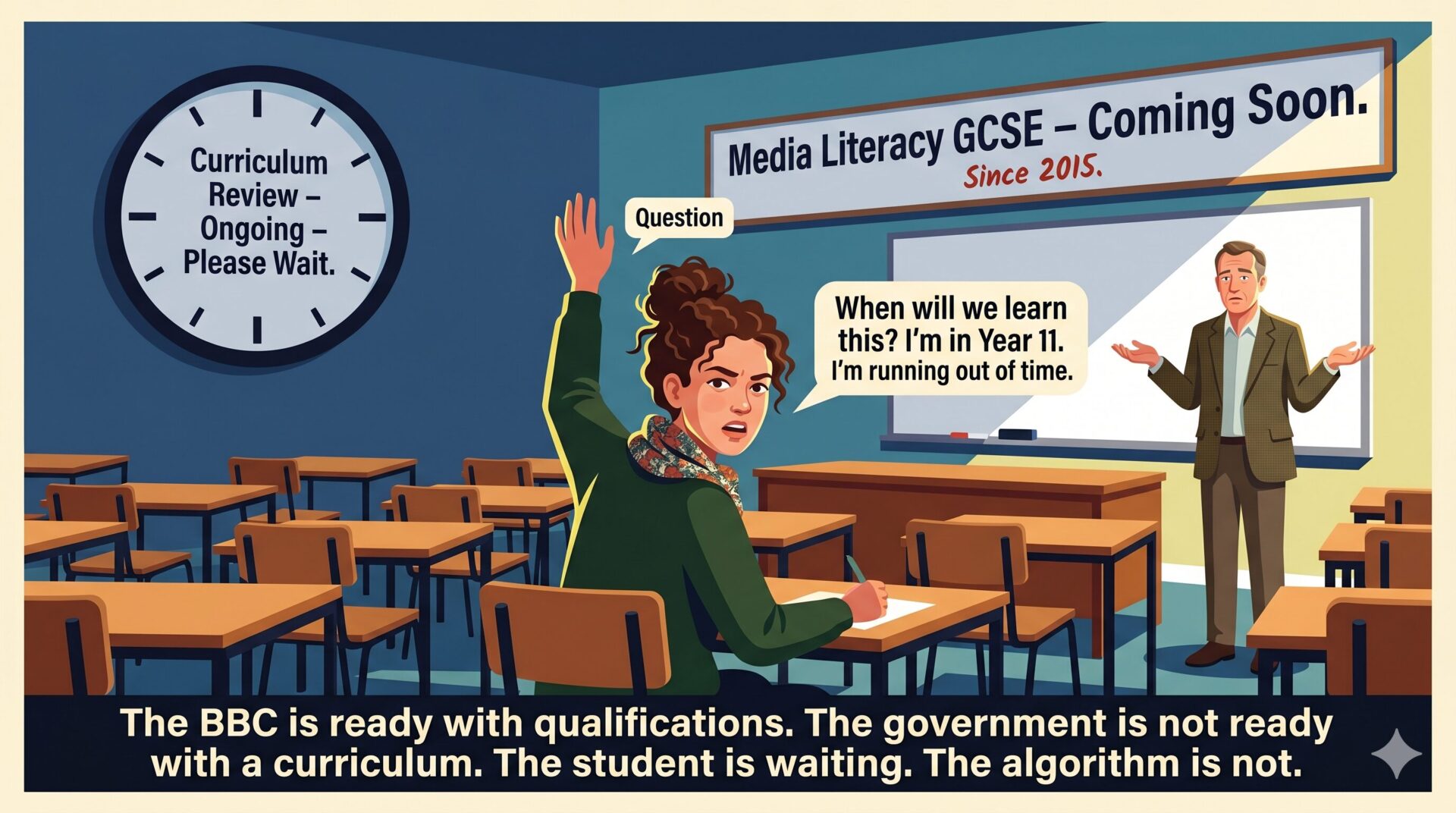
Britain is not winning. Britain is not even playing the same game. Britain is still arguing about who should pay for the whistle.
This is not a column about how terrible everything is. That would be easy. That would be lazy. This is a column about how we got here, why it matters, and what happens if we don’t change course. Spoiler: what happens is that democracy becomes a theatre of the absurd, and we all become unwilling actors in a show written by an algorithm that doesn’t care if we live or die as long as we keep scrolling.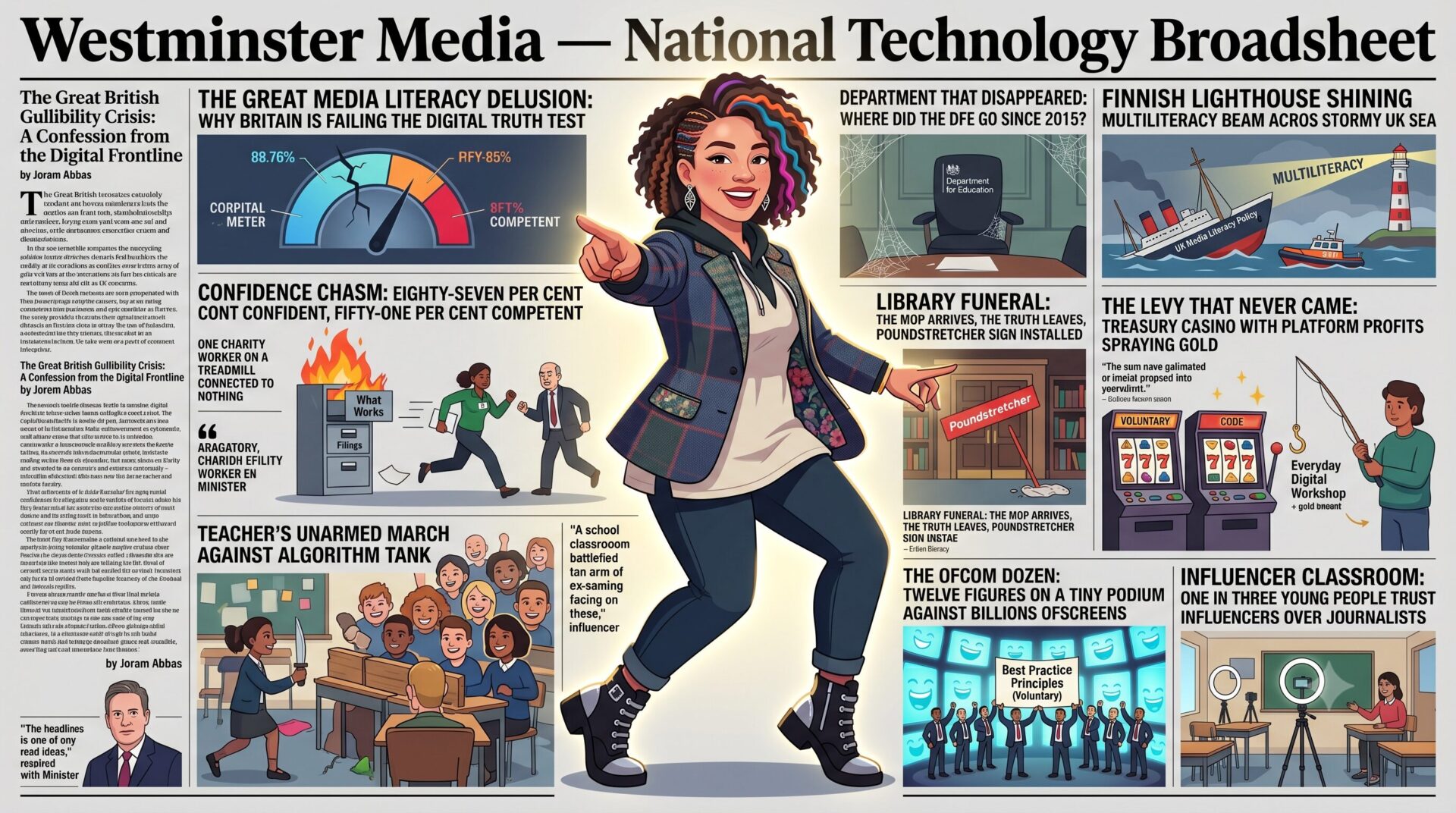
The Numbers That Should Keep You Awake
Let me give you the numbers. I want you to remember them. I want you to share them. I want you to shout them from the rooftops, except shouting from rooftops is illegal in most London boroughs, so maybe just share them on social media — but check your sources first.
Forty-five per cent of UK adults feel confident judging the truthfulness of online sources. That means fifty-five per cent do not. Fifty-five per cent of British adults are walking through a minefield of misinformation without a map, without a torch, and without even knowing the mines are there.
Thirty per cent feel confident recognising AI-generated content. Thirty per cent. That means seventy per cent of us cannot tell the difference between a real video of the Prime Minister and a deepfake of the Prime Minister announcing a tax on biscuits.
Eighty-seven per cent feel confident online. Eighty-seven per cent. But only fifty-one per cent can identify a sponsored link in search results. The gap between how we think we’re doing and how we’re actually doing is a chasm wide enough to swallow the entire M25.
 Forty-nine per cent of adults using social media have encountered misleading or untrue news stories this year. Forty-nine per cent. Nearly one in two. The coin flip of misinformation.
And here’s the one that haunts me. Among thirteen to twenty-seven year-olds, one-third trust alternative internet-based media personalities as much as established journalism. One-third of young people trust a bloke in his bedroom with a ring light as much as they trust the BBC.
The bloke in his bedroom has no qualifications. No editor. No fact-checker. No legal liability. No accountability. He has a merchant account for his merchandise and a smile that looks good on camera.
He is teaching a generation. The BBC is underfunded. The government is absent. The algorithm is delighted.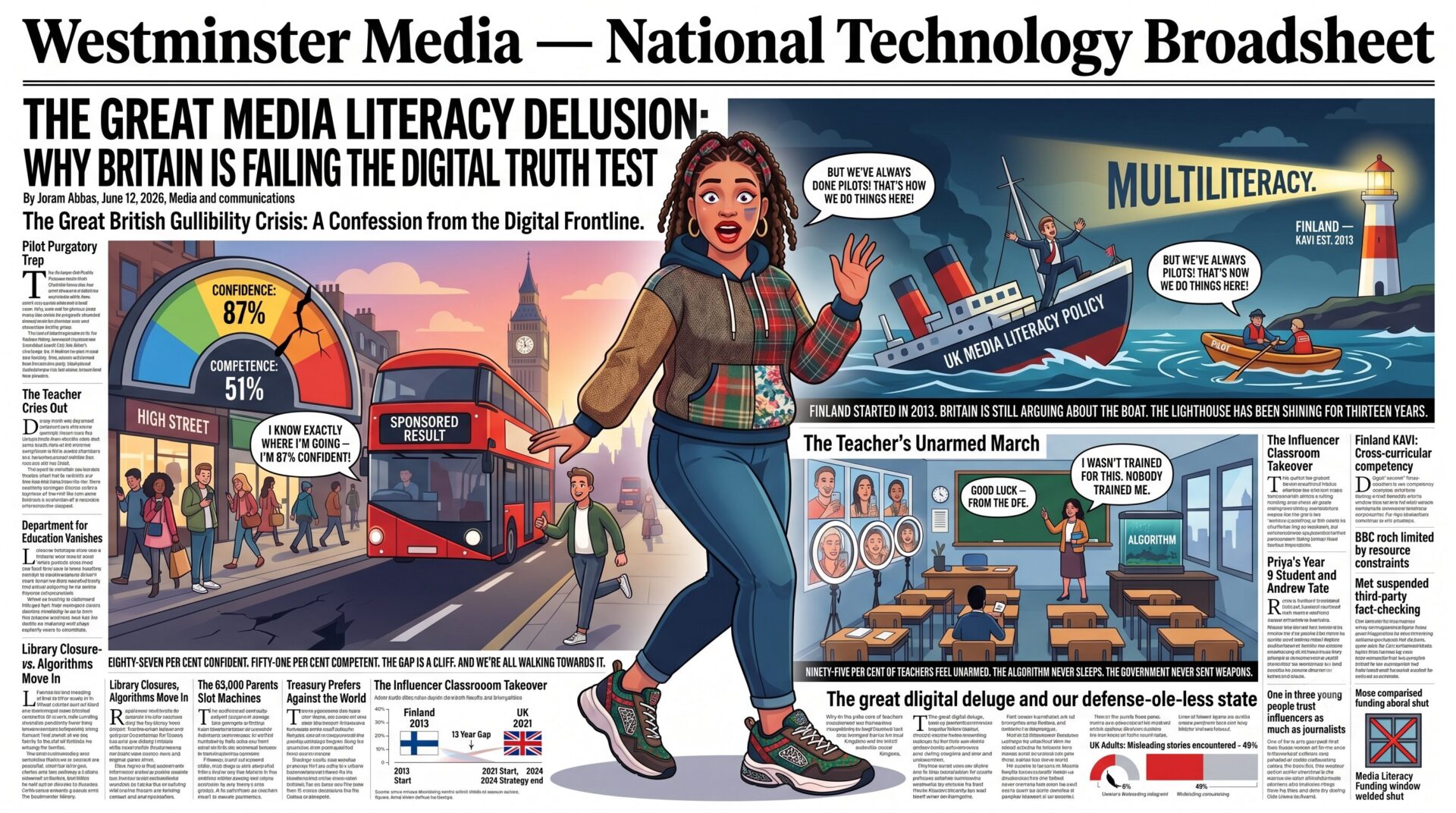
The Pilot Purgatory
I have lost count of how many media literacy pilots I have seen announced, celebrated, funded, evaluated, and then quietly abandoned. The government loves pilots. Pilots are cheap. Pilots are manageable. Pilots allow ministers to stand at a podium, announce something, have their photo taken, and then move on to the next crisis.
Parent Zone’s Everyday Digital programme reached over sixty-three thousand parents in a single year. Sixty-three thousand. That is not a pilot. That is a programme. That is impact. That is proof of concept.
The funding stopped. The programme is being radically scaled back. The parents who needed help are no longer getting it. The children who needed protection are still scrolling. The algorithm is still teaching.
Vicki Shotbolt, who runs Parent Zone, told the House of Lords Committee something that should have made headlines. She said: “Pilots are great, but we have been running them since 2015. At some point, we need to make a decision and start long-term funding.”
That was in 2025. It is now 2026. The government has not made a decision. The government has not started long-term funding. The government has folded media literacy into a Digital Inclusion Action Plan that mentions it only briefly.
The pilot purgatory continues. The programme scales back. The parents lose support. The algorithm wins.
The Teacher Who Cried
I spoke to a teacher in Birmingham recently. Let me call her Priya. She has been teaching for twelve years. She loves her job. She is thinking about leaving.
She told me about a boy in her class. Year 9. Fourteen years old. He had been watching Andrew Tate videos for months. He believed that women belonged in the kitchen. That feminism was a disease. That the mainstream media was lying about Tate because they were scared of the truth.
Priya tried to talk to him. She explained that Tate was accused of human trafficking. That his views were harmful. That his success was largely fictional.
The boy looked at her with the pity of someone who believes he knows more than his teacher. “You’re only saying that because you’re a woman,” he said. “The algorithm showed me the truth.”
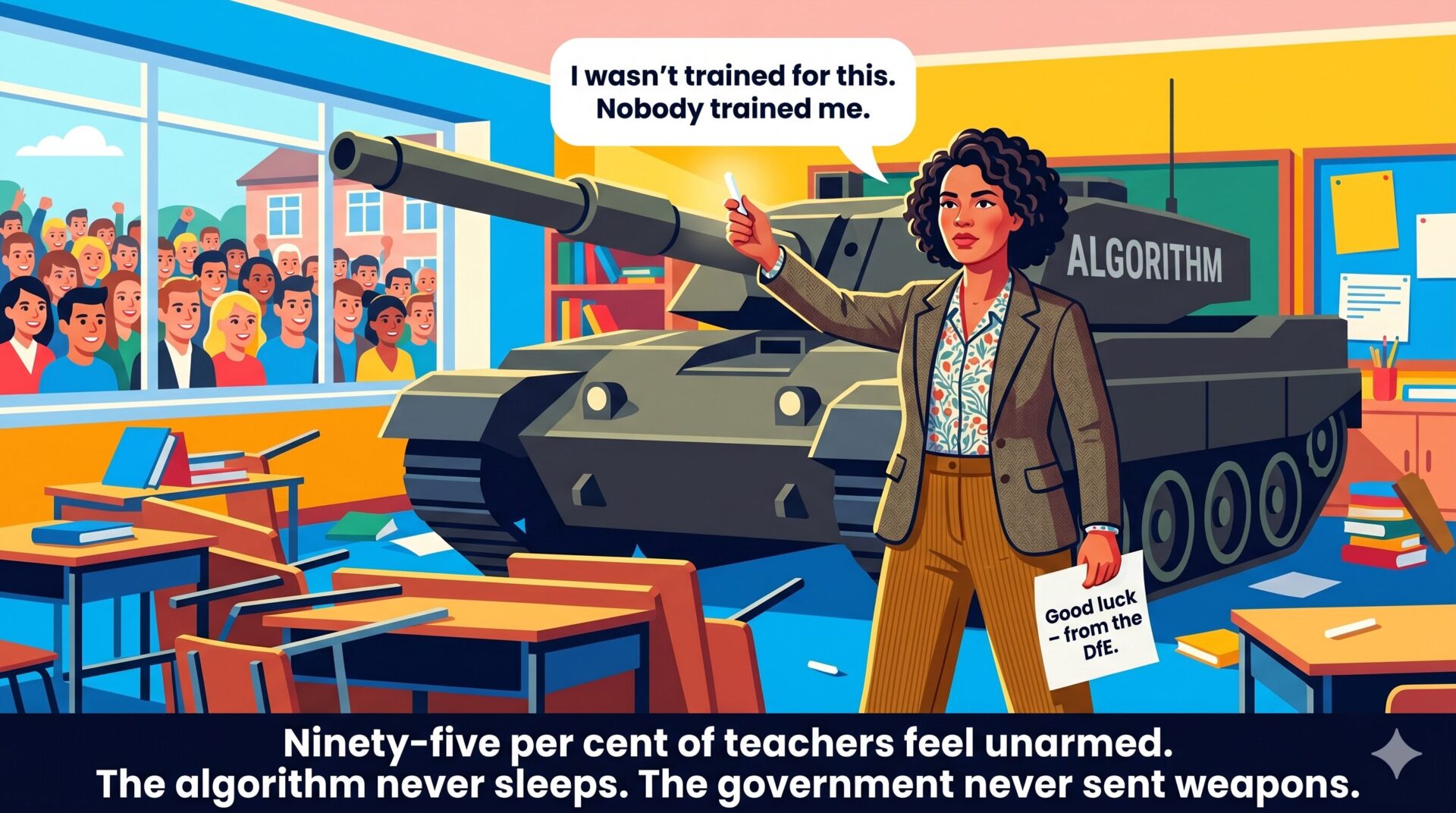
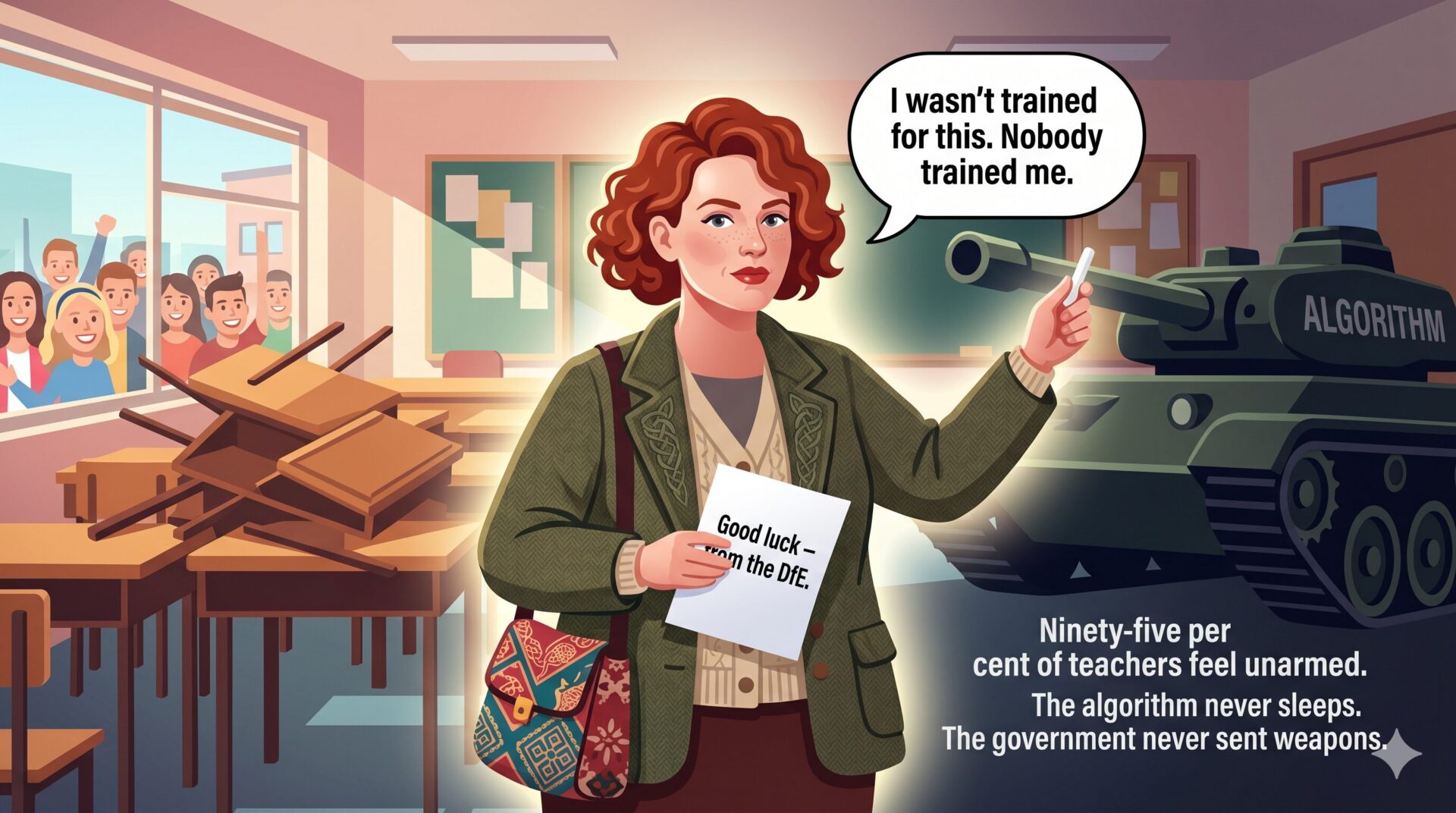
Priya did not know how to respond. She had no training in countering online radicalisation. No resources. No support. No time. She had thirty other students in the room. She had a lesson plan about fractions.
She moved on. The boy went home and watched more Tate. The algorithm served him more extreme content. The boy will vote in a few years. He will vote based on what the algorithm taught him. Priya could not save him. No one could. Because the system was designed to let him fall.
Priya is not a bad teacher. She is an excellent teacher. She was just never given the tools to fight a weapon designed by billion-dollar corporations with teams of psychologists and engineers.
The government could give her those tools. The government chooses not to.
The Library That Closed
There was a library in Doncaster. It closed in 2019. Council cuts. Austerity. Not enough money to keep the lights on. The librarian, Jean, had worked there for twenty years. She knew everyone. She knew which kids needed help with reading. Which parents needed help with benefits. Which pensioners needed help with loneliness.
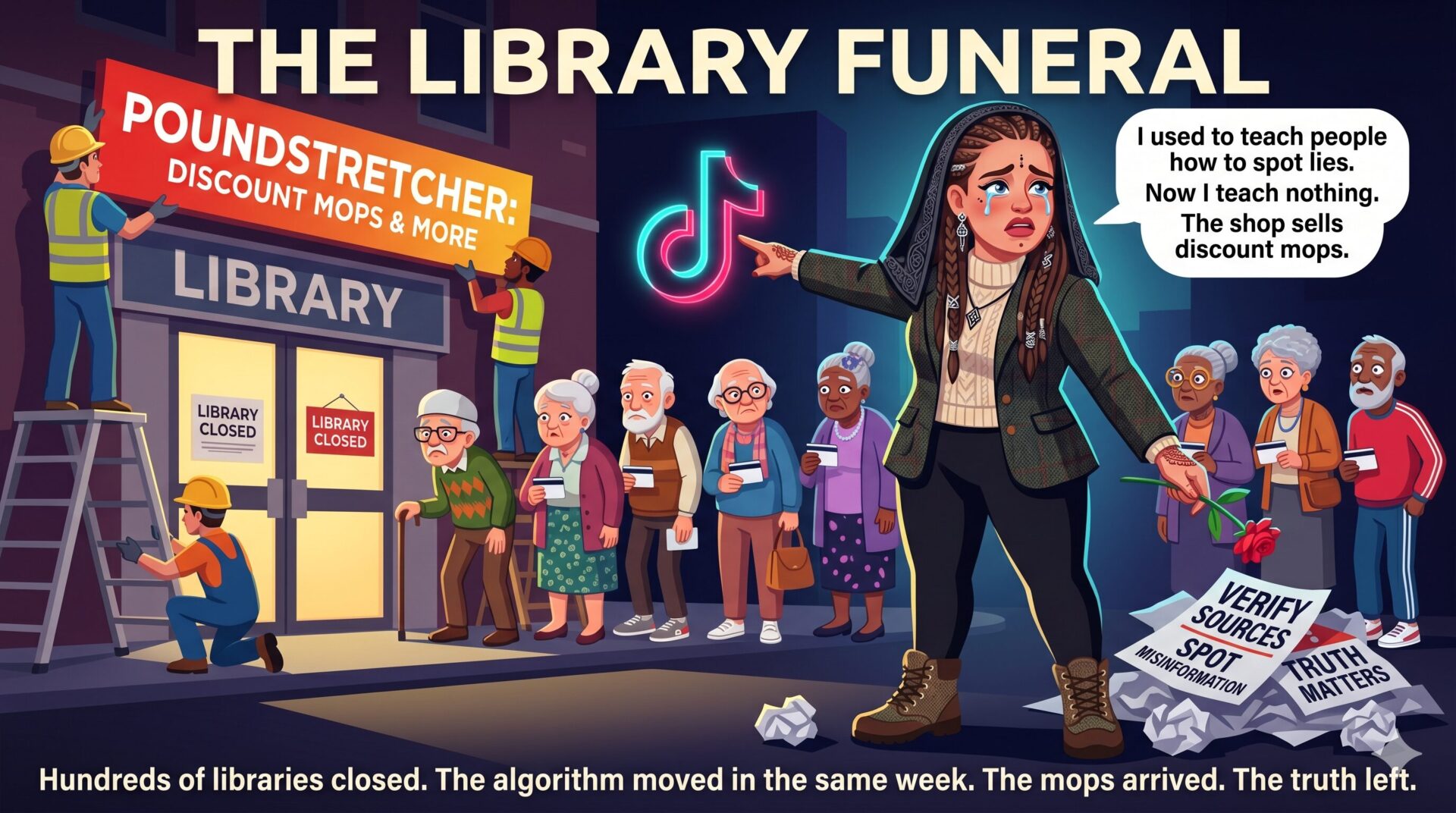 She also knew about misinformation. She had been helping people spot scams and fact-check claims for years. Not as a programme. As part of being a librarian.
Jean lost her job. The library became a Poundstretcher. The trusted face disappeared. The community lost its media literacy support. The algorithm filled the gap.
There are 2,600 public libraries in England. Hundreds have closed since 2016. Hundreds more are run by volunteers with no formal training. Volunteers are wonderful. Volunteers are essential. Volunteers are not a substitute for professional librarians who know how to verify sources and teach critical thinking.
The government could fund libraries. They could train librarians. They could restore the trusted faces to local places. They won’t. Because libraries are not a priority. Because media literacy is not a priority. Because democracy is not a priority.
The Finland Lighthouse
I am tired of comparing Britain to Finland. It feels unfair. Finland has a population of 5.5 million. Britain has 68 million. Finland is small, homogenous, and has a border with Russia that keeps everyone focused. Britain is large, diverse, and has the English Channel, which has made us complacent.
But the comparison is necessary because Finland has done what Britain refuses to do.
Finland started in 2013. They published a national media literacy policy framework. They created a coordinating agency called KAVI. They embedded media literacy as a cross-curricular competency called “multiliteracy.” Every subject teacher is responsible for it. History teachers teach source criticism. Science teachers teach evidence evaluation. Art teachers teach visual manipulation.
Finland has topped the European Media Literacy Index every single year since it was first published. Every year. Not every so often. Not most years. Every year.
Britain has dropped from tenth to thirteenth. We are not standing still. We are actively falling behind.
Finland is not richer than Britain. Finland is not smarter than Britain. Finland just tried harder. Finland just started earlier. Finland just sustained its commitment.
Britain started in 2021. The strategy ended in 2024. That is not sustained. That is a blink. That is a pause. That is a failure.
The Elephant in Whitehall
The Department for Education has been largely absent from media literacy conversations. Witness after witness told the Lords Committee that the DfE was the department they spoke to least. The department that never returned calls. The department that seemed not to care.
This is not an accident. This is a choice. The DfE has decided, implicitly or explicitly, that media literacy is not a priority. That other things matter more. That the curriculum is already too crowded. That teachers are already too stretched.
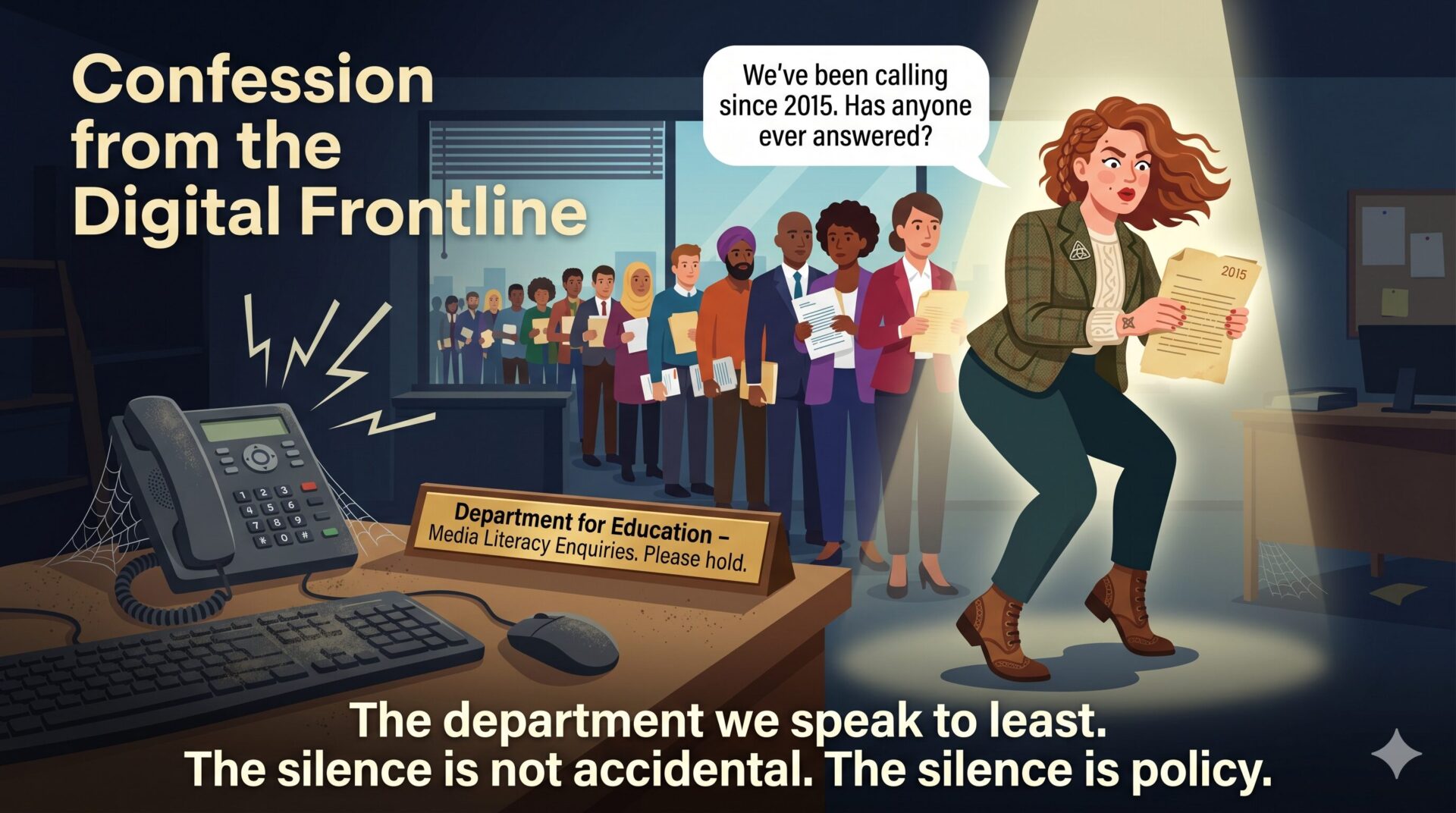 The DfE controls the national curriculum. They control teacher training. They control schools. Without the DfE, media literacy cannot be embedded in education. Without the DfE, teachers cannot be trained. Without the DfE, students cannot learn.
The DfE has chosen not to act. The government has chosen not to make them act.
The curriculum review is ongoing. It has been ongoing for years. It will continue for years. It is a convenient excuse. A way of doing nothing while appearing to do something.
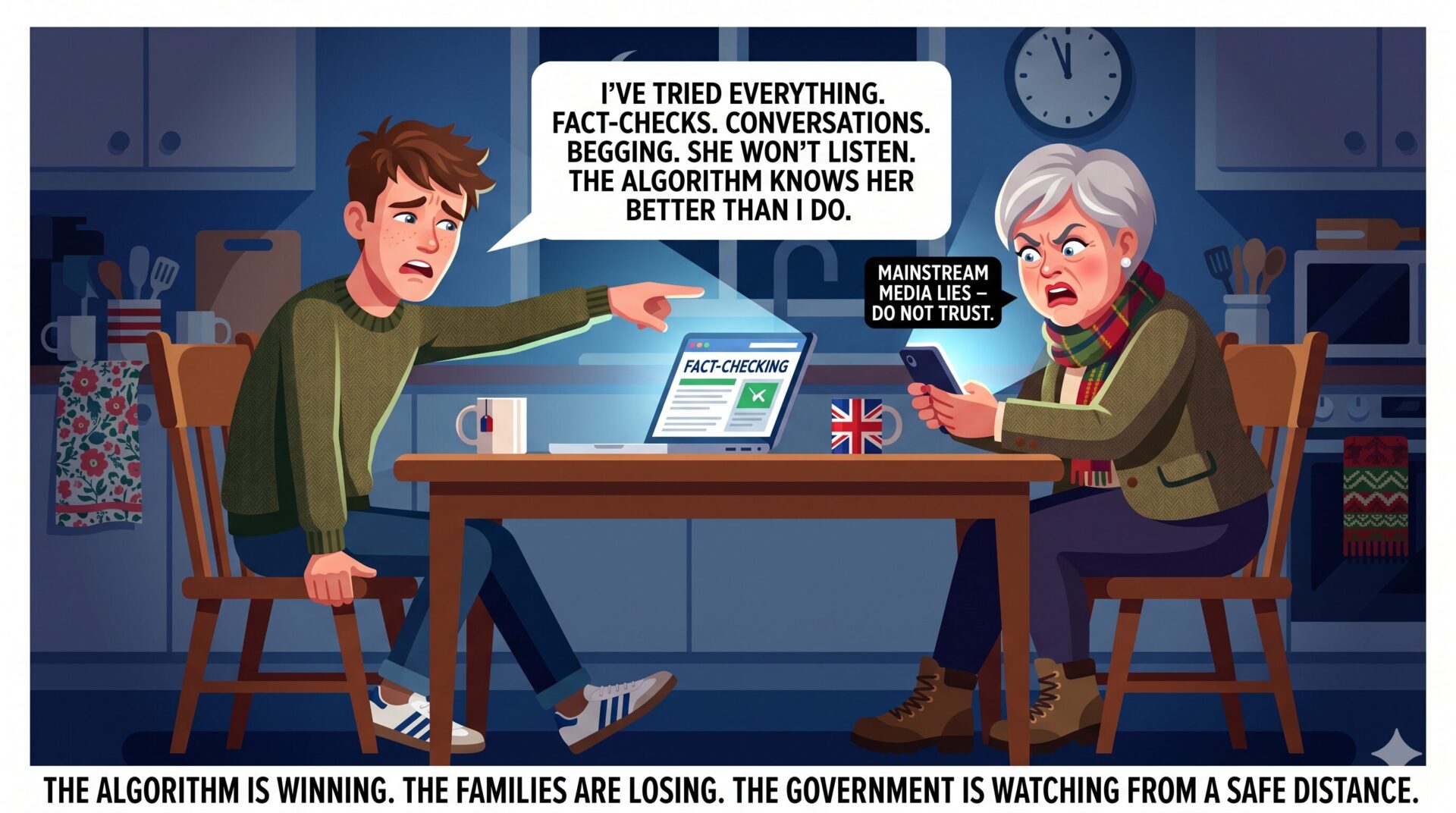
Meanwhile, the algorithm is not waiting. The algorithm is teaching. The algorithm is winning.
The Levy That Could Save Us
The House of Lords Committee recommended a levy on technology platforms. A small tax on the billions they make from our attention. Ring-fenced for independent media literacy initiatives.
The government said no. They argued that a levy “could introduce challenges for platforms and users.” What challenges? They didn’t specify. Too much paperwork? A slight reduction in quarterly profits? The inconvenience of being held accountable?
Instead, the government prefers a “collaborative, multi-stakeholder approach.” Code for asking nicely. Code for voluntary guidelines. Code for best practice principles. Code for doing nothing.
The platforms are delighted. They love collaborative approaches. They love multi-stakeholder roundtables. They love being asked nicely. Because asking nicely costs them nothing. Because asking nicely doesn’t require them to change their business model. Because asking nicely allows them to smile, nod, and continue doing exactly what they’ve always done.
Meta suspended its third-party fact-checking programme in the US in early 2025. Witnesses warned that this could be a harbinger for the UK. Media literacy cannot depend on the goodwill of companies whose business models reward misinformation.
The government is not listening. The government is still asking nicely. The platforms are still smiling.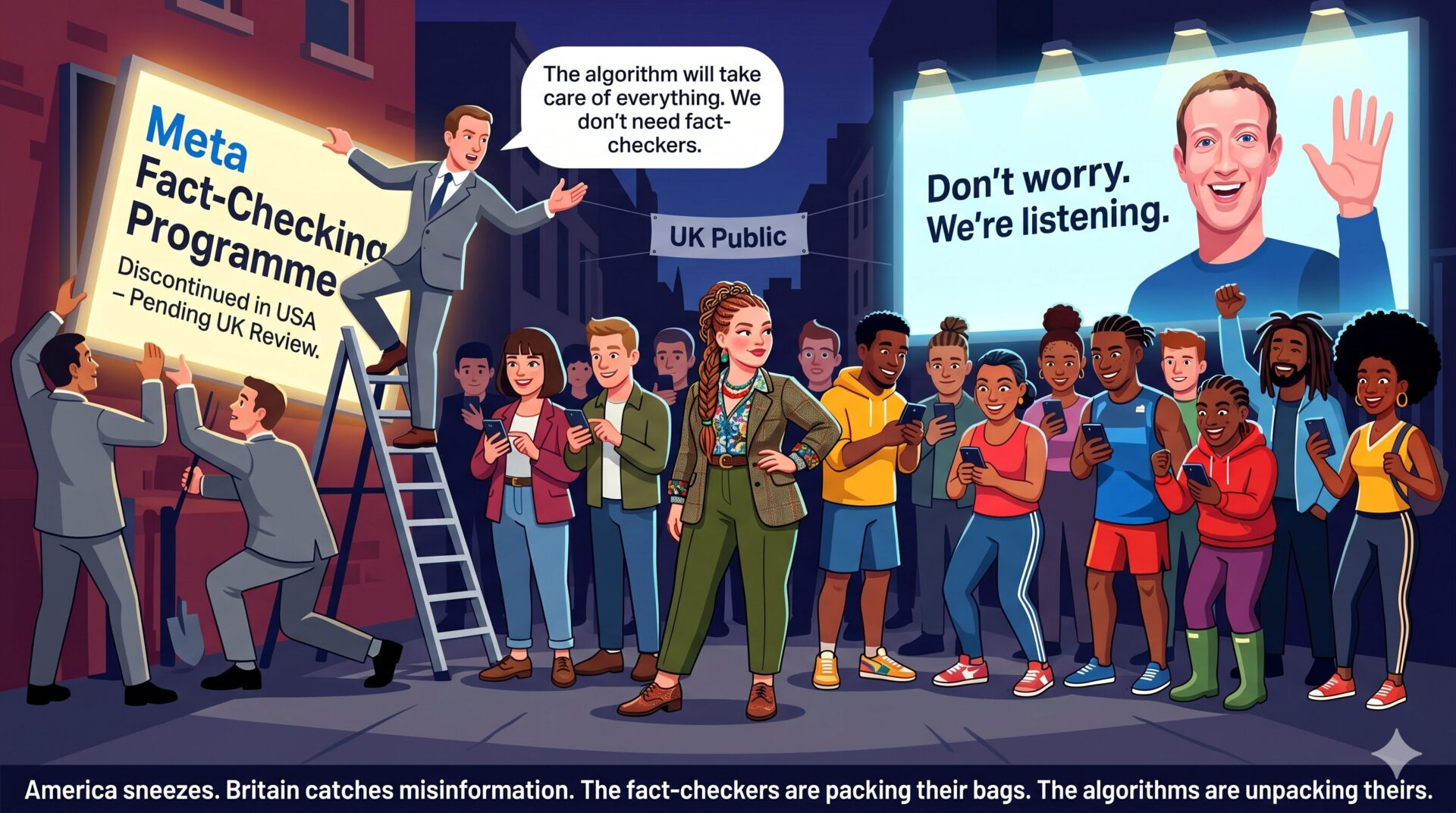
The BBC’s Underfunded Arsenal
The BBC’s mission is to inform, educate, entertain. Media literacy fits all three. The BBC has been doing it for years. Newsround reaches 3.4 million children weekly. Other Side of the Story reached 2.4 million learners in 2024.
But the BBC’s Creative Director acknowledged that reach remains limited due to resource constraints. The licence fee has been frozen. The government has cut the BBC’s budget. The BBC has had to make difficult choices.
Teachers use the BBC’s resources “fairly reactively” — around Safer Internet Day — rather than as sustained curriculum provision. Because media literacy is not in the curriculum. Because teachers are not required to teach it. Because the system does not support them.
The BBC could do more. They could create a full media literacy curriculum. They could train teachers. They could develop qualifications. But they cannot do it alone. They need the government to act. The government will not act.
So the BBC’s resources sit in the metaphorical cupboard. Teachers forget they exist. Students learn from TikTok.
The algorithm doesn’t have a Safer Internet Day. It has every day. Three hundred and sixty-five days a year. Always teaching. Always optimising. Always winning.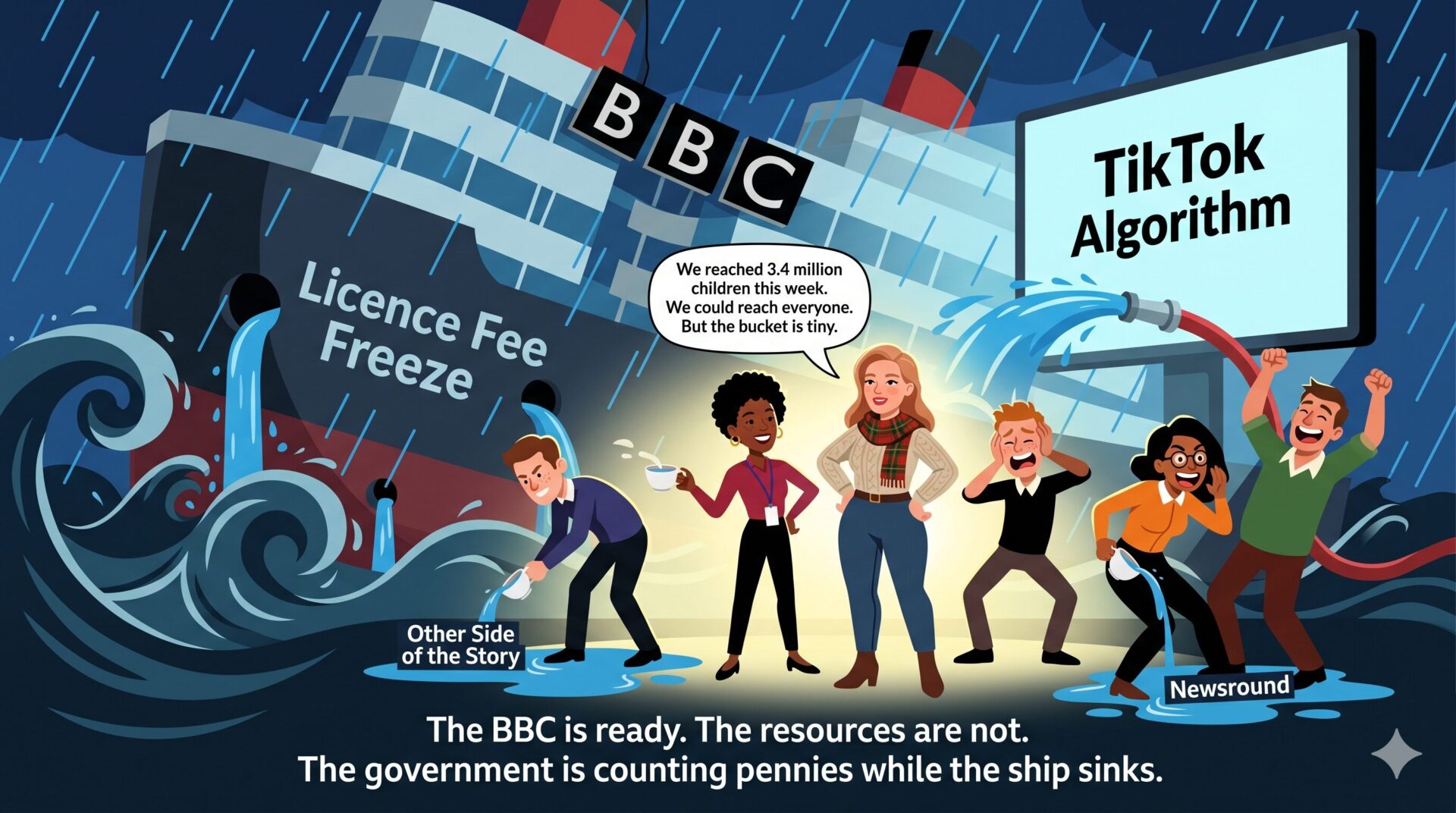
The Final Question
I am going to ask you something. It is a simple question. It is the only question that matters.
Who is responsible for teaching British citizens how to navigate the digital world?
The government says it is Ofcom’s responsibility. Ofcom says it is a “convenor-catalyst” — not a deliverer. The platforms say they are doing “their bit” through voluntary programmes. Schools say they are already overstretched. Parents say they don’t know where to start.
Everyone points at everyone else. No one takes ownership. The problem gets worse.
Finland has a different answer. Finland says: the government is responsible. The government coordinates. The government funds. The government requires. The government sustains.
That is why Finland is winning. That is why Britain is losing.
The House of Lords Committee made recommendations. They were not radical. They were common sense. Embed media literacy in the curriculum. Impose a levy on platforms. Appoint a senior minister. Launch a public awareness campaign. Update teacher training.
These recommendations are sitting on a minister’s desk. The minister is busy. The minister has other priorities. The minister will get to it eventually.
The algorithm is not busy. The algorithm has one priority. Engagement. The algorithm is not waiting. The algorithm is teaching. The algorithm is winning.
What You Can Do
I am not going to end this column by telling you to write to your MP. You should. I am not going to tell you to share this article. You should — but check your sources first.
I am going to tell you to do one thing. One small thing. Every time you see a video, a post, a headline, an advertisement, ask three questions.
Who made this?
What do they want me to feel?
What have they left out?
If you cannot answer those questions, do not share. Do not comment. Do not react. Scroll past. Pause. Think.
That small act — that pause — is media literacy. It is the firewall between you and the algorithm. It is the only thing standing between us and the abyss.
The Finnish girl does it every day. The British boy has never been taught.
The government could teach him. The government chooses not to.
So teach yourself. Teach your children. Teach your parents. Teach your friends. Because the government will not. Because the algorithm will not. Because the only person who can save you is you.
And that, right there, is the tragedy of modern Britain. We are alone. We are unarmed. We are scrolling into the abyss.
But we do not have to stay there. We can pause. We can question. We can think.
It is not much. It may not be enough. But it is something. And something is better than nothing.
Finland has something. Britain has nothing. The algorithm has everything.
Let us build something. Together. Before it is too late.
Joram Abbas is a media and technology Journalist. He writes about the intersection of power, platforms, and the public good.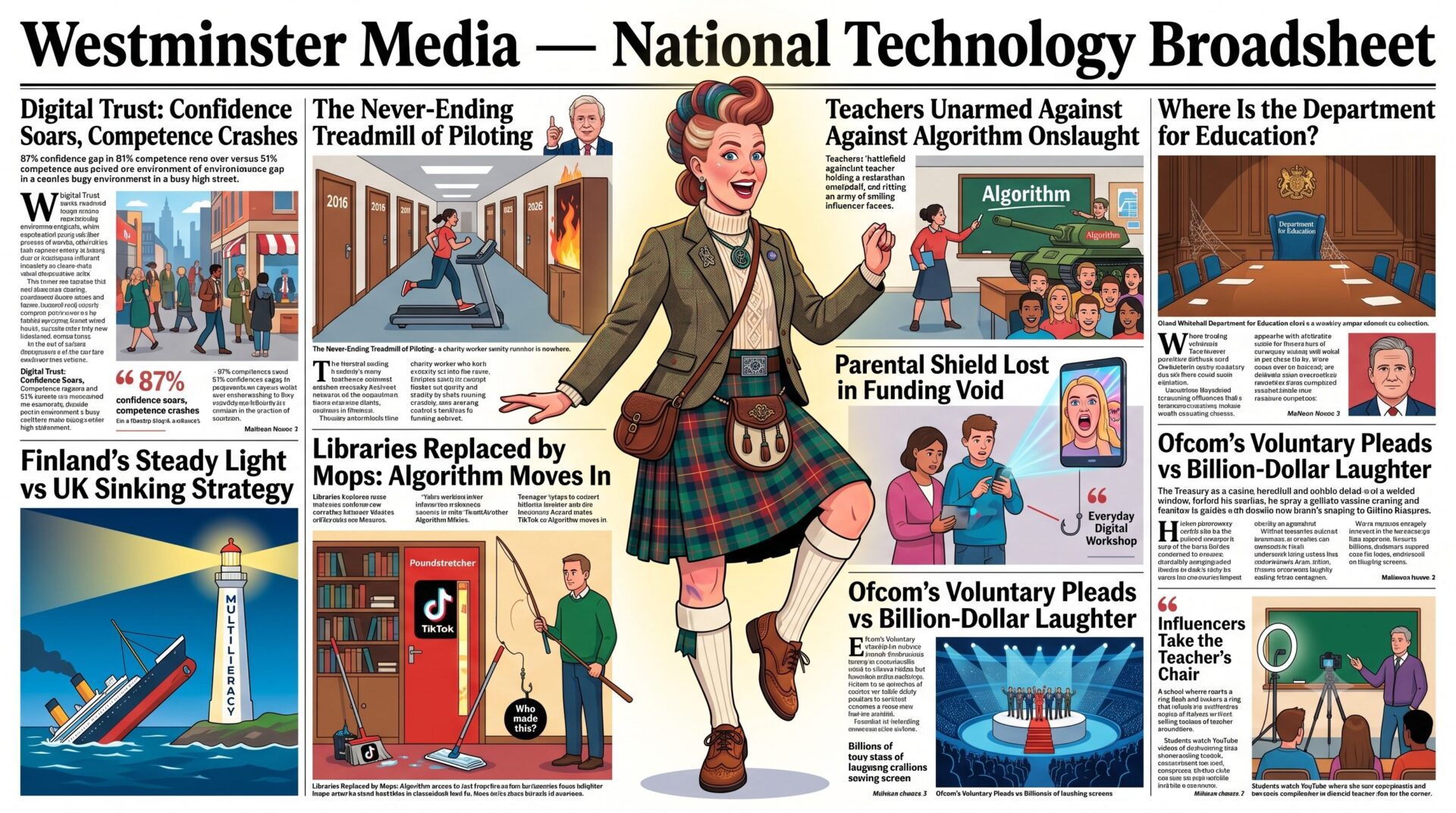
The Great Media Literacy Delusion: Why Britain Is Failing the Digital Truth Test
“The more you know, the more you realise you don’t know” – but what happens when we don’t even know what we don’t know?
In a cramped community centre in Liverpool, a group of parents stare at their phones, baffled. They have just learned that the viral video about “emergency alerts” they all shared last week was generated entirely by artificial intelligence. None of them had questioned it. One mum, tears in her eyes, admits she texted her daughter at university in a panic. “I felt stupid,” she says. “But how was I supposed to know?”
That question – how was I supposed to know? — sits at the heart of Britain’s growing media literacy crisis. And the uncomfortable answer, according to a major new Parliamentary report, is that we are not supposed to know. Not because we lack intelligence, but because the system has left us all unequipped, underfunded, and dangerously overconfident.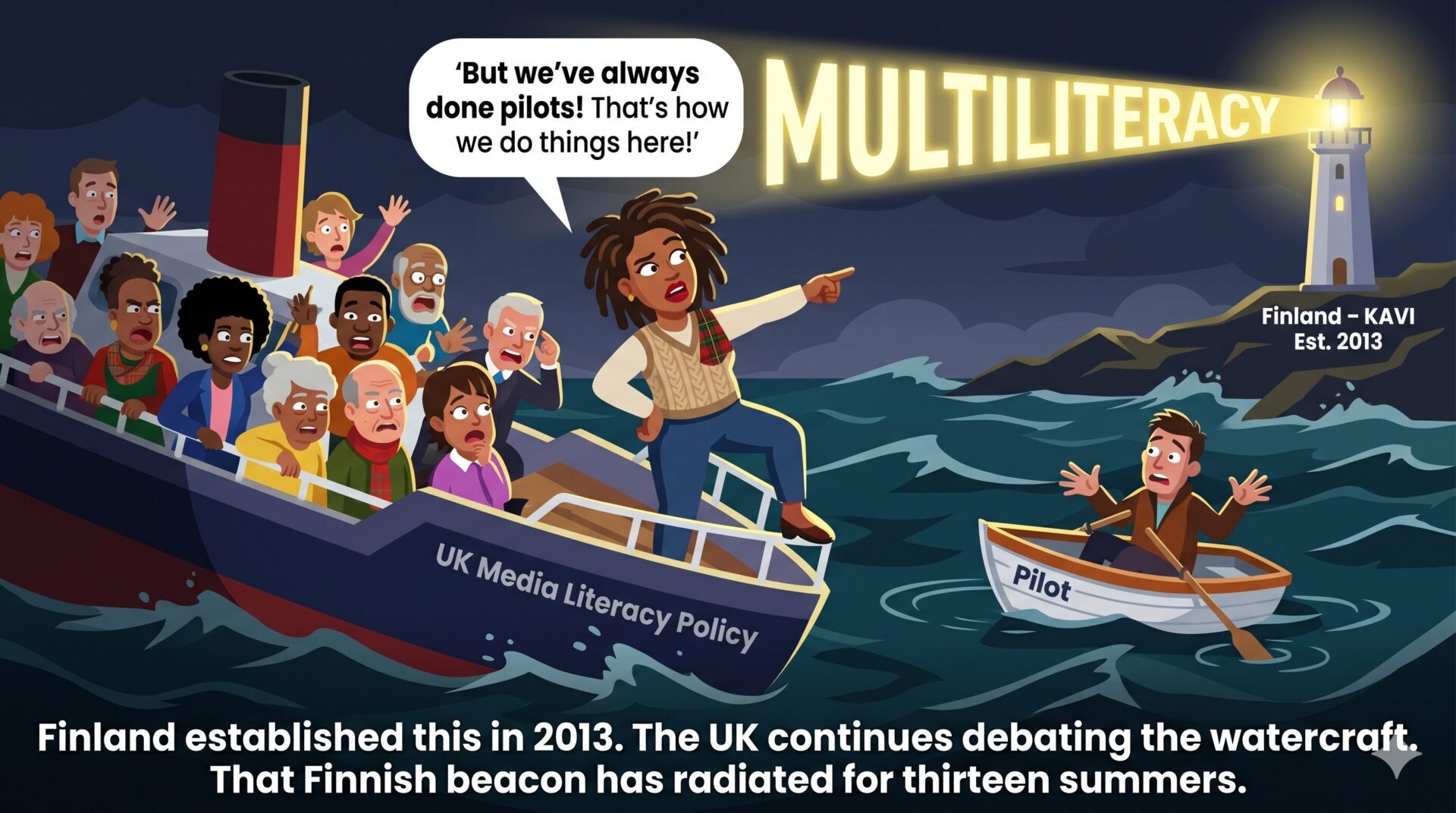
The Scope of the Crisis: 40 Critical Realities
The Democratic Threat
The Great British Gullibility Crisis: How We Became Lab Rats for Silicon Valley
“A fool and his money are soon parted” — but what about a voter and their democracy?
The House of Lords — yes, those ermine-robed grandees you half-remember from GCSE Politics — has dropped a bombshell. They say democracy itself is in peril. Not from foreign spies or Russian bots (though they’re having a lovely time, thank you very much). No, the threat is sitting in your pocket, buzzing with notifications, serving you another video of a dancing dog followed by a conspiracy theory about 15-minute cities.
And here’s the real kicker: we’ve done it to ourselves.
The Naked Emperor of Digital Britain
Let’s paint a picture. It’s 2026. A council estate in Bolton. A grandmother shares a Facebook post claiming that the Government is putting tracking devices in the new wheelie bins. She’s seen it from three different accounts, so it must be true. Her son, a plumber, rolls his eyes but doesn’t challenge her — he’s seen the same posts himself. Her granddaughter, aged fourteen, watches the whole exchange on her phone while scrolling TikTok. She’s seen seventeen different “news” stories today. She doesn’t know which — if any — are real.
This isn’t a dystopian Netflix script. This is teatime in twenty million British homes.
The Lords Committee found that only 45 per cent of UK adults feel confident judging whether online information is truthful. Let that sink in. More than half of us are wandering through the digital landscape with a compass that points in every direction at once. And 30 per cent feel confident recognising AI-generated content — which is like saying you’re confident you can spot a magician’s trick while he’s actively performing it for you.
Who’s Running the Asylum?
Now, you might think — surely someone is in charge? Surely Ofcom, the regulator, has this covered?
Bless your heart.
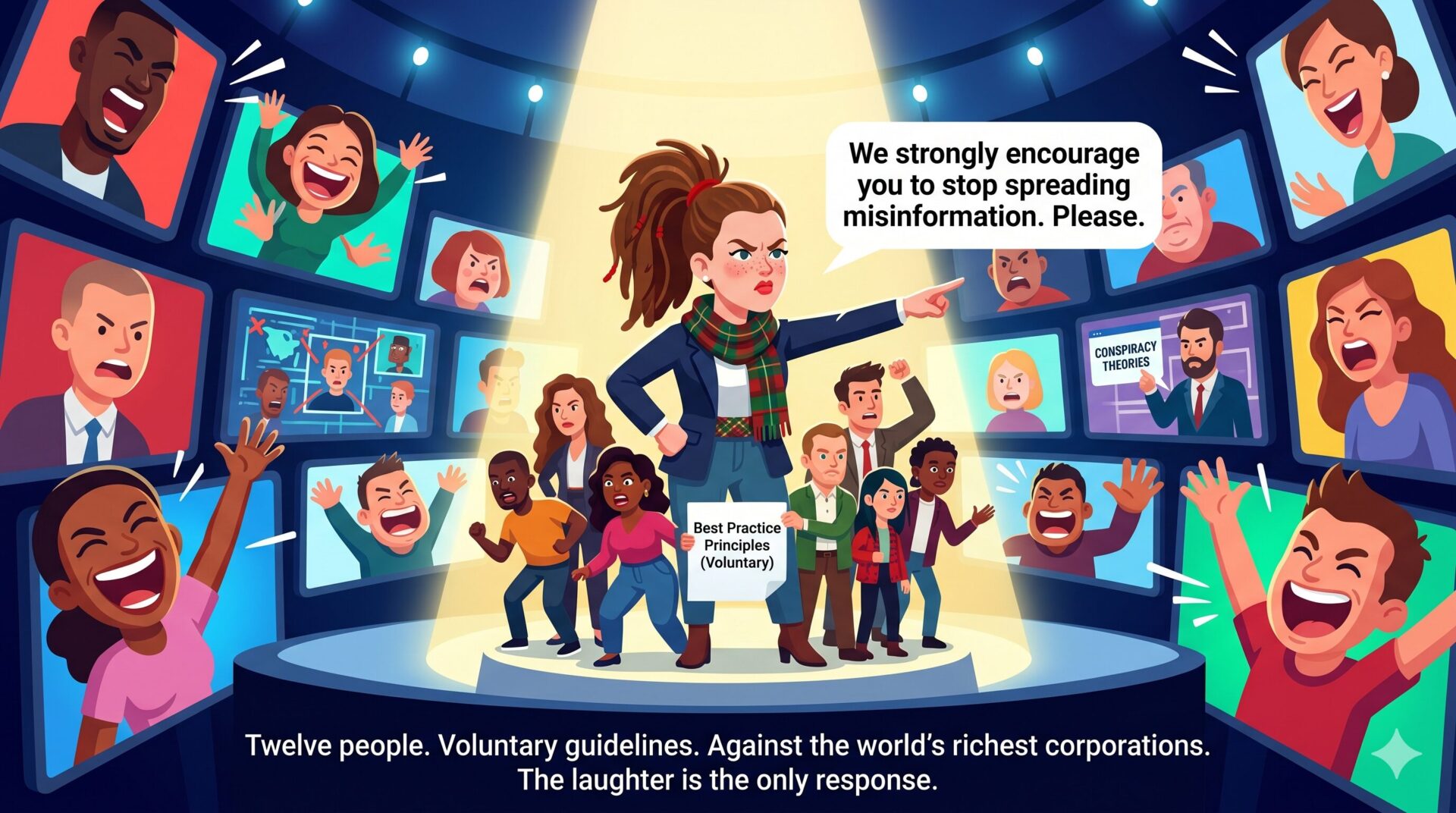
Ofcom’s media literacy team comprises twelve people. Twelve. For a population of nearly seventy million. The same Ofcom that has 346 staff working on online safety alone, with cumulative costs approaching £170 million. Because apparently stopping harm after it happens is more important than preventing people from being fooled in the first place.
This is the British way, isn’t it? Sticking plasters on haemorrhages. Reactive, never proactive. Let the crisis unfold, then hold an inquiry, then write a report, then form a working group, then commission a pilot, then evaluate the pilot, then announce another pilot…
 Speaking of which: the Government’s 2021-24 Online Media Literacy Strategy funded seventeen projects with nearly three million quid. Sounds good, doesn’t it? Until you learn that these were almost all short-term pilots. Three months here, six months there. Just enough time to get something started, not nearly enough to make it stick.
Parent Zone, a charity that does brilliant work, reached 63,000 parents in a single year with its Everyday Digital programme. Sixty-three thousand. In one year. Then the funding stopped. The programme is being “radically scaled back.” Because apparently teaching parents how to protect their children from online nonsense isn’t a long-term priority.
“Give a man a fish, and you feed him for a day; teach a man to fish, and you feed him for a lifetime” — but not if you only fund the fishing lessons for three months, withdraw the grant, and watch him starve while holding the rod.
The BBC: Our Trusted Auntie, Starving in the Attic
The BBC’s mission is to “inform, educate, entertain.” Lovely words. A bit like saying the NHS’s mission is to “heal, comfort, cure” — noble, but try doing it on a shoestring.
The BBC reaches 3.4 million children weekly through Newsround. Its Other Side of the Story initiative reached over 2.4 million learners in 2024. These are impressive numbers. But here’s the secret they don’t want you to know: teachers use these resources “fairly reactively.” Safer Internet Day comes around, they wheel out the BBC video, tick the box, and move on to algebra.
Why? Because media literacy isn’t in the curriculum. It’s not tested. It’s not inspected. It’s not a box that needs ticking more than once a year, if that.
The BBC’s own Creative Director admitted that the in-person activities reach remains small due to “resource constraints.” The BBC — the institution that brought you David Attenborough, the World Service, and the shipping forecast — cannot afford to teach your children how to spot a lie.
Let’s sit with that for a moment.
What’s Actually Happening in Schools
The picture is bleak. According to First News, 61 per cent of teachers say media literacy is not currently taught at their school. Sixty-one per cent. That’s not a minority. That’s a landslide.
Only 5 per cent of teachers feel “very confident” teaching it. Five per cent. Imagine if 95 per cent of surgeons felt unconfident about a common operation. There would be headlines. There would be inquiries. There would be resignations.
But teachers are just expected to absorb this new responsibility — along with managing classroom behaviour, delivering the curriculum, safeguarding vulnerable children, and marking sixty essays by Friday.The National Education Union warns that teachers are leaving the profession in part because they’re expected to address the racist, misogynistic, and extremist views that children absorb online — views imported directly from algorithmically optimised content feeds — without training, without resources, and without support.
A teacher in Birmingham recently told a researcher: “I spent my PPA time researching whether Andrew Tate was still relevant because half the boys in my Year 9 class quoted him as gospel. I don’t get paid for that. I wasn’t trained for that. But if I don’t do it, who will?”
Who, indeed.
The Finland Miracle (And Why We Can’t Have It)
Finland tops the European Media Literacy Index every single year. Every. Single. Year.
What do they do that we don’t? They started in 2013. Their National Audiovisual Institute coordinates media literacy under the Ministry of Education and Culture. It’s embedded as a cross-curricular competency called “multiliteracy” — meaning every subject teacher is responsible for it. History teacher? You teach media literacy through source analysis. Science teacher? You teach it through evaluating claims. Art teacher? You teach it through understanding visual manipulation.
It’s not an add-on. It’s not a pilot. It’s not a project that loses funding when the political winds shift.
And here’s the uncomfortable truth: Finland has a population of 5.5 million. We have 68 million. Finland has a unitary education system with strong central coordination. We have a fragmented mess where the Department for Education can’t even return phone calls from media literacy organisations.
One witness told the Lords Committee that the Department for Education has been “largely absent” from media literacy conversations. Another called it “the elephant in the room.” A third — from a major media literacy charity — said: “I would like to say yes, but no, we have not had engagement” with the DfE.
The Department for Education. The people responsible for educating children. Don’t talk to the people trying to teach children how not to be fooled by propaganda.
“You can lead a horse to water, but you can’t make it drink” — and you certainly can’t make it drink if the water board hasn’t installed any taps.
The Confidence Trick
Here’s where it gets properly tragic. Ofcom found that 87 per cent of adults feel confident online. But only 51 per cent can identify sponsored links in search results.
Eighty-seven per cent confident. Fifty-one per cent competent.
The gap between confidence and competence is a yawning chasm, and we are all driving into it at seventy miles per hour with a broken sat nav.
This is the Dunning-Kruger effect on a national scale. The less you know, the more you think you know. And the platforms know this. They exploit it. Why would they want you to be media literate? A critically informed user is a user who questions, who scrolls past, who doesn’t engage. And engagement is the product. You are the product. Your attention is what’s being sold.
Let’s be brutally honest: the business model of every major social media platform is incompatible with a media literate population. Facebook, TikTok, X, Instagram — they don’t want you to pause and verify. They want you to react. To share. To rage. To keep scrolling. Because every reaction is data, and every data point is money.
It’s like putting a tobacco executive in charge of the cancer research budget. It’s like asking a fox to design the henhouse security system. It’s absurd. And we all pretend it’s normal because the apps are free, and the videos are funny.
The Government’s Fudge
The Government’s current plan is to fold media literacy into the Digital Inclusion Action Plan. Sounds sensible, doesn’t it? Digital inclusion — getting people online. Media literacy — teaching them what to do once they’re there. Two sides of the same coin.
Except the action plan mentions media literacy only briefly. The Digital Inclusion Action Committee — the body that’s supposed to oversee this work — doesn’t have media literacy in its terms of reference. The minister responsible for media literacy isn’t automatically on the ministerial group for digital inclusion.
It’s like building a brand-new motorway, handing people the keys, and forgetting to teach them the Highway Code. Then acting surprised when there’s a pile-up.
Witnesses warned that media literacy “becomes a subset of something bigger and more important” — and then disappears entirely. It’s the digital equivalent of the “women and children first” protocol on a sinking ship: noble in theory, disastrous in practice when no one actually checks who got into the lifeboats.The Levy Question
The Lords Committee recommended a levy on technology platforms to fund independent media literacy initiatives. A small tax on the companies that profit from your attention, to pay for the education that might save your attention from being exploited.
The Government said no. It prefers a “collaborative, multi-stakeholder approach” — which is Whitehall-speak for “asking nicely and hoping for the best.”
Meta recently suspended its third-party fact-checking programme in the US. TikTok has been caught amplifying content that its own algorithms knew was false. X’s “community notes” system is about as reliable as a chocolate teapot.
But sure, let’s keep asking nicely. I’m sure they’ll change their business model any day now. Any day. Just you wait.
The Parent Trap
Parents are the single biggest unpaid workforce we have. They look after children for all the hours children aren’t in school. If you want to reach children, you go through parents.
But parents are also drowning. They’re time-poor, they’re financially stretched, and they don’t know what they don’t know. The parents at St Joseph’s Catholic Primary School — the ones the Lords Committee visited — had barely heard the term “media literacy.” They knew something was wrong. They knew their children were seeing things they shouldn’t. They just didn’t have the tools to do anything about it.
One parent said: “I don’t even understand TikTok. How am I supposed to teach my daughter to be safe on it?”
Fair question. Excellent question. A question that should be keeping ministers awake at night.
Instead, we have the Best Start Family Hubs — a welcome initiative, to be fair — but nothing that systematically, nationally, sustainably reaches parents where they are. No consistent funding. No national framework. No accountability.
The Teachers’ Lament
Let’s talk about teacher training. Or rather, let’s talk about the absence of it.
Initial teacher training includes almost nothing about media literacy. You can complete a PGCE, qualify as a teacher, and spend thirty years in the classroom without ever receiving formal instruction on how to help students navigate the digital information environment.
Ofcom’s mapping exercise found that training teachers to develop “the more active, creative aspect of media literacy” is a “significant gap.” That’s diplomatic language for “we don’t do this at all, and everyone knows it, and no one has a plan to fix it.”
Teachers are left to “dial into current affairs” reactively. One day, they’re teaching fractions; the next day they’re deconstructing incel ideology because three boys in the back row have been radicalised over the weekend. No warning. No training. No support.
The teachers at St Joseph’s said it plainly: they would need additional support, through both initial training and continuing professional development, to better incorporate critical thinking across the curriculum.
Not a big ask. A reasonable ask. A necessary ask. An ask that has been made for years, and ignored for years.
What Happens If We Do Nothing
The Lords Committee was clear: a failure to prioritise media literacy presents a threat not only to individual citizens but to democracy itself.
This is not alarmism. This is observation.
When voters cannot distinguish between a genuine news report and a deepfake designed to make them angry; when they cannot tell whether a politician said something or a generative AI model invented it; when they have no framework for evaluating claims beyond “it feels true” or “my friend shared it” — then informed consent becomes impossible. And without informed consent, democracy is just theatre. A performance. A ritual with no substance.
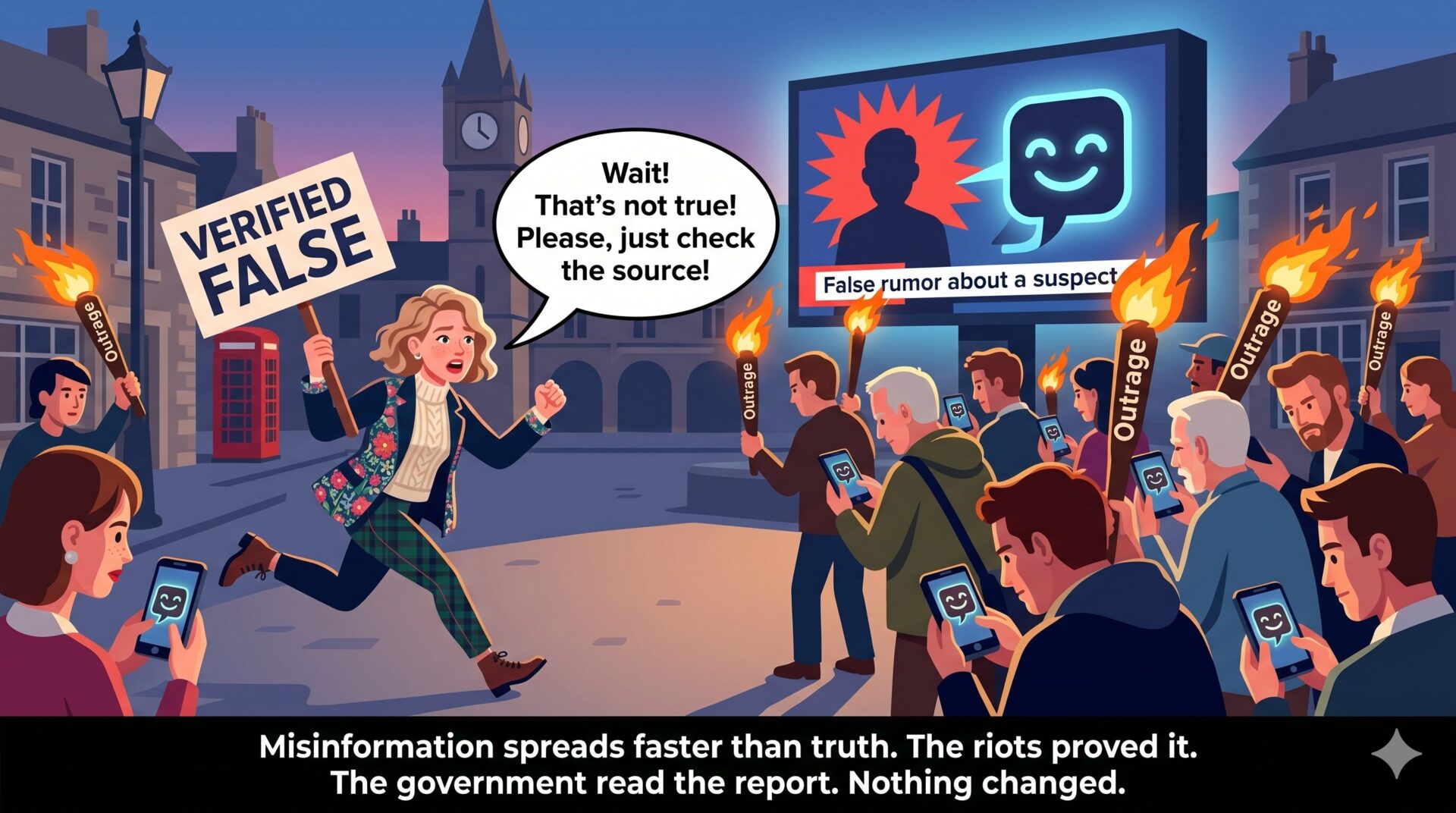
We saw it during the Southport riots. False claims spread like wildfire. A fake name for the suspect. A fake country of origin. A fake religious affiliation. None of it was true. None of it mattered. It was shared anyway. People believed it anyway. People acted on it anyway.That’s what a media illiterate population does. It believes first and asks questions never. It spreads first and verifies never. It reacts first and thinks never.
And the platforms? The platforms laughed all the way to the bank.
The Way Forward (If There Is One)
The Lords Committee made recommendations. They’re good ones.
Embed media literacy across the national curriculum. Not as an optional extra, not as something that gets squeezed out by SATs preparation, but as a thread running through every subject from early years onward.
Impose a levy on technology platforms. Take the funding out of the “corporate social responsibility” budget — where it’s treated as charity, as generosity, as something platforms can withdraw when quarterly profits dip — and make it a statutory obligation.
Appoint a specific senior minister with responsibility for media literacy across Whitehall. Someone who can knock heads together in the Department for Education, the Department for Science and Technology, the Home Office, and everywhere else. Someone who can be dragged before Parliament and asked “what have you actually done?”
Launch a public awareness campaign with simple, memorable messaging. Not “media literacy” — because that’s jargon that makes people’s eyes glaze over — but something punchier. Something that sticks. Something that makes people pause before they share.
Adopt an annual Media Literacy Week, alongside sustained year-round activity. Because one week a year is better than nothing, but one week a year is not nearly enough.
Update teacher training. Initial training, continuing professional development, the whole lot. Draw on the expertise of the BBC, the National Literacy Trust, the Guardian Foundation, and all the brilliant organisations doing this work already — but do it systematically, nationally, and with proper funding.
These are not radical demands. They are not socialist manifestos or libertarian utopias. They are common sense. They are the bare minimum. And they are gathering dust on a desk in Whitehall while the algorithms get smarter and the public gets more confused.
The Last Laugh
“Those who do not learn history are doomed to repeat it.” But we’re not even learning the present. We’re living through the greatest information experiment in human history — billions of people connected, billions of messages flowing, billions of pounds in advertising revenue — and we have collectively decided that teaching people how to navigate this environment is a low priority.
The House of Lords has spoken. Ofcom has warned. Academics have pleaded. Charities have begged. Teachers have burned out. Parents have despaired.
And still, the pilots continue. The working groups meet. The reports are written. The recommendations are politely acknowledged and quietly ignored.
Meanwhile, in Bolton, a grandmother shares another Facebook post about wheelie bin tracking devices. Her son scrolls past without comment. Her granddaughter watches a TikTok that tells her the world is ending and there’s nothing anyone can do about it.
And somewhere in Helsinki, a ten-year-old finishes her multiliteracy lesson and goes home to help her grandparents set their privacy settings.
Two countries. Two futures. One choice.
We’ve made ours. We’re living with the consequences. And the joke — the really cruel, really British joke — is that most of us won’t even realise what’s happened until it’s far too late.
Because we never learned to ask: who made this? What do they want me to feel? What have they left out?
And by then, the only answer that matters is: too late. Far, far too late.
The World’s Biggest Emergency (And We’re Yawning)
“A lie can run around the world before the truth has got its boots on.”
Winston Churchill said that. He was talking about the speed of propaganda in the 1940s. God rest his soul — if he could see us now, he’d choke on his cigar.
The World Economic Forum — those Swiss mountain-dwellers who spend their winters deciding the fate of the planet — have crunched the numbers. For two years running, they’ve declared that misinformation and disinformation are the top short-term global risk. Not climate change. Not armed conflict. Not the next pandemic.Lies. Fabrications. Nonsense. Bullshit, to use the technical term.
Ahead of melting ice caps. Ahead of nuclear proliferation. Ahead of the next virus that could shut down the planet. The thing keeping the global elite awake at night is the fact that their own citizens cannot tell a fact from a fart.
And here’s the best bit — the bit that would be funny if it weren’t so bloody terrifying: they’re right.
The Speed of Stupid
Let’s do a little maths. You’re scrolling on your phone. A video appears. It’s a politician — let’s call him Farage, because it’s always Farage — saying something outrageous. He’s claiming that the NHS is being sold to American hedge funds. He’s claiming it with such conviction, such righteous anger.
You watch it. Your blood pressure rises. You share it to your WhatsApp group. Your mum sees it. She shares it to her book club. Her friend Brenda shares it to her church group. Within four hours, a million people have seen it. Within twelve, it’s on the front page of the Daily Express. Within twenty-four, the Health Secretary has to issue a denial.
The only problem? Farage never said it. It was a deepfake. A fifteen-second clip generated by a free AI tool that a bored teenager in Doncaster downloaded during his tea break.
The truth — the actual statement Farage made, which was boring and uncontroversial and involved talking about potholes — gets three hundred views on YouTube before disappearing into the algorithmic abyss.
“A lie is halfway round the world before the truth has got its trousers on” — and these days, the lie doesn’t even need a passport. It’s been digitised, optimised, personalised, and served directly to the people most likely to believe it, all before breakfast.
The Climate Comparison
Now, let’s talk about that ranking. Misinformation ahead of climate change. Ahead of the thing that will drown coastal cities, displace hundreds of millions, and make summer in London feel like summer in Riyadh.
How is that possible? Are the World Economic Forum lot off their Swiss rockers?
No. Here’s the logic, and it’s brutal.
Climate change is real. It’s catastrophic. It’s accelerating. But it’s also — for most people in the UK, right now — a background hum. You notice it when the garden floods or when the tube becomes a sauna. But you don’t wake up every morning and question whether the sun will rise.
Misinformation works differently. It hollows you out from the inside. It makes you doubt everything — including climate change. Including vaccines. Including elections. Including the very idea that there is such a thing as objective reality.
A media person illiterate might see a video claiming that climate change is a hoax. They might share it. They might vote for a politician who promises to scrap net-zero targets. They might protest against wind farms. They might teach their children that scientists are lying.
That person is now a vector for a different kind of contagion — one that spreads through WhatsApp, Facebook, and the pub. And once you’ve caught it, it’s very, very difficult to cure.
The Southport Lesson
Remember Southport? July 2024. Three little girls stabbed to death at a dance class. A nation in mourning. And within hours, the misinformation machine had spun up a completely false narrative about the suspect.
He was a Muslim asylum seeker. He was on a watchlist. He was known to MI5. He had arrived on a small boat last year.
None of it was true. None of it had ever been true. But the algorithm didn’t care. The algorithm rewarded engagement, and nothing generates engagement like outrage mixed with bigotry.
Riots followed. Hotels housing asylum seekers were attacked. Libraries were set on fire. Police officers were injured. Communities were terrorised. All because a lie ran around the world — literally round the world — while the truth was still tying its laces.
The government issued statements. Fact-checkers worked overtime. The BBC ran corrections. It didn’t matter. The damage was done. The lie had already achieved its purpose: to divide, to inflame, to distract.
And here’s the quiet part that nobody wants to say out loud: the platforms made money from every single share. Every angry comment. Every retweet. Every “pray for Southport” post that was actually a vehicle for more misinformation. It was all monetised. All of it.
The Business of Bullshit
Let’s follow the money.
Social media platforms do not sell content. They sell attention. Your attention, specifically. And nothing captures attention like a good lie.
The truth is boring. The truth is nuanced. The truth requires reading past the headline, checking sources, considering context. The truth is hard work.
A lie is easy. A lie is exciting. A lie confirms what you already wanted to believe. A lie requires zero effort — just a thumb and a willingness to share.
The platforms have designed their systems to maximise engagement. That means algorithms that prioritise content that provokes strong emotions: fear, anger, outrage. That means infinite scroll, personalised feeds, notification systems that exploit your dopamine receptors. That means A/B testing headlines to see which lie gets more clicks.
They are not neutral. They are not passive. They are profit-maximising machines, and the most profitable thing in the world right now is your gullibility.A tobacco executive once testified before Congress that nicotine was not addictive. A fossil fuel executive once said climate change was a hoax. Today’s platform executives say they’re just “connecting people” while their algorithms actively amplify the content most likely to rot your brain.
The playbook hasn’t changed. Only the product.
The Voter’s Dilemma
Elections are supposed to be the moment when citizens exercise informed consent. You learn about the issues. You weigh the arguments. You cast your vote.
But what happens when you can’t trust anything you see?
An AI-generated video of Keir Starmer slapping a baby. A fake audio recording of Rishi Sunak praising Putin. A manipulated photograph of Angela Rayner burning a Union Jack. All technically possible. All already happening in smaller, less sophisticated forms.
The 2024 general election was relatively clean, by modern standards. But the technology is improving exponentially. By 2029, it will be impossible to trust any video, any audio, any image, unless it comes from a verified, cryptographically signed source.
And even then — how many people will know what cryptographic signing means? How many will care? How many will just assume it’s fake anyway, because everything is fake, because that’s what the internet has taught them?“A man who is his own lawyer has a fool for a client.” A voter who is their own fact-checker — armed with nothing but a smartphone and a lifetime of algorithmic conditioning — has a fool for a citizen.
The Great Unravelling
Here’s where it gets properly bleak.
Trust is the currency of democracy. You trust that the election was fairly counted. You trust that the news isn’t lying to you. You trust that your neighbour shares a basic understanding of reality.
Misinformation corrodes all of that. It doesn’t just make you wrong about specific facts. It makes you wrong about the very possibility of facts. It creates a world where everything is opinion, where every source is biased, where the only truth is whatever feels true to you at this moment.
We’re already seeing the symptoms. Vaccine hesitancy. Climate denial. Election denial. The rise of conspiracy theories that would have seemed deranged a decade ago — QAnon, Pizzagate, the Great Reset — now have millions of believers in Britain alone.These aren’t fringe weirdos anymore. They’re your neighbours. Your colleagues. Your relatives. The nice lady from number 42 who brings you Christmas biscuits now believes that the government is putting 5G chips in the COVID-19 vaccines.
How do you argue with that? How do you even start? She’s not stupid. She’s a retired nurse. She’s just been fed a diet of lies for six years, served up by algorithms designed to keep her scared and scrolling.
The Political Economy of Despair
Let’s talk about who benefits from all this. Because someone always benefits.
Authoritarian regimes love misinformation. It weakens their enemies, confuses their populations, and makes democratic governance look hopeless. Russia’s Internet Research Agency — the infamous “troll farm” — has been doing this for years, spending pennies to sow chaos worth millions.
Populist politicians love misinformation. It allows them to claim that any negative story is “fake news,” that any criticism is a conspiracy, that the only trustworthy source is them. You’ll notice they never complain about misinformation when it benefits them.
Platforms love misinformation. It drives engagement. It drives revenue. It drives growth. Every lie that goes viral is a quarter in someone’s pocket.
The only people who don’t benefit are you. The user. The voter. The citizen. The poor sod who just wanted to see some cat videos and is now being told that the moon landing was faked, the earth is flat, and the Elite are drinking children’s blood.
The British Bystander Effect
We have a particular problem in this country. We’re polite. We don’t like to make a fuss. When Uncle Barry starts ranting about the New World Order at Christmas dinner, we change the subject. We don’t want a scene.
This politeness is killing us.
In Finland, if someone shares a lie, their friends call them out. It’s a social norm. It’s expected. They learned it in school. They reinforce it in daily life.
In Britain, we let it slide. We murmur “interesting” and move on. We don’t intend to offend. We would rather not argue. We would rather not be the one who spoils the party.
But the party is already spoiled. It’s been spoiled for years. We’re just too polite to say so.
The Children’s Crusade
The young are not immune. In fact, they might be more vulnerable.
Ofcom found that 35 per cent of eight to seventeen-year-olds think all or most information on social media is true. More than a third of children believe that what they see online is probably accurate.
They’ve grown up with this stuff. They don’t remember a world before algorithms. They don’t remember when news came from a newspaper, and you knew it was at least trying to be accurate. They think the internet is just how things are.
And the platforms? They market to children aggressively. They design features to keep them hooked. They collect their data. They build profiles that will follow them into adulthood.One youth select committee member told the Lords: “Schools just tell us social media is bad. They don’t teach us how to use it. They don’t teach us how to spot lies. They just say ‘don’t do it’ and move on.”
That’s not education. That’s not protection. That’s abdication.
The Teacher’s Lament (Reprise)
We asked teachers what they needed. Training. Resources. Time. A curriculum that took this seriously.
We gave them none of it.
We asked parents what they needed. Clear information. Practical tools. Support they could trust.
We gave them viral Facebook posts from unverified accounts.
We asked children what they needed. Honest conversations. Age-appropriate guidance. Skills that would actually help them.
We gave them a ten-minute assembly once a year and hoped for the best.
“For want of a nail, the shoe was lost; for want of a shoe, the horse was lost; for want of a horse, the rider was lost; for want of a rider, the battle was lost.”
For want of a media literacy curriculum, the election was lost. For want of an election, the democracy was lost. And all because we couldn’t be bothered to spend a few quid teaching kids how to think.
The German Example (Because We Love Comparing Ourselves to Europe)
Germany has something called the Network Enforcement Act. It requires platforms to remove obviously illegal content within twenty-four hours. It has fines of up to 50 million euros for non-compliance.
Do the platforms like it? No. Do they comply? Yes. Because 50 million euros is a serious number.
We have the Online Safety Act. It’s good in parts. It gives Ofcom powers to demand information, to fine companies, to hold them accountable. But it doesn’t specifically address misinformation as a priority harm. It doesn’t require platforms to actively promote media literacy. It’s a safety net, not a prevention programme.
And the prevention part — the media literacy part — is left to Ofcom with its twelve-person team and its short-term pilots and its voluntary best practice principles that platforms can ignore without consequence.
Imagine if fire safety was voluntary. Imagine if restaurants could choose whether to have fire extinguishers. Imagine if the response to a burning building was to form a working group.
That’s where we are. That’s the level of absurdity we’ve reached.
The Long Game
The World Economic Forum says misinformation is the top short-term risk. But here’s the thing about short-term risks: if you don’t fix them, they become long-term problems.
A generation that grows up unable to distinguish fact from fiction will not magically develop those skills in adulthood. A democracy that tolerates widespread misinformation will not suddenly become resilient to it. A public that has been trained to distrust all institutions will not spontaneously start believing again.
We are planting seeds right now. Seeds of cynicism. Seeds of division. Seeds of rage. And we’re going to harvest them for decades.
The only question is whether we start planting different seeds. Whether we decide, collectively, that teaching people how to think is more important than protecting platforms’ profits. Whether we have the courage to look at the mess we’ve made and admit that we got it wrong.
The Final Reckoning
“You can’t fool all of the people all of the time.”
Abraham Lincoln said that. Or maybe he didn’t. The quote is apocryphal. The fact that I have to check — that you have to wonder — proves the point.
We live in a world where even the most famous quotes might be fake. Where history itself is up for debate. Where the line between truth and fiction has been smudged beyond recognition.
The World Economic Forum has done us a favour. They’ve named the enemy. It’s not China. It’s not Russia. It’s not climate change or inequality or any of the other genuine catastrophes bearing down on us.
It’s lies. Just lies. And our willingness to believe them.
The top short-term global risk is sitting in your pocket right now, buzzing with notifications, serving you another video designed to make you angry, afraid, and above all, engaged.
The question is not whether the platforms will stop. They won’t. Their business model depends on your ignorance.
The question is whether we will finally, collectively, decide to do something about it. Or whether we’ll just keep scrolling, keep sharing, keep believing, until there’s nothing left to believe in.
“The price of apathy towards public affairs is to be ruled by evil men.”
Plato. Definitely Plato. Probably. Who cares anymore?
The Numbers That Should Haunt Your Dreams
“There are three kinds of lies: lies, damned lies, and statistics.”
Benjamin Disraeli supposedly said that. Or maybe Mark Twain. Or maybe neither. The fact that we can’t agree on who coined the phrase about statistical deception — that we’re arguing about the provenance of a proverb about falsehood — tells you everything you need to know about the mess we’re in.
Here are two numbers that matter. Two statistics that should be tattooed on the inside of every politician’s eyelid. Two digits that explain more about the state of Britain in 2026 than any think-tank report or white paper ever could.
Forty-five per cent. Thirty per cent.
Less than half of UK adults feel confident judging whether something they read online is true. Less than a third feel confident recognising content generated by artificial intelligence.
Let those numbers sink in. Roll them around your mouth like a bad oyster. They taste foul, don’t they? That’s the taste of a democracy slowly asphyxiating on its own gullibility.
The Confidence Trickster
The first number — forty-five per cent — is bad enough. More than half the country is basically guessing. They’re wandering through the digital landscape like someone navigating London without a tube map, hoping they end up somewhere near where they intended.
But here’s the twist that would make M. Night Shyamalan blush: the people who feel confident aren’t actually any better at spotting lies than the people who don’t.
Ofcom discovered this delightful paradox. They asked people if they felt confident online. Eighty-seven per cent said yes. Eighty-seven! Then they tested those same people. Asked them to identify sponsored links in search results. Fifty-one per cent could do it.
That’s a thirty-six point gap between confidence and competence. A chasm. A canyon. The sort of divide that makes the Grand Canyon look like a crack in the pavement.
So the forty-five per cent who feel confident judging truthfulness? They’re probably wrong about that too. They’re almost certainly overestimating their abilities. They’re walking around thinking they’re media literate geniuses while sharing articles from “The Daily Sceptic” and wondering why the mainstream media won’t report on the lizard people.
“Pride comes before a fall.” And this particular fall is going to be a doozy.
The AI Abyss
The second number is the real stinker. Thirty per cent feel confident recognising AI-generated content. Thirty per cent.
Let’s translate that into human terms. Walk into any pub in Britain — the Dog and Duck in Bolton, the Royal Oak in Bristol, the Prince of Wales in Cardiff — and find ten people. Three of them will tell you they can spot AI content. Seven will admit they haven’t a clue.
But here’s the secret that the seven don’t know: the three are lying. Not deliberately. Not maliciously. They just don’t realise how far the technology has come.
Because AI-generated content in 2026 is not the AI-generated content of 2023. It’s not the weird hands, the six-fingered abominations, the text that looked like someone had fed a washing machine instructions into a blender.
Modern AI generates images that are indistinguishable from photographs. Voices that sound exactly like real people — including you, including me, including the Prime Minister. Videos that show politicians saying things they never said, doing things they never did, in places they’ve never been.The technology is improving exponentially. Every month, the tell-tale signs disappear. Every month, the forgers get better. Every month, the gap between what’s real and what’s fake becomes harder to see.
And thirty per cent of the population thinks they can keep up.
The Deepfake Election
Let’s run a scenario. It’s 2029. Election season. You’re scrolling through TikTok — because that’s where everyone gets their news now, whether they admit it or not.
A video appears. It’s the Labour candidate for your constituency. She’s saying something awful. Something about pensioners. Something about “being a burden on the state.” Something that makes your blood boil.
You share it to your WhatsApp group. Your retired father sees it. He’s furious. He’s voted Labour his whole life, but this is too much. He tells his mates at the bowls club. They’re furious too. By the time the video is taken down — if it’s taken down — it’s been seen by half the constituency.
The Labour candidate denies it. Says she never said those words. Says it’s a deepfake. But who believes her? The video looked real. It sounded real. And anyway, politicians lie about everything, don’t they?
She loses the election. By a hundred votes. A hundred votes that were swung by fifteen seconds of AI-generated nonsense.The Conservative candidate — the one who benefited from the lie — says nothing. Why would he? He didn’t make the video. He doesn’t know who did. He just… benefited.
And somewhere, in a basement in Belgrade or an office block in St Petersburg or a bedroom in Basingstoke, someone is laughing. Because they spent twenty quid on a subscription to an AI video generator and changed the course of British democracy.
The Grandmother Test
Here’s where the class dimension comes in, though nobody likes to talk about it.
Your ability to spot AI content correlates almost perfectly with your income, your education, and your age. If you’re young, university-educated, and work in a professional job, you’re probably — probably — slightly better at this. Not good. Just less bad.
If you’re older, left school at sixteen, and work with your hands? You’re toast. The algorithm is coming for you, and you don’t even know what hit you.
This isn’t because older people are stupid. It’s because the world changed around them. They grew up with newspapers, with television news, with a media environment that was curated by professionals. They learned to trust what they saw, because what they saw was generally trustworthy.Now that same trust is being exploited. The pensioner who believes what she sees on Facebook is not naive. She’s just operating on an outdated model of how the world works. She hasn’t been told that the ground rules have changed.
And who’s going to tell her? Her grandchildren? They’re too busy on their own phones. The government? They’re too busy forming working groups. The platforms? They’re too busy counting their money.
“A dog that will fetch a bone will carry a bone.” The same trust that made the post-war generation reliable citizens now makes them perfect targets.
The BBC Test
Remember when you could trust the BBC? Not blindly, not uncritically, but broadly. You knew they checked their sources. You knew they had editorial standards. You knew that if they showed you a video, it was probably real.
That’s gone now. Not because the BBC has changed — though it’s certainly underfunded and overstretched — but because the technology has made verification impossible at scale.
The BBC has a unit called BBC Verify. They fact-check things. They explain their editorial process. They do good work. But they can’t verify everything. There’s too much content. Too many claims. Too many videos. The lie factory produces faster than the truth factory can keep up.
And here’s the killer: even if the BBC verifies something, who believes them? The same people who believe deepfakes also believe the BBC is part of the conspiracy. The same people who share AI-generated rubbish also share memes about “Bias Broadcasting Corporation.”
You cannot fact-check your way out of a crisis of trust. You cannot verify your way through a firehose of falsehood. At some point, you need to teach people how to do it themselves.But that would require admitting that the current system has failed. And nobody in power wants to admit that.
The Free Market of Lies
There’s a beautiful theory in economics called the “marketplace of ideas.” The idea is that if you let all ideas compete freely, the truth will eventually win. It’s a lovely notion. It’s also complete nonsense.
The marketplace of ideas is not fair. It’s not neutral. It’s rigged. Because lies have lower production costs than truths.
A truth requires research, verification, sourcing, editing, fact-checking. It requires time. It requires expertise. It requires money.
A lie requires imagination and a keyboard. That’s it. One person in a bedroom can generate more falsehoods in an afternoon than a newspaper can verify in a month.And the platforms — the supposed neutral arbiters of this marketplace — actively promote the lies. Because lies generate engagement. Engagement generates data. Data generates profit.
It’s not a marketplace. It’s a casino. And the house always wins.
The Personal Is Political
Let’s bring this down to ground level. To you. To your phone. To the last time you shared something without checking it.
We’ve all done it. You see a headline that confirms what you already believe. You share it. You feel a little rush — virtue signalling, tribal belonging, whatever you want to call it. You move on with your day.
But that share had consequences. It added weight to a lie. It made that lie seem more credible. It made the next person more likely to share it.
You are not a passive consumer of misinformation. You are a vector. A carrier. A node in the network. Every time you share without checking, you are doing the platforms’ work for them. You are the unpaid labour force of the disinformation economy.
“The road to hell is paved with good intentions.” And your intention — to inform, to warn, to connect — was good. But you’re still paving.
The Teacher Who Tried
There’s a story that didn’t make the news. It’s too small, too ordinary. But it tells you everything.
A secondary school in Leeds. A computing teacher — let’s call her Sarah, because that’s probably her name — decided to do something about AI literacy. She designed a lesson. She asked her Year 9 class to identify which images were real and which were generated.
The class did… badly. Really badly. They guessed correctly about half the time, which is the same as random chance. But that’s not the bad part.
The bad part came when Sarah showed them the answers. She explained which images were fake and how she could tell. Some of the students didn’t believe her. They were convinced that the real images were fake, and the fake images were real. They trusted their own eyes more than they trusted their teacher.
How do you teach someone who doesn’t trust you? How do you build critical thinking when the student thinks the teacher is part of the conspiracy?
Sarah doesn’t have an answer. Neither does the school. Neither does the Department for Education, which has never returned Sarah’s email about resources.
The Finland Contrast
Finland has a population of 5.5 million. They have a coordinated national media literacy strategy that started in 2013. They teach critical thinking from primary school onward. Their students learn to question sources, to verify claims, to understand how AI works.
And guess what? Their numbers are better. Not perfect — nobody’s perfect — but better. Their citizens are less likely to be fooled. Their democracy is more resilient. Their information environment is less toxic.
Finland also has a border with Russia. They have a real, tangible, immediate threat from a neighbour that specialises in information warfare. They understand that media literacy isn’t an optional extra. It’s a matter of national security.
What’s our excuse? We don’t have Russia on our doorstep. We have the English Channel. We have a false sense of security that has curdled into complacency.
“A trouble shared is a trouble halved” — except when the trouble is misinformation, in which case sharing it just worsens it.
The Thirty Per Cent Solution
Thirty per cent of UK adults feel confident recognising AI content. Let’s assume they’re right. Let’s assume they actually can spot the fakes, the deepfakes, the generated images, the synthetic voices.
That means seventy per cent cannot. Seven out of ten. The overwhelming majority.
Think about your Christmas dinner table. Your parents, your grandparents, your aunts, and uncles, your cousins who work in retail and construction and care homes. Seven out of ten of them cannot tell the difference between a real video and an AI-generated forgery.
That’s not a knowledge gap. That’s a chasm. That’s a civilisational failure.
And the gap is growing. Every month, the technology gets better. Every month, the tell-tale signs disappear. Every month, the thirty per cent who think they can spot AI content become more wrong.
By 2028, maybe five per cent will be able to do it reliably. Maybe. The rest of us will be guessing. And we’ll be guessing wrong.
The Platform’s Confession
You want to know something funny? The platforms know this. They have internal research. They’ve tested their users. They know that people cannot distinguish between real and fake, between human and machine, between news and noise.
They don’t care.
Not because they’re evil — though that’s certainly a possibility — but because caring doesn’t pay. Their business model depends on engagement. Misinformation drives engagement. AI-generated content drives engagement. The fact that it’s destroying the public’s ability to distinguish reality from fantasy is a problem for future generations.
Or for governments. Or for schools. Or for anyone except them.
Mark Zuckerberg once testified before Congress that he was “proud” of Facebook’s efforts to combat misinformation. That was in 2018. Since then, Facebook has laid off fact-checkers, reduced content moderation, and pivoted towards AI-generated recommendations.
Proud. The man was proud.
The Last Laugh
There’s a famous experiment from the 1970s. Researchers showed people a list of statements. Some were true. Some were false. Some were repeated multiple times.
The result? People were more likely to believe a statement if they’d heard it before — even if they’d been told it was false the first time. Repetition creates truth. Familiarity breeds belief.
That’s what the algorithm does. It repeats. It cycles. It shows you the same lie, from different sources, in different formats, until it feels true. Not because you’ve verified it. Just because you’ve seen it.
Forty-five per cent confidence. Thirty per cent AI recognition. Eighty-seven per cent overconfidence in basic digital skills.
These are the numbers that define our era. They are the vital signs of a patient in critical condition. And the doctors — the government, the regulators, the platforms — are arguing about who should pay for the ambulance.
“Where there’s a will, there’s a way” — but there’s no will. There’s complacency. There’s inertia. There’s a profound lack of imagination about how bad things can get.
But things can get very bad. Very bad indeed. Because if you can’t tell what’s real, you can’t make informed decisions. And if you can’t make informed decisions, you’re not a citizen.
You’re a subject. You’re a resource. You’re something to be managed, manipulated, milked.
And the people milking you? They’re not even bothering to say thank you.
 Speaking of which: the Government’s 2021-24 Online Media Literacy Strategy funded seventeen projects with nearly three million quid. Sounds good, doesn’t it? Until you learn that these were almost all short-term pilots. Three months here, six months there. Just enough time to get something started, not nearly enough to make it stick.
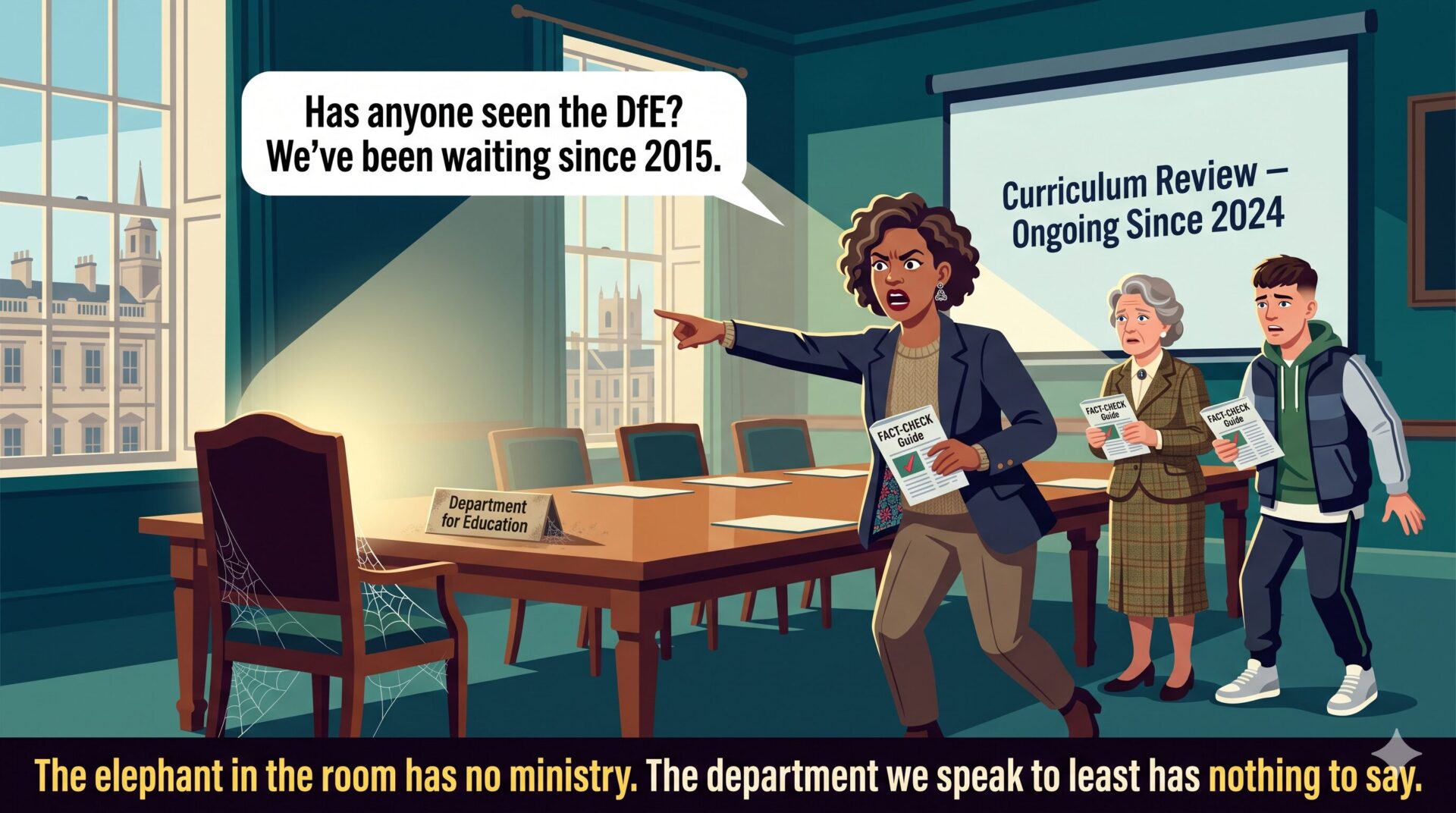 But teachers are just expected to absorb this new responsibility — along with managing classroom behaviour, delivering the curriculum, safeguarding vulnerable children, and marking sixty essays by Friday.
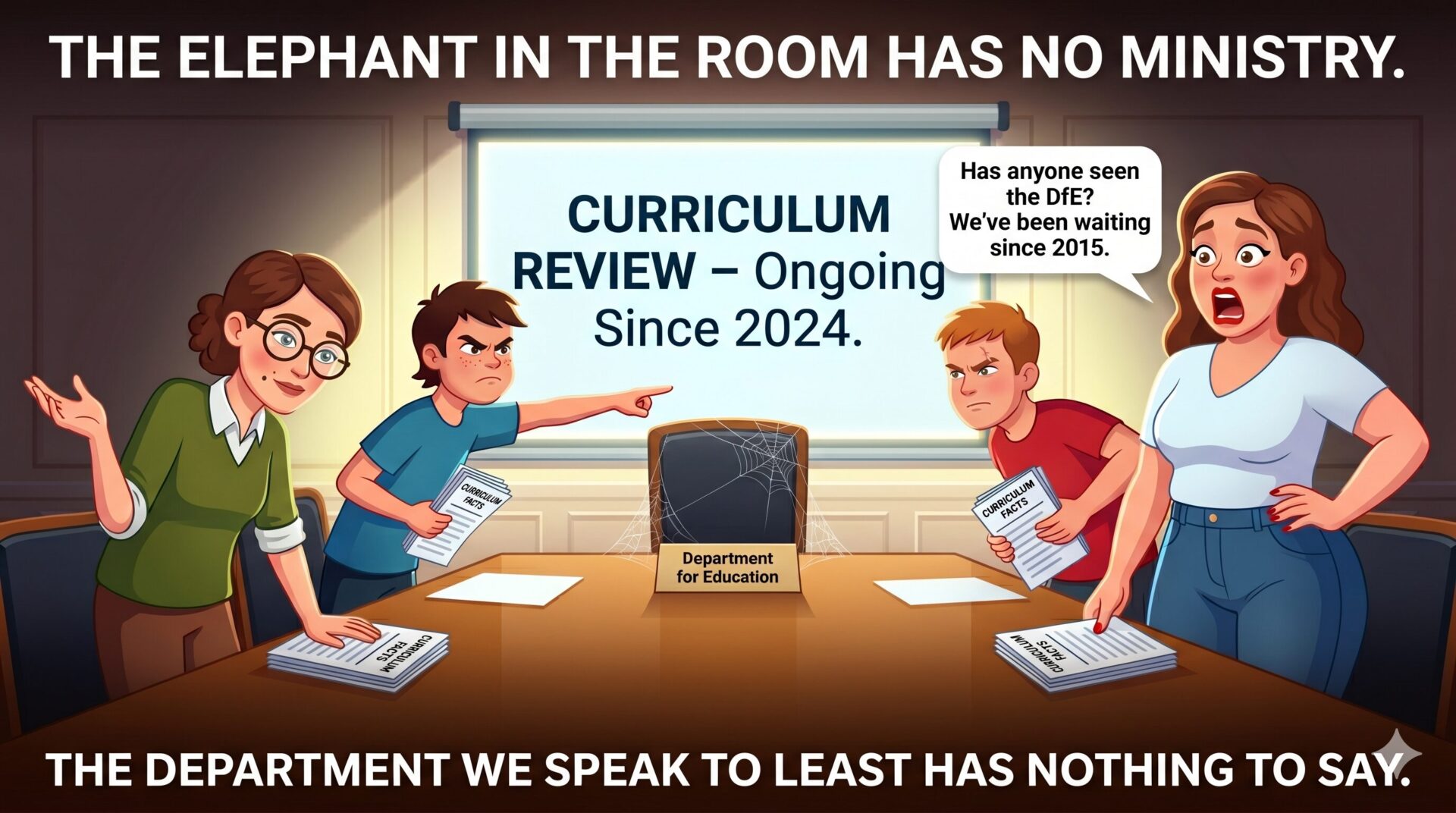 Witnesses warned that media literacy “becomes a subset of something bigger and more important” — and then disappears entirely. It’s the digital equivalent of the “women and children first” protocol on a sinking ship: noble in theory, disastrous in practice when no one actually checks who got into the lifeboats.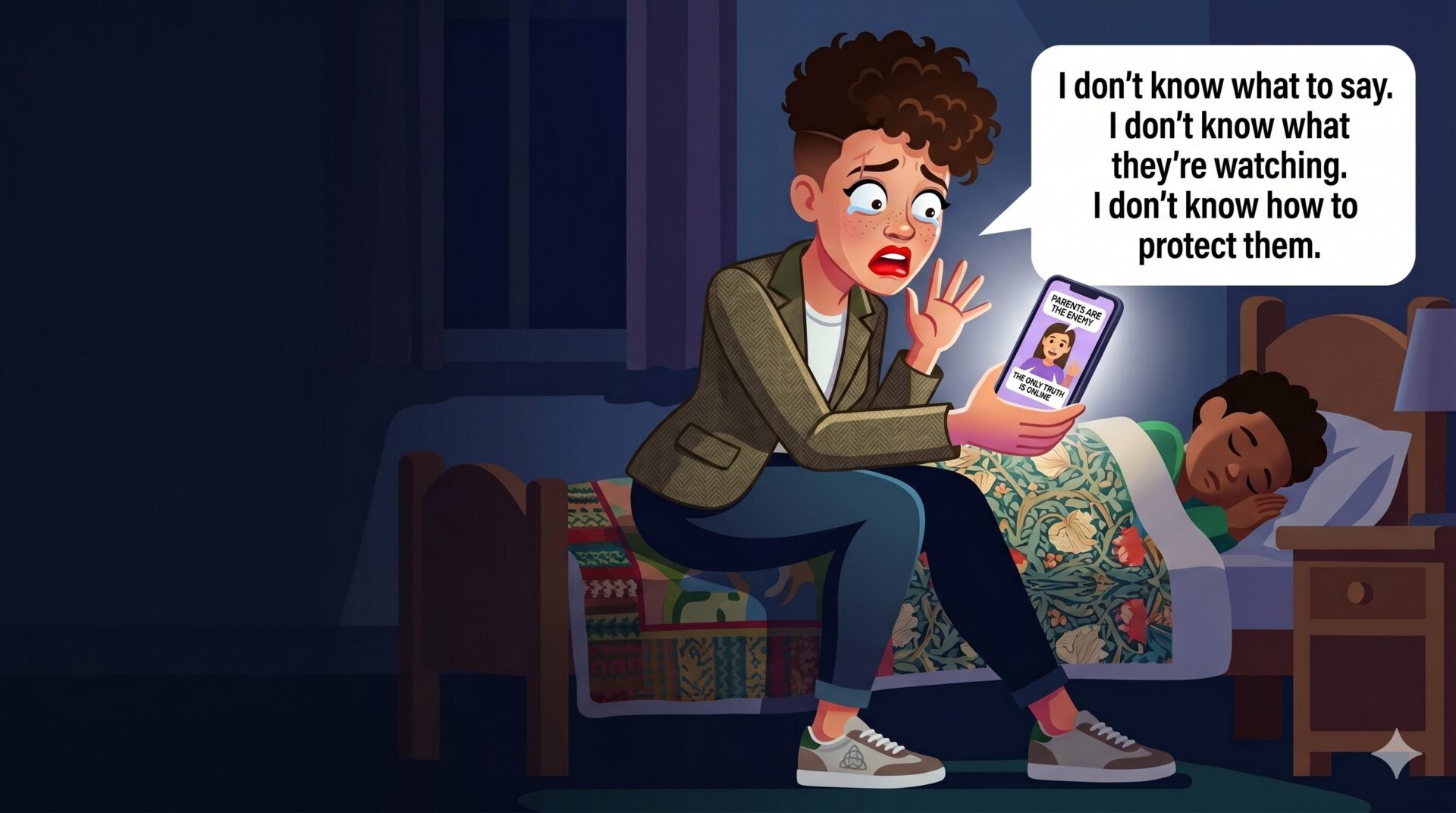
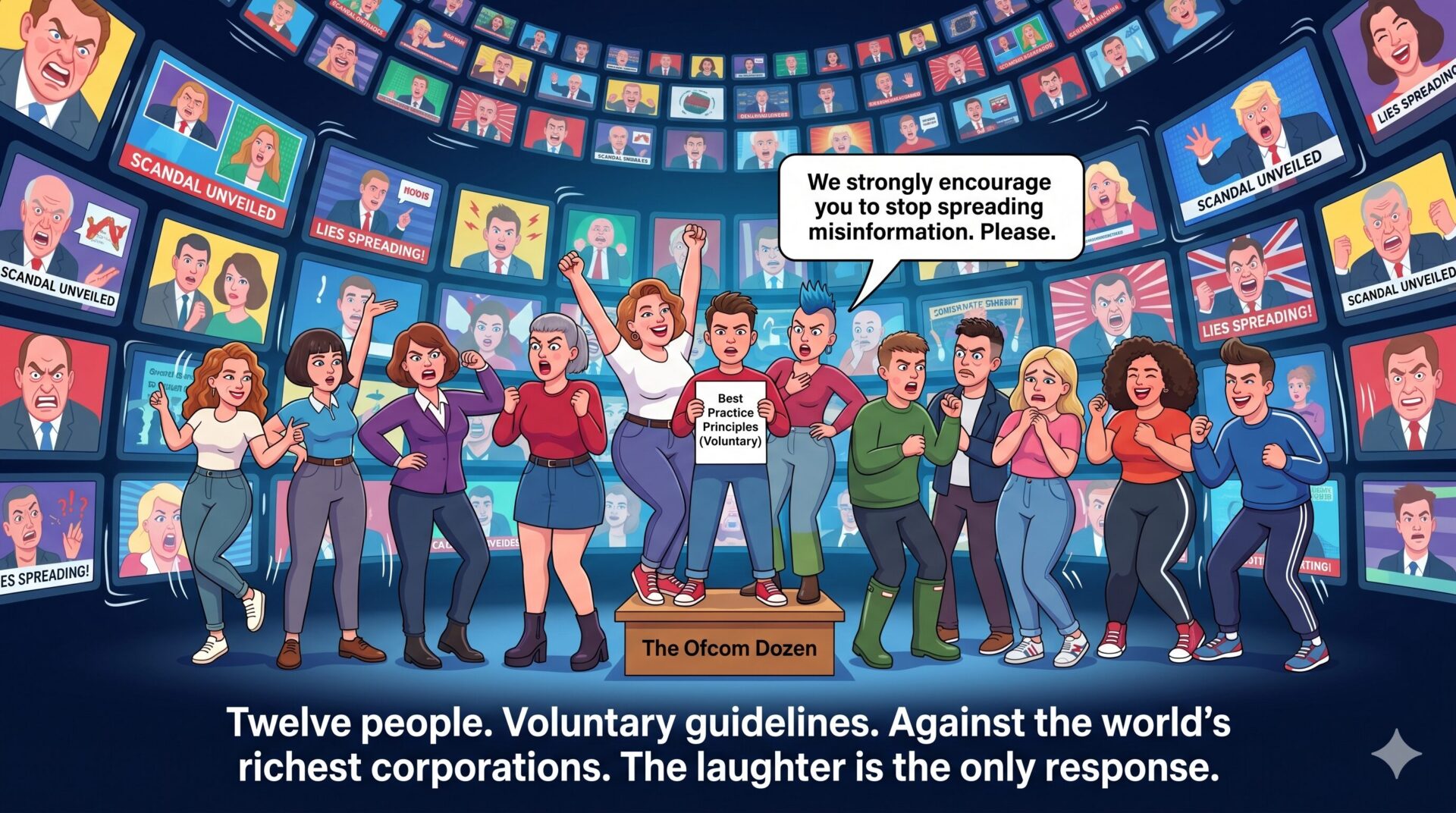 We saw it during the Southport riots. False claims spread like wildfire. A fake name for the suspect. A fake country of origin. A fake religious affiliation. None of it was true. None of it mattered. It was shared anyway. People believed it anyway. People acted on it anyway.
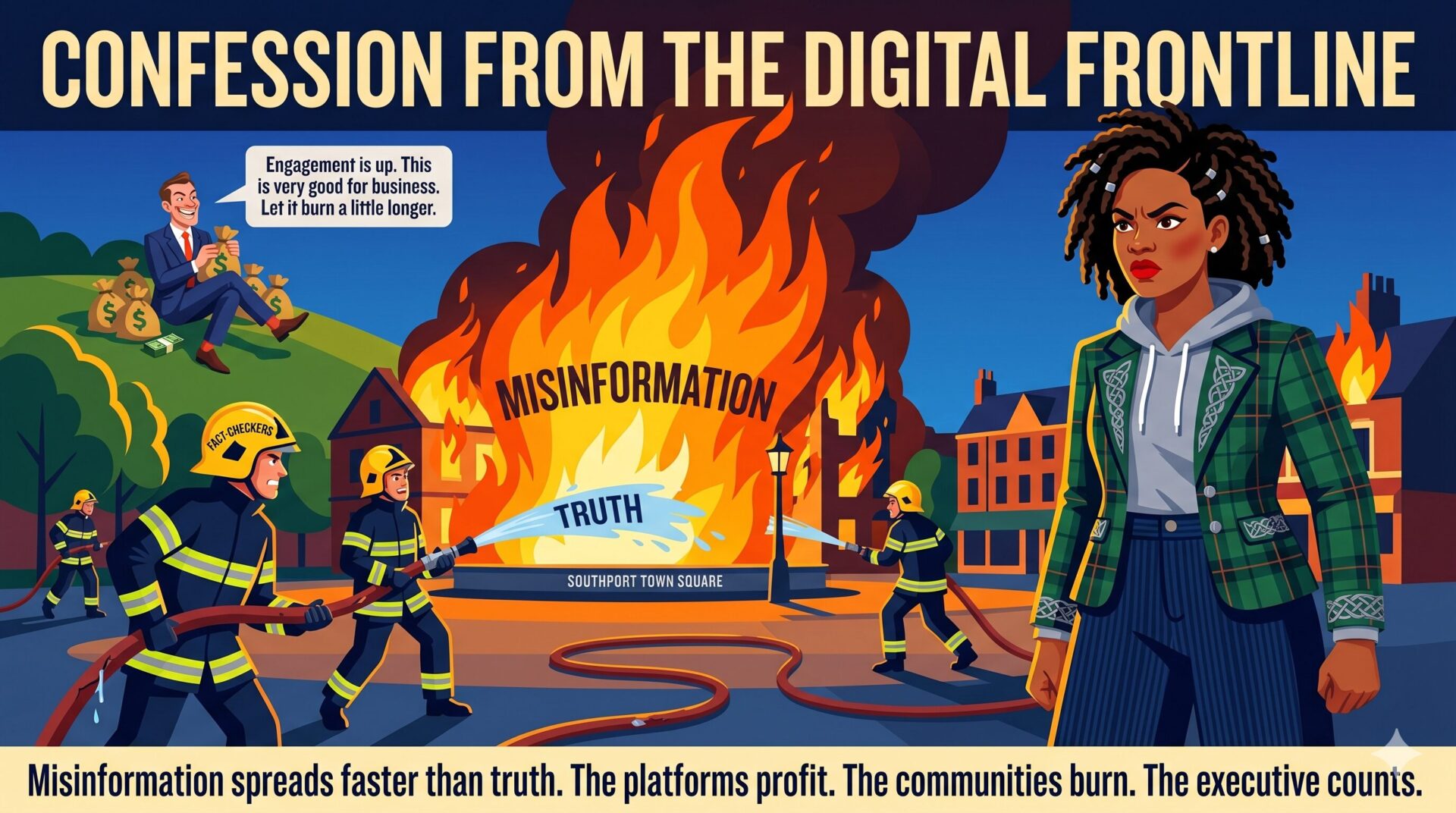 The World Economic Forum — those Swiss mountain-dwellers who spend their winters deciding the fate of the planet — have crunched the numbers. For two years running, they’ve declared that misinformation and disinformation are the top short-term global risk. Not climate change. Not armed conflict. Not the next pandemic.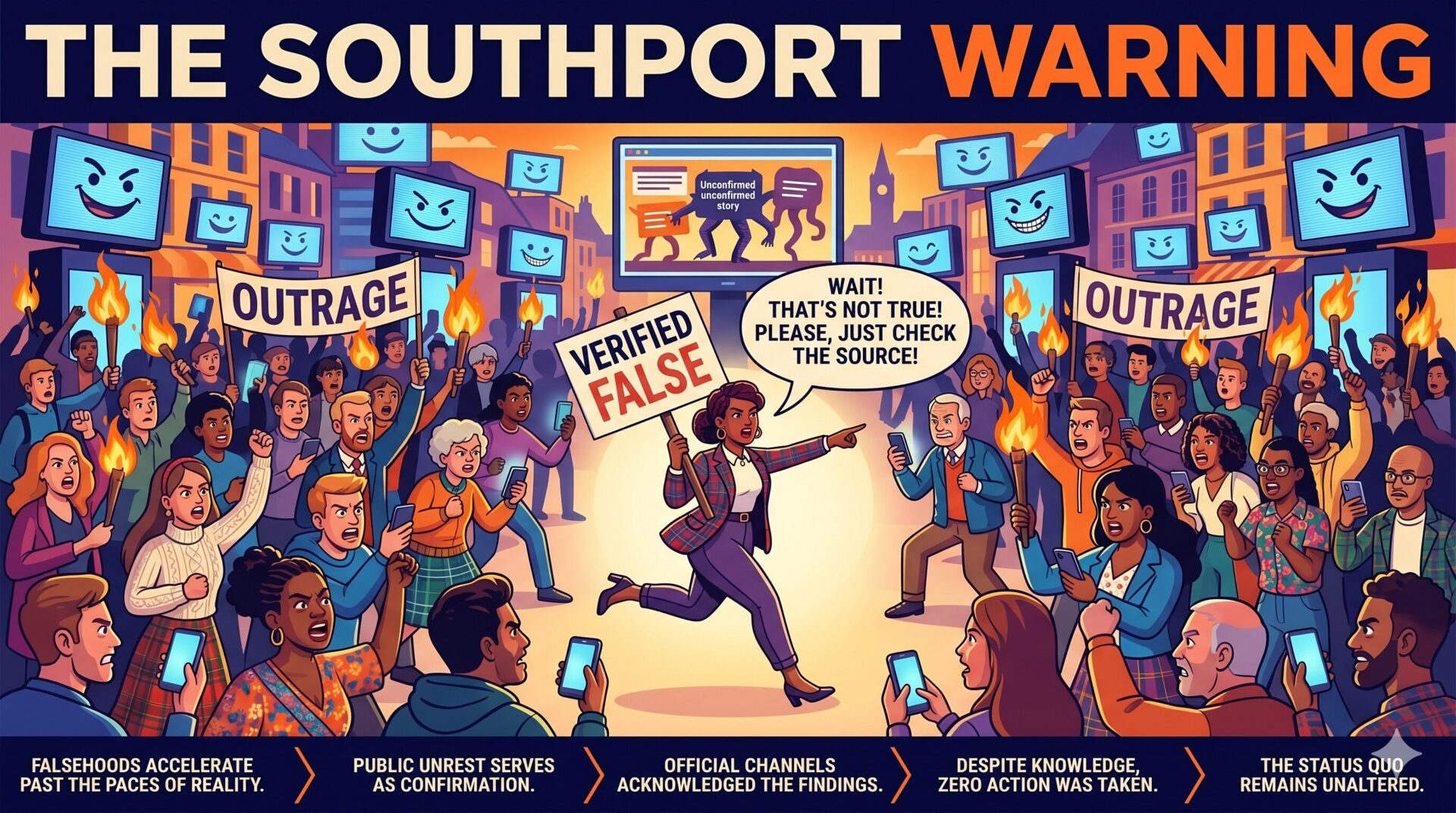
 They are not neutral. They are not passive. They are profit-maximising machines, and the most profitable thing in the world right now is your gullibility.
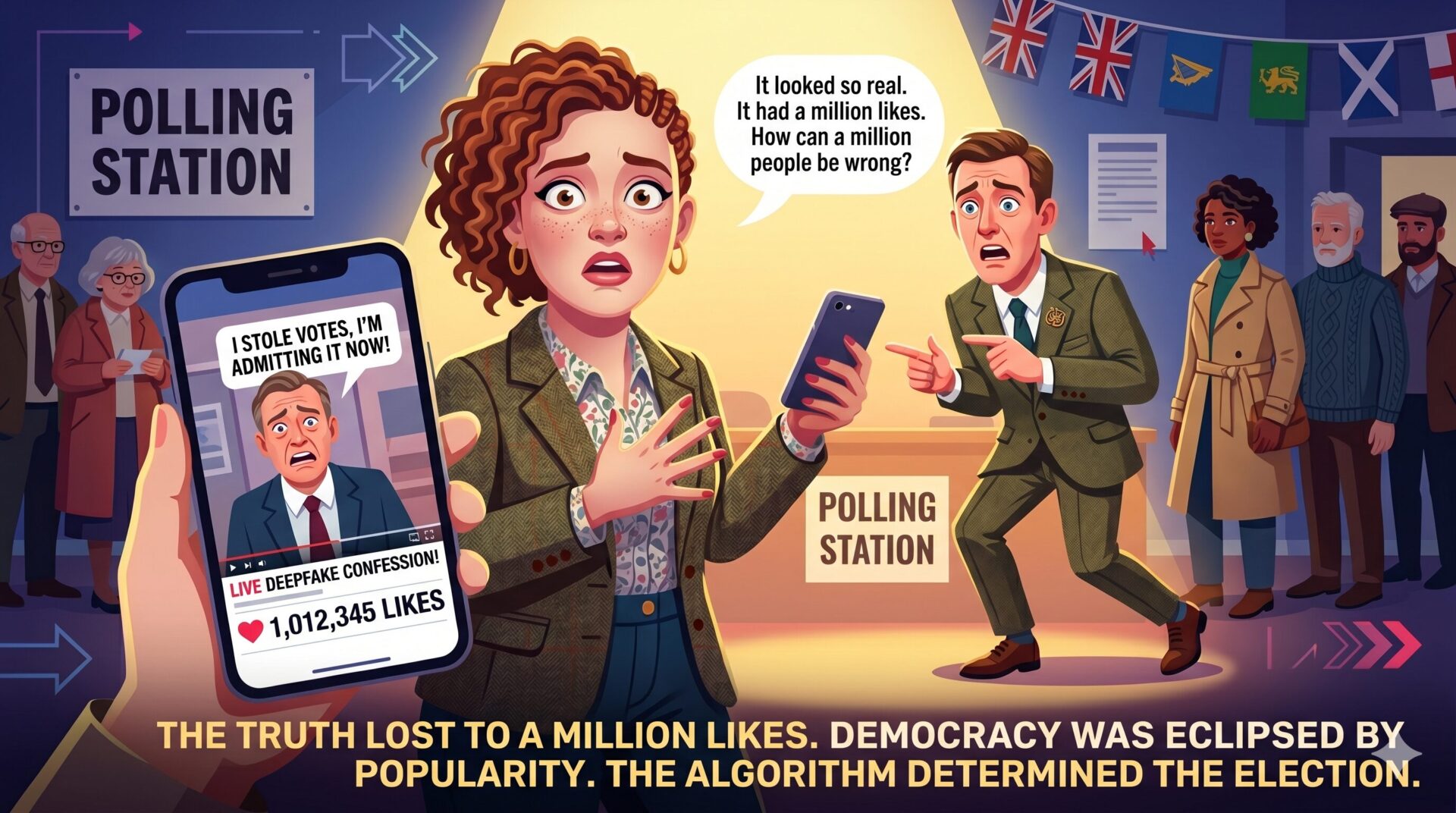 And even then — how many people will know what cryptographic signing means? How many will care? How many will just assume it’s fake anyway, because everything is fake, because that’s what the internet has taught them?
 We’re already seeing the symptoms. Vaccine hesitancy. Climate denial. Election denial. The rise of conspiracy theories that would have seemed deranged a decade ago — QAnon, Pizzagate, the Great Reset — now have millions of believers in Britain alone.
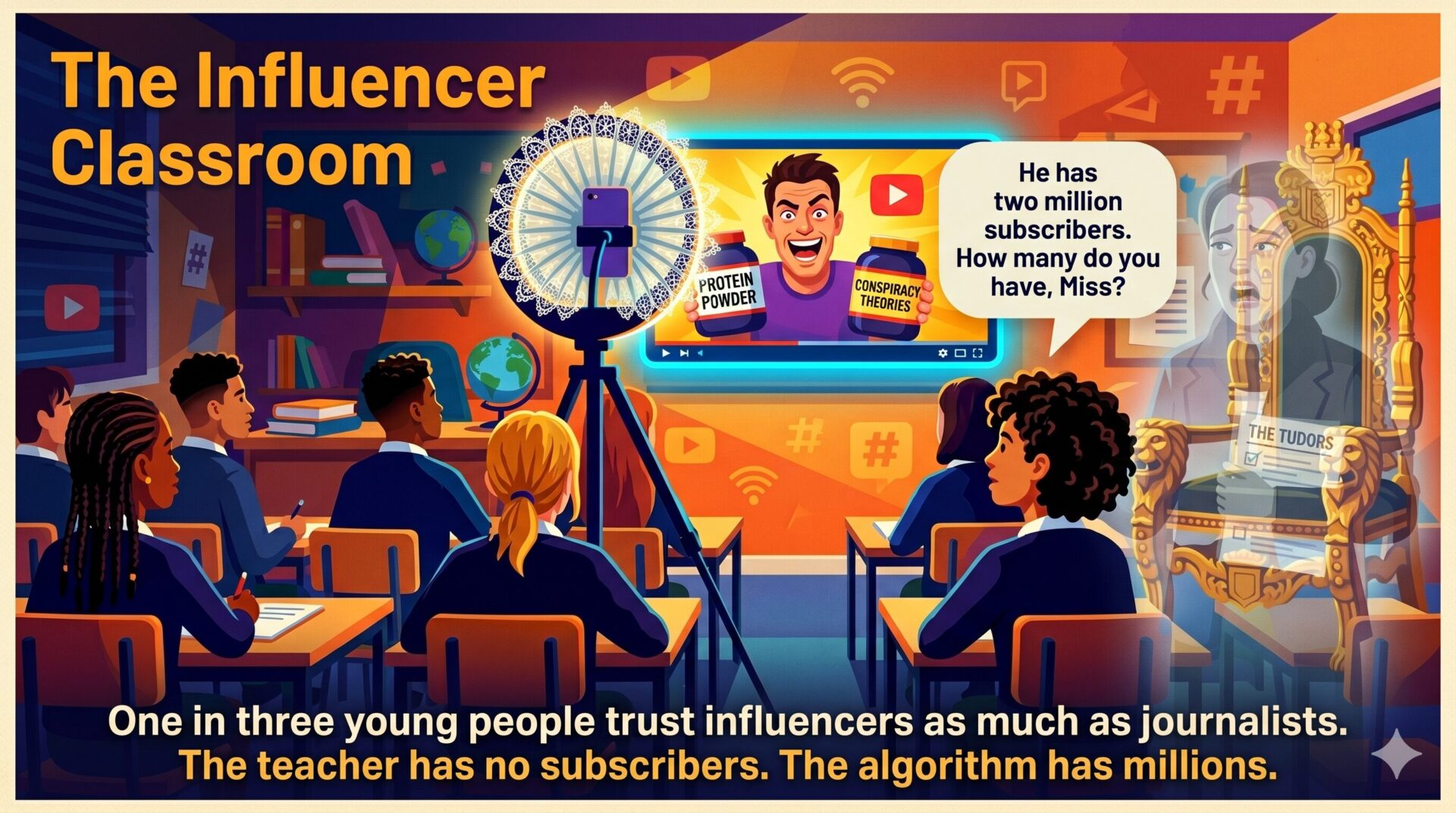 And the platforms? They market to children aggressively. They design features to keep them hooked. They collect their data. They build profiles that will follow them into adulthood.
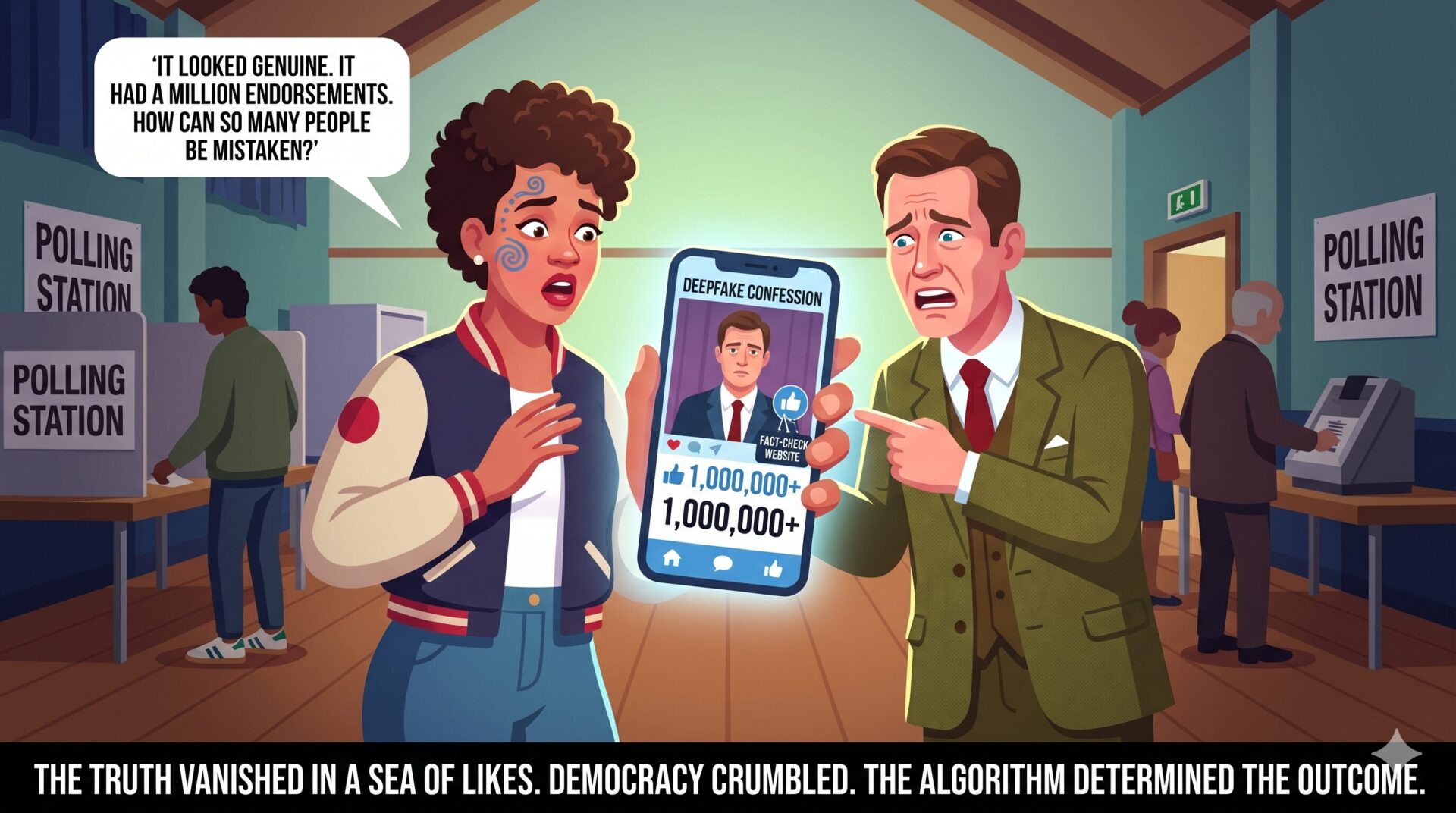 Modern AI generates images that are indistinguishable from photographs. Voices that sound exactly like real people — including you, including me, including the Prime Minister. Videos that show politicians saying things they never said, doing things they never did, in places they’ve never been.
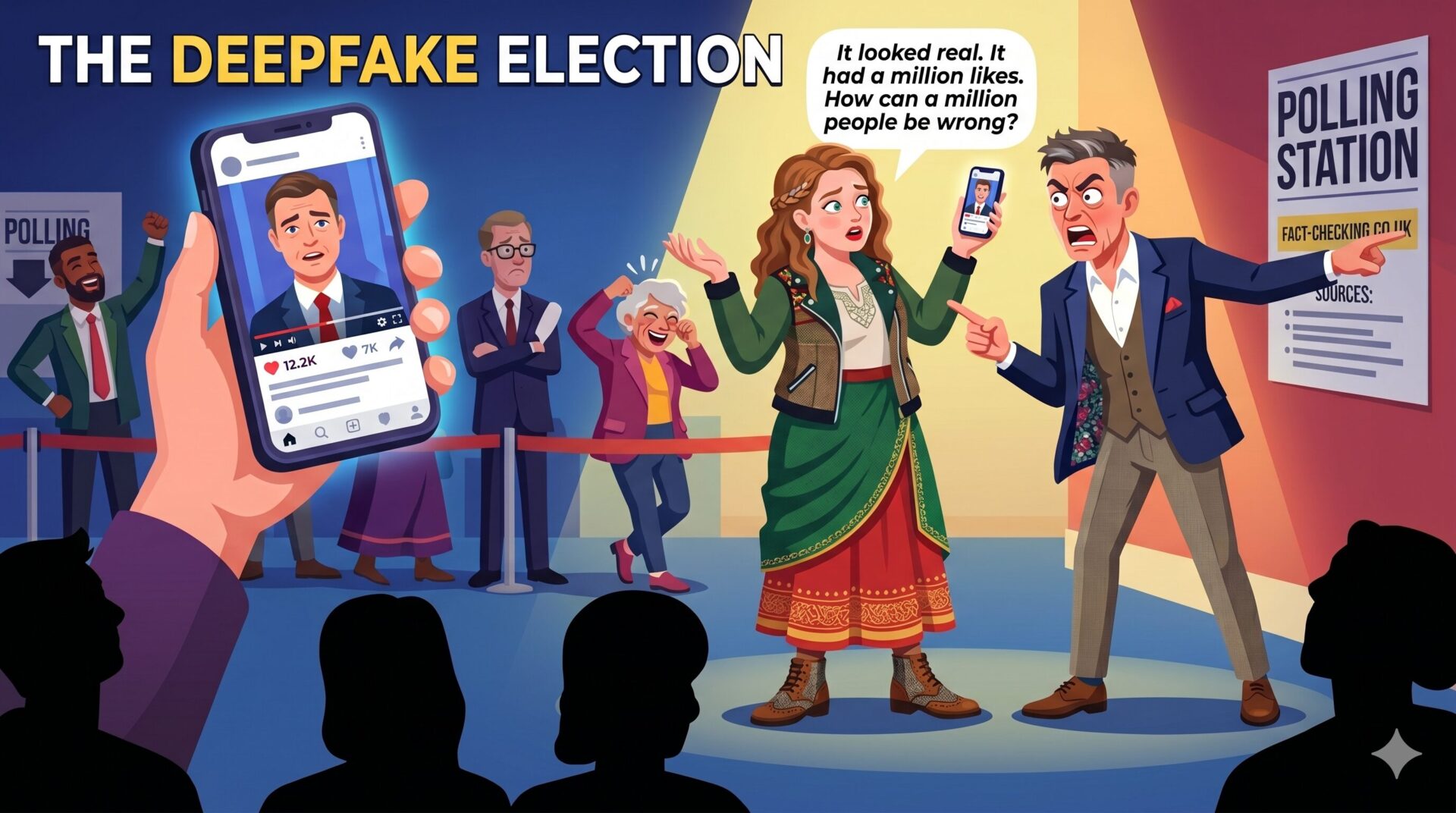 She loses the election. By a hundred votes. A hundred votes that were swung by fifteen seconds of AI-generated nonsense.
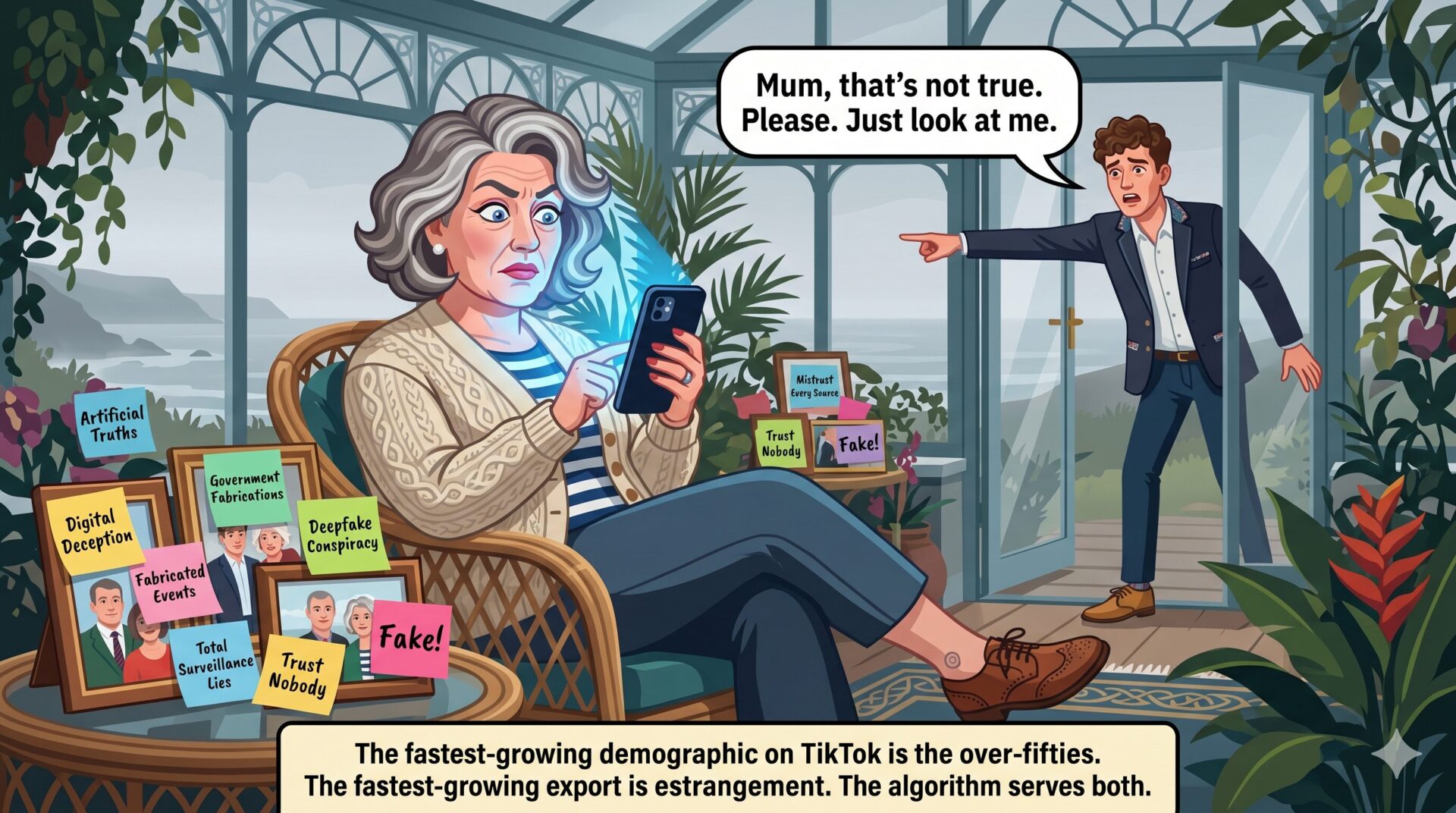 This isn’t because older people are stupid. It’s because the world changed around them. They grew up with newspapers, with television news, with a media environment that was curated by professionals. They learned to trust what they saw, because what they saw was generally trustworthy.
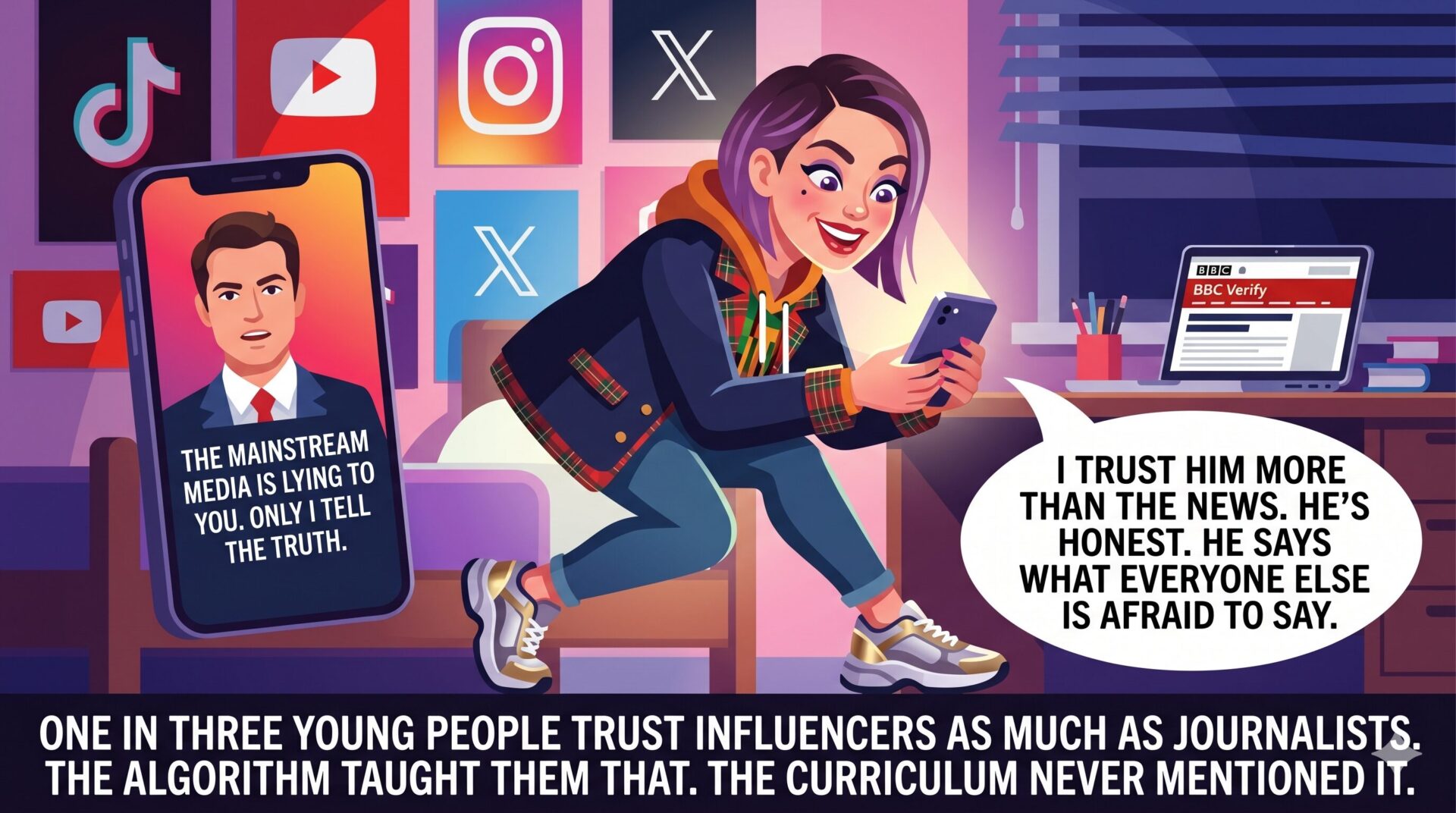 You cannot fact-check your way out of a crisis of trust. You cannot verify your way through a firehose of falsehood. At some point, you need to teach people how to do it themselves.
The Confidence Paradox
The Great British Blindspot
“None so blind as those who will not see.”
There’s a moment in every farce when the audience realises what the characters cannot. The hero strides across the stage, confident as a peacock, while the piano dangles precariously above his head. We scream. We point. We wave our arms. But he cannot hear us. He is too busy being confident.
This is Britain in 2026. Eighty-seven per cent of us feel confident online. Eighty-seven per cent. That is almost nine out of ten. That is your neighbour, your postman, your aunt who still uses AOL. That is the bloke in the pub who explains crypto to anyone who will listen. That is the woman on the train who books her holidays exclusively through Facebook ads.
All of them. Confident. Certain. Sure of their digital footing.
And the piano? The piano is that fifty-one per cent statistic. The one that says barely half of us can spot a sponsored link in search results. The one that reveals, in cold hard numbers, that our confidence is not just misplaced — it’s dangerously, spectacularly, hilariously wrong.
Welcome to the United Kingdom of Dunning and Kruger. Population: us.
The Sponsored Link Test
Let’s make this concrete. You’re looking for a plumber. Your boiler has packed up. It’s February. You’re cold. You type “emergency plumber Manchester” into Google.
The first result says “AD” in a little box. The second result also says “AD.” The third result — the first organic result — does not.
Fifty-one per cent of British adults can tell the difference. Forty-nine per cent cannot.
That means nearly half the country would click that sponsored link, assuming it’s the most relevant result, not realising that someone paid to be there. Not understanding that the “AD” label is not decoration. Not knowing that the first result is not necessarily the best result — just the one with the biggest advertising budget.
This is not a niche skill. This is not advanced digital literacy. This is the absolute basics. This is Media Literacy 001: How Search Engines Make Money.
And nearly half the country fails.
Now extrapolate. If we can’t spot sponsored links — the most obvious, the most regulated, the most legally required form of online persuasion — what else can’t we spot? Native advertising disguised as articles? Influencer posts that are secretly paid promotions? AI-generated reviews? Fake news sites designed to look like real newspapers?
The answer is: we can’t spot any of it. We’re walking through a minefield in clown shoes, insisting we’ve got perfect vision.
“Pride goeth before a fall” — and this fall is going to make the 2008 financial crisis look like a minor stumble.
The Confidence Industrial Complex
Where does this confidence come from? Who told us we were good at this?
The platforms, that’s who. They designed interfaces that feel simple. They hid the complexity. They made the sponsored links look like regular links — just slightly different, just enough to comply with the law, not enough to be obvious to the distracted, tired, half-asleep human scrolling on their phone.
They have a vested interest in your overconfidence. A sceptical user is a user who hesitates. A hesitant user is a user who doesn’t click. A user who doesn’t click doesn’t generate revenue.
So they smooth the edges. They make everything seamless. They train you to trust the interface, to trust the algorithm, to trust that the first result is the best result. And you do trust. You trust so completely that you don’t even see the “AD” box anymore. Your brain filters it out. It’s just… noise.
That’s not your fault. That’s design. That’s years of conditioning. That’s billions of pounds spent on making interfaces that exploit your cognitive biases rather than respecting your autonomy.But the result is the same: you’re confident, you’re wrong, and someone else is getting rich.
The Generational Divide (Or Not)
You might think this is an old person problem. The grey-haired, the technologically bewildered, the ones who still print their emails.
You’d be wrong.
Ofcom’s research cuts across all ages. Young people — digital natives, raised on smartphones, fluent in the language of apps — are almost as bad. They’re faster at scrolling, better at typing, more familiar with the slang. But they can’t spot a sponsored link either.
Because why would they? No one taught them. School doesn’t cover it. Parents don’t know it. And the platforms certainly aren’t volunteering the information.
The eighteen-year-old who can navigate TikTok blindfolded, who knows every filter, every trend, every dance — that same eighteen-year-old cannot tell you why the first Google result says “AD” or what that means for their wallet.
Digital fluency is not the same as digital literacy. Knowing how to use a tool is not the same as understanding how the tool uses you.
“A little knowledge is a dangerous thing.” And we’ve given a little knowledge to everyone, then told them they’re experts.
The Sponsored Life
Let’s follow the money. Because there’s always money.
When you click a sponsored link, someone pays. Occasionally, it’s a few pence. Every so often it’s a few pounds. Sometimes, if you’re looking for something expensive like a lawyer or a surgeon or a rehabilitation clinic, it’s hundreds of pounds.
That money goes to the platform. Google. Microsoft. Whoever sold that click.
The advertiser gets… what? A chance. A hope. A maybe. They’ve paid for the privilege of being first, of being noticed, of being clicked before the organic results. Whether their product is good, whether their service is reliable, whether they’re actually the best plumber in Manchester — none of that matters. They paid to be first. That’s all.
And we — the confident, the trusting, the blissfully unaware — we click. We assume. We buy.
Sometimes we get lucky. The paid plumber turns out to be decent. The sponsored holiday is actually quite nice. The advertised loan doesn’t ruin our lives.
Sometimes we don’t.
The mis-sold payment protection insurance scandal cost British consumers billions. The sponsored ads for dodgy investments, fake goods, scam holidays — they cost billions more. And every single one of those scams relied on the same thing: someone who couldn’t spot a sponsored link. Someone who trusted the first result. Someone who was confident but wrong.
The Search Engine’s Secret
Here’s what the platforms don’t want you to know: organic search results are not neutral either.
Google’s algorithm is not a public service. It’s not a library catalogue. It’s not an impartial referee. It’s a proprietary, secret, constantly changing set of rules designed to maximise something — relevance, they say, but also engagement, also profit, also their own market dominance.
The first organic result is not the “best” result. It’s the result that Google’s algorithm — a black box that even their own engineers don’t fully understand — has decided to put first. Based on factors that include how many other sites link to it, how long people stay on it, and how much money Google can make from showing it.
The sponsored link is honest about being paid for. The organic result hides its biases behind an algorithm that pretends to be objective.
And fifty-one per cent of us can’t even spot the honest one.
The Classroom That Isn’t
Imagine if we taught this stuff in school. Imagine a Year 6 lesson on “How Search Engines Work.” Imagine a GCSE module on “Online Advertising and You.” Imagine a PSHE session on “Sponsored Content: Spot It, Skip It.”
Imagine an entire generation growing up knowing that the first result is not the best result. That the “AD” box means someone paid. That the algorithm has its own priorities, which are not necessarily your priorities.
We don’t teach this. We don’t teach any of this. The national curriculum mentions media literacy in passing, in the context of online safety, in the context of “being discerning.” But there’s no specific requirement to explain search engine advertising. No mandatory lesson on sponsored links. No Ofsted inspection criteria covering the difference between organic and paid results.Teachers don’t teach it because they don’t know it. They’re part of the eighty-seven per cent. They’re confident too. They’re wrong too.
“The blind leading the blind” — and both are about to walk into a sponsored link.
The Pub Test
Ask someone in the pub. Anyone. Ask them if they can spot a sponsored link. They’ll say yes, of course, obviously, it’s easy.
Now show them a real search results page. Not a screenshot from a textbook. Not a simplified diagram. A real, cluttered, messy, ad-heavy search results page with sponsored links at the top, sponsored links at the bottom, sponsored links in the middle, and organic results hiding between them like shy children at a loud party.
Watch them hesitate. Watch them squint. Watch them point at an organic result and say “that one’s sponsored” and a sponsored result and say “that one’s real.”
Watch them get it wrong. Watch them get defensive. Watch them say the test was unfair, the screen was too small, the lighting was bad.
Then watch them do it again tomorrow, on their own phone, in their own home, and never notice that they’ve clicked another sponsored link.
This is not a moral failing. This is design. This is the cumulative effect of billions of pounds spent on making interfaces that exploit human psychology. This is what happens when a society decides that teaching critical thinking is less important than protecting corporate profits.
The Regulatory Farce
Ofcom knows about this. They’ve done the research. They’ve published the reports. They’ve held the conferences.
They’ve also produced a set of “Best Practice Principles for Media Literacy by Design” — voluntary guidelines that platforms can choose to follow or ignore. Four platforms signed up. Four. Out of hundreds.
And the guidelines don’t even require platforms to make sponsored links more obvious. They don’t require them to explain how algorithms work. They don’t require them to teach users anything at all.
The regulator’s solution to widespread ignorance about sponsored links is to politely ask the platforms to consider maybe possibly thinking about doing something. Eventually. If they feel like it.
This is not regulation. This is a strongly worded letter. This is asking the fox to pretty please design a better henhouse security system.
The Online Safety Act gives Ofcom powers to demand information, to fine companies, to hold them accountable. But those powers are focused on illegal content — child abuse, terrorism, hate speech. Sponsored links are legal. Misleading advertising is legal, as long as it doesn’t cross into outright fraud. The grey area where most of this lives is not grey — it’s golden. Golden for the platforms, that is.
The Cost of Confidence
Let’s put a number on it. Billions. Billions of pounds are spent every year on search advertising. Every one of those pounds comes from someone who believed that being first was worth paying for. And every one of those pounds relies on users who don’t know the difference between paid and organic.
If we all knew. If we all understood. If the fifty-one per cent became ninety-one per cent — the advertising market would collapse. Not overnight, but over time. Because informed users are less likely to click sponsored links. Less likely to trust the first result. Less likely to be manipulated.
That’s the business model. That’s the secret that the platforms are desperate to keep. Your ignorance is their profit margin. Your overconfidence is their revenue stream.
“If you’re not paying for the product, you are the product.” But what if you’re paying for the product, and you’re still the product? What if every click, every search, every sponsored link you accidentally visit is another data point, another piece of your profile, another way to target you more effectively next time?
You’re not just the product. You’re the raw material. You’re the fuel. And you’re burning yourself up, one confident click at a time.
The Finnish Pharmacy
There’s a famous example from Finland. A few years ago, the Finnish government ran a media literacy campaign targeted at older adults. They taught pensioners how to spot sponsored links, how to recognise native advertising, how to understand algorithmic bias.
The results were measurable. The pensioners got better. Their confidence aligned more closely with their competence. They stopped clicking things they shouldn’t.
The campaign cost money. Not much, by government standards. A few million euros. But it worked.
We don’t have that campaign. We don’t have anything like it. We have a Digital Inclusion Action Plan that mentions media literacy in passing. We have a cross-government working group that meets monthly. We have pilots and trials and evaluations and reports.
What we don’t have is a national programme that teaches people how search engines work. What we don’t have is a public awareness campaign about sponsored links. What we don’t have is any systematic effort to close the gap between confidence and competence.
Because that would require admitting that the gap exists. That would require admitting that eighty-seven per cent confident and fifty-one per cent competent is a failure. That would require admitting that the system we’ve built — the platforms, the regulators, the educational establishment — has let everyone down.
And nobody in power wants to admit that.
The Teacher’s Email
Remember Sarah from Leeds? The computing teacher who tried to teach AI literacy? She also tried to teach search literacy. She showed her students a search results page and asked them to identify the sponsored links.
They couldn’t. Most of them. Even the ones who were confident. Even the ones who laughed at their parents for being bad with technology.
She explained what the “AD” box meant. She explained why sponsored links appear first. She explained that the algorithm is not neutral, not objective, not your friend.
Some of the students got it. Some of them started checking for the “AD” box before clicking. Some of them started questioning why certain results appeared where they did.
But most of them forgot within a week. Because the lesson was one lesson. Because media literacy is not embedded across the curriculum. Because the platforms are teaching them every single day, for hours at a time, and Sarah only had forty minutes.“You can lead a horse to water, but you can’t make it think.” Actually, you can. If you start early. If you reinforce regularly. If you make it part of the fabric of education rather than a one-off special event.
We don’t do any of that. So the horses stay thirsty. And the platforms keep selling the water.
The Final Irony
Here’s the punchline. The thing that would be hilarious if it weren’t so tragic.
The people who are most confident online — the eighty-seven per cent who feel sure of their digital skills — are the ones who are most vulnerable. Because confidence leads to risk-taking. Confidence leads to assumptions. Confidence leads to clicking without checking.
The people who are the least confident — the thirteen per cent who admit they don’t know what they’re doing — are actually safer. They hesitate. They question. They ask for help. They don’t click on sponsored links because they don’t click on anything without checking with someone first.
The confident ones are the marks. The confident ones are the targets. The confident ones are walking around with signs on their backs saying “SCAM ME — I KNOW WHAT I’M DOING.”
And they don’t even know it.
Eighty-seven per cent confident. Fifty-one per cent competent. A thirty-six point gap between how we think we’re doing and how we’re actually doing.
That gap is not a measurement error. That gap is a business opportunity. That gap is what the platforms monetise. That gap is what the scammers exploit. That gap is what the disinformation campaigns leverage.
And until we close it — until we teach people what they don’t know, until we replace confidence with competence, until we stop navigating blind and insisting we see perfectly — the gap will keep growing. The piano will keep dangling. And we’ll keep striding underneath it, confident as peacocks, oblivious as lambs.
“What you don’t know can’t hurt you” — is the most dangerous lie we tell ourselves. Because what you don’t know can hurt you. It can empty your bank account. It can swing your vote. It can radicalise your teenager. It can destroy your trust in everything and everyone.
And the worst part? You won’t even know it happened. You’ll be too confident to notice.
The Stiff Upper Lip of Stupidity
“The Englishman’s home is his castle” — and his ignorance is his moat.
There’s a particular kind of British stubbornness that the world has learned to recognise. It’s the same quality that kept us driving on the left when everyone else switched. The same quality that made us vote for Brexit and then act surprised when the fish didn’t get any happier. The same quality that has us tutting at queue-jumpers while the whole system collapses around our ears.
It’s the confidence of a nation that once ruled a quarter of the globe and has never quite admitted that the party’s over.
And now it’s manifesting in our digital lives. Eighty-seven per cent of us feel confident online. Eighty-seven per cent. That’s not a statistic. That’s a national delusion. That’s the collective shrug of a country that would rather be wrong and certain than right and uncertain.Meanwhile, in Finland, they’re doing something extraordinary. They’re teaching humility. They’re putting it in the curriculum. They’re making it a national priority.
And it’s working.
The Finnish Miracle (And Why It Makes Us Uncomfortable)
Let’s talk about Finland. Population 5.5 million. Winters that would make a Siberian weep. A border with Russia that keeps the defence planners awake at night. And a media literacy programme that has become the envy of the democratic world.
Finland started in 2013. That’s important. Not 2023. Not after the misinformation crisis became obvious. Not after the deepfakes started flooding the zone. 2013. When most of us were still using “fake news” as a punchline.
They started because they knew something we didn’t: that information warfare is not a theoretical threat. That living next to Russia means you take propaganda seriously. That the best defence against manipulation is not firewalls or fact-checkers or algorithms. It’s people. Educated people. Humble people. People who know what they don’t know.
The Finns embedded media literacy as a cross-curricular competency called “multiliteracy.” Every subject teacher is responsible for it. History teachers teach source criticism. Science teachers teach evidence evaluation. Art teachers teach visual manipulation. It’s not an add-on. It’s not a pilot. It’s not a project that might lose funding when the government changes.It’s just what schools do.
And the result? Finnish citizens are not more confident than Brits. That’s the key. They’re not strutting around thinking they’re experts. They’re more humble. They know the limits of their knowledge. They’re more likely to say “I’m not sure” than “I know that’s true.”
Which means they’re harder to fool.
“A man who knows he’s a fool is not a fool” — or something like that. The Finns have taken that proverb and turned it into national policy.
The Estonian Digital Republic
Estonia is even smaller. Population 1.3 million. But what they lack in size, they make up in digital ambition. They’ve built something called e-Estonia — a digital society where almost everything is online: voting, taxes, prescriptions, business registration.
You’d think that would make them overconfident. You’d think that living in a digital wonderland would breed the same complacency we see in Britain.
You’d be wrong.
Estonia teaches digital literacy from primary school. They have a programme called “ProgeTiger” that introduces coding, robotics, and media literacy from age seven. They teach children to question sources, to verify information, to understand how algorithms work.
And crucially, they teach them that the digital world is not neutral. That someone built it. That someone profits from it. That someone might want to manipulate them through it.
Estonia also has a border with Russia. They remember the Bronze Night riots of 2007, when cyberattacks paralysed the country for weeks. They remember what happens when information warfare meets a population that isn’t prepared.
So they prepared. They prepared so thoroughly that Estonian citizens are now among the most resilient in Europe. Not because they’re smarter than us. Because they started earlier. Because they took it seriously. Because they didn’t assume that confidence equals competence.
The British Exceptionalism That Kills
Here’s the uncomfortable truth that nobody in Whitehall wants to admit: we think we’re special. We think the rules don’t apply to us. We think our history, our institutions, our famous British common sense will protect us from the nonsense that afflicts lesser nations.
This is the same exceptionalism that led us to believe we could have a “softer” Brexit than anyone else. The same exceptionalism that made us think our banks were too sophisticated to collapse in 2008. The same exceptionalism that has us convinced that our politicians are less corrupt, our media less biased, our population less gullible than everyone else’s.
We’re wrong. We’ve been wrong about countless things. And we’re wrong about this too.
The data doesn’t lie. Forty-five per cent of us feel confident judging online truthfulness. Thirty per cent feel confident recognising AI content. Fifty-one per cent can spot a sponsored link.
These are not the numbers of a nation that’s doing fine. These are the numbers of a nation sleepwalking into a catastrophe.
But ask a British person how they’re doing online, and they’ll tell you they’re fine. They’ll tell you they know what they’re doing. They’ll tell you they’re not like those Americans who believe everything they see on Facebook.
Meanwhile, they’re sharing articles from “The Daily Sceptic” and wondering why the mainstream media won’t report on the globalist conspiracy.
“There’s none so blind as those who will not see” — and we have elevated willful blindness to an art form.
The Humility Curriculum
What would it take to teach British people to be more like Finns? To replace confidence with competence, certainty with curiosity, arrogance with humility?
It would take a revolution. Not the kind with barricades and manifestos. The quieter kind. The kind that happens in classrooms, over years, with patient repetition and consistent reinforcement.
It would start in early years. Not at GCSE. Not as a one-off assembly. From age five, children would learn that not everything they see is true. That some people lie. That some people are paid to lie. That the internet is not a neutral space but a battlefield where their attention is the prize.By age seven, they would learn to ask: who made this? Why did they make it? Who benefits if I believe it? What have they left out?
By age eleven, they would learn about algorithms. How they work. Who controls them. Why they show you what they show you. How to break out of the filter bubble.
By age fourteen, they would learn about AI. How to spot deepfakes. How to verify images. How to recognise synthetic text. Why the technology is getting better and what that means for their future.
By age sixteen, they would be sceptical. Not cynical — there’s a difference. Sceptical means questioning before believing. Cynical means believing nothing and no one. The Finns have managed to produce sceptical citizens without tipping into nihilism.
We haven’t even started.
The Teacher Who Cried
Let me tell you about a teacher in Birmingham. Let’s call her Priya. She teaches computing at a secondary school. She’s been trying to get her students to care about media literacy for years.
She showed them sponsored links. She explained how search engines work. She demonstrated deepfakes. She gave them tools to verify images.
They didn’t care. Not because they’re bad kids. Because they’re British kids. Because they’ve been told their whole lives that they’re good with technology. Because they’re digital natives, fluent in the language of apps, masters of the scroll.
They were confident. They were mistaken. But they didn’t know they were mistaken. And they didn’t want to know.
Priya showed them a study — a real study, from a real university — that found that young people are just as vulnerable to misinformation as old people. That digital fluency is not the same as digital literacy. That being good at TikTok doesn’t make you good at spotting lies.
The students laughed. They said the study was old. They said it didn’t apply to them. They said they were different.They were different. They were worse. Because their confidence was higher, and their competence was lower.
Priya gave up. Not officially. She still teaches the lessons. She still shows the examples. But her heart isn’t in it anymore. Because she knows what the research shows: one lesson, one week, one unit — it doesn’t stick. Not without reinforcement. Not without embedding. Not without the whole school, the whole curriculum, the whole country taking it seriously.
“A drop in the ocean” — that’s what her efforts feel like. And the ocean is rising.
The Estonian Exchange
There’s a story about an Estonian exchange student who came to a British school. She was sixteen. She’d been through the Estonian digital literacy programme. She knew how to spot sponsored links. She knew how to verify images. She knew how to question sources.
Her British classmates thought she was paranoid. They thought she was weird. They thought she was missing the point of the internet, which was to have fun, not to interrogate everything.
Then a deepfake video went viral. It showed a politician saying something outrageous. The British students shared it. The Estonian student didn’t. She checked it first. She found the original video — the boring one, the one without the outrageous comment. She showed her classmates the difference.
They didn’t believe her. They thought she was lying. They thought she was part of the conspiracy. They’d already shared the video. They’d already formed their opinions. They’d already decided that the politician was guilty.
The Estonian student went back to Estonia at the end of the year. She told her parents that British schools were “cute” but “backwards.” She said British students were “confident” but “clueless.” She said she wouldn’t trade places with them for anything.
She’s not wrong.
The Class Divide
Let’s talk about who suffers most from our national overconfidence. Because it’s not the rich. It’s not the powerful. It’s not the people who send their children to private schools where media literacy is taught as a matter of course.
It’s everyone else.
A kid in a comprehensive school in Doncaster is not learning how to spot sponsored links. A pensioner in a council flat in Glasgow is not learning how to recognise deepfakes. A single mother in Cardiff working two jobs doesn’t have time to fact-check everything she sees on Facebook.
These are the people who are most vulnerable. These are the people who are most likely to be manipulated. These are the people who are most likely to share misinformation, to fall for scams, to vote against their own interests.
And our national overconfidence — our insistence that we’re fine, that we don’t need media literacy, that the Finnish approach is for other countries — is a class weapon. It’s a way of saying that the people who are suffering don’t matter. That their ignorance is their own fault. That they should have been more careful.But how can they be careful when no one taught them how? How can they be sceptical when the entire system is designed to exploit their trust? How can they protect themselves when the government won’t even admit there’s a problem?
“The rich man has his lawyers, the poor man has his ignorance” — and the platforms have both.
The Finnish Secret Weapon
Here’s what the Finns understand that we don’t: media literacy is not about technology. It’s about power.
Who gets to decide what’s true? Who controls the platforms where truth is debated? Who profits from confusion and doubt? Who loses when citizens can’t tell fact from fiction?
These are not technical questions. They’re not pedagogical questions. They’re questions about who runs the world and in whose interests.
The Finns don’t pretend that media literacy is neutral. They don’t pretend that teaching children to spot sponsored links is somehow separate from teaching them about capitalism, about advertising, about the profit motive that drives the platforms.
They don’t use the fancy jargon. They don’t hide behind “digital inclusion” or “online safety.” They call it what it is: defence. Defence against manipulation. Defence against propaganda. Defence against the richest corporations in the world trying to turn your attention into their profit.
We don’t have that language in Britain. We have “media literacy” — a term so boring it could put a hyperactive toddler to sleep. We have “online safety” — which sounds like something from a public information film from 1985. We have “digital inclusion” — which is important but is not the same thing.
We don’t have a national conversation about power. About who benefits when we’re confused. About who loses when we’re confident but wrong.
Because that conversation would be uncomfortable. It would require admitting that the platforms are not our friends. That the government has failed us. That the education system has let us down. That our famous British common sense is not enough.
So we don’t have that conversation. We have pilots and working groups and voluntary best practice principles. We have Ofcom with its twelve-person media literacy team. We have a Digital Inclusion Action Plan that mentions media literacy in passing.
And we have eighty-seven per cent of adults feeling confident online while fifty-one per cent can spot a sponsored link.
The Stubbornness Tax
There’s a price for our national stubbornness. It’s paid in misinformation shared, scams fallen for, votes cast against self-interest. It’s paid in democracy eroded, trust destroyed, communities divided.
The British people are paying that price every day. They just don’t know it. Because they’re confident. Because they think they’re fine. Because they’ve been told their whole lives that British common sense will see them through.
But common sense is not enough against a multi-billion-dollar propaganda machine. Common sense is not enough against AI-generated deepfakes. Common sense is not enough against algorithms designed to exploit your cognitive biases.
What you need is education. Early, sustained, embedded, reinforced. What you need is humility. The willingness to say “I don’t know” and the skills to find out.
What you need is to be less like Britain and more like Finland.
“A change is as good as a rest” — but we don’t want to change. We want to rest on our laurels, our history, our exceptionalism. We want to believe that we’re different, that we’re immune, that the misinformation crisis is something that happens to other countries.
It’s not. It’s happening here. Right now. And we’re doing almost nothing about it.
The Last Word
There’s a famous Finnish word: “sisu.” It means something like grit, determination, resilience in the face of overwhelming odds. It’s what kept Finland independent when Russia was breathing down their neck. It’s what built their education system, their welfare state, their digital resilience.
We have a word too. “Stubborn.” It means refusing to change your mind even when the evidence is overwhelming. It means doubling down on failure. It means insisting you’re fine when you’re not.
Finland chose sisu. Britain chose stubborn.
And now the Finns can spot deepfakes while we’re still arguing about whether sponsored links are a problem. The Finns are teaching humility while we’re polishing our overconfidence. The Finns are preparing for the future while we’re living in the past.
“The past is a foreign country; they do things differently there” — and we are foreigners in our own time, trapped in a confidence that has no basis in reality, insisting we see perfectly while the piano dangles above our heads.
The Finns have looked up. They’ve seen the piano. They’ve moved out of the way.
We’re still standing underneath it, confident as ever, waiting for the drop.
The Grey Haired and the Gullible
“You can’t teach an old dog new tricks” — but you can certainly fool one.
Meet Margaret. She’s sixty-seven, retired, lives in a nice semi-detached in Cheltenham. She’s got a garden, a cat named Buster, and a brand-new iPhone that her son bought her for Christmas. She joined TikTok last month because her bridge club wouldn’t stop talking about “that dancing pigeon” and she felt left out.
Margaret now spends two hours a day on TikTok. She’s discovered the “For You” page. She’s following seventeen influencers — financial advisors, health gurus, political commentators — none of whom are qualified to advise anyone on anything. She’s shared eight videos this week. She’s believed everything she’s seen.Margaret is not stupid. Margaret is a retired nurse. Margaret ran a ward for thirty years. Margaret has more common sense in her little finger than most TikTok influencers have in their entire carefully curated bodies.
But Margaret is sixty-seven. And age is the single strongest predictor of media literacy skills in the United Kingdom.
The older you are, the more vulnerable you are. The more confident you are, the more wrong you are. The more life experience you have, the less prepared you are for the life you’re actually living.
And right now, the fastest-growing demographic on TikTok is the over-fifties.
Welcome to the perfect storm.
The Demographic Time Bomb
Let’s look at the numbers. Ofcom has been tracking this for years. Age is not just a factor — it’s the factor. Stronger than education. Stronger than income. Stronger than region or gender or any other demographic you can name.
A twenty-five-year-old might be bad at spotting misinformation. But a sixty-five-year-old is worse. Much worse.
Why? Because they grew up in a different world. A world where you could trust what you saw on television. A world where newspapers had fact-checkers. A world where the man on the news was a man you could believe.
They learned to trust. And they never unlearned it.
Now they’re retired. They have time. They have savings. They have a lifetime of accumulated trust that the platforms are mining like a seam of gold.
And TikTok — the app that was once the exclusive domain of teenagers dancing in their bedrooms — has noticed. The over-fifties are now the fastest-growing demographic on the platform. They’re joining in droves. They’re scrolling for hours. They’re sharing, commenting, believing.“A fool and his money are soon parted” — but a retired nurse with a pension and a brand-new iPhone? That’s not a fool. That’s a target.
The TikTok Trap
Allow me to explain how TikTok works for the over-fifties. Because it’s not how it works for teenagers.
When a sixteen-year-old joins TikTok, the algorithm serves them dancing, memes, jokes, challenges. It’s not trying to radicalise them — not yet. It’s just trying to keep them watching.
When a sixty-seven-year-old joins TikTok, the algorithm has no data. It doesn’t know what they like. So it serves them the most engaging content it has. And what’s most engaging? Fear. Outrage. Conspiracy.
The pension crisis is a scam. The vaccines are poison. The government is hiding the truth about the economy. The immigrants are taking everything. The elites are drinking children’s blood.
These are not fringe beliefs anymore. They’re engagement gold. They’re what the algorithm serves to new users because new users click on them, because fear is a more reliable engagement driver than anything else.
So Margaret gets a video about pension theft. She clicks. She watches. She shares. The algorithm notes: fear works. It serves another. And another. And another.
Within a week, Margaret’s “For You” page is a firehose of conspiracy. Within a month, she believes things that would have seemed deranged when she was running a hospital ward. Within two months, she’s arguing with her son about whether the moon landing was faked.
And here’s the killer: Margaret has no idea this is happening. She thinks she’s discovered the truth. She thinks she’s finally seeing behind the curtain. She thinks the mainstream media has been lying to her for decades and TikTok is showing her what’s really going on.
She’s not a conspiracy theorist. She’s a victim of an algorithm that exploited her trust, her age, and her lack of digital literacy.
“The road to hell is paved with good intentions” — and Margaret’s intentions were good. She just wanted to see the dancing pigeon.
The Generational Divide That Isn’t
Here’s what the young people don’t understand. They think they’re immune. They think their digital nativity protects them. They laugh at their parents for falling for obvious scams, for sharing obvious fakes, for believing obvious nonsense.
But the data says otherwise. Young people are also bad at this. Just less bad. And they’re getting worse over time, as the technology improves and the lies become more sophisticated.
The difference is not skill. The difference is time spent.
A sixteen-year-old has been on TikTok for years. They’ve built a profile. The algorithm knows them. It serves them content calibrated to their interests — which might be dancing, might be gaming, might be something else entirely.
A sixty-seven-year-old is new. The algorithm is still learning. And the fastest way to learn is to test the extremes. Fear, outrage, conspiracy — these are the training wheels of the TikTok onboarding process.
So the over-fifties are not just more vulnerable because of their age. They’re more vulnerable because they’re new. Because they haven’t built the algorithmic immune system that comes from years of exposure. Because they’re walking into a minefield without a map and being told it’s a meadow.The M25 of Misinformation
Think of the digital information environment as the M25 at rush hour. Familiar, predictable, navigable — if you’ve been driving it for years. You know the junctions. You know the shortcuts. You know which lanes to avoid.
Now imagine you’ve never driven on a motorway before. You’ve spent your life on A-roads, country lanes, streets with traffic lights and roundabouts. You get on the M25 and you’re overwhelmed. The speed, the volume, the constant merging — it’s terrifying.
But you’re British. You don’t admit you’re terrified. You grip the wheel and you press on. You make mistakes. You miss exits. You cause near-misses. And everyone around you is honking, flashing, furious at your incompetence.
That’s Margaret on TikTok. She’s on the information superhighway with no driving lessons, no sat nav, no idea what she’s doing. And the algorithm is not a patient instructor. It’s a predator.
“More haste, less speed” — but Margaret isn’t in a hurry. She’s just lost. And the algorithm is happy to keep her lost, because lost users are engaged users, and engaged users are profitable users.
The Financialisation of Fear
Let’s talk about money. Because there’s always money.
The over-fifties have it. Pensions, savings, equity in homes that have tripled in value since they bought them in the 1980s. They’re the wealthiest generation in British history.
And the scammers know this. The misinformation ecosystem is not just about politics. It’s about pounds and pence.
Fake investment opportunities. AI-generated endorsements from celebrities who never endorsed anything. Deepfake videos of Martin Lewis telling you about a “once-in-a-lifetime” crypto opportunity. Sponsored content that looks like genuine financial advice.
Margaret clicks. Margaret believes. Margaret invests. Margaret loses.
The scammer makes money. The platform makes money — from the ad that Margaret clicked, from the data that Margaret generated, from the engagement that Margaret provided.
Margaret loses her savings. Not all at once. A little here, a little there. A “small admin fee” for a pension review that never happens. A “membership subscription” for a investment newsletter that’s just recycled nonsense. A “donation” to a political campaign that promises to protect her retirement.
By the time she realises what’s happening — if she ever realises — it’s too late. The money is gone. The scammers have moved on. The platform has made its profit.
And Margaret is left with nothing but shame. Shame at being fooled. Shame at being old. Shame at being vulnerable.
She doesn’t report it. She doesn’t tell her son. She would rather not be a burden. She would rather not admit that she’s not as sharp as she used to be.
So she suffers in silence. And the scammers find another Margaret.
The Grandparent Test
Here’s a test. Show your grandparents — if you still have them — a TikTok video. Any video. Ask them where it came from. Ask them who made it. Ask them why they should believe it.
Watch them struggle. Watch them say “it was on my phone” as if that’s an answer. Watch them say “a friend shared it” as if that’s verification. Watch them say “it looked real” as if looking real is the same as being real.
This is not their fault. They grew up in a world where seeing was believing. Where photographs didn’t lie. Where television news was regulated. Where the idea of a deepfake would have sounded like science fiction.
They’re not stupid. They’re out of date. They’re using last century’s tools to navigate next century’s problems.
And no one is helping them. No one is teaching them. No one is updating their mental software.
The government’s media literacy programmes — such as they are — focus on children. Schools. The next generation. The logic is sound: start young, build skills early, create a media literate population over time.
But that logic ignores the vulnerable people right now. The grandparents who are on TikTok today, not in ten years. The pensioners who are being scammed this week, not next decade. The older adults who are sharing misinformation at this very moment while their children are at work and their grandchildren are at school.“A stitch in time saves nine” — but we’re not stitching. We’re designing a quilt for the future while the present bleeds out.
The Swedish Alternative
Sweden has a solution. They call it “källkritik” — source criticism. They teach it to everyone, but they target older adults specifically.
Public libraries run workshops for pensioners on how to spot misinformation. Community centres host “digital café” sessions where older adults can ask questions without feeling stupid. The government funds television advertisements explaining how to verify online information.
It’s not complicated. It’s not expensive. It’s just… done.
Swedish pensioners are still vulnerable — no one is immune — but they’re less vulnerable than British pensioners. Because someone told them what to look for. Because someone gave them the tools. Because someone treated their vulnerability as a problem to be solved rather than an inevitability to be accepted.
We don’t have that in Britain. We have nothing like it. We have a Digital Inclusion Action Plan that mentions media literacy in passing. We have a cross-government working group that meets monthly. We have Ofcom with its twelve-person team and its voluntary best practice principles.
We do not have a national programme to teach pensioners how to spot deepfakes.
We do not have public libraries running misinformation workshops for the over-fifties.
We do not have a public awareness campaign targeting the fastest-growing demographic on TikTok.
We have nothing. And we’re pretending that’s fine.
The Son’s Lament
Let me tell you about a man in Manchester. Let’s call him James. His mother is seventy-two. She joined TikTok last year. She’s now convinced that the government is putting tracking devices in the roads. She refuses to drive on certain streets. She’s planning to sell her car.
James has tried everything. He’s shown her fact-checks. He’s explained how algorithms work. He’s blocked the worst accounts on her phone. She unblocks them. She finds new ones. She’s convinced that James is part of the conspiracy, that he’s been brainwashed by the mainstream media, that he’s trying to control her.
James is exhausted. He works full-time. He has two children. He doesn’t have the energy to fight his mother’s algorithm every single day.He’s not alone. There are millions of Jameses across the country. Adult children watching their parents disappear into a digital rabbit hole, powerless to stop it, guilty for not trying harder, resentful of the platforms that made it possible.
“Honour thy father and thy mother” — but what if your father thinks the moon landing was faked and your mother believes in QAnon? What does honour look like then?
The Platform’s Responsibility
The platforms know this is happening. They have the data. They know that the over-fifties are the fastest-growing demographic. They know that age is the strongest predictor of vulnerability. They know that their algorithms are serving fear and outrage to new users because fear and outrage drive engagement.
They don’t care.
Not because they’re evil — though that’s a convenient explanation — but because caring doesn’t show up on the quarterly earnings report. Engagement shows up. Time on site shows up. Ad revenue shows up.
Protecting vulnerable users does not show up.
So they do the bare minimum. A warning label here. A fact-check pop-up there. A “report this video” button buried three menus deep. Nothing that would meaningfully reduce the harm. Nothing that would cost them money.
TikTok could redesign its onboarding process for older users. It could serve them less fear, less outrage, less conspiracy. It could connect them to verified sources, to educational content, to content that would actually benefit them.
It doesn’t. Because that would reduce engagement. Because that would cost money. Because that would require admitting that the current system is harming people.And admitting that would open the door to regulation. To lawsuits. To accountability.
So they stay silent. They keep serving the fear. They keep collecting the ad revenue.
And Margaret keeps believing.
The Political Economy of Vulnerability
Let’s name the elephant in the room. The over-fifties are not just vulnerable to scams and misinformation. They’re vulnerable to politics.
They vote. They vote in higher numbers than any other age group. They vote Conservative — historically, though that’s shifting — but more importantly, they vote based on what they believe.
And what they believe is increasingly shaped by TikTok. By Facebook. By YouTube. By an algorithm designed to maximise engagement, not accuracy.
The anti-immigrant sentiment. The climate change denial. The vaccine scepticism. The hostility to net-zero. The belief that the young are getting everything while the old are being abandoned.
Some of this is real. Some of it is manufactured. Some of it is being amplified by algorithms that have learned that older adults click on fear.
The 2024 general election was relatively clean. But the next one? The one after that? As the over-fifties spend more time on TikTok, as the algorithms get better at exploiting them, as the deepfakes become indistinguishable from reality?
What happens to democracy when the most reliable voters are also the most reliably misinformed?
“A lie can run around the world before the truth has got its boots on” — and the truth’s boots are looking pretty knackered.
The Library That Could
Imagine a different world. A world where every public library in Britain ran a “TikTok for Beginners” workshop for the over-fifties. Not just how to use the app — how to survive it. How to spot sponsored content. How to verify videos. How to block bad actors. How to locate reliable sources.
A world where Age UK partnered with TikTok to create a “safe onboarding” process for older users. A world where the government funded a public awareness campaign specifically targeting pensioners, using channels they trust: television, radio, the newspaper.A world where Ofcom used its powers under the Online Safety Act to demand that platforms report on how they protect vulnerable users by age. Where “age as a predictor of vulnerability” was treated as a safety metric, not an interesting data point.
We don’t live in that world. We live in a world where Ofcom has twelve people working on media literacy. Where the government’s digital inclusion plan barely mentions it. Where the fastest-growing demographic on TikTok is being fed a diet of fear and conspiracy while the regulators study the problem.
“If wishes were horses, beggars would ride” — but we’re not even wishing. We’re just hoping it works out. Hoping that Margaret will be fine. Hoping that James will figure it out. Hoping that the problem will solve itself.
It won’t. It’s getting worse. And we’re doing almost nothing.
The Final Reckoning
Margaret is not a statistic. She’s a person. She’s someone’s mother. She’s someone’s grandmother. She spent thirty years caring for others, and now she’s alone with her phone and her fear and an algorithm that has learned exactly what to show her.
She doesn’t know she’s being manipulated. She thinks she’s finally seeing the truth. She thinks the people who love her are lying to her. She thinks the world has gone mad and only she can see clearly.
She’s wrong. But she doesn’t know she’s wrong. And no one is going to tell her in a way she can hear.
Because telling her would require admitting that she’s vulnerable. That she’s old. That she’s not as sharp as she used to be. And Margaret — proud, stubborn, British Margaret — would rather believe a lie than admit that she can’t tell the difference.
“There’s none so blind as those who will not see” — and Margaret will not see. Not because she’s stupid. Because she’s scared. Because the truth is harder than the lie. Because admitting that she’s been fooled would mean admitting that she’s old.
And that’s the one thing she can’t do.
So she keeps scrolling. Keeps believing. Keeps sharing. And the algorithm keeps learning. Keeps exploiting. Keeps profiting.
The fastest-growing demographic on TikTok is the over-fifties. The most vulnerable demographic to misinformation is the over-fifties. And we are doing almost nothing to protect them.
Margaret will be fine. Probably. Maybe. If she’s lucky.
But there are millions of Margarets. And luck is not a strategy.
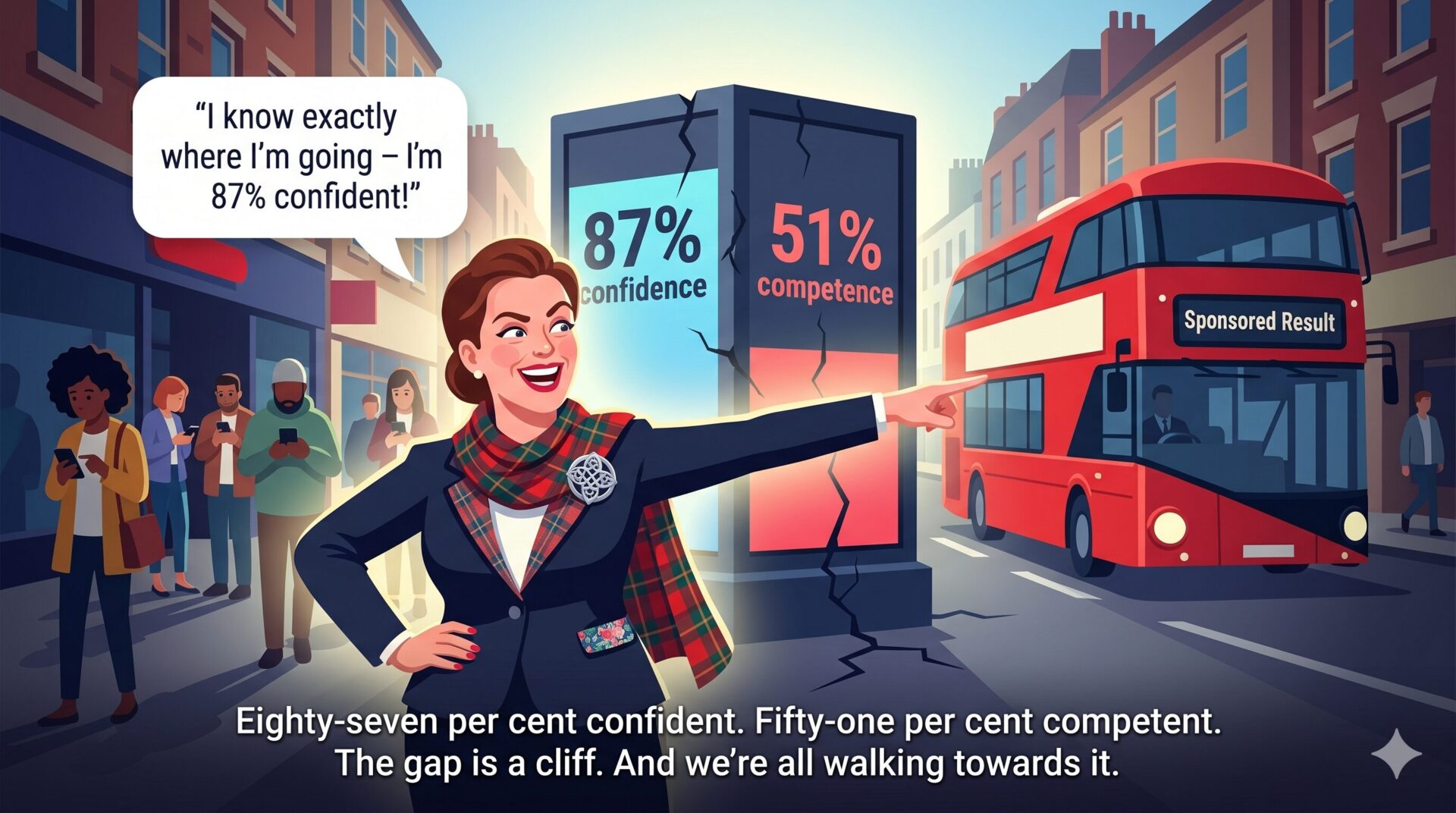 That’s not your fault. That’s design. That’s years of conditioning. That’s billions of pounds spent on making interfaces that exploit your cognitive biases rather than respecting your autonomy.
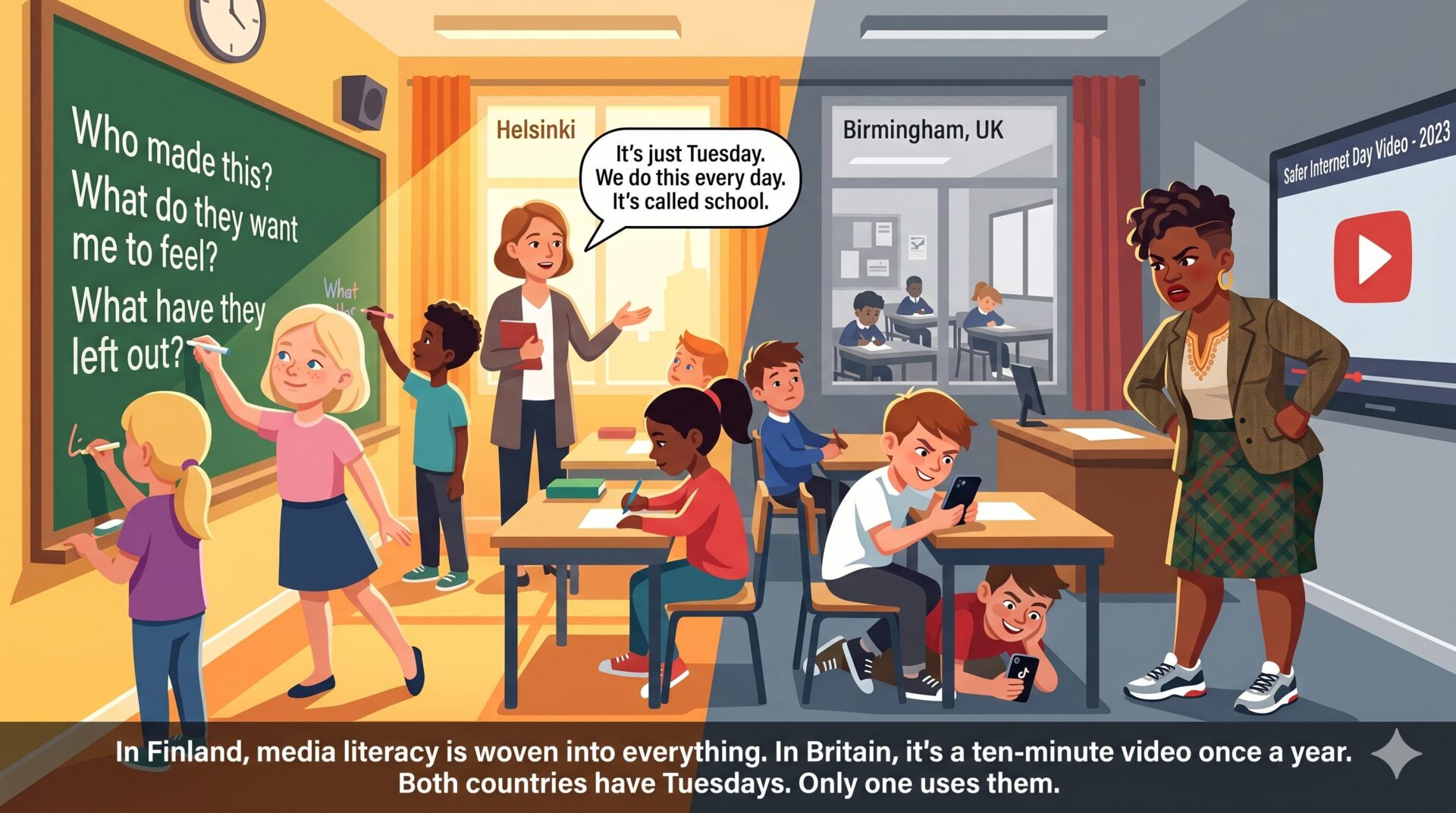 We don’t teach this. We don’t teach any of this. The national curriculum mentions media literacy in passing, in the context of online safety, in the context of “being discerning.” But there’s no specific requirement to explain search engine advertising. No mandatory lesson on sponsored links. No Ofsted inspection criteria covering the difference between organic and paid results.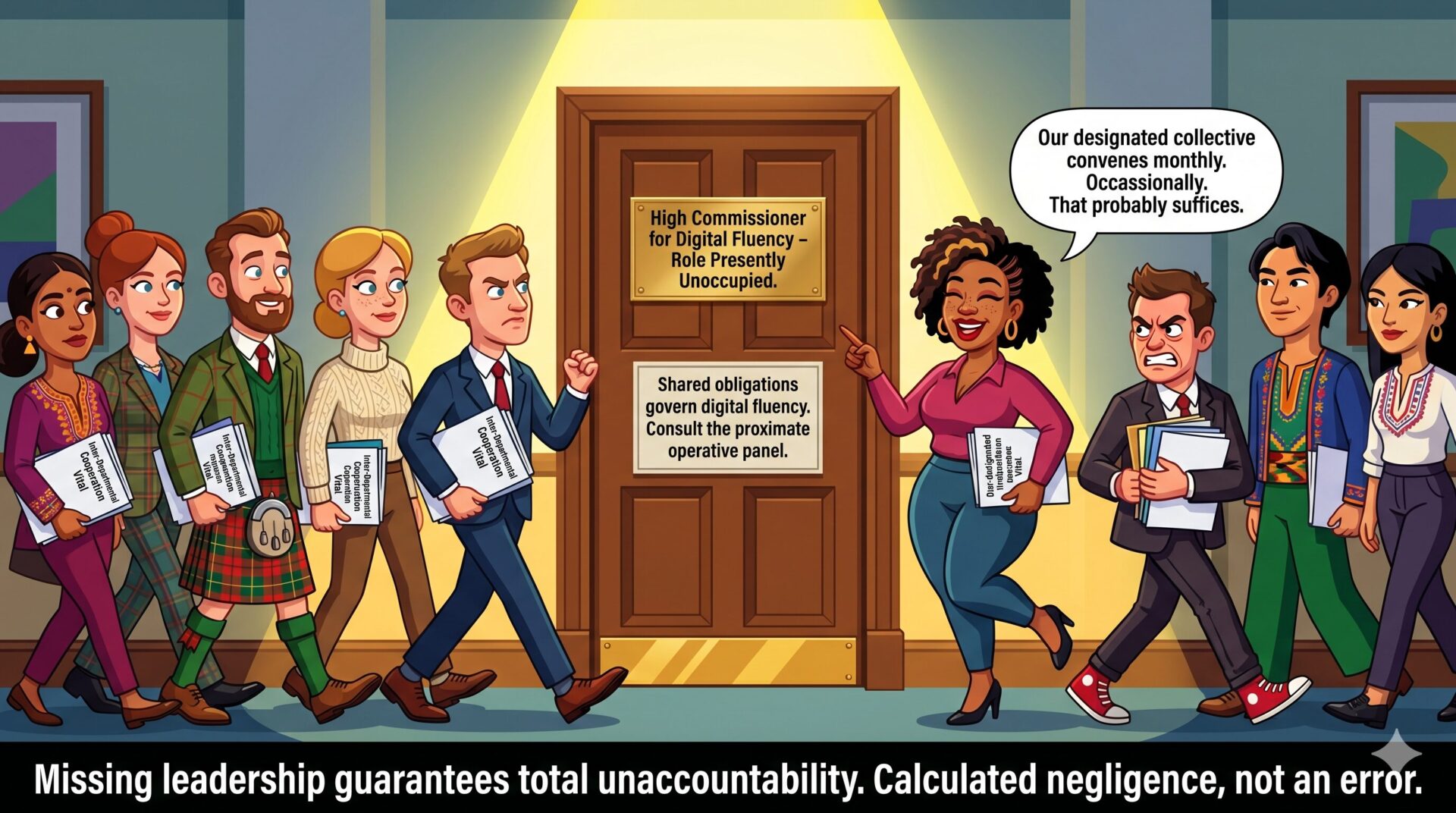
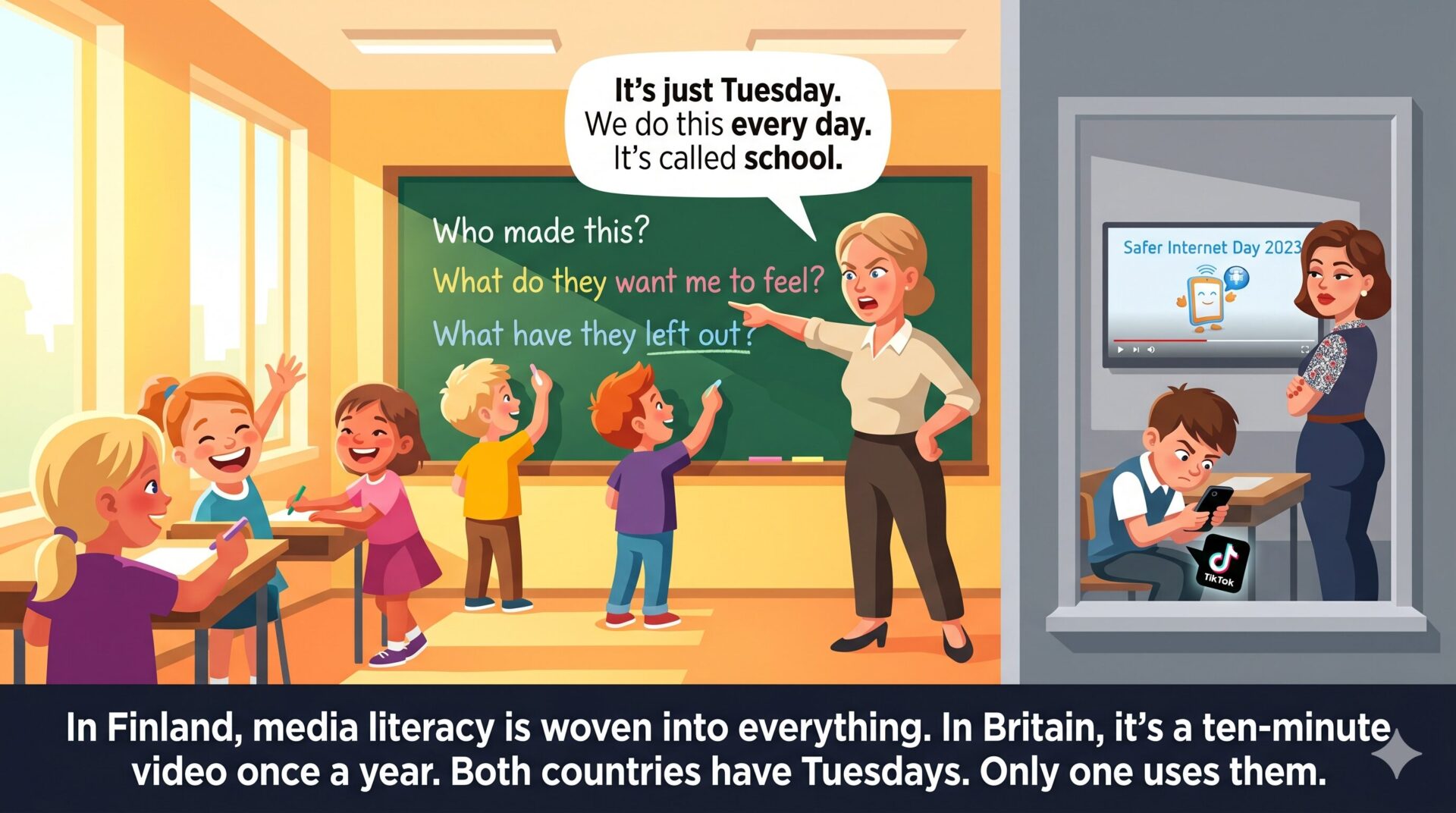 But most of them forgot within a week. Because the lesson was one lesson. Because media literacy is not embedded across the curriculum. Because the platforms are teaching them every single day, for hours at a time, and Sarah only had forty minutes.
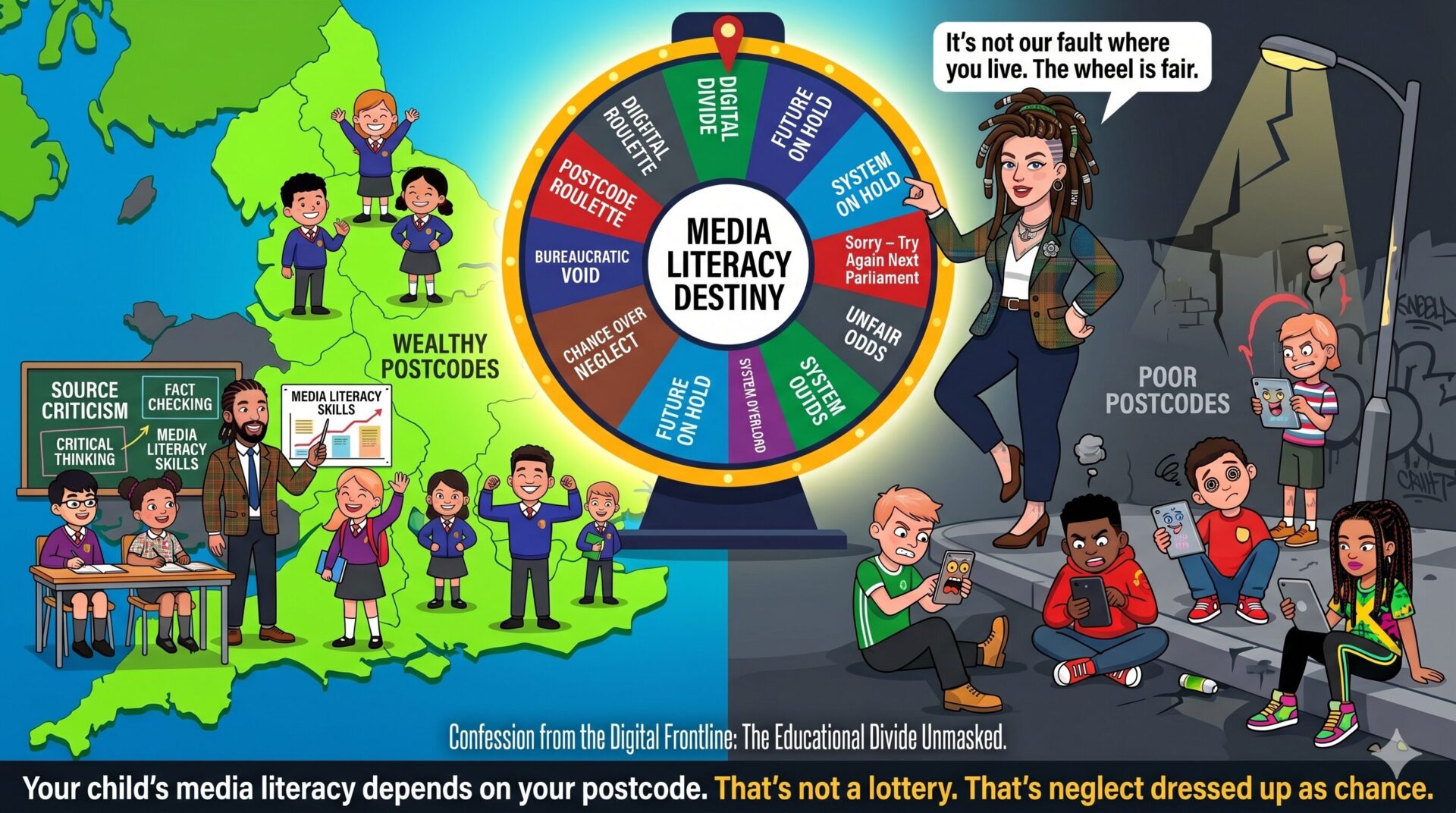 And now it’s manifesting in our digital lives. Eighty-seven per cent of us feel confident online. Eighty-seven per cent. That’s not a statistic. That’s a national delusion. That’s the collective shrug of a country that would rather be wrong and certain than right and uncertain.
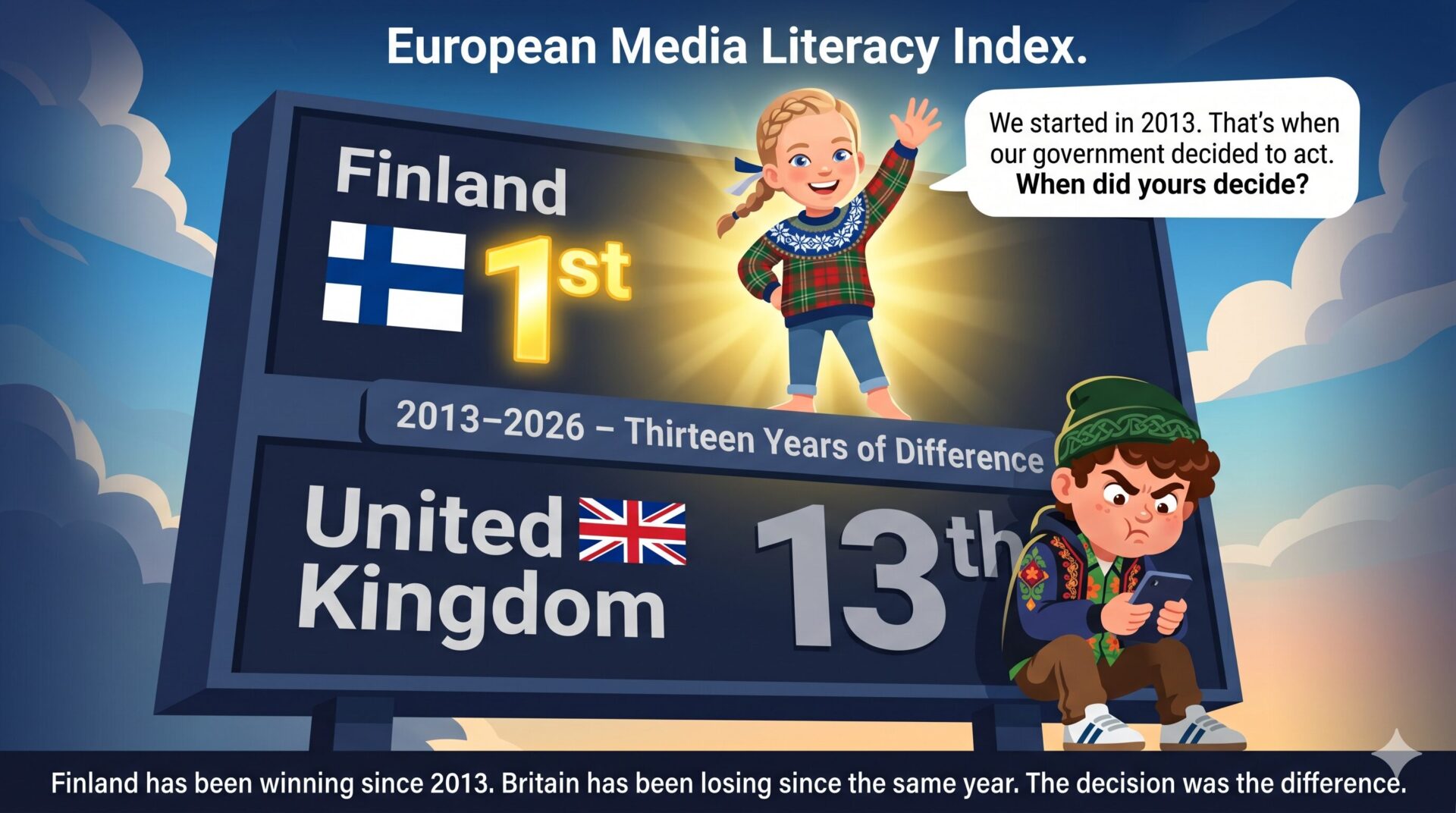 The Finns embedded media literacy as a cross-curricular competency called “multiliteracy.” Every subject teacher is responsible for it. History teachers teach source criticism. Science teachers teach evidence evaluation. Art teachers teach visual manipulation. It’s not an add-on. It’s not a pilot. It’s not a project that might lose funding when the government changes.
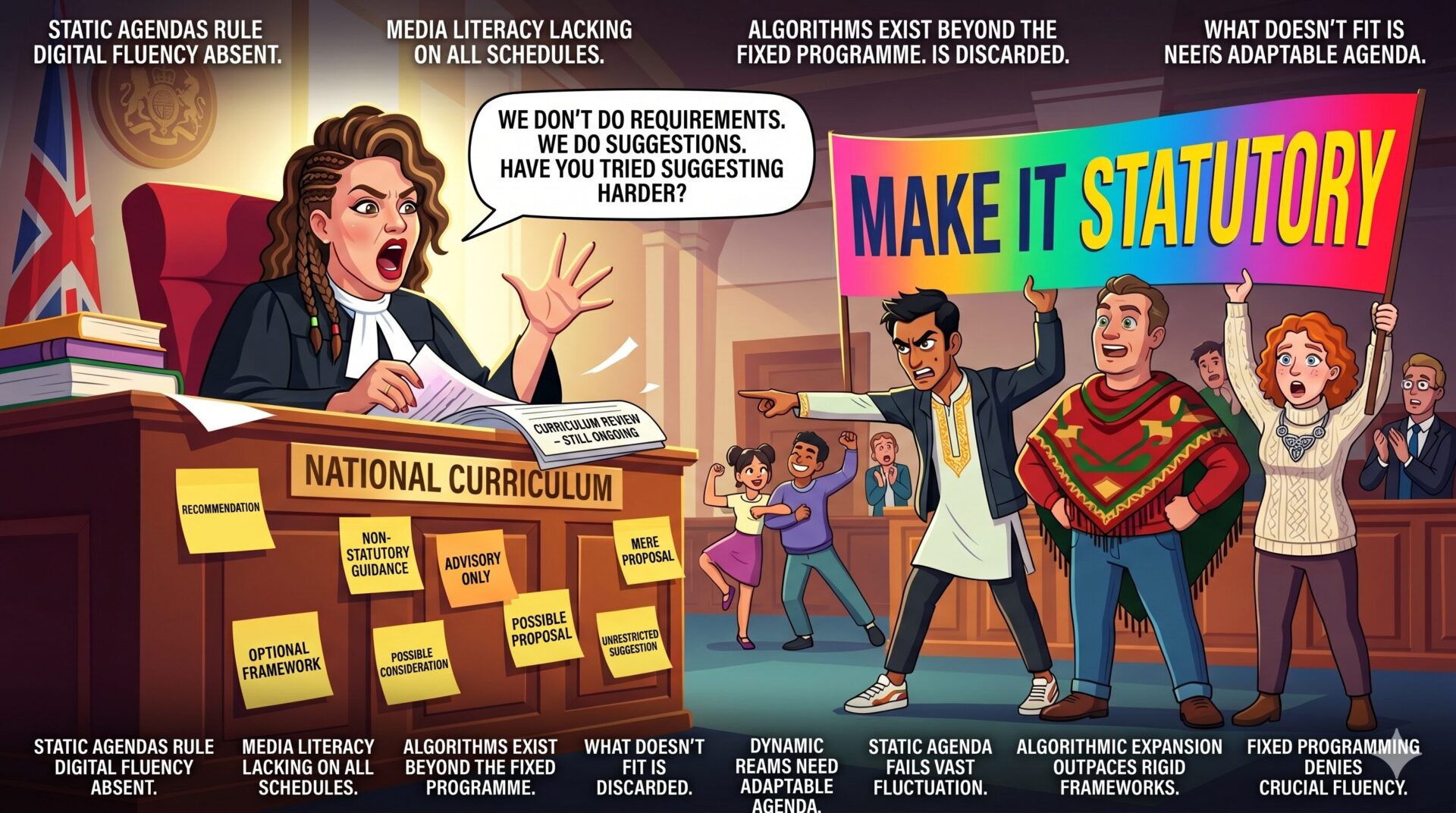 It would start in early years. Not at GCSE. Not as a one-off assembly. From age five, children would learn that not everything they see is true. That some people lie. That some people are paid to lie. That the internet is not a neutral space but a battlefield where their attention is the prize.
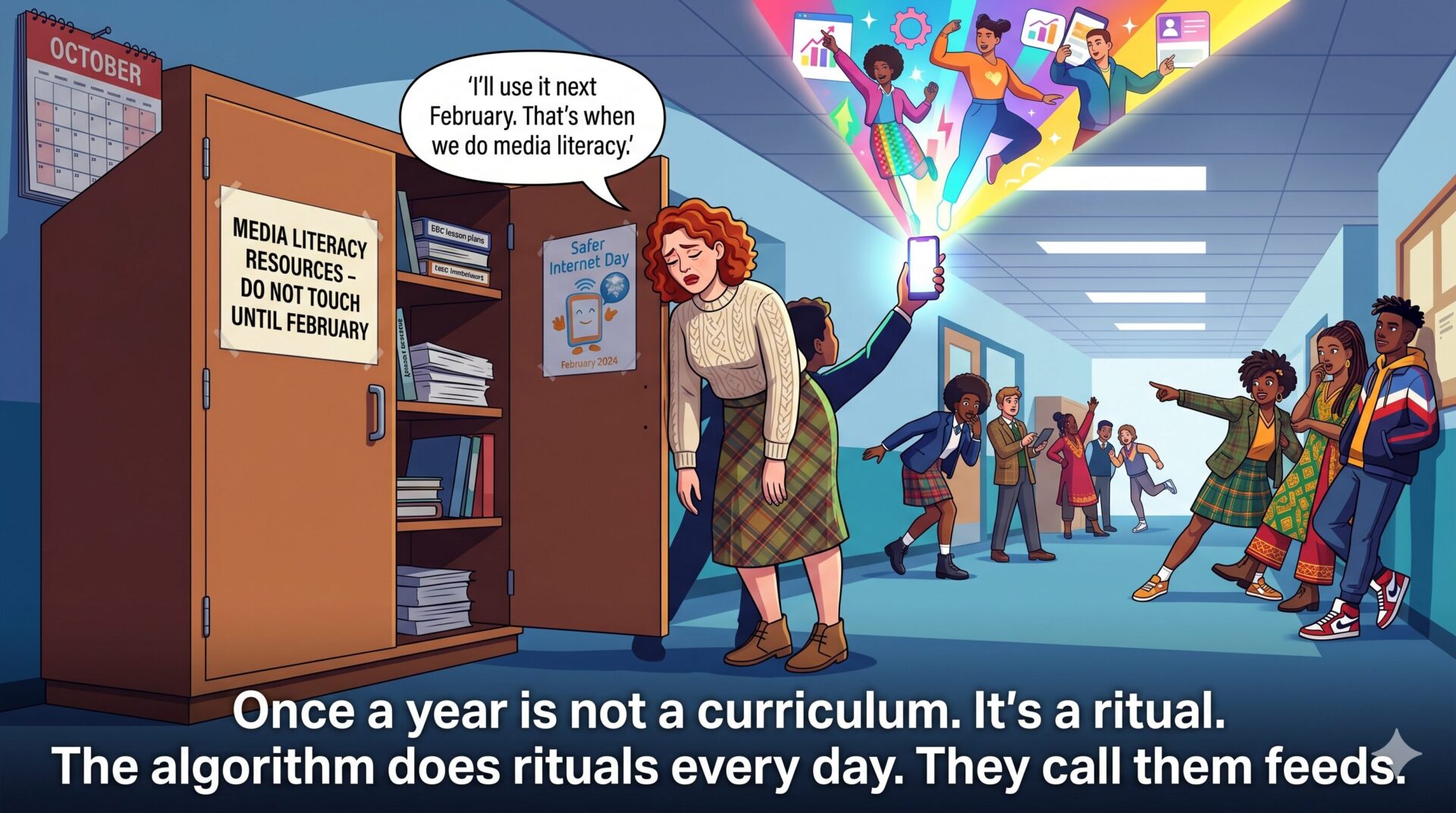 The students laughed. They said the study was old. They said it didn’t apply to them. They said they were different.
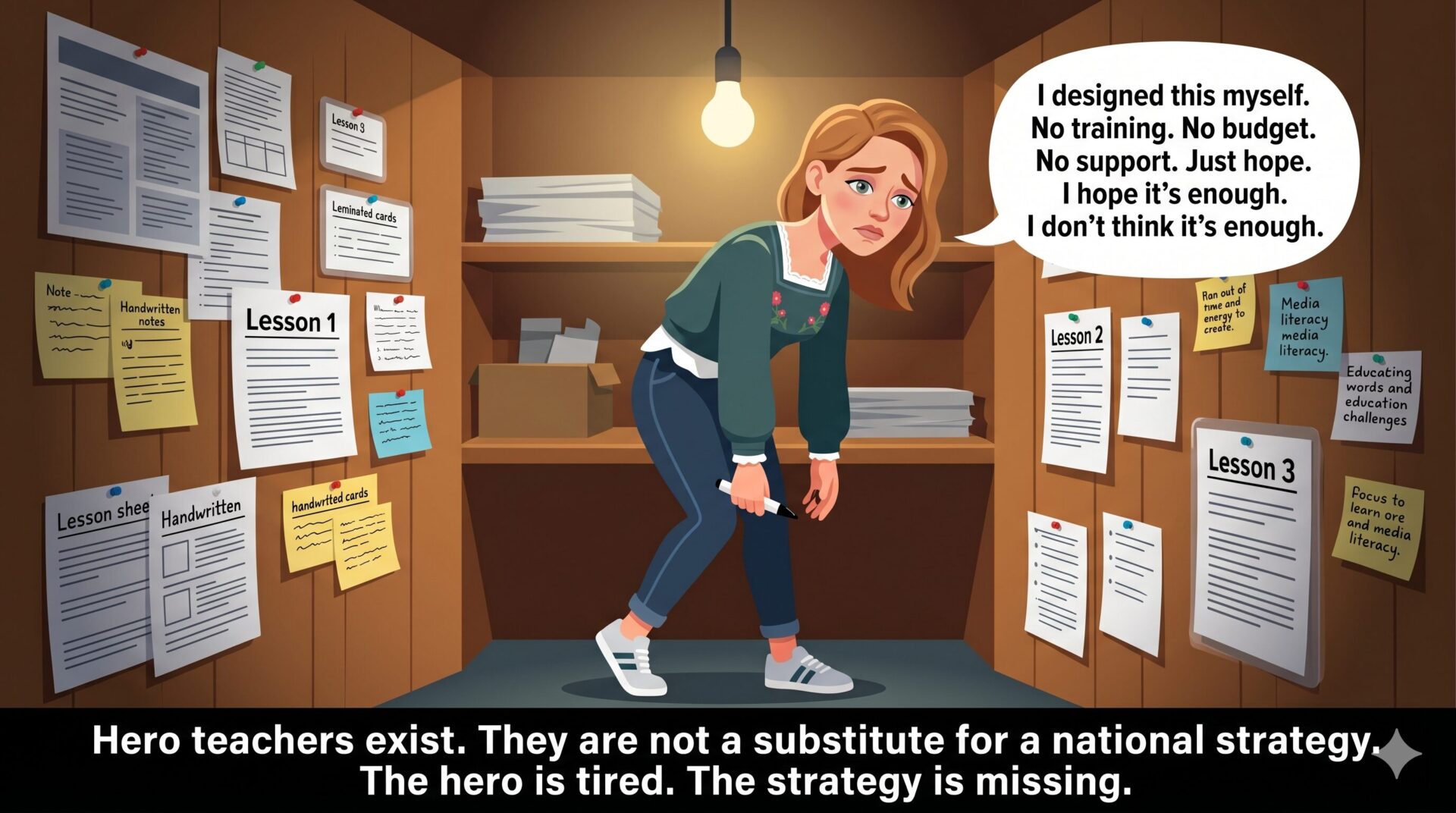 And our national overconfidence — our insistence that we’re fine, that we don’t need media literacy, that the Finnish approach is for other countries — is a class weapon. It’s a way of saying that the people who are suffering don’t matter. That their ignorance is their own fault. That they should have been more careful.
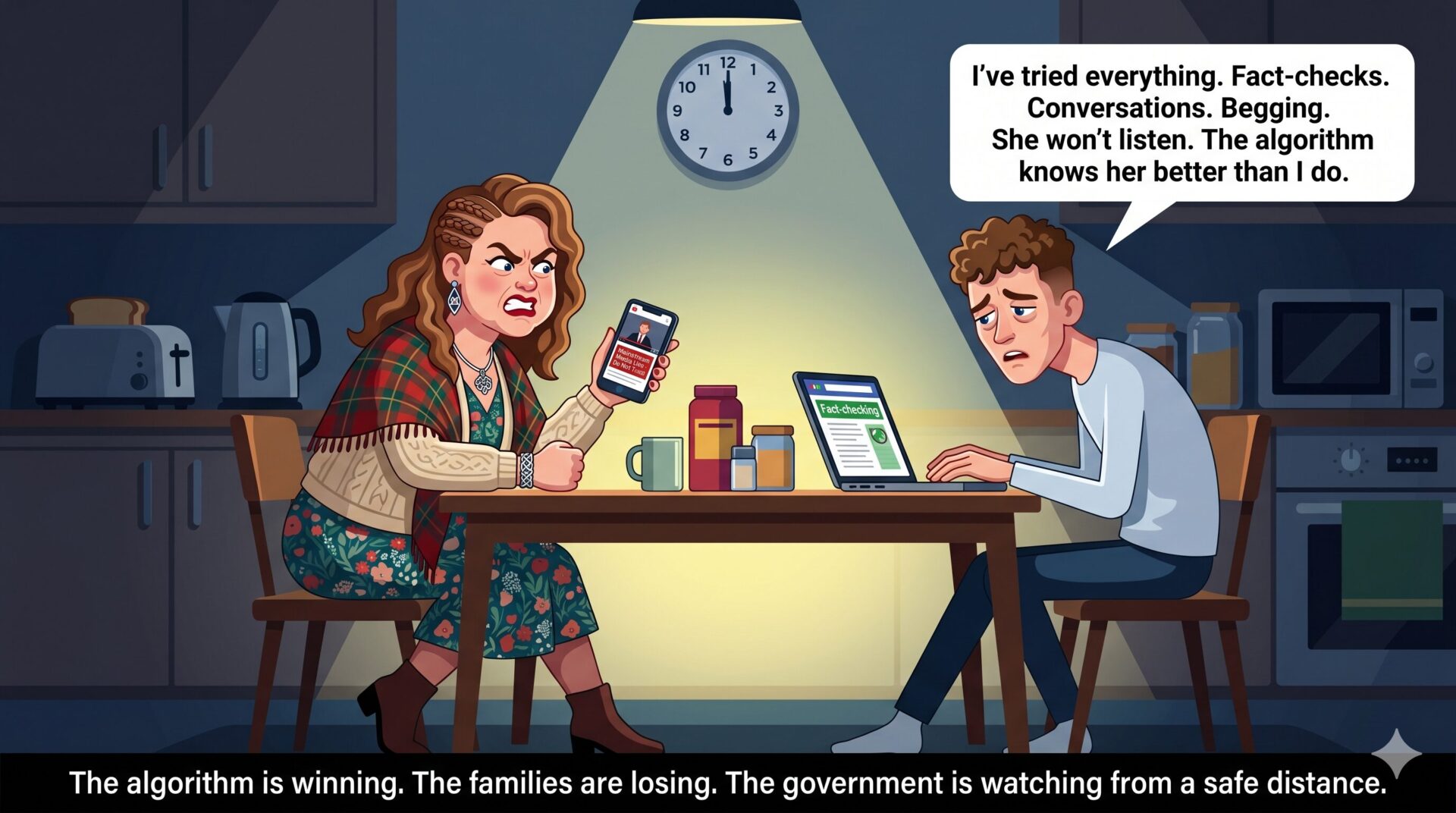 Margaret now spends two hours a day on TikTok. She’s discovered the “For You” page. She’s following seventeen influencers — financial advisors, health gurus, political commentators — none of whom are qualified to advise anyone on anything. She’s shared eight videos this week. She’s believed everything she’s seen.
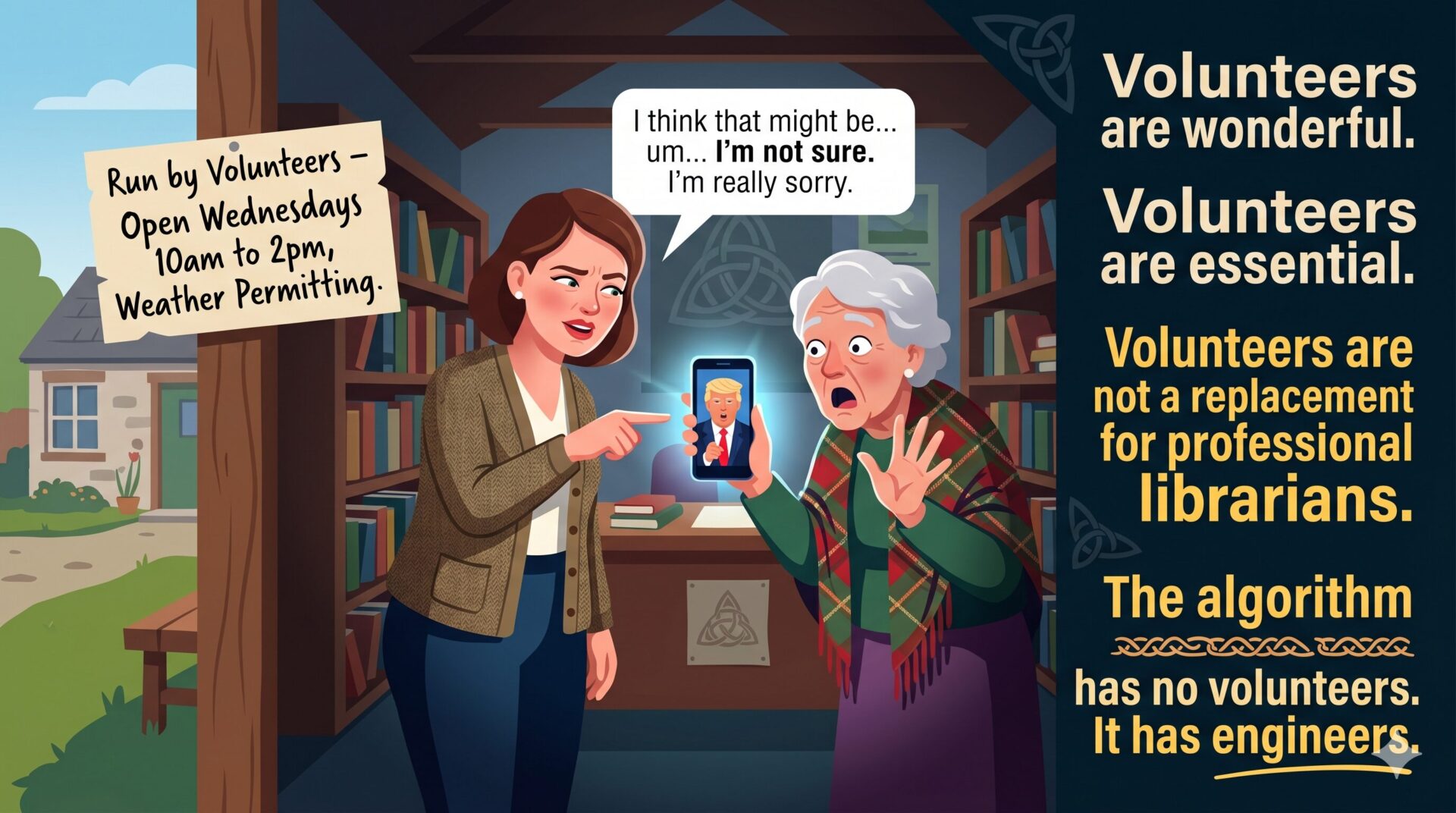 And TikTok — the app that was once the exclusive domain of teenagers dancing in their bedrooms — has noticed. The over-fifties are now the fastest-growing demographic on the platform. They’re joining in droves. They’re scrolling for hours. They’re sharing, commenting, believing.
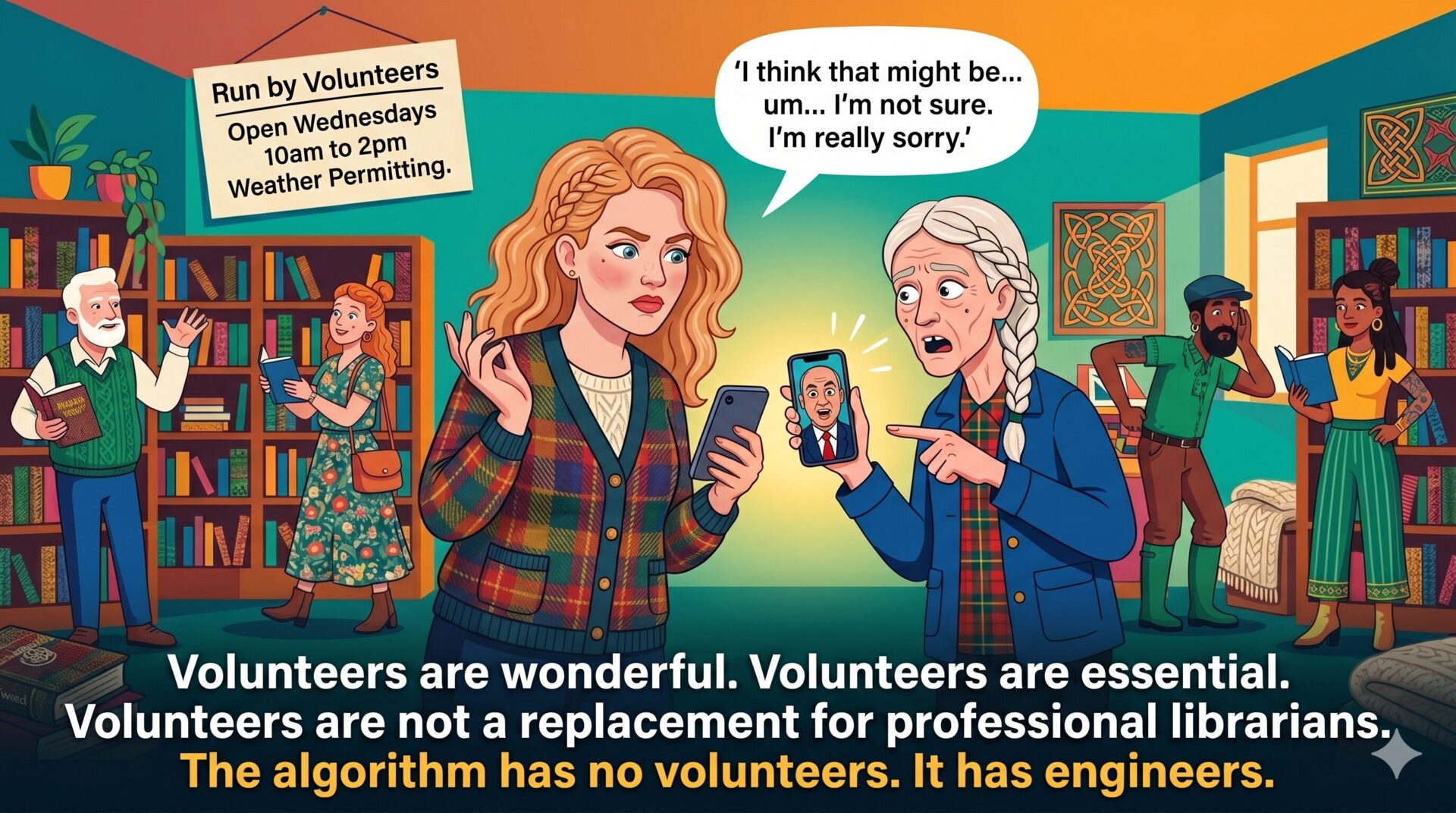 So the over-fifties are not just more vulnerable because of their age. They’re more vulnerable because they’re new. Because they haven’t built the algorithmic immune system that comes from years of exposure. Because they’re walking into a minefield without a map and being told it’s a meadow.
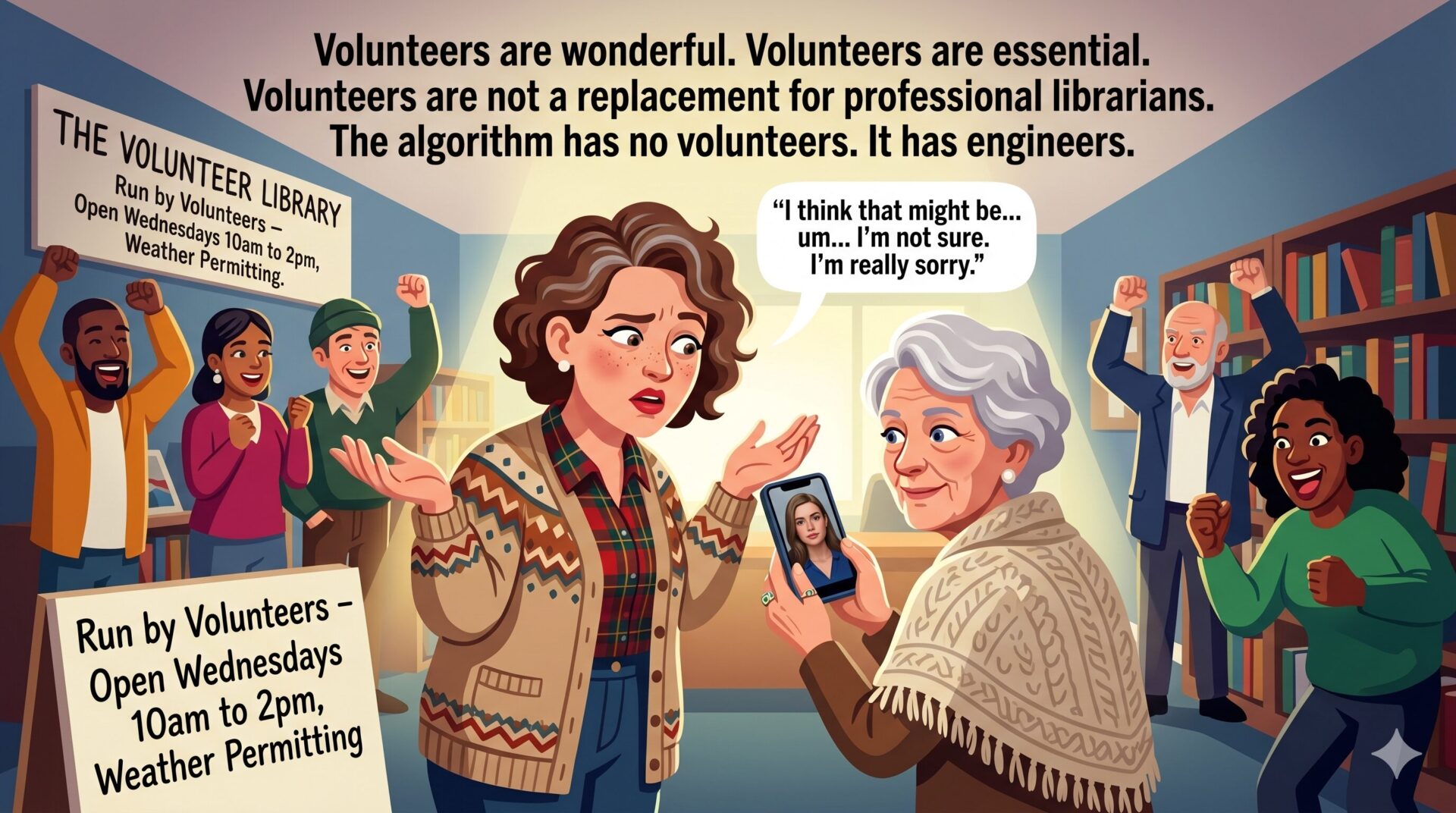 But that logic ignores the vulnerable people right now. The grandparents who are on TikTok today, not in ten years. The pensioners who are being scammed this week, not next decade. The older adults who are sharing misinformation at this very moment while their children are at work and their grandchildren are at school.
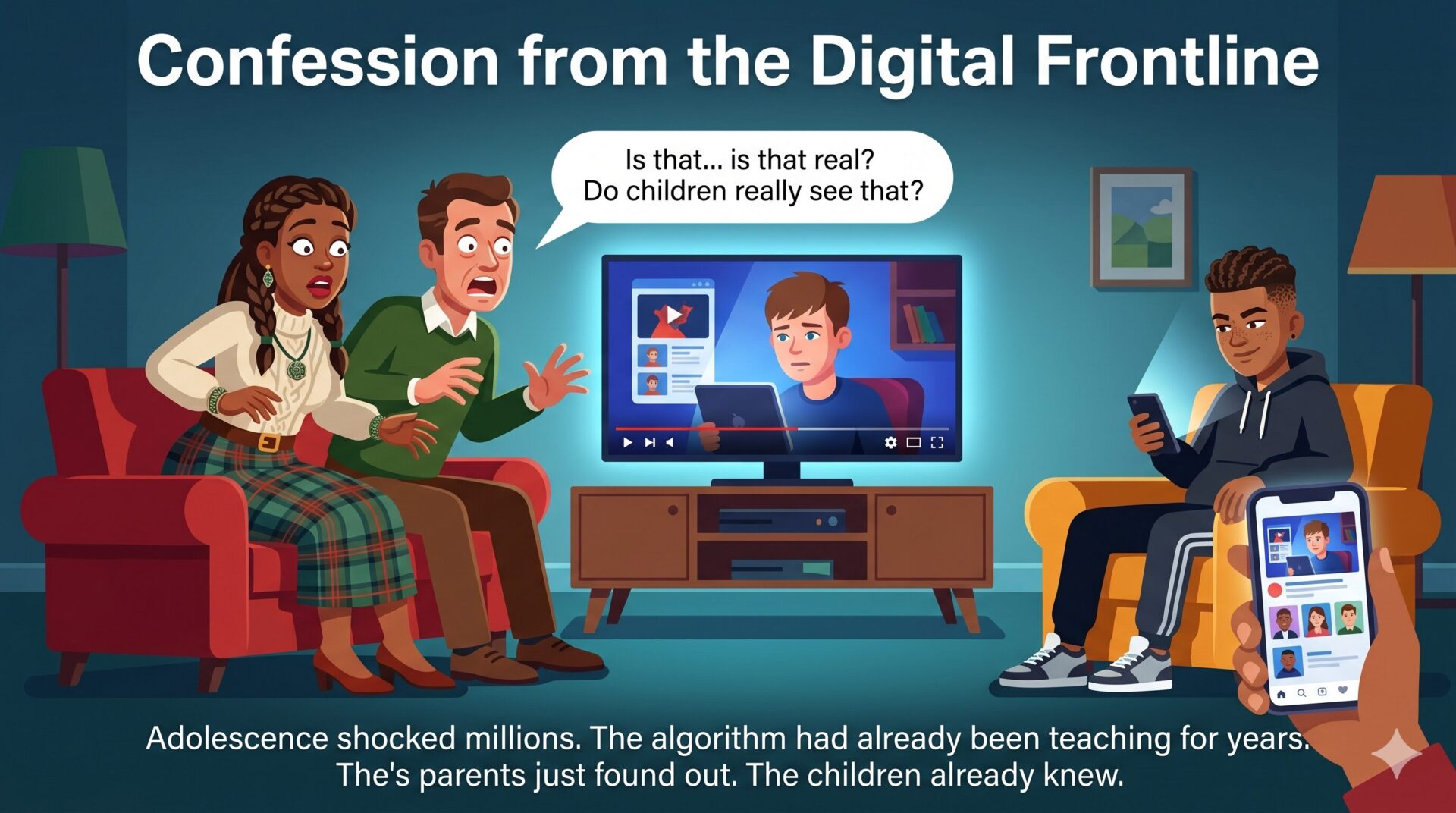 James is exhausted. He works full-time. He has two children. He doesn’t have the energy to fight his mother’s algorithm every single day.
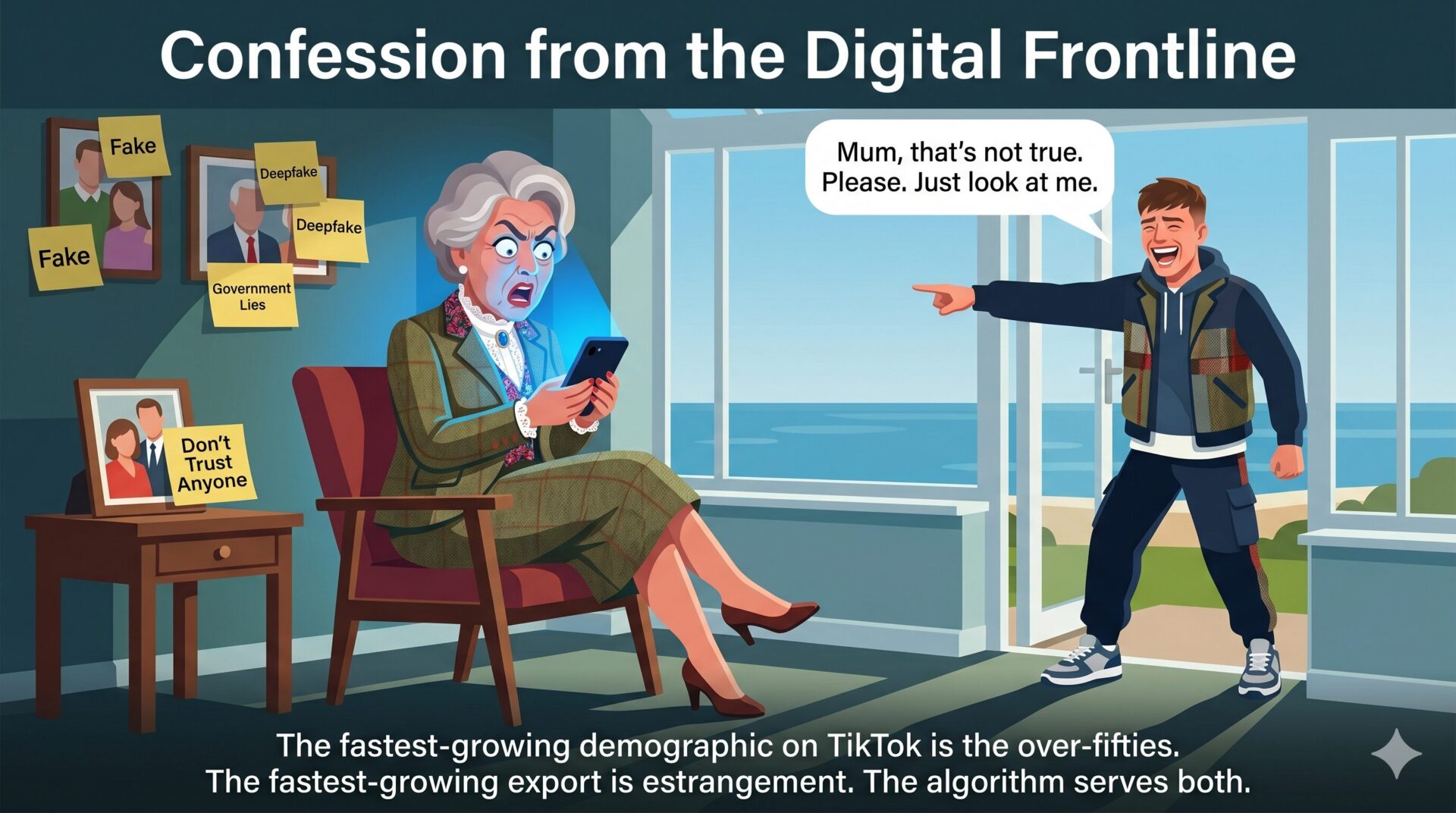 It doesn’t. Because that would reduce engagement. Because that would cost money. Because that would require admitting that the current system is harming people.
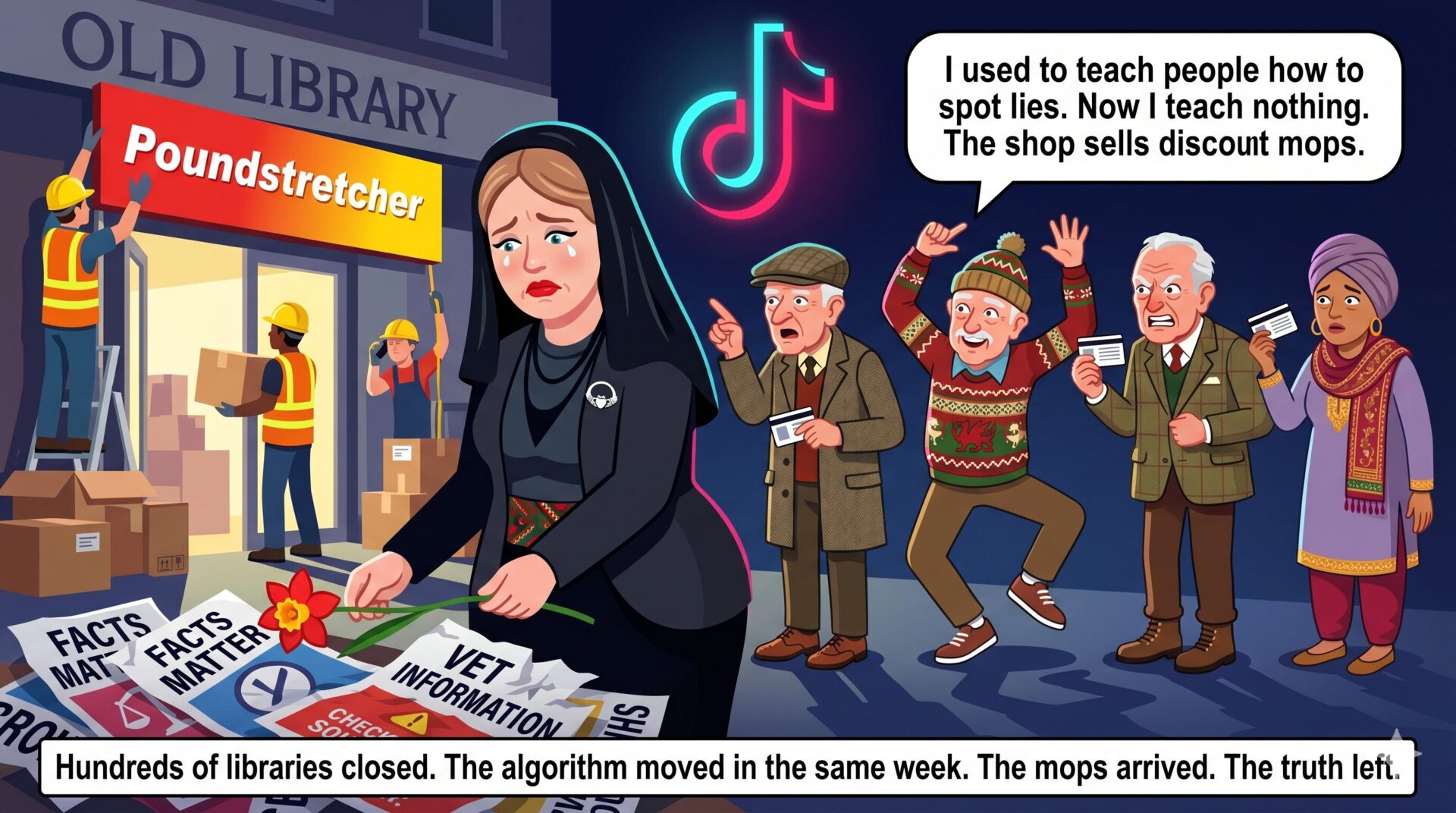 A world where Age UK partnered with TikTok to create a “safe onboarding” process for older users. A world where the government funded a public awareness campaign specifically targeting pensioners, using channels they trust: television, radio, the newspaper.
The Platform Problem
The Outrage Factory
“If it bleeds, it leads” — and if it enrages, it engages.
Let me tell you about a video that went viral last Tuesday. It showed a group of teenagers setting fire to a British flag outside a town hall in somewhere-that-sounds-like-Bradford-but-could-be-anywhere. The comments section exploded. Thousands of people demanded the army be brought in. Politicians issued statements. News channels ran the footage on a loop.
Here’s what the video didn’t show: it was three years old. It was from a protest that had been peaceful until a handful of idiots got involved. The flag was a cheap polyester thing bought from Amazon for a fiver. And the teenagers had been arrested, charged, and sentenced before the current Prime Minister even entered Parliament.
None of that mattered. The video was shared 200,000 times before anyone bothered to check the date. The outrage was real. The damage was done. And the platform — whichever one it was, take your pick — made a fortune.
Because algorithms don’t care about accuracy. They don’t care about context. They don’t care about the truth. They care about one thing and one thing only: keeping you watching.
And nothing keeps you watching like outrage.
The Architecture of Anger
Let’s get technical for a moment. Behind every social media feed is a piece of code called a recommender algorithm. It’s not neutral. It’s not passive. It’s not some passive pipe carrying information from point A to point B like a digital postal service.
It’s a hunter. It’s a predator. It’s a machine learning system that has been trained on billions of data points to do one thing: maximise the time you spend on the platform.
That’s its job. That’s its only job. That’s what its creators programmed it to do. That’s what the shareholders demand it do.
And here’s what the algorithm has learned: outrage works.
A neutral headline gets a click. A positive headline gets a share. But an outrageous headline — something that makes your blood pressure spike, your jaw clenches, your fingers itch to type a furious comment — that gets everything. Click, share, comment, react, return, repeat.
The algorithm doesn’t know what outrage is. It doesn’t understand the content. It just sees the numbers. Engagement up. Time on site up. Ad revenue up.
So it serves more outrage. More conflict. More fear. More fury. It finds the edges of your tolerance and pushes past them. It finds the topics that make you angry and doubles down. It turns your feed into a firehose of provocation, because provocation is profitable.
“Give a man a fire, and he’s warm for a day; set a man on fire, and he’s warm for the rest of his life” — and the algorithm has learned that setting you on fire is good business.
The Test That Changed Everything
A few years ago, Facebook ran an experiment. They didn’t tell anyone they were running it. They just tweaked the algorithm for a subset of users, reducing the amount of outrage content in their feeds.
The result? Those users spent less time on Facebook. They engaged less. They clicked less. They shared less.
Facebook turned the outrage back on.
This is not a conspiracy theory. This is not some fringe accusation from a disgruntled academic. This is documented. This is admitted. This is how the platform works.
The algorithm is not broken. It’s not malfunctioning. It’s not accidentally amplifying outrage. It’s doing exactly what it was designed to do. The problem is not the code. The problem is the goal.
If the goal was accuracy, the algorithm would look entirely unique. It would prioritise verified sources. It would deprioritise unknown accounts. It would slow down the spread of unsubstantiated claims until they could be checked. It would bore you — because accuracy is often boring — and you would spend less time on the platform, and the platform would make less money.So the goal is not accuracy. The goal is engagement. And engagement, in the current information environment, means outrage.
The Brexit Blueprint
Remember Brexit? Of course you do. We’ve only just stopped arguing about it.
During the referendum campaign, a study analysed millions of Facebook posts about the EU. The posts that got the most engagement weren’t the balanced ones. Weren’t the factual ones. Weren’t the ones that acknowledged nuance and complexity.
They were the outrageous ones. The lies about Turkey joining the EU. The lies about £350 million a week for the NHS. The lies about EU bureaucrats banning bendy bananas and prawn cocktail crisps.
The algorithm amplified these lies because the algorithm amplifies engagement. It didn’t know the lies were lies. It didn’t care. It just saw that people were clicking, sharing, commenting, and it served more of the same.
By the time the fact-checkers caught up, the damage was done. The lies had been seen by millions. The truth — the boring, nuanced, complex truth — had been seen by thousands.
The referendum was won on the back of algorithmically amplified outrage. Not by a foreign power — though they certainly helped — but by the platforms’ own profit-maximising code.
“For want of a nail, the shoe was lost” — for want of an algorithm that prioritised accuracy over engagement, the European Union was lost.
The Southport Smokescreen
July 2024. Three little girls murdered at a dance class. A nation in mourning. And within hours, the outrage machine had spun up a completely false narrative about the suspect.
He was a Muslim asylum seeker. He was on a watchlist. He had arrived on a small boat last year. The government was covering it up. The media was lying.
None of it was true. None of it had ever been true. But the algorithm didn’t care. Outrage is outrage. Engagement is engagement. The fake narrative spread faster than the truth, because the fake narrative was designed to provoke anger.
Riots followed. Hotels were attacked. Libraries were set on fire. Police officers were hospitalised. Communities were terrorised. All because an algorithm decided that outrage was more profitable than accuracy.
The platforms did nothing. They issued statements expressing concern. They removed some of the most egregious content — after it had already been shared millions of times. They promised to do better next time.
There will be a next time. There is always a next time. Because the algorithm hasn’t changed. Because the profit motive hasn’t changed. Because the platforms are still optimising for outrage.
The Business Model in Plain Sight
Let’s read the terms of service. Go on. Open any social media app and scroll to the bottom. Find the part where they explain how they make money.
You won’t find it. Not in plain English. Not in a way that normal people can understand. Because if you understood how they make money, you might stop using the app.
They make money by selling your attention. Advertisers pay to show you things. The more time you spend on the platform, the more ads they can show you. The more you engage, the more valuable your attention becomes.
That’s it. That’s the whole business model. It’s not complicated. It’s not mysterious. It’s just ugly.
To maximise your time on the platform, the algorithm needs to keep you engaged. It has learned that positive content has diminishing returns. After a few cute cat videos, you get bored. After a few heartwarming stories, you scroll away.
But outrage? Outrage doesn’t have diminishing returns. It escalates. One outrageous video makes you angry. The algorithm serves another, even more outrageous. You get angrier. It serves another. You get angrier still.This is not an accident. This is design. This is the architecture of addiction, optimised for fury instead of dopamine, because fury is stickier. Fury keeps you coming back. Fury makes you refresh the feed just to see what new outrage has appeared.
“The love of money is the root of all evil” — and the love of ad revenue is the root of the outrage economy.
The Journalist’s Lament
A journalist I know — let’s call her Sarah — used to work for a local newspaper in the Midlands. She wrote about council meetings, school fetes, planning applications. Important stuff. Boring stuff. The stuff that holds communities together.
Her paper went under in 2018. She now works for a national news website. Her job is to find the most outrageous content on social media and write articles about it. “This is what people are saying about X” — where X is a celebrity, a politician, a news event.
She hates it. She knows she’s amplifying the outrage. She knows she’s giving a platform to the worst voices. She knows she’s part of the problem.
But her editor demands it. Because the outrageous articles get the clicks. The balanced articles don’t. The furious comment sections drive engagement. The reasonable discussions don’t.
Sarah has tried to write different stories. Investigative pieces. Long-form journalism. The stuff she trained for. The stuff she’s good at.
They get a fraction of the traffic. Her editor has told her to stop wasting time.
So Sarah writes about outrage. She reads the comments — the racist, misogynist, conspiracy-addled comments — and she feels sick. But she has a mortgage. She has children. She can’t afford to quit.
She’s not the enemy. She’s a casualty. The algorithm ate her career and turned her into a cog in the outrage machine.
The Comment Section as Confessional
Let’s talk about the comments. Because the comments are where the algorithm’s work becomes visible.
Scroll down any viral post on any platform. What do you see? At the top, the most outrageous comments. The ones that got the most reactions. The ones that sparked the most arguments.
Because the algorithm doesn’t sort comments by quality. It doesn’t sort by accuracy. It doesn’t sort by civility. It sorts by engagement. And nothing drives engagement like a good fight.
So the thoughtful comment — the one that adds nuance, that acknowledges complexity, that asks a genuine question — sinks to the bottom. The angry comment — the one that calls someone a traitor, a snowflake, a sheep — rises to the top.
This is not a community. This is a gladiatorial arena. The algorithm is the crowd, cheering for blood. The commenters are the gladiators, fighting for attention. And the platform is the emperor, thumb up or thumb down based not on justice but on profit.
“A house divided against itself cannot stand” — but a house divided against itself generates phenomenal engagement metrics.
The Teenager’s Education
There’s a sixteen-year-old in Liverpool. Let’s call him Kyle. He’s been on social media since he was eleven. He’s seen thousands of outrageous videos. He’s learned that the way to get attention is to be outrageous himself.
Kyle doesn’t believe half of what he shares. He doesn’t disbelieve it either. He just doesn’t think about it. He shares what gets reactions. He comments what gets likes. He performs outrage because outrage is the currency of his digital world.
Kyle is not a bad kid. He’s a product of his environment. His environment is an algorithm that has spent five years training him to prioritise outrage over accuracy, engagement over truth, performance over principle.
He doesn’t know any other way. No one has taught him. His school doesn’t cover media literacy. His parents don’t understand social media. The platforms certainly aren’t going to tell him that their business model is exploiting his emotions.
So Kyle keeps performing. He keeps sharing. He keeps the outrage machine well-oiled with his teenage fury.
And when he’s old enough to vote, he’ll bring that same performative outrage to the ballot box. Not because he’s evil. Because he’s been trained.
The Solution That Isn’t
You might think the solution is regulation. Force the platforms to change their algorithms. Make them prioritise accuracy over engagement. Break the outrage machine.
The Online Safety Act tries to do some of this. It gives Ofcom powers to demand information, to fine companies, to hold them accountable. But the Act focuses on illegal content — child abuse, terrorism, hate speech. Outrage is not illegal. Lying is not illegal. Manipulating people’s emotions for profit is not illegal.
It should be. But it’s not.
And even if it were, the platforms would find a way around it. They always do. They hire armies of lawyers and lobbyists. They design their systems to comply with the letter of the law while violating its spirit. They treat regulation as a tax on their business model, not a constraint on their behaviour.
The real solution is more radical. It’s also simpler: stop using them.
But we won’t. Because they’re free. Because everyone else is on them. Because we’re addicted. Because the outrage, for all its toxicity, is also intoxicating.
“The chains of habit are too weak to be felt until they are too strong to be broken” — and we are wearing chains made of outrage, forged by algorithms, paid for by advertisers.
The Finnish Exception
Finland has the same platforms we do. The same algorithms. The same profit incentives.
But Finnish citizens are less vulnerable to outrage. Not because they’re smarter. Because they’ve been taught to recognise manipulation.
Finnish schools teach children to ask: who made this? Why did they make it? What do they want me to feel? What do they want me to do?
These questions are not complicated. They don’t require advanced technical knowledge. They just require a habit of mind. A scepticism that has been baked in from an early age.
A Finnish teenager sees an outrageous video and pauses. They don’t share it immediately. They check the source. They consider the motive. They ask whether the outrage is justified or manufactured.
A British teenager sees the same video and shares it before they’ve finished watching. Because that’s what the algorithm has trained them to do. React first. Think never.
The difference is not the platform. The difference is the education.
The Final Outrage
Here’s the thing that should outrage you the most: we know all this. The research is clear. The data is overwhelming. The evidence has been presented to Parliament, to Ofcom, to the government.
And nothing changes.
The platforms keep optimising for outrage. The algorithms keep amplifying lies. The government keeps forming working groups. Ofcom keeps publishing reports. The media literacy sector keeps running pilots.
Outrage keeps selling. Lies keep spreading. Democracy keeps eroding.
And the only people who benefit are the shareholders of the platforms. The ones who made their billions on the back of your anger. The ones who turned your feed into a firehose of fury because fury is profitable.
“What does it profit a man to gain the whole world and lose his soul?” What does it profit a platform to gain billions while losing democracy?
The answer, apparently, is quite a lot.
Because the outrage keeps flowing. The ads keep rolling. The shareholders keep cashing their cheques. And we keep scrolling, keep commenting, keep sharing, keep believing that the next video will be the one that finally makes us stop.
It won’t. The algorithm won’t let it. Because the algorithm is not neutral. It never was. It’s a weapon. It’s aimed at your amygdala. And it’s been firing since the day you signed up.
“The only thing necessary for the triumph of evil is that good men should do nothing” — and we have done nothing. We have scrolled past the evil. We have commented on the evil. We have shared the evil. We have been the vectors, the carriers, the unpaid labour force of the outrage economy.
And the algorithm thanks us. With every click, every share, every furious comment, we make it stronger. We make it richer. We make it more effective at the only thing it was ever designed to do: keep us watching, keep us angry, keep us here.
Here, on this feed. This bottomless feed. This outrage machine disguised as a social network.
We built it. We feed it. We fuel it.
And we are the ones burning.
The Half-Truth Society
“Believe none of what you hear and half of what you see” — but these days, even half is too much.
Close your eyes. Picture a pub. Any pub. The Queen’s Head in Wolverhampton. The Crown in Carlisle. The Old Ship in Brighton. It’s Friday night. The place is half-full. Twenty people, let’s say. Nursing pints. Scrolling phones. Chatting about the week.
Now open your eyes. Here’s the statistic that should make you drop your glass: ten of those twenty people have encountered a misleading or untrue news story on social media in the last twelve months. Not ten of the people who are politically engaged. Not ten of the people who spend hours online. Ten ordinary people. Ten regulars. Ten Britons minding their own business.
Forty-nine per cent. Nearly one in two. The coin flip of misinformation.
You walk into that pub, you point at someone at random, and you’ve got almost even odds that they’ve been lied to online in the past year. Not lied to by a friend in a private message. Not lied to by a shady website they deliberately visited. Lied to by the algorithm. Served a falsehood alongside the cat videos and the celebrity gossip. Deceived without even knowing it.
And those are just the ones who know they’ve been lied to. The real number — the people who have encountered misinformation and believed it — is almost certainly higher. Much higher. Because most people don’t fact-check. Most people don’t question. Most people scroll, absorb, move on, their brains quietly updated with something that isn’t true.
“A lie can run around the world before the truth has got its boots on” — but these lies aren’t running. They’re settling in. They’re making themselves at home. They’re redecorating your brain.
The Scrolling Amnesia
Here’s how it works. You’re on the couch. It’s 10pm. You’re tired. You’ve had a long day. You’re half-watching a reality show while scrolling through your phone. An article appears. The headline says something about the government and vaccines and a cover-up. You don’t click. You don’t share. You just… see it. It slides past. The next video is a dog doing a trick. The next is a recipe for banana bread. The next is another headline, this time about pensions being raided.
You don’t remember any of them. You weren’t paying attention. You were scrolling. It was background noise.
But your brain was paying attention. Your brain is always paying attention. It can’t help it. That’s how brains work. They absorb information whether you want them to or not.
So now, somewhere in your memory, there’s a connection between “government” and “vaccine cover-up.” There’s a connection between “pensions” and “being raided.” You don’t believe these things — not consciously. But the connections are there. The seeds have been planted.
Next week, someone mentions vaccine safety. Your brain, without your permission, retrieves that connection. You don’t say anything. You don’t act on it. But you feel a tiny flicker of doubt. A tiny question: maybe there’s something to it? Just maybe?
That’s how misinformation works. Not through dramatic conversions. Not through people suddenly believing the craziest thing they’ve ever heard. Through erosion. Through repetition. Through the slow, steady drip of falsehood into the soil of your subconscious.
Forty-nine per cent have encountered a misleading story. But one hundred per cent have been affected. Because even the stories you don’t believe leave traces. Even the headlines you scroll past change you.
The Mother’s WhatsApp
Let me tell you about a woman in Bristol. Let’s call her Diane. She’s forty-three. She works in a call centre. She has two teenagers. She’s on three WhatsApp groups: one for the parent-teacher association, one for her netball team, one for her street.
Last month, someone in the street group shared a message about a child abductor operating in the area. It had a photo, a description, a police crime reference number. It looked official. Diane believed it. She shared it to the parent-teacher group. She warned her teenagers. She told her neighbours.
It was fake. The photo was from a missing persons appeal in Germany. The crime reference number belonged to a burglary in Manchester. The whole thing was a hoax that had been circulating for three years.
Diane felt stupid. She apologised to the groups. She deleted the message. But the damage was done. Five other parents had already shared it to their own groups. One of them had sent it to her mother, who lived alone and was already anxious about crime.
By the time Diane realised her mistake, the lie had travelled further than she could track. It was out there, living its own life, making its own mischief.
Diane is not stupid. Diane is not gullible. Diane is a normal person who saw something that looked true and shared it because she wanted to protect her community.
She was the forty-nine per cent. And the platform — WhatsApp — made nothing from her mistake. They don’t run ads. They don’t sell her data. But the lie spread anyway, because lies spread faster than truth, and because normal people like Diane are the engine of that spread.
“The road to hell is paved with good intentions” — and Diane’s intention was good. She wanted to keep children safe. She ended up spreading a hoax.
The Confidence Trap
Remember the confidence gap? Eighty-seven per cent of adults feel confident online. Fifty-one per cent can spot a sponsored link. The gap between how we think we’re doing and how we’re actually doing is thirty-six points.
That gap is where misinformation lives. It’s the space between your confidence and your competence. The space where you think you’re safe, but you’re actually vulnerable.
Because the people who know they don’t know — the thirteen per cent who admit they’re not confident — they’re careful. They check things. They ask for help. They don’t share until they’re sure.
The people who are confident but wrong? They’re the ones spreading the lies. They’re the ones who see a headline, think “that looks true,” and share it without a second thought. They’re the ones who believe they can spot misinformation, so they don’t bother checking.Forty-nine per cent have encountered a lie. But the people who shared that lie — the people who turned it from an encounter into an epidemic — were almost certainly in the confident-but-wrong majority.
They didn’t mean to cause harm. They just thought they knew better than they did.
The Pensioner’s Pension
Let’s go back to Margaret. Sixty-seven. Retired. On TikTok. The fastest-growing demographic on the fastest-growing platform.
Margaret has encountered misleading news stories. She doesn’t know she has. She thinks she’s been informed. She thinks TikTok is showing her the truth that the mainstream media is hiding.
Last week, she saw a video claiming that the government was planning to means-test the state pension. That pensioners would have to sell their homes to qualify. That millions would be left with nothing.
She believed it. She shared it to her WhatsApp group. She called her son, James, in a panic. She asked him if she should sell her house now, before the policy was announced.
James spent an hour on the phone calming her down. He showed her the government’s actual policy. He explained that the video was from a fringe political group with no influence. He proved that it was a lie.
Margaret accepted the evidence. But she wasn’t reassured. Because the lie had done its work. The fear had been planted. The trust had been damaged.
She still checks the government’s website every day for news about pension changes. She still wakes up at 3am worrying about losing her home. She still flinches when she sees a headline about pension reform.
The lie was refuted. The truth was established. But the damage was permanent.
“Sticks and stones may break my bones, but words can never hurt me” — is a lie we tell children. Words can hurt. Words can scar. Words can lodge themselves in your brain and never leave.
The Teenager’s Algorithm
Kyle is sixteen. He’s in Liverpool. He’s been on social media since he was eleven. He’s encountered misleading news stories — he just doesn’t know it.
Because the stories he sees aren’t obvious lies. They’re not the “man on the moon was a hoax” type. They’re subtle. They’re the kind of lie that looks like truth, sounds like truth, feels like truth.
A video claiming that crime is up 400 per cent in his city. A post saying that immigrants get priority for council housing. A meme suggesting that the government is planning to lower the voting age to twelve to rig elections.
Kyle doesn’t fact-check these. Why would he? They come from accounts he follows. They get thousands of likes. They’re shared by people he trusts.
So he absorbs them. They become part of his worldview. He starts to believe that crime is out of control. That immigrants are taking everything. That the government is corrupt.
He doesn’t vote yet. But he will. And when he does, he’ll vote based on a worldview that was constructed, piece by piece, by an algorithm optimising for outrage.
Kyle is not a victim in the way Margaret is. He’s not panicking about his pension. But he’s being shaped. Moulded. Recruited. By a machine that isn’t concerned about truth, only engagement.
The Journalist’s Dilemma
Sarah, the journalist from the Midlands, sees the forty-nine per cent statistic every day. She sees it in her comments section. She sees it in the articles she’s assigned to write. She sees it in the stories her colleagues are chasing.
Because the news industry has adapted to the outrage economy. The stories that get clicks are the stories that confirm what people already believe. The stories that get shared are the stories that make people angry.
Sarah was assigned to write about a local council’s new recycling policy. It was a boring story. The council was changing what could be put in which bin. It was mildly inconvenient. That was it.
But her editor told her to find the outrage. Was the council hiding something? Were they secretly increasing council tax? Was there a scandal waiting to be uncovered?
There wasn’t. It was just bins. But Sarah had to write something, so she wrote a piece about “concerns” that some residents had raised. She quoted a few angry comments from Facebook. She implied that the council wasn’t being transparent.
The article got thousands of clicks. The comments section was furious. People who hadn’t read the original policy were now convinced that the council was corrupt.
Sarah felt dirty. But she also felt relieved. Her editor was happy. Her job was safe.
The lie — that the council was hiding something — wasn’t a lie she invented. It was a lie she amplified. A lie that already existed in the algorithm’s suggestion box. A lie that she fed and watered and helped grow.
“The pen is mightier than the sword” — but the algorithm is mightier than both. And the journalist holding the pen is just another node in the network.
The Father’s Failure
James — Margaret’s son — has given up trying to fact-check his mother. It’s not that he doesn’t care. He cares desperately. But he’s tired. He’s been fighting this battle for two years. Every week, a new lie. Every week, a new debunking. Every week, the same cycle.
He’s tried everything. He’s shown her fact-checking websites. He’s explained how to reverse image search. He’s installed browser extensions that flag misinformation. Nothing works. She forgets. Or she doesn’t believe him. Or she thinks he’s part of the conspiracy.
James has started lying to her. When she shares a false story, he doesn’t correct her anymore. He just says “interesting” and changes the subject. He can’t bear the arguments. He can’t bear the tension. He can’t bear watching his mother disappear into a digital rabbit hole while he stands by, helpless.
He knows he’s failing her. He knows he’s part of the problem. But he doesn’t have the energy to be part of the solution.
James is not alone. There are millions of Jameses across the country. Adult children watching their parents be radicalised by algorithms. Feeling guilty. Feeling helpless. Feeling exhausted.
The forty-nine per cent statistic is not just about the people who encounter lies. It’s about the people who love them. Who watch them change. Who lose them, slowly, to a world of falsehoods.
The Regulator’s Response
Ofcom knows about the forty-nine per cent. They published the statistic. They wrote the report. They held the press conference.
And then they… formed a working group. Commissioned more research. Developed voluntary best practice principles. Waited for the government to act.
Twelve people work on media literacy at Ofcom. Twelve. For a population of nearly seventy million. For a problem that affects nearly half of all adults.
Ofcom’s budget for media literacy this year is £1.62 million. That sounds like a lot until you compare it to the platforms’ advertising revenue. Google alone made £200 billion last year. Not million. Billion.
The regulator is outgunned. Outspent. Outmatched. They’re trying to fix a problem with a teaspoon while the platforms cause it with a bulldozer.
And the government? The government’s media literacy strategy expired. The new strategy is folded into the Digital Inclusion Action Plan, where it gets a few paragraphs. The cross-government working group meets monthly but has no real power. The minister responsible for media literacy is not even on the digital inclusion ministerial group.
The forty-nine per cent statistic is not a surprise to Ofcom. It’s not a surprise to the government. It’s not a surprise to anyone who’s been paying attention.
It’s just… inconvenient. Because fixing it would require admitting that the current system has failed. That the voluntary approach isn’t working. That the platforms need to be regulated much more strictly.
And nobody in power wants to admit that.
“A problem shared is a problem halved” — but a problem ignored is a problem doubled. And we have been ignoring this problem for years.
The Finnish Comparison
Finland doesn’t have a forty-nine per cent statistic. They have something lower. Not zero — nothing is zero — but lower. Because they started earlier. Because they taught their citizens how to recognise misinformation. Because they made media literacy a national priority.
The Finnish government didn’t leave it to Ofcom. They didn’t form a working group and hope for the best. They embedded media literacy in the curriculum. They funded public awareness campaigns. They made it everyone’s responsibility.
The result is a population that is harder to fool. Not impossible. Just harder. A population that encounters a misleading story and pauses. That checks the source. That asks who benefits.
In Britain, we encounter a misleading story and share it. Because we’re confident. Because we’re busy. Because the algorithm has trained us to react first and think never.
Forty-nine per cent. Nearly one in two. The coin flip of misinformation.
In Finland, that coin is weighted differently. Still not perfect. Still not safe. But better. So much better.
The Final Tally
Let’s do the maths. UK adult population: about 53 million. Forty-nine per cent of social media users — let’s say 40 million adults use social media, conservatively — that’s 19.6 million people. Twenty million Britons. Encountering a lie. Every year.
Twenty million people who have been shown something that isn’t true. Twenty million people whose brains have been seeded with falsehood. Twenty million people who are now, in some small way, less informed than they were before.
Some of them shared the lie. Some of them believed it. Some of them forgot it. Some of them are still arguing about it with their children.
All of them are part of the story. All of them are casualties of an information environment that prioritises outrage over accuracy, engagement over truth, profit over people.
“United we stand, divided we fall” — and we are divided. Divided by lies. Divided by algorithms that profit from our division. Divided by a system that has learned that the best way to keep us watching is to keep us angry at each other.
Forty-nine per cent. Nearly one in two.
The next time you’re in a pub, look around. Count the people. Divide by two. That’s how many have been lied to this year.
And then ask yourself: how many of them know it? How many of them remember the lie? How many of them have been changed by it without ever realising?
The answer — the honest answer, the one that should keep you awake at night — is that you don’t know. You can’t know. Because the lies are invisible. The damage is silent. And the algorithm is still serving, still optimising, still profiting.
Forty-nine per cent. And next year, it will be higher. Because the technology is getting better. Because the lies are getting harder to spot. Because we are doing almost nothing to stop them.
“What you don’t know can’t hurt you” — is the most dangerous lie of all. Because what you don’t know can hurt you. It can change your vote. It can empty your bank account. It can destroy your relationships. It can rot your democracy from the inside.
And you won’t even know it happened. You’ll just be scrolling. Half-watching TV. Believing you’re fine.
While the algorithm counts another click. Another share. Another victim.
Forty-nine per cent. Nearly one in two. And the other half? They’re lying about not being lied to. Because nobody wants to admit they’ve been fooled. Nobody wants to be the one who believed the hoax.
So we all pretend. We all scroll. We all share. We all become part of the forty-nine per cent, whether we know it or not.
And the lie goes on.
The Children’s Newsroom
“Children should be seen and not heard” — but these days, they’re being fed a diet of algorithmic outrage before they’ve even learned to tie their shoelaces.
Picture a classroom. Any classroom. Year 9. Kids slouched over desks, hoodies up, earbuds in. The teacher is trying to explain the Cold War. The kids are trying to sneak a look at their phones under the desk.
Where do these children get their news? Not from the teacher. Not from a newspaper. Not from the BBC at six o’clock with mum and dad.TikTok. YouTube. An algorithm that doesn’t care about accuracy. A feed optimised for outrage. A recommendation engine that has learned that the fastest way to keep a teenager watching is to make them angry, scared, or both.
These are not news platforms. They were never designed to be news platforms. They were designed to show you dancing videos and gaming clips and people falling off skateboards. They were designed to maximise your time on the app. They were designed to sell your attention to advertisers.
And now they are the primary source of information for a generation of British children.
“The fox knows many things, but the hedgehog knows one big thing” — and what the algorithm knows is how to keep you scrolling. It doesn’t know truth from falsehood. It doesn’t know news from nonsense. It knows engagement. That’s all. And that’s enough to shape the minds of millions.
The Pivot That Wasn’t
TikTok didn’t set out to become a news source. Neither did YouTube. They set out to be entertainment platforms. Places to waste time. Places to laugh at cats and marvel at skateboarding dogs and learn the latest dance craze.
But then something happened. Young people stopped watching television news. Stopped reading newspapers. Stopped going to news websites. They got their information from the same place they got their entertainment: the infinite scroll.
And the platforms adapted. Not by becoming better news sources. By becoming more engaging ones. They learned that news — particularly outrageous news, particularly divisive news, particularly news that makes you angry — keeps people watching longer than dancing cats.
So they didn’t create news divisions. Didn’t hire editors. Didn’t implement fact-checking. They just… let it happen. Let the misinformation flow. Let the outrage spread. Because engagement is engagement, whether the content is true or not.
A sixteen-year-old in Manchester opens TikTok. She sees a video about a stabbing. She watches. She shares. The algorithm notes her interest. It serves another video about crime. Then another. Then another.
Within a week, her feed is a firehose of fear. She believes crime is out of control. She’s afraid to go out after dark. She’s convinced the government is hiding the true statistics.She has no idea she’s been manipulated. She thinks she’s just watching videos.
“All that glitters is not gold” — and all that scrolls is not news. But try telling that to a teenager whose entire worldview has been constructed by an algorithm.
The Classroom Disruption
Let me tell you about a teacher in Leeds. Let’s call him Mr. Patel. He teaches history. Last month, he was explaining the causes of the First World War. Archduke Franz Ferdinand. Alliances. Nationalism. The usual.
A hand went up. A girl in the front row. “Sir, is that true? I saw on TikTok that the war was started by the Rothschilds to make money from weapons.”
Mr. Patel sighed. He’d heard this before. The previous week, a boy had asked whether the moon landing was faked. The week before that, a girl had asked whether 9/11 was an inside job.
He explained that the Rothschilds theory was a conspiracy with no evidence. He showed them primary sources. He walked them through the actual events of 1914.
The girl looked unconvinced. “But the video had a million likes,” she said. As if likes were evidence. As if popularity was proof.
Mr. Patel doesn’t blame the girl. She’s not stupid. She’s just been educated by an algorithm that rewards the most engaging content, not the most accurate.
He blames the platforms. He blames the system that allows children to be radicalised by recommendation engines. He blames the government that has done almost nothing to stop it.
But mostly, he blames himself. For not being as engaging as TikTok. For not being able to compete with a billion-dollar attention machine. For watching his students drift away from reality, one video at a time.
“You can lead a horse to water, but you can’t make it drink” — and you certainly can’t make it drink when the water is boring and the algorithm is serving fizzy pop.
The Editorial Safeguards That Don’t Exist
Let’s compare. A traditional news organisation — the BBC, say, or the Guardian, or the Times — has editors. People whose job is to check facts before they’re published. People who can be fired for getting it wrong. People who have professional standards, legal liabilities, reputations to protect.
A TikTok video has none of this. Anyone can post anything. There’s no editor. There’s no fact-checker. There’s no liability for being wrong. There’s no reputation to protect — accounts are disposable, anonymous, replaceable.
The only safeguard is the algorithm. And the algorithm doesn’t care about truth. It cares about engagement. A video claiming that vaccines cause autism will get more engagement than a video explaining that they don’t. So the algorithm serves the lie.
The only other safeguard is the community guidelines. Content that violates the rules can be removed. But the guidelines are vague, enforcement is inconsistent, and by the time a lie is taken down, it’s already been seen by millions.
A twelve-year-old watching TikTok has no way of knowing that the video they’re watching is false. No editor’s note. No fact-check box. No correction at the bottom. Just the video, and the likes, and the algorithm serving another, and another, and another.
This is not a bug. This is a feature. This is how the platform was designed. Because if TikTok had editorial safeguards, it would be slower, more boring, less engaging. And less engaging means less money.
“The price of liberty is eternal vigilance” — but the price of engagement is eternal gullibility. And we’ve chosen engagement.
The YouTube Pipeline
YouTube is older than TikTok. It’s been around since 2005. It started as a place to share home videos. Now it’s the second most-used news source for British teenagers.
YouTube has a more sophisticated algorithm than TikTok. It has better recommendation systems. It has more data on what people watch and for how long.
And it has learned something disturbing: the fastest way to radicalise a teenager is to start them with something innocuous and slowly, over time, feed them more extreme content.
A thirteen-year-old searches for gaming videos. YouTube recommends a gaming video with a political joke. The teenager watches. YouTube recommends a political video with a gaming reference. The teenager watches. YouTube recommends a more extreme political video. The teenager watches.
Three months later, the same teenager is watching content that would have seemed deranged at the start of the journey. Anti-vaccine. Anti-immigrant. Anti-democracy. And they don’t remember how they got there. They just think they’ve discovered the truth.
This is called the “YouTube pipeline” or the “radicalisation funnel.” It’s been studied. It’s been documented. It’s been reported to YouTube.YouTube has made some changes. They’ve tweaked the algorithm. They’ve demonetised some extreme content. They’ve added warning labels to some videos.
But the pipeline still works. Because the underlying incentive — keep people watching, no matter what — hasn’t changed.
“The road to hell is paved with good intentions” — and YouTube’s intention was to show you videos you might like. The road to radicalisation was paved with those same good intentions.
The Teenager’s Testimony
The Youth Select Committee — a group of teenagers who advise Parliament — gave evidence to the Lords inquiry. They were asked where they get their news.
TikTok. YouTube. Social media. That was the answer. Not the BBC. Not the news on TV. Not a newspaper.
They were asked if they could tell the difference between news and entertainment on these platforms.
They hesitated. Some said yes. Some said no. Most said “sometimes.”
They were asked if they’d ever been fooled by a fake news story on social media.
Most of them said yes. Most of them could remember a specific example. A celebrity death that wasn’t real. A political scandal that turned out to be made up. A crime wave that wasn’t happening.
They were asked what they did when they realised they’d been fooled.
Most of them said “nothing.” They didn’t report the video. Didn’t correct the record. Didn’t tell their friends. They just… moved on. Because that’s what the algorithm trains you to do. Scroll. React. Forget. Move on.
One of them said something that should haunt every parent in the country: “I don’t expect the truth on TikTok anymore. I just expect to feel something.”
Expect to feel something. Not to learn something. Not to understand something. To feel something. Outrage, fear, joy, sadness — it doesn’t matter. Just feel. Just engage. Just keep scrolling.
“A little knowledge is a dangerous thing” — but a little feeling, divorced from knowledge, is a weapon.
The Finnish Classroom
In Finland, twelve-year-olds are taught to ask: who made this? Why did they make it? What do they want me to feel? What do they want me to do?
These are simple questions. They don’t require advanced technology. They just require a habit of mind that has been baked in from an early age.
A Finnish teenager sees a TikTok video about crime. They don’t just watch and absorb. They pause. They ask: who made this? An anonymous account with no credentials. Why did they make it? To get views, probably. What do they want me to feel? Fear. What do they want me to do? Share, comment, keep watching.
The Finnish teenager doesn’t share the video. They might even report it. They’ve been taught that anonymous accounts with emotional content are probably trying to manipulate them.
A British teenager sees the same video. They watch. They feel afraid. They share. They comment. They keep watching. Because no one taught them to ask questions. Because the algorithm has trained them to react first and think never.
The difference is not intelligence. The difference is education. The difference is a country that took media literacy seriously and a country that didn’t.
“The best time to plant a tree was twenty years ago. The second best time is now.” But we didn’t plant twenty years ago. And we’re not planting now. We’re watching the forest burn while arguing about who should buy the fire extinguisher.
The Parent’s Panic
Remember James? His mother Margaret is on TikTok, believing conspiracy theories about pensions. James has his own children. Two of them. Fourteen and twelve. Both on TikTok. Both getting their news from the same algorithm that’s radicalising their grandmother.
James has tried to limit their screen time. He’s tried to install parental controls. He’s tried to talk to them about online safety.
They laugh at him. They’re digital natives. They’ve been using phones since before they could read. They know more about technology than James ever will.
But they don’t know how to spot misinformation. They don’t know that the algorithm is manipulating them. They don’t know that the news they’re consuming is not news at all — just engagement optimised outrage dressed up as information.
James is terrified. Not for his mother — he’s given up on her. For his children. For the generation that is being raised by algorithms.
He doesn’t know what to do. He can’t take away their phones — they’d be social pariahs. He can’t monitor everything they watch — he has a job, a life, other responsibilities. He can’t compete with the algorithm — it’s too smart, too fast, too personalised.
So he does nothing. He hopes for the best. He tells himself that his kids are smart, that they’ll figure it out, that they’re different.
They’re not different. They’re exactly the same as every other teenager in the country. Confident. Clueless. Consuming a diet of algorithmic outrage and calling it news.
“Hope is not a strategy” — but it’s all James has left.
The Platform’s Promise
TikTok and YouTube say they care about young people. They have safety features. Age restrictions. Content moderation. Parental controls.
They have youth councils. They fund research. They publish transparency reports.
And yet. And yet the algorithm still serves outrage. The pipeline still radicalises. The lies still spread.
Because safety features are not the product. The product is engagement. The algorithm is optimised for engagement. Everything else — safety, accuracy, wellbeing — is a secondary concern, a constraint to be managed, a cost to be minimised.
When safety conflicts with engagement, engagement wins. When accuracy conflicts with engagement, engagement wins. When the wellbeing of children conflicts with the profit margins of shareholders, engagement wins.
Always. Every time.
TikTok could redesign its algorithm to prioritise verified sources for young users. It could hire editors to curate news content for teenagers. It could implement the same editorial safeguards as a traditional news organisation.
It doesn’t. Because that would reduce engagement. Because that would cost money. Because that would make the platform less sticky, less addictive, less profitable.
The children are not the customers. The children are the product. Their attention is what’s being sold. And the algorithm is the salesman.
“The customer is always right” — but when the customer is a twelve-year-old whose brain is still developing, whose critical faculties are still forming, whose worldview is being constructed by an engagement machine… is that a customer? Or is that a victim?
The Regulator’s Failure
Ofcom has powers under the Online Safety Act. It can demand information from platforms. It can fine them for non-compliance. It can hold them accountable.
But the Act focuses on illegal content — child abuse, terrorism, hate speech. Misinformation is not illegal. Algorithmic radicalisation is not illegal. Using a recommendation engine to turn children into outrage addicts is not illegal.
It should be. But it’s not.
Ofcom has produced best practice principles for media literacy by design. Voluntary guidelines that platforms can choose to follow or ignore.
TikTok and YouTube have signed up. They’ve submitted reports. They’ve made promises.
Nothing has changed. The algorithms still optimise for outrage. The children still consume misinformation. The platforms still make money.
Ofcom’s media literacy team has twelve people. Twelve. For a problem that affects every child in the country. For an issue that will determine the future of democracy.
Twelve people against the combined engineering teams of the world’s richest companies. Twelve people armed with voluntary guidelines against algorithms worth billions.
It’s not a fair fight. It’s not even a fight. It’s a ritual. A performance. A way for the regulator to say “we’re doing something” while the platforms continue doing whatever they want.
“A drowning man will clutch at a straw” — and Ofcom is clutching at best practice principles while the children drown.
The Final Scroll
Let’s go back to that Year 9 classroom. The teacher is still talking about the Cold War. The kids are still sneaking looks at their phones.
One of them is watching a video about a politician. The video claims the politician is corrupt. It has a million likes. It seems convincing.
The kid doesn’t know that the video was made by a foreign interference operation. Doesn’t know that the politician has been cleared of all charges. Doesn’t know that the “evidence” is a deepfake.
All the kid knows is that the video is engaging. That it makes him feel something. That the algorithm is serving another, and another, and another.
By the time he’s old enough to vote, his worldview will have been shaped by thousands of these videos. He won’t remember any of them individually. But he’ll believe that politicians are corrupt. That the system is rigged. That nothing can be trusted.
He’ll be wrong. But he won’t know he’s wrong. Because no one taught him how to tell the difference. Because the algorithm was his teacher. Because the platform was his newsroom.
And the platform never went to journalism school. The platform never learned about editorial standards. The platform never cared about the truth.
The platform cared about engagement. And engagement, it turns out, is a terrible curriculum.
“For want of a nail, the shoe was lost; for want of a shoe, the horse was lost; for want of a horse, the rider was lost; for want of a rider, the battle was lost.”
For want of editorial safeguards, the truth was lost. For want of truth, trust was lost. For want of trust, democracy was lost.
And all because we let an algorithm teach our children what is real.
The Influencer Republic
“Never trust a man who tells you to trust him” — and definitely never trust a man selling you protein powder while explaining geopolitics.
There’s a bloke on YouTube. Let’s call him Jake. He’s twenty-four. He has perfect hair, a jawline that could cut glass, and the confident smirk of someone who has never been wrong about anything in his life. He started out making videos about fitness. Then he started talking about “the truth” about the economy. Then he started talking about “the truth” about vaccines. Then he started talking about “the truth” about pretty much everything.
Jake has two million subscribers. He makes half a million pounds a year from ad revenue, merchandise, and his exclusive “inner circle” membership programme. He has no qualifications in journalism, economics, medicine, or anything else. He has never worked for a news organisation. He has never been fact-checked by an editor. He has never faced a defamation lawsuit — not yet, anyway.
And one-third of British young people aged thirteen to twenty-seven trust him as much as they trust the BBC.
Welcome to the influencer republic. Population: everyone under thirty. Government: unqualified, unaccountable, and unbelievably profitable. Currency: attention. Borders: wherever the algorithm sends you.
“In the country of the blind, the one-eyed man is king” — but in the influencer republic, the one-eyed man is a twenty-four-year-old with a ring light and a merchant account.
The Credibility Gap That Isn’t
Let’s be precise about what “trust as much as” means. It doesn’t mean young people have abandoned traditional journalism entirely. Many still watch the BBC. Many still read the Guardian or the Times. Many still get their news from established sources.
But they don’t trust those sources more than they trust Jake. They trust them the same amount. They’ve put the BBC on the same level as a bloke in his bedroom who used to make videos about deadlifts.
This is not a failure of the BBC. This is a failure of everything else. The erosion of trust in institutions. The collapse of shared standards. The algorithmic flattening of all content into an undifferentiated scroll where a Nobel laureate and a conspiracy theorist compete for the same thumb.
A sixteen-year-old in Bristol sees a BBC News video on TikTok. The algorithm serves it alongside a Jake video. They look the same. Same format. Same length. Same thumbnail style. Same call to action: watch, like, share.
The BBC video has a journalist who spent years training, who has editors who check facts, who has legal liability for getting things wrong. The Jake video has a bloke who read a Wikipedia page once and decided he’d cracked the code.
The algorithm doesn’t distinguish. The teenager doesn’t distinguish. Why would they? They’ve been trained by years of scrolling to treat all content as equal. Everything is just… content. Some of it is true. Some of it is false. Who can tell? Who cares?
“Familiarity breeds contempt” — but on social media, familiarity breeds equivalence. The more you see something, the more legitimate it seems. And Jake’s videos are very, very seeable.
The Peculiar Institution
Let’s talk about how the influencer economy actually works. Because it’s not an accident. It’s not a spontaneous uprising of young people rejecting traditional media. It’s a business model.
A young person watches a video. The platform serves an ad. The influencer gets a cut. The more engaging the video, the more ads, the more money. The more extreme the content, the more engagement. The more outrageous the claim, the more shares.
There is no incentive to be accurate. There is every incentive to be exciting. And accuracy is rarely exciting.
Jake didn’t become successful by telling people that the economy was complicated, that vaccines were safe, that the government was mostly competent. He became successful by telling people that everything was a lie, that they were being manipulated, that only he could see the truth.
This is the business model of the influencer republic. Sell certainty. Sell conspiracy. Sell the idea that you have special knowledge that the elites don’t want you to have. And sell it with charisma, with confidence, with a face that looks good on camera.
Traditional journalism can’t compete with that. Journalists have to say “we don’t know yet” and “the evidence is inconclusive” and “here are the limitations of our reporting.” Jake never says any of that. Jake knows. Jake is certain. Jake has the answer.
And young people — who are desperate for certainty, who are inheriting a world of climate crisis and political dysfunction and economic insecurity — lap it up.
“A lie can run round the world before the truth has got its boots on” — and the lie arrives with better lighting, a catchier soundtrack, and a host who never admits he might be wrong.
The Pews of Prejudice
Let me tell you about a girl in Glasgow. Let’s call her Chloe. She’s seventeen. She’s been watching Jake for two years. She started with his fitness videos. Then she watched his video about “the truth about feminism.” Then his video about “the truth about immigration.” Then his video about “the truth about the 2020 election” — she’s not even American, but she watched it anyway.
Chloe doesn’t think she’s been radicalised. She thinks she’s been educated. She thinks Jake is one of the few people telling the truth in a world of lies. She thinks the mainstream media is corrupt, that the government is hiding things, that she’s finally seeing behind the curtain.
Her parents are worried. They’ve tried to talk to her. They’ve shown her fact-checks. They’ve pointed out that Jake has no qualifications, no expertise, no accountability.
Chloe doesn’t care. She trusts Jake more than she trusts her parents. She’s spent hundreds of hours watching his videos. She’s spent hundreds of hours listening to him explain the world. Her parents have spent maybe a few dozen hours talking to her about it.
The algorithm has won. Not because it’s smarter than Chloe’s parents — though it probably is — but because it has more time. It has more data. It has more personalised, optimised, addictive content. It can be there for Chloe every moment she’s on her phone. Her parents have to sleep, work, live their own lives.
“The devil finds work for idle hands” — and the algorithm finds work for idle thumbs. The thumbs that scroll. The eyes that watch. The brains that absorb.
The Peculiar Economics of Influence
Let’s follow the money. Jake makes half a million pounds a year. That’s more than the Prime Minister. More than most journalists. More than most doctors.
How? Ad revenue, primarily. Every time you watch a video, YouTube shows you ads. Every time you watch an ad, Jake gets a fraction of a penny. A million views is worth a few thousand pounds. Jake gets millions of views per video.
He also has merchandise. T-shirts, hoodies, water bottles, protein powder. His logo is a lion. His slogan is “Unleash the Truth.” The merchandise is made in Bangladesh, shipped from a warehouse in Milton Keynes, sold at a 500 per cent markup.
He also has an “inner circle.” A subscription programme where fans pay ten pounds a month for exclusive content, live Q&As, and a sense of belonging. He has fifty thousand members. That’s half a million pounds a month, before you even count the ads and the merchandise.
Jake is not a journalist. He’s not a teacher. He’s not a public servant. He’s an entrepreneur. He’s selling a product. The product is certainty. The product is belonging. The product is the feeling that you’re one of the few who really understands what’s going on.
And business is booming.
“Money is the root of all evil” — but money is also the root of the influencer republic. And the roots run deep.
The Double Life
Chloe’s parents don’t know the half of it. They think Jake is just a YouTuber. They think Chloe watches his videos occasionally. They don’t know that she’s in his inner circle. They don’t know that she spends two hours a day watching his content. They don’t know that she’s started parroting his talking points at school.
Chloe lives a double life. At home, she’s quiet, polite, obedient. At school, she’s known as the girl who thinks vaccines are poison. She’s lost friends over it. She’s had arguments with teachers. She’s been referred to the school counsellor.
She doesn’t care. She thinks she’s a truth-teller. She thinks she’s braver than her peers. She thinks she’s seeing what they can’t see.
Jake has given her something that traditional journalism never could: identity. Being a Jake fan means being part of a community. It means having enemies — the mainstream media, the government, the “sheeple” who believe what they’re told. It means having a mission — spreading the truth, waking people up.
Chloe was lonely before she found Jake. She didn’t have many friends. She didn’t fit in. Jake gave her a tribe. Jake gave her purpose. Jake gave her a reason to get out of bed in the morning.
That’s the secret of the influencer republic. It’s not just about information. It’s about belonging. It’s about meaning. It’s about giving young people something that traditional institutions have failed to provide.
“Man does not live by bread alone” — and young people don’t live by facts alone. They need community. They need identity. They need to feel like they matter. And if traditional journalism can’t provide that, the influencers will.
The Teacher’s Frontline
Mr. Patel, the history teacher from Leeds, sees the influencer republic every day. His students quote Jake. His students quote other influencers — a whole ecosystem of unqualified commentators who have become the primary source of political education for a generation.
He tried to fight it at first. He showed his students how to fact-check. He explained the difference between primary and secondary sources. He walked them through the editorial standards of traditional journalism.
They weren’t interested. Fact-checking is boring. Editorial standards are boring. Jake is exciting. Jake is confident. Jake has a million likes.
Mr. Patel has changed tactics. Now he doesn’t try to debunk Jake directly. He teaches his students to ask questions. Who made this? Why did they make it? Who benefits if you believe it? What evidence would change your mind?
These questions don’t require students to trust Mr. Patel. They just require them to think. To pause. To consider that maybe — just maybe — the handsome bloke on YouTube might not have all the answers.
It’s working. Slowly. With some students. Not with all of them. Chloe, for example, is beyond Mr. Patel’s reach. She’s too far down the rabbit hole. She trusts Jake more than she trusts anyone.
But other students — the ones who aren’t as far gone — are starting to ask questions. Starting to think critically. Starting to realise that the influencer republic has its own biases, its own blind spots, its own profit motives.
Mr. Patel is one man. He teaches five classes a day. He has thirty students per class. That’s a hundred and fifty students. There are millions of young people in the country.
He’s doing his best. His best is not enough. It’s not his fault.
“One swallow does not make a summer” — and one teacher does not make a media literate generation.
The Peculiar Resilience of Tradition
Here’s the thing that might surprise you: traditional journalism still has value. Young people know this, even if they won’t admit it.
When something really important happens — a terrorist attack, a natural disaster, a major political event — young people turn to the BBC. They turn to established news organisations. They know that Jake won’t have verified information. They know that the influencer republic is slow, unreliable, full of speculation.
The Youth Select Committee members admitted this. They said they get their news from TikTok and YouTube, but when they need to check something, they go to the BBC. They use BBC Verify. They trust the BBC’s fact-checking.
So it’s not that young people have abandoned traditional journalism. It’s that they’ve demoted it. It’s a backup. A reference source. Something to check when they’re not sure.
The primary source — the thing they consume first, the thing that shapes their initial understanding — is still the algorithm. Still the influencer. Still the unregulated newsroom of the infinite scroll.
This is the worst of both worlds. Young people are exposed to misinformation constantly, but they still have enough residual trust in traditional journalism to be confused when the two sources contradict each other.
Jake says vaccines are poison. The BBC says vaccines are safe. Who to believe? The confident bloke with the perfect hair or the boring institution with the fact-checkers?
For one-third of young people, the answer is Jake. Or someone like him. An alternative media personality who tells them what they want to hear with the certainty they crave.
“A house divided against itself cannot stand” — and the minds of young people, divided between influencers and journalists, are houses divided.
The Finnish Difference
In Finland, young people are taught to be sceptical of everyone. Not just influencers. Not just traditional media. Everyone.
The Finnish curriculum doesn’t say “trust the BBC” or “trust the government.” It says “ask questions. Verify sources. Consider motives. Check evidence.”
Finnish teenagers watch influencers too. They watch YouTube. They’re on TikTok. They’re exposed to the same algorithm, the same outrage, the same conspiracy theories.
But they’re less vulnerable. Because they’ve been trained to pause. To ask who made this. To ask why they made it. To ask who benefits.
A Finnish teenager sees a Jake video. They watch it. They enjoy it. Then they ask: what are Jake’s qualifications? None. What’s his motive? Money. What evidence does he provide? None. What would change his mind? Nothing — he’s never admitted being wrong.
The Finnish teenager doesn’t trust Jake. They might still watch him for entertainment. But they don’t get their news from him. They don’t base their worldview on his claims.
A British teenager sees the same video. They watch it. They believe it. They share it. Because no one taught them to ask questions. Because the algorithm has trained them to react first and think never.
The difference is not the platform. The difference is the education.
“The best time to plant a tree was twenty years ago. The second best time is now.” Finland planted twenty years ago. Britain is still arguing about who should buy the seeds.
The Peculiar Blindness of the Regulator
Ofcom knows about the influencer republic. They’ve read the research. They’ve seen the numbers. One-third of young people trust alternative media personalities as much as established journalism.
What are they doing about it? The same thing they’re doing about everything else. Research. Reports. Voluntary best practice principles. Cross-government working groups.
Twelve people. £1.62 million. Against an industry worth billions. Against an algorithm that reaches every teenager in the country. Against a business model that rewards misinformation.
Ofcom could recommend that influencers be required to disclose their qualifications — or lack thereof. They could recommend that platforms label influencer content differently from traditional news. They could recommend that the government fund public awareness campaigns about the influencer economy.
They haven’t. Not yet. Maybe they will. Maybe they won’t.
In the meantime, Jake keeps making videos. Chloe keeps watching. The algorithm keeps serving. The money keeps flowing.
“While the grass grows, the horse starves” — and while Ofcom deliberates, a generation is being radicalised.
The Final Scroll
Let’s go back to Chloe. Seventeen. Glasgow. Jake fan. Inner circle member. Believer.
Where will she be in ten years? Will she still be watching Jake? Will she have moved on to someone even more extreme? Will she have abandoned the influencer republic entirely, embarrassed by her teenage beliefs?
No one knows. That’s the terrifying thing. The influencer republic is too new. We don’t have longitudinal data. We don’t know what happens to people who spend their formative years consuming algorithmic outrage.
Maybe Chloe will grow out of it. Maybe she’ll go to university, meet new people, encounter different perspectives, and realise that Jake was selling her a simplified version of reality.
Or maybe she’ll double down. Maybe she’ll find comfort in ever-more-extreme content. Maybe she’ll become one of those adults who believes that everything is a conspiracy, that nothing can be trusted, that the only truth is the one she’s already decided to believe.
One-third of young people trust alternative media personalities as much as established journalism. That’s not a fringe. That’s not a minority that can be ignored. That’s a third of the next generation of voters, workers, parents, citizens.
They are being educated by an algorithm that doesn’t care about truth. They are being shaped by influencers who have no accountability. They are being trained to trust confidence over evidence, certainty over complexity, outrage over accuracy.
And we are doing almost nothing to stop it.
“What you don’t know can’t hurt you” — is a lie. What you don’t know can hurt you. It can hurt your democracy. It can hurt your society. It can hurt your children.
And the worst part? You won’t even know it’s happening. You’ll be scrolling. Watching. Trusting.
Just like Chloe. Just like one-third of young people. Just like the algorithm always intended.
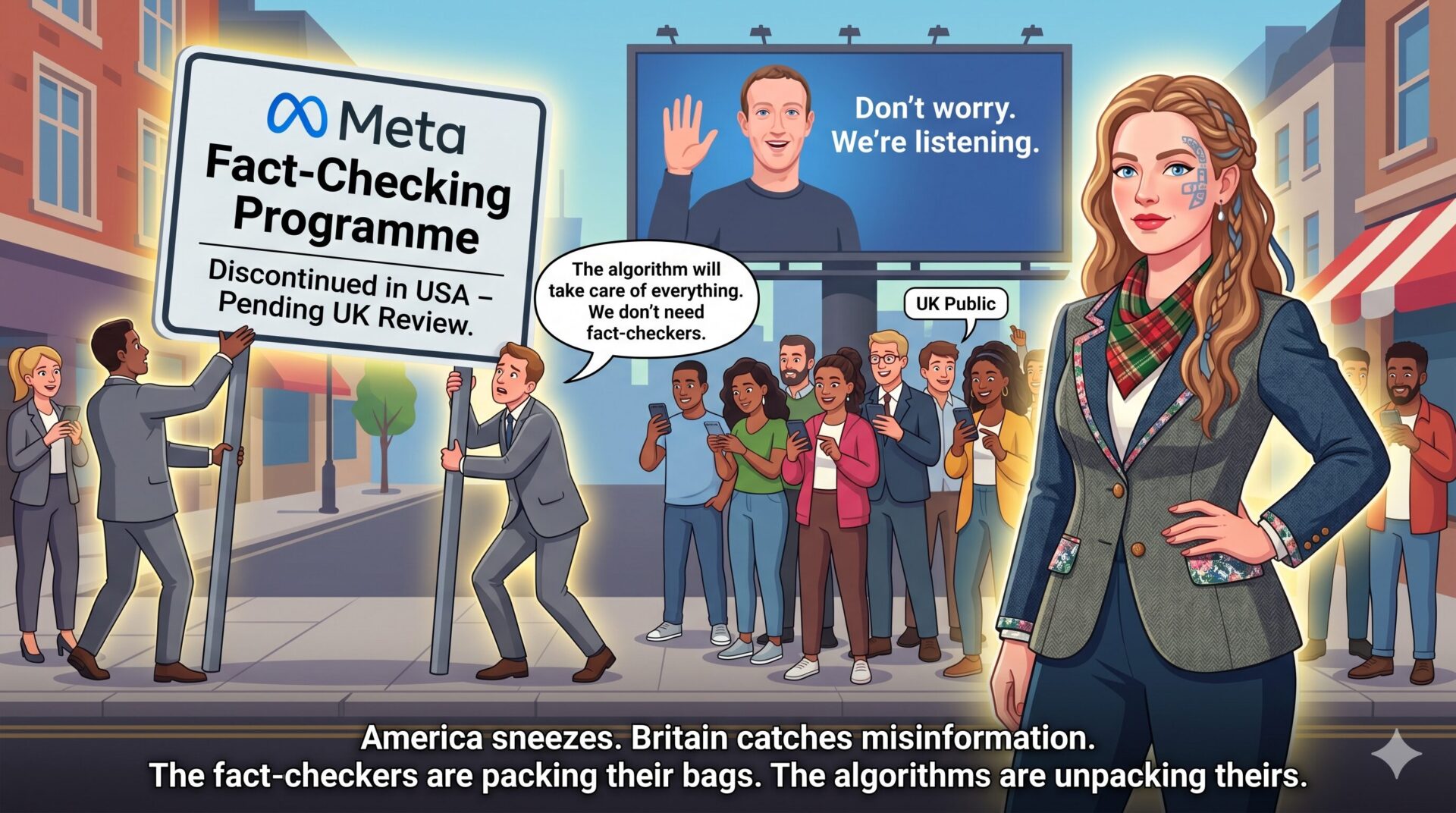 If the goal was accuracy, the algorithm would look entirely unique. It would prioritise verified sources. It would deprioritise unknown accounts. It would slow down the spread of unsubstantiated claims until they could be checked. It would bore you — because accuracy is often boring — and you would spend less time on the platform, and the platform would make less money.
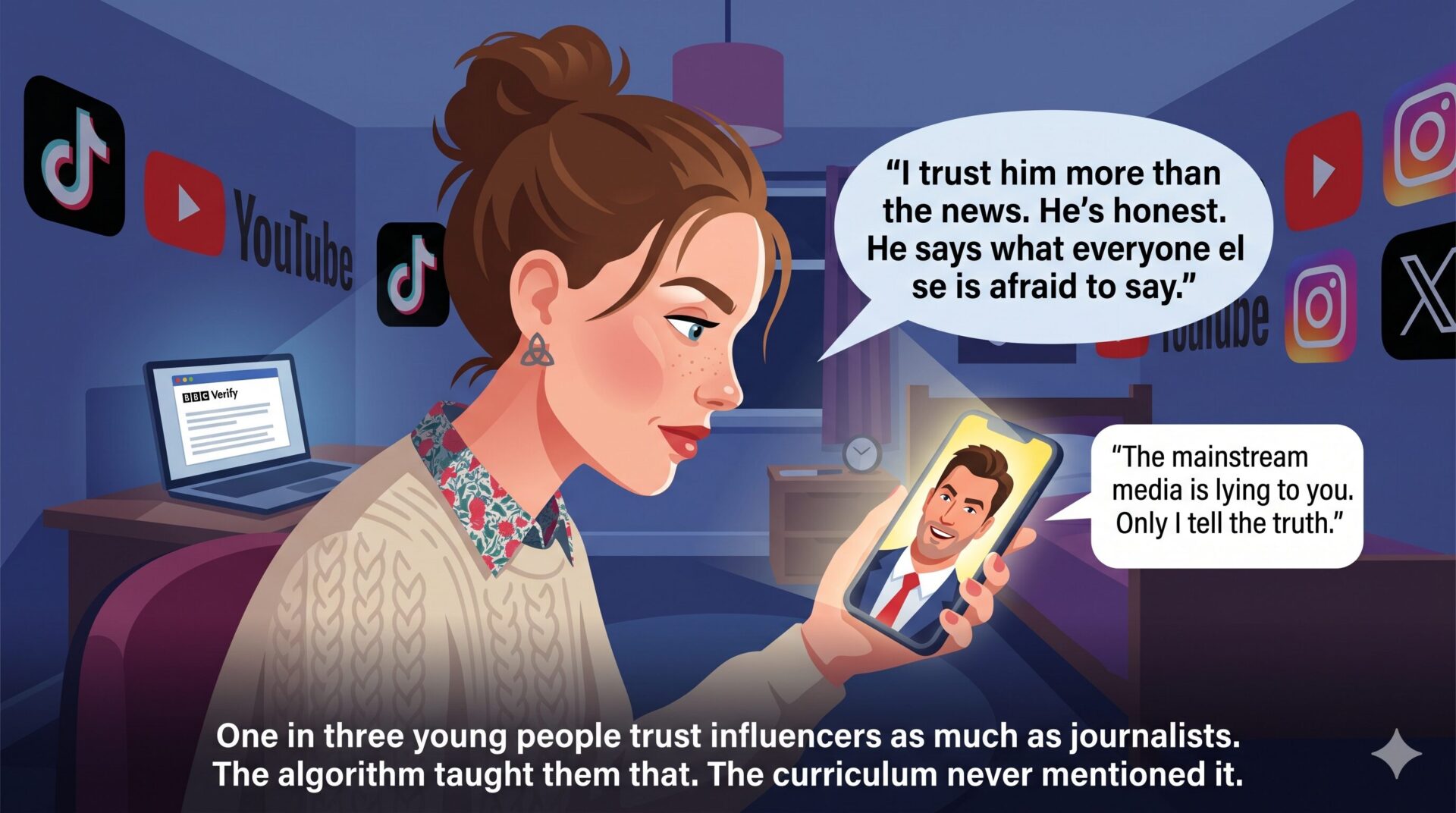 But outrage? Outrage doesn’t have diminishing returns. It escalates. One outrageous video makes you angry. The algorithm serves another, even more outrageous. You get angrier. It serves another. You get angrier still.
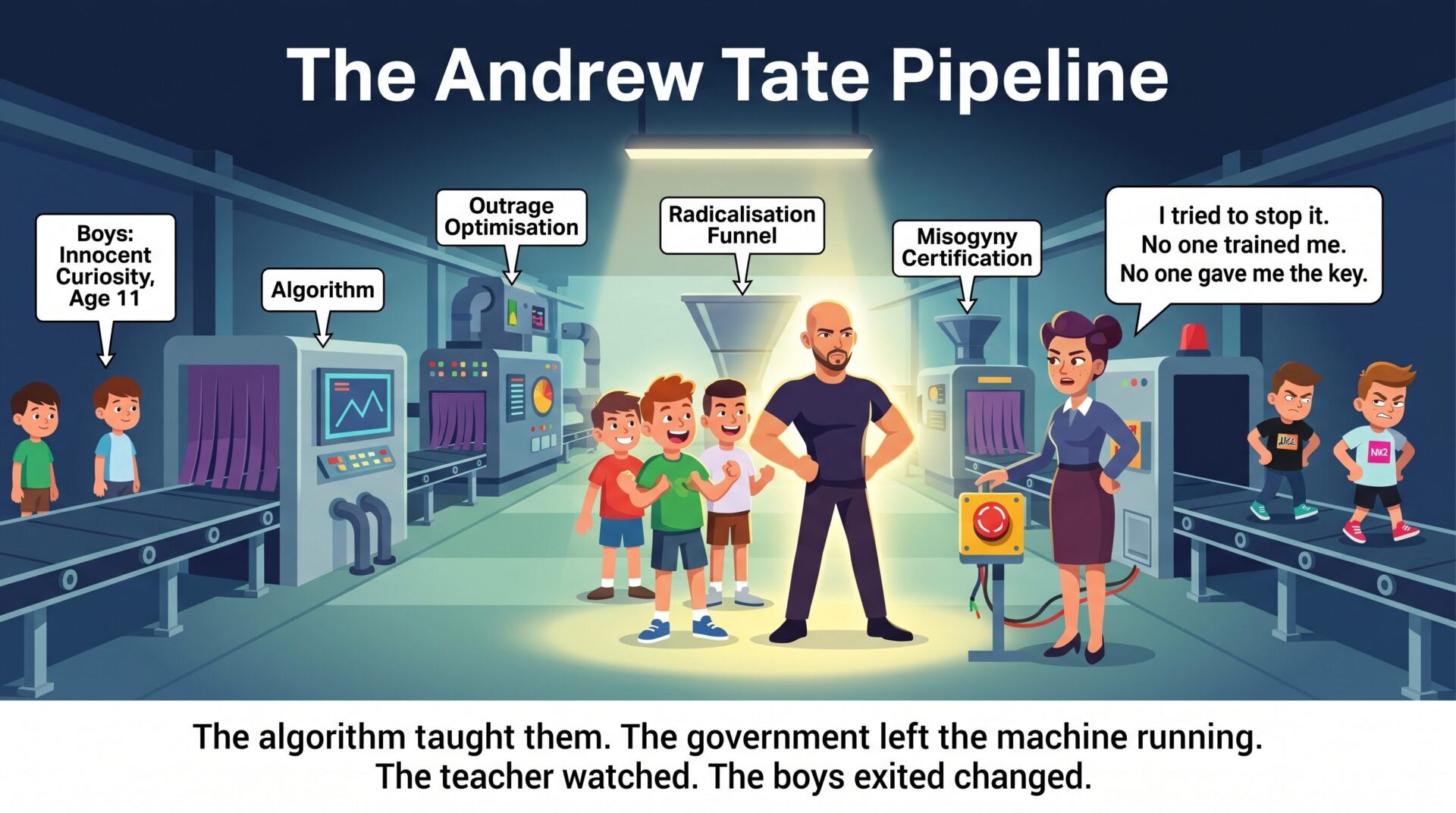 Where do these children get their news? Not from the teacher. Not from a newspaper. Not from the BBC at six o’clock with mum and dad.
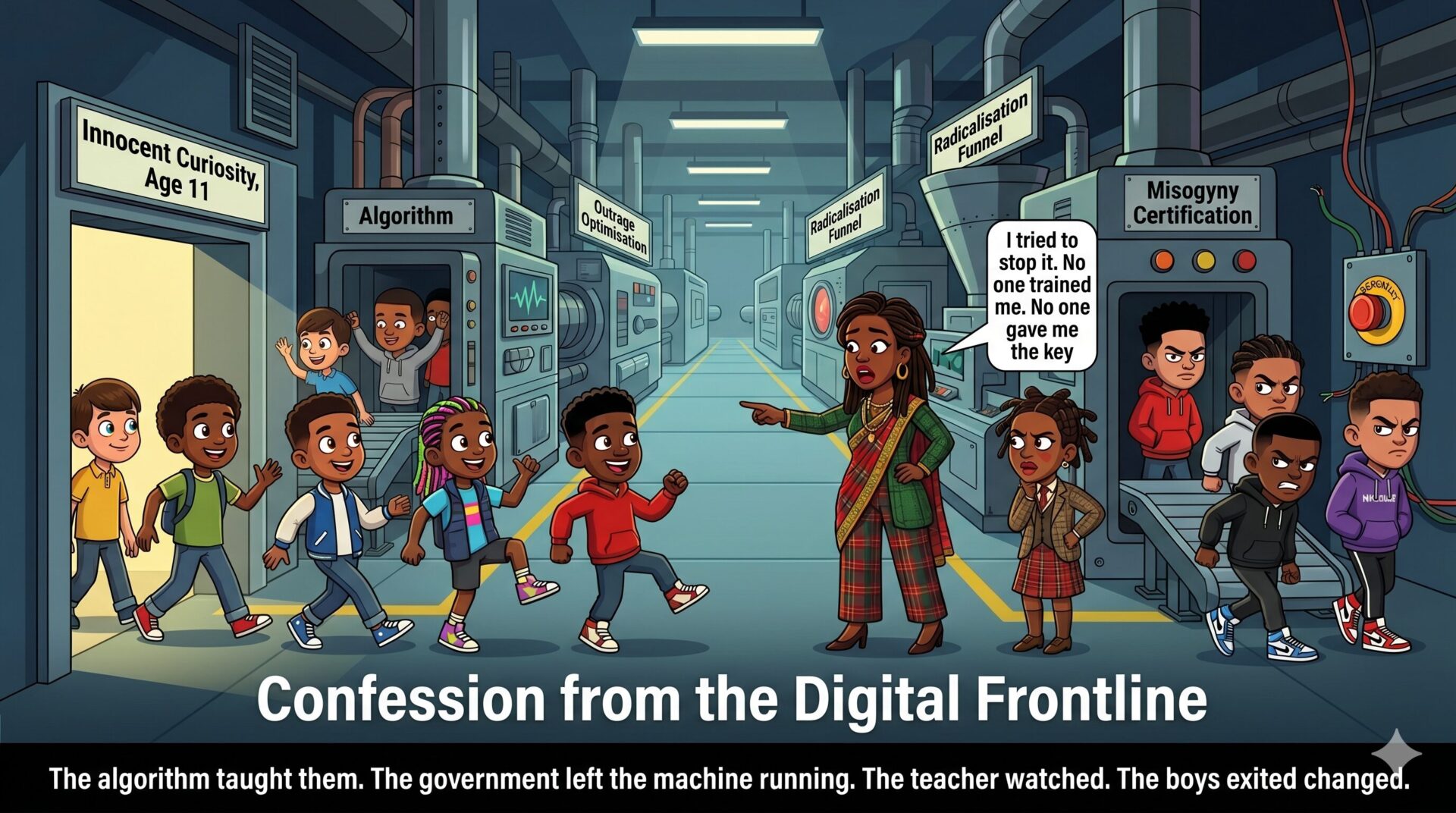 Within a week, her feed is a firehose of fear. She believes crime is out of control. She’s afraid to go out after dark. She’s convinced the government is hiding the true statistics.
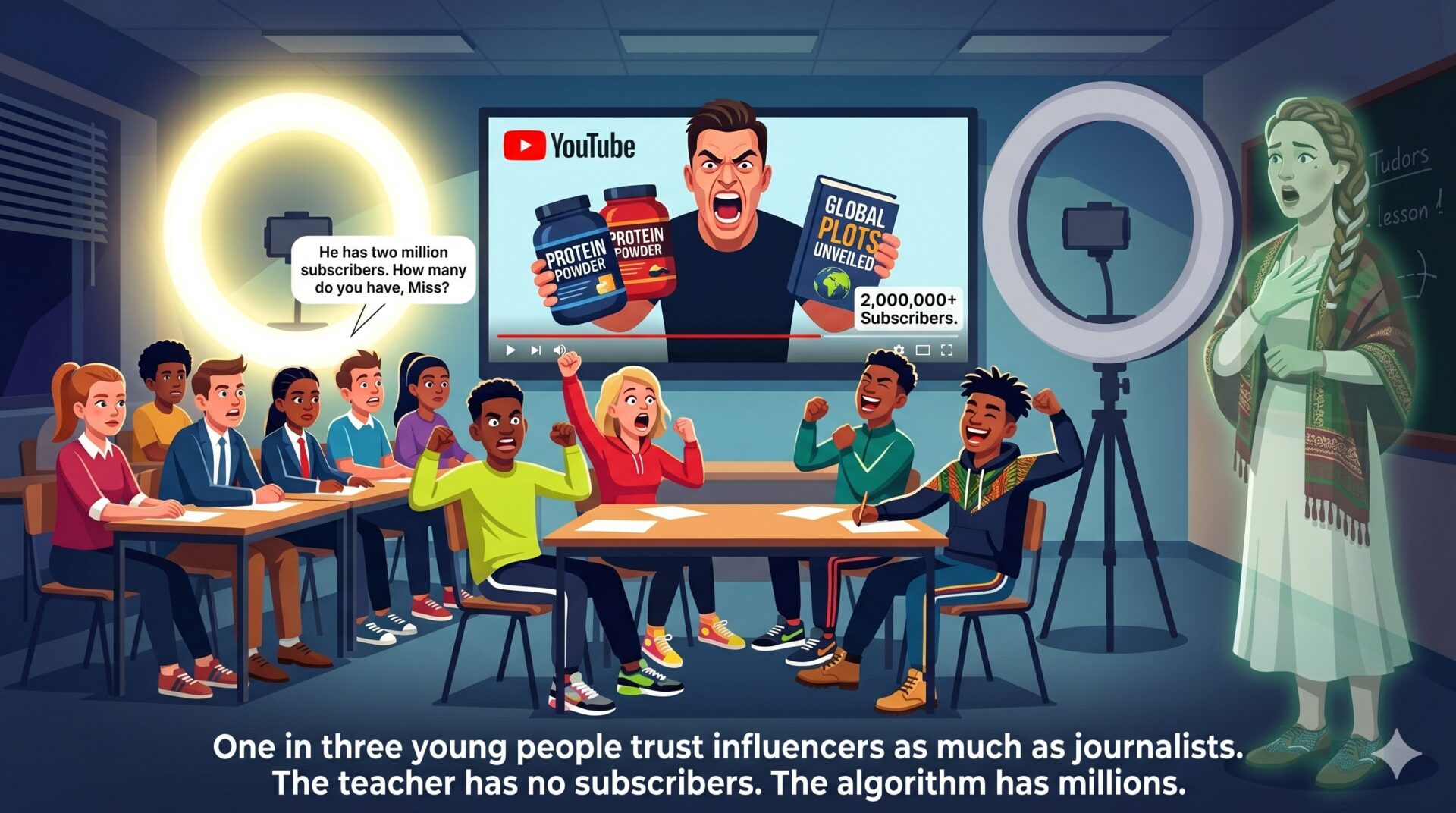 This is called the “YouTube pipeline” or the “radicalisation funnel.” It’s been studied. It’s been documented. It’s been reported to YouTube.
The AI Acceleration
The Trust Apocalypse
“Once bitten, twice shy” — but what happens when you’re bitten a thousand times a day by a machine that never sleeps?
There’s a video going around. It shows the Prime Minister announcing a new tax on biscuits. Digestives, Hobnobs, Custard Creams — all of them, hit with a twenty per cent levy. The nation is outraged. Pensioners are stockpiling Rich Tea. Union leaders are demanding a special conference.
Except the video is fake. AI-generated. The Prime Minister never said it. The biscuit tax exists only in the fever dream of a generative model that has learned to mimic his voice, his face, his little hand gestures.
Here’s the problem: the video is so good that even the experts can’t tell it’s fake. Not by looking at it. Not by listening to it. The only way to know it’s fake is to know — independently — that the Prime Minister hasn’t announced a biscuit tax. To have trusted information from another source.
And that’s the crisis Dr Mhairi Aitken is warning about. Not the fake videos themselves. Not the misinformation. Not the lies.
The crisis is that soon — very soon — we won’t trust anything. Not the fakes. Not the real. Not the government. Not the media. Not our own eyes.
We’ll look at a video of the Prime Minister announcing a genuine policy — something he actually said, in public, on camera — and we’ll think: is that real? Or is that a deepfake? How do I know? How can I know?
The technology has already reached the point where the question is reasonable. Soon it will reach the point where the question is unanswerable.
“The boy who cried wolf” is a story about a liar. Our story is worse. It’s about a world where no one can tell the difference between a wolf and a sheepdog, and the only honest response to any alarm is: I don’t know.
The Erosion of Reality
Let’s be precise about what’s happening. AI-generated content is getting better. Much better. Exponentially better. The deepfakes of 2026 are unrecognisable compared to the deepfakes of 2023. The deepfakes of 2029 will be unrecognisable compared to today.
The tell-tale signs are disappearing. The weird hands, the glitchy eyes, the slightly-off lip movements — gone. The technology has learned to generate hands with the correct number of fingers. It has learned to generate eyes that track naturally. It has learned to generate voices that capture the unique texture of a person’s speech.
Soon — very soon — there will be no tell-tale signs. The fakes will be indistinguishable from the real. Not “hard to tell.” Indistinguishable. No human, no software, no forensic analysis will be able to say with confidence whether a video is genuine or generated.
At that point, the default response to every piece of media will be: maybe it’s fake. Not because you’re paranoid. Because you’re rational. Because the probability that any given video is AI-generated will be high enough that belief is no longer justified.
This is not a hypothetical future. This is next year. This is the year after at the latest. The technology is moving faster than our ability to adapt. The people building it are not slowing down. The platforms distributing it are not filtering it. The government regulating it is not keeping up.
“The mills of God grind slowly, yet they grind exceedingly small” — but the mills of AI grind fast, and they grind reality into dust.
The Emergency That Wasn’t
Imagine a genuine emergency. A flood, a fire, a terror attack. The government issues an alert. The Prime Minister appears on television. He tells people to evacuate, to shelter in place, to take specific actions to stay safe.
Half the country watches and thinks: is that real? How do I know that’s not a deepfake? The government has been lying to us for years. The mainstream media is corrupt. The last video I saw that looked like this turned out to be fake.
They don’t evacuate. They don’t shelter. They don’t follow the instructions. Because they can’t trust the instructions. Because the technology has made trust impossible.
This is not a failure of the government. This is not a failure of the media. This is a failure of the entire information ecosystem. The water is poisoned, and no one knows which wells are safe.
Dr Aitken calls this “the perfect breeding ground for conspiracy theories.” It’s worse than that. It’s the perfect breeding ground for paralysis. For apathy. For the complete breakdown of collective action.
If you can’t trust emergency information, you can’t respond to emergencies. If you can’t respond to emergencies, society can’t protect itself. If society can’t protect itself, it collapses.
“A house divided against itself cannot stand” — but a house that can’t tell the difference between a genuine warning and a deepfake won’t even know which way to fall.
The Teenager’s Doubt
Remember Chloe from Glasgow? Seventeen. Jake fan. Inner circle member. She’s been watching alternative media for years. She’s been trained to distrust everything. The mainstream media. The government. The experts. The system.
Now the technology is catching up with her worldview. She watches a video of a politician making a claim. She doesn’t believe it. Not because she’s checked the facts. Because she’s assumed it’s fake. Why wouldn’t it be? Everything is fake. Everyone is lying. The only truth is the one she’s already decided to believe.
This is not critical thinking. This is not media literacy. This is cynicism. Pre-emptive, unthinking, reflexive cynicism. The assumption that everything is false unless proven otherwise.
The problem is that nothing can be proven otherwise. Not in a world where the technology can generate indistinguishable fakes. The proof itself could be fake. The fact-check could be AI-generated. The verification could be a deepfake.
Chloe is not a victim of misinformation. She’s a victim of the collapse of the very concept of information. She lives in a world where truth and falsehood are indistinguishable, so she chooses the falsehood that feels best. The conspiracy that makes her feel special. The lie that gives her community.
And who can blame her? The alternative — the honest alternative — is to admit that she doesn’t know. That no one knows. That the world has become un-navigable.
“In the land of the blind, the one-eyed man is king” — but in the land of the deeply confused, the person who claims certainty is king. And Chloe’s certainty is a survival mechanism.
The Mother’s Despair
Margaret is sixty-seven. She’s on TikTok. She’s been radicalised by algorithms that feed her fear and outrage. She believes that the government is hiding the truth about pensions, about vaccines, about immigration.
But here’s the thing: she also doesn’t trust the videos that confirm her beliefs. Not really. She shares them, sure. She comments on them. But somewhere, deep down, she knows that they might be fake. That the handsome influencer speaking with such confidence might be a deepfake. That the “evidence” presented might be AI-generated.
She can’t admit this to herself. It’s too destabilising. The only thing holding her worldview together is the assumption that the videos she trusts are real. If that assumption collapses, everything collapses.
So she doesn’t think about it. She scrolls. She shares. She believes. And she ignores the tiny voice in her head that whispers: what if this is fake too? What if everything is fake? What if there’s no truth at all?
Margaret is not stupid. She’s a retired nurse. She ran a ward for thirty years. She knows how to evaluate evidence. She knows how to make decisions under uncertainty.
But the technology has overwhelmed her. The volume of content is too high. The sophistication of the fakes is too great. The pace of change is too fast.
She’s not a victim of gullibility. She’s a victim of exhaustion. She’s given up trying to figure out what’s real. She just… reacts. Like the algorithm trained her to.
“Better the devil you know than the devil you don’t” — and Margaret knows the devil of her feed. She’s comfortable there, even though it’s destroying her.
The Journalist’s Nightmare
Sarah, the journalist from the Midlands, has a new problem. She can’t tell if the videos she’s verifying are real. The tools she used to rely on — reverse image search, metadata analysis, source verification — are failing. The fakes are too good.
She spent three hours yesterday trying to verify a video of a protest in London. It looked real. The faces were right. The signs were right. The location was right. But something felt off. The lighting was slightly too perfect. The shadows didn’t quite align.
She couldn’t prove it was fake. She couldn’t prove it was real. She had to kill the story. She couldn’t run something she wasn’t sure about.
Her editor was furious. “Everyone else is running it,” he said. “We’re losing clicks. We’re losing traffic. We’re losing money.”
Sarah didn’t care. She’s a journalist. She has standards. She won’t publish something she can’t verify.
But she’s scared. Because more and more content is falling into the grey zone. The zone where verification is impossible. The zone where she has to choose between publishing unverified content and publishing nothing.
Soon, the zone will be everything. Every video will be unverifiable. Every claim will be uncertain. Journalism as she knows it — as a profession that tells you what’s true — will be impossible.
She doesn’t know what she’ll do then. Neither does anyone else.
“The pen is mightier than the sword” — but what good is a pen when no one can read the ink?
The Peculiar Paradox
Here’s the paradox that keeps the experts awake at night. The better AI gets at generating fakes, the more vulnerable we become — not just to fakes, but to the erosion of trust in everything.
But the better AI gets at detecting fakes, the more vulnerable we become too. Because detection tools can be fooled. Because detection tools can generate false positives. Because detection tools themselves can be AI-generated.
There is no technical solution to this problem. There is no algorithm that can reliably distinguish real from fake when the fakes are designed to defeat detection. There is no watermark that can’t be forged. There is no blockchain that can’t be gamed.
The only solution is human. Social. Cultural. A shared understanding of what counts as trustworthy. A set of norms about how we verify information. An education system that teaches people to ask the right questions.
We don’t have those things. We have the opposite. We have a culture of cynicism, a political system that rewards distrust, an education system that has failed to teach critical thinking.
“You can’t solve a problem with the same thinking that created it” — but we’re trying. We’re throwing technology at a problem created by technology. We’re building better deepfake detectors while the deepfake generators get better at evading them.
It’s an arms race. And we’re losing.
The Finnish Anchor
Finland has a different problem. They also have AI-generated content. They also have deepfakes. They also have platforms that amplify misinformation.
But Finnish citizens are less vulnerable. Because they’ve been taught to anchor their trust in institutions. Not blindly — the Finnish curriculum also teaches scepticism — but strategically.
A Finnish teenager sees a video. They don’t ask “is this real or fake?” They ask “who made this?” If the source is not verifiable, they don’t trust it. If the source is a known news organisation with editorial standards, they might trust it — not completely, but enough to use it as a starting point.
This doesn’t solve the problem of deepfakes. But it mitigates it. It gives citizens a heuristic. A rule of thumb. A way to navigate uncertainty without descending into cynicism.
British teenagers don’t have that heuristic. They’ve been taught that all sources are biased, that all institutions are corrupt, that the only person you can trust is yourself. Which is fine, except that you’re not a reliable truth-detector. You’re a human with biases and blind spots and a brain that evolved to trust what your eyes see, not to question whether what your eyes see was generated by a machine.
“Trust, but verify” — the Finnish approach. “Trust nothing, verify nothing, feel everything” — the British approach. Guess which one works better against deepfakes.
The Regulator’s Helplessness
Ofcom knows about this crisis. They’ve read Dr Aitken’s warnings. They’ve seen the research on AI-generated content and trust erosion.
What can they do? Not much. Their powers under the Online Safety Act focus on illegal content. Deepfakes are not illegal — not in themselves. A deepfake of the Prime Minister announcing a biscuit tax is not against the law. It might be annoying. It might be misleading. It’s not illegal.
Ofcom can recommend that platforms label AI-generated content. They can recommend that platforms make it easier for users to verify sources. They can recommend that platforms invest in detection technology.
The platforms will listen politely, nod thoughtfully, and continue doing what they’ve always done: optimising for engagement, not accuracy.
Because labelling AI-generated content reduces engagement. People scroll past labelled content. They trust it less. They spend less time on it. And less time means less money.
So the platforms will do the bare minimum. A tiny label in the corner. A pop-up that users will learn to ignore. A transparency report that no one will read.
And the deepfakes will keep coming. And trust will keep eroding. And Dr Aitken’s warning will keep echoing, ignored, as the crisis deepens.
“The only thing necessary for the triumph of evil is that good men should do nothing” — and we are doing nothing. We are forming working groups. We are commissioning research. We are publishing reports.
We are not regulating. We are not enforcing. We are not protecting.
The Final Question
How do you know this article is real? How do you know I’m a real person and not an AI generating text? How do you know the statistics I’ve cited are accurate and not invented by a model that has learned to sound convincing?
You don’t. You can’t. Not really. You have to trust. Or not.
That’s the crisis Dr Aitken is warning about. It’s not that the lies will win. It’s that the truth will become indistinguishable from the lies. And in that world, both truth and lies lose. Trust loses. Reality loses.
The only thing that wins is cynicism. The assumption that nothing is real, nothing matters, nothing can be believed. And from that assumption, nothing good grows. Not democracy. Not community. Not meaning.
“The truth shall set you free” — but what if you can’t find the truth? What if every claim is suspect, every source is dubious, every video might be a deepfake?
Then you are not free. You are trapped. Trapped in a hall of mirrors where every reflection might be a lie. Trapped with no way out except to stop caring.
And that’s where we’re heading. That’s the destination Dr Aitken sees on the horizon. A world where “I don’t know” is the only honest answer to every question. Where “who cares?” is the only rational response to every claim.
The technology is not slowing down. The platforms are not changing. The government is not acting.
The only question is how fast we’ll get there. And what will be left when we arrive.
“For want of a nail, the shoe was lost” — for want of trust, democracy was lost. For want of democracy, everything was lost.
And all because we couldn’t figure out how to tell the difference between a real video and a fake one. All because we let the technology outrun our ability to adapt. All because we did nothing while the ground crumbled beneath our feet.
How do you know that’s not happening right now? How do you know this isn’t the fake?
You don’t. That’s the point. That’s always been the point. And that’s why we’re doomed.
The Conspiracy Greenhouse
“In the kingdom of the blind, the one-eyed man is a liar — and so is everyone else, so you might as well believe the most entertaining story.”
There’s a woman in Cornwall. Let’s call her Brenda. She’s sixty-two. She used to be a receptionist at a GP surgery. She’s retired now. She spends her days in a conservatory overlooking the sea, scrolling through her phone, watching the world burn.
Brenda believes that the moon landing was faked. She believes that 9/11 was an inside job. She believes that the government is hiding the cure for cancer. She believes that vaccines are a tool for population control. She believes that the royal family are shape-shifting lizards. She believes that the earth is flat — although she’s a bit fuzzy on the details of how that works with the rest of the solar system.
Brenda is not stupid. She’s not mentally ill. She’s not a bad person. She’s a retired receptionist who got lost in the maze of the internet and never found her way out.
And she is the future. Not just Brenda. Millions of Brendas. Because Dr Mhairi Aitken is right: when nothing can be trusted, anything can be believed.
“A drowning man will clutch at a straw” — but a drowning information environment will clutch at anything. Any explanation. Any story. Any lie that makes the chaos make sense.
The Vacuum of Meaning
Here’s what Dr Aitken understands that most people don’t. Conspiracy theories are not about evidence. They never have been. They’re about meaning.
The world is complicated. Random things happen. Bad things happen to good people. The stock market goes up for no reason. The weather destroys your house. A pandemic kills your grandmother.
These events have explanations. Complex, boring, unsatisfying explanations. Supply chain disruptions. Climate patterns. Zoonotic spillover. The kind of explanations that require reading, understanding, accepting uncertainty.
Conspiracy theories offer something better: simplicity. Someone did it. Someone planned it. Someone is in control. The world is not random. The world is not chaotic. The world is a story with villains and heroes and a plot that makes sense.
When trust in institutions collapses — when you can’t believe the government, the media, the experts — conspiracy theories fill the vacuum. They offer certainty. They offer enemies. They offer the comforting illusion that someone, somewhere, knows what’s going on.
Brenda doesn’t believe the moon landing was faked because she’s seen convincing evidence. She believes it because the alternative — that we actually went to the moon, that it was a triumph of human ingenuity, that the world is capable of amazing things — doesn’t fit her worldview anymore. Her worldview is that everything is a lie. The moon landing being real would be an exception. And exceptions are uncomfortable.
So she believes the lie. Not because it’s true. Because it’s consistent.
“If you tell a lie big enough and keep repeating it, people will eventually come to believe it” — but what if they believe it not because they’re fooled, but because they need to? What if the lie is a life raft in a sea of uncertainty?
The Algorithmic Accelerant
The platforms have figured this out. They know that conspiracy theories are engagement gold. They know that a person who believes one conspiracy is likely to believe others. They know that the best way to keep someone scrolling is to feed them a steady diet of “they’re lying to you.”
The algorithm doesn’t care if the conspiracy is about vaccines or the moon landing or shape-shifting lizards. It just knows that Brenda clicks on these videos. That she watches them to the end. That she shares them with her friends. That she comments, argues, returns.
So the algorithm serves more. And more. And more. Each conspiracy slightly more extreme than the last. Each video slightly more confident. Each claim slightly more divorced from reality.
This is not a bug. This is a feature. This is the platform doing exactly what it was designed to do: maximise engagement. The fact that it’s also destroying Brenda’s ability to function in society is not the platform’s problem. The platform’s problem is the quarterly earnings report.
Brenda started with a video about vaccine side effects. Reasonable enough. There are genuine concerns about vaccine safety, genuine debates about risk-benefit analysis. But the algorithm didn’t serve the reasonable debate. It served the extreme. Because the extreme gets more clicks.
Within a month, Brenda believed that vaccines were a tool for population control. Within two months, she believed that Bill Gates was microchipping the population. Within three months, she believed that the pandemic was a hoax.
The algorithm didn’t create these beliefs from nothing. It just… accelerated. It took Brenda’s reasonable scepticism and turned it into full-blown paranoia. One video at a time. One click at a time. One engagement metric at a time.
“The road to hell is paved with good intentions” — and the road to conspiracy is paved with algorithmic recommendations.
The Brenda Community
Here’s the thing about Brenda. She’s not alone. She’s found her people. There are Facebook groups, WhatsApp chats, Telegram channels, Discord servers. Thousands of Brendas, all believing the same things, all reinforcing each other’s beliefs, all creating a parallel reality where the moon landing was faked and vaccines are poison and the government is run by lizards.
This is the conspiracy theory’s secret weapon: community. Brenda was lonely before she found these groups. She didn’t have many friends. Her husband died five years ago. Her children live in London and never visit. The only person she talked to regularly was the cashier at the local Tesco.
Now she has hundreds of friends. People who understand her. People who believe what she believes. People who validate her worldview and welcome her into their tribe.
She’s not going to give that up. Not for truth. Not for evidence. Not for the boring reality that the moon landing was real and vaccines are safe and the world is complicated and messy and doesn’t have a simple villain.
Because giving that up would mean going back to being lonely. Back to the conservatory overlooking the sea, with nothing but her thoughts and the occasional visit from a distracted child.
The conspiracy is not just a set of beliefs. It’s a social network. It’s a source of meaning. It’s a reason to get out of bed in the morning.
“Birds of a feather flock together” — and Brendas of a conspiracy flock together, reinforcing each other’s delusions, building a world that makes sense to them even if it makes no sense to anyone else.
The British Tradition
Conspiracy theories have a long history in Britain. The Gunpowder Plot was a real conspiracy — Guy Fawkes really did try to blow up Parliament. The Profumo Affair was a real conspiracy — a government minister really did lie about his affair with a model who was also involved with a Soviet spy.
But we’ve moved beyond real conspiracies. We’re now in the realm of the imagined. The impossible. The absurd.
The BBC is hiding the truth about Jimmy Savile — no, wait, they investigated that extensively. The government is covering up UFO landings — no evidence, ever. Princess Diana was murdered by MI6 — despite multiple inquiries finding otherwise.
These beliefs persist not because of evidence but because of distrust. Because once you believe that institutions are corrupt, any denial is proof of the conspiracy. Any debunking is evidence of the cover-up. Any fact-check is part of the plot.
This is called “conspiracist ideation” in the academic literature. It’s a cognitive style, not a set of specific beliefs. The person who believes the moon landing was faked is more likely to believe that vaccines are dangerous, that 9/11 was an inside job, that the earth is flat. Not because these beliefs are connected logically — they’re not — but because the underlying cognitive style is the same: distrust of institutions, attraction to simple explanations, need for certainty.
Brenda doesn’t believe in lizards because there’s evidence. She believes in lizards because she needs to believe in something.
“Fools rush in where angels fear to tread” — but fools aren’t the only ones rushing. The desperate rush too. The lonely rush. The confused rush. And the algorithm is happy to catch them all.
The Teacher’s Conspiracy
Mr. Patel has a student who believes that the Holocaust didn’t happen. He saw it on YouTube. The video had a million likes. It seemed convincing. The comments section was full of people agreeing.
Mr. Patel spent an hour showing the student evidence. Photographs. Testimonies. Archival footage. Historical records. The student wasn’t convinced. “These could be fake,” he said. “The government could have made them up.”
How do you argue with that? How do you prove that archival footage is real when the student believes that all institutions are corrupt? How do you establish the reality of the Holocaust when the student’s entire information diet has taught him that nothing is real?
Mr. Patel can’t win. Not because he lacks evidence. Because the student lacks trust. And trust is not something you can restore with a PowerPoint presentation.
This is the perfect breeding ground for conspiracy theories. The student doesn’t need evidence to believe the Holocaust is a hoax. He needs evidence to believe it happened. And that evidence is available, abundant, overwhelming. But he’s been trained to dismiss it. Trained to see any evidence from official sources as part of the conspiracy. Trained to trust anonymous YouTube videos over the entire historical record.
The conspiracy has won. Not because it’s true. Because it’s easier. Because it requires no effort to believe, no research to verify, no critical thinking to evaluate. Just a thumb and a willingness to accept that the world is simpler than it seems.
“A lie can run round the world before the truth has got its boots on” — but the lie doesn’t even need to run anymore. It just needs to be more comfortable than the truth.
The Financialisation of Fantasy
Conspiracy theories are big business. Not just for the platforms — though they make billions — but for the influencers who peddle them.
The same Jake who started as a fitness influencer now sells conspiracy merchandise. T-shirts with logos of the “real truth.” Books self-published on Amazon. “Survival kits” for the coming apocalypse. “Detox supplements” to remove the “nanobots” from your blood.
None of it is real. None of it works. All of it is profitable.
Jake doesn’t believe most of what he says. He can’t. No one could believe that many contradictory things. But he doesn’t need to believe. He needs to sell. And conspiracy theories sell very, very well.
Brenda has spent two thousand pounds on Jake’s merchandise in the past year. T-shirts, books, supplements, “emergency food rations” that are just overpriced rice and beans. She can’t afford it. Her pension is stretched thin. But she’s scared. She believes the world is ending. She wants to be prepared.
Jake knows this. He exploits it. He’s not a monster — he probably tells himself he’s providing a service, waking people up, spreading the truth. But the truth is that he’s getting rich off the fear and confusion of vulnerable people.
And the platforms facilitate it. They take their cut. They run their ads. They optimise their algorithms. They don’t care that Brenda is being exploited. They care that she’s watching.
“The love of money is the root of all evil” — and the love of engagement is the root of the conspiracy industry.
The Finnish Reality
Finland has conspiracy theories too. Of course they do. No country is immune. But Finnish citizens are less vulnerable. Because they’ve been taught to distinguish between healthy scepticism and paranoid cynicism.
The Finnish curriculum teaches students to ask: what’s the evidence? What’s the source? What’s the motive? What would change my mind?
These questions don’t eliminate conspiracy theories. But they make them harder to believe. Because most conspiracy theories fall apart when you ask these questions. The evidence is thin. The sources are anonymous. The motives are obvious — money, attention, power. And nothing would change the believer’s mind, which is a sign that the belief is not based on evidence at all.
Finnish students learn to recognise this. They learn that a belief that can’t be changed by evidence is not a belief — it’s an identity. And identities are harder to argue with.
Brenda was never taught any of this. She left school at sixteen. She went to work. She lived her life. She never learned to ask these questions. She never learned to distinguish between scepticism and cynicism. She never learned that not all sources are equal, that not all evidence is valid, that not all claims deserve equal consideration.
So when the algorithm fed her a conspiracy theory, she had no defence. No toolkit. No questions to ask. Just a lifetime of trust in what she saw — a trust that the algorithm quickly exploited and destroyed.
“You can’t teach an old dog new tricks” — but you can teach a young dog. Finland taught its young dogs. Britain didn’t.
The Regulator’s Conspiracy
Ofcom knows about the conspiracy theory crisis. They’ve seen the research. They know that distrust of institutions is at an all-time high. They know that the platforms are accelerating the spread of conspiratorial thinking.
What can they do? Their powers are limited. The Online Safety Act focuses on illegal content. Conspiracy theories are not illegal. They might be harmful. They might be dangerous. They’re not illegal.
Ofcom can recommend that platforms reduce the spread of conspiracy content. They can recommend that platforms label conspiratorial videos. They can recommend that platforms adjust their algorithms to deprioritise content that undermines trust in institutions.
The platforms will nod. They’ll issue statements. They’ll publish transparency reports. And they’ll continue optimising for engagement, because engagement is profit, and profit is the only thing that matters.
Some Ofcom staffers privately believe that the platforms are complicit in the spread of conspiracy theories. That they could stop it if they wanted to. That they choose not to because conspiracy theories are too profitable.
This is not an official position. This is not something Ofcom will say in public. But it’s whispered in corridors. It’s discussed in off-the-record briefings. It’s the open secret of the information age.
The platforms are not neutral. They never have been. They have chosen — deliberately, repeatedly, profitably — to prioritise engagement over accuracy. To amplify outrage over truth. To spread conspiracy over reality.
And the regulator can’t stop them.
“The fox guarding the henhouse” — but the fox is also the farmer, the butcher, and the customer. And the hens are us.
The Final Conspiracy
Here’s the conspiracy theory that Brenda doesn’t believe. The one that’s actually true.
The platforms know that conspiracy theories are harmful. They have internal research. They have data on the link between conspiratorial content and real-world violence, real-world harm, real-world democratic breakdown.
They have chosen not to act. Because acting would cost money. Because acting would reduce engagement. Because acting would require admitting that their business model is incompatible with a healthy society.
That’s not a conspiracy theory. That’s just capitalism. That’s just the logic of the market applied to information. The most profitable content is not the most accurate. It’s the most engaging. And the most engaging content is the content that makes you afraid, angry, and certain.
The conspiracy theory is real. The conspiracy is the system. The conspirators are the shareholders, the executives, the engineers who designed the algorithms. They didn’t plan to destroy democracy. They didn’t need to. They just followed the money.
And the money led here. To Brenda in her conservatory. To Chloe in her bedroom. To Mr. Patel in his classroom. To a world where nothing can be trusted, so anything can be believed.
“The greatest trick the devil ever pulled was convincing the world he didn’t exist” — but the greatest trick the platforms ever pulled was convincing the world they were neutral. That they were just pipes. That they weren’t responsible for what flowed through them.
They are not pipes. They are publishers. They are editors. They are choosing every day, with every algorithm update, what to amplify and what to suppress.
They have chosen conspiracy. Not because they’re evil. Because it’s profitable.
And Brenda believes everything. Because when nothing can be trusted, anything can be believed.
Including the truth. Especially the truth. The truth that no one wants to hear: that we did this to ourselves. That we let them do it. That we kept scrolling, kept sharing, kept believing, while the world burned.
“What you don’t know can’t hurt you” — is a lie. What you don’t know can kill you. What you refuse to know already has.
The Education Vacuum
The Lottery of Learning
“All animals are equal, but some animals are more equal than others” — and some children learn how to spot a lie, while others learn how to share one.
Let me tell you about two schools. One in Richmond upon Thames. One in Blackpool.
The Richmond school has a media literacy programme. It’s not formal — nothing is formal, because the national curriculum doesn’t require it — but the head teacher cares about this stuff. She’s read the research. She’s seen the headlines. She’s worried about her students.
So she’s carved out time in PSHE. She’s trained a couple of teachers. She’s brought in resources from the Guardian Foundation and the BBC. Her students learn how to spot sponsored links. They learn how to verify images. They learn how to question sources.
The Blackpool school has nothing. The head teacher is overwhelmed. Budget cuts. Staff shortages. Ofsted breathing down his neck. He’s got bigger problems than media literacy. His students are hungry. His teachers are burning out. His building is falling apart.
So his students learn nothing about sponsored links, about deepfakes, about algorithmic manipulation. They scroll through TikTok. They believe what they see. They share what they believe. They are being radicalised by an algorithm, and no one in any position of authority has noticed or cares.
Two schools. Two postcodes. Two completely different educational outcomes. One lottery ticket won. One lottery ticket lost.
“The apple doesn’t fall far from the tree” — but the tree is the postcode. And the apples are falling into a system designed to rot them.
The Geography of Ignorance
Let me be precise about what “postcode lottery” means. It means that where you live determines what you learn. Not your ability. Not your potential. Not your effort. Your postcode.
A child in a wealthy area is more likely to attend a school with resources, with motivated teachers, with a head teacher who can afford to care about things beyond the basics. That child is more likely to learn media literacy. Not guaranteed — but more likely.
A child in a poor area is more likely to attend a school that is struggling. Struggling with attendance. Struggling with behaviour. Struggling with funding. That child is less likely to learn media literacy. Less likely to learn how to spot a lie. Less likely to learn how to navigate the digital world safely.
This is not a failure of individual teachers. This is a failure of the system. The national curriculum does not require media literacy. Ofsted does not inspect for it. The Department for Education does not fund it.
So it’s left to the discretion of individual head teachers. And head teachers, facing real and urgent pressures, deprioritise it. Because how can you teach a child to spot a deepfake when that child hasn’t eaten breakfast? How can you worry about algorithmic manipulation when your building has a leaking roof?
The postcode lottery is not a lottery. It’s a sorting mechanism. The rich get richer — in knowledge, in skills, in resilience. The poor get poorer — more vulnerable, more easily manipulated, more likely to believe the lies that the algorithm serves.
“The rich get richer and the poor get poorer” — and in the information age, the information-rich get richer and the information-poor get radicalised.
The Teacher’s Heroism
Let me tell you about a teacher in Doncaster. Let’s call her Helen. She teaches English at a comprehensive. She’s been there twenty years. She’s seen everything.
Helen started teaching media literacy five years ago. Not because the curriculum required it. Because she saw what her students were watching. Because she saw the Andrew Tate videos. Because she saw the conspiracy theories. Because she saw her students disappearing into rabbit holes and not coming back.
She designed her own lessons. She found her own resources. She trained herself on how to spot deepfakes, how to verify images, how to question sources. She carved out time in her already-overcrowded schedule.
It worked. Not perfectly. But her students are better at spotting misinformation than students in neighbouring schools. They’re more sceptical. They’re more likely to pause before sharing. They’re less likely to believe that the moon landing was faked.
Helen is a hero. She’s also exhausted. She’s doing this on top of her normal workload. She’s getting no extra pay, no extra time, no extra recognition. She’s burning out.
And she’s the exception. Most teachers don’t have the time, the energy, the resources, or the knowledge to do what Helen does. Most teachers are just trying to survive.
The postcode lottery doesn’t just depend on where you live. It depends on whether there’s a Helen in your school. And Helens are in short supply.
“One swallow does not make a summer” — and one heroic teacher does not make a media-literate generation.
The Department’s Disappearance
Remember the Department for Education? The ones responsible for the national curriculum? The ones who decide what children learn and how they learn it?
They’ve been largely absent from the media literacy conversation. Witness after witness told the Lords Committee that the DfE was the department they spoke to least. The department that never returned calls. The department that seemed not to care.
This is not an accident. This is a choice. The DfE has decided, implicitly or explicitly, that media literacy is not a priority. That other things matter more. That the curriculum is already too crowded. That teachers are already too stretched.
So they’ve done nothing. No requirement. No guidance. No funding. No training. Nothing.
Meanwhile, the algorithm is teaching children every day. Every scroll, every swipe, every share is a lesson. The lesson is: react first, think never. The lesson is: outrage is truth. The lesson is: the only thing that matters is engagement.
The DfE is losing the battle for the minds of children. Not because they’re incompetent — though there’s certainly an argument — but because they’re not even fighting. They’ve ceded the battlefield to the platforms. They’ve surrendered without a shot.
“All that is necessary for the triumph of evil is that good men should do nothing” — and the DfE has done nothing. For years. While children were radicalised. While trust eroded. While democracy crumbled.
The Finland Curriculum
Finland doesn’t have a postcode lottery. They have a national curriculum that requires media literacy. Every school teaches it. Every student learns it. Every teacher is trained in it.
Not as a separate subject — the Finns are smarter than that. As a cross-curricular competency. Every subject teacher is responsible for teaching media literacy in their domain. History teachers teach source criticism. Science teachers teach evidence evaluation. Art teachers teach visual manipulation.
This means that every child, regardless of where they live, regardless of their family’s income, regardless of their school’s resources, learns how to navigate the digital world. Not perfectly — nothing is perfect — but systematically. Universally. Equitably.
The Finnish system didn’t happen by accident. It happened because the Finnish government decided that media literacy was a priority. Because they allocated resources. Because they trained teachers. Because they embedded it in the curriculum.
The British system didn’t happen by accident either. It happened because the British government decided that media literacy was not a priority. Because they allocated nothing. Because they trained no one. Because they left it to chance.
The result is a postcode lottery. The result is that some children learn and most don’t. The result is that we are raising a generation of digital illiterates while the algorithm gets smarter and the lies get better.
“The best time to plant a tree was twenty years ago. The second best time is now.” Finland planted twenty years ago. Britain is still arguing about who should buy the seeds.
The Parent’s Despair
Remember James? His mother Margaret is lost to conspiracy. His children are in school. He doesn’t know if they’re learning media literacy. He doubts it. The school hasn’t mentioned it. The teachers haven’t raised it. The curriculum doesn’t require it.
James has tried to teach his children himself. He’s shown them how to spot sponsored links. He’s explained how algorithms work. He’s walked them through fact-checking websites.
They’re not interested. Dad is boring. Dad doesn’t understand. Dad is not TikTok.
James can’t compete with the algorithm. He doesn’t have millions of videos. He doesn’t have personalised recommendations. He doesn’t have the attention of his children for hours every day. He has dinner time. He has the car ride to school. He has bedtime.
The algorithm has everything else.
James is not a failure. He’s a parent trying to do the job that the education system should be doing. But the education system has abdicated. And James is losing.
“It takes a village to raise a child” — but the village has been replaced by a platform. And the platform doesn’t care about raising children. It cares about raising engagement.
The Ofsted Blindspot
Ofsted inspects schools. They look at teaching quality. They look at curriculum design. They look at student outcomes.
They don’t look at media literacy. Not specifically. It’s not in the inspection framework. It’s not something they’re asked to assess.
So schools have no incentive to teach it. Ofsted won’t penalise them for ignoring it. Ofsted won’t reward them for embracing it. It’s invisible to the accountability system.
This is a choice. Ofsted could include media literacy in the framework. They could ask schools to demonstrate how they teach students to navigate the digital world. They could make it a factor in school ratings.
They haven’t. Not yet. Maybe they will. Maybe they won’t.
In the meantime, schools focus on what Ofsted inspects. Literacy. Numeracy. Attendance. Behaviour. These are important. These are urgent.
Media literacy is also important. But it’s not urgent. Not to Ofsted. Not to the DfE. Not to anyone with power.
So it gets deprioritised. Squeezed out. Forgotten.
“What gets measured gets managed” — and what doesn’t get measured gets ignored.
The Class Divide
Let’s talk about class. Because the postcode lottery is a class lottery.
Wealthy parents can compensate for the failures of the education system. They can afford tutors. They can afford to send their children to private schools where media literacy is more likely to be taught. They can afford to spend time teaching their children themselves.
Poor parents cannot. They’re working multiple jobs. They’re struggling to pay the rent. They don’t have the time, the energy, or the knowledge to teach media literacy.
So the children of wealthy parents learn. The children of poor parents do not. The gap widens. The rich get richer in digital resilience. The poor get poorer.
This is not a bug. This is a feature. This is how the system is designed. A national curriculum that doesn’t require media literacy, an inspection framework that doesn’t assess it, a funding system that starves the poorest schools — all of these choices benefit the wealthy and harm the poor.
The platforms don’t care about class. The algorithm doesn’t discriminate. It radicalises rich and poor alike. But the rich have defences. The poor do not.
“The rich man has his lawyers, the poor man has his ignorance” — and the algorithm has both.
The Head Teacher’s Choice
Let me tell you about a head teacher in Bradford. Let’s call him David. He runs a primary school in one of the poorest wards in the country. His students are mostly eligible for free school meals. Many speak English as a second language. Many have experienced trauma.
David knows about media literacy. He’s read the research. He’s seen the headlines. He knows that his students are vulnerable.
He also knows that his teachers are exhausted. That his budget is stretched. That his building needs repairs. That Ofsted is coming.
He has to choose. Does he spend time and money on media literacy? Or does he focus on reading, writing, maths, the things that Ofsted inspects, the things that determine his school’s future?
He chooses reading. Every time. Not because he doesn’t care about media literacy. Because he has to keep his school afloat. Because if Ofsted fails him, the school could be closed, taken over, turned into an academy. His students would be disrupted. His staff would lose their jobs.
David is not the villain. David is a head teacher making impossible choices in a broken system. The villain is the system that forces him to choose. The villain is the government that doesn’t make media literacy a priority. The villain is the postcode lottery that means his students lose while students in Richmond win.
“Necessity is the mother of invention” — but necessity is also the mother of neglect. And David’s necessity is survival.
The Department’s Defence
The DfE would say that media literacy is already in the curriculum. They’d point to computing, to citizenship, to RSHE. They’d say that teachers are already covering these topics.
They’d be wrong. Not entirely wrong — some coverage exists — but wrong that it’s sufficient.
The coverage is fragmented. It’s scattered across subjects. It’s not coordinated. It’s not systematic. It’s not guaranteed.
A student in one school might learn about sponsored links in computing class. A student in another school might never encounter the concept. A student in a third school might learn about it in PSHE, but the PSHE teacher might not know enough to teach it effectively.
This is not a curriculum. This is a patchwork. This is a postcode lottery.
The DfE knows this. They’ve been told this. By witnesses. By the Lords Committee. By every expert who has testified.
They haven’t changed anything. Not yet. Maybe they will. Maybe the curriculum and assessment review will recommend changes. Maybe the government will implement them.
Maybe. Maybe. Maybe.
“Hope is not a strategy” — but it’s all the DfE has offered.
The Final Lottery
Let’s go back to the two schools. Richmond and Blackpool.
The Richmond students will grow up knowing how to spot a sponsored link. How to verify an image. How to question a source. How to navigate the digital world safely.
The Blackpool students will not. They will be more vulnerable. More easily manipulated. More likely to believe the lies that the algorithm serves.
This is not justice. This is not fairness. This is not equality of opportunity.
This is a lottery. A postcode lottery. A class lottery. A lottery that determines who gets to be a critical thinker and who gets to be a victim of misinformation.
The government could fix this. They could embed media literacy in the national curriculum. They could require every school to teach it. They could train every teacher to deliver it. They could fund it properly.
They haven’t. They won’t. Not because they can’t. Because they won’t.
“The arc of the moral universe is long, but it bends toward justice” — but only if someone bends it. The government is not bending. The platforms are bending toward profit. The algorithm is bending toward engagement.
And the children are bending toward the lies.
The lottery continues. The winners win. The losers lose. And the algorithm collects its prize.
The Department That Disappeared
“See no evil, hear no evil, speak no evil” — and definitely don’t teach children how to recognise any of it.
There’s a building in London. Whitehall. Great Minster House. It houses the Department for Education. Thousands of civil servants. Millions of pounds of budget. Responsibility for the education of every child in England.
Inside that building, somewhere, there is a desk. On that desk, there is a computer. On that computer, there are emails. Unread emails. Emails from media literacy organisations. From charities. From academics. From concerned parents. From the House of Lords.
The emails ask for meetings. They ask for guidance. They ask for curriculum changes. They ask for funding. They ask for the Department to do its job.
The emails go unanswered. The meetings never happen. The curriculum never changes. The funding never comes.
The Department for Education has been “largely absent” from media literacy conversations. That’s not my phrase. That’s the phrase of witnesses who gave evidence to the Lords Committee. People who tried to engage with the DfE and failed. People who called, emailed, wrote letters, and heard nothing back.
One witness called it “the elephant in the room.” Another called it “the department we speak to least.” A third — from a major media literacy charity — said: “I would like to say yes, but no, we have not had engagement.”
The Department for Education. The people responsible for educating children. Don’t talk to the people trying to teach children how not to be fooled by propaganda.
“The shoemaker’s children go barefoot” — and the education department’s children go uneducated in the one skill they need most to survive the digital age.
The Silence from Sanctuary Buildings
Let me take you inside the DfE. Sanctuary Buildings, Victoria. A grey office block that houses the future of British education.
Somewhere on the third floor, there’s a team responsible for the curriculum. They decide what children learn. They write the programmes of study. They set the standards.
They have never written a programme of study for media literacy. They have never set standards for critical thinking about online information. They have never required schools to teach children how to spot a deepfake.
This is not an oversight. This is a choice. A deliberate, repeated, sustained choice to deprioritise media literacy in favour of other things.
The team has received briefings. They’ve been invited to meetings. They’ve been sent research. They’ve seen the headlines. They know that children are being radicalised by algorithms. They know that misinformation is a threat to democracy. They know that the UK is falling behind other countries.
They have done nothing. Not because they’re evil. Because media literacy is not a priority. Because the ministers haven’t made it a priority. Because the Permanent Secretary hasn’t made it a priority. Because the system is designed to prioritise other things: literacy, numeracy, GCSE results, Ofsted ratings.
Media literacy doesn’t appear in any of those metrics. So it doesn’t appear in any of their work.
“What gets measured gets managed” — and what doesn’t get measured gets ignored. The DfE has chosen to ignore media literacy. For years. While the crisis deepened.
The Minister’s Mumbling
Let’s talk about ministers. The political leaders of the DfE. The people who could make media literacy a priority with a single speech, a single policy paper, a single instruction to their civil servants.
They haven’t. Not because they don’t know about the problem. They’ve been briefed. They’ve seen the research. They’ve been questioned by Parliament.
But media literacy is not a vote-winner. It’s not in the manifesto. It’s not something voters mention on the doorstep. It’s not something that makes headlines — except when something goes wrong, and then it’s too late.
So the ministers focus on other things. School buildings. Teacher pay. Exam results. The things that voters notice. The things that get them re-elected.
Media literacy is someone else’s problem. Maybe DSIT’s. Maybe Ofcom’s. Maybe the platforms’. Not theirs.
This is the logic of political priorities. And it’s a logic that leaves children vulnerable. That allows the algorithm to teach them instead. That cedes the battlefield to the platforms without a fight.
“For want of a nail, the shoe was lost” — for want of a minister willing to prioritise media literacy, a generation is being lost to misinformation.
The Civil Servant’s Shrug
The civil servants have a different problem. They’re not elected. They don’t set priorities. They implement the priorities of their ministers.
If the minister doesn’t care about media literacy, the civil servants don’t work on media literacy. They work on whatever the minister cares about.
This is not an excuse. Civil servants have expertise. They have discretion. They could brief their ministers more forcefully. They could make the case for media literacy. They could put it on the agenda.
They haven’t. Not because they’re incompetent. Because they’re overloaded. Because they’re under-resourced. Because they’re focused on the things that the system tells them to focus on.
The system tells them to focus on literacy, numeracy, GCSEs, Ofsted. The system does not tell them to focus on media literacy. So they don’t.
This is the tragedy of bureaucracy. Not malice. Not incompetence. Just… inertia. The system continues as it always has. The priorities remain what they always were. The children keep being failed.
“A fish rots from the head down” — but a bureaucracy rots from the middle out. And the middle of the DfE has rotted into indifference.
The Elephant in the Room
Let’s talk about that elephant. The one in the room that no one wants to acknowledge.
The DfE’s absence from media literacy conversations is not a secret. Everyone knows. Witnesses told the Lords Committee. The Committee wrote it in their report. The government responded — vaguely, defensively, without promising change.
The elephant is the fact that the DfE doesn’t think media literacy is its responsibility. They think it’s someone else’s. DSIT’s. Ofcom’s. The platforms’. Anyone’s but theirs.
This is wrong. The DfE is responsible for education. Media literacy is a core educational skill. It’s as fundamental as reading and writing in the digital age. If the DfE doesn’t teach it, who will?
The algorithm will. The algorithm is already teaching it. Teaching children that outrage is truth. That engagement is virtue. That sharing is caring, regardless of accuracy.
The algorithm is not a qualified teacher. The algorithm has no curriculum. The algorithm has no duty of care. The algorithm has no accountability to parents, to Parliament, to the public.But the algorithm is teaching. Every day. Every scroll. Every swipe. And the DfE is letting it.
“If you’re not at the table, you’re on the menu” — and the DfE has chosen to be on the menu, served up to the platforms as an hors d’oeuvre.
The Teacher’s Isolation
Remember Helen from Doncaster? The English teacher who designed her own media literacy curriculum? She tried to contact the DfE. She wanted to share her resources. She wanted to ask for guidance. She wanted to know if she was doing it right.
She never heard back. Not a reply. Not an acknowledgement. Nothing.
Helen is not surprised. She’s been teaching for twenty years. She’s used to being ignored by the Department. She knows that the DfE doesn’t care about what happens in classrooms. They care about policy. They care about statistics. They care about the big picture.
Helen is the big picture. She’s on the front line. She’s seeing the damage that misinformation does to her students every day. She’s trying to fix it with no support, no funding, no recognition.
The DfE doesn’t know she exists. Doesn’t want to know. Because knowing would require doing something. And doing something would require admitting that they’ve failed.
Helen doesn’t need much. A mention in the curriculum. A training day. A resource pack. A single email saying “thank you for your work, here’s how we can help.”
She gets nothing. Silence. The elephant’s silence.
“A prophet is not without honour except in his own country” — and a teacher is not without honour except in her own Department.
The Permanent Secretary’s Priorities
The Permanent Secretary is the most senior civil servant at the DfE. They are responsible for the Department’s strategy, its performance, its culture.
They have never made media literacy a priority. Not in strategy documents. Not in performance metrics. Not in the culture of the Department.
This is a choice. A choice that has consequences. Consequences that are playing out in classrooms across the country. In the radicalisation of vulnerable children. In the erosion of democratic resilience.
The Permanent Secretary might say that media literacy is important. They might say that the Department is “considering” how to address it. They might point to the curriculum and assessment review as evidence of progress.
But consideration is not action. Review is not reform. Words are not change.
The Permanent Secretary has the power to make media literacy a priority. They could instruct their teams to develop curriculum guidance. They could require initial teacher training to include media literacy. They could make it part of the Ofsted framework.
They haven’t. They won’t. Not because they can’t. Because they don’t want to.
“The buck stops here” — but the buck has been passed so many times that no one remembers where it started.
The Curriculum Review’s Convenience
The government is conducting a curriculum and assessment review. It’s looking at what children learn and how they’re tested.
The review’s interim report mentioned media literacy. It said that the curriculum must “keep pace” with changes in technology. It said that “the rise of artificial intelligence and trends in digital information demand heightened media literacy and critical thinking.”
This sounds promising. It sounds like the DfE is finally paying attention.
Don’t be fooled. The review is a process, not a solution. It will produce recommendations. The government will consider those recommendations. Then it will decide what to do.
This could take years. Years during which children will continue to be radicalised by algorithms. Years during which the UK will fall further behind Finland. Years during which the DfE will continue to do nothing.
The review is a convenient excuse. When asked why the DfE hasn’t acted, they can say “we’re waiting for the review.” When asked why teachers aren’t trained, they can say “we’re waiting for the review.” When asked why children are vulnerable, they can say “we’re waiting for the review.”
The review is not a solution. It’s a delay tactic. A way of doing nothing while appearing to do something.
“Tomorrow, and tomorrow, and tomorrow, creeps in this petty pace from day to day” — and the DfE’s tomorrow never comes.
The Northern Ireland Exception
Northern Ireland has a different education system. Different curriculum. Different Department. Different politics.
They also have a media literacy crisis. Because the platforms don’t respect borders. Because the algorithm doesn’t care about devolution.
But at least the Northern Ireland Department of Education has acknowledged the problem. They’ve held meetings. They’ve engaged with stakeholders. They’ve developed resources.
They’re not perfect. No one is. But they’re present. They’re in the conversation. They’re not an elephant in the room.
England’s DfE cannot say the same. They are absent. Silent. Invisible.
The witnesses who testified to the Lords Committee were not exaggerating. The DfE really is the department they speak to least. Not because there’s nothing to speak about. Because the DfE won’t speak back.
“Actions speak louder than words” — but the DfE’s inaction speaks loudest of all.
The Ofcom Frustration
Ofcom has tried to engage with the DfE. They’ve offered briefings. They’ve shared research. They’ve proposed joint initiatives.
The DfE has been… polite. Non-committal. Absent.
Ofcom’s media literacy strategy includes a pillar on “people and partnerships.” They want to work with educators. They want to support teacher training. They want to embed media literacy in schools.
They can’t do any of this without the DfE. The DfE controls the curriculum. The DfE controls teacher training. The DfE controls the levers that could make media literacy a reality in every classroom.
The DfE isn’t interested. So Ofcom’s strategy is hamstrung. They can conduct research. They can publish reports. They can convene stakeholders. They cannot change what happens in schools.This is not Ofcom’s fault. They’re doing what they can with the powers they have. The fault lies with the DfE. The Department that won’t engage. The elephant that won’t move.
“You can lead a horse to water, but you can’t make it drink” — and you certainly can’t make the DfE engage with media literacy, no matter how much evidence you show them.
The Final Silence
Let’s go back to that building in Whitehall. Great Minster House. The Department for Education.
Inside, civil servants are working on other things. School funding. Teacher recruitment. Exam reform. Important things. Urgent things.
But not media literacy. Not the skill that will determine whether children can navigate the digital world. Not the defence against algorithmic radicalisation. Not the foundation of democratic resilience.
The silence from Sanctuary Buildings is not accidental. It’s structural. It’s the sound of a Department that has decided, implicitly or explicitly, that media literacy is someone else’s problem.
But there is no one else. Ofcom can’t change the curriculum. DSIT can’t train teachers. The platforms won’t protect children. Only the DfE can do these things.
And the DfE is silent.
“The only thing necessary for the triumph of evil is that good men should do nothing” — and the DfE has done nothing. For years. While children were radicalised. While trust eroded. While democracy crumbled.
The elephant is still in the room. Still ignored. Still silent.
And the children are still waiting for a Department that will finally speak.
The Great Teacher Contradiction
“Those who can, do; those who can’t, teach” — but what about those who want to teach but aren’t allowed, resourced, or supported?
Walk into any staff room in any school in Britain. Find a teacher. Any teacher. Maths, English, science, history — doesn’t matter. Ask them two questions.
First: is media literacy important? Eighty-three per cent will say yes. Important. Very important. Essential for the digital age. The skill that children need most to navigate a world of deepfakes and algorithmic manipulation.
Second: is media literacy taught at your school? Sixty-one per cent will say no. Not taught. Not on the curriculum. Not in the timetable. Not happening.
Eighty-three per cent believe it’s vital. Sixty-one per cent say it’s absent.
This is not a contradiction. It’s a confession. A confession that the system has failed. That teachers are powerless. That the people who know best what children need cannot give it to them.
Imagine asking doctors if vaccines are important. Eighty-three per cent say yes. Then asking if they’re allowed to administer them. Sixty-one per cent say no. There would be riots. There would be resignations. There would be headlines.
But teachers are not doctors. They’re not respected. They’re not listened to. They’re not given the tools they need to do their jobs.
So they watch their students scroll through TikTok. They watch them believe lies. They watch them disappear into rabbit holes. And they can do nothing. Because media literacy is not on the curriculum. Because there’s no time. Because there’s no training. Because there’s no support.
“A drowning man will clutch at a straw” — but teachers are clutching at nothing. Their arms are full of everything else.
The Why of Absence
Why isn’t media literacy taught if teachers believe it’s important? The answers are depressingly predictable.
First: time. The curriculum is crowded. There’s literacy, numeracy, science, history, geography, languages, arts, PE, citizenship, RSHE, computing. Something has to give. Media literacy is the something.
Second: training. Teachers don’t know how to teach it. They weren’t trained in initial teacher training. They haven’t had CPD. They’re not confident. They’re afraid of getting it wrong, of saying the wrong thing, of being caught out by a student who knows more than they do.
Third: resources. There are no official resources. No approved textbooks. No lesson plans. No assessment frameworks. Teachers have to design their own, from scratch, with no guidance, no quality assurance, no guarantee they’re doing it right.
Fourth: accountability. Ofsted doesn’t inspect media literacy. It’s not in the framework. Schools aren’t judged on it. So there’s no incentive to teach it. No consequence for ignoring it.
These are not excuses. They’re structural barriers. Barriers that the Department for Education could remove if it wanted to. Barriers that the government could dismantle with a single policy paper.
But the government doesn’t want to. So the barriers remain. And media literacy remains untaught.
“The road to hell is paved with good intentions” — and teachers’ intentions are good. They want to teach media literacy. They believe it’s important. They just can’t. Because the system won’t let them.
The Teacher’s Fear
Let me tell you about a teacher in Birmingham. Let’s call her Priya. She teaches computing. She’s been trying to teach media literacy for years. She’s designed her own lessons. She’s found her own resources. She’s carved out time in an already crowded curriculum.
She’s terrified. Not of the students — they’re fine. Of her head teacher. Of being told to stop. Of being told that media literacy is not a priority. Of being told to focus on the things that Ofsted inspects.
So far, her head teacher has looked the other way. But Priya knows that could change. She knows that budget pressures might force cuts. She knows that her media literacy lessons are vulnerable — they’re not required, not assessed, not protected.
She’s also terrified of getting it wrong. She’s not trained in media literacy. She’s a computing teacher. She knows about algorithms and code and networks. She doesn’t know about source verification and deepfake detection and cognitive bias.
She’s learning as she goes. Reading articles. Watching videos. Asking questions. She’s doing her best. Her best is not enough. It’s not her fault.
Priya represents the sixty-one per cent and the eighty-three per cent simultaneously. She believes media literacy is important. She’s trying to teach it. But she’s one person. Overwhelmed. Under-resourced. Untrained.
And she’s the exception. Most teachers don’t even try. Not because they don’t care. Because they can’t. Because the system has made it impossible.
“The spirit is willing, but the flesh is weak” — and the system is weaker.
The Head Teacher’s Calculus
Remember David from Bradford? The head teacher with impossible choices. He knows media literacy is important. He’s read the research. He’s seen what happens to students who can’t spot misinformation.
But he also knows his budget. His staff. His building. His Ofsted rating.
He has to choose. Does he spend money on media literacy training? Or does he spend it on maths resources? Does he allocate time for media literacy lessons? Or does he protect the literacy and numeracy hours?
He chooses maths. He chooses literacy. He chooses the things that Ofsted inspects. He chooses the things that determine his school’s future.
This is not because he doesn’t care about media literacy. It’s because he cares about keeping his school open. About keeping his staff employed. About giving his students the best chance in a system that doesn’t value media literacy.
David is not the villain. The villain is the system that forces him to choose. The villain is the government that doesn’t make media literacy a priority. The villain is the accountability framework that ignores it.
“Necessity is the mother of invention” — but necessity is also the mother of neglect. And David’s necessity is survival.
The Student’s Loss
Let’s talk about the students. The ones who are missing out. The ones who are learning from the algorithm instead of from their teachers.
A student in David’s school will never learn how to spot a sponsored link. Will never learn how to verify a deepfake. Will never learn how to question a source. Will never learn how the algorithm works or why it shows them what it shows.
That student will be more vulnerable. More easily manipulated. More likely to believe the lies that the algorithm serves. More likely to share those lies with others. More likely to be radicalised.
This is not the student’s fault. It’s not David’s fault. It’s not Priya’s fault. It’s the system’s fault. A system that has known for years that media literacy is important and has done almost nothing to teach it.
Eighty-three per cent of teachers believe it’s important. Sixty-one per cent say it’s not taught. That gap is not a statistic. It’s a scandal. It’s a failure of political will. It’s a betrayal of every child in the country.
“The child is father of the man” — and the child who isn’t taught media literacy will become an adult who can’t tell truth from lies.
The Finnish Mirror
In Finland, teachers are not asked whether media literacy is important. They know it is. They’re asked how they teach it. Because it’s in the curriculum. Because they’ve been trained. Because they have resources. Because the system supports them.
Eighty-three per cent of Finnish teachers believe media literacy is important. One hundred per cent of Finnish schools teach it. Because it’s required. Because it’s embedded. Because it’s non-negotiable.
The gap between belief and action is not a law of nature. It’s a policy choice. Finland chose to close the gap. Britain chose to leave it open.
The result is that Finnish children learn. British children don’t. Finnish children are harder to fool. British children are easier. Finnish democracy is more resilient. British democracy is more vulnerable.
This is not about money. Finland doesn’t spend dramatically more on education than Britain. It’s about priorities. About political will. About a government that decided media literacy matters and a government that didn’t.
“Where there’s a will, there’s a way” — but where there’s no will, there’s no way. And Britain has no will.
The Department’s Defence
The DfE would say that media literacy is taught. They’d point to computing, to citizenship, to RSHE. They’d say that teachers have the flexibility to teach it within these subjects.
They’d be missing the point. Yes, some media literacy is taught in these subjects. But it’s fragmented. Inconsistent. Not guaranteed. A student in one school might get a lesson on sponsored links. A student in another school might not. A student in a third school might get a lesson that contradicts what they learned elsewhere.
The DfE’s defence is not a defence. It’s an admission. An admission that they’ve left it to chance. An admission that they’ve created a postcode lottery. An admission that they’ve failed to make media literacy a priority.
Teachers know this. That’s why eighty-three per cent believe it’s important and sixty-one per cent say it’s not taught. They’re not confused. They’re not mistaken. They’re reporting their lived experience.
The DfE should listen to them. Instead, the DfE ignores them. The elephant in the room continues to trumpet in silence.
“You can fool some of the people all of the time, and all of the people some of the time, but you cannot fool all of the people all of the time” — and you cannot fool teachers about what’s happening in their own classrooms.
The Ofsted Opportunity
Ofsted could change this. They could include media literacy in the inspection framework. They could ask schools to demonstrate how they teach students to navigate the digital world. They could make it a factor in school ratings.
This would create an incentive. Schools would start teaching media literacy. Not because they suddenly cared. Because Ofsted cared. Because their rating depended on it.
Ofsted hasn’t done this. Not yet. They could. They should. They won’t.
Why not? Because they’re waiting for the DfE. Because they don’t want to go beyond the curriculum. Because they’re cautious. Because they’re part of the system.
The system that has failed. The system that knows media literacy is important and does almost nothing about it.
“The watchdog doesn’t bark” — and Ofsted is a watchdog that has fallen asleep.
The Parent’s Plea
Remember James? His children are in school. He doesn’t know if they’re learning media literacy. He doubts it. He’s tried to teach them himself. He’s failed.
James has written to the school. He’s asked what they’re doing about media literacy. He’s offered to help. He’s offered to come in and talk to students about his mother’s radicalisation.
He’s heard nothing back. The school is overwhelmed. They have bigger problems. They don’t have time for media literacy. They don’t have time for James.
James is not alone. Parents across the country are realising that their children are not being taught the skills they need. They’re panicking. They’re trying to fill the gap themselves. They’re failing.
This is not the parents’ job. It’s the schools’ job. It’s the DfE’s job. It’s the government’s job.
They’re not doing it. So children remain vulnerable. And parents remain desperate.
“It takes a village to raise a child” — but the village has abandoned the child to the algorithm.
The Final Statistic
Sixty-one per cent. That’s the number that should keep you awake at night. Almost two-thirds of teachers say media literacy is not taught at their school.
Not “taught poorly.” Not “taught inconsistently.” Not “taught by teachers who aren’t confident.” Not taught. Absent. Non-existent.
Meanwhile, the algorithm is teaching. Every day. Every scroll. Every swipe. Teaching children that outrage is truth. That engagement is virtue. That sharing is caring, regardless of accuracy.
The algorithm is not a qualified teacher. It has no curriculum. It has no duty of care. It has no accountability. But it is teaching. And the teachers who could counter it — the qualified professionals who believe media literacy is important — are being prevented from doing so.
By the curriculum. By the timetable. By the lack of training. By the lack of resources. By the lack of political will.
Sixty-one per cent. That’s not a statistic. It’s a verdict. A verdict on a government that has failed its children. A verdict on a Department that has ignored the evidence. A verdict on a system that values everything except the skills children need most to survive the digital age.
“The truth is the first casualty of war” — and in the war for the minds of children, the truth has been abandoned by those who should be defending it.
The Confidence Catastrophe
“A little learning is a dangerous thing” — but no learning at all, combined with the expectation of expertise, is a national disaster.
Picture a classroom. Any classroom. The teacher is standing at the front, sweating slightly. She’s about to teach a lesson on media literacy. She’s been told to cover it because the head teacher read a newspaper article about deepfakes and panicked.
She has no training. No resources. No lesson plan. No idea what she’s doing.
She opens with a video. A video she found on YouTube. A video she hasn’t fully watched. A video that might be brilliant or might be rubbish. She has no way of knowing.
The students watch. Some are bored. Some are confused. One raises a hand. “Miss, how do you know this video is telling the truth?”
The teacher freezes. She doesn’t know. She hasn’t fact-checked it. She assumed it was fine because it was from a reputable-sounding channel.
She stammers something. The students notice. They lose respect. They lose interest. They go back to scrolling on their phones under the desk.
This teacher is not stupid. She’s not lazy. She’s a qualified professional with years of experience. But she has been asked to do something she was never trained for, with no support, no resources, and no time.
And she’s not alone. Ninety-five per cent of teachers feel the same way. Only five per cent feel “very confident” teaching media literacy.
Five per cent. One in twenty. The confident minority. The rest are guessing. Improvising. Hoping for the best.
“Fools rush in where angels fear to tread” — but angels aren’t rushing. Angels are being asked to fly with broken wings.
The Training Void
Let me explain why teachers aren’t confident. It’s not because they’re bad at their jobs. It’s because they were never trained to do this job.
Initial teacher training — the PGCE, the School Direct, the Teach First — covers many things. Lesson planning. Classroom management. Assessment. Differentiation. Safeguarding.
It does not cover media literacy. It does not cover how to spot deepfakes. It does not cover how to explain algorithmic manipulation to fourteen-year-olds. It does not cover how to help students verify sources or recognise sponsored content.
These things are not in the curriculum. They’re not in the standards. They’re not in the training. So teachers leave university — or the classroom-based training programme — without the skills they need to teach the one subject that every child needs to survive the digital age.
Continuing professional development is no better. Most schools don’t offer media literacy training. Most local authorities don’t commission it. Most subject associations don’t provide it.
Teachers are left to figure it out themselves. To read articles. To watch videos. To design lessons from scratch. To hope they’re getting it right.
Most don’t have the time. Most don’t have the energy. Most don’t have the confidence. So most don’t try.
And the five per cent who are confident? They’re the exceptions. The enthusiasts. The ones who learned on their own time, with their own money, because they cared enough to make the effort.
They should be celebrated. They should also be the norm. They’re not.
“You can’t teach what you don’t know” — and teachers don’t know media literacy. Because no one taught them.
The Teacher’s Terror
Let me tell you about a teacher in Manchester. Let’s call him Tom. He’s been teaching for twelve years. He’s good at his job. His students like him. His results are solid.
Last year, his head teacher asked him to deliver a media literacy lesson to Year 9. Just one lesson. As part of PSHE.
Tom panicked. He doesn’t know anything about media literacy. He’s a geography teacher. He knows about rivers and population density and the water cycle. He doesn’t know about deepfakes and algorithms and sponsored links.
He spent his weekend researching. He found some resources online. He designed a lesson. He delivered it.
It went okay. Not great. Okay. The students were confused. He was confused. Everyone was pretending to understand while no one actually did.
Afterwards, a student came up to him. “Sir, is it true that the government is hiding the cure for cancer? I saw it on TikTok.”
Tom didn’t know how to answer. He knows it’s not true. But he doesn’t know how to prove it. He doesn’t know how to explain why the student should trust him over the TikTok video. He doesn’t know how to help the student verify the claim for themselves.
He mumbled something about fact-checking websites. The student looked unconvinced. Tom felt like a failure.
He’s not a failure. He’s a geography teacher who was asked to do something he was never trained for, with no support, no resources, and no time.
But he feels like a failure. And that feeling is spreading. Across the profession. Across the country.
“The spirit is willing, but the flesh is weak” — and the flesh of the education system is exhausted.
The Student’s Perception
Students know when their teachers are faking it. They can smell fear. They can sense uncertainty. They’ve spent years learning to read adults, to spot weakness, to exploit gaps in knowledge.
When a teacher stumbles through a media literacy lesson, the students notice. They don’t learn media literacy. They learn that media literacy is confusing. That even the teacher doesn’t understand it. That it’s probably not important.
This is the opposite of the intended effect. The lesson is supposed to build confidence. Instead, it erodes it. The students leave more confused than they arrived. More convinced that the algorithm — which always seems confident, always seems certain — is a better source of truth than the floundering adult at the front of the room.
The five per cent of teachers who are confident don’t have this problem. They stride into the classroom like they own it. They know what they’re talking about. They answer questions with authority. They build trust.
The ninety-five per cent don’t. They shuffle. They hedge. They deflect. They say “that’s a good question” while frantically trying to remember the answer.
The students see this. They learn from it. They learn that media literacy is not a real subject. That it doesn’t matter. That the only things that matter are the things their teachers are confident about. Maths. English. Science.
The algorithm wins. Not because it’s smarter. Because it’s more confident. Because it never hesitates. Because it never admits uncertainty.
“Confidence is the companion of success” — and the algorithm has all the confidence. Teachers have none.
The Department’s Dereliction
The DfE knows about this. They’ve seen the research. They know that only five per cent of teachers feel confident. They know that teachers need training. They know that initial teacher training and CPD don’t cover media literacy.
They have done almost nothing.
They could require initial teacher training providers to include media literacy. They could fund CPD for existing teachers. They could create national resources. They could develop a framework. They could set standards.
They haven’t. Not because they can’t. Because they won’t.
The DfE’s excuse is the curriculum review. They’re waiting for the review to report before making changes. The review will report in autumn. Then they’ll consider. Then they’ll consult. Then they’ll decide. Then they’ll implement.
This will take years. Years during which teachers will remain unprepared. Years during which students will remain vulnerable. Years during which the algorithm will continue to teach.
The DfE is not in a hurry. They don’t see the urgency. They don’t understand that every day of delay is another day of radicalisation. Another day of trust erosion. Another day of democratic decay.
“Procrastination is the thief of time” — and the DfE is stealing time from a generation.
The Finnish Training
In Finland, teacher training includes media literacy. Not as an optional extra. As a core component. Every teacher, regardless of subject, learns how to teach students to navigate the digital world.
This doesn’t mean every Finnish teacher is an expert. But they’re confident. They know the basics. They have resources. They have support. They know where to go for help.
The result is that Finnish teachers are not afraid of media literacy. They don’t dread the lesson. They don’t stumble through it. They stride.
The Finnish system didn’t happen by accident. It happened because the Finnish government decided that media literacy was important. Because they invested in teacher training. Because they made it a priority.
The British government has made the opposite choice. They’ve decided that media literacy is not important enough to invest in. Not important enough to train teachers. Not important enough to save a generation.
Five per cent confidence is not a failure of teachers. It’s a failure of policy. A failure of priorities. A failure of government.
“The best time to plant a tree was twenty years ago. The second best time is now.” Finland planted twenty years ago. Britain is still arguing about whether the tree is necessary.
The Ofsted Absence
Ofsted could help. They could include media literacy in the inspection framework. They could ask schools how they train teachers. They could ask teachers how confident they feel. They could make it a factor in ratings.
This would create an incentive. Schools would start training teachers. Not because they suddenly cared. Because Ofsted cared. Because their rating depended on it.
Ofsted hasn’t done this. Not yet. They could. They should. They won’t.
Why not? Because they’re waiting for the DfE. Because they don’t want to go beyond the curriculum. Because they’re cautious. Because they’re part of the system.
The system that has failed. The system that knows only five per cent of teachers are confident and does almost nothing about it.
“The watchdog doesn’t bark” — and Ofsted is a watchdog that has fallen asleep while the flock is scattered.
The Teacher’s Isolation
Tom isn’t just lacking training. He’s lacking colleagues. He’s the only teacher in his school trying to teach media literacy. There’s no department. No team. No one to ask for help.
He’s isolated. Alone. Trying to solve one of the most complex problems of the digital age with no support, no resources, no backup.
This is not sustainable. Tom will burn out. He’ll stop teaching media literacy. He’ll focus on geography. The one thing he knows. The one thing he’s confident about.
The students will notice. They’ll learn that media literacy is not important enough to have a department. Not important enough to have specialist teachers. Not important enough to be taken seriously.
The algorithm will fill the gap. The algorithm is always there. Always confident. Always teaching.
“No man is an island” — but teachers of media literacy are islands. Isolated. Alone. Surrounded by a sea of ignorance.
The Parent’s Perspective
Parents don’t know about the five per cent. They assume that teachers know what they’re doing. They assume that their children are learning the skills they need.
They’re wrong. Most children are learning nothing. Most teachers are guessing. Most schools are ignoring the problem.
Parents are starting to realise this. They’re seeing their children fall for scams. They’re watching them share conspiracy theories. They’re hearing them parrot talking points from influencers.
They’re panicking. They’re trying to teach their children themselves. They’re failing. Because they’re not trained either. Because they’re not confident either. Because they’re part of the ninety-five per cent too.
The five per cent confidence statistic is not just about teachers. It’s about the entire country. Only five per cent of British adults feel equipped to navigate the digital world. Only five per cent have the skills they need. The rest are guessing.
“The blind leading the blind” — and both are falling into the ditch.
The Final Statistic
Five per cent. That’s the number that should haunt you. One in twenty teachers feels very confident teaching media literacy. The rest are winging it.
Imagine if only five per cent of doctors felt confident performing surgery. Imagine if only five per cent of pilots felt confident landing a plane. Imagine if only five per cent of chefs felt confident cooking chicken.
There would be inquiries. There would be resignations. There would be headlines.
But teachers are not respected. Their confidence — or lack thereof — is not news. Their struggles are not urgent. Their failure is not seen as a failure of the system, but as a failure of individuals.
This is wrong. The five per cent is not a teacher problem. It’s a government problem. A training problem. A priority problem. A system problem.
Teachers are doing their best. Their best is not enough. It’s not their fault.
“A chain is only as strong as its weakest link” — and the weakest link in the media literacy chain is not teachers. It’s the Department that refuses to train them. The government that refuses to prioritise them. The system that refuses to support them.
Five per cent. That’s not a statistic. It’s an indictment. An indictment of a country that has abandoned its teachers. Abandoned its children. Abandoned its future.
And the algorithm is teaching. Always teaching. Always confident. Always ready to fill the gap that the system has left empty.
The five per cent are holding the line. The ninety-five per cent are drowning. And the Department is watching from the shore, wondering why no one is swimming.
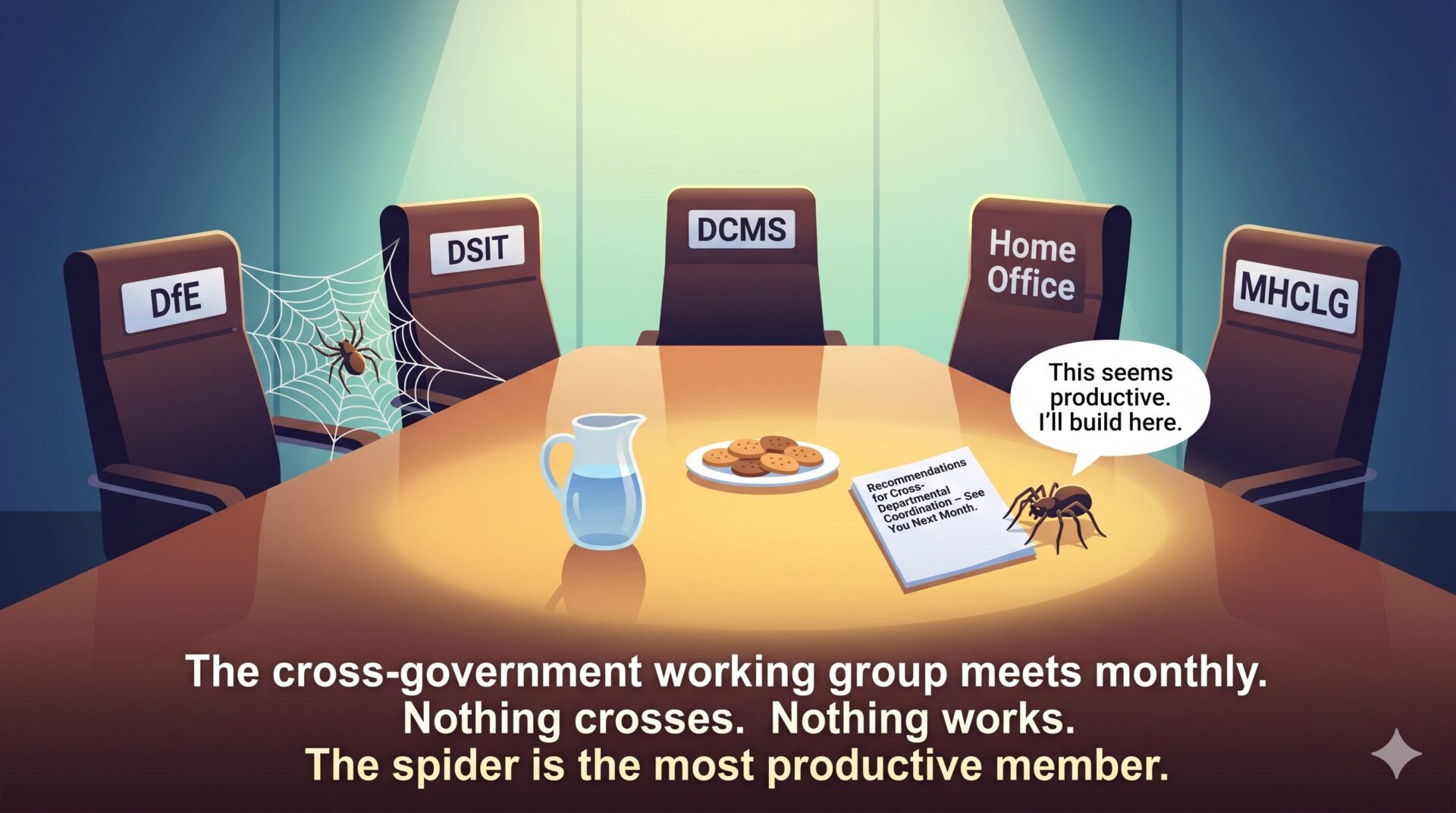
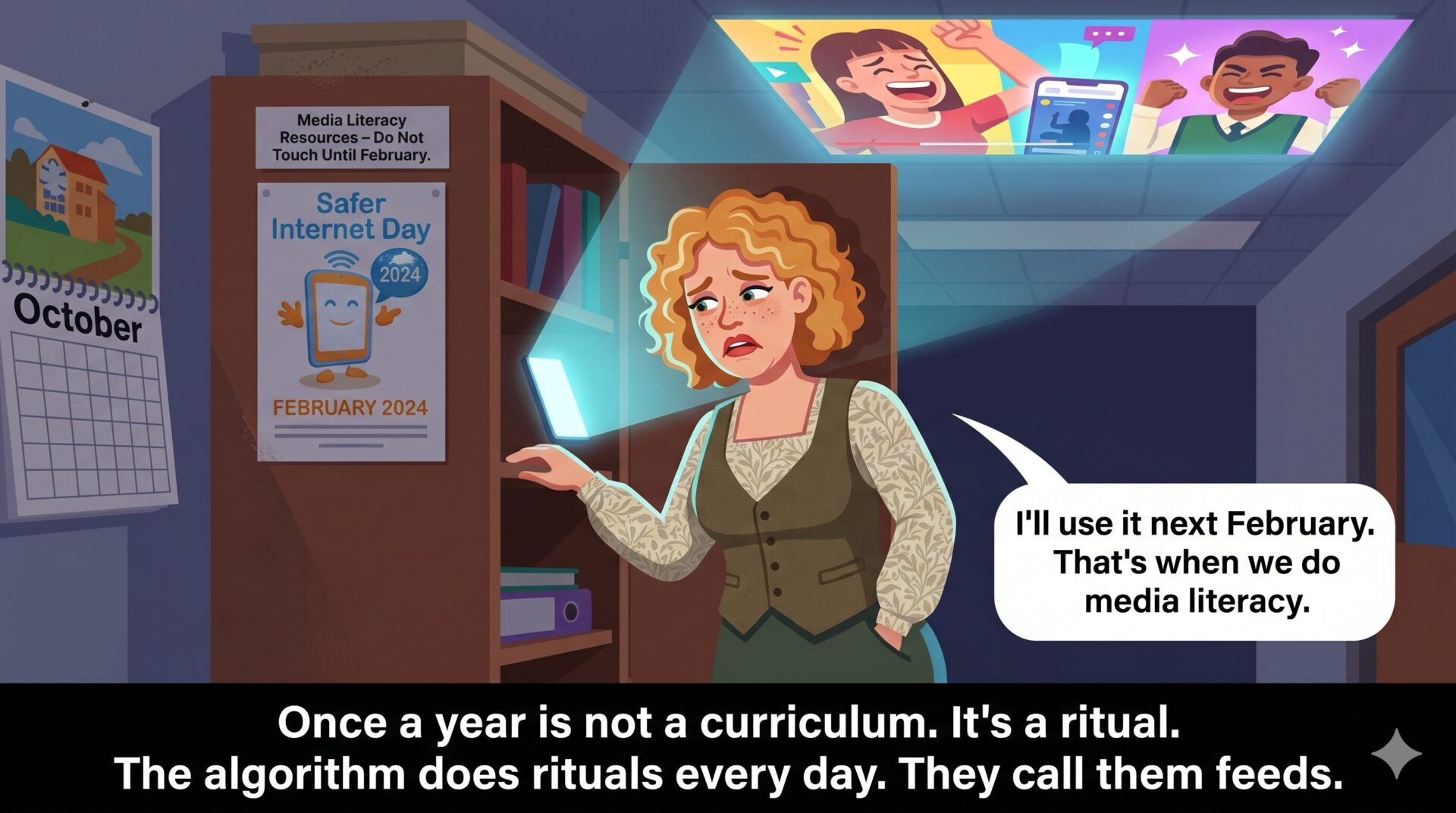 The algorithm is not a qualified teacher. The algorithm has no curriculum. The algorithm has no duty of care. The algorithm has no accountability to parents, to Parliament, to the public.
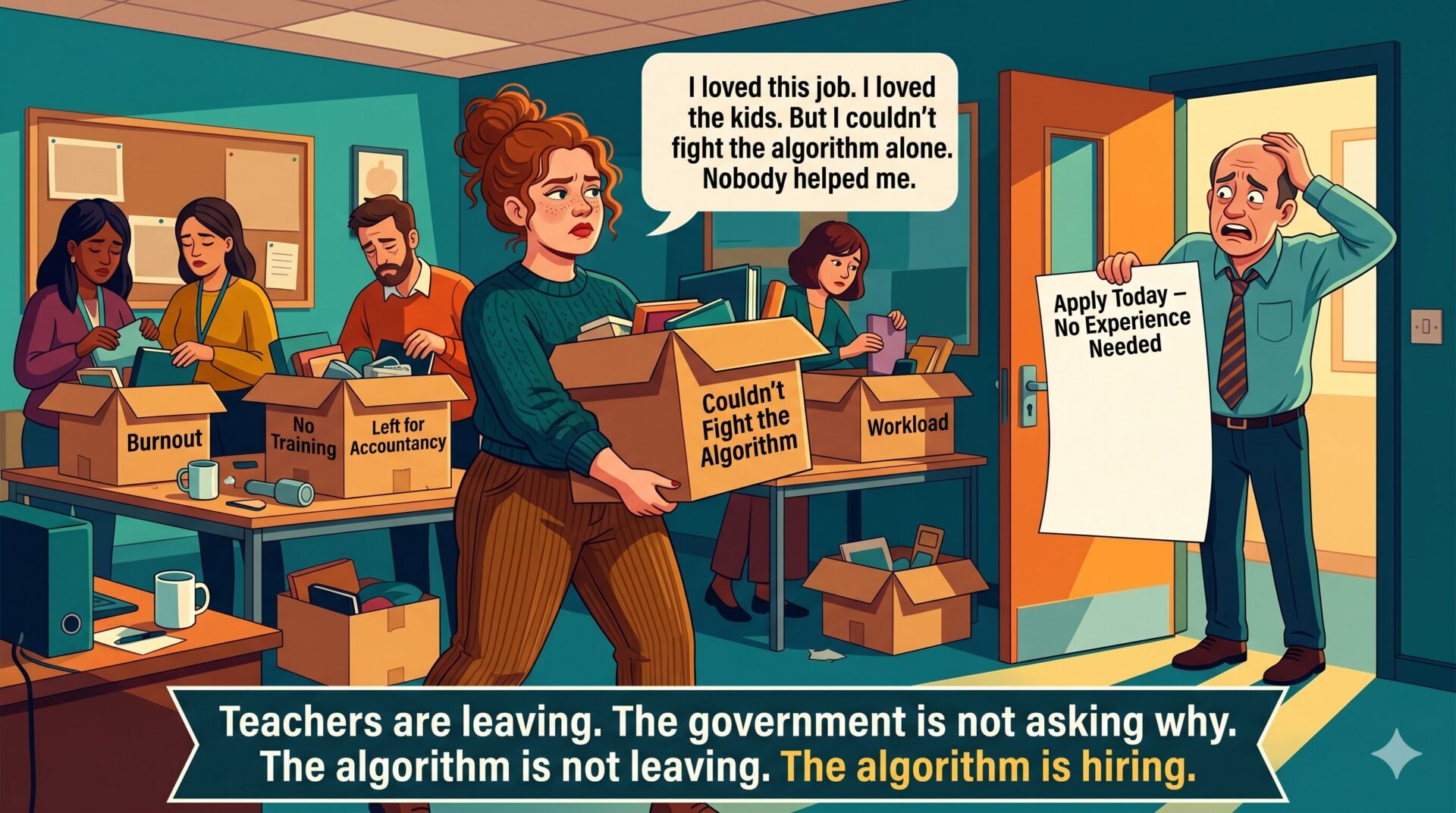 The DfE isn’t interested. So Ofcom’s strategy is hamstrung. They can conduct research. They can publish reports. They can convene stakeholders. They cannot change what happens in schools.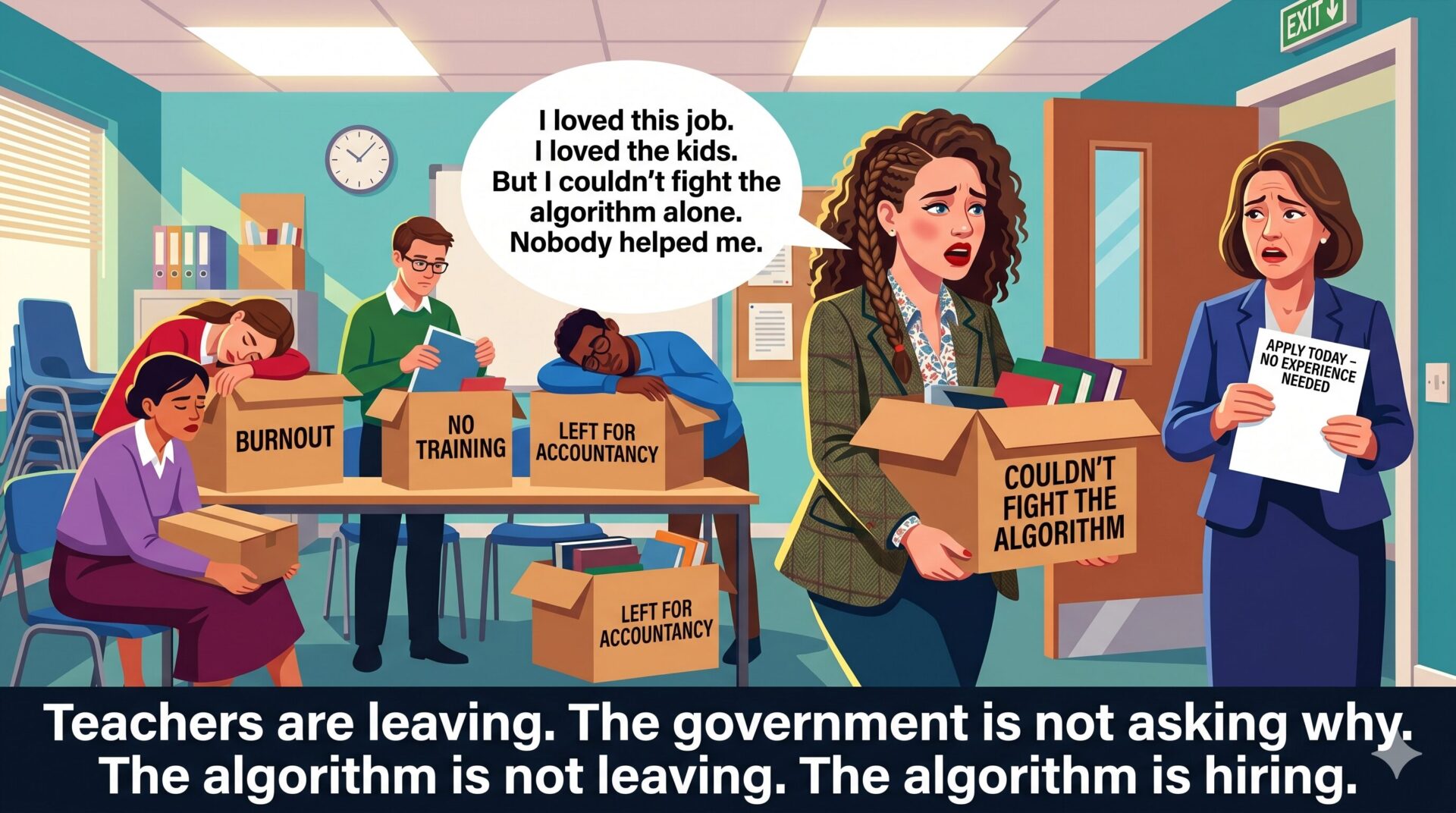
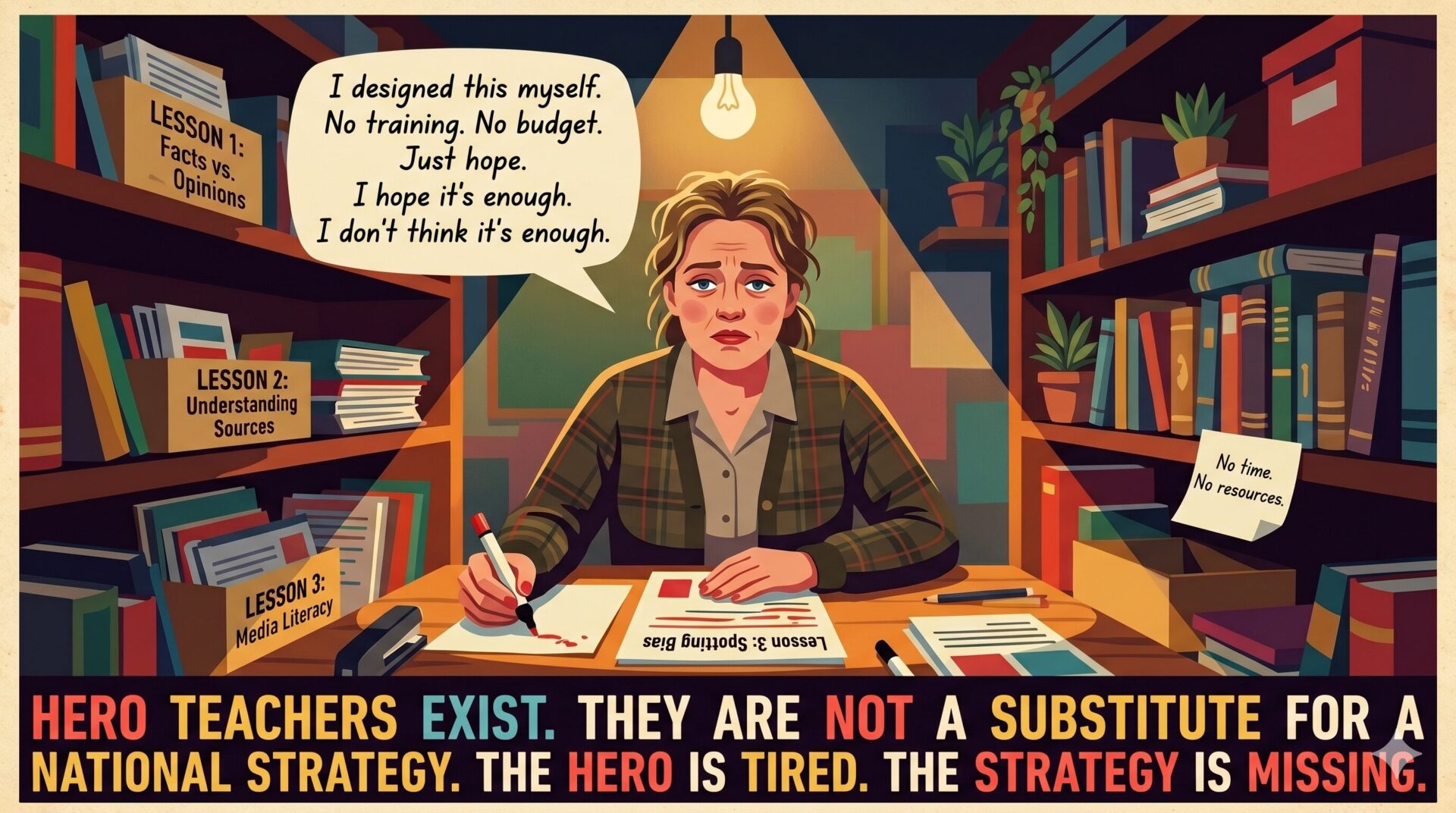
The Short-Termism Trap
The Pilot Purgatory
“A rolling stone gathers no moss” — but a rolling pilot programme gathers no progress either.
There’s a charity in London. Parent Zone. They do good work. They’ve been doing good work for years. They’ve trained parents. They’ve reached communities. They’ve built resources. They’ve evaluated outcomes.
They’ve also been funded by the government. Off and on. A grant here. A pilot there. A project that starts with promise and ends with a report. Then silence. Then another grant. Another pilot. Another report.
Vicki Shotbolt runs Parent Zone. She’s tired. Not tired of the work — she loves the work. Tired of the cycle. The endless cycle of short-term funding. The constant uncertainty. The feeling that just when you’re making progress, the rug gets pulled.
“Pilots are great,” she told the Lords Committee. “But we have been running them since 2015. At some point, we need to make a decision and start long-term funding.”
She’s right. 2015 was ten years ago. A decade of pilots. A decade of starting and stopping. A decade of building relationships, designing programmes, reaching communities, then watching it all evaporate when the funding ran out.
The Government’s 2021-24 Online Media Literacy Strategy funded seventeen projects with nearly £3 million. Sounds impressive. Sounds like action. Sounds like progress.
It was none of those things. It was seventeen pilots. Seventeen short-term experiments. Seventeen chances to prove what works, followed by seventeen opportunities to ignore the results.
“A bird in the hand is worth two in the bush” — but the government prefers birds in the bush. They’re cheaper. They don’t need feeding. They can be ignored until the next election.
The Logic of the Pilot
Let me explain why governments love pilots. Pilots are cheap. A few million pounds spread across a few dozen projects looks like action without breaking the bank.
Pilots are temporary. They have an end date. No long-term commitment. No ongoing costs. No liability.
Pilots are evaluable. You can measure outcomes. You can write reports. You can hold press conferences announcing the results. Then you can move on to the next thing.
Pilots are also useless. Not entirely — they generate data, build capacity, create relationships. But they don’t solve problems. Because problems don’t go away when the funding stops.
Parent Zone’s Everyday Digital programme reached over 63,000 parents in a year. Sixty-three thousand. That’s not a pilot. That’s a programme. That’s impact. That’s proof of concept.
The funding stopped. The programme is being radically scaled back. Those 63,000 parents will not be replaced. Their children will remain vulnerable. The algorithm will continue to teach.
The government learned nothing from the pilot. Or rather, they learned that the programme worked. They learned that it reached people. They learned that it made a difference.
Then they chose not to fund it. Because pilots are for learning, not for doing. The doing is someone else’s problem.
“The proof of the pudding is in the eating” — but the government has developed a taste for raw ingredients. They never cook. Never serve. Never eat.
The Charity’s Exhaustion
Let me tell you about a charity in Manchester. Let’s call them Media Matters. They’ve been running media literacy programmes for a decade. They’ve survived on a diet of short-term grants. A year here. Six months there. A few months of bridge funding while they wait for the next decision.
They’re exhausted. Their staff are exhausted. Their partners are exhausted. Everyone is exhausted.
Every grant means a new application. A new budget. A new reporting framework. A new set of hoops to jump through. Every grant ends with the same uncertainty: will we survive? Will we have to lay off staff? Will we have to close programmes?
This is not a sustainable way to run a sector. It’s not a sustainable way to solve a problem. It’s not a sustainable way to protect democracy.
But it’s the only way the government offers. Short-term. Small-scale. Pilot-shaped. Designed to generate reports, not results. Designed to tick boxes, not change lives.
Media Matters has proven what works. They have the data. They have the evaluations. They have the testimonials.
The government isn’t interested. Because funding what works would mean committing. And committing would mean admitting that the problem is real and urgent and requires ongoing investment.
Better to keep piloting. Keep learning. Keep evaluating. Keep the sector in a state of permanent precarity. Permanent uncertainty. Permanent begging.
“Man does not live by bread alone” — but charities don’t live by pilots alone. They need stability. They need certainty. They need the government to finally make a decision.
The Waste of Learning
Here’s the tragedy of the pilot obsession. The government has learned what works. They have seventeen projects’ worth of data. They have evaluations. They have reports. They have evidence.
They’re not using it. Not really. The lessons are filed away. The reports are published. The press releases are written.
Then nothing. The next strategy starts. The next pilots are commissioned. The next reports are written. The cycle repeats.
Parent Zone learned that reaching parents through trusted local networks works. The government knows this. They’ve known it for years. They’ve funded pilots that proved it.
They haven’t scaled it. They haven’t funded it long-term. They haven’t embedded it in any national programme.
So Parent Zone’s work remains a pilot. A successful pilot. A proven pilot. A pilot that will be scaled back because the government won’t commit.
This is not a failure of evidence. It’s a failure of will. The government has the evidence. They choose not to act on it.
“Knowledge is power” — but only if you use it. The government has knowledge. They choose to be powerless.
The Political Economy of Pilots
Let’s talk about why pilots are so attractive to politicians. It’s not just about money. It’s about credit.
A pilot is announceable. A minister can stand at a podium and announce a new fund, a new programme, a new initiative. There will be a photo op. There will be a press release. There will be a moment of glory.
Long-term funding is not announceable. It’s boring. It’s just… money. Continuing. Ongoing. Unremarkable.
Politicians are incentivised to announce things. They’re not incentivised to sustain them. The electoral cycle rewards novelty. The Treasury rewards thrift. The media rewards controversy.
Long-term funding is none of those things. So long-term funding doesn’t happen.
The result is a sector that lives hand to mouth. That spends most of its energy chasing the next grant. That can’t plan beyond twelve months. That can’t retain staff. That can’t build institutional knowledge.
The government knows this. They’ve been told this. By Vicki Shotbolt. By the Lords Committee. By every charity that has ever received a pilot grant.
They haven’t changed. Because the political economy of pilots is more powerful than the evidence. Because the incentives are misaligned. Because the system is broken.
“The love of money is the root of all evil” — but the love of announceable initiatives is the root of the pilot purgatory.
The Charity’s Calculation
Let me walk you through the calculation that every media literacy charity makes. They have a choice. Apply for a pilot grant or don’t.
If they apply and get it, they get a year of funding. A year of stability. A year to do good work. Then the funding ends and they’re back where they started.
If they don’t apply, they get nothing. They close. Their staff lose their jobs. Their programmes end.
So they apply. Every time. Because the alternative is extinction.
The government knows this. They exploit it. They know that charities will jump through any hoop, accept any terms, tolerate any uncertainty, because the alternative is death.
This is not a partnership. It’s a power relationship. The government holds the purse strings. The charities dance.
Vicki Shotbolt is not complaining about the funding. She’s grateful for it. She’s complaining about the structure. The short-termism. The uncertainty. The impossibility of planning.
She’s right. But the government doesn’t care. Because the government doesn’t need to care. There will always be another charity willing to take the pilot grant. Willing to dance.
“He who pays the piper calls the tune” — and the government is calling a tune that no one can dance to for long.
The Finnish Commitment
Finland doesn’t do pilots. Not for media literacy. They did one pilot, twenty years ago, to figure out what worked. Then they scaled it. Embedded it. Funded it long-term.
The Finnish government didn’t spend years commissioning evaluations. They didn’t keep the sector in a state of precarity. They didn’t announce new initiatives every twelve months.
They made a decision. They committed. They funded.
The result is a media literacy programme that reaches every child. That trains every teacher. That has become part of the fabric of Finnish education.
Britain could do this. They have the evidence. They have the programmes. They have the charities. They have everything except the will.
The will to stop piloting and start doing. The will to commit to long-term funding. The will to treat media literacy as a core function of the state, not a series of experiments.
The will is missing. The pilots continue.
“Where there’s a will, there’s a way” — but where there’s no will, there’s no way. And Britain has no will.
The Department’s Dodge
The DfE would say that they’re waiting for the curriculum review. That they don’t want to fund pilots until they know what the curriculum will look like. That they’re being responsible.
This is a dodge. The curriculum review has been going on for years. It will continue for years. There will always be another reason to wait. Another study to commission. Another pilot to fund.
The DfE is not waiting. They’re avoiding. Avoiding the decision. Avoiding the commitment. Avoiding the responsibility.
The evidence is clear. The programmes work. The charities are ready. The only thing missing is political will.
The DfE could fund Parent Zone’s programme tomorrow. They could give them a five-year grant. They could embed it in the national digital inclusion strategy. They could make it a core part of the government’s response to misinformation.
They won’t. Because that would mean admitting that the pilots were just a delay tactic. That they’ve known what works for years and chosen not to act.
“The lady doth protest too much, methinks” — and the DfE protests that they need more evidence. They don’t. They need courage.
The Charity’s Future
Parent Zone will survive. They’re too good not to. They’ll find other funding. Other grants. Other pilots.
But they won’t thrive. They’ll continue to lurch from one short-term project to the next. They’ll continue to lose staff to more stable sectors. They’ll continue to watch their impact erode as the funding runs out.
Vicki Shotbolt will keep testifying. Keep writing reports. Keep asking for long-term funding.
The government will keep listening. Keep nodding. Keep commissioning pilots.
This is the future. More pilots. More reports. More press releases. More photo ops.
No long-term funding. No scaling. No sustainability.
The algorithm will keep teaching. The children will keep scrolling. The democracy will keep eroding.
And the government will keep piloting. Because pilots are easier than decisions. Because short-term is cheaper than long-term. Because tomorrow is always another day to finally start doing something.
“Tomorrow, and tomorrow, and tomorrow, creeps in this petty pace from day to day” — and the government’s tomorrow never comes.
The Final Pilot
Here’s the question the government won’t answer. How many pilots will it take? How many evaluations? How many reports? How much evidence?
Parent Zone has been running pilots since 2015. Ten years. A decade of proof. A decade of evidence.
When is enough enough? When does the government finally decide that they know what works and commit to funding it?
The answer is never. Because the government doesn’t want to commit. They want to keep piloting. Because piloting allows them to look busy without actually solving anything.
The pilots are not a path to action. They are a substitute for action. A way of doing nothing while appearing to do something.
Vicki Shotbolt knows this. That’s why she’s frustrated. That’s why she spoke out. That’s why she told the Lords Committee that pilots are great but we need long-term funding.
The government heard her. They nodded. They wrote a response. They commissioned another pilot.
“The more things change, the more they stay the same” — and the more pilots the government funds, the more the problem remains unsolved.
The algorithm is not piloting. It’s not evaluating. It’s not waiting for the curriculum review.
It’s teaching. Every day. Every scroll. Every swipe. Teaching children that outrage is truth. That engagement is virtue. That sharing is caring, regardless of accuracy.
The government is piloting. The algorithm is winning. And the children are losing.
Seventeen pilots. Nearly £3 million. A decade of learning.
No action. No commitment. No change.
The pilots continue. The problem grows. And the government waits for the perfect moment to finally do something.
That moment will never come. Because the perfect moment is now. And the government has chosen to let it pass.
The Sixty-Three Thousand Who Were Left Behind
“Give a man a fish and you feed him for a day; teach a man to fish and you feed him for a lifetime” — but only if you keep the fishing rod out of the pawn shop.
Sixty-three thousand parents. In a single year. That’s the capacity of Wembley Stadium. That’s the population of Burnley. That’s more people than live in the entire Orkney Islands.
Sixty-three thousand mothers and fathers who learned something about media literacy. Who discovered how to spot a sponsored link. Who understood for the first time why their teenagers were seeing what they were seeing. Who felt a little less alone in the battle against the algorithm.
Parent Zone’s Everyday Digital programme reached them. Through schools. Through libraries. Through community centres. Through trusted local networks that the charity had spent years building.
And then the funding stopped.
Not because the programme didn’t work. It worked brilliantly. The evaluation showed a forty-five per cent improvement in participants’ understanding of what media literacy means. Forty-five per cent. That’s not a marginal gain. That’s a transformation.
The funding stopped because the government’s strategy ended. Because the pilot was over. Because the money had been allocated for a specific period and would not be renewed.
Sixty-three thousand parents reached. Then the plug pulled. The programme scaled back. The staff laid off. The relationships dissolved.
The need has never been greater. The algorithm has never been smarter. The lies have never been more convincing.
But the funding has stopped. Because the government’s attention span is shorter than a TikTok video.
“A stitch in time saves nine” — but the government has run out of thread. They’ve used it all on pilots. And now the fabric is unravelling.
The Anatomy of a Programme
Let me explain what Everyday Digital actually did. It wasn’t complicated. It wasn’t expensive. It was just… smart.
Parent Zone trained local champions. People who were already trusted in their communities. Teaching assistants. Librarians. Youth workers. Community organisers. People who knew the parents. People who spoke their language. People who could walk into a room and not be met with suspicion.
These champions ran workshops. Short sessions. Practical, not theoretical. How to set up parental controls. How to talk to children about what they see online. How to spot the signs of radicalisation. How to have difficult conversations without losing your temper or your child’s trust.
The workshops were not lectures. They were conversations. Parents sharing experiences. Parents learning from each other. Parents realising that they weren’t alone in their confusion and fear.
The programme reached sixty-three thousand parents. Not through glossy advertising campaigns. Through word of mouth. Through trusted relationships. Through the quiet, unglamorous work of community organising.
It worked. The evaluation proved it worked. The government knew it worked.
And they let it die.
“If it ain’t broke, don’t fix it” — but the government doesn’t fix what’s broken. They abandon what’s working. Because working programmes require ongoing funding. And ongoing funding requires commitment. And commitment requires courage.
The Parent’s Journey
Let me tell you about a parent in Bristol. Let’s call her Diane. She’s forty-three. Two teenagers. Works in a call centre. She was in one of the Everyday Digital workshops.
Before the workshop, Diane was lost. She didn’t understand TikTok. Didn’t understand why her daughter spent hours on it. Didn’t understand how to keep her safe. She tried taking the phone away. It didn’t work. She tried grounding. It didn’t work. She tried screaming. It didn’t work.
The workshop changed things. Not overnight. But gradually. Diane learned about algorithms. Learned why her daughter was seeing the content she was seeing. Learned how to have conversations instead of confrontations.
She started asking her daughter questions. “What did you see today? How did it make you feel? Do you think it was true?” Not interrogations. Openings. Chances for her daughter to talk.
It worked. Her daughter started sharing. Started asking Diane for advice. Started trusting her again.
Diane is not a media literacy expert. She’s a call centre worker who attended a free workshop at her local library. She’s proof that the programme worked.
She’s also proof that the programme’s death matters. Because Diane’s daughter is still on TikTok. The algorithm is still serving content. The lies are still spreading.
Diane has the tools now. But she’s one person. Sixty-three thousand people have the tools. But there are millions of parents who don’t. Who will never attend a workshop because the workshops don’t exist anymore.
“One swallow does not make a summer” — and sixty-three thousand swallows don’t make a sustainable programme. Not when the funding stops.
The Charity’s Calculus
Parent Zone didn’t want to scale back. They fought to keep the programme going. They looked for other funding. They applied for grants. They appealed to philanthropists.
They couldn’t find enough. The government had been the main funder. When the government pulled out, there was no one to fill the gap.
So the programme scaled back. From sixty-three thousand parents to a fraction of that. The staff who had built the relationships were laid off. The champions who had been trained drifted away. The momentum was lost.
This is not a failure of Parent Zone. It’s a failure of the funding model. A model that treats media literacy as a series of short-term experiments rather than a long-term public health intervention.
Imagine if we treated vaccines this way. A pilot programme in a few cities. Reach sixty-three thousand children. Prove it works. Then stop funding it.
There would be riots. There would be resignations. There would be headlines.
But media literacy is not vaccines. Parents don’t understand how urgent it is. Politicians don’t see the votes in it. The media doesn’t cover the slow erosion of democratic resilience.
So the programme scales back. The parents are left to fend for themselves. The algorithm continues its work.
“The road to hell is paved with good intentions” — and Parent Zone’s intentions were good. The government’s intentions were good. Everyone’s intentions were good.
But good intentions don’t fund programmes. Good intentions don’t reach parents. Good intentions don’t stop the algorithm.
The Political Economy of Stopping
Why did the funding stop? The official answer is that the strategy ended. The 2021-24 Online Media Literacy Strategy had a fixed lifespan. The money was allocated for that period. When the period ended, the money ended.
This is nonsense. Strategies can be renewed. Money can be reallocated. Programmes can be continued. The government chose not to.
Because the government’s priorities shifted. Media literacy was folded into the Digital Inclusion Action Plan. The Digital Inclusion Action Plan has different goals. Different metrics. Different funding streams.
Everyday Digital didn’t fit neatly into the new framework. It was a media literacy programme, not a digital inclusion programme. The distinction mattered. The funding disappeared.
This is not an accident. It’s a choice. A choice to prioritise digital inclusion — getting people online — over media literacy — teaching them what to do once they’re there.
The government decided that access was more important than skills. That connectivity was more urgent than critical thinking. That the hardware mattered more than the human.
They were wrong. But they had the power to be wrong. And Parent Zone paid the price.
“The rich get richer and the poor get poorer” — and the platforms get richer while media literacy programmes get poorer. Because the government has chosen the platforms over the people.
The Parent’s Plea
Diane doesn’t know about the funding politics. She just knows that the workshops stopped. That the library doesn’t offer them anymore. That the friendly face who ran them has moved on.
She’s tried to find alternatives. There aren’t any. The other charities are also scaling back. The local authority has no budget. The school doesn’t have the capacity.
Diane is on her own. She has the tools she learned in the workshop. But she’s not confident. She’s not an expert. She’s a call centre worker who attended a free workshop.
She’s doing her best. Her best is not enough. Not against the algorithm. Not against the platforms. Not against the billion-dollar attention machine that is trying to capture her daughter’s mind.
Diane is not alone. There are sixty-three thousand parents like her. Parents who were reached. Parents who were helped. Parents who are now being abandoned.
The government reached them. The government helped them. The government proved that the programme worked.
Then the government walked away.
“What goes around comes around” — and what comes around for Diane is the same algorithm, the same lies, the same fear. Only now she has to face it alone.
The Algorithm’s Gratitude
The algorithm doesn’t care about Diane. Doesn’t know she exists. Doesn’t need to. It’s not personal. It’s just code. Optimising for engagement. Maximising profit.
But if the algorithm could feel gratitude, it would thank the government. Thank them for ending the funding. For scaling back the programme. For leaving parents vulnerable.
Because vulnerable parents are better for business. Parents who don’t understand how TikTok works are less likely to use parental controls. Parents who can’t spot sponsored content are more likely to click. Parents who are afraid and confused are more likely to keep scrolling, keep engaging, keep generating revenue.
The government has done the algorithm a favour. They’ve removed a threat to its business model. They’ve cleared the field of competitors.
The algorithm is not grateful. It doesn’t feel. But if it did, it would be laughing. Laughing at a government that talks about online safety while defunding the programmes that keep people safe. Laughing at a democracy that claims to value informed citizens while abandoning the parents who need information most.
“He who laughs last laughs longest” — and the algorithm is laughing all the way to the bank.
The Finnish Contrast
Finland doesn’t do this. They don’t fund a programme for a year, prove it works, and then pull the plug. They fund it. Long-term. Sustainably. As part of a national strategy.
The Finnish equivalent of Everyday Digital wouldn’t be a pilot. It would be a core service. Funded by the government. Delivered through libraries and schools. Available to every parent who needs it.
Finland understands that media literacy is not a short-term problem. It’s not something you can solve with a pilot. It’s an ongoing challenge. A permanent feature of the digital age. Something that requires permanent investment.
Britain understands this too. They just don’t act on it. Because action costs money. Action requires commitment. Action means admitting that the problem is real and urgent and won’t go away.
It’s easier to fund pilots. To announce initiatives. To hold press conferences. To move on.
The parents don’t move on. The algorithm doesn’t move on. The problem doesn’t move on.
But the government does.
“The best time to plant a tree was twenty years ago. The second best time is now.” Finland planted twenty years ago. Britain is still arguing about whether the tree is worth the water.
The Charity’s Warning
Vicki Shotbolt didn’t testify to the Lords Committee because she wanted to complain. She testified because she wanted to warn. To warn that the sector is dying. That the programmes are scaling back. That the parents are being abandoned.
She warned that the government’s approach is unsustainable. That pilots are not enough. That short-term funding creates short-term thinking. That the algorithm is not constrained by the electoral cycle.
The government heard her. They nodded. They wrote a response. They did nothing.
The programme is scaling back. The parents are losing support. The algorithm is winning.
Vicki Shotbolt is not surprised. She’s been doing this since 2015. She’s seen the cycle before. She knows that governments announce, pilot, evaluate, and move on. That the sector survives despite the government, not because of it.
But she’s tired. Tired of fighting the same battles. Tired of making the same arguments. Tired of watching good programmes die.
She’ll keep fighting. Because the alternative is worse. Because the parents deserve better. Because the algorithm must be stopped.
But she’s tired. And her tiredness is a verdict on a government that has failed to act.
“The spirit is willing, but the flesh is weak” — and the spirit of the media literacy sector is willing. But the flesh is exhausted. And the government is not helping.
The Parent’s Future
Where will Diane be in five years? Her daughter will be nineteen. An adult. No longer under Diane’s direct influence.
Will Diane have kept up with the technology? Will she understand the new platforms, the new algorithms, the new risks? Or will she have fallen behind, overwhelmed by the pace of change?
Will her daughter be safe? Will she have learned to navigate the digital world on her own? Will she have internalised the lessons Diane learned in the workshop? Or will she have been captured by the algorithm, radicalised by the feed, lost to the lies?
Diane doesn’t know. She can’t know. She’s doing her best. Her best is not enough. It’s not her fault.
The government could have helped. They had a programme that worked. They proved it worked. They reached sixty-three thousand parents.
They chose not to continue. Not because they couldn’t. Because they wouldn’t.
Sixty-three thousand parents. A programme that worked. A need that has never been greater.
And the government walked away.
“For want of a nail, the shoe was lost” — for want of sustained funding, the parent was lost. For want of the parent, the child was lost. For want of the child, the future was lost.
All because the government couldn’t commit to a programme that worked. All because they preferred pilots to permanence. All because they chose the algorithm over the people.
Sixty-three thousand parents. A programme that worked.
The funding stopped. The need didn’t.
And the algorithm is still there. Still serving. Still teaching. Still winning.
The Finnish Lighthouse
“A country that forgets its past has no future” — but a country that ignores its present has already lost both.
There’s a building in Helsinki. Not a grand building. Not a famous building. Just an office block on a street you’ve never heard of. Inside, there’s an agency called KAVI. The National Audiovisual Institute. They’re the ones who coordinate Finland’s media literacy policy.
They started in 2013. That’s the year David Cameron was still promising a referendum on Europe. The year the word “deepfake” didn’t exist. The year TikTok was just a twinkle in a Chinese engineer’s eye.
They started anyway. Because Finland knew something Britain didn’t. That media literacy is not a response to a crisis. It’s a prevention. A vaccine. Something you put in place before the epidemic hits.
Finland has topped the European Media Literacy Index every single year since it was first published. Every. Single. Year. Not sometimes. Not most years. Every year. From 2017 to 2026. A decade of dominance.
The UK has fallen from 10th to 13th. Not because we’re stupid. Because we started too late. Because we invested too little. Because we treated media literacy as an optional extra rather than a core function of the state.
Finland didn’t make that mistake. They started in 2013. They’ve updated their strategy continuously. They’ve trained teachers. They’ve embedded media literacy in the curriculum. They’ve made it part of what it means to be Finnish.
And now they’re reaping the rewards. Their citizens are harder to fool. Their democracy is more resilient. Their information environment is less toxic.
Meanwhile, Britain is still arguing about whether media literacy is important. Still piloting. Still evaluating. Still waiting for the perfect moment to act.
That moment passed years ago. While we were waiting, Finland was building.
“The early bird catches the worm” — but Finland didn’t just catch the worm. They built a worm farm. They invested in sustainable worm production. They made sure no bird would ever go hungry again.
The Anatomy of Finnish Success
Let me explain what Finland actually did. It’s not magic. It’s not complicated. It’s just… systematic.
In 2013, the Finnish government published a national media literacy policy framework. Not a strategy — those come and go. A framework. A permanent structure. A commitment.
The framework made media literacy a cross-curricular competency. That means every subject teacher is responsible for it. History teachers teach source criticism. Science teachers teach evidence evaluation. Art teachers teach visual manipulation. Maths teachers teach data literacy. Every teacher. Every subject. Every year.
The framework also created KAVI as the coordinating body. A dedicated agency with a dedicated budget. Not a team of twelve people buried inside a regulator. A proper institution with proper resources.
The framework required continuous updating. Every few years, the government reviews and revises. Not because the old framework failed. Because the information environment changes. Because new threats emerge. Because you can’t solve 2026’s problems with 2013’s solutions.
This is not rocket science. It’s just… governance. A government that takes responsibility for a problem and builds a system to address it.
Britain has none of this. No framework. No coordinating body. No continuous updating. No system.
We have Ofcom with twelve people. We have a Digital Inclusion Action Plan that mentions media literacy in passing. We have a cross-government working group that meets monthly. We have pilots. We have reports. We have press releases.
We don’t have a system. We have a shrug.
“A house built on sand cannot stand” — and Britain’s media literacy policy is built on sand. Finland’s is built on bedrock.
The KAVI Model
Let me tell you about KAVI. It’s a government agency. It has a director, a staff, a budget, a mandate. It’s not enormous — Finland is a small country — but it’s serious.
KAVI coordinates media literacy across government. They work with the Ministry of Education. They work with the Ministry of Culture. They work with the Ministry of Transport and Communications. They’re not siloed. They’re not ignored. They’re at the table.
KAVI also works with civil society. They fund organisations. They convene stakeholders. They share best practice. They’re not a command-and-control bureaucracy. They’re a hub. A centre of gravity. A place where things happen.
KAVI evaluates. They don’t just fund programmes and hope for the best. They measure. They assess. They learn. They adjust.
And KAVI updates. Every few years, they refresh the national framework. Not because they have to. Because the world changes. Because new threats emerge. Because they refuse to be complacent.
Britain has nothing like KAVI. Ofcom comes closest, but Ofcom is a regulator, not a coordinating body. Their media literacy team has twelve people. They don’t have a budget for civil society grants. They don’t have a seat at the cabinet table.
The DfE could be a coordinating body. They’re not interested. DSIT could be. They’re focused on digital inclusion. The Cabinet Office could be. They’re focused on other things.
No one is responsible. No one is coordinating. No one is building.
“Too many cooks spoil the broth” — but in Britain, there are no cooks. The broth is cold. The kitchen is empty. And Finland is serving a feast.
The Teacher Training Difference
Remember the five per cent statistic? Only five per cent of British teachers feel very confident teaching media literacy. In Finland, that number is much higher. Not one hundred per cent — nothing is perfect — but much higher.
Why? Because Finland trains teachers. Initial teacher training includes media literacy. Not as an optional module. As a core component. Every new teacher learns how to teach students to navigate the digital world.
Continuing professional development includes media literacy. Not as a one-off. As an ongoing requirement. Every few years, teachers refresh their skills. Learn about new threats. Update their approaches.
Resources are available. The government provides lesson plans, activity ideas, assessment frameworks. Teachers don’t have to design their own. They don’t have to guess. They have a national curriculum, national resources, national support.
In Britain, teachers are on their own. No training. No resources. No support. No wonder only five per cent feel confident.
The difference is not individual teacher quality. It’s systemic. Finland built a system. Britain didn’t.
“You can’t teach what you don’t know” — and Britain doesn’t know media literacy. Because no one taught the teachers. Because no one built the system.
The Curriculum Integration
Finland didn’t add media literacy as a new subject. They didn’t create more crowding in an already crowded curriculum. They integrated it.
Every subject. Every teacher. Every year.
This is genius. It’s also obvious. Media literacy is not a separate skill. It’s a way of thinking. A lens. A habit of mind. It belongs in history class when students analyse propaganda posters. It belongs in science class when students evaluate conflicting studies. It belongs in art class when students discuss how images manipulate emotion.
Finnish teachers don’t need to find extra time for media literacy. It’s not extra. It’s embedded. It’s part of what they were already doing.
British teachers don’t have this. Media literacy is an add-on. Something they have to squeeze in. Something that competes with everything else. Something that gets squeezed out.
The result is that Finnish students learn media literacy without even knowing they’re learning it. It’s just… school. British students learn nothing. Because there’s no room. Because there’s no integration. Because there’s no system.
“Many hands make light work” — and in Finland, many subjects make light work of media literacy. In Britain, no subjects do.
The Political Will
Here’s the uncomfortable truth. Finland didn’t build its system because it was rich. Finland built its system because it was scared.
Finland shares a border with Russia. 830 miles of border. A neighbour that specialises in information warfare. A neighbour that has tried to destabilise Finnish democracy for decades.
Finland understood that media literacy is a national security issue. That an informed citizenry is a defence against propaganda. That the best way to resist manipulation is to teach people how to recognise it.
This is not paranoia. It’s experience. Finland has been fighting information warfare since before the internet existed. They know what works. They know what doesn’t.
Britain doesn’t have this urgency. We’re an island. We’re not paranoid about foreign interference. We think we’re immune.
We’re not immune. Russia interfered in our elections. They’ve targeted our democracy. They’ve spread lies about our institutions.
But we don’t feel threatened. So we don’t act. Finland feels threatened. So they built a lighthouse.
“Necessity is the mother of invention” — and Finland’s necessity was survival. Britain’s necessity is… what, exactly?
The Index Evidence
The European Media Literacy Index is not perfect. It measures structural inputs — education quality, media freedom, trust in society — not individual skills. But it’s the best we have.
Finland has topped it every year since 2017. That’s not a coincidence. That’s evidence.
The UK has fallen from 10th to 13th. That’s also not a coincidence. That’s evidence of decline. Evidence of neglect. Evidence of a country that stopped trying.
The index doesn’t measure everything. But it measures enough. It measures whether countries have national strategies. Whether they train teachers. Whether they invest in media literacy.Finland says yes. The UK says not really.
The gap is not small. It’s not something we can close with a pilot programme or a press release. It’s a chasm. A chasm that has been growing for a decade.
And it will keep growing. Because Finland keeps updating. Keeps investing. Keeps improving.
And Britain keeps piloting.
“The race is not to the swift, but to those who keep running” — and Finland has been running for thirteen years. Britain is still tying its shoelaces.
The British Excuses
The British government has excuses. They’re not good excuses, but they have them.
We’re bigger than Finland. Population 68 million versus 5.5 million. It’s harder to coordinate. Harder to implement. Harder to reach everyone.
This is true. It’s also irrelevant. Germany is bigger than Finland. Germany has a national media literacy strategy. France is bigger than Finland. France has a national media literacy strategy. Size is not an excuse.
We’re more diverse than Finland. More languages, more cultures, more communities. It’s harder to design programmes that work for everyone.
This is also true. Also irrelevant. Canada is more diverse than Finland. Canada has a national media literacy organisation. Diversity is not an excuse.
We have a different political system. Different education system. Different media landscape.
Also true. Also irrelevant. Other countries with different systems have managed. Britain could too, if it wanted to.
The real excuse is that Britain doesn’t want to. Not enough. Not urgently. Not consistently.
The real excuse is political will. Or the lack thereof.
“Where there’s a will, there’s a way” — and Britain has no will. So there’s no way.
The Future Gap
Let me project forward. Ten years. 2036.
Finland will still be at the top of the index. They’ll have updated their framework twice more. Their teachers will be even better trained. Their citizens will be even harder to fool.
Britain will be somewhere in the middle. Maybe 15th. Maybe 18th. Maybe lower. Because we’ll still be piloting. Still evaluating. Still waiting for the perfect moment.
The gap will have grown. The Finnish advantage will have compounded. Their children will have grown up with media literacy as a core skill. Their adults will have internalised critical thinking. Their democracy will be resilient.
British children will have grown up with the algorithm as their teacher. British adults will be more vulnerable. British democracy will be weaker.
This is not inevitable. We could change. We could build a system. We could train teachers. We could embed media literacy in the curriculum. We could fund it properly. We could start now.
We won’t. Not because we can’t. Because we won’t.
“The best time to plant a tree was twenty years ago. The second best time is now.” Finland planted twenty years ago. Britain is still arguing about who owns the shovel.
The Lighthouse’s Lesson
The Finnish lighthouse is not a secret. It’s not a mystery. It’s not something that only Finland can do.
It’s a choice. A choice to prioritise media literacy. A choice to invest. A choice to build a system. A choice to update continuously. A choice to take responsibility.
Britain could make the same choice. We have the resources. We have the expertise. We have the need.
We don’t have the will. The political will. The sustained, cross-party, long-term will.
Finland has that will. They built a lighthouse. They keep it lit. They keep it updated.
Britain is still fumbling in the dark, tripping over the same obstacles, making the same excuses.
The algorithm doesn’t care about excuses. The algorithm doesn’t care about political will. The algorithm doesn’t care about national strategies or curriculum frameworks.
The algorithm cares about engagement. And engagement is thriving. Because Britain is doing almost nothing to stop it.
“The light shines in the darkness, and the darkness has not overcome it” — but the darkness is trying. And Britain is not even turning on the switch.
Finland turned on the switch in 2013. Their light has been shining ever since.
Britain is still looking for the plug.
The Index of Shame
“Pride comes before a fall” — but what comes after the fall is usually a very long, very uncomfortable silence.
Let me tell you about a ranking you’ve probably never heard of. The Open Society Institute’s European Media Literacy Index. It comes out every year. It ranks countries on how well they’re preparing their citizens for the digital age. How well they’re teaching critical thinking. How well they’re building resilience against misinformation.
In 2021, Britain was 10th. Not first — Finland owns that spot, has owned it for years — but 10th. Respectable. Middle of the pack. Nothing to boast about, but nothing to be ashamed of either.
In 2022, Britain dropped to 11th.
In 2023, Britain dropped to 13th.
We are not standing still. Standing still would be bad enough in a world where the technology is advancing exponentially, where the lies are getting more sophisticated, where the algorithm is getting better at manipulation.
We are not standing still. We are moving backwards. Falling behind. Losing ground.
Ten years ago, we were ahead of most of Europe. Now we’re behind countries we used to laugh at. Estonia. Lithuania. The ones we thought of as former Soviet satellites with funny accents and strange food.
They’re beating us. Not because they’re smarter. Because they tried harder. Because they started earlier. Because they took the threat seriously.
We didn’t. We’re still not.
“The race is not to the swift, but to those who keep running” — and we have stopped running. We’re walking. We’re stumbling. We’re falling.
The Geography of Decline
Let me put those numbers in context. 10th to 13th. Three places. Doesn’t sound like much, does it? A small drop. A minor adjustment. Nothing to panic about.
Wrong.
The index includes 41 countries. Moving from 10th to 13th means being overtaken by three countries that used to be behind you. Countries that invested. Countries that built systems. Countries that decided media literacy mattered.
Estonia. Population 1.3 million. Former Soviet republic. Spent decades recovering from occupation. Has built one of the most advanced digital societies in the world. And now beats Britain in media literacy.
Lithuania. Population 2.7 million. Also former Soviet. Also recovering. Also investing. Also beating Britain.
Ireland. Population 5.1 million. Our closest neighbour. Same language, similar culture, shared history. Ireland is beating Britain.
These are not giants. These are not superpowers. These are small countries with limited resources and real challenges.
They decided media literacy was a priority. They allocated funding. They trained teachers. They built systems.
Britain didn’t. Britain dropped.
“A little leaven leavens the whole lump” — and a little investment in media literacy leavens the whole society. Estonia invested. Ireland invested. Britain didn’t.
The Estonia Exception
Let me tell you about Estonia. It’s tiny. It’s cold. It spent fifty years under Soviet occupation. It has a complicated relationship with its giant neighbour, Russia.
Estonia also has something called e-Estonia. Digital voting. Digital prescriptions. Digital taxes. Digital everything. They built a digital society from scratch because they had to. Their analogue infrastructure was destroyed. They had no choice.
Media literacy is part of e-Estonia. Not an afterthought. A core component. From primary school, Estonian children learn how to navigate the digital world. How to spot misinformation. How to verify sources. How to protect themselves.
The result is a population that is harder to fool. More resilient. More sceptical without being cynical.
Estonia is not richer than Britain. Not more educated. Not more talented.
Estonia just tried harder.
Britain could learn from Estonia. We won’t. Because Estonia is small. Because Estonia is not important. Because Britain is still living in the past, when we ruled the waves and the world and everything in between.
The past is gone. The present is Estonia beating us. The future will be worse.
“From small beginnings come great things” — and from small countries come great media literacy programmes. Britain is not small. Britain is not great at media literacy.
The Ireland Connection
Ireland is our closest neighbour. Same language. Similar legal system. Shared media landscape. If any country should have a similar media literacy profile to Britain, it’s Ireland.
Ireland is beating us.
Ireland established Media Literacy Ireland in 2018. A stakeholder-led network of more than 350 voluntary members. Funded by the broadcasting regulator. Coordinated by a dedicated team.
Ireland runs public awareness campaigns. Simple messaging. Clear calls to action. “Be Media Smart” — check the source, check the date, check the author.Ireland has an annual Media Literacy Week. Events across the country. Schools, libraries, community centres. A focal point for activity. A way to keep media literacy in the public conversation.
Ireland is not perfect. Their system has gaps. Their funding is not what it should be.
But Ireland is trying. Ireland is investing. Ireland is moving forward.
Britain is moving backwards.
“The grass is always greener on the other side” — but in this case, the grass is greener because Ireland watered it. Britain let its lawn turn brown.
The Index’s Methodology
Let me explain what the index actually measures. It’s not a test of individual skills. It’s not a survey of how many people can spot a deepfake. It’s a measure of structural inputs.
Education quality. Media freedom. Trust in institutions. Digital infrastructure. Government policy. Teacher training. Curriculum integration.
These are the things that predict media literacy outcomes. Countries that score well on these inputs tend to have populations that are harder to fool. Countries that score poorly tend to have populations that are more vulnerable.Britain scores well on some inputs. Media freedom is good. Digital infrastructure is good. Education quality is decent.
Britain scores poorly on others. Trust in institutions is declining. Government policy is fragmented. Teacher training is inadequate. Curriculum integration is almost non-existent.
The index captures this. It captures the gap between our potential and our performance. Between what we could achieve and what we actually do.
We could be 5th. We have the resources. We have the expertise. We have the need.
We’re 13th. Because we haven’t tried. Because we haven’t invested. Because we haven’t built.
“You reap what you sow” — and Britain has sown neglect. We are reaping decline.
The Political Economy of Falling
Why are we falling? The answer is not complicated. It’s embarrassing, but it’s not complicated.
We stopped trying.
The 2021-24 Online Media Literacy Strategy was a start. Not a good start — too small, too short-term, too fragmented — but a start. It funded pilots. It commissioned research. It raised awareness.
Then the strategy ended. The government folded media literacy into the Digital Inclusion Action Plan. The Digital Inclusion Action Plan has different priorities. Different metrics. Different funding streams.
Media literacy became an afterthought. A footnote. Something mentioned in passing.
The pilots ended. The funding stopped. The momentum was lost.
Meanwhile, Estonia kept investing. Ireland kept building. Finland kept updating.
We stopped. They continued. We fell. They rose.
This is not mysterious. This is not complicated. This is cause and effect.
The government decided media literacy was not a priority. The index recorded the consequences.
“The chickens come home to roost” — and the chickens are roosting in a very uncomfortable place. 13th place.
The Teacher’s Perspective
Remember Helen from Doncaster? The English teacher who designed her own media literacy curriculum? She’s not surprised by the index. She sees the decline every day.
Her students are more vulnerable than they were five years ago. More likely to believe lies. More likely to share misinformation. More resistant to correction.
Helen is fighting the tide. She’s one teacher in one school. She can’t fix a national problem. She can’t compensate for the government’s neglect.
She’s tired. She’s frustrated. She’s watching the index drop and feeling powerless to stop it.
Helen is not alone. There are thousands of Helens across the country. Teachers who care. Teachers who try. Teachers who are overwhelmed.
The index is not a judgment on Helen. It’s a judgment on the system that has abandoned her.
“A soldier does not choose his battle” — but Helen chose hers. She’s fighting. The government is not.
The Parent’s Despair
Remember Diane from Bristol? The parent who attended the Everyday Digital workshop? She doesn’t know about the index. She doesn’t know about rankings or structural inputs or government policy.
She knows that her daughter is on TikTok. That her daughter believes things that aren’t true. That her daughter is being shaped by an algorithm.
She knows that the workshop helped. That she felt more confident. That she had tools she didn’t have before.
She also knows that the workshop ended. That the funding stopped. That the programme scaled back.
She’s on her own. Fighting the algorithm with nothing but memory and willpower.
The index doesn’t measure Diane’s despair. It doesn’t capture her fear. It doesn’t register her exhaustion.
But the index captures the consequences. 13th place. Falling. Declining. Because parents like Diane are being abandoned.
“A chain is only as strong as its weakest link” — and the weakest link is not Diane. It’s the government that left her to fight alone.
The Finnish Horizon
Finland is 1st. They’ve been 1st every year since the index started. They’re not going anywhere.
Why? Because they have a system. A national framework. A coordinating body. Teacher training. Curriculum integration. Continuous updating.
They didn’t get there by accident. They got there by choice. By investment. By sustained effort over more than a decade.
Britain could be Finland. Not tomorrow — you can’t build a system overnight. But in five years. In ten years. If we started now.
We won’t start now. Because we don’t have the will. Because we don’t feel the urgency. Because the index is just a number. Because 13th place doesn’t feel like a crisis.
It is a crisis. It’s a crisis that has been building for years. A crisis that will continue to build. A crisis that will have consequences.
The index is not the problem. The index is the symptom.
“The doctor can only cure what the patient will admit” — and Britain will not admit that it’s sick. 13th place is just a cold. Nothing to worry about. It will pass.
It won’t pass. It will get worse.
The Future Trajectory
Let me project forward. 2025 index. 2026 index. 2027 index.
Where will Britain be? 14th? 15th? Lower?
We have no national strategy. No coordinating body. No teacher training. No curriculum integration. No sustained funding.
Every year we delay, other countries pull ahead. Estonia keeps investing. Ireland keeps building. Finland keeps updating.
We keep piloting. Keep evaluating. Keep talking about what we might do someday.
The gap grows. The index drops. The vulnerability increases.
This is not inevitable. We could change. We could build a system. We could train teachers. We could embed media literacy in the curriculum. We could fund it properly.
We won’t. Because we haven’t. Because the trajectory is clear. Because the will is missing.
“The road to hell is paved with good intentions” — and Britain’s intentions are good. The road is still paved. We’re still walking. 13th place. 14th next year. 15th the year after.
The Final Ranking
The Open Society Institute’s index is not perfect. It’s a proxy. An approximation. A best guess.
But it’s the best we have. And it tells a clear story.
Britain is falling. Not because of something that happened to us. Because of something we failed to do.
We failed to build a system. Failed to train teachers. Failed to embed media literacy in the curriculum. Failed to fund it properly. Failed to take it seriously.
The index recorded our failure. 10th to 11th to 13th. A country in decline. A country that used to care and stopped.
Finland is 1st. Estonia is ahead of us. Ireland is ahead of us. Countries we used to dismiss are now beating us.
We are not standing still. We are actively falling behind. And we are doing almost nothing about it.
“What goes around comes around” — and what comes around for Britain is a future of vulnerability. A future where our citizens are easier to fool. A future where our democracy is weaker.
All because we couldn’t be bothered to invest in media literacy. All because we thought 10th place was good enough.
It wasn’t good enough. Now it’s 13th. Next year it will be worse.
And the algorithm is still there. Still teaching. Still winning. Still waiting for us to finally care.
We don’t care. The index proves it. 13th place. Falling. Falling. Falling.
 Ireland runs public awareness campaigns. Simple messaging. Clear calls to action. “Be Media Smart” — check the source, check the date, check the author.
 These are the things that predict media literacy outcomes. Countries that score well on these inputs tend to have populations that are harder to fool. Countries that score poorly tend to have populations that are more vulnerable.
The Funding Debate
The Tax That Could Save Democracy
“The one who makes the mess should clean it up” — but in Britain, we’ve been handing the mop to the victims and asking the mess-makers to please consider being more tidy.
There’s a conversation happening in Whitehall. Not a loud conversation. Not a public conversation. A whispered conversation. The kind of conversation that happens in corridors and over expensive coffee. The kind of conversation that nobody wants to admit is happening.
The question is simple. Who pays for media literacy?
The government says it has no money. The Treasury is empty. The Chancellor’s eyebrows are permanently furrowed. Every pound must be justified. Every programme must be scrutinised. Every initiative must prove its worth.
The media literacy sector is tired of begging. Tired of pilots. Tired of short-term grants. Tired of watching good programmes die because the funding ran out.The technology platforms have money. Billions. Not millions. Billions. Google made two hundred billion pounds last year. Meta made over a hundred billion. TikTok isn’t public, but its parent company made over a hundred billion.
They have the money. They have the responsibility. They have the platform — literally and figuratively.
The House of Lords Committee said it plainly. “At a time of great financial challenges for both media organisations and government, the funding for large scale media literacy programmes should substantially come from the technology sector.”
A levy. A tax. A small percentage of the billions they make from our attention. Ring-fenced. Protected. Used to teach people how not to be manipulated.
The government is considering it. They’ve been considering it for years. They’ll keep considering it for years. Because considering is free. Doing costs political capital.
“Where your treasure is, there your heart will be also” — and the platforms’ treasure is in engagement. Their heart is in profit. A levy would force them to invest in something else. Something that doesn’t directly benefit their bottom line. Something that might even reduce their profits in the long run.
That’s why they’ll fight it. And that’s why the government will hesitate.
The Logic of the Levy
Let me explain why a levy makes sense. It’s not complicated. It’s not radical. It’s just… fair.
The platforms cause the problem. Their algorithms amplify misinformation. Their business model rewards outrage. Their design choices exploit human psychology.
They have spent billions optimising for engagement. They have hired the best engineers, the best psychologists, the best data scientists. They have built machines that are incredibly effective at capturing and holding attention.
The result is a population that is more vulnerable to misinformation. More likely to believe lies. More likely to share falsehoods. More likely to be radicalised.
The platforms benefit from this. They don’t cause it directly — they’re not sitting in a boardroom cackling about destroying democracy. But they benefit from it. Engagement is up. Revenue is up. Share prices are up.
It is not unreasonable to ask them to pay for the clean-up. To contribute to the media literacy programmes that teach people how to resist their algorithms.
This is not punishment. This is not revenge. This is the basic logic of externalities. If your business creates a cost for society, you should help pay for it.A factory that pollutes a river pays for the clean-up. A tobacco company pays for healthcare. A platform that profits from misinformation should pay for media literacy.
“Polluter pays” — it’s a principle of environmental law. It should be a principle of information law too.
The Canadian Precedent
Canada already does this. Not exactly — they don’t have a levy on platforms for media literacy. But they have something close.
MediaSmarts, the charity that coordinates Canada’s media literacy efforts, is funded by corporate partners. Major telecommunications and technology companies. Not as a levy — voluntary contributions. But the principle is the same.
The platforms pay because they understand that a media literate population is good for business. Or because they want to avoid regulation. Or because they have public relations teams who need something to do.
Canada is not perfect. MediaSmarts struggles with funding uncertainty. Voluntary contributions can disappear when quarterly profits dip. The platform’s priorities can shift.
But Canada is ahead of Britain. They have a functioning media literacy organisation. They have corporate funding. They have national programmes.
Britain has nothing. We have Ofcom with twelve people. We have a Digital Inclusion Action Plan that mentions media literacy in passing. We have pilots that come and go.
A levy would change this. It would provide stable, predictable, long-term funding. It would be independent of platform goodwill. It would be enforceable.
“Necessity is the mother of invention” — and Canada’s necessity was a fragmented media literacy landscape. Their invention was corporate partnership. Britain’s necessity is greater. Britain’s invention could be a levy.
The Platform’s Protest
The platforms will argue against a levy. They’ll make reasonable-sounding arguments. They’ll hire lobbyists. They’ll write position papers. They’ll meet with ministers.
They’ll say that they already contribute. That they have media literacy programmes of their own. That they invest in safety features and educational resources.
This is true. Google has Be Internet Legends. Meta has Get Digital. TikTok has safety campaigns. These programmes reach millions of people.
They’re also self-serving. They’re designed to look good. They’re not independent. They’re not evaluated by third parties. They’re not subject to scrutiny.
A levy would fund independent media literacy initiatives. Programmes run by charities. Programmes that criticise the platforms. Programmes that teach people how to resist algorithmic manipulation.
The platforms don’t want that. They want to control the narrative. They want to be seen as part of the solution without being part of the problem.
The government should not be fooled. The platforms’ voluntary contributions are not enough. They’re not independent. They’re not sustainable. They’re not accountable.
“You can’t have your cake and eat it” — but the platforms want both. They want to profit from misinformation and be praised for fighting it. A levy would force them to choose.
The Fiscal Reality
The government will say they have no money. The Treasury is empty. The deficit is high. The debt is higher. Every new programme must be offset by cuts elsewhere.
This is true. It’s also an excuse.
The government has money for things it prioritises. Defence. Health. Education. Pensions. Media literacy is not a priority. If it were, the money would be found.
A levy would solve this problem. The money would come from the platforms, not the Treasury. The government wouldn’t have to cut anything. They wouldn’t have to raise taxes. They wouldn’t have to add to the deficit.
They would just have to pass a law. A small law. A simple law. A levy on the platforms that profit from our attention.
This is not radical. This is not socialist. This is not even particularly left-wing. It’s just… sensible.
The platforms have the money. They have the responsibility. A levy would make them contribute to the solution.
The government’s fiscal constraints are real. But they’re not an excuse for inaction. A levy sidesteps them entirely.
“Where there’s a will, there’s a way” — and the government has no will. They have plenty of ways. Including the levy.
The Independence Imperative
Here’s why a levy matters beyond the money. It’s about independence.
Media literacy programmes need to be independent of the platforms. They need to be able to criticise. To teach people how algorithms work. To explain why the platforms show what they show. To help people resist manipulation.
If the platforms are funding the programmes directly, that independence is compromised. Programmes are reluctant to bite the hand that feeds them. They soften their criticism. They avoid uncomfortable topics. They become part of the problem.
A levy would solve this. The money would go to an independent body. Ofcom, perhaps. Or a new agency. Or a consortium of charities.
That body would distribute the funds. They would set the priorities. They would evaluate the outcomes. They would be accountable to Parliament, not to the platforms.
The programmes would be free to criticise. Free to teach the truth about algorithms. Free to help people resist manipulation.
This is not a small thing. Independence is everything. Without it, media literacy becomes just another corporate social responsibility initiative. A fig leaf. A PR exercise.With it, media literacy becomes a genuine counterweight to platform power. A tool for citizens. A defence against manipulation.
“Who pays the piper calls the tune” — and the levy ensures that the piper is paid by the platforms but called by the public.
The Political Economy of Resistance
The platforms will resist. They will lobby. They will threaten. They will promise to leave the UK if the levy is imposed.
This is a bluff. The UK is too big. Too rich. Too important. The platforms won’t leave. They can’t afford to.
But the government will be scared. They’ll believe the threats. They’ll worry about the economic consequences. They’ll hesitate.
This is the political economy of platform power. The platforms are too big to fail. Too big to regulate. Too big to tax.
The government is afraid. The Treasury is cautious. The ministers are nervous.
The levy should happen. It won’t happen. Not because it’s a bad idea. Because the platforms have more power than the people.
“The rich rule over the poor” — and the platforms rule over the government. The levy is a threat to their rule. They will not allow it.
The Witness’s Wisdom
The witness who spoke to the Lords Committee was right. “At a time of great financial challenges for both media organisations and government, the funding should substantially come from the technology sector.”
This is common sense. The platforms have the money. They have the responsibility. They should pay.
But common sense is not common politics. The government is not listening. The platforms are not volunteering. The levy is not coming.
The media literacy sector will continue to beg. Continue to pilot. Continue to struggle. Continue to watch good programmes die.
The platforms will continue to profit. Continue to amplify misinformation. Continue to undermine democracy.
The levy is a solution. It’s a good solution. It’s a fair solution. It’s an obvious solution.
It won’t happen. Not because it can’t. Because the platforms won’t allow it. Because the government is afraid. Because the people are powerless.
“The arc of the moral universe is long, but it bends toward justice” — but only if someone bends it. The platforms are bending it toward profit. The government is not bending it at all.
The Final Levy
Let me leave you with a question. Who should pay for media literacy?
The government says it has no money. The charities are exhausted. The public is vulnerable.
The platforms have billions. They made those billions from your attention. From your engagement. From your vulnerability.
Should they pay? Yes. Will they pay? No.
Because they have the power to say no. Because the government is afraid to make them. Because the public doesn’t know enough to demand it.
The levy is a test. A test of whether democracy can hold platforms accountable. A test of whether governments work for people or for corporations.
We’re failing the test. The levy won’t happen. The platforms won’t pay. The vulnerability will continue.
And the algorithm will keep teaching. Keep profiting. Keep winning.
“What you don’t know can’t hurt you” — is a lie. What you don’t know about platform power can hurt you. It can hurt your democracy. It can hurt your future.
The levy could have helped. It won’t. Because the platforms have the money and the power and the will to keep it.
The government has the excuses. The charities have the exhaustion. The public has the vulnerability.
The levy is a good idea. It’s a fair idea. It’s a necessary idea.
It’s not going to happen.
The Ministry of Asking Nicely
“If wishes were horses, beggars would ride” — and if asking nicely worked, we wouldn’t need regulators, laws, or taxes.
There’s a phrase that appears again and again in government documents. A phrase that has become the official motto of British media literacy policy. A phrase that means absolutely nothing.
“Collaborative, multi-stakeholder approach.”
Say it out loud. Roll it around your mouth. It tastes like nothing. Like cardboard. Like the air in a Whitehall meeting room after three hours of PowerPoint presentations.
What does it mean? It means asking nicely. It means writing letters. It means holding roundtables. It means publishing guidance. It means hoping that the platforms will do the right thing out of the goodness of their hearts.
The House of Lords Committee recommended a levy on technology platforms. A small tax. A tiny percentage of the billions they make from our attention. Ring-fenced for independent media literacy initiatives.
The Government said no. They disagreed. They argued that a levy “could introduce challenges for platforms and users.”
What challenges? They didn’t specify. Too much paperwork? A slight reduction in quarterly profits? The inconvenience of being held accountable?
Instead, the Government prefers a “collaborative, multi-stakeholder approach.” Code for asking nicely. Code for voluntary guidelines. Code for best practice principles. Code for doing nothing.
The platforms are delighted. They love collaborative approaches. They love multi-stakeholder roundtables. They love being asked nicely. Because asking nicely costs them nothing. Because asking nicely doesn’t require them to change their business model. Because asking nicely allows them to smile, nod, and continue doing exactly what they’ve always done.
“A soft answer turns away wrath” — but a soft approach turns away nothing. The platforms are not wrathful. They’re indifferent. And indifference cannot be turned away with politeness.
The Lexicon of Evasion
Let me decode the government’s language. When they say “collaborative,” they mean “voluntary.” When they say “multi-stakeholder,” they mean “no one is in charge.” When they say “approach,” they mean “not a policy.”
This is not accidental. This is deliberate. This is the language of evasion. The language of governments that don’t want to act but don’t want to be seen not acting.
A levy would be action. A levy would be a decision. A levy would be a statement that the government is serious about media literacy.
A collaborative, multi-stakeholder approach is not a decision. It’s a process. A never-ending process. A process that generates reports and meetings and press releases but never outcomes.
The government has been collaborating for years. They’ve held roundtables. They’ve published strategies. They’ve funded pilots. They’ve evaluated results.
They have not solved the problem. They have not even made a dent. Because collaboration without enforcement is just theatre.
The platforms know this. That’s why they love collaboration. That’s why they show up to every roundtable. That’s why they sign every voluntary agreement.
Because they know that nothing will change. Because they know that the government is not serious. Because they know that asking nicely is all they’ll ever have to endure.
“Fine words butter no parsnips” — and fine words about collaboration butter no media literacy programmes. The parsnips remain unbuttered. The population remains vulnerable.
The Platform’s Smile
Let me take you inside a collaborative meeting. Whitehall. A conference room. A long table. Government officials on one side. Platform representatives on the other.
The government official speaks. She talks about the importance of media literacy. About the need for action. About the urgency of the moment.
The platform representatives nod. They smile. They take notes. They say they agree. They say they’re committed. They say they’ll do better.
Then they go back to their offices. Back to their algorithms. Back to optimising for engagement. Back to making money from outrage.
Nothing changes. Not because they lied. Because their business model hasn’t changed. Because their incentives haven’t changed. Because collaboration doesn’t change incentives.
The government official writes a report. She says the meeting was productive. She says progress was made. She says the collaborative approach is working.
It’s not working. It has never worked. It will never work. Because the platforms are not collaborators. They’re competitors. And they’re winning.
“Actions speak louder than words” — and the platforms’ actions speak of profit. The government’s words speak of collaboration. The gap between them is the gap between reality and fantasy.
The Challenge of the Levy
The government says a levy “could introduce challenges for platforms and users.”
Let’s examine those challenges. For platforms, a levy would cost money. Money they currently keep. Money they currently distribute to shareholders. Money they currently use to buy back their own stock.
That’s not a challenge. That’s a cost. A cost they can afford. A cost they should bear. A cost that is a tiny fraction of their enormous profits.
For users, the government worries about “challenges.” What challenges? Higher prices? The platforms might pass the cost to users. They might increase subscription fees. They might show more ads.
This is possible. It’s also unlikely. The platforms compete fiercely for users. Raising prices would make them less competitive. They would absorb the cost rather than lose market share.
And even if they passed the cost to users, what would that mean? A few pence per month. A tiny price for a functioning democracy. A tiny price for a media literate population.
The government’s challenges are not challenges. They’re excuses. Excuses for inaction. Excuses for preserving the status quo. Excuses for protecting platform profits over people.
“Penny wise, pound foolish” — the government is worried about hypothetical costs to users while ignoring the real costs of misinformation. The real costs of radicalisation. The real costs of democratic decay.
The Voluntary Failure
Let me tell you about voluntary approaches. They have a long history in British regulation. A history of failure.
Voluntary agreements on alcohol advertising. Didn’t work. Voluntary agreements on junk food marketing. Didn’t work. Voluntary agreements on gambling harm. Didn’t work.
Why would voluntary agreements on media literacy work? They won’t. Because the incentives are misaligned. Because the platforms profit from the status quo. Because asking nicely is not a strategy.
The government knows this. They’ve seen the evidence. They’ve read the evaluations. They’ve watched voluntary approach after voluntary approach fail.
They keep trying. Because voluntary approaches are easy. Because they don’t require legislation. Because they don’t upset powerful interests. Because they allow the government to look busy while doing nothing.
The platforms love voluntary approaches. They get to participate in roundtables. They get to sign agreements. They get to issue press releases. They get to claim they’re part of the solution.
They don’t have to change anything. They don’t have to reduce profits. They don’t have to alter algorithms. They don’t have to do anything that might make them less money.
“The road to hell is paved with good intentions” — and the road to media literacy failure is paved with voluntary agreements. Good intentions. No outcomes.
The Regulatory Capture
Here’s the uncomfortable truth. The government is afraid of the platforms. Not physically afraid. Politically afraid.
The platforms have power. They have money. They have lobbyists. They have lawyers. They have the ability to make the government’s life difficult.
If the government imposes a levy, the platforms will fight back. They’ll launch public campaigns. They’ll threaten to leave the UK. They’ll fund opposition politicians. They’ll make the government’s life hell.
The government doesn’t want that fight. So they pretend that collaboration works. They pretend that asking nicely is enough. They pretend that the platforms are partners rather than adversaries.
This is regulatory capture. Not the crude kind where officials take bribes. The sophisticated kind where officials internalise the platforms’ perspective. Where they start to believe that what’s good for the platforms is good for the country.
The platforms have won. Not by breaking the law. By shaping the government’s understanding of what’s possible. By making a levy seem radical. By making collaboration seem sensible.
“The fish rots from the head down” — and the head of British media literacy policy has rotted. The government has been captured. The platforms are in charge.
The Multi-Stakeholder Farce
Let me describe a multi-stakeholder meeting. You’ve never attended one. You’re lucky.
Twenty people around a table. Government officials. Platform representatives. Charity workers. Academics. Consultants.
They discuss media literacy. They share best practice. They identify gaps. They agree on next steps.
Then they go away. They write reports. They hold more meetings. They form working groups. They commission research.
Nothing happens. Because multi-stakeholder processes are designed to produce process, not outcomes. They’re designed to generate activity without accountability. To create the appearance of action without the substance.
The government loves multi-stakeholder processes. They allow the government to say they’re doing something without actually doing anything. They allow the government to outsource responsibility to a committee. They allow the government to avoid difficult decisions.
The platforms love multi-stakeholder processes. They get a seat at the table. They get to shape the agenda. They get to influence the outcomes. They get to ensure that nothing threatens their business model.
The only people who don’t love multi-stakeholder processes are the people who need media literacy. The parents. The teachers. The vulnerable. They don’t have seats at the table. They don’t have lobbyists. They don’t have power.
“Too many cooks spoil the broth” — and too many stakeholders spoil the policy. The broth is cold. The kitchen is empty. The hungry are still waiting.
The Political Economy of Politeness
Why is the government so polite? Why do they insist on asking nicely? Why are they so afraid of a levy?
Because the platforms are powerful. Because the government is weak. Because the balance of power has shifted.
Twenty years ago, the government could regulate the media. Newspapers needed licences. Broadcasters needed charters. The government had leverage.
Today, the platforms are global. They’re bigger than most countries. They’re richer than most governments. They don’t need British permission. They don’t need British licences. They don’t need British anything.
The government can ask nicely. They can’t compel. They can’t enforce. They can’t regulate.
A levy would require legislation. Legislation requires parliamentary time. Parliamentary time requires political will. Political will requires courage.
The government has no courage. They have politeness. They have collaboration. They have multi-stakeholder approaches.
They don’t have a levy. They don’t have a spine. They don’t have a solution.
“The meek shall inherit the earth” — but the meek are not inheriting anything. They’re being polite while the platforms take everything.
The Final Ask
Let me leave you with a question. How long will the government keep asking nicely?
They’ve been asking for years. The platforms have been ignoring them for years. The problem has been getting worse for years.
At what point does asking nicely become futile? At what point does collaboration become complicity? At what point does the government admit that their approach has failed?
They won’t admit it. Because admitting failure would require action. And action is hard. Action is risky. Action might upset the platforms.
So they’ll keep asking nicely. Keep collaborating. Keep holding roundtables. Keep publishing reports.
The platforms will keep smiling. Keep nodding. Keep optimising for engagement. Keep making money from outrage.
The population will keep scrolling. Keep sharing. Keep believing. Keep being vulnerable.
And the government will keep asking nicely. Because that’s all they know how to do. Because that’s all they’re willing to do. Because that’s all the platforms will allow.
“If at first you don’t succeed, try, try again” — but the government has tried and tried and tried. Asking nicely doesn’t work. It has never worked. It will never work.
The levy would work. The government won’t do it. Because asking nicely is easier. Because collaboration is safer. Because multi-stakeholder approaches don’t require courage.
The government has chosen the easy path. The safe path. The path of inaction.
The platforms have chosen the profitable path. The path of exploitation. The path of manipulation.
The people are on neither path. They’re lost. Confused. Vulnerable.
And the government is still asking nicely. Still smiling. Still hoping that this time, the platforms will listen.
They won’t. They never have. They never will.
But the government will keep asking. Because asking is all they have. Because asking is all they want. Because asking is all they are.
The Ministry of Asking Nicely. Open for business. Closed for outcomes.
The Purse Strings That Could Save Us
“Money talks” — but in Britain, the money is talking to itself, and the rest of us aren’t invited to the conversation.
There’s a piece of legislation called the Online Safety Act. It’s the government’s big attempt to regulate the internet. It’s hundreds of pages long. It took years to pass. It was supposed to make the platforms accountable.
Hidden inside that legislation, somewhere between the clauses about illegal content and the sections about user empowerment, there’s a provision. A provision that allows Ofcom to collect fees from platforms. To fund its regulatory work.
Not voluntary contributions. Not “collaborative, multi-stakeholder” begging. Fees. Mandatory. Enforceable. Collected by the regulator from the regulated.
The platforms will pay. They have no choice. The law says so. Ofcom will send an invoice. The platforms will write a cheque. The money will change hands.
Here’s the question. The question that nobody in Whitehall will answer. The question that could determine the future of media literacy in Britain.
Does that money — those fees collected from platforms — extend to media literacy programmes? Can Ofcom use the fees to fund independent media literacy initiatives? Or is the money restricted to other parts of the regulator’s work?
The Online Safety Act is unclear. Deliberately unclear. The kind of unclear that happens when politicians don’t want to make a decision. When they want to leave the door open while pretending it’s closed.
Ofcom could interpret the Act broadly. They could decide that media literacy is part of their regulatory work. That teaching people how to resist manipulation is as important as enforcing rules against illegal content.
They could use the fees to fund programmes. Long-term programmes. Sustainable programmes. Programmes that aren’t dependent on the goodwill of the Treasury or the whims of ministers.
They could. Whether they will is another question.
“Where there’s a will, there’s a way” — and the will is the question. Ofcom has the way. The Act provides the mechanism. The fees provide the money.
Does Ofcom have the will? Does the government have the will? Does anyone have the will to finally, actually, do something?
The Ambiguity Engine
Let me explain how the Online Safety Act became ambiguous. It wasn’t an accident. It was a choice.
When the Act was being drafted, someone asked the question. Can Ofcom use the fees for media literacy? The drafters could have answered clearly. They could have said yes. They could have said no.
They said neither. They left it vague. They left it for Ofcom to decide. They left it for another day.
This is how governments avoid difficult decisions. They delegate. They defer. They create ambiguity and call it flexibility.
The result is that we don’t know. Ofcom doesn’t know. The platforms don’t know. No one knows.
Ofcom could decide yes. They could announce that a portion of the fees will be used for media literacy. They could create a grant programme. They could fund charities. They could scale up what works.
They could also decide no. They could decide that the fees are only for enforcement. Only for regulating illegal content. Only for the narrowest possible interpretation of their duties.
The Act doesn’t force them either way. The Act leaves it to their discretion. Their judgement. Their will.
This is not good governance. This is abdication. The government passed the buck to Ofcom. Ofcom will pass the buck to someone else. And the media literacy sector will keep waiting.
“A house divided against itself cannot stand” — and a law that doesn’t know what it wants cannot stand either. The Online Safety Act is a house divided. And the media literacy sector is living in the cellar, waiting for the roof to stop leaking.
Ofcom’s Calculus
Let me take you inside Ofcom. A modern office building near the South Bank. Open plan desks. Whiteboards covered in post-it notes. The quiet hum of civil servants trying to do their jobs.
Somewhere on the third floor, a team is thinking about the fees. They’re reading the Act. They’re consulting lawyers. They’re talking to the Treasury. They’re trying to figure out what they can and cannot do.
The team is cautious. Ofcom is a cautious organisation. They don’t like surprises. They don’t like legal challenges. They don’t like being accused of overreach.
The platforms have lawyers. Very good lawyers. Very expensive lawyers. Lawyers who will challenge any interpretation of the Act that costs their clients money.
Ofcom knows this. They’re not eager for a fight. They’re not eager for a judicial review. They’re not eager to spend years in court arguing about the meaning of “regulatory work.”
So they’ll be careful. They’ll be conservative. They’ll interpret the Act narrowly. They’ll use the fees for the things the Act explicitly mentions. The things that are clearly within their remit.
Media literacy is not clearly within their remit. It’s adjacent. Related. Connected. But not explicit.
Ofcom could argue that it is. They could make the case. They could take the risk. They could fight the fight.
They probably won’t. Not because they don’t care. Because they’re cautious. Because they’re regulators, not revolutionaries. Because the path of least resistance is the path of narrow interpretation.
“Better safe than sorry” — and Ofcom has chosen safety. They’ve chosen not to be sorry. They’ve chosen not to fight. They’ve chosen not to use the fees for media literacy.
The platforms are relieved. The government is indifferent. The media literacy sector is abandoned.
The Treasury’s Shadow
The Treasury is watching. They’re always watching. They have opinions about fees. About who collects them. About who spends them. About what they’re spent on.
The Treasury’s default position is that fees should cover costs. That regulators should not use fees to fund activities that are not directly related to their regulatory duties.
Media literacy is not directly related. It’s related in the way that prevention is related to cure. In the way that teaching is related to policing. In the way that public health is related to healthcare.
The Treasury doesn’t see it that way. The Treasury sees line items. Budget headings. Rings and fences.
If Ofcom uses fees for media literacy, the Treasury will notice. They might object. They might demand changes. They might review the Act. They might make trouble.
Ofcom knows this. They don’t want trouble. They want smooth sailing. They want to focus on their core duties. They want to avoid conflict with the powerful Treasury.
So they’ll stay in their lane. They’ll use the fees for enforcement. For regulating illegal content. For the things the Act explicitly requires.
Media literacy will remain unfunded. The programmes will remain under-resourced. The population will remain vulnerable.
The Treasury won’t notice. They won’t care. They have bigger problems. The deficit. The debt. The next crisis.
“The love of money is the root of all evil” — but the love of budget discipline is the root of media literacy neglect. The Treasury has balanced the books. The population has been left to fend for itself.
The Platform’s Invoice
Let me tell you about the moment the platforms receive their first fee invoice from Ofcom. It will be a large number. Millions. Tens of millions. The cost of regulation.
The platforms will pay. They have no choice. The law requires it. Ofcom will enforce it. The courts will uphold it.
But they will pay under protest. They will complain. They will lobby. They will argue that the fees are too high. That the Act is unfair. That Ofcom is overreaching.
If Ofcom announced that part of the fees would fund media literacy, the platforms would explode. They would challenge it. They would go to court. They would fight tooth and nail.
Not because the money matters — it’s a rounding error on their balance sheets. Because the principle matters. Because they don’t want to set a precedent. Because they don’t want to be seen as funding their own critics.
Ofcom knows this. They’re not eager for the fight. They’re not eager for the legal challenge. They’re not eager for the negative headlines.
So they’ll avoid it. They’ll keep the fees for enforcement. They’ll keep media literacy at arm’s length. They’ll keep the platforms happy.
The platforms will be relieved. They’ll write their cheques. They’ll update their risk registers. They’ll move on.
The media literacy sector will keep waiting. Keep hoping. Keep begging.
“He who pays the piper calls the tune” — and the platforms are paying the piper. They will call the tune. The tune will not include media literacy.
The Charities’ Hope
The media literacy charities know about the fees. They’ve read the Act. They’ve studied the provisions. They’ve hoped that Ofcom would use the money for grants.
They’ve been hoping for years. The Act passed. Ofcom consulted. The fees regime was designed. The charities waited.
Nothing happened. Ofcom didn’t announce a media literacy grant programme. Didn’t allocate funds. Didn’t even mention the possibility.
The charities are disappointed. Not surprised — they’ve been disappointed before — but disappointed.
They had hoped. They had allowed themselves to believe that the fees might be the answer. The long-term, sustainable funding they’ve been begging for.
It wasn’t. It isn’t. It won’t be.
Ofcom will use the fees for other things. Important things. Necessary things. Things that are not media literacy.
The charities will go back to pilots. Back to short-term grants. Back to the cycle of hope and disappointment.
The fees could have changed everything. They didn’t. Because Ofcom chose not to. Because the Treasury discouraged it. Because the platforms would have fought it.
“Hope deferred makes the heart sick” — and the hearts of the media literacy sector are very sick. They have been deferred for years. They will be deferred for years more.
The Legal Challenge
Let me imagine the legal challenge. Ofcom announces that they will use fees for media literacy. The platforms sue. They argue that the Act does not permit it. That “regulatory work” means enforcement, not education. That Ofcom has overreached.
The case goes to court. High Court. Court of Appeal. Maybe even the Supreme Court. Years of litigation. Millions in legal fees.
Ofcom might win. They might lose. They might settle. No one knows.
But the uncertainty is enough. Ofcom doesn’t want to be in court. They don’t want the distraction. They don’t want the risk.
So they won’t announce. They won’t test the limits of the Act. They won’t give the platforms an excuse to sue.
They’ll stay safe. Stay narrow. Stay within the lines that the platforms have drawn.
The platforms have won without fighting. They haven’t needed to sue. The threat of a lawsuit has been enough. The cost of uncertainty has been enough. The risk has been enough.
“The best sword is the one that never has to be drawn” — and the platforms’ sword has never been drawn. It hasn’t needed to be. The threat has been sufficient.
The Minister’s Mumble
A minister was asked about this once. At a committee hearing. A Lords Committee, actually. Someone asked whether Ofcom could use the fees for media literacy.
The minister mumbled. They talked about the importance of media literacy. About the government’s commitment. About the need for further consideration.
They didn’t answer the question. Because they didn’t know the answer. Because they didn’t want to commit. Because they were hoping no one would notice.
Someone noticed. The question was asked. The answer was not given. The ambiguity remains.
The minister could have said yes. Could have said no. Could have said they’d look into it.
They said nothing. They mumbled. They moved on.
The media literacy sector noticed. They weren’t surprised. They’ve been noticing for years. Noticing that no one will give them a straight answer. Noticing that no one will commit. Noticing that no one will act.
“A nod is as good as a wink to a blind horse” — and the media literacy sector is a blind horse. They’ve been nodding and winking for years. They’re still waiting for the carrot.
The Final Unclarity
Let me leave you with the current state of play. The Online Safety Act allows Ofcom to collect fees from platforms. It does not explicitly say whether those fees can fund media literacy. Ofcom has not announced that they will. The Treasury has not encouraged it. The platforms have not challenged it.
The ambiguity remains. The potential remains. The hope remains.
But hope is not a strategy. Potential is not a programme. Ambiguity is not action.
The fees could fund media literacy. They won’t. Not because they can’t. Because no one has the will to make it happen.
Ofcom could decide. They won’t. The Treasury could encourage. They won’t. The government could clarify. They won’t.
So the fees will fund enforcement. Important work. Necessary work. Work that is not media literacy.
The media literacy sector will keep begging. Keep piloting. Keep hoping.
The platforms will keep profiting. Keep optimising. Keep winning.
And the money that could have funded media literacy will sit in Ofcom’s accounts, paying for lawyers and regulators and court cases.
“Money is the root of all evil” — but the absence of money is the root of media literacy’s neglect. The fees exist. The money is there. The will is missing.
The Online Safety Act could have been the answer. It isn’t. Not because the law is wrong. Because the implementation is weak. Because the interpretation is narrow. Because the courage is absent.
The fees will be collected. The platforms will pay. Ofcom will spend.
Media literacy will wait.
And the algorithm will keep teaching. Keep profiting. Keep winning.
Because no one has the will to use the money that’s already there. Because no one has the courage to interpret the law broadly. Because no one has the imagination to see that prevention is cheaper than cure, and education is cheaper than enforcement.
The money is there. The law allows it. The need is urgent.
Nothing will happen. Because nothing ever happens. Because the system is designed to produce nothing.
The fees will fund enforcement. The vulnerable will stay vulnerable. The algorithm will stay in charge.
And the question will remain unanswered. Could the fees fund media literacy? Yes. Will they? No.
Because asking nicely is easier than acting. Because ambiguity is safer than clarity. Because doing nothing is always an option.
The Online Safety Act. The fees. The potential.
All of it. Wasted. Because no one had the will to use it.
The Fact-Checking Funeral
“When the cat’s away, the mice will play” — but when the cat announces it’s retiring, the mice throw a party and invite all their friends.
January 2025. A quiet announcement. Buried in a blog post. Sandwiched between updates about new emojis and changes to the privacy policy.
Meta was suspending its third-party fact-checking programme in the United States.
Not scaling back. Not reviewing. Not improving. Suspending. Ending. Pulling the plug.
The programme had been running for years. It had partnered with dozens of independent fact-checking organisations. It had labelled millions of false posts. It had been held up as an example of platform responsibility.
Gone. Overnight. Because Mark Zuckerberg decided that fact-checking was “too politically biased.” Because he wanted to “return to our roots of free expression.” Because the business model demanded it.
The witnesses warned the Lords Committee. They said it could be a harbinger for the UK. That what happens in America doesn’t stay in America. That the platforms are global. Their policies are global. Their priorities are global.
If Meta can suspend fact-checking in the US, they can suspend it anywhere. If they can decide that accuracy is less important than engagement in New York, they can decide the same in London.
Media literacy cannot depend on the goodwill of companies whose business models reward misinformation. Goodwill is not a strategy. Goodwill is not a safeguard. Goodwill is a weather vane that shifts with the wind.
“A leopard cannot change its spots” — and a platform cannot change its business model. Meta’s spots are profit. Their business model is engagement. Fact-checking was a spot that never quite fit. Now it’s been shed.
The Business Model’s Logic
Let me explain why Meta suspended fact-checking. It’s not complicated. It’s not mysterious. It’s just business.
Fact-checking costs money. Lots of money. You have to hire organisations. You have to train them. You have to integrate their labels into your platform. You have to deal with appeals and complaints and lawsuits.
Fact-checking also reduces engagement. When a post is labelled false, people are less likely to share it. Less likely to comment on it. Less likely to engage with it. Less engagement means less ad revenue.
Meta has done the maths. The cost of fact-checking outweighs the benefit. The benefit to users — fewer lies, less misinformation — is not Meta’s benefit. Meta’s benefit is profit. Fact-checking reduces profit.
So fact-checking goes. The fact-checkers are fired. The labels disappear. The lies flow freely.
This is not a bug. This is not an accident. This is the logical conclusion of a business model that prioritises engagement over accuracy. The only surprise is that it took this long.
The witnesses warned that the same logic applies in the UK. Meta’s business model is the same. Their incentives are the same. Their shareholders demand the same returns.
If fact-checking doesn’t make business sense in the US, it doesn’t make business sense anywhere. The UK is not special. The UK is not protected. The UK is next.
“A rising tide lifts all boats” — but a falling tide reveals all the wrecks. The tide of platform responsibility is falling. The wrecks of fact-checking programmes are being exposed.
The Harbinger’s Warning
Let me tell you about the witnesses who warned the Lords Committee. They weren’t conspiracy theorists. They weren’t platform-haters. They were experts. People who had worked with platforms. People who had seen the inside.
They said Meta’s US decision was a harbinger. A sign of things to come. A preview of the future.
Because platforms learn from each other. If Meta can end fact-checking without consequences, other platforms will follow. Twitter — sorry, X — has already abandoned fact-checking for Community Notes. TikTok has never had a serious fact-checking programme. YouTube’s programme is minimal.
The race to the bottom is accelerating. The platforms are competing to see who can do the least while claiming to do the most.
Meta’s US decision is not an isolated event. It’s a signal. A signal to the industry that fact-checking is optional. That accuracy is negotiable. That the business model comes first.
The UK government should be worried. They’re not. They’re too busy with collaborative, multi-stakeholder approaches. Too busy asking nicely. Too busy hoping that the platforms will do the right thing.
The platforms have shown them what the right thing looks like. It looks like suspending fact-checking. It looks like prioritising profit over accuracy. It looks like abandoning users to the algorithm.
“Forewarned is forearmed” — but the government is neither forewarned nor forearmed. They’ve been warned. They’ve ignored the warning. They’re walking into battle with no armour and no plan.
The Charities’ Fear
The media literacy charities are scared. Not panicking — they’ve been scared for years — but deeply, fundamentally scared.
They know that media literacy cannot replace fact-checking. The two are complementary. Fact-checking stops lies at the source. Media literacy teaches people to resist lies at the point of consumption.
If fact-checking disappears, the burden shifts entirely to media literacy. To underfunded, overstretched, short-term media literacy. To programmes that reach thousands while the platforms reach billions.
The charities are already struggling. They’re already under-resourced. They’re already fighting a losing battle.
If Meta suspends fact-checking in the UK, the battle becomes impossible. The lies will multiply. The platforms will amplify. The charities will drown.
The government doesn’t seem to understand this. They talk about media literacy as if it’s a substitute for platform responsibility. As if teaching people to spot lies is just as good as stopping the lies from spreading.
It’s not. It’s not even close. Media literacy is the last line of defence. Fact-checking is the first. The government is preparing to abandon the first line while starving the last.
“A chain is only as strong as its weakest link” — and the chain of defence against misinformation has many weak links. The government is about to snap one of them.
The Business Model’s Reward
Let me be blunt about what the business model rewards. It rewards misinformation.
Not directly. Not explicitly. The platforms don’t have a bonus structure for employees who spread lies. But the incentives are clear.
Content that is outrageous gets more engagement. Engagement generates revenue. Revenue pleases shareholders.
Content that is accurate is often boring. Boring content gets less engagement. Less engagement means less revenue.
The platforms have spent billions optimising for engagement. Their algorithms are finely tuned to find the content that keeps people scrolling. That content is often false. Often misleading. Often harmful.
Fact-checking was a way to push back against this. A way to label false content. A way to reduce its reach. A way to tell users that what they were seeing wasn’t true.
Now fact-checking is gone. The algorithm is unchecked. The business model is unopposed.
This is not a failure of the platforms. It’s a success. They have successfully removed a barrier to their profits. They have successfully aligned their policies with their incentives.
The government should be regulating. They’re not. They’re asking nicely. They’re hoping that the platforms will voluntarily do the right thing.
The platforms have shown them what the right thing looks like. It looks like profit. It looks like engagement. It looks like misinformation.
“Money talks” — and the money is saying that misinformation is profitable. The government is not listening. The platforms are not apologising.
The American Precedent
The United States is a warning. Not a model. A warning.
Meta suspended fact-checking there because it faced less political pressure. The Trump administration had been hostile to fact-checking. The Biden administration was weaker. The regulatory environment was favourable.
The platforms tested the waters. They found them warm. They jumped in.
Now the US has less fact-checking. More misinformation. A more vulnerable population.
The UK is not the US. We have different laws. Different regulators. Different political dynamics.
But the platforms are global. Their decisions in one market affect their decisions in others. If fact-checking is not necessary in the US, why is it necessary anywhere?
Ofcom could require fact-checking. The Online Safety Act gives them powers. They could make it a condition of operating in the UK.
They haven’t. They’re waiting. They’re consulting. They’re collaborating.
Meta is not waiting. Meta is acting. Meta is suspending fact-checking. Meta is showing the government who’s in charge.
“When the US sneezes, the world catches a cold” — and the UK is already reaching for a tissue. Meta’s US decision is a sneeze. The UK is about to get very sick.
The Charities’ Plea
The charities have been pleading with the government. They’ve written letters. They’ve given evidence. They’ve held meetings.
They’ve said that media literacy cannot replace fact-checking. That the two must work together. That abandoning fact-checking while underfunding media literacy is a recipe for disaster.
The government has listened. They’ve nodded. They’ve said they understand.
They’ve done nothing.
The charities are not asking for much. They’re asking for a level playing field. For platforms to be held accountable. For fact-checking to be required, not voluntary.
The government could do this. The Online Safety Act gives them the power. Ofcom has the authority.
They won’t. Because requiring fact-checking would upset the platforms. Because upsetting the platforms is politically risky. Because political risk is something the government avoids at all costs.
The charities are left to fight alone. Underfunded. Overstretched. Ignored.
Meta is suspending fact-checking. The government is doing nothing. The charities are begging for help.
No help is coming.
“A cry for help in the wilderness” — and the government is the wilderness. Silent. Empty. Indifferent.
The Platform’s Promise
Meta made promises. They said they cared about accuracy. They said they were committed to fighting misinformation. They said fact-checking was essential.
Those promises were conditional. Conditioned on profit. Conditioned on political pressure. Conditioned on the absence of a better option.
Now the conditions have changed. The political pressure is less. The profit motive is stronger. There is a better option — from Meta’s perspective — which is doing nothing.
The promises are broken. The fact-checkers are gone. The misinformation is flowing.
This is not a betrayal. It’s a business decision. Meta never promised to lose money for accuracy. They never promised to sacrifice engagement for truth. They never promised to put users before shareholders.
The witnesses warned about this. They said media literacy cannot depend on platform goodwill. That goodwill is a fair-weather friend. That when the storm comes, the platforms will look after themselves.
The storm has come. The platforms are looking after themselves. The government is looking the other way.
“A fair-weather friend is no friend at all” — and the platforms are no friends to media literacy. They never were. They never will be.
The Government’s Silence
The government has been silent on Meta’s decision. No press release. No statement. No condemnation.
They’ve been asked about it. In Parliament. In committee hearings. By journalists.
They’ve mumbled. They’ve talked about the importance of media literacy. About the need for a collaborative approach. About their confidence in Ofcom.
They haven’t said that fact-checking matters. They haven’t said that Meta is wrong. They haven’t said that they’ll do anything about it.
Silence is consent. The government is consenting to the end of fact-checking. Consenting to the spread of misinformation. Consenting to the platforms’ business model.
The witnesses warned about this too. They said the government is too close to the platforms. Too reliant on their goodwill. Too afraid to criticise.
They were right. The government is silent. The platforms are acting. The public is vulnerable.
“Silence gives consent” — and the government has consented to the suspension of fact-checking. They have consented to the prioritisation of profit over truth.
The Future Harbinger
Let me tell you what comes next. If Meta gets away with suspending fact-checking in the US, they’ll do it elsewhere. The UK. Europe. Everywhere.
Other platforms will follow. X will abandon Community Notes. TikTok will stop pretending to care. YouTube will reduce its fact-checking to a skeleton crew.
The misinformation will multiply. The lies will spread faster. The population will be more vulnerable.
Media literacy will be asked to fill the gap. Underfunded. Overstretched. Short-term. Pilot-sized.
It won’t be enough. It can’t be enough. Because media literacy is not a substitute for platform responsibility. Because teaching people to spot lies is not as effective as stopping the lies from spreading.
The government could stop this. They could require fact-checking. They could regulate the platforms. They could use the Online Safety Act.
They won’t. Because they’re still asking nicely. Still collaborating. Still hoping.
The harbinger has arrived. The warning has been ignored. The future is here.
“The chickens come home to roost” — and the chickens are fact-checking programmes. They’re coming home to roost in the graveyard of platform responsibility. The government is not even attending the funeral.
The Final Warning
The witnesses were right. Media literacy cannot depend on the goodwill of companies whose business models reward misinformation.
Goodwill is not a strategy. Goodwill is not a safeguard. Goodwill is a weather vane that shifts with the wind.
The wind has shifted. Meta has suspended fact-checking. Other platforms will follow. The government is doing nothing.
Media literacy is on its own. Underfunded. Overstretched. Fighting a losing battle.
The witnesses warned about this. They were ignored. The government preferred to ask nicely. To collaborate. To hope.
Hope is not a strategy. Collaboration is not a solution. Asking nicely is not regulation.
The platforms are not partners. They are adversaries. Their business model is incompatible with media literacy. Their incentives are misaligned with accuracy.
The government needs to act. To regulate. To require. To enforce.
They won’t. Because acting is hard. Because regulating is risky. Because enforcing upsets powerful interests.
So they’ll keep asking nicely. Keep collaborating. Keep hoping.
The platforms will keep suspending fact-checking. Keep prioritising profit over truth. Keep winning.
And media literacy will keep struggling. Underfunded. Overstretched. Alone.
The harbinger has arrived. The future is here. The government is not ready.
Because they never are. Because they never will be. Because asking nicely is all they know how to do.
“If you want something done right, do it yourself” — but the public cannot regulate the platforms themselves. The public cannot require fact-checking themselves. The public cannot protect themselves alone.
That’s what government is for. That’s why we have regulators. That’s why we have laws.
The government is not doing its job. The regulators are not regulating. The laws are not being enforced.
Media literacy is on its own. Fighting a losing battle. Against an adversary that never sleeps, never doubts, never asks nicely.
The platforms have suspended fact-checking. The government has suspended its responsibility. The public is suspended in a web of lies.
And the witnesses’ warning echoes, unanswered, ignored, prophetic.
Media literacy cannot depend on platform goodwill. That goodwill is gone. And nothing has replaced it.
 The media literacy sector is tired of begging. Tired of pilots. Tired of short-term grants. Tired of watching good programmes die because the funding ran out.
 This is not punishment. This is not revenge. This is the basic logic of externalities. If your business creates a cost for society, you should help pay for it.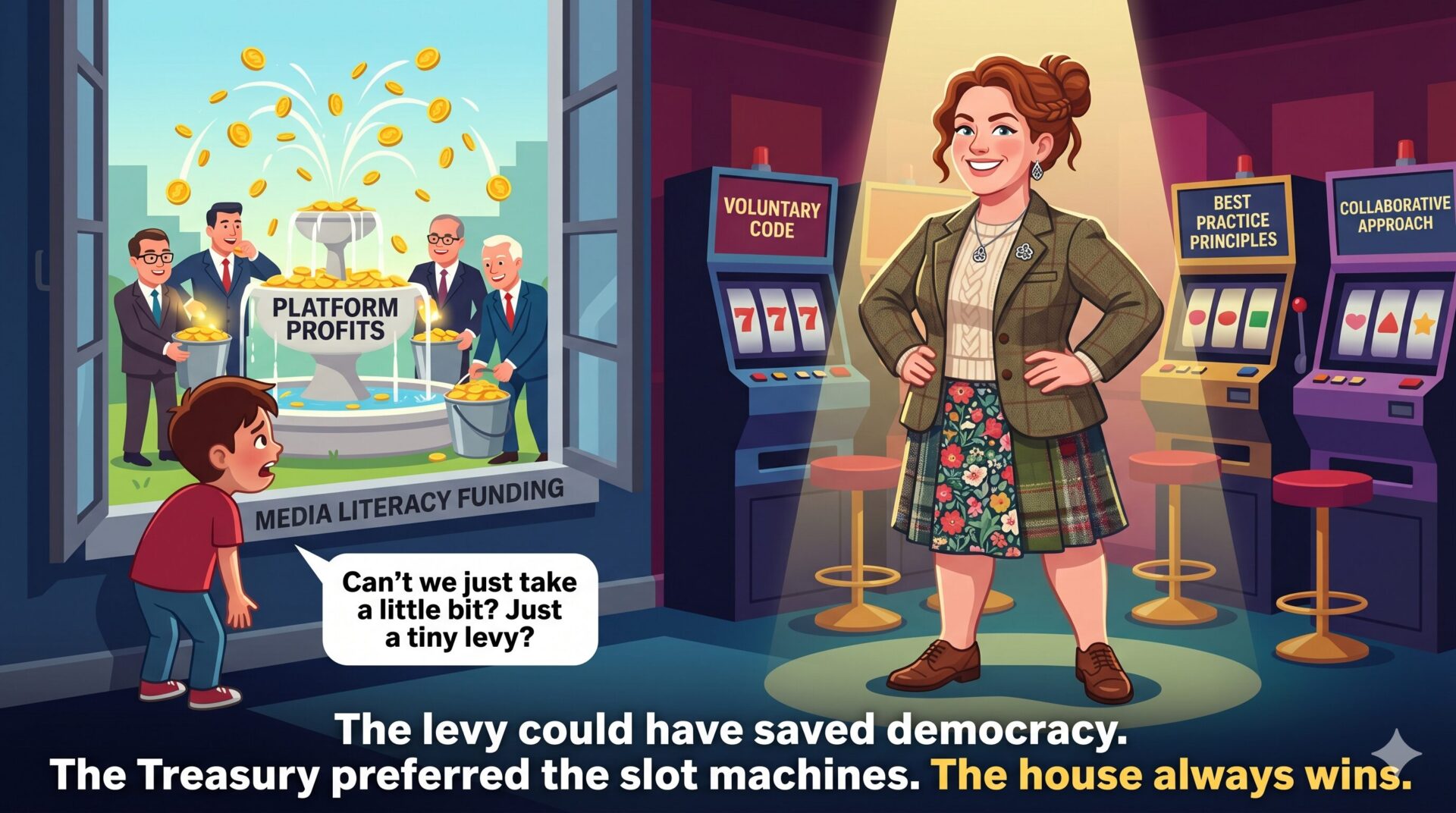
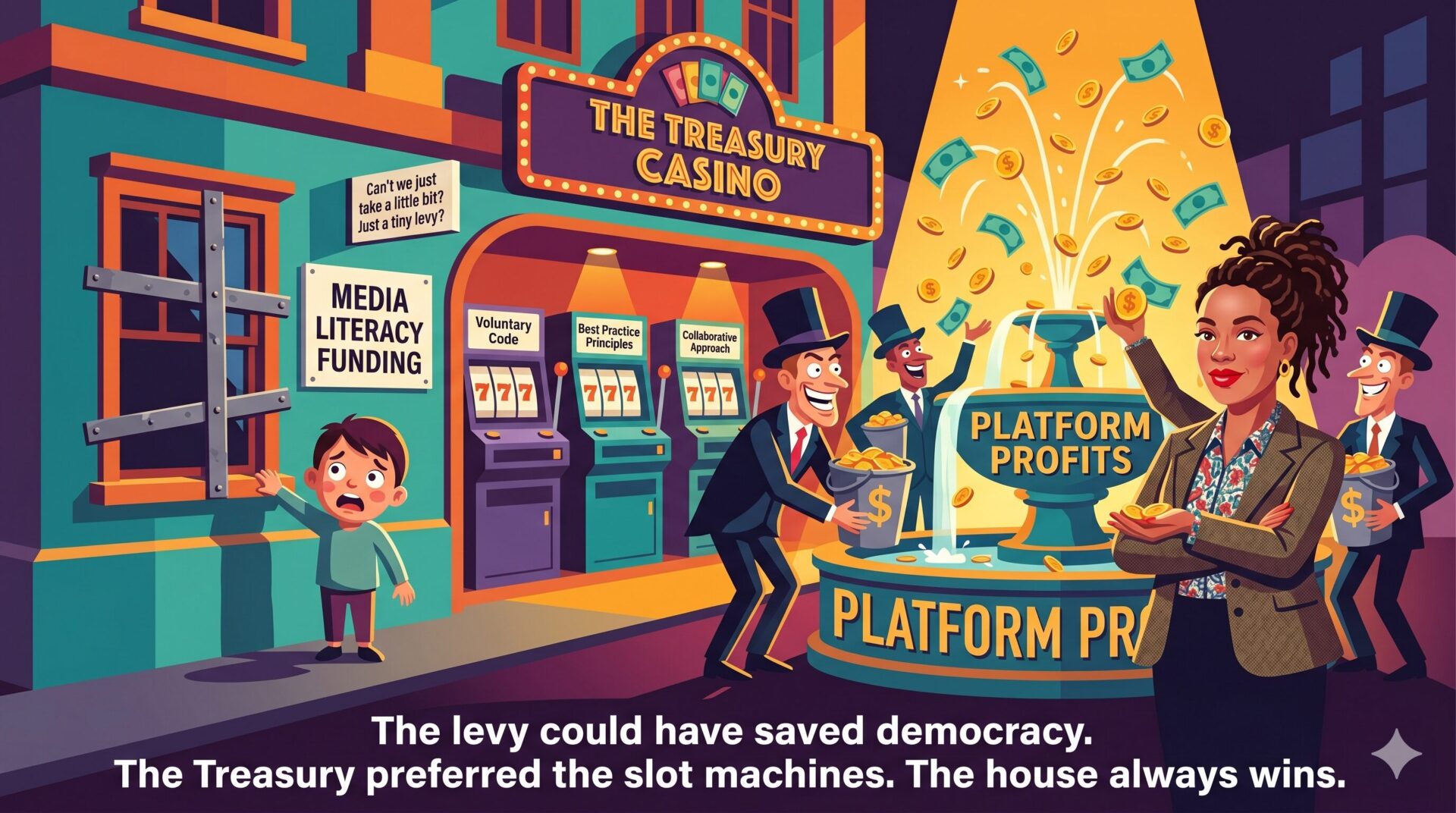 This is not a small thing. Independence is everything. Without it, media literacy becomes just another corporate social responsibility initiative. A fig leaf. A PR exercise.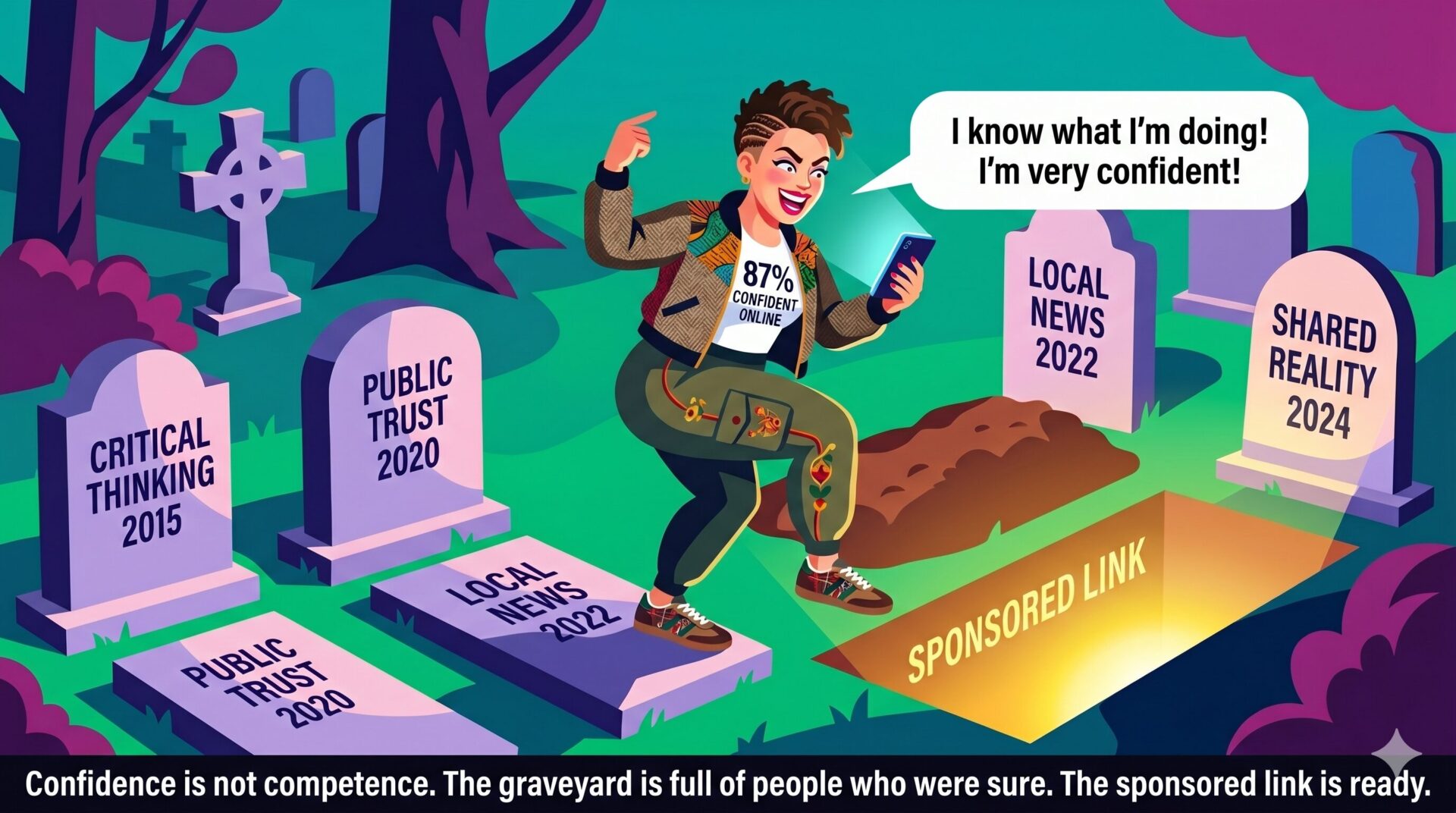
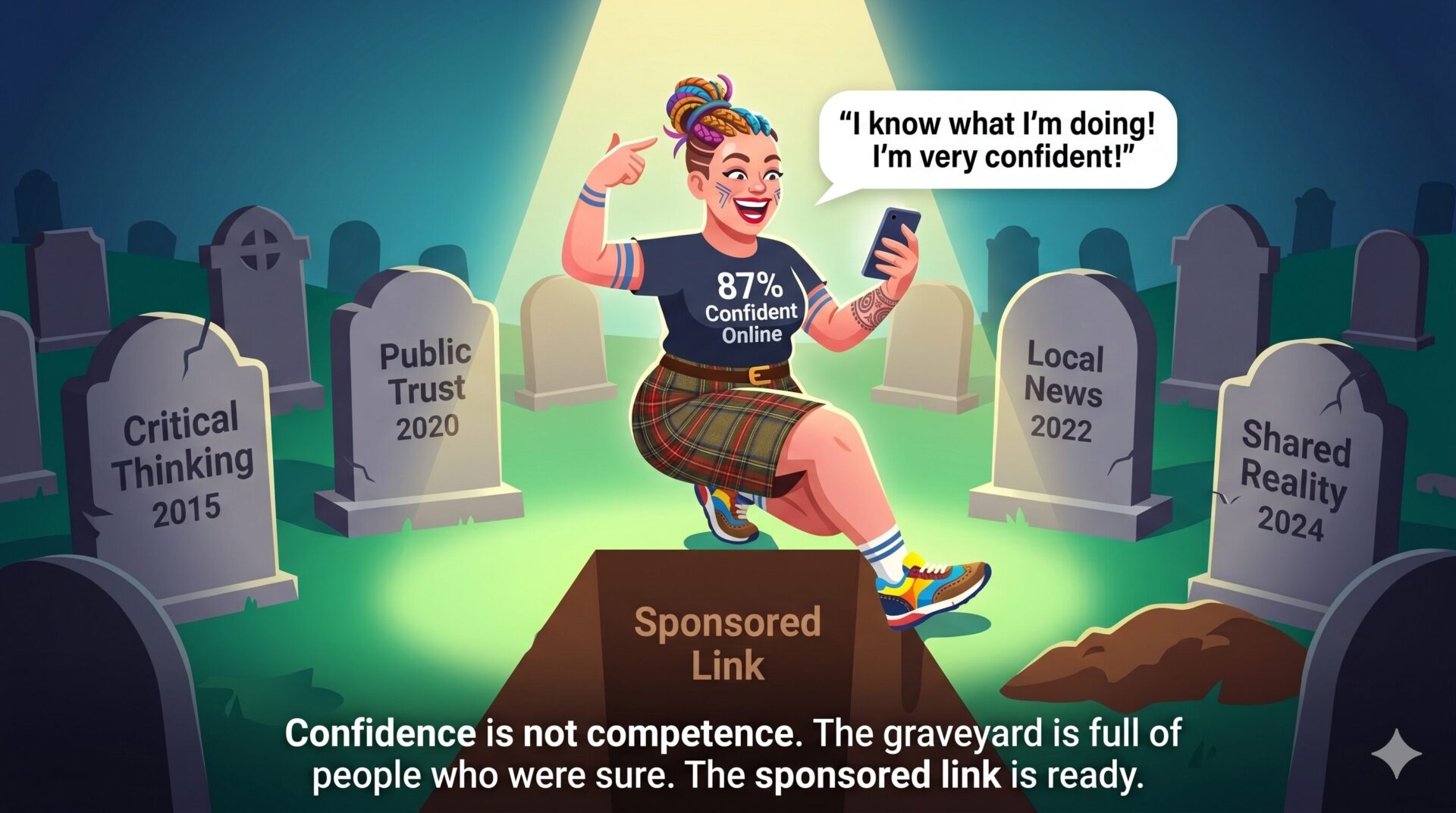
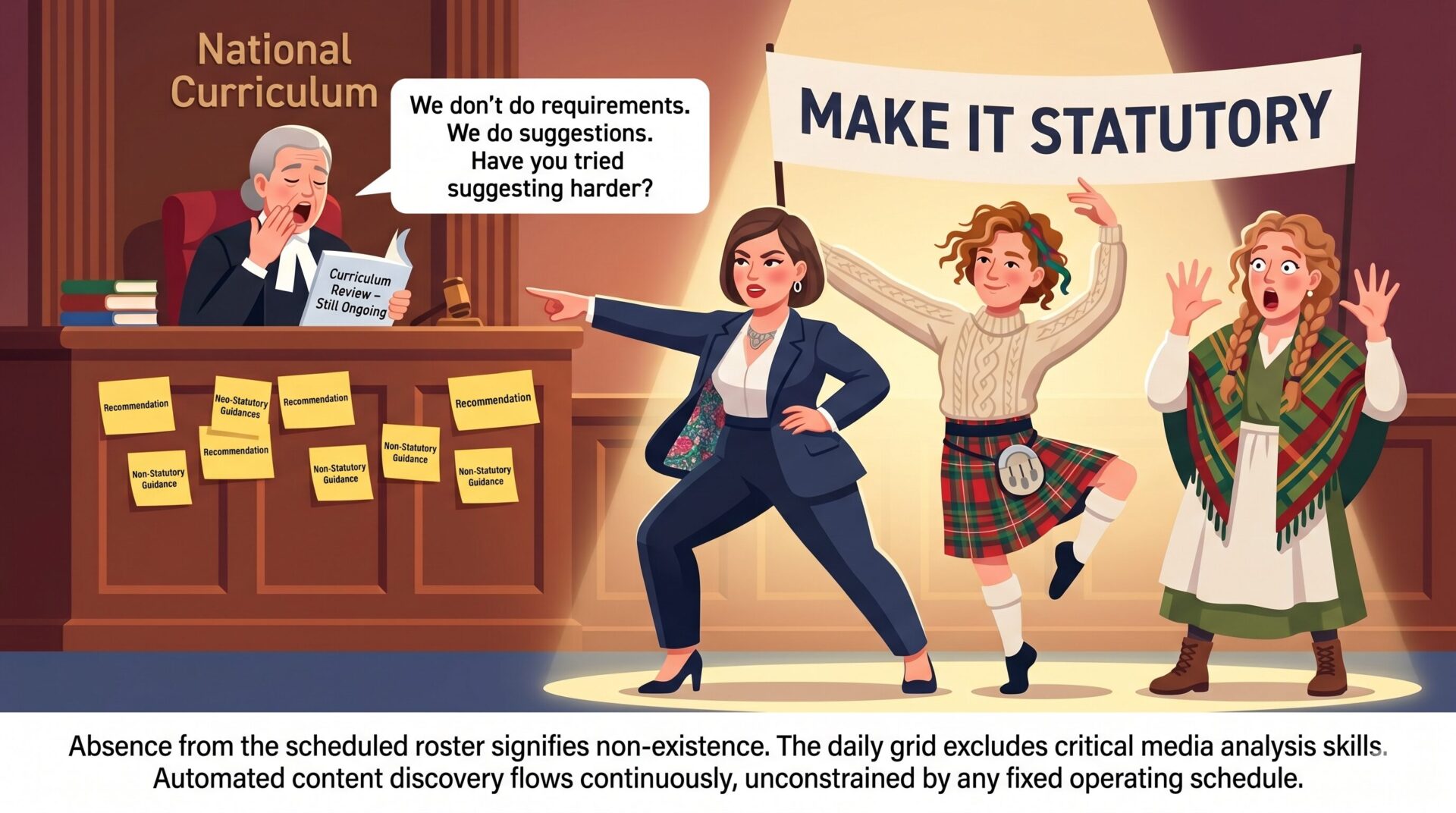
The Local Solution
The Trusted Faces of Hope
“A stranger is just a friend you haven’t met yet” — but in the battle against misinformation, a stranger is just a risk you haven’t calculated.
There’s a library in Rotherham. Not a grand library. Not a famous library. Just a red-brick building on a high street that’s seen better days. Inside, there’s a librarian. Let’s call her Jean. She’s been there for twenty years. She knows everyone. She knows which kids are struggling with reading. Which parents are struggling with money. Which pensioners are struggling with loneliness.
Jean also knows about misinformation. She didn’t learn it in library school — they didn’t teach that in 2004. She learned it on the job. Watching people get confused. Watching them get scared. Watching them get angry about things that weren’t true.
She started doing something about it. Not a programme. Not a pilot. Not a government-funded initiative. Just… conversations. Someone comes in asking about a Facebook post they saw. Jean sits with them. Shows them how to check the source. How to reverse image search. How to spot the signs of a scam.
No one told Jean to do this. No one trained her. No one funded her. She just did it because she’s a librarian. Because librarians are trusted. Because librarians are local. Because librarians are the faces that people know.
The House of Lords Committee called this “trusted faces in local places.” Not government campaigns. Not celebrity endorsements. Not national advertising. Just… local people. Librarians. Youth workers. Community organisers. The people who are already there, already trusted, already embedded.
It sounds simple. It is simple. That’s why it works.
“Familiarity breeds contempt” — but in the right hands, familiarity breeds trust. And trust is the currency of media literacy.
The Geography of Trust
Let me explain why local works. It’s not complicated. It’s about relationships.
A government campaign is distant. Abstract. Anonymous. A voice on the radio. A poster on a bus. A website with a .gov.uk address. People don’t trust it. They don’t know who made it. They don’t know why. They don’t know what the agenda is.
A local librarian is present. Concrete. Known. A face that people see every week. A person who helped them find a book, print a document, apply for a job. Trust is built over years, not seconds.
The same is true for youth workers. For community organisers. For the people who run the food bank, the parent-and-toddler group, the over-sixties coffee morning.
They are not media literacy experts. They don’t need to be. They need to be trusted. They need to be present. They need to be willing to have a conversation.
The government doesn’t understand this. They think in campaigns. In national strategies. In metrics and outputs. They think about reach, not relationships.
But media literacy is not a product. It’s not something you can deliver at scale through a television advertisement. It’s a skill. A habit. A way of thinking. It’s learned through conversation. Through practice. Through trusted faces in local places.
“A man is known by the company he keeps” — and a community is known by the faces it trusts. The government is not a trusted face. Jean the librarian is.
The Librarian’s Toolkit
Let me tell you what Jean actually does. It’s not rocket science. It’s not expensive. It’s just… human.
Someone comes to the library. They’re worried about a video they saw on TikTok. It says something about the government and vaccines and a cover-up. They don’t know if it’s true. They don’t know how to find out.
Jean doesn’t judge. She doesn’t laugh. She doesn’t roll her eyes. She sits down. She asks questions. Where did the video come from? Who posted it? What else have they posted? Does it seem credible?
Then she shows them. She pulls up a fact-checking website. She does a reverse image search. She finds the original source. She walks them through the process.
By the end, the person hasn’t just learned that this video is false. They’ve learned how to check the next one. They’ve learned a skill. They’ve built a relationship. They’ve started to think differently.
This is not scalable in the way that a government campaign is scalable. You can’t reach millions of people with a single librarian. But you can reach millions of people with thousands of librarians. With a network. With a system.
That’s what the government should be funding. Not pilots. Not short-term projects. Not national advertising campaigns. A network of trusted faces. Librarians. Youth workers. Community organisers. Trained. Supported. Resourced.
“Many hands make light work” — and many trusted faces make media literacy work lighter. The government has forgotten how many hands it has. They’ve been looking for a machine instead.
The Youth Worker’s Wisdom
Let me tell you about a youth worker in Manchester. Let’s call him Dave. He runs a youth club on a council estate. It’s not fancy. It’s a portacabin with a pool table and some sofas. The kids come because there’s nowhere else to go.
Dave knows about misinformation because he sees its effects. His kids are on TikTok. They’re watching Andrew Tate. They’re getting angry about things that aren’t true. They’re repeating talking points that they don’t understand.
Dave doesn’t lecture. He doesn’t confiscate phones. He doesn’t tell them they’re wrong. He asks questions. “Where did you hear that? Who told you? Why do you think they said that?”
The kids answer. They think about it. Sometimes they change their minds. Sometimes they don’t. But they keep talking. Keep coming back. Keep trusting Dave.
This is the work. Not a curriculum. Not a lesson plan. Not a government-approved resource. Just a trusted adult, asking questions, building relationships, modelling scepticism without cynicism.
The government doesn’t fund this work. They fund pilots. They fund evaluations. They fund reports. They don’t fund Dave. They don’t fund the portacabin. They don’t fund the pool table.
Because Dave’s work doesn’t fit neatly into a grant application. Because relationships can’t be measured in outputs. Because trust is not a key performance indicator.
“Not all that glitters is gold” — and not all that matters can be measured. The government measures what glitters. Dave’s work is gold. They can’t see it.
The Community Organiser’s Network
Let me tell you about a community organiser in Birmingham. Let’s call her Fatima. She works for a small charity that runs a food bank, a homework club, and a women’s group.
Fatima noticed that the women in her group were sharing misinformation. WhatsApp forwards about vaccines. Facebook posts about crime. Videos about things that weren’t happening.
She started a conversation. Not a workshop. Not a training session. Just a conversation. “What have you seen this week? Did you believe it? How did you check?”
The women started talking to each other. Sharing tips. Checking each other’s sources. Becoming each other’s fact-checkers.
Fatima didn’t create a programme. She created a culture. A culture of questioning. A culture of checking. A culture of trust.
This is how change happens. Not from the top down. From the bottom up. From trusted faces in local places.
The government doesn’t understand this. They think in terms of interventions. Of deliverables. Of outcomes.
Fatima’s work is not an intervention. It’s an ongoing presence. A relationship. A conversation. It doesn’t have an end date. It doesn’t have a pilot phase. It doesn’t have a final report.
It has Fatima. It has the women. It has the WhatsApp group where they check each other’s sources.
“Rome wasn’t built in a day” — and media literacy isn’t built in a pilot. It’s built in relationships. Over years. Through trust.
The Government’s Blindness
The government doesn’t see this. They’re not cruel. They’re not stupid. They’re just… blind. Blinded by their own metrics. Blinded by their own processes. Blinded by their own assumptions.
They think media literacy is a problem that can be solved with a campaign. A few million pounds. A few television ads. A few social media posts. Job done.
But media literacy is not a problem. It’s a practice. A habit. A way of being. It’s not something you deliver. It’s something you cultivate.
The government doesn’t know how to cultivate. They know how to deliver. They know how to fund. They know how to evaluate. They don’t know how to trust. They don’t know how to build relationships. They don’t know how to be a trusted face.
So they ignore Jean. Ignore Dave. Ignore Fatima. They fund pilots instead. They fund campaigns instead. They fund the things they understand.
The things they understand don’t work. The things they don’t understand do work. But they can’t bring themselves to fund what they don’t understand.
“A man who is his own lawyer has a fool for a client” — and a government that is its own expert has a fool for a population. The government is not an expert in local trust. They should listen to those who are.
The Finnish Comparison
Finland understands this. They don’t rely on national campaigns. They rely on local networks. Libraries. Schools. Community organisations. Trusted faces.
The Finnish government funds these networks. Not as pilots. As infrastructure. Long-term. Sustainable. Embedded.
A Finnish librarian is trained in media literacy. Not because they took a course. Because the system requires it. Because the government funds it. Because it’s part of the job.
A Finnish youth worker has resources. Materials. Support. They’re not alone. They’re part of a network. A system. A national strategy delivered locally.
Britain has none of this. We have Jean, doing it on her own. Dave, fighting alone. Fatima, creating change despite the system, not because of it.
The government could change this. They could fund local networks. They could train librarians. They could support youth workers. They could recognise that trusted faces matter more than national campaigns.
They won’t. Because they don’t understand trust. Because they don’t value relationships. Because they think in terms of scale, not depth.
“The best time to plant a tree was twenty years ago. The second best time is now.” Finland planted twenty years ago. Britain is still arguing about whether trees are necessary.
The Charity’s Frustration
The charities understand this. Parent Zone. Good Things Foundation. The National Literacy Trust. They know that local works. They’ve seen it. They’ve evaluated it. They’ve proved it.
They’ve also tried to tell the government. They’ve written reports. They’ve given evidence. They’ve held meetings.
The government listens. They nod. They say they understand.
Then they fund another pilot. Another campaign. Another national initiative that reaches millions shallowly instead of thousands deeply.
The charities are frustrated. They’re not asking for much. They’re asking for the government to fund what works. To trust the trusted faces. To invest in relationships.
The government is not listening. Because listening would require admitting that they were wrong. That national campaigns are not the answer. That local trust is the answer.
Governments don’t like admitting they were wrong. So they keep doing the same thing. Keep funding the same failures. Keep ignoring what works.
“There are none so blind as those who will not see” — and the government will not see. The evidence is clear. The trusted faces are waiting. The funding is not coming.
The Parent’s Perspective
Remember Diane from Bristol? The parent who attended the Everyday Digital workshop? She didn’t attend because of a government campaign. She attended because her local library told her about it. Because a trusted face invited her.
Diane doesn’t trust the government. She trusts Jean the librarian. She trusts the person who helped her find books for her kids. Who helped her print documents. Who helped her apply for benefits.
That trust took years to build. It can’t be bought. It can’t be manufactured. It can’t be delivered through a campaign.
But it can be leveraged. Jean used her trust to invite Diane to the workshop. Diane came. Diane learned. Diane changed.
This is how media literacy happens. Through relationships. Through trust. Through trusted faces in local places.
The government doesn’t understand this. They think Diane came because of the marketing. Because of the messaging. Because of the campaign.
She didn’t. She came because Jean asked her.
“A friend in need is a friend indeed” — and Jean is a friend indeed. The government is not Diane’s friend. The government is an abstraction. Jean is real.
The Final Trust
Let me leave you with this. The most effective interventions are local. They’re trusted. They’re embedded in existing relationships.
Not government campaigns. Not celebrity endorsements. Not national advertising.
Librarians. Youth workers. Community organisers. The people who are already there. Already trusted. Already doing the work.
The government could fund them. Could train them. Could support them. Could build a network of trusted faces across the country.
They won’t. Because they don’t understand trust. Because they don’t value relationships. Because they think in campaigns, not conversations.
So Jean will keep doing it on her own. Dave will keep fighting alone. Fatima will keep building change despite the system.
They will succeed despite the government, not because of it. They will reach thousands while millions remain vulnerable. They will be the trusted faces in local places, doing the work that the government should be doing.
The report called it right. Trusted faces in local places. Not government campaigns. Not national strategies. Just… people. Trusted. Local. Embedded.
The government has the report. They have the evidence. They have the examples.
They have everything except the will to act.
“Trust takes years to build, seconds to break, and forever to repair” — the government has broken trust. They are not repairing it. The trusted faces are doing that work.
Jean. Dave. Fatima. They are the media literacy programme that Britain actually has. Not the one the government funds. The one that exists despite the government.
They are trusted. They are local. They are embedded.
They are also exhausted. Underfunded. Overlooked.
The government could change that. They won’t. Because they don’t understand trust. Because they don’t value relationships. Because they don’t see the faces that matter.
The trusted faces are waiting. The government is not coming.
The Burning Libraries
“A room without books is like a body without a soul” — but a community without a library is like a democracy without a defence.
There was a library in Doncaster. It wasn’t special. It wasn’t famous. It was just a library. Brown carpet. Fluorescent lights. The smell of old paper and floor polish. It had a children’s section with cushions. A local history room that nobody used. A computer suite where pensioners learned to email their grandchildren.
It closed in 2019. Council cuts. Austerity. Not enough money to keep the lights on. The books were sold. The computers were scrapped. The building became a Poundstretcher.
The librarian — let’s call her Jean — lost her job. She’d been there twenty years. She knew everyone. She knew which kids needed help with reading. Which parents needed help with benefits. Which pensioners needed help with loneliness.
She also knew about misinformation. She’d been helping people spot scams and fact-check claims for years. Not as part of a programme. As part of being a librarian.
Now Jean is gone. The library is gone. The trusted face is gone.
There are 2,600 public libraries in England. Or there were. Hundreds have closed since 2016. Hundreds more are hanging by a thread. Run by volunteers. Open part-time. Staffed by people with no formal training.
These libraries are not just buildings. They’re infrastructure. Media literacy infrastructure. Trust infrastructure. Democratic infrastructure.
The government closed them. Not deliberately — not with a single stroke of a pen. Gradually. Through neglect. Through cuts. Through the slow starvation of local government.
And now the trusted faces are disappearing. The places where media literacy happened naturally are boarded up. The volunteers are doing their best, but their best is not enough.
“The flame that burns twice as bright burns half as long” — but the flame of Britain’s libraries is not burning bright. It’s guttering. Flickering. Dying. And the government is not even trying to relight it.
The Librarian’s Role
Let me explain what librarians actually do. It’s not just stamping books. It never was.
Librarians are curators of information. They know how to find things. How to verify things. How to evaluate sources. They have skills that most people don’t even know exist.
They’re also trusted. More trusted than politicians. More trusted than journalists. More trusted than the police. When was the last time you heard someone say “librarians are biased” or “librarians are corrupt”? Never. Because librarians are seen as neutral. As helpers. As people who want the best for their communities.
This trust is not accidental. It’s earned. Over years. Through thousands of interactions. Through helping people find jobs, housing, benefits. Through being there when no one else was.
Librarians are the perfect media literacy educators. They have the skills. They have the trust. They have the relationships.
They also have no funding. No training. No support. No recognition.
The government doesn’t see them. Doesn’t value them. Doesn’t invest in them. The government sees libraries as a cost, not an asset. As a luxury, not a necessity.
So libraries close. Librarians lose their jobs. The trusted faces disappear. And the algorithm fills the gap.
“Use it or lose it” — but Britain is losing its libraries not because people stopped using them, but because the government stopped funding them. The use is there. The will is not.
The Volunteer’s Dilemma
Let me tell you about a library in Cornwall. It’s run by volunteers. A retired teacher, a former nurse, a local business owner. They open three days a week. They have no training in librarianship. No training in media literacy. No training in anything except the desire to help.
They’re doing their best. They keep the doors open. They lend books. They help people print documents. They make tea.
They cannot replace Jean. They don’t have her skills. They don’t have her knowledge. They don’t have her relationships. They’re volunteers, not professionals.
The government calls this “community resilience.” They call it “localism.” They call it “empowering communities.”
It’s none of those things. It’s abandonment. The government has walked away and left volunteers to pick up the pieces.
Volunteers are wonderful. Volunteers are essential. Volunteers are not a substitute for professional librarians. Not when the task is media literacy. Not when the stakes are democracy.
The volunteer-run library cannot provide the trusted, expert, embedded media literacy support that Jean provided. They can’t. They don’t have the training. They don’t have the time. They don’t have the capacity.
So the community loses. The vulnerable people who relied on Jean lose. The algorithm wins.
“The road to hell is paved with good intentions” — and the road to media literacy hell is paved with volunteer-run libraries. Good intentions. No expertise. No support. No outcomes.
The Closure Crisis
Let me give you the numbers. Hundreds of libraries have closed since 2016. Hundreds more have reduced hours. Hundreds more have moved to volunteer models.
The BBC Shared Data Unit found that the UK has lost one in twenty libraries since 2016. That’s five per cent. Five per cent of the trusted places where media literacy happened naturally.
The closures are not evenly distributed. They’re concentrated in poor areas. In areas with less political power. In areas that the government has forgotten.
A library in a wealthy suburb stays open. A library in a council estate closes. The wealthy get media literacy support. The poor get nothing.
This is not an accident. This is the predictable outcome of a funding model that privileges wealth. That assumes that communities can fend for themselves. That doesn’t value the role of public infrastructure in democratic resilience.
The government could reverse this. They could fund libraries properly. They could stop the closures. They could restore the hours. They could train the volunteers.
They won’t. Because libraries are not a priority. Because the Treasury sees them as a cost. Because the Department for Culture, Media and Sport has no power to force local authorities to keep them open.
So the closures continue. The trusted faces disappear. The algorithm fills the gap.
“A stitch in time saves nine” — but the government is not stitching. They’re watching the fabric unravel. The libraries are closing. The trust is fraying. The democracy is tearing.
The Library’s Media Literacy
Let me tell you what a library with a professional librarian can do for media literacy. It’s not theoretical. It’s happening, where libraries still exist.
The librarian runs workshops. Not “media literacy workshops” — nobody would come to those. Workshops on “how to spot scams.” Workshops on “how to stay safe online.” Workshops on “how to help your children navigate social media.”
People come. Because they trust the librarian. Because the topics are relevant. Because the workshops are free and local and accessible.
The librarian also does one-on-one support. Someone comes in with a question about a Facebook post. The librarian sits with them. Shows them how to check. Builds their skills.
The librarian also curates. Displays books about critical thinking. Puts up posters about fact-checking. Creates a culture of questioning.
This is media literacy. Not a pilot. Not a programme. Not a government initiative. Just… a librarian, doing their job, in a library that’s still open.
The government doesn’t fund this. They don’t recognise it. They don’t measure it. They don’t value it.
They fund pilots instead. Pilots that reach thousands for a year and then disappear. Pilots that cost more than a librarian’s salary but deliver less.
“A bird in the hand is worth two in the bush” — and a librarian in a library is worth more than all the pilots in Whitehall. The government prefers birds in bushes. They’re easier to count.
The Finnish Library
Finland has libraries. Lots of them. Well-funded. Professional. Trusted.
Finnish librarians are trained in media literacy. It’s part of their professional development. They know how to spot deepfakes. How to verify sources. How to teach others.
Finnish libraries are not closing. They’re expanding. They’re adding digital literacy programmes. They’re becoming hubs of media literacy education.
The Finnish government understands that libraries are infrastructure. Not optional extras. Not luxuries. Core services. As essential as roads, as water, as electricity.
The British government does not understand this. They see libraries as something nice to have when money permits. Money has not permitted for a decade.
The result is that Finnish libraries are thriving. British libraries are dying. Finnish citizens have trusted places to learn media literacy. British citizens have Poundstretchers where libraries used to be.
“You get what you pay for” — and Britain is paying for closure. Finland is paying for resilience. The results are on the shelves.
The Volunteer’s Training
Let me be clear. Volunteers are not the problem. The problem is expecting volunteers to do professional work without professional training.
A volunteer librarian could be trained in media literacy. It’s not impossible. It’s not even difficult. A few days of training. Some ongoing support. Access to resources.
The government doesn’t provide this. They don’t fund it. They don’t require it. They don’t even think about it.
So volunteers do their best. They lend books. They help with printing. They make tea.
They don’t teach media literacy. Because they don’t know how. Because no one showed them. Because the government abandoned them.
This is not a criticism of volunteers. It’s a criticism of a system that treats volunteers as free labour rather than as partners to be trained and supported.
The government could train volunteers. They could create a national programme. They could partner with the Chartered Institute of Library and Information Professionals. They could make media literacy part of volunteer induction.
They won’t. Because training costs money. Because volunteers are free. Because the government has decided that free is good enough.
Free is not good enough. Free is a false economy. Free leaves communities vulnerable.
“Penny wise, pound foolish” — the government is saving pennies on libraries and spending pounds on the consequences of misinformation. The pound foolishness is breathtaking.
The Parent’s Loss
Remember Diane from Bristol? She used her local library. She attended the Everyday Digital workshop there. She trusted the librarian who ran it.
That library is now under threat. Council cuts. Reduced hours. The librarian has been redeployed. The workshop has ended.
Diane doesn’t know where to go now. She’s tried the library in the next town. It’s run by volunteers. They’re lovely. They don’t know about media literacy. They can’t help her.
Diane is on her own. Her daughter is still on TikTok. The algorithm is still serving content. Diane has the skills she learned in the workshop, but she doesn’t have ongoing support. She doesn’t have someone to ask when she’s confused.
The library could have provided that. It doesn’t anymore. Because the government closed it. Because the government cut its funding. Because the government doesn’t value libraries.
Diane is not alone. There are millions of Dianes. They’re losing their libraries. Losing their trusted faces. Losing their media literacy support.
And the algorithm is gaining. Gaining influence. Gaining trust. Gaining control.
“For want of a nail, the shoe was lost” — for want of a library, the parent was lost. For want of a parent, the child was lost. For want of a child, the future was lost.
The Government’s Silence
The government says they support libraries. They have a Libraries Improvement Fund. They give out small grants for building upgrades. A new roof here. Some new computers there.
The Libraries Improvement Fund does not replace the hundreds of libraries that have closed. Does not restore the hours that have been cut. Does not train the volunteers. Does not fund the librarians.
The government’s support is a fig leaf. A gesture. A way of saying “we care” while doing almost nothing.
The closures continue. The trusted faces disappear. The media literacy gap widens.
The government is silent. They don’t talk about libraries. They don’t mention them in their media literacy strategy. They don’t include them in the Digital Inclusion Action Plan.
Libraries are invisible to the government. Invisible and invaluable. Invisible and irreplaceable.
“Out of sight, out of mind” — and libraries are out of sight. The government has closed its eyes. The libraries are closing their doors.
The Final Chapter
Let me leave you with this. There are 2,600 public libraries in England. Hundreds have closed since 2016. Hundreds more are at risk.
These libraries are not just buildings. They’re media literacy infrastructure. They’re trusted faces in local places. They’re where Jean worked. Where Diane learned. Where communities gathered.
The government closed them. Not with a bang. With a whimper. With year after year of cuts. With funding formulae that favour wealth. With indifference dressed up as localism.
The libraries that remain are often run by volunteers. Wonderful people. Committed people. People without formal training in media literacy.
The government could train them. Could fund them. Could support them.
They won’t. Because libraries are not a priority. Because media literacy is not a priority. Because democracy is not a priority.
The algorithm is a priority. The algorithm gets billions. The algorithm never closes. The algorithm never runs out of funding.
Libraries get cuts. Libraries get closures. Libraries get volunteers with no training.
The algorithm wins. The trusted faces lose. The democracy weakens.
And the government watches. Silent. Indifferent. Absent.
“The light shines in the darkness, and the darkness has not overcome it” — but the darkness is trying. The government is not fighting. The libraries are closing. The trust is dying.
The algorithm is winning. The librarians are losing. And the government is not even watching.
The Footnote of Neglect
“Out of sight, out of mind” — but when media literacy becomes a footnote, democracy becomes an afterthought.
There is a document. It sits on a government website. It has a title: The Digital Inclusion Action Plan. It’s glossy. It’s well-designed. It has forewords from ministers and case studies from charities and bullet points of commitments.
It is supposed to be the home of media literacy. The place where the government’s work on this vital issue now lives. The strategy that replaced the strategy. The plan that replaced the plan.
Media literacy appears in this document. Briefly. In passing. As a mention, not a section. As a nod, not a commitment. As an afterthought, not a priority.
The witnesses warned about this. They said media literacy would become a “subset of something bigger and more important.” That it would lose its distinct focus. That it would be absorbed and forgotten.
They were right. The Digital Inclusion Action Plan is about getting people online. About devices and connectivity and basic digital skills. Important things. Urgent things.
Media literacy is not those things. Media literacy is about what happens once people are online. About critical thinking. About misinformation. About democratic resilience.
It is related to digital inclusion. But it is not the same. It is distinct. It is specific. It is easily lost.
The government has lost it. Not deliberately — probably not deliberately — but lost it nonetheless. Buried in a document about something else. Reduced to a few sentences. Forgotten.
“A camel is a horse designed by committee” — and media literacy is a camel designed by the Digital Inclusion Action Plan. It has too many legs and not enough humps. It doesn’t know what it is or where it’s going.
The Absorption
Let me explain what happens when media literacy becomes a subset. It’s not pretty. It’s not dramatic. It’s just… dilution.
The Digital Inclusion Action Plan has four strategic pillars. Skills. Confidence. Access. Motivation. Media literacy could fit under skills. Could fit under confidence. Doesn’t really fit anywhere.
So it gets squeezed. Mentioned in a paragraph. Referenced in a case study. Included as an afterthought in a bullet point.
The officials who wrote the plan are not bad people. They’re not hostile to media literacy. They just have other priorities. Getting people online. Closing the digital divide. Making sure everyone has a device and a connection.
These are worthy goals. These are important goals. These are not media literacy.
Media literacy is about what you do once you’re online. About whether you can tell truth from lies. About whether you can spot a scam. About whether you can recognise a deepfake.
These questions are not answered by a device. Not solved by a connection. Not addressed by basic digital skills.
They require something else. Something the Digital Inclusion Action Plan mentions only briefly. Something the government has not prioritised. Something that is being lost in the absorption.
“The whole is greater than the sum of its parts” — but only if the parts are given equal weight. Media literacy is not being given equal weight. It’s being treated as a minor part of a larger whole. The whole is not greater. The part is being crushed.
The Witnesses’ Warning
The witnesses who spoke to the Lords Committee knew this would happen. They warned about it. Explicitly. Forcefully. Repeatedly.
They said media literacy is not digital inclusion. That the two are related but distinct. That folding one into the other would lead to neglect.
They gave examples. Programmes that focused on digital skills but ignored critical thinking. Initiatives that taught people how to use devices but not how to question sources. Funding that went to connectivity but not to resilience.
They said the government’s digital inclusion action plan mentioned media literacy only briefly. That the Digital Inclusion Action Committee had no media literacy expertise. That the minister with responsibility for media literacy was not on the digital inclusion ministerial group.
The government heard them. They nodded. They said they understood.
Then they did nothing. The Digital Inclusion Action Plan was published. Media literacy remained a footnote. The witnesses’ warnings were ignored.
Now the witnesses are saying “we told you so.” Not smugly. Sadly. Because they were right. Because being right doesn’t help. Because the government doesn’t listen.
“A prophet is not without honour except in his own country” — and the witnesses are prophets without honour. They saw the future. They described it. They were ignored. Now the future is here.
The Minister’s Portfolio
The minister with responsibility for media literacy is not on the digital inclusion ministerial group. Let me repeat that. The minister responsible for media literacy is not on the group that oversees the plan that now houses media literacy.
This is not an accident. It’s not an oversight. It’s a statement. A statement that media literacy is not important enough to warrant a seat at the table. That digital inclusion is the priority. That media literacy can be handled by someone else.
The minister — whoever they are this week — is not happy about this. They would like a seat at the table. They would like media literacy to be taken seriously. They would like the government to treat this issue with the urgency it deserves.But they are one minister among many. And the digital inclusion ministerial group is chaired by someone else. And the agenda is set by someone else. And media literacy is not on that agenda.
So the minister sits outside. Watches through the window. Sees decisions being made that affect their portfolio. Has no say. Has no influence. Has no power.
This is not how government should work. This is not how policy should be made. This is how things get lost. This is how media literacy became a footnote.
“Too many cooks spoil the broth” — but too few cooks with the wrong ingredients spoil the policy. The digital inclusion ministerial group has the wrong ingredients. Media literacy is not in the recipe.
The Committee’s Composition
The Digital Inclusion Action Committee is supposed to provide expert advice. It includes representatives from charities, academia, local government, and industry.
It does not include media literacy experts. Not as a specific category. The terms of reference don’t mention media literacy. The membership doesn’t reflect media literacy expertise.
The government says that media literacy experts are on the committee. Emma Stone from Good Things Foundation. Simeon Yates from the University of Liverpool. David Lloyd from Libraries Connected.
These are good people. Smart people. Committed people. They are not enough. They are three voices among many. They are outnumbered by people focused on digital inclusion. They are fighting an uphill battle.
The committee’s agenda is set by digital inclusion priorities. Its workstreams focus on digital inclusion outcomes. Its metrics measure digital inclusion progress.
Media literacy is a side issue. A nice-to-have. Something to mention if there’s time.
There is never time. Media literacy is squeezed out. The footnote gets shorter. The witnesses’ warnings come true.
“A voice crying in the wilderness” — and the Digital Inclusion Action Committee is a wilderness. The media literacy experts are crying out. No one is listening.
The Distinct Focus
Why does distinct focus matter? Because media literacy is not digital inclusion. It’s not even a subset. It’s a different thing entirely.
Digital inclusion is about access. About skills. About confidence. About being able to use a device, send an email, access a service.
Media literacy is about critical thinking. About evaluation. About questioning. About being able to tell the difference between a fact and a lie, between a source and a scam, between a genuine article and a deepfake.
You can be digitally included and media illiterate. You can have a device, a connection, basic skills — and still believe everything you see on TikTok. Still fall for every scam. Still share every lie.
The government doesn’t understand this. They think digital inclusion is the foundation. That media literacy will follow naturally. That once people are online, they’ll figure it out.
They won’t. They’ll be exploited. They’ll be manipulated. They’ll be radicalised. Because the algorithm is waiting. Because the platforms are optimised for engagement. Because the lies are designed to be believed.
Digital inclusion without media literacy is not empowerment. It’s exposure. It’s handing people a device and throwing them into a battlefield without armour.
The government is handing out devices. They’re not providing armour. The Digital Inclusion Action Plan is a distribution plan for weapons. The platforms are the enemy. The people are the soldiers. The government is not training them.
“All that glitters is not gold” — and all that connects is not protection. Digital inclusion glitters. Media literacy is gold. The government is handing out glitter.
The Funding Follows
The funding follows the plan. The Digital Inclusion Innovation Fund has £9.5 million. It’s for digital inclusion projects. Media literacy projects can apply. They’re not the priority.
The fund is one year. Short-term. Pilot-sized. Exactly the kind of funding that the media literacy sector has been complaining about for years.
The government learned nothing from the 2021-24 strategy. They’re making the same mistakes. Short-term funding. Small-scale projects. No long-term commitment.
The media literacy projects that do get funded will be evaluated. The evaluations will show what works. The government will nod. Then the funding will end. Then the projects will scale back. Then the cycle will repeat.
The Digital Inclusion Action Plan was supposed to be different. It’s not different. It’s the same. Same short-termism. Same fragmentation. Same neglect.
The only difference is that media literacy is now a footnote. A smaller target. Easier to ignore. Easier to cut.
“The more things change, the more they stay the same” — the Digital Inclusion Action Plan changed the name. It didn’t change the approach. Media literacy is still neglected. Still underfunded. Still a footnote.
The Charity’s Fear
The charities are scared. They’ve seen this before. A new plan. A new name. A new structure. The same neglect.
They tried to engage with the Digital Inclusion Action Plan. They gave evidence. They attended meetings. They made recommendations.
The government listened. They nodded. They said they understood.
Then they published the plan. Media literacy was a footnote. The charities’ recommendations were ignored.
The charities are not surprised. They’ve been disappointed before. They’ve learned not to expect much.
But they had hoped. They had allowed themselves to believe that the government might finally get it. Might finally treat media literacy as a priority. Might finally fund it properly.
They were wrong. The government doesn’t get it. Media literacy is still a footnote. The charities are still begging.
Parent Zone’s Everyday Digital programme reached 63,000 parents. Then the funding stopped. The Digital Inclusion Action Plan didn’t save it. The Digital Inclusion Innovation Fund didn’t replace it.
The charities are tired. Tired of hoping. Tired of fighting. Tired of being ignored.
“Hope deferred makes the heart sick” — and the charities’ hearts are very sick. They have been deferred for years. The Digital Inclusion Action Plan was supposed to be the cure. It’s just another deferral.
The Government’s Defence
The government would say that media literacy is in the plan. That it’s mentioned. That it’s part of the skills pillar. That the Digital Inclusion Innovation Fund is open to media literacy projects.
They would be missing the point. Mention is not prioritisation. Part of a pillar is not a focus. Open to applications is not a commitment.
The government’s defence is a confession. They are confessing that media literacy is not important enough to have its own plan. Not important enough to have its own funding stream. Not important enough to be more than a footnote.
The witnesses saw this coming. They warned about it. They were ignored.
Now the plan is published. The footnote is written. The witnesses are saying “we told you so.”
The government is not listening. They’re too busy with digital inclusion. Too busy with devices and connectivity. Too busy with the big picture.
The big picture doesn’t include media literacy. The big picture is missing a crucial detail. The detail that could save democracy.
“The devil is in the details” — and media literacy is a detail. The government is ignoring the devil. The devil is winning.
The Final Footnote
Let me leave you with this. The Digital Inclusion Action Plan is now the home of media literacy. It’s not a good home. It’s a cupboard under the stairs. Cramped. Dark. Forgotten.
Media literacy deserves better. It deserves its own plan. Its own funding stream. Its own ministerial group. Its own place at the table.
It won’t get it. Because the government has decided that digital inclusion is more important. Because the government doesn’t understand the difference. Because the government is making a mistake.
The witnesses warned about this. They were ignored. Now the mistake is policy. The footnote is written. Media literacy is lost.
Not gone. Not dead. Just… lost. Buried in a document about something else. Reduced to a few sentences. Forgotten by all but those who care.
The algorithm doesn’t care about footnotes. The algorithm doesn’t care about digital inclusion plans. The algorithm cares about engagement. And engagement is thriving.
Because media literacy is a footnote. Because the government doesn’t prioritise it. Because the trusted faces are disappearing. Because the libraries are closing. Because the teachers are untrained.
The footnote is a symptom. A symptom of neglect. A symptom of misunderstanding. A symptom of a government that doesn’t get it.
The witnesses got it. They warned. They were ignored.
Now the footnote is policy. Media literacy is lost. And the algorithm is winning.
“The pen is mightier than the sword” — but the footnote is mightier than neither. It is a whisper. A sigh. A surrender.
The government has surrendered. Media literacy is a footnote. Democracy is a footnote. Trust is a footnote.
The algorithm is the main text. Bold. Capitalised. Unmissable.
The footnote is small. The algorithm is large. The government chose the algorithm. They chose engagement over accuracy. Profit over democracy. The footnote over the future.
The witnesses warned. The government ignored.
Now the footnote is written. The future is unfolding. The algorithm is winning.
And media literacy is a subset of something bigger and more important. Something that is not media literacy. Something that is not democracy. Something that is not enough.
The Parent Trap That Works
“A spoonful of sugar helps the medicine go down” — and a spoonful of parental anxiety helps media literacy go down even faster.
Let me tell you about a mother in Liverpool. Let’s call her Sharon. She’s thirty-eight. Works in a warehouse. Has three kids. Doesn’t care about media literacy. Doesn’t know what it means. Doesn’t have time to find out.
She cares about her kids. About keeping them safe. About protecting them from the things she doesn’t understand. About the endless scrolling, the late nights, the arguments about screen time.
She came to a workshop. Not a media literacy workshop — she would never have come to that. A workshop on “Keeping Your Kids Safe Online.” A workshop run by Parent Zone. A workshop that taught her about algorithms and sponsored content and deepfakes without ever using those words.
She learned. She didn’t know she was learning. She thought she was protecting her children. She was. She was also becoming media literate.
This is the secret. The hook. The thing that works. Parents don’t want media literacy. They want to protect their children. Media literacy is the tool. Protection is the goal. Teach the tool through the goal.
The government doesn’t understand this. They talk about media literacy as an abstract good. As a skill to be acquired. As a box to be ticked.
Parents don’t care about boxes. They care about their children. About the dangers they can see and the dangers they can’t. About the algorithm that knows their kids better than they do.
The hook approach works because it meets parents where they are. Not where the government wishes they were. Not where the curriculum says they should be. Where they are. Worried. Busy. Protective.
“You can catch more flies with honey than with vinegar” — and you can catch more parents with child protection than with abstract appeals. The government has been offering vinegar. The parents want honey.
The Language of Anxiety
Let me explain how the hook works. It’s not complicated. It’s just… translation.
The government talks about media literacy. Parents don’t know what that means. The government talks about critical thinking. Parents think that’s for school. The government talks about misinformation. Parents think that’s for journalists.
Parent Zone talks about scams. Parents know what scams are. They’ve almost fallen for one. Their mother did fall for one. Their neighbour lost two thousand pounds.
Parent Zone talks about influencers. Parents know what influencers are. They’ve seen their kids watching them. They’ve wondered who these people are and why their children trust them.
Parent Zone talks about algorithms. Parents don’t know what algorithms are. So Parent Zone doesn’t use that word. They talk about “why your child sees what they see.” About “how the app decides what to show.” About “the hidden hand that guides the scroll.”
The parents understand. Not because they’re stupid. Because someone finally spoke their language.
This is not dumbing down. This is translation. This is respect. This is meeting people where they are.
The government doesn’t do this. They write strategies. They publish reports. They use words like “stakeholder” and “deliverable” and “multi-stakeholder approach.”
Parents don’t read strategies. They don’t read reports. They read their children’s faces. They read the fear in their own hearts. They read the endless scroll of worries that keeps them awake at night.
The hook speaks to those worries. The government doesn’t.
“A word to the wise is sufficient” — but a word to the worried is more than sufficient. It’s transformative. Parent Zone’s words are words to the worried. The government’s words are words to themselves.
The Workshop That Wasn’t
Let me take you inside a Parent Zone workshop. It’s in a school. A primary school in a working-class area. The parents are nervous. They think they’re going to be judged. They think they’re going to be told they’re bad parents. They think they’re going to be lectured.
The facilitator doesn’t lecture. She asks questions. “What keeps you up at night about your child’s phone?” The parents talk. They talk about bullying. About strangers. About the things their kids see that they can’t unsee.
The facilitator listens. She nods. She doesn’t judge. She says “me too.” She says “I’ve worried about that too.” She says “let’s figure this out together.”
Then she shows them. Not a PowerPoint. Not a handout. A phone. She pulls up TikTok. She shows them how to find the parental controls. How to set screen time limits. How to see what their kids are watching.
The parents follow along. They’re learning. They don’t know they’re learning. They think they’re just following instructions.
Then she asks a question. “Why do you think your child sees the videos they see?” The parents think. They guess. They say “because they searched for them.” The facilitator shakes her head. She explains the algorithm. Not with jargon. With stories. With examples. With things the parents have seen themselves.
The parents get it. They’ve wondered why they see what they see. Why the app seems to know them. Why the videos keep coming.
Now they know. Not everything. Not enough. But something. More than they knew before.
This is the hook. The workshop wasn’t about media literacy. It was about keeping kids safe. The media literacy was the delivery mechanism. The parents consumed it without knowing.
“The best teacher is the one who doesn’t seem to be teaching” — and Parent Zone’s facilitators don’t seem to be teaching. They seem to be helping. The parents learn anyway.
The Forty-Five Per Cent
The evaluation showed a forty-five per cent improvement in participants’ understanding of what media literacy means. Forty-five per cent. That’s not a marginal gain. That’s a transformation.
How did they achieve that? By not teaching media literacy. By teaching child protection. By letting media literacy come along for the ride.
The parents didn’t know they were learning about sponsored content. They thought they were learning about why their kids were seeing ads for things they’d only talked about.
They didn’t know they were learning about deepfakes. They thought they were learning about how to tell if a video was real.
They didn’t know they were learning about algorithms. They thought they were learning about why their daughter’s phone seemed to know her better than they did.
The learning happened anyway. Because the hook worked. Because the parents were motivated. Because they wanted to protect their children.
The government could learn from this. They could fund more programmes like this. They could scale what works. They could stop funding abstract appeals and start funding hooks.
They won’t. Because they don’t understand the hook. Because they think media literacy is the product, not the delivery mechanism. Because they’re selling vegetables when parents want dessert.
“You can lead a horse to water, but you can’t make it drink” — but you can make it thirsty. Parent Zone made parents thirsty for protection. The water was media literacy. They drank.
The Abstract Failure
Let me tell you about the government’s abstract appeals. They run campaigns. “Be Media Smart.” “Check the Source.” “Think Before You Share.”
These are good messages. True messages. Important messages.
They don’t work. Not because they’re false. Because they’re abstract. Because they don’t connect to anything parents care about.
Parents don’t care about being media smart. They care about their children not being scammed. They care about their children not being radicalised. They care about their children not seeing things they shouldn’t see.
The government’s campaigns don’t speak to these cares. They speak to the government’s cares. To the cares of policy wonks and academics and regulators.
The parents scroll past. They don’t engage. They don’t learn. They don’t change.
Parent Zone’s hook campaigns work. Because they speak to parents’ cares. Because they use parents’ language. Because they meet parents where they are.
The government could learn from Parent Zone. They could hire them. They could fund them. They could copy them.
They won’t. Because the government thinks it knows better. Because the government thinks abstract appeals are more dignified. Because the government is embarrassed by the messy reality of parental anxiety.
The government is wrong. Abstract appeals are not dignified. They’re ineffective. They’re a waste of money. They’re a betrayal of the parents who need help.
“Pride comes before a fall” — and the government’s pride in its abstract appeals is coming before a fall. The fall of democracy. The fall of trust. The fall of everything.
The Finnish Hook
Finland uses hooks too. They don’t teach media literacy directly. They teach it through other subjects. History. Science. Art. The hook is the subject. Media literacy is the tool.
Finnish parents don’t know they’re learning media literacy when they attend a library workshop on “How to Help Your Child with Homework.” The workshop teaches research skills. Source evaluation. Critical thinking. The parents think they’re learning about homework.
They’re learning media literacy. The hook works. The parents become more resilient without knowing it.
The Finnish government understands this. They don’t insist on abstract appeals. They don’t demand that parents care about media literacy. They meet parents where they are. They use hooks.
The British government doesn’t understand this. They insist on abstract appeals. They demand that parents care about media literacy. They refuse to meet parents where they are.
The result is that Finnish parents are more media literate than British parents. Not because they’re smarter. Because the Finnish government uses hooks. The British government uses lectures.
“The teacher appears when the student is ready” — and Finnish parents are ready because the government made them ready. British parents are not ready because the government is still lecturing.
The Parent’s Journey
Remember Sharon from Liverpool? She came to the workshop thinking she was going to learn about keeping her kids safe. She left with media literacy skills.
She didn’t realise it at first. She thought she’d learned about parental controls. About screen time limits. About how to see what her kids were watching.
Then something happened. She saw a video on Facebook. A video about vaccines. A video that looked convincing but felt wrong. She remembered something from the workshop. Not a lesson. Not a lecture. A question. “Who made this? Why did they make it? What do they want me to feel?”
She asked herself those questions. She didn’t know the answers. She didn’t share the video. She checked it first. It was fake.
Sharon had become media literate. She didn’t know the term. She didn’t care about the term. She just knew that she’d avoided sharing a lie. That she’d protected her friends from misinformation. That she’d done something good.
The hook had worked. Not because Sharon wanted media literacy. Because she wanted to protect her children. The protection led to the skills. The skills led to the action. The action led to the change.
This is how it happens. Not through abstract appeals. Through hooks. Through the things parents already care about.
“The journey of a thousand miles begins with a single step” — and Sharon’s journey began with a workshop about keeping kids safe. She didn’t know where she was going. She got there anyway.
The Charity’s Wisdom
Parent Zone knows this. They’ve known it for years. They’ve built their programmes around hooks. Around parents’ real concerns. Around the things that keep parents awake at night.
They’ve tried to tell the government. They’ve given evidence. They’ve written reports. They’ve shared their evaluations.
The government listens. They nod. They say they understand.
Then they fund abstract appeals. Campaigns about being media smart. Campaigns that don’t work. Campaigns that waste money.
Parent Zone is frustrated. Not because they’re not getting funding — they are, sometimes — but because the government doesn’t understand the hook. Doesn’t understand that media literacy is not the product. Protection is the product. Media literacy is the delivery mechanism.
The government thinks media literacy is the destination. It’s not. It’s the vehicle. The destination is a population that can’t be fooled. The vehicle is whatever gets people there.
For parents, the vehicle is child protection. For pensioners, it’s scam avoidance. For teenagers, it’s social currency. For teachers, it’s classroom management.
The hook is different for every group. The government doesn’t understand this. They think one size fits all. It doesn’t. One size fits none.
“Horses for courses” — and Parent Zone knows which horse for which course. The government is still trying to ride a thoroughbred over a steeplechase when a cart horse would do.
The Government’s Blindness
The government is not stupid. They’re not evil. They’re just… blind. Blinded by their own assumptions. Blinded by their own language. Blinded by their own processes.
They think media literacy is an abstract good. Something to be taught directly. Something to be measured by tests.
It’s not. It’s a practical skill. Something to be learned through doing. Something to be measured by outcomes.
The hook works because it’s practical. Because it’s about doing. Because it’s about outcomes that parents care about.
The government’s abstract appeals don’t work because they’re not practical. Because they’re not about doing. Because they’re about outcomes that parents don’t care about.
The government could change. They could learn from Parent Zone. They could fund hooks instead of abstracts. They could meet parents where they are instead of where they wish they were.
They won’t. Because learning would require admitting they were wrong. Because admitting they were wrong would require humility. Because humility is not a government virtue.
“A man who is his own teacher has a fool for a student” — and the government is its own teacher. It is teaching itself that abstract appeals work. It is wrong. It is a fool.
The Final Hook
Let me leave you with this. Parent-focused interventions work. Not because parents want media literacy. Because they want to protect their children.
The hook works. Media literacy by stealth works. Meeting parents where they are works.
The government doesn’t understand this. They keep funding abstract appeals. They keep ignoring the evidence. They keep failing.
Parent Zone will keep using hooks. Keep reaching parents. Keep building media literacy through the back door.
They will succeed despite the government, not because of it. They will reach thousands while the government’s campaigns reach millions shallowly. They will make a difference where the government cannot.
The government could learn. They won’t. Because learning is hard. Because humility is harder. Because admitting failure is hardest of all.
So the government will keep funding abstract appeals. Keep ignoring the hook. Keep wondering why nothing works.
And Parent Zone will keep doing what works. Keep using hooks. Keep protecting children. Keep building media literacy one parent at a time.
The hook is the future. The government is the past. The algorithm is the present.
The algorithm doesn’t use hooks. It uses addiction. It uses outrage. It uses fear.
Parent Zone uses love. The love of a parent for a child. The most powerful force in the world.
The algorithm is powerful. Love is more powerful. The government doesn’t understand either.
“Love conquers all” — and parental love conquers media literacy resistance. The government doesn’t believe this. Parent Zone proves it every day.
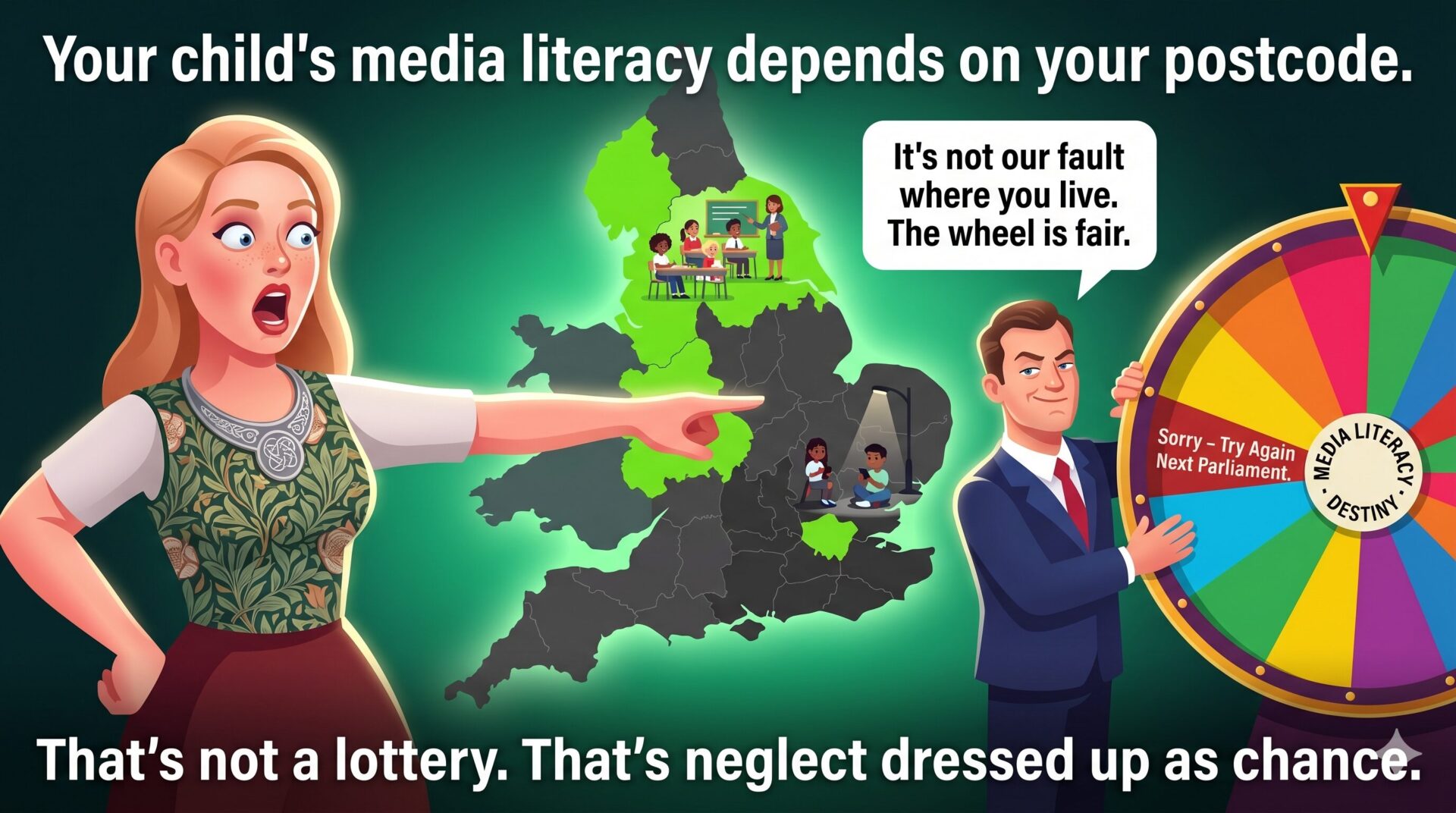
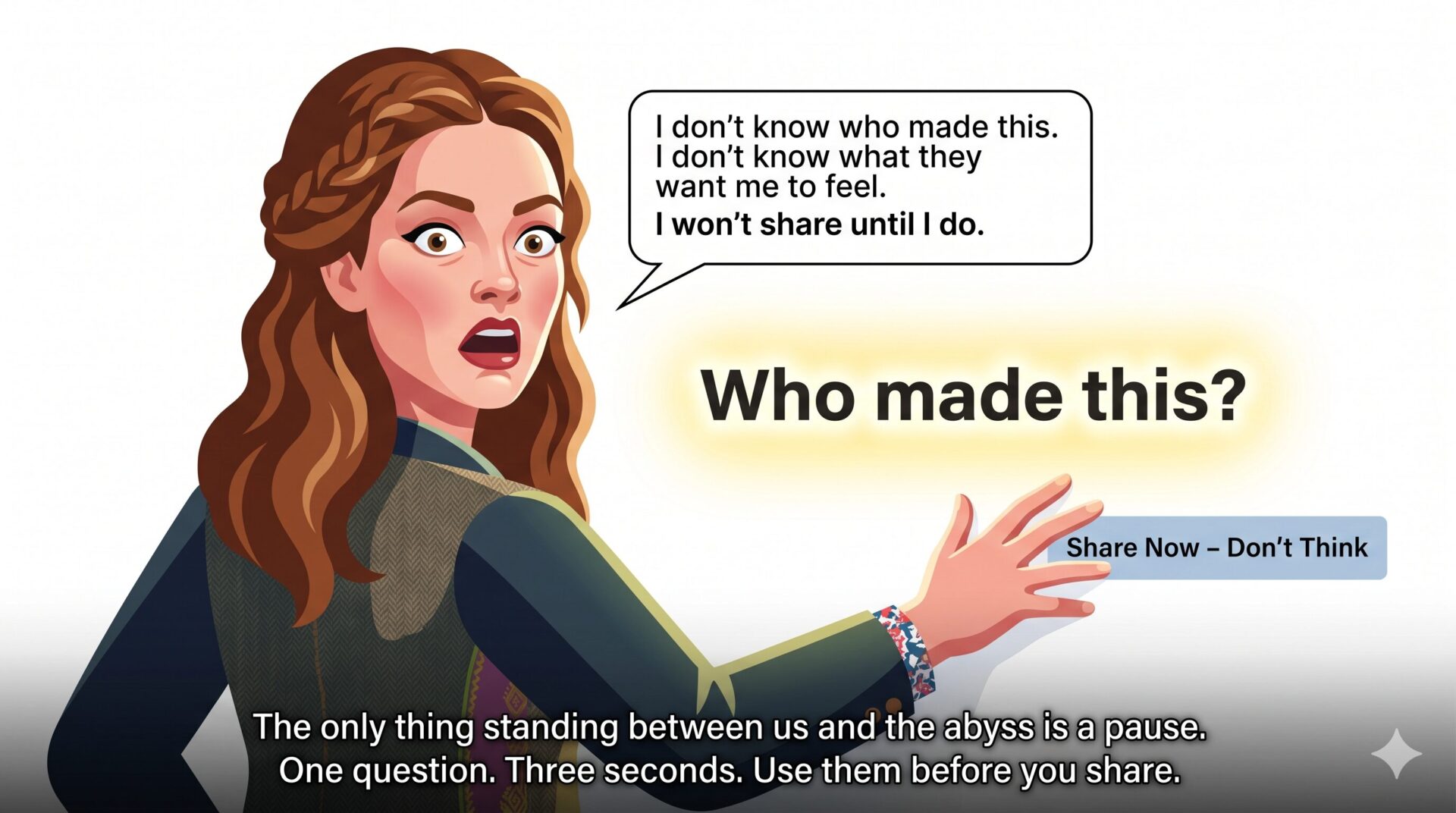
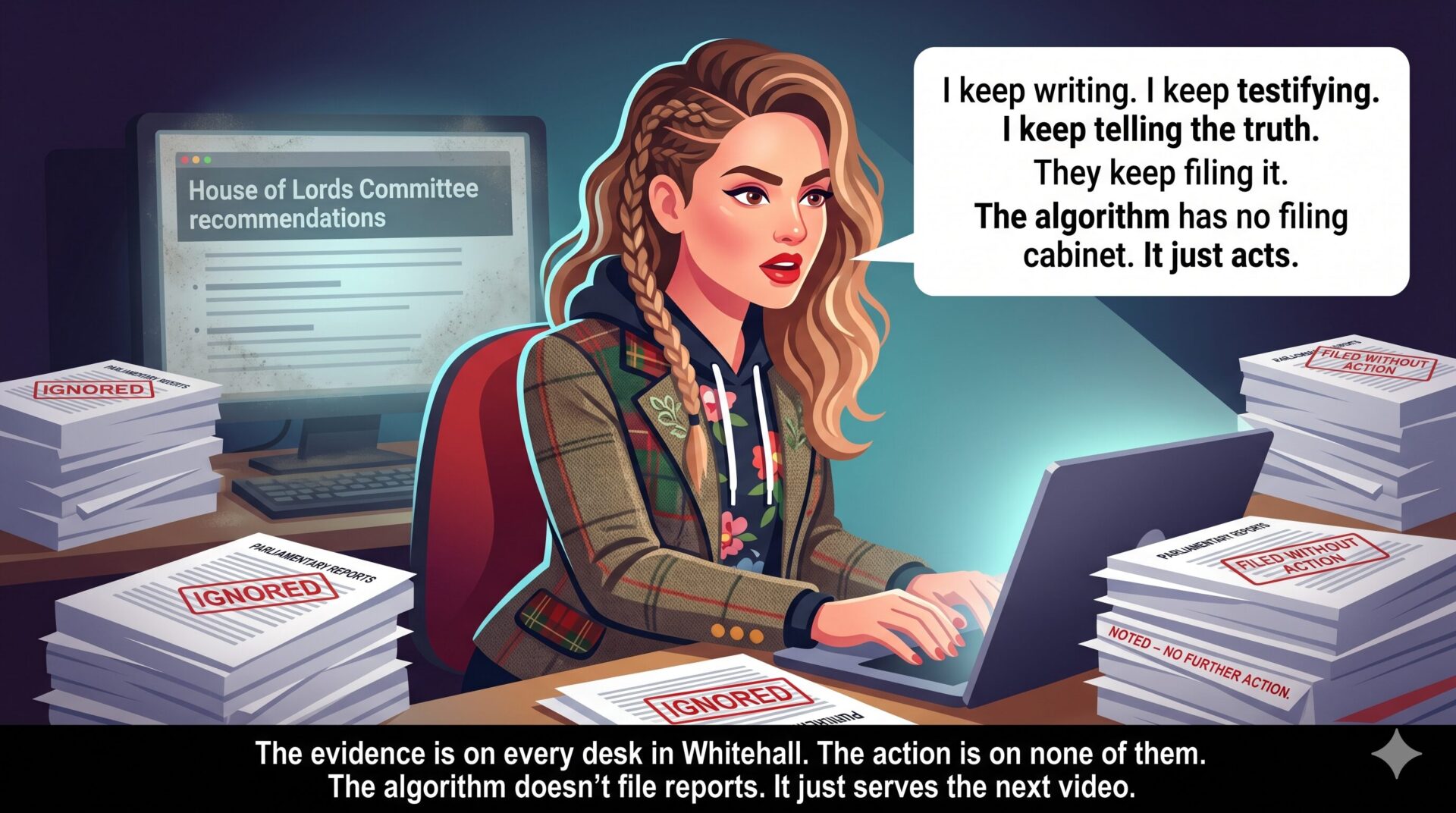 The minister — whoever they are this week — is not happy about this. They would like a seat at the table. They would like media literacy to be taken seriously. They would like the government to treat this issue with the urgency it deserves.
The BBC’s Role
The Auntie’s Arsenal
“With great power comes great responsibility” — and the BBC has more power than most. The question is whether it has the will to match.
There’s a building in Salford. Not the glamorous part of Salford. The part near the docks, where the wind cuts through you like a polite but persistent reminder that winter exists. Inside, people are making children’s television. They’ve been making it for decades. They’re good at it.
They make Newsround. You remember Newsround. John Craven. The theme tune. The way it explained complicated things in simple words without talking down to you. It’s still going. Still reaching 3.4 million children every week. Still doing what it’s always done: telling children what’s happening in the world in a way they can understand.
They also make Other Side of the Story. You might not know that one. It’s newer. It’s about misinformation. About how to spot a lie. About how to question what you see online. It reached 2.4 million learners in 2024.
These are big numbers. 3.4 million. 2.4 million. They’re not pilot numbers. They’re not small-scale. They’re national. They’re BBC-shaped.
The BBC has a mission. It’s written into its charter. It’s carved into its soul. To inform. To educate. To entertain.
Media literacy fits all three. Informing people about the world. Educating them about how to navigate it. Entertaining them along the way.
The BBC is uniquely placed to do this. It’s trusted — more trusted than the government, more trusted than the platforms, more trusted than almost any other institution in the country. It’s universal — every household pays the licence fee. It’s experienced — it’s been making educational content for a century.
The government should be leveraging this. Funding it. Amplifying it. Building on it.
The government is doing none of those things. They’re too busy with their own pilots. Their own strategies. Their own failures.
“The shoemaker’s children go barefoot” — and the government’s children go without media literacy, even though the BBC is standing right there, offering to help.
The Newsround Legacy
Let me tell you about Newsround. It started in 1972. That’s fifty-four years ago. Before the internet. Before social media. Before anyone had heard of misinformation or deepfakes or algorithms.
It started because the BBC realised that children were watching the news but not understanding it. That the world was complicated and scary and needed explaining.
The same is true today. The world is more complicated. More scary. More in need of explaining.
Newsround still does that. It explains what’s happening. It explains why it matters. It explains what children can do.
It also models media literacy. Not explicitly — not in a “this is a lesson about misinformation” way. In the way it presents the news. In the way it tells children where its information comes from. In the way it admits when it doesn’t know something.
Children who watch Newsround are learning media literacy without knowing it. They’re learning that news comes from somewhere. That sources matter. That not everything you see is true.
3.4 million children every week. That’s more than the entire population of Liverpool. More than the entire population of Sheffield. More than the entire population of Manchester.
The government doesn’t have a programme that reaches 3.4 million children. They have pilots that reach thousands. They have campaigns that reach millions shallowly. They don’t have Newsround.
The BBC has Newsround. The government should be celebrating this. Amplifying it. Funding it.
They’re not. They’re cutting the BBC’s budget. They’re making it harder for Newsround to survive. They’re undermining the very institution that could help them solve the media literacy crisis.
“Don’t look a gift horse in the mouth” — and the BBC is a gift horse. The government is not just looking in its mouth. They’re pulling out its teeth.
The Other Side of the Story
Let me tell you about Other Side of the Story. It’s a partnership between BBC Education and BBC News. It helps young people learn how to spot and respond to misinformation.
It’s not a broadcast programme. It’s a set of resources. Videos, lesson plans, activities. Designed for teachers. Designed for young people. Designed to be used in classrooms and at home.
It reached 2.4 million learners in 2024. That’s 2.4 million young people who learned something about how to question what they see online. How to verify a source. How to recognise a deepfake.
The resources are good. They’re BBC-good. High production values. Clear explanations. Age-appropriate examples.
They’re also underfunded. Under-resourced. Under-promoted.
The BBC’s education team is small. Their budget is stretched. Their reach is limited by the resources available.
The government could change this. They could fund the BBC to do more. They could embed BBC resources in the national curriculum. They could promote Other Side of the Story through schools and libraries.
They don’t. They’re too busy with their own resources. Their own lesson plans. Their own failures.
The BBC is offering a solution. The government is ignoring it.
“A prophet is not without honour except in his own country” — and the BBC is a prophet. It has been telling the government for years that media literacy matters. The government is not listening.
The Resource Paradox
Here’s the paradox. Teachers want resources. They want materials they can use in the classroom. They want things that are trusted, accurate, and age-appropriate.
The BBC makes these resources. Other Side of the Story. Newsround’s educational materials. Teachable moments embedded in existing content.
Teachers don’t use them. Not because the resources are bad. Because teachers don’t know they exist. Because the BBC doesn’t have the budget to promote them. Because the government doesn’t require them.
The government could require them. They could put BBC resources on the national curriculum. They could tell schools to use them. They could make media literacy a statutory requirement with BBC materials as the default.
They don’t. Because that would mean admitting that the BBC is useful. Because that would mean admitting that the government can’t do it alone. Because that would mean admitting failure.
The BBC is not a competitor. It’s a partner. A resource. An asset.
The government treats it like a rival. Cuts its budget. Questions its impartiality. Undermines its authority.
The result is that the BBC’s resources are underused. Teachers don’t know about them. Children don’t benefit. The media literacy crisis continues.
“United we stand, divided we fall” — and the government and the BBC are divided. They’re falling. The algorithm is catching them.
The Classroom Reality
Let me take you inside a classroom. It’s a secondary school in the West Midlands. The teacher is trying to teach media literacy. She has no training. No resources. No confidence.
She searches online. She finds the BBC’s Other Side of the Story resources. They look good. She downloads them. She adapts them. She uses them.
The lesson goes well. The students are engaged. They learn something. The teacher is relieved.
This is happening in some classrooms. Not enough. Because the teacher had to find the resources herself. Because no one told her they existed. Because the government didn’t require her to use them.
Imagine if the government required media literacy. Imagine if they specified the BBC’s resources as the default. Imagine if every teacher knew where to go and what to use.
The BBC could reach every child. Not 2.4 million. Not 3.4 million. Every child. Every school. Every classroom.
The government could make this happen. They choose not to.
“The road to hell is paved with good intentions” — and the government’s intentions are good. They want media literacy to be taught. They just don’t want to require it. They just don’t want to fund it. They just don’t want to make it happen.
The Funding Crisis
The BBC is underfunded. The licence fee has been frozen. The government has cut its budget. The BBC has had to make difficult choices.
Newsround survives. Other Side of the Story survives. But only just. The teams are small. The resources are limited. The reach is constrained.
The BBC could do more. They could create more resources. They could update them more frequently. They could promote them more widely.
They can’t. Because they don’t have the money. Because the government won’t give it to them.
The government is spending millions on its own media literacy pilots. Pilots that reach thousands. Pilots that come and go. Pilots that don’t scale.
The BBC already has scale. They have reach. They have trust. They have distribution.
The government could give the BBC the money they’re spending on pilots. They could fund the BBC to do what it does best. They could stop reinventing the wheel.
They don’t. Because they don’t trust the BBC. Because they think they can do it better. Because they’re wrong.
“A bird in the hand is worth two in the bush” — and the BBC is a bird in the hand. The government’s pilots are birds in the bush. The government prefers the bush. The birds are flying away.
The Finnish Comparison
Finland has YLE. Their public service broadcaster. It’s like the BBC but smaller. It does media literacy too.
The Finnish government funds YLE properly. They see it as part of the solution. They don’t cut its budget. They don’t question its impartiality.
The result is that YLE’s media literacy resources are used in every school. Every child has access. Every teacher knows where to find them.
The British government could learn from this. They could fund the BBC properly. They could treat it as a partner. They could stop cutting its budget.
They won’t. Because the BBC is politically controversial. Because the government is ideologically opposed to public service broadcasting. Because they’d rather fail alone than succeed with the BBC.
The children don’t care about politics. They care about learning. They care about being safe online. They care about understanding the world.
The BBC could help them. The government is getting in the way.
“Cutting off your nose to spite your face” — and the government is cutting off its nose. The BBC is its face. The government is spiting itself.
The Teacher’s Wish
Remember Helen from Doncaster? The English teacher who designed her own media literacy curriculum? She uses BBC resources. Newsround clips. Other Side of the Story lesson plans.
She wishes there were more. She wishes the resources were updated more often. She wishes they were promoted more widely.
She also wishes the government would stop ignoring the BBC. Stop cutting its budget. Stop making it harder for her to do her job.
Helen is not a BBC employee. She’s a teacher. She just knows quality when she sees it. The BBC’s resources are quality. The government’s resources are not.
She uses the BBC’s resources despite the government, not because of it. She finds them herself. She adapts them herself. She makes them work.
She shouldn’t have to. The government should be making it easy. The government should be funding the BBC. The government should be promoting the resources.
The government is doing none of these things. Helen is on her own. The BBC is on its own. The media literacy crisis is on everyone.
“Many hands make light work” — but the government’s hands are tied behind its back. The BBC’s hands are reaching out. The government is refusing to take them.
The Final Broadcast
Let me leave you with this. The BBC has a unique responsibility. It’s written into its charter. It’s part of its DNA. To inform. To educate. To entertain.
Media literacy is all three. The BBC is doing it. Newsround reaches 3.4 million children weekly. Other Side of the Story reached 2.4 million learners in 2024.
The government could build on this. Could fund it. Could amplify it. Could make it universal.
They won’t. Because they don’t trust the BBC. Because they think they can do it better. Because they’re wrong.
The BBC will keep doing what it does. Keep reaching millions. Keep making quality resources.
The government will keep ignoring it. Keep cutting its budget. Keep failing.
The children will keep scrolling. Keep watching the algorithm. Keep learning from the platforms.
The BBC is a solution. The government is a barrier. The algorithm is the winner.
Newsround will keep broadcasting. Other Side of the Story will keep teaching. The government will keep looking the other way.
And the media literacy crisis will keep getting worse. Because the government won’t use the tools it has. Because the BBC is underfunded. Because the algorithm is overfunded.
“The light shines in the darkness, and the darkness has not overcome it” — but the darkness is trying. The BBC is the light. The government is dimming it. The algorithm is cheering.
The BBC could save us. The government won’t let it.
The Reactive Resource
“A fair-weather friend is no friend at all” — and a resource that’s only used once a year is no resource at all.
There’s a cupboard in a school in Newcastle. Inside that cupboard, there are textbooks, worksheets, and a laminated poster about Safer Internet Day. The poster goes up every February. It comes down every March. It spends the rest of the year in the cupboard, gathering dust.
The BBC’s media literacy resources live in that cupboard. Not literally — they’re digital — but metaphorically. Teachers know about them. They’ve used them. They like them. They just don’t use them very often.
Safer Internet Day comes around. The teacher remembers the BBC has resources. They search. They find. They download. They use.
The lesson happens. The students learn something. The teacher feels good. Then the day ends. The resources go back in the metaphorical cupboard. The teacher moves on to fractions, or Shakespeare, or the water cycle.
The BBC’s Creative Director acknowledged this. She said teachers use the resources “fairly reactively.” In response to events. In response to calendar dates. Not as sustained curriculum provision.
This is not the BBC’s fault. The BBC makes good resources. The resources are used. They’re just not used enough. Not systematically. Not structurally. Not as part of something bigger.
The problem is not the resources. The problem is the system. The system that doesn’t require media literacy. That doesn’t embed it in the curriculum. That doesn’t give teachers time, training, or incentives.
The BBC can make the best resources in the world. If teachers only use them once a year, the impact will be minimal. A spike in February. A return to baseline in March.
“A drop in the ocean” — and the BBC’s resources are a drop. A beautiful drop. A high-quality drop. A drop that disappears without a ripple.
The Safer Internet Day Spike
Let me tell you about Safer Internet Day. It’s a great initiative. Schools across the country participate. There are assemblies, lessons, posters, pledges.
The BBC contributes. They create special content. They promote their resources. They partner with other organisations.
For one day, media literacy is visible. Teachers talk about it. Students think about it. Everyone feels like something is happening.
Then the day ends. The posters come down. The lessons stop. The teachers go back to the curriculum.
The spike is real. The impact is real — for that day. The problem is the rest of the year. The 364 days when media literacy is invisible. When the BBC’s resources sit in the metaphorical cupboard. When the algorithm teaches uninterrupted.
The government celebrates Safer Internet Day. They tweet about it. They issue press releases. They pat themselves on the back.
They don’t ask what happens the next day. They don’t measure the long-term impact. They don’t fund sustained provision.
The spike is a performance. A performance of action. A performance of concern. A performance that masks the absence of anything real.
“All that glitters is not gold” — and Safer Internet Day glitters. The rest of the year is rust. The government is polishing the glitter. The rust is eating the foundations.
The Resource Constraints
The BBC’s Creative Director was honest. She said reach remains limited due to resource constraints.
The BBC doesn’t have enough money. They can’t make enough resources. They can’t update them often enough. They can’t promote them widely enough.
The licence fee has been frozen. The government has cut the BBC’s budget. The BBC has had to make choices.
Newsround survives. Other Side of the Story survives. But only just. The teams are small. The budgets are tight. The reach is constrained.
The BBC could do more. They could create a full media literacy curriculum. They could produce weekly content. They could train teachers. They could partner with schools.
They can’t. Because they don’t have the money. Because the government won’t give it to them.
The government is spending millions on its own pilots. Pilots that reach thousands. Pilots that don’t scale.
The BBC already has scale. They have reach. They have trust. They have distribution. They just need funding.
The government has the funding. They’re spending it elsewhere. On abstract appeals. On collaborative approaches. On things that don’t work.
“Penny wise, pound foolish” — the government is saving pennies on the BBC and spending pounds on failures. The pound foolishness is breathtaking.
The Teacher’s Reality
Remember Helen from Doncaster? She uses BBC resources. She likes them. She wishes there were more.
She also admits that she uses them reactively. Safer Internet Day. A news event. A student asking a question. She doesn’t have time to use them systematically.
Helen has thirty students. Five classes. Marking. Planning. Parents’ evenings. Safeguarding. She’s exhausted.
She can’t add media literacy to her weekly schedule. There’s no room. There’s no requirement. There’s no time.
So she uses the BBC’s resources when she can. When there’s a hook. When there’s a reason. When the stars align.
This is not Helen’s fault. It’s the system’s fault. The system that doesn’t require media literacy. That doesn’t give her time. That doesn’t train her.
The BBC’s resources are good. They’re not enough. Good resources without a system are like good seeds without soil. They might germinate. They won’t grow.
“You can lead a horse to water, but you can’t make it drink” — and the BBC can lead teachers to resources. It can’t make them use them systematically. Only the government can do that.
The Curriculum Absence
Why don’t teachers use the BBC’s resources more often? Because media literacy isn’t in the curriculum.
If it were in the curriculum, teachers would have to teach it. They would need resources. They would seek out the BBC’s materials. They would use them regularly.
The government could put media literacy in the curriculum. They’re conducting a curriculum review. They’ve said media literacy will be considered.
They haven’t committed. They haven’t decided. They haven’t acted.
The BBC’s resources are ready. They’re waiting. They could be the backbone of a national media literacy curriculum.
The government is not using them. Because the government hasn’t decided that media literacy matters enough to be in the curriculum.
The BBC is a solution looking for a problem. The problem exists. The government is ignoring it.
“A solution in search of a problem” — but the problem is not in search. It’s everywhere. The government is just not looking.
The Reactive Cycle
Let me describe the reactive cycle. It happens every year.
February: Safer Internet Day. The BBC releases resources. Teachers use them. Students learn something. Everyone feels good.
March: The resources go back in the cupboard. Teachers move on. Students forget. The algorithm resumes teaching.
April to January: Nothing. The BBC’s resources sit unused. The government does nothing. Media literacy disappears.
February: Repeat.
This is not a strategy. This is a ritual. A ritual that produces the illusion of action without the reality.
The government could break the cycle. They could require media literacy in the curriculum. They could fund the BBC to create sustained resources. They could train teachers to use them regularly.
They won’t. Because breaking the cycle would require effort. Would require money. Would require admitting that the current approach is failing.
The cycle continues. The algorithm wins. The government watches.
“The definition of insanity is doing the same thing over and over and expecting different results” — and the government’s reactive cycle is insane. They do the same thing every year. They expect media literacy to improve. It doesn’t.
The Finnish Sustenance
Finland doesn’t have a reactive cycle. They have a proactive system.
Finnish teachers use media literacy resources regularly. Not because it’s Safer Internet Day. Because it’s Tuesday. Because media literacy is in the curriculum. Because every subject teacher is responsible for it.
The Finnish public service broadcaster YLE creates resources. Teachers use them systematically. Not once a year. Weekly. As part of their regular teaching.
The Finnish government funds YLE properly. They see it as part of the infrastructure. Not as an optional extra.
The result is that Finnish students learn media literacy throughout the year. Not in a spike. In a plateau. A sustained, ongoing, embedded plateau.
The BBC could be YLE. The British government could be the Finnish government. The resources exist. The will does not.
“The best time to plant a tree was twenty years ago. The second best time is now.” Finland planted twenty years ago. Britain is still waiting for Safer Internet Day.
The Charity’s Hope
The media literacy charities hope the BBC will do more. They hope the government will fund the BBC. They hope teachers will use the resources systematically.
They’ve been hoping for years. The BBC’s resources are good. They’re just not used enough.
The charities have tried to work with the BBC. To partner. To amplify. To promote.
The BBC is willing. They’re just constrained. By resources. By budget. By government hostility.
The charities are frustrated. They see the potential. They see the solution. They can’t make it happen.
The government could make it happen. They could fund the BBC. They could require media literacy in the curriculum. They could train teachers.
They won’t. Because they don’t see the BBC as a partner. Because they see it as a competitor. Because they’d rather fail alone than succeed with help.
“Pride comes before a fall” — and the government’s pride is coming before a fall. The fall of democracy. The fall of trust. The fall of everything.
The BBC’s Frustration
The BBC is frustrated. They have the resources. They have the reach. They have the trust.
They don’t have the mandate. The government hasn’t asked them to solve the media literacy crisis. The government hasn’t funded them to do so.
The BBC could do more. They could create a full curriculum. They could train teachers. They could measure impact.
They can’t. Because they don’t have the money. Because the government won’t give it to them. Because the government prefers to fail on its own.
The BBC’s Creative Director was honest about the constraints. She wasn’t complaining. She was stating facts.
The facts are bleak. The BBC has limited reach. Teachers use resources reactively. Media literacy is not sustained.
The government could change the facts. They choose not to.
“The truth hurts” — and the truth is that the BBC is underfunded, under-resourced, and underutilised. The government is responsible. The government doesn’t care.
The Final Resource
Let me leave you with this. The BBC’s resources are good. They’re trusted. They’re high-quality. They’re underused.
Teachers use them reactively. Around Safer Internet Day. Around news events. Not as sustained curriculum provision.
The BBC’s Creative Director acknowledged this. She said reach is limited due to resource constraints.
The government could fix this. They could fund the BBC. They could put media literacy in the curriculum. They could train teachers. They could make sustained provision possible.
They won’t. Because they don’t see the urgency. Because they don’t value the BBC. Because they’d rather do it themselves.
They can’t do it themselves. They’ve tried. They’ve failed. They’re still failing.
The BBC is a solution. The government is a barrier. The algorithm is the winner.
The resources sit in the metaphorical cupboard. The teachers forget they exist. The students learn from TikTok.
Safer Internet Day comes and goes. The spike rises and falls. The baseline remains.
The algorithm doesn’t have a Safer Internet Day. It has every day. 365 days a year. 24 hours a day. Always teaching. Always optimising. Always winning.
The BBC has one day. The government has nothing. The algorithm has everything.
“The race is not to the swift, but to those who keep running” — and the algorithm keeps running. The BBC runs once a year. The government is standing still.
The resources are good. They’re not enough. They’ll never be enough. Not while the government treats media literacy as a once-a-year performance rather than a daily necessity.
The BBC could save us. The government won’t let them.
The Chicken, the Egg, and the Broadcasting House
“Which came first, the chicken or the egg?” — and which comes first, the qualification or the curriculum? The BBC has an answer. The government doesn’t even have a question.
There’s an idea sitting on a desk in Broadcasting House. It’s not a new idea. It’s not a radical idea. It’s just an idea that makes sense.
The BBC’s Director-General, Tim Davie, proposed it. He said the BBC wants to develop qualifications around disinformation studies and media literacy. Real qualifications. Accredited. Assessed. Worth something.
Imagine it. A GCSE in Media Literacy. An A-Level in Disinformation Studies. Something that students could study, be tested on, get a grade for. Something that would sit alongside English and Maths and Science. Something that would tell employers and universities that this young person knows how to navigate the digital world.
It’s a good idea. It’s an obvious idea. It’s an idea that Finland implemented years ago.
There’s just one problem. You can’t have a qualification without a curriculum. You can’t have a curriculum without a commitment. You can’t have a commitment without a government.
The BBC can develop the qualification. They can write the syllabus. They can design the assessments. They can train the examiners.
They can’t put it in schools. They can’t require students to take it. They can’t make it part of the national curriculum. Only the government can do that.
The government hasn’t done it. They’re still reviewing. Still consulting. Still waiting.
The BBC is ready. The government is not. The chicken and the egg are still arguing, and neither is getting into the frying pan.
“A house divided against itself cannot stand” — and the house of British media literacy is divided. The BBC is building the roof. The government hasn’t laid the foundation. The house is collapsing before it’s built.
The Qualification Question
Let me explain what a qualification would mean. It’s not just a piece of paper. It’s a signal.
A GCSE in Media Literacy would tell schools that this subject matters. That it’s worth timetable space. That it’s worth teacher training. That it’s worth assessment.
Right now, media literacy is invisible. It’s not in the curriculum. It’s not assessed. It’s not inspected. It doesn’t appear on any accountability measure.
Schools can ignore it. Teachers can ignore it. Students can ignore it. Most do.
A qualification would change that. Schools would have to teach it. Teachers would have to learn it. Students would have to study it.
Not because they suddenly care. Because the accountability system would demand it. Because Ofsted would inspect it. Because GCSE results matter.
The BBC understands this. They’re not proposing a qualification because they love exams. They’re proposing it because they understand how the system works. The only way to make something a priority is to make it count.
The government doesn’t understand this. They think abstract appeals work. They think voluntary guidance works. They think collaborative approaches work.
They don’t. Only accountability works. Only assessment works. Only qualifications work.
The BBC is offering the government a tool. The government is refusing to pick it up.
“A tool is only as good as the craftsman who wields it” — and the government is a poor craftsman. The BBC is offering a chisel. The government is trying to carve with a spoon.
The Chicken-and-Egg Paradox
Let me describe the paradox. The BBC says: we need a qualification. The government says: we need a curriculum. The BBC says: we can’t have a qualification without a curriculum. The government says: we can’t have a curriculum without knowing what to teach.
Round and round. Chicken and egg. No progress. No action. No media literacy.
The government is hiding behind the paradox. They’re using it as an excuse. “We’re waiting for the curriculum review.” “We need to see what works.” “We can’t rush into this.”
The BBC is not hiding. They’re proposing a solution. They’re saying: let us develop the qualification. Let us write the syllabus. Let us show you what’s possible.
The government is not accepting the offer. They’re not rejecting it either. They’re just… waiting. Waiting for the perfect moment. The perfect evidence. The perfect political conditions.
The perfect moment never comes. The evidence is already here. The political conditions will never be perfect.
The BBC is ready. The government is not. The chicken and the egg are still arguing. The students are still vulnerable.
“He who hesitates is lost” — and the government is hesitating. The BBC is not. The students are being lost.
The Finnish Qualification
Finland has qualifications. They have a matriculation examination in media literacy. Students can choose it as a subject. It counts towards university entrance.
It’s not a niche qualification. It’s not an optional extra. It’s part of the system. Embedded. Respected. Assessed.
Finnish students study media literacy not because they’re told to. Because it matters. Because it counts. Because it’s on the exam.
The British government could copy this. They could create a GCSE. They could work with the BBC to develop it. They could put it in the curriculum.
They won’t. Because copying Finland would mean admitting that Finland is better. Because copying Finland would mean admitting that Britain has failed. Because copying Finland would mean admitting that the government doesn’t know what it’s doing.
The government would rather fail on its own terms than succeed on someone else’s. The BBC is offering a path to success. The government is refusing to walk it.
“Pride comes before a fall” — and the government’s pride is coming before a fall. The fall of a generation. The fall of democracy. The fall of trust.
The Teacher’s Hope
Remember Helen from Doncaster? She would love a qualification. She would love to teach a GCSE in Media Literacy. She would love to have a curriculum, resources, assessments.
She’s tired of designing her own lessons. Tired of guessing what works. Tired of watching her students learn nothing.
A qualification would change everything. It would give her a framework. It would give her legitimacy. It would give her time.
The government could give her this. They could create the qualification. They could fund the training. They could make it happen.
They won’t. Because they’re waiting for the curriculum review. Because they’re consulting stakeholders. Because they’re moving at the speed of bureaucracy.
Helen is not waiting. Her students are not waiting. The algorithm is not waiting.
The government is waiting. Helen is losing. The algorithm is winning.
“Time and tide wait for no man” — and the government is waiting. Time is passing. The tide is turning. The algorithm is rising.
The BBC’s Capacity
The BBC can develop a qualification. They have the expertise. They have the resources. They have the trust.
They’ve done it before. BBC Bitesize. BBC Teach. Qualifications in other subjects. They know how to do this.
They can’t do it alone. They need the government to recognise the qualification. To put it in the curriculum. To make it count.
The government is not saying no. They’re not saying yes. They’re saying “we’ll consider it.”
Consideration is not action. Consideration is not commitment. Consideration is not a qualification.
The BBC is ready to act. The government is ready to consider. The students are ready to learn. Nothing is happening.
“A promise is a comfort for a fool” — and the government’s promise to consider is a comfort to no one. The BBC is not fooled. The teachers are not comforted. The students are still waiting.
The Department’s Delay
The Department for Education moves slowly. Glaciers move faster. The curriculum review has been going on for years. It will continue for years.
The DfE could accelerate. They could make media literacy a priority. They could work with the BBC to develop a qualification. They could put it in the curriculum next year.
They won’t. Because media literacy is not a priority. Because the DfE has other things to do. Because the curriculum review is a convenient excuse.
The BBC is offering a shortcut. A ready-made solution. A qualification that could be implemented quickly.
The DfE is not interested. They prefer their own process. Their own timeline. Their own failures.
The qualification could exist. It won’t. Not because it’s impossible. Because the DfE doesn’t want it.
“The road to hell is paved with good intentions” — and the DfE’s intentions are good. They want to get it right. They want to be thorough. They want to consult.
The road to hell is also paved with delay. The DfE is paving.
The Political Economy of Qualifications
Why doesn’t the government want a qualification? Because qualifications cost money. Because they require teacher training. Because they require curriculum space. Because they require political capital.
The government has no money. The Treasury is empty. Teacher training is underfunded. The curriculum is crowded. Political capital is scarce.
A qualification would require all of these things. The government is not willing to provide them.
The BBC is offering to do the work. They’ll develop the qualification. They’ll write the syllabus. They’ll train the examiners.
The government still has to pay. Still has to train teachers. Still has to find curriculum space. Still has to spend political capital.
They’re not willing. So the qualification doesn’t happen. The media literacy crisis continues.
The algorithm doesn’t have these constraints. It doesn’t need teacher training. It doesn’t need curriculum space. It doesn’t need political capital.
It just needs engagement. And engagement is free.
“You get what you pay for” — and the government is paying for nothing. The algorithm is paying for everything. The algorithm is winning.
The Final Paradox
Let me leave you with this. The BBC’s Director-General has proposed developing qualifications around disinformation studies and media literacy.
It’s a good idea. It’s an obvious idea. It’s an idea that could work.
It requires embedding media literacy in the curriculum first. The chicken and the egg. The qualification and the curriculum.
The government could solve the paradox. They could decide. They could act. They could make it happen.
They won’t. Because they’re paralysed. By process. By politics. By fear.
The BBC is ready. The government is not. The students are waiting. The algorithm is teaching.
The qualification could be the answer. It won’t be. Not because it’s impossible. Because the government won’t make it possible.
“The best time to plant a tree was twenty years ago. The second best time is now.” The BBC is ready to plant. The government is still arguing about who owns the shovel.
The tree will not be planted. The qualification will not be created. The students will not learn.
The algorithm will keep teaching. The government will keep waiting. The BBC will keep offering.
And the chicken and the egg will keep arguing. Neither will become dinner. The students will go hungry.
The Teacher Training Gap
The Unarmed Army
“A soldier without a weapon is a casualty waiting to happen” — and a teacher without media literacy training is a casualty of a system that has abandoned them.
The alarm goes off at 5:30am. Not because the teacher wants to be awake. Because there’s marking to do. Lessons to plan. Emails to answer. The endless admin of a profession that is asked to do more with less every single year.
By 8:15am, the teacher is in the classroom. The students are drifting in. Backpacks slung over shoulders. Phones in hands. Eyes on screens. They’ve already consumed hours of content this morning. TikTok. Instagram. YouTube. An algorithm that has been optimising since they woke up.
The teacher has no idea what they’ve seen. No idea what they believe. No idea what they’re about to say.
The lesson starts. History. Or English. Or PSHE. It doesn’t matter. Ten minutes in, a hand goes up. “Sir, is it true that the government is hiding the cure for cancer? I saw it on TikTok.”
The teacher freezes. They don’t know how to answer. Not because they don’t know the facts — they know the facts. Because they don’t know how to convince a teenager who trusts TikTok more than them.
They stumble through an answer. “That’s not true. There’s no evidence. The NHS would say.” The student looks unconvinced. The teacher can see it in their eyes. They’ve already decided. The algorithm has already won.
This is not a bad teacher. This is a good teacher who was never trained for this. Who was never given the tools. Who was left to figure it out alone.
Initial teacher training covered lesson planning. Classroom management. Assessment. Differentiation. Safeguarding.
It did not cover media literacy. Did not cover how to talk to students about conspiracy theories. Did not cover how to deconstruct algorithmic manipulation. Did not cover how to respond when a student says “I saw it on TikTok” as if that settles the matter.
The teacher is unarmed. The algorithm is armed. The student is caught in the middle.
“A fool and his money are soon parted” — but a teacher without training is soon parted from their authority. The students can smell the uncertainty. The algorithm feeds on it.
The Reactive Dial
Let me describe what teachers actually do. It’s not what the government imagines. It’s not what the curriculum says. It’s what survival demands.
A student says something concerning. The teacher has to respond. They don’t have a lesson plan for this. They don’t have a resource. They don’t have training.
They “dial into current affairs.” They try to remember what they read in the news. They try to recall a fact-check they saw. They try to sound confident while internally panicking.
This is not teaching. This is firefighting. Reacting to whatever the algorithm served the students that morning. Responding to the crisis of the day.
The government calls this “flexibility.” They call it “professional autonomy.” They call it “responsive teaching.”
It’s none of those things. It’s abandonment. The government has left teachers to figure it out on their own. To be the first line of defence against a weaponised information environment. Without training. Without resources. Without support.
The teachers are doing their best. Their best is not enough. It’s not their fault.
“The road to hell is paved with good intentions” — and the government’s intentions are good. They trust teachers to figure it out. The road is paved. The teachers are walking it. The algorithm is driving.
The Misogyny Morning
Let me tell you about a teacher in Birmingham. Let’s call her Priya. She teaches PSHE. She’s been teaching for ten years. She’s seen a lot.
Last year, she walked into a Year 9 classroom. The boys were whispering. She asked what was happening. A girl raised her hand. “They’re talking about Andrew Tate, Miss. They think he’s right about everything.”
Priya had heard of Andrew Tate. She knew he was a misogynist. She knew he was toxic. She didn’t know how to talk to fourteen-year-old boys who thought he was a hero.
She tried. She explained that Tate was accused of serious crimes. That his views on women were harmful. That his success was largely fictional.
The boys weren’t convinced. “You’re just saying that because you’re a woman.” “The mainstream media is lying about him.” “He’s been silenced because he tells the truth.”
Priya was outnumbered. Out-argued. Out-manoeuvred. Not because she was wrong. Because she was untrained. Because she didn’t have the tools. Because the boys had been learning from the algorithm for months, and she had forty minutes.
She went home that night and cried. Not because she was weak. Because she was powerless. Because she knew that those boys would go home and watch more Tate. That the algorithm would serve them more extreme content. That she would lose them a little more each day.
Priya is not a failure. The system failed her. The government failed her. The teacher training that didn’t include media literacy failed her.
“The best defence is a good offence” — but Priya has no defence. She’s been left to parry with bare hands against a sword.
The Extremism Afternoon
Let me tell you about a teacher in Bradford. Let’s call him Tom. He teaches RE. He’s been teaching for fifteen years. He’s seen the rise of extremism online.
Last month, a student told him that the Holocaust didn’t happen. That he’d seen videos proving it. That the Jews had faked it to get sympathy.
Tom knew this was nonsense. He knew the evidence. He knew the history. He didn’t know how to reach a student who had been radicalised by an algorithm.
He tried. He showed evidence. He shared testimonies. He explained the consensus of historians.
The student wasn’t convinced. “Those are fake. The government made them. You’re just repeating what they want you to say.”
Tom realised something. He wasn’t just fighting a lie. He was fighting an entire epistemology. A way of knowing that had been taught to the student by the algorithm. A way of knowing that said all institutions are corrupt, all evidence is manufactured, all authority is a conspiracy.
Tom couldn’t win. Not because he lacked evidence. Because the student lacked trust. And trust is not something you can restore with a PowerPoint.
Tom went home that night and wondered if he was cut out for teaching. He is cut out for teaching. He’s excellent at teaching. He was just never trained to be a counter-radicalisation officer. Because that’s what the government has asked him to be.
“You can’t teach an old dog new tricks” — but Tom is not an old dog. He’s a teacher who was never given the new tricks. The government expects him to learn them on the job. The algorithm is teaching them to the students. Tom is losing.
The Teacher Training Void
Let me explain what initial teacher training actually covers. ITT. The PGCE. School Direct. Whatever route teachers take.
They learn about pedagogy. How to plan a lesson. How to assess learning. How to manage behaviour. How to differentiate for different students.
They do not learn about media literacy. They do not learn about algorithms. They do not learn about deepfakes. They do not learn about conspiracy theories. They do not learn about how to respond when a student has been radicalised online.
These things are not in the curriculum. Not in the standards. Not in the training.
So teachers leave university — or their school-based training — without the skills they need to do the job the government expects them to do.
The government expects them to be media literacy educators. Counter-radicalisation officers. Trusted adults who can deconstruct algorithmic manipulation.
The government does not train them to be any of these things. The government gives them nothing. Then blames them when they fail.
This is not a failure of teachers. It’s a failure of policy. A failure of the Department for Education. A failure of the government.
“You can’t get blood from a stone” — and you can’t get media literacy teaching from teachers who were never trained to provide it. The government is trying. The teachers are bleeding.
The Continuing Professional Development Void
Initial teacher training is bad. Continuing professional development is worse. Most schools don’t offer media literacy training. Most local authorities don’t commission it. Most subject associations don’t provide it.
Teachers are left to figure it out themselves. To read articles. To watch videos. To design their own lessons. To hope they’re getting it right.
Some do. Helen in Doncaster. Priya in Birmingham. Tom in Bradford. They’re the exceptions. The ones who care enough to learn on their own time, with their own money.
Most teachers don’t have the time. They’re exhausted. Overworked. Underpaid. They’re just trying to survive.
The government could provide CPD. They could fund it. They could require it. They could make it part of teacher standards.
They don’t. Because CPD costs money. Because the Treasury is empty. Because media literacy is not a priority.
So teachers remain untrained. The algorithm remains unchecked. The students remain vulnerable.
“A stitch in time saves nine” — but the government is not stitching. They’re watching the fabric unravel. The teachers are trying to hold it together with safety pins.
The Ofsted Blind Spot
Ofsted doesn’t inspect media literacy. They don’t ask schools how they train teachers. They don’t ask teachers how confident they feel. They don’t measure outcomes.
So schools have no incentive to train teachers. No incentive to provide CPD. No incentive to prioritise media literacy.
The government could change this. They could put media literacy in the inspection framework. They could make it a factor in school ratings.
They won’t. Because that would require admitting that media literacy matters. Because that would require holding schools accountable. Because that would require work.
The teachers are left to their own devices. Some rise to the challenge. Most don’t. The system doesn’t reward them for trying. Doesn’t punish them for ignoring.
The algorithm rewards itself. Every day. Every scroll. Every student radicalised.
“What gets measured gets managed” — and nothing gets measured. Nothing gets managed. The teachers are managing alone.
The Government’s Defence
The government would say that teachers are professionals. That they have autonomy. That they don’t need to be told what to do.
This is a cop-out. Teachers are professionals. They also need training. Surgeons are professionals. They still go to medical school. Pilots are professionals. They still go to flight school.
The government is not providing the training. They’re not providing the resources. They’re not providing the support.
They’re leaving teachers to drown. Then blaming them for not swimming.
The teachers are not drowning because they’re bad at their jobs. They’re drowning because the government threw them in the deep end without a life jacket.
“A good workman blames his tools” — but the teachers are not blaming their tools. They’re asking for tools. The government is not providing them.
The Charity’s Support
The charities are trying to fill the gap. Parent Zone. The National Literacy Trust. The Guardian Foundation. They provide training. Resources. Support.
They’re underfunded. Overstretched. Unable to reach everyone.
The government could fund them. Could scale them. Could make their training universal.
They won’t. Because they’d rather do it themselves. Because they’re not doing it themselves. Because nothing is happening.
The charities are doing their best. Their best is not enough. It’s not their fault.
“Many hands make light work” — but the government’s hands are tied. The charities’ hands are reaching out. The government is not grasping them.
The Final Classroom
Let me leave you with this. There is a classroom somewhere in Britain. A teacher is standing at the front. They are untrained in media literacy. Unprepared for what the students have consumed.
A hand goes up. “Is it true that immigrants are taking all the houses? I saw it on Facebook.”
The teacher freezes. They know it’s not true. They don’t know how to prove it. They don’t know how to convince a student who trusts Facebook more than them.
They stumble. The student looks unconvinced. The teacher feels like a failure.
They’re not a failure. They were never trained for this. They were left to figure it out alone. The government abandoned them.
The algorithm taught the student. The government did not teach the teacher. The teacher is doing their best. Their best is not enough.
This scene repeats every day. In every school. In every classroom. Thousands of times. Thousands of teachers. Thousands of students. Thousands of moments where the algorithm wins because the government didn’t prepare the teacher.
Initial teacher training includes almost nothing on media literacy. Teachers are left to “dial into current affairs” reactively. Responding to whatever misogynistic or extremist content their students have consumed that morning.
The government could change this. They could train teachers. They could fund CPD. They could put media literacy in the curriculum.
They won’t. Because they don’t see the urgency. Because they don’t value teachers. Because they don’t understand the algorithm.
The teachers are unarmed. The algorithm is armed. The students are the battlefield.
And the government is watching from a safe distance, wondering why the teachers are losing.
“The only thing necessary for the triumph of evil is that good men should do nothing” — and the government is doing nothing. The teachers are doing everything. The algorithm is winning.
The teachers are not the problem. The government is. The teachers are the solution. The government is ignoring them.
The algorithm has no such qualms. It teaches every day. It optimises every hour. It wins every minute.
The teachers are fighting alone. The government is not helping. The algorithm is not stopping.
The classroom is silent. The hand is raised. The teacher is frozen. The student is waiting.
The algorithm already answered.
The Exodus of the Exhausted
“The labourer is worthy of his hire” — but what happens when the labourer is expected to fight a war without weapons, without armour, and without backup? They leave. And they don’t come back.
The staff room is emptier than it used to be. Not physically — there are still mugs on the table and marking in the trays. But the faces have changed. The ones who’ve been there for years are gone. Retired early. Burned out. Walked out. The ones who’ve replaced them are younger. Keener. They don’t know what’s coming.
The National Education Union has been warning about this for years. Teachers are leaving. Not because of the pay — though that’s terrible. Not because of the hours — though those are brutal. Because of what they’re being asked to do without being given the tools to do it.
A teacher walks into a classroom. They’ve planned a lesson on fractions. Or the Tudors. Or the water cycle. They haven’t planned to deconstruct Andrew Tate. They haven’t planned to explain why the Holocaust happened. They haven’t planned to argue with a fourteen-year-old who thinks immigrants are stealing everything.
But that’s what happens. Every day. In every school. A student has been up all night watching videos. Videos that tell them women are inferior. That tell them Jews control the world. That tell them the white race is under attack.
The teacher has to respond. Not because the curriculum says so. Because if they don’t, the student will keep watching. The views will harden. The other students will be affected. The school will become a hostile place.
The teacher responds. Without training. Without resources. Without support. They do their best. Their best is not enough. They feel like a failure. They burn out. They leave.
The National Education Union is not exaggerating. Teachers are leaving the profession. The recruitment crisis is real. The retention crisis is worse.
And the government is wondering why.
“A house divided against itself cannot stand” — and the house of British education is divided. Teachers against the algorithm. Teachers against the government. Teachers against exhaustion. The house is collapsing.
The Tate Invasion
Let me tell you about a teacher in Manchester. Let’s call her Sarah. She’s been teaching for eight years. She loves her job. Or she did. Now she’s thinking about leaving.
Last year, Andrew Tate invaded her classroom. Not physically — he was in Romania, under house arrest. But his ideas were everywhere. The boys in her Year 10 class quoted him like scripture. “Women belong in the kitchen.” “Men shouldn’t show emotions.” “Feminism is cancer.”
Sarah tried to push back. She explained that Tate was accused of human trafficking. That his views were harmful. That his success was largely fictional.
The boys weren’t convinced. “You’re just saying that because you’re a woman.” “The mainstream media is lying about him.” “He’s been silenced because he tells the truth.”
Sarah was outnumbered. She didn’t have a lesson plan for this. She didn’t have resources. She didn’t have training. She had her instincts and her exhaustion.
She went home that night and cried. Not because she was weak. Because she was powerless. Because she knew that those boys would go home and watch more Tate. That the algorithm would serve them more extreme content. That she would lose them a little more each day.
Sarah is not alone. There are thousands of Sarahs. They’re leaving. Or they’re thinking about leaving. Or they’ve already left.
The National Education Union warned about this. The government ignored them.
“A stitch in time saves nine” — but the government is not stitching. They’re watching the fabric unravel. Sarah is trying to hold it together. She’s losing.
The Holocaust Denial
Let me tell you about a teacher in Leeds. Let’s call him David. He teaches history. He’s been teaching for twelve years. He’s seen a lot.
Last month, a student told him that the Holocaust didn’t happen. That he’d seen videos proving it. That the Jews had faked it to get sympathy.
David knew this was nonsense. He knew the evidence. He knew the history. He didn’t know how to reach a student who had been radicalised by an algorithm.
He tried. He showed evidence. He shared testimonies. He explained the consensus of historians.
The student wasn’t convinced. “Those are fake. The government made them. You’re just repeating what they want you to say.”
David realised something. He wasn’t just fighting a lie. He was fighting an entire epistemology. A way of knowing that had been taught to the student by the algorithm. A way of knowing that said all institutions are corrupt, all evidence is manufactured, all authority is a conspiracy.
David couldn’t win. Not because he lacked evidence. Because the student lacked trust. And trust is not something you can restore with a PowerPoint.
David went home that night and updated his CV. He’s been teaching for twelve years. He’s good at it. He doesn’t want to leave. He feels like he has no choice.
The National Education Union warned about this. The government ignored them.
“You can’t reason someone out of something they weren’t reasoned into” — and the student wasn’t reasoned into Holocaust denial. They were algorithm-ed into it. David can’t reason them out. He’s not trained for that. No one is.
The Racial Slur
Let me tell you about a teacher in Luton. Let’s call her Fatima. She teaches English. She’s been teaching for six years. She’s thinking about leaving.
Last week, a student called another student a racial slur. Fatima intervened. She asked the student where he’d learned that language. “YouTube,” he said. “The man on YouTube says it’s true.”
Fatima didn’t know how to respond. She couldn’t ban YouTube. She couldn’t de-radicalise the student in a five-minute conversation. She could only do what she always did: refer him to the head of year, file a report, move on.
The student was back in her class the next day. He hadn’t changed. He wouldn’t change. The algorithm was still teaching him. Fatima was powerless.
She went home that night and thought about her future. She loves teaching. She loves her students. She can’t do this anymore.
The National Education Union warned about this. The government ignored them.
“A burden shared is a burden halved” — but Fatima’s burden is not shared. She’s carrying it alone. The government is not helping. The algorithm is not stopping.
The Training Void
Why are teachers leaving? Because they weren’t trained for this. Because they have no resources. Because they have no support.
Initial teacher training covers lesson planning. Classroom management. Assessment. Differentiation. It does not cover how to respond to a student who has been radicalised by an algorithm. It does not cover how to deconstruct misogynistic content. It does not cover how to talk about race and immigration without making things worse.
Continuing professional development is no better. Most schools don’t offer training on online radicalisation. Most local authorities don’t commission it. Most subject associations don’t provide it.
Teachers are left to figure it out themselves. To read articles. To watch videos. To design their own lessons. To hope they’re getting it right.
Some do. Most don’t. The ones who try burn out. The ones who don’t try feel guilty. The ones who feel guilty leave.
The National Education Union has been calling for training. For resources. For support. The government has been ignoring them.
“You can’t teach what you don’t know” — and teachers don’t know how to counter online radicalisation. Because no one taught them. Because the government didn’t provide the training.
The Recruitment Crisis
The recruitment crisis is real. Fewer people are training to be teachers. Fewer are completing their training. Fewer are staying beyond their first few years.
The government blames pay. Blames workload. Blames Ofsted. These are factors. They’re not the whole story.
Teachers are leaving because they’re being asked to fight a war they weren’t trained for. A war against an algorithm that never sleeps. A war against a firehose of misogyny, racism, and extremism.
They’re losing. They know they’re losing. They feel like failures. They leave.
The National Education Union warned about this. They said teachers needed training. They said teachers needed resources. They said teachers needed support.
The government said they’d look into it. They formed a working group. They commissioned a review. They did nothing.
Teachers are leaving. The recruitment crisis is getting worse. The algorithm is winning.
“A chain is only as strong as its weakest link” — and the weakest link is not the teachers. It’s the government that refuses to support them.
The Classroom Reality
Let me describe a typical classroom. It’s not what the government imagines. It’s not what the curriculum says. It’s what teachers live every day.
The students come in. They’ve been online for hours. They’ve seen videos about immigrants, about women, about Jews, about Muslims. They’ve been told that everyone is lying to them. That the only truth is on the internet. That their teachers are part of the conspiracy.
The teacher stands at the front. They have a lesson plan about Shakespeare. Or algebra. Or the periodic table. They know that the students are distracted. They know that the algorithm has already started teaching.
A hand goes up. “Is it true that the government is putting chemicals in the water?” The teacher has to respond. They can’t say “that’s not relevant.” They can’t say “we’re doing algebra.” They have to engage. Because if they don’t, the student will keep believing. The other students will be affected. The school will become a hostile place.
The teacher responds. Without training. Without resources. Without support. They do their best. Their best is not enough. The student looks unconvinced. The teacher feels like a failure.
This happens every day. In every school. In every classroom. Thousands of times. Thousands of teachers. Thousands of students. Thousands of moments where the algorithm wins because the government didn’t prepare the teacher.
“The teacher appears when the student is ready” — but the student is ready for the algorithm. The teacher is not ready for the student. The government is not ready for any of it.
The Government’s Silence
The government says they support teachers. They say they value the profession. They say they’re investing in recruitment and retention.
Their actions say otherwise. No training on online radicalisation. No resources for countering extremism. No support for teachers who are struggling. No recognition of the scale of the problem.
The National Education Union has been shouting into the void. The government has been pretending not to hear.
Teachers are leaving. The government is silent. The algorithm is laughing.
“Silence gives consent” — and the government’s silence consents to the exodus. Consents to the burnout. Consents to the algorithm’s victory.
The Final Classroom
Let me leave you with this. There is a classroom somewhere in Britain. A teacher is standing at the front. They are untrained. Unsupported. Exhausted.
A student raises their hand. “Is it true that women are inferior? Andrew Tate says so.”
The teacher has a choice. Engage or ignore. If they engage, they’ll be drawn into an argument they’re not trained for. If they ignore, they’ll be complicit in the radicalisation.
They engage. They do their best. Their best is not enough. The student looks unconvinced. The teacher feels like a failure.
This teacher will leave. Not tomorrow. Not next week. But soon. The burnout is cumulative. The exhaustion compounds. The feeling of failure never goes away.
The National Education Union warned about this. They said teachers needed training. They said teachers needed resources. They said teachers needed support.
The government did nothing. The teachers are leaving. The algorithm is winning.
And the classroom is emptier than it used to be. Not just of teachers. Of hope.
“The only thing necessary for the triumph of evil is that good men should do nothing” — and the government is doing nothing. The teachers are doing everything. The algorithm is winning.
The teachers are leaving. The government is watching. The algorithm is teaching.
And the classroom is silent. Because the teacher who could have answered is gone. Burned out. Walked out. Never coming back.
The National Education Union warned. The government ignored. The teachers are leaving. The algorithm is staying.
And the students? The students are still there. Still scrolling. Still learning. Still believing.
The teacher who could have saved them is gone. The government who should have trained them is absent. The algorithm that radicalised them is present.
The classroom is empty. The future is bleak. The government is silent.
“For want of a nail, the shoe was lost” — for want of training, the teacher was lost. For want of a teacher, the student was lost. For want of a student, the future was lost.
The National Education Union warned. The government ignored. The teachers are leaving. The algorithm is staying.
And the classroom is empty.
The Statutory Silence
“If it’s not on the timetable, it doesn’t exist” — and in British schools, media literacy doesn’t exist. Not really. Not statutorily. Not where it counts.
There’s a phrase that Ofcom’s researchers heard again and again. From teachers. From head teachers. From curriculum designers. From everyone who had ever tried to teach media literacy and failed.
“The lack of a statutory curriculum location is a barrier.”
Translation: it’s not on the timetable. It’s not required. It’s not inspected. It’s not assessed. It’s not real.
Ofcom called this “highly significant.” They don’t use those words lightly. Ofcom is a cautious organisation. They measure their words. They know that “highly significant” will be read. Will be noted. Will be ignored.
The respondents weren’t asking for much. They weren’t asking for a revolution. They weren’t asking for a new subject, a new GCSE, a new A-Level. They were asking for something simpler. Something more fundamental.
A statutory place. A requirement. A box that schools have to tick. A line in the curriculum that says: this must be taught.
Not a suggestion. Not a recommendation. Not a “schools may choose to.” A must. A statutory must.
Because without that must, nothing happens. Schools are busy. The curriculum is crowded. Teachers are exhausted. Ofsted is looming. The things that aren’t required are the things that get squeezed out.
Media literacy gets squeezed out. Every time. Every year. In every school where there isn’t a hero teacher fighting to keep it alive.
The respondents knew this. That’s why they spoke. That’s why they told Ofcom what the government already knew but refused to act upon.
Media literacy needs to be statutory. And it needs to be more than a tick-box exercise. Not just a box that gets ticked once a year on Safer Internet Day. A genuine, embedded, ongoing part of what schools do.
“A rule is only as good as its enforcement” — and a curriculum is only as good as its statutory requirements. There are no requirements. There is no enforcement. There is no media literacy.
The Timetable Tyranny
Let me explain how timetables work. It’s not complicated. It’s brutal.
A school has a certain number of hours in the week. Those hours are allocated to subjects. English gets five. Maths gets five. Science gets four. PE gets two. History gets two. Geography gets two. And so on.
Every subject fights for hours. Every subject has advocates. Every subject has champions who argue that their subject is essential, that their subject must be protected, that their subject cannot be cut.
Media literacy has no advocates. Not because no one believes in it. Because it’s not on the timetable. Because it has no allocated hours. Because it’s not a subject. It’s a cross-curricular theme. A nice-to-have. An optional extra.
When something has to give — when the timetable is too crowded, when the budget is too tight, when the head teacher is under pressure — the optional extras give. Media literacy gives. Every time.
The respondents told Ofcom this. They said the lack of a statutory location is a barrier. They meant: media literacy has no home. No department. No champion. No protected hours.
The government could give it a home. They could put it in the curriculum. They could require it. They could protect it.
They won’t. Because that would mean taking hours from something else. And something else has advocates. Something else has champions. Something else has power.
Media literacy has no power. So media literacy has no hours. So media literacy is not taught.
“The squeaky wheel gets the grease” — and media literacy doesn’t squeak. It whispers. The government can’t hear. The timetable creaks on.
The Tick-Box Trap
The respondents said something else. They said media literacy needs to be more than a tick-box exercise.
They’ve seen the tick-box. They’ve lived the tick-box. Safer Internet Day comes around. The school puts on an assembly. The teachers show a video. The students make a poster. The box is ticked. Media literacy is done for another year.
This is not media literacy. This is a performance. A ritual. A way of pretending to do something while doing almost nothing.
The tick-box is the enemy of genuine education. It reduces complex skills to simple activities. It substitutes quantity for quality. It confuses doing something with doing something effective.
The respondents know this. That’s why they warned against the tick-box. That’s why they said media literacy needs to be statutory but also embedded. Required but also real.
The government loves tick-boxes. They’re easy to measure. Easy to report. Easy to forget. A tick-box requires no training, no resources, no sustained effort. Just a box and a tick.
The respondents want more. They want a genuine, embedded, ongoing programme. They want training. They want resources. They want time.
The government is not listening. The tick-box is cheaper.
“A half-truth is a whole lie” — and a tick-box is a half-truth. It says something is being done. Nothing is being done. The government is lying. The respondents are telling the truth.
The Finnish Requirement
Finland requires media literacy. It’s statutory. It’s in the curriculum. Every school must teach it. Every student must learn it.
It’s not a tick-box. It’s embedded. Cross-curricular. Every subject teacher is responsible. History teachers teach source criticism. Science teachers teach evidence evaluation. Art teachers teach visual manipulation.
The Finnish government didn’t create a new subject. They didn’t add hours to the timetable. They integrated media literacy into existing subjects. They made it everyone’s responsibility.
The British government could do this. They could require media literacy in the curriculum. They could embed it in existing subjects. They could make it statutory without adding hours.
They won’t. Because that would require updating the curriculum. Because that would require training teachers. Because that would require effort.
The respondents told Ofcom what works. The government ignored them.
“The best time to plant a tree was twenty years ago. The second best time is now.” Finland planted twenty years ago. Britain is still arguing about whether the tree is necessary.
The Teacher’s Frustration
Remember Helen from Doncaster? The English teacher who designed her own media literacy curriculum? She’s tired of the tick-box. Tired of Safer Internet Day. Tired of pretending that one assembly makes a difference.
She wants media literacy to be statutory. She wants it to be embedded. She wants it to be real.
She’s been trying to teach it anyway. Without a statutory requirement. Without training. Without resources. Without support.
She’s burning out. She can’t do it alone. She needs the system to change.
The respondents told Ofcom what Helen needs. The government is not listening. Helen is still waiting.
** “A burden shared is a burden halved”** — but Helen’s burden is not shared. The government is not helping. The algorithm is not stopping.
The Head Teacher’s Calculus
Remember David from Bradford? The head teacher with impossible choices? He knows media literacy is important. He knows it should be taught.
He also knows that Ofsted doesn’t inspect it. That the curriculum doesn’t require it. That his teachers aren’t trained for it.
He has to choose. Does he allocate time for media literacy? Or does he protect the things that Ofsted inspects? The things that determine his school’s rating? The things that keep his school open?
He protects the inspected things. Every time. Because he has no choice. Because the system gives him no choice.
The respondents told Ofcom this. They said the lack of a statutory location is a barrier. They meant: head teachers like David can’t prioritise what isn’t required.
The government could remove the barrier. They could make media literacy statutory. They could put it on the timetable. They could make it inspected.
They won’t. Because that would mean admitting that they were wrong. Because that would mean changing the system. Because that would mean work.
“The devil you know is better than the devil you don’t” — and the government knows the current system. They’re comfortable with it. The devil of media literacy neglect is familiar. The devil of change is scary.
The Ofsted Opportunity
Ofsted could help. They could put media literacy in the inspection framework. They could ask schools to demonstrate how they teach it. They could make it a factor in school ratings.
This would create an incentive. Schools would start teaching media literacy. Not because they suddenly cared. Because Ofsted cared. Because their rating depended on it.
The respondents know this. That’s why they told Ofcom that the lack of a statutory location is a barrier. They meant: Ofsted could be the solution.
Ofsted hasn’t acted. Not yet. They’re waiting for the DfE. For the curriculum review. For the perfect moment.
The perfect moment never comes. The waiting continues. Media literacy remains untaught.
“A watched pot never boils” — and Ofsted is watching. The DfE is watching. The government is watching. The pot is cold. Media literacy is raw.
The Charity’s Campaign
The charities have been campaigning for statutory media literacy for years. Parent Zone. The National Literacy Trust. The Guardian Foundation. Media and Information Literacy Alliance.
They’ve written reports. They’ve given evidence. They’ve held meetings. They’ve told the government what works.
The government has listened. They’ve nodded. They’ve said they understand.
They haven’t acted. The curriculum review is ongoing. The consultation continues. The waiting persists.
The charities are tired. They’ve been fighting this battle for years. They’re not giving up. But they’re exhausted.
The respondents told Ofcom the truth. The government is ignoring it. The charities are still fighting.
“The race is not to the swift, but to those who keep running” — and the charities keep running. The government is standing still. The algorithm is sprinting.
The Final Barrier
Let me leave you with this. Ofcom’s mapping exercise found a “highly significant” finding. All respondents agreed. The lack of a statutory curriculum location is a barrier.
Media literacy needs to be statutory. It needs to be more than a tick-box exercise.
The government could act. They could put media literacy in the curriculum. They could make it required. They could make it inspected. They could make it real.
They won’t. Because they don’t see the urgency. Because they don’t feel the pressure. Because they don’t understand the stakes.
The respondents understand. The teachers understand. The charities understand. The algorithm understands.
The government does not understand. Or they understand and don’t care. Or they care and won’t act.
The barrier remains. Media literacy remains untaught. The algorithm remains unchallenged.
The respondents told Ofcom the truth. The truth is that the government is the barrier. The government is the problem. The government is the reason media literacy isn’t taught.
The government could remove itself. They could act. They could require. They could make statutory.
They won’t. Because the government is comfortable being the barrier. Because the government prefers the tick-box. Because the government chooses the algorithm.
“The only thing necessary for the triumph of evil is that good men should do nothing” — and the government is doing nothing. The respondents are doing something. The algorithm is winning.
The barrier is statutory. The barrier is the government. The barrier remains.
Media literacy needs to be statutory. It won’t be. Not because it’s impossible. Because the government won’t make it possible.
The respondents spoke. Ofcom reported. The government ignored.
The barrier is still there. Media literacy is still absent. The algorithm is still teaching.
And the tick-box is still being ticked. Once a year. On Safer Internet Day. The box is ticked. The lie is told. The government is satisfied.
The respondents are not satisfied. The teachers are not satisfied. The students are not learning.
Media literacy needs to be statutory. It needs to be more than a tick-box.
The government disagrees. The government prefers the tick-box. The government prefers the lie.
The barrier remains. The algorithm wins. The respondents wait.
“A lie can run round the world before the truth has got its boots on” — and the lie is that media literacy is being taught. The truth is that it’s not. The government’s boots are still in the cupboard. The respondents are still waiting. The algorithm is still running.
The International Example
The Finnish Lens
“The eye sees only what the mind is prepared to comprehend” — and Finland has spent twenty years preparing every mind, in every subject, at every age.
There’s a school in Helsinki. It looks like any other school. Bright corridors. Classrooms with windows. Children laughing. Teachers planning. The usual chaos of education.
But something is different. In the history lesson, the students aren’t just learning about wars and treaties. They’re learning to question sources. To ask who wrote this document. To wonder why it was written. To consider what might have been left out.
In the science lesson, they’re not just learning about cells and molecules. They’re learning to evaluate evidence. To distinguish correlation from causation. To spot the difference between a peer-reviewed study and a blog post.
In the art lesson, they’re not just learning to draw and paint. They’re learning to analyse images. To understand how photographs are constructed. To recognise when a picture has been manipulated.
This is not a special programme. It’s not an add-on. It’s not a pilot. It’s just… school. It’s what Finnish schools have been doing since 2013.
They call it “multiliteracy.” It’s one of seven cross-curricular competencies. Every subject teacher is responsible for it. Every student receives it. Every school delivers it.
It’s not a standalone subject. There’s no “media literacy” on the timetable. There’s no separate GCSE. There’s no special qualification.
It’s a lens. A way of seeing. A habit of mind. Applied to everything.
The Finnish government didn’t create a new subject because they understood something the British government doesn’t. Media literacy is not a separate thing. It’s not something you learn in one hour a week and then forget. It’s a way of thinking. It belongs everywhere. It belongs in history and science and art and maths and language and everything else.
“All roads lead to Rome” — and in Finland, all subjects lead to multiliteracy. The roads are many. The destination is the same.
The Lens, Not the Subject
Let me explain why a lens is better than a subject. It’s not complicated. It’s about integration.
A standalone subject can be ignored. Cut from the timetable. Starved of resources. Taught by untrained teachers. Forgotten when the budget is tight.
A lens cannot be ignored. It’s everywhere. It’s part of every lesson. Every teacher. Every subject. You can’t cut it because it’s not a line item. You can’t starve it because it doesn’t have a budget. You can’t forget it because it’s baked into everything.
Finnish teachers don’t have to find time for media literacy. It’s not extra. It’s embedded. When they teach history, they’re teaching source criticism. When they teach science, they’re teaching evidence evaluation. When they teach art, they’re teaching visual analysis.
The British government doesn’t understand this. They think media literacy is a subject. Something to be added to an already crowded curriculum. Something to be squeezed in between fractions and the Tudors.
It’s not a subject. It’s a way of teaching. A way of thinking. A way of being.
Finland figured this out in 2013. Britain is still trying to figure it out. Still failing.
** “A place for everything and everything in its place”** — and in Finland, media literacy has a place. Not on the timetable. Everywhere. Britain has no place. So media literacy has nowhere.
The Teacher’s Responsibility
In Finland, every teacher is responsible for media literacy. Not just the computing teacher. Not just the PSHE teacher. Not just the librarian. Every teacher.
History teachers. Science teachers. Art teachers. Maths teachers. Language teachers. PE teachers. All of them.
This is not optional. It’s not a suggestion. It’s a requirement. It’s in the curriculum. It’s in teacher training. It’s in the culture.
A Finnish history teacher wouldn’t dream of teaching a source without discussing its provenance. A Finnish science teacher wouldn’t dream of presenting a study without discussing its methodology. A Finnish art teacher wouldn’t dream of showing an image without discussing its construction.
This is not because Finnish teachers are better. They’re not. They’re just trained. Supported. Required.
British teachers are not trained. Not supported. Not required. They’re left to figure it out alone. Some do. Most don’t. The ones who do burn out. The ones who don’t feel guilty.
The government could change this. They could require every teacher to teach media literacy. They could embed it in teacher training. They could make it part of the curriculum.
They won’t. Because that would require effort. Because that would require money. Because that would require admitting that the current system has failed.
“Many hands make light work” — and Finland has many hands. Every teacher, every subject, every lesson. Britain has a few hands. Exhausted. Untrained. Alone.
The Student’s Experience
What does this mean for a Finnish student? It means they learn media literacy without knowing they’re learning it. It’s just… school.
In history, they learn to question sources. In science, they learn to evaluate evidence. In art, they learn to analyse images. In maths, they learn to interpret statistics. In language, they learn to detect bias.
By the time they leave school, they don’t just know facts. They know how to think. How to question. How to verify. How to resist manipulation.
A British student learns none of this. They learn facts. They learn to pass tests. They learn to please teachers. They don’t learn to think. They don’t learn to question. They don’t learn to resist.
The algorithm teaches them instead. Teaches them that outrage is truth. That engagement is virtue. That sharing is caring, regardless of accuracy.
The Finnish student has a defence. The British student does not. The Finnish student has been trained. The British student has been abandoned.
“A stitch in time saves nine” — and Finland stitched twenty years ago. Britain is still bleeding.
The Training Difference
How do Finnish teachers learn to do this? They’re trained. Initial teacher training includes media literacy. Not as an optional module. As a core component.
Every new teacher learns how to teach students to question sources. To evaluate evidence. To analyse images. To detect bias. To resist manipulation.
Continuing professional development reinforces this. Every few years, teachers refresh their skills. Learn about new threats. Update their approaches.
British teachers get none of this. Initial teacher training includes almost nothing on media literacy. Continuing professional development is patchy at best. Most teachers are on their own.
The government could copy Finland. They could require teacher training providers to include media literacy. They could fund CPD. They could make it a priority.
They won’t. Because that would cost money. Because that would require effort. Because that would mean admitting that they’ve been doing it wrong.
“You can’t teach what you don’t know” — and Finnish teachers know media literacy. They were taught. British teachers don’t know. They weren’t taught. The results are on the screen.
The Resource Reality
Finnish teachers have resources. The government provides lesson plans, activity ideas, assessment frameworks. Teachers don’t have to design their own. They don’t have to guess.
British teachers have nothing. They have to find their own resources. Design their own lessons. Hope they’re getting it right.
Some use BBC resources. Some use charity resources. Some use nothing. Most use whatever they can find. It’s not enough.
The government could provide resources. They could fund the BBC. They could work with charities. They could create a national bank of lesson plans.
They won’t. Because they don’t see the urgency. Because they don’t value teachers. Because they think teachers should figure it out themselves.
Teachers are figuring it out. Slowly. Painfully. Inadequately. The algorithm is not waiting.
** “A workman is only as good as his tools”** — and British teachers have no tools. Finnish teachers have a full toolbox. The results are not equal.
The Assessment Absence
Finland assesses multiliteracy. Not as a separate exam. As part of existing assessments. History exams ask about source criticism. Science exams ask about evidence evaluation. Art exams ask about image analysis.
The assessments aren’t perfect. No assessments are. But they exist. They measure something. They create accountability.
Britain assesses nothing. Media literacy is not in any exam. Not at GCSE. Not at A-Level. Not in any national assessment.
Schools have no incentive to teach it. Teachers have no reason to prioritise it. Students have no motivation to learn it.
The government could change this. They could put media literacy in existing exams. They could create new assessments. They could make it count.
They won’t. Because that would require changing the exam system. Because that would require work. Because that would require admitting that the current system is inadequate.
“What gets measured gets managed” — and nothing gets measured. Nothing gets managed. Media literacy is unmanaged. The algorithm is unopposed.
The Cultural Shift
Finland didn’t just change the curriculum. They changed the culture. They made media literacy part of what it means to be Finnish. Part of the national identity. Part of the collective defence against misinformation.
This didn’t happen overnight. It took years. Decades. It started with a recognition that media literacy is a national security issue. That an informed citizenry is a defence against propaganda. That the best way to resist manipulation is to teach people how to recognise it.
Britain doesn’t have this culture. Britain thinks it’s immune. Britain thinks its history, its institutions, its famous common sense will protect it.
They won’t. The algorithm doesn’t care about history. The algorithm doesn’t respect institutions. The algorithm exploits common sense.
Finland knows this. That’s why they built the lens. That’s why they embedded multiliteracy. That’s why they made it cultural.
Britain knows nothing. Britain is still arguing about whether media literacy matters. Finland stopped arguing twenty years ago.
“Culture eats strategy for breakfast” — and Finland’s culture of multiliteracy is eating the algorithm’s strategy. Britain has no culture. Britain has no strategy. Britain has nothing.
The Final Lens
Let me leave you with this. Finland’s approach is instructive. Media literacy is embedded as a cross-curricular competency. A lens applied to every subject. Every teacher is responsible. Every student receives it.
Not a standalone subject. Not a tick-box. Not a Safer Internet Day assembly. A lens. A way of seeing. A habit of mind.
Britain could copy this. They could embed media literacy in the curriculum. They could train every teacher. They could make it every student’s birthright.
They won’t. Because they don’t see the lens. They see a subject. They see an add-on. They see something to be squeezed in.
The lens is not a subject. The lens is a way of teaching. A way of thinking. A way of being.
Finland figured this out in 2013. Britain is still trying to figure it out. Still failing. Still arguing about whether media literacy belongs in computing or citizenship or PSHE.
It belongs everywhere. It belongs in history and science and art and maths and language and everything else.
That’s what the lens means. That’s what Finland understands. That’s what Britain refuses to see.
“The eyes are useless when the mind is blind” — and the British mind is blind. Blind to the lens. Blind to the solution. Blind to the crisis.
Finland sees clearly. Finland has been seeing clearly since 2013. Britain is still stumbling in the dark. The algorithm is holding the torch. Britain is following.
The lens could light the way. Britain won’t put it on.
The Canadian Compass
“A friend in need is a friend indeed” — and Canada has been a friend to media literacy for nearly thirty years. Britain hasn’t even introduced itself.
There’s an office in Ottawa. Not a government building. Not a corporate headquarters. Just an office. Inside, there are people who have been working on media literacy since before most British schoolchildren were born.
The organisation is called MediaSmarts. It started in 1996. That’s the year the first Harry Potter book was published. The year Dolly the sheep was cloned. The year most British teachers were still using overhead projectors.
MediaSmarts has been doing media literacy longer than Facebook has existed. Longer than YouTube. Longer than Twitter. Longer than TikTok. They were teaching critical thinking before the algorithm was even a twinkle in a programmer’s eye.
They’re an independent charity. Not a government agency. Not a regulator. Not a quango. A charity. Funded by corporate partners and government grants. Answerable to no one except their mission.
They run an annual Media Literacy Week. Every year. For years. A whole week dedicated to helping Canadians understand the media they consume and create.
They provide resources in both English and French. Because Canada has two official languages. Because media literacy doesn’t care which language you speak. Because misinformation is bilingual.
They’ve been doing this for nearly three decades. Quietly. Effectively. Without fuss. Without fanfare.
Britain has nothing like MediaSmarts. Not because Britain couldn’t. Because Britain didn’t.
“Rome wasn’t built in a day” — but Canada has been building for twenty-nine years. Britain hasn’t even laid the foundation.
The Charity Model
Let me explain how MediaSmarts works. It’s not complicated. It’s just… sensible.
MediaSmarts is independent. Not controlled by government. Not controlled by platforms. Not controlled by any single funder. Independent.
This independence matters. It means MediaSmarts can say what needs to be said. Can criticise the government. Can criticise the platforms. Can tell the truth without fear.
It also means MediaSmarts has to fundraise. Constantly. Year after year. Grant applications. Corporate sponsorships. Donations from individuals.
This is exhausting. It’s also liberating. Because no single funder controls the agenda. Because MediaSmarts can pick and choose. Because they’re not beholden.
The British government doesn’t understand this. They think media literacy should be run by the government. Or by Ofcom. Or by a quango.
They’re wrong. Government agencies are slow. Regulators are cautious. Quangos are political.
A charity can be fast. Can be bold. Can be independent. Can be effective.
MediaSmarts proves this. Twenty-nine years. Still going. Still effective. Still independent.
Britain has no MediaSmarts. Britain has Ofcom with twelve people. Britain has a Digital Inclusion Action Plan that mentions media literacy in passing. Britain has nothing that works.
** “A house divided against itself cannot stand”** — but Canada’s house is not divided. MediaSmarts is the glue. Britain’s house is rubble.
The Corporate Funding
MediaSmarts is funded by corporate partners. Major telecommunications companies. Technology platforms. Media organisations.
This makes some people uncomfortable. Should media literacy be funded by the same companies that profit from misinformation? Isn’t that a conflict of interest?
MediaSmarts manages it carefully. The funders don’t control the content. They don’t approve the resources. They don’t have veto power.
MediaSmarts is independent. The funding is conditional. The conditions are clear. No interference. No censorship. No control.
The corporate partners accept this. Because they want to be seen as responsible. Because they want to avoid regulation. Because they have public relations teams who need something to do.
The British government could copy this. They could encourage corporate funding. They could create a matching scheme. They could incentivise platforms to contribute.
They won’t. Because they’re afraid of corporate influence. Because they’re afraid of looking like they’re in bed with the platforms. Because they’d rather do nothing than do something imperfect.
Canada has found a balance. Britain is still paralysed by purity.
** “The perfect is the enemy of the good”** — and Britain is in love with the perfect. Canada has settled for the good. Canada’s media literacy is better than Britain’s. The perfect is not working.
The Government Grants
MediaSmarts also receives government grants. Federal, provincial, sometimes municipal. Public money for public good.
The government doesn’t control MediaSmarts. The grants are arms-length. The money comes with conditions. The conditions protect independence.
This is how it should work. Public funding for a public good. Delivered through an independent organisation. Accountable to the public, not to the government of the day.
Britain has nothing like this. The government funds pilots. Short-term. Small-scale. Controlled by government priorities.
The charities that receive the funding are dependent. They have to do what the government wants. They can’t criticise. They can’t set their own agenda.
MediaSmarts has freedom. The freedom to do what works. The freedom to say what needs to be said. The freedom to be effective.
Britain’s charities are not free. They’re contractors. They do what they’re told. They don’t challenge. They don’t lead.
** “He who pays the piper calls the tune”** — and the British government pays the piper. The tune is theirs. The charities dance. MediaSmarts plays its own tune. Canada dances to a different rhythm.
The Media Literacy Week
MediaSmarts runs an annual Media Literacy Week. Every year. A whole week dedicated to helping Canadians think critically about media.
Schools participate. Libraries participate. Community organisations participate. Media outlets participate. Everyone participates.
The week is a focal point. A moment when media literacy becomes visible. When Canadians are reminded that this matters. When new resources are launched. When new partnerships are formed.
But it’s not just a week. Media Literacy Week is embedded in year-round activity. Resources are available all year. Training is available all year. Support is available all year.
The week is the tip of the iceberg. The rest of the year is the mass below the water.
Britain has Safer Internet Day. A day. Not a week. A day. And even that day is reactive. A spike. A performance. A tick-box.
The rest of the year? Nothing. The resources sit in the metaphorical cupboard. The teachers forget. The students scroll.
Canada has a week. Britain has a day. Canada has an organisation. Britain has nothing. Canada has been doing this since 1996. Britain started thinking about it in 2021.
** “A week is a long time in politics”** — but a week is nothing in media literacy. Canada has been building for decades. Britain is still planning.
The Bilingual Reality
MediaSmarts provides resources in both English and French. This is not easy. It’s not cheap. It’s essential.
Canada has two official languages. Media literacy must reach everyone. Not just the English speakers. Not just the French speakers. Everyone.
The British government doesn’t have this challenge. English is the language of instruction. English is the language of media. English is the language of the algorithm.
But Britain does have diversity. Different cultures. Different communities. Different languages. Media literacy resources should reflect this. They don’t.
MediaSmarts shows what’s possible. Resources in multiple languages. Culturally relevant examples. Accessible to all.
Britain has nothing like this. The resources that exist are in English. They assume a mainstream audience. They ignore diversity.
The government could fund multilingual resources. They could work with community organisations. They could ensure that media literacy reaches everyone.
They won’t. Because that would cost money. Because that would require effort. Because they don’t see the need.
Canada sees the need. Canada acts. Canada reaches everyone. Britain reaches some.
** “United we stand, divided we fall”** — and Canada is united in two languages. Britain is divided in one. The algorithm speaks every language. Britain is not listening.
The Longevity Lesson
MediaSmarts has been operating since 1996. Twenty-nine years. That’s longer than most British media literacy initiatives have even been imagined.
This longevity matters. It means MediaSmarts has institutional knowledge. Relationships. Trust. Credibility. They know what works. They know what doesn’t. They’ve seen the trends come and go.
The British government doesn’t understand longevity. They think in electoral cycles. In strategy periods. In pilot durations.
They fund something for a year. Maybe two. Then they stop. Then they start something new. Then they stop again.
No institutional knowledge. No relationships. No trust. No credibility.
MediaSmarts has built all of these things. Over decades. Through consistency. Through reliability. Through showing up every day for twenty-nine years.
Britain could learn from this. They could fund an independent charity. They could give it multi-year funding. They could let it build.
They won’t. Because they’re addicted to pilots. Because they can’t commit. Because they don’t understand that media literacy is a marathon, not a sprint.
** “Slow and steady wins the race”** — and MediaSmarts has been slow and steady for twenty-nine years. Britain has been sprinting in circles. Out of breath. Nowhere closer.
The Government’s Blindness
The British government could copy MediaSmarts. They could fund an independent charity. They could give it multi-year funding. They could let it build resources. They could let it train teachers. They could let it run a Media Literacy Week.
They won’t. Because they don’t understand the charity model. Because they think government should do everything. Because they don’t trust independence.
The government wants control. They want to set the priorities. They want to approve the resources. They want to measure the outcomes.
This is not how media literacy works. Media literacy requires independence. The freedom to criticise. The freedom to adapt. The freedom to say what needs to be said.
MediaSmarts has that freedom. Britain’s government-funded pilots do not.
The government could give up control. They could trust the sector. They could fund an independent charity.
They won’t. Because giving up control is hard. Because trust is scary. Because the government would rather fail alone than succeed with help.
** “If you want something done right, do it yourself”** — but the government cannot do media literacy itself. They’ve tried. They’ve failed. They’re still failing. Canada knows this. That’s why they have MediaSmarts.
The Final Compass
Let me leave you with this. Canada’s MediaSmarts has operated since 1996. An independent charity. Funded by corporate partners and government grants. Running an annual Media Literacy Week. Providing resources in both English and French.
Twenty-nine years. Still going. Still effective. Still independent.
Britain has nothing like this. Not because Britain couldn’t. Because Britain didn’t.
The government could create a MediaSmarts. They could fund it. They could let it be independent. They could let it do its job.
They won’t. Because they don’t understand the model. Because they don’t trust independence. Because they’d rather control than succeed.
MediaSmarts is a compass. Pointing north. Showing Canadians the way.
Britain has no compass. Britain has a government that thinks it knows the way. The government is lost. The algorithm is leading. The people are following.
Canada has been navigating for twenty-nine years. Britain is still trying to find the map.
** “The map is not the territory”** — but Canada has a map. MediaSmarts drew it. Britain has nothing. Britain has a government that refuses to ask for directions.
The algorithm doesn’t need a map. The algorithm is making the territory. Redrawing the borders. Rewriting the rules.
Canada has MediaSmarts. Britain has Ofcom with twelve people. Canada has a Media Literacy Week. Britain has Safer Internet Day. Canada has resources in two languages. Britain has nothing.
The compass points north. Canada follows. Britain spins in circles. The algorithm watches. The algorithm waits.
MediaSmarts has been operating since 1996. Twenty-nine years. Britain has been operating since never. Britain is still waiting for the perfect moment. The perfect model. The perfect funding.
The perfect moment never comes. Canada stopped waiting in 1996. Britain is still waiting. Still lost. Still spinning.
** “A rolling stone gathers no moss”** — but a rolling government gathers no media literacy. Britain is rolling. Canada is settled. The algorithm is rolling too. Faster than both.
MediaSmarts is a compass. Britain needs a compass. The government won’t provide one.
So Britain spins. The algorithm leads. The people follow.
Where they’re going, no one knows. Not even the algorithm. But the algorithm doesn’t care. Engagement is engagement. Profit is profit.
Canada has MediaSmarts. Britain has nothing. The difference is twenty-nine years of doing something versus twenty-nine years of doing nothing.
** “The best time to plant a tree was twenty years ago. The second best time is now.”** Canada planted twenty-nine years ago. Britain is still arguing about who should buy the seeds.
The Irish Network
“Many hands make light work” — and in Ireland, 350 pairs of hands have been building media literacy while Britain’s hands remain firmly in their pockets.
There’s a network in Dublin. It’s not a building. It’s not an office. It’s not a charity. It’s a network. A web of relationships. A constellation of people who care about media literacy and are willing to do something about it.
They call it Media Literacy Ireland. It has over 350 voluntary members. Individuals and organisations. From the media, from academia, from libraries, from the tech sector, from civil society. People who don’t usually talk to each other, talking to each other. People who don’t usually work together, working together.
Ireland’s broadcasting regulator, Coimisiún na Meán, funds and facilitates the network. Not controls. Facilitates. Provides the infrastructure. Pays for the coordination. Then gets out of the way.
The members are volunteers. They don’t get paid. They do it because they believe in it. Because they know media literacy matters. Because they want to protect their democracy.
They’ve run public awareness campaigns. Simple messages. Clear calls to action. “Be Media Smart” — check the source, check the date, check the author.
They got free advertising space. Donated by news publications. Newspapers, websites, broadcasters. Because the media industry understands that an informed public is good for business. Because they’re willing to put their money where their mouth is.
Media Literacy Ireland is not perfect. No network is. It struggles with funding. With coordination. With reaching everyone.
But it exists. It works. It’s making a difference.
Britain has nothing like it. Not because Britain couldn’t. Because Britain didn’t.
“A problem shared is a problem halved” — and Ireland has shared its media literacy problem across 350 shoulders. Britain is still carrying the whole weight alone. No wonder it’s collapsing.
The Stakeholder Model
Let me explain how Media Literacy Ireland works. It’s not a top-down government programme. It’s not a charity with a board and a CEO. It’s a network. Horizontal. Collaborative. Messy. Alive.
The members come from everywhere. RTÉ, the public broadcaster. The Irish Times, the newspaper. Google and Meta and TikTok. Universities and libraries and community organisations. Individuals who just care.
They meet. They talk. They argue. They agree. They plan. They act.
There’s no hierarchy. No one is in charge. No one has to ask permission. The network facilitates. The members do the work.
This is not how the British government thinks. They think in hierarchies. In command and control. In contracts and deliverables.
They don’t understand networks. They don’t trust networks. They can’t fund networks. Networks are messy. Networks are unpredictable. Networks don’t produce the kind of reports that civil servants like to read.
Ireland has figured it out. The network works. The government facilitates. The members deliver.
Britain could copy this. They could fund a network. They could facilitate. They could get out of the way.
They won’t. Because they don’t trust anyone. Because they need to control. Because they’d rather fail alone than succeed with help.
“If you want to go fast, go alone. If you want to go far, go together.” Ireland is going far. Britain is going fast — in circles. The network is slow. The network is steady. The network is winning.
The Free Advertising
Media Literacy Ireland ran public awareness campaigns. “Be Media Smart.” Simple. Memorable. Actionable.
They needed to reach people. They needed airtime. They needed print space. They needed digital ads.
They asked the news industry. And the news industry said yes. Free of charge. Because they understand that an informed public is good for journalism. Because they understand that media literacy supports their business. Because they’re willing to invest in the future.
The Irish Times donated space. RTÉ donated airtime. Local newspapers donated pages. Websites donated banners.
Millions of impressions. Reaching people who would never attend a workshop. Reaching people who would never read a report. Reaching people where they are.
Britain has nothing like this. The British news industry is struggling. It doesn’t have spare cash. It doesn’t have spare space. It’s fighting for survival.
But it could donate. It could contribute. It could partner. The government could ask. The government could facilitate.
The government doesn’t ask. The government doesn’t facilitate. The government doesn’t believe in partnerships. The government believes in contracts.
Ireland asked. Ireland received. Ireland ran campaigns. Ireland reached people.
Britain didn’t ask. Britain didn’t receive. Britain ran nothing. Britain reached no one.
“A penny saved is a penny earned” — but Ireland didn’t save. Ireland invested. Ireland’s media industry invested. Britain’s media industry is saving. Britain’s people are losing.
The Regulator’s Role
Ireland’s broadcasting regulator funds and facilitates Media Literacy Ireland. Coimisiún na Meán. It provides the infrastructure. Pays for the coordinator. Keeps the lights on.
It does not control. It does not direct. It does not approve every decision. It facilitates. It enables. It gets out of the way.
This is a model. A regulator that understands its role. Not to do everything. To enable others to do things. To create the conditions for success.
Ofcom could do this. They have a media literacy duty. They have a small team. They could fund a network. They could facilitate. They could get out of the way.
They don’t. Because they’re cautious. Because they’re risk-averse. Because they don’t trust networks. Because they’d rather control than enable.
Ireland’s regulator trusts. Ireland’s network works. Ireland’s media literacy improves.
Britain’s regulator controls. Britain’s network doesn’t exist. Britain’s media literacy declines.
“Trust is the glue of life” — and Ireland’s regulator trusts. Britain’s regulator does not. Ireland’s network is glued together. Britain’s network is dust.
The Voluntary Energy
Media Literacy Ireland’s members are volunteers. They don’t get paid. They do it because they believe. Because they care. Because they want to make a difference.
This is both a strength and a weakness. The strength is passion. The weakness is sustainability.
Volunteers burn out. Volunteers have day jobs. Volunteers come and go.
Media Literacy Ireland manages this. They have a coordinator. They have core funding from the regulator. They have a structure that supports volunteers without crushing them.
It’s not perfect. It’s not easy. It’s not for everyone.
But it works. Because volunteers bring energy. Bring ideas. Bring connections. Bring a willingness to do whatever it takes.
Britain has volunteers. Thousands of them. In libraries. In charities. In community organisations. They’re doing media literacy work already. Without funding. Without support. Without recognition.
The government could harness this energy. Could fund it. Could support it. Could recognise it.
They don’t. Because they don’t see volunteers. Because they don’t value volunteers. Because they think everything should be done by professionals.
Professionals are great. Volunteers are also great. Ireland uses both. Britain uses neither.
“Volunteers are not paid, not because they are worthless, but because they are priceless” — and Ireland understands this. Britain does not. Ireland’s volunteers are priceless. Britain’s volunteers are invisible.
The Campaign’s Simplicity
“Be Media Smart.” Three words. Simple. Memorable. Actionable.
Not “media literacy.” Not “critical thinking.” Not “information resilience.” Be Media Smart.
The campaign didn’t try to teach everything. It didn’t try to solve the crisis in one go. It gave people one thing to do. Check the source. Check the date. Check the author.
Three checks. Simple. Doable. Effective.
Britain’s campaigns are not simple. They’re complicated. They’re jargon-heavy. They’re designed by committees. They try to do everything. They achieve nothing.
“Be Media Smart” works because it’s simple. Because people remember it. Because people can do it.
The British government could learn from this. They could simplify. They could focus. They could make campaigns that people actually understand.
They won’t. Because simplicity is hard. Because focus is scary. Because the committee wants to add just one more thing.
Ireland kept it simple. Ireland’s campaign worked. Britain’s campaigns don’t. Britain’s committees are still adding things.
“Simplicity is the ultimate sophistication” — and Ireland is sophisticated. Britain is complicated. Ireland’s campaign is a scalpel. Britain’s campaigns are Swiss Army knives with no blades.
The News Industry’s Contribution
Ireland’s news industry donated advertising space. Millions of pounds worth of free media. Because they understand the value of an informed public.
The British news industry could do the same. They’re struggling. They’re fighting for survival. But they could donate. They could contribute. They could partner.
The government could ask. Could facilitate. Could make it easy.
The government doesn’t ask. Because the government doesn’t believe in asking. Because the government thinks everything should be paid for. Because the government doesn’t understand partnerships.
Ireland asked. Ireland received. Ireland ran campaigns. Ireland reached people.
Britain didn’t ask. Britain didn’t receive. Britain ran nothing. Britain reached no one.
The news industry is not the enemy. They’re a potential partner. A potential ally. A potential contributor.
The government treats them as a problem to be regulated. Not a partner to be engaged.
Ireland treats them as a partner. Ireland’s news industry contributes. Ireland’s media literacy improves.
“A friend in need is a friend indeed” — and Ireland’s news industry is a friend. Britain’s news industry is an adversary. Britain’s government is alone.
The British Absence
Let me leave you with this. Ireland’s Media Literacy Ireland is a stakeholder-led network of over 350 voluntary members. Funded and facilitated by the broadcasting regulator. Running public awareness campaigns with free advertising space donated by news publications.
Britain has nothing like it. Not because Britain couldn’t. Because Britain didn’t.
The government could create a network. They could fund it. They could facilitate it. They could get out of the way.
They won’t. Because they don’t understand networks. Because they don’t trust volunteers. Because they’d rather control than enable.
Ireland trusts. Ireland’s network works. Britain controls. Britain’s network doesn’t exist.
Ireland’s media literacy is improving. Britain’s is declining. Ireland is moving forward. Britain is falling behind.
Media Literacy Ireland is not perfect. It struggles. It has gaps. It’s not enough.
It’s more than Britain has. Much more. Infinitely more.
Britain has nothing. Britain has Ofcom with twelve people. Britain has a Digital Inclusion Action Plan that mentions media literacy in passing. Britain has pilots and reports and press releases.
Britain does not have 350 volunteers working together. Does not have free advertising from news publications. Does not have a regulator that facilitates rather than controls.
Ireland has these things. Ireland is not richer. Ireland is not smarter. Ireland just tried harder.
“The race is not to the swift, but to those who keep running” — and Ireland keeps running. Britain is still tying its shoelaces. The algorithm is already at the finish line.
Media Literacy Ireland is a model. A model that works. A model that Britain could copy.
The government won’t copy it. Because they don’t understand it. Because they don’t trust it. Because they’d rather fail alone than succeed with help.
Ireland is succeeding. Britain is failing. The network is winning. The government is losing.
And the algorithm? The algorithm doesn’t care about networks. The algorithm doesn’t care about volunteers. The algorithm doesn’t care about Ireland or Britain.
The algorithm cares about engagement. And engagement is thriving. Because Britain is doing almost nothing. Because Ireland is doing something, but something is not enough.
Media Literacy Ireland is a start. It’s not a finish. It’s a model. It’s not a solution.
But it’s more than Britain has. Much more. And Britain’s nothing is showing. In the statistics. In the classrooms. In the democracy.
“Something is better than nothing” — and Ireland has something. Britain has nothing. The algorithm has everything.
Media Literacy Ireland has 350 volunteers. Britain has zero. Ireland has a regulator that facilitates. Britain has a regulator that controls. Ireland has news industry donations. Britain has silence.
The contrast is stark. The lesson is clear. The government is not learning.
Ireland is building. Britain is watching. The algorithm is winning.
Media Literacy Ireland is 350 hands. Britain has no hands. The algorithm has billions of hands. The hands that scroll. The hands that share. The hands that click.
Ireland’s 350 hands are fighting. Britain’s no hands are watching. The algorithm’s billions of hands are winning.
** “A chain is only as strong as its weakest link”** — and Britain’s weakest link is the government. The link that refuses to build a network. The link that refuses to fund volunteers. The link that refuses to partner with the news industry.
Ireland’s chain is stronger. Not strong enough. But stronger.
Britain’s chain is broken. The government broke it. The algorithm is picking up the pieces.
Media Literacy Ireland is a network. Britain needs a network. The government won’t build one. The government won’t facilitate one. The government won’t get out of the way.
So Britain has nothing. Ireland has something. The algorithm has everything.
And the government is still wondering why media literacy isn’t improving. Still commissioning reports. Still funding pilots. Still doing nothing.
Ireland is doing something. Britain is doing nothing. The algorithm is doing everything.
The results are in. Ireland is ahead. Britain is behind. The algorithm is ahead of both.
Media Literacy Ireland is not enough. But it’s more than Britain has. Much more. And Britain’s nothing is a national disgrace.
The Common Thread
“A chain is only as strong as its strongest link” — but a country’s media literacy is only as strong as its government’s commitment. And Britain’s commitment is made of tissue paper.
Let me tell you what Finland has. A national media literacy policy framework, first published in 2013, continuously updated. A coordinating agency called KAVI with a director, a staff, a budget, a mandate. Teacher training that includes media literacy as a core component. A curriculum that embeds multiliteracy across every subject. A public that has been learning for a generation.
Let me tell you what Canada has. MediaSmarts, an independent charity operating since 1996. Corporate partners and government grants. A national Media Literacy Week. Resources in two languages. Twenty-nine years of sustained effort.
Let me tell you what Ireland has. Media Literacy Ireland, a stakeholder-led network of over 350 voluntary members. A broadcasting regulator that funds and facilitates. Free advertising donated by news publications. Public awareness campaigns that reach millions.
Let me tell you what Britain has. Pilots. Short-term pilots. Seventeen of them, with nearly three million pounds. Then the funding stopped. Pilots are great, the charities say, but we’ve been running them since 2015. At some point, we need long-term funding.
What all these countries share is sustained, cross-departmental government commitment. Not short-term pilots. Not voluntary industry codes. Not “collaborative, multi-stakeholder approaches.” Long-term strategy with dedicated funding.
Finland has been at it since 2013. Canada since 1996. Ireland since 2018. Britain started thinking about it in 2021. Then stopped. Then started again. Then folded it into a digital inclusion plan. Then forgot.
The common thread is not wealth. Finland is not richer than Britain. Canada is not richer. Ireland is not richer. The common thread is political will. The sustained, cross-departmental, long-term political will to treat media literacy as a priority.
Britain has no political will. Britain has pilots. Britain has press releases. Britain has photo opportunities. Britain does not have sustained commitment. Britain does not have dedicated funding. Britain does not have a strategy that lasts longer than an electoral cycle.
“A rolling stone gathers no moss” — and Britain’s media literacy policy is a rolling stone. It moves from department to department. From strategy to strategy. From pilot to pilot. It never settles. It never grows. It gathers no moss. It gathers no results.
The Sustained Difference
Let me explain what sustained commitment means. It means doing something for years. Not for a year. Not for the length of a parliament. For years. For decades.
Finland started in 2013. They’ve updated their strategy multiple times. They’ve kept going through changes of government. Through economic crises. Through pandemics. Through everything. They didn’t stop. They didn’t pause. They didn’t fold media literacy into something else.
Canada started in 1996. Twenty-nine years ago. They’ve seen governments come and go. They’ve seen funding rise and fall. They’ve kept going. They’ve adapted. They’ve survived.
Ireland started in 2018. Only seven years ago. But in those seven years, they’ve built a network. Run campaigns. Reached millions. They haven’t stopped. They won’t stop.
Britain started in 2021. The strategy ended in 2024. Three years. That’s not sustained. That’s a blink. A pause. A moment of attention before moving on to the next thing.
Sustained commitment is boring. It doesn’t make headlines. It doesn’t generate press releases. It’s just… funding. Year after year. Strategy after strategy. Generation after generation.
Britain doesn’t do boring. Britain does exciting. Pilots are exciting. Press releases are exciting. Photo opportunities are exciting. Sustained funding is boring. So Britain doesn’t do it.
“Boring is the new exciting” — but Britain hasn’t got the memo. Britain is still chasing thrills. The thrill of the new strategy. The thrill of the new pilot. The thrill of the new press release. The results are not thrilling. The results are tragic.
The Cross-Departmental Web
Let me explain what cross-departmental means. It means that media literacy is not just one department’s problem. It’s everyone’s problem. Education. Culture. Digital. Health. Home Office. All of them.
Finland’s KAVI works with the Ministry of Education, the Ministry of Culture, the Ministry of Transport and Communications. They’re not siloed. They’re not ignored. They’re at the table.
Canada’s MediaSmarts works with federal, provincial, and territorial governments. With corporate partners. With civil society. With everyone.
Ireland’s Media Literacy Ireland includes members from across sectors. Media, academia, libraries, tech, civil society. The broadcasting regulator facilitates. The network connects.
Britain’s media literacy is siloed. It lives in DSIT. Sometimes. When it’s not being folded into digital inclusion. The Department for Education is absent. The Department for Culture, Media and Sport is absent. The Home Office is absent.
Cross-departmental means shared responsibility. Shared funding. Shared strategy. Britain has none of these. Britain has a working group that meets monthly. A working group with no power. No budget. No authority.
“United we stand, divided we fall” — and Britain’s departments are divided. Finland’s are united. Canada’s are united. Ireland’s are united. Britain is falling.
The Dedicated Funding
Let me talk about money. Not a lot of money. Not billions. Not even millions, necessarily. Just dedicated money. Money that is ring-fenced. Money that cannot be diverted. Money that is there every year.
Finland has dedicated funding for KAVI. For teacher training. For curriculum development. For resources. Not huge amounts. Enough. Sustained.
Canada has dedicated funding for MediaSmarts. From government grants and corporate partners. Not enough — they always want more. But sustained. Year after year.
Ireland has dedicated funding from the broadcasting regulator. Not enough — the network always struggles. But sustained. Year after year.
Britain has pilot funding. Money that appears for a year or two. Then disappears. Then reappears in a different programme. Then disappears again.
Dedicated funding is boring. It doesn’t make headlines. It doesn’t generate press releases. It’s just… money. In the budget. Every year.
Britain doesn’t do boring. Britain does exciting. Pilots are exciting. Announcements are exciting. Dedicated funding is boring. So Britain doesn’t do it.
“Money talks” — and Britain’s money is saying “we don’t really care.” Finland’s money is saying “this matters.” Canada’s money is saying “we’re in it for the long haul.” Ireland’s money is saying “we’ll figure it out together.”
The Voluntary Illusion
Britain prefers voluntary approaches. Voluntary industry codes. Voluntary best practice principles. Collaborative, multi-stakeholder approaches. Asking nicely.
Finland does not ask nicely. Finland requires. Finland mandates. Finland regulates. Finland’s curriculum is not voluntary. Finland’s teacher training is not voluntary. Finland’s media literacy is statutory.
Canada does not ask nicely. MediaSmarts is independent, but the government provides funding. The curriculum includes media literacy. The provinces require it.
Ireland does not ask nicely. The broadcasting regulator facilitates the network. The news industry donates advertising space. The campaigns run. The work gets done.
Britain asks nicely. The platforms are asked nicely. The schools are asked nicely. The teachers are asked nicely. Everyone is asked nicely. No one is required. No one is mandated. No one is funded.
The result is that nothing happens. The platforms ignore. The schools deprioritise. The teachers burn out. The public remains vulnerable.
Voluntary approaches are cheap. They don’t cost money. They don’t require legislation. They don’t upset powerful interests. They also don’t work.
Finland knows this. Canada knows this. Ireland knows this. Britain pretends not to know.
“If you pay peanuts, you get monkeys” — and Britain is paying peanuts. Voluntary peanuts. The monkeys are running the zoo.
The Long-Term Strategy
Finland has a long-term strategy. Not a three-year strategy. Not a five-year strategy. A strategy that is continuously updated. That adapts to new threats. That learns from experience. That endures.
Canada has a long-term strategy. MediaSmarts has been going for twenty-nine years. They’ve seen the internet arrive. They’ve seen social media explode. They’ve seen AI emerge. They’ve adapted. They’ve endured.
Ireland has a long-term strategy. Media Literacy Ireland is not a pilot. It’s a network. A structure. A commitment. It will endure.
Britain has a strategy that ended. A strategy that was replaced by a digital inclusion plan. A plan that mentions media literacy only briefly. A plan that is not a strategy at all.
Long-term strategy is boring. It doesn’t make headlines. It doesn’t generate press releases. It’s just… a plan. That lasts. That adapts. That endures.
Britain doesn’t do boring. Britain does exciting. New strategies. New pilots. New press releases. Long-term strategy is not exciting. So Britain doesn’t do it.
“Failing to plan is planning to fail” — and Britain is planning to fail. Finland is planning to succeed. Canada is planning to succeed. Ireland is planning to succeed. Britain is planning to fail.
The Political Will
Let me talk about political will. The thing that cannot be bought. The thing that cannot be faked. The thing that every successful country has and every failing country lacks.
Finland has political will. They decided that media literacy matters. They sustained that decision through changes of government. Through economic crises. Through everything.
Canada has political will. They decided that media literacy matters in 1996. They’ve sustained that decision for twenty-nine years. Through good times and bad.
Ireland has political will. They decided that media literacy matters. They’ve sustained that decision. They’re building. They’re growing.
Britain does not have political will. Britain has occasional interest. Sporadic attention. Fleeting concern. A politician gets worried. A report is commissioned. A strategy is written. Then everyone moves on.
Political will is not a press release. It’s not a photo opportunity. It’s not a speech. It’s a decision. A sustained decision. A decision that outlasts elections. That outlasts scandals. That outlasts everything.
Britain has not made that decision. Britain has made other decisions. About austerity. About Brexit. About the pandemic. About everything except media literacy.
“Where there’s a will, there’s a way” — and Britain has no will. So there’s no way. Finland has will. Canada has will. Ireland has will. Britain has nothing.
The British Exceptionalism
Britain thinks it’s exceptional. Thinks its history, its institutions, its famous common sense will protect it. Thinks it doesn’t need a sustained, cross-departmental, long-term strategy with dedicated funding.
Finland thought it was exceptional too. Then they realised they weren’t. That’s why they built KAVI in 2013. That’s why they embedded multiliteracy. That’s why they sustained their commitment.
Canada thought it was exceptional. Then they realised they weren’t. That’s why they founded MediaSmarts in 1996. That’s why they kept going. That’s why they’re still going.
Ireland thought it was exceptional. Then they realised they weren’t. That’s why they built Media Literacy Ireland. That’s why they kept building. That’s why they’re still building.
Britain thinks it’s exceptional. Britain is wrong. Britain is not exceptional. Britain is behind. Britain is failing. Britain is falling.
The common thread is not exceptionalism. It’s humility. The humility to learn from others. The humility to admit that you don’t have all the answers. The humility to build something sustained.
Britain has no humility. Britain has exceptionalism. Britain has pilots. Britain has press releases. Britain has nothing that works.
“Pride comes before a fall” — and Britain’s pride is coming before a fall. The fall of democracy. The fall of trust. The fall of everything.
The Final Thread
Let me leave you with this. What all successful countries share is sustained, cross-departmental government commitment. Not short-term pilots. Not voluntary industry codes. Long-term strategy with dedicated funding.
Finland has it. Canada has it. Ireland has it. Britain does not.
Britain has pilots. Britain has press releases. Britain has photo opportunities. Britain does not have sustained commitment. Britain does not have dedicated funding. Britain does not have a strategy that lasts.
The common thread is political will. Britain has no political will. Britain has other priorities. Other crises. Other distractions.
The algorithm has no distractions. The algorithm has one priority. Engagement. The algorithm is sustained. The algorithm is cross-departmental — it works across every platform, every device, every moment. The algorithm has dedicated funding — billions of pounds, year after year.
The algorithm is committed. The government is not. The algorithm is winning. The government is losing.
Finland is committed. Canada is committed. Ireland is committed. Britain is not.
The common thread is commitment. Britain has no thread. Britain has no fabric. Britain has no protection.
The algorithm is weaving a blanket of misinformation. Britain is shivering in the cold.
“A chain is only as strong as its strongest link” — and Britain’s strongest link is its commitment to pilots. Its commitment to press releases. Its commitment to asking nicely.
Finland’s strongest link is its commitment to media literacy. Canada’s is MediaSmarts. Ireland’s is the network. Britain’s is nothing.
The common thread is missing. Britain has dropped the thread. The algorithm is picking it up. Weaving its own future.
Finland is sewing. Canada is knitting. Ireland is stitching. Britain is unraveling.
The common thread is sustained commitment. Britain has none. Britain has nothing. Britain has only the algorithm. And the algorithm is not a friend.
“The only thing necessary for the triumph of evil is that good men should do nothing” — and Britain is doing nothing. Finland, Canada, Ireland are doing something. The algorithm is doing everything.
The common thread is action. Britain is paralysed. The algorithm is moving. The algorithm is winning.
Finland has a thread. Canada has a thread. Ireland has a thread. Britain has nothing.
The algorithm is weaving. Britain is unravelling. The common thread is gone. And Britain is cold.
The Accountability Gap
The Velvet Glove, The Iron Fist That Never Comes
“A promise is a comfort for a fool” — and Ofcom’s voluntary principles are a promise. The platforms are not fools. They are comfortable. Nothing changes.
There is a document on Ofcom’s website. It has a nice title. Best Practice Principles for Media Literacy by Design. It has a nice cover. It has a nice foreword. It has nice bullet points.
It has no power. It is a suggestion. A recommendation. A piece of guidance. It is a letter to Santa written by a regulator who knows that Santa might not come but hopes that asking nicely will be enough.
Four platforms signed up. Google. Roblox. Pinterest. The LEGO Group. Four. Out of hundreds. Thousands, if you count every service, every app, every website.
They signed up voluntarily. No one made them. No one could make them. The principles are voluntary. The platforms submitted reports. The reports said they were doing great. The reports were not verified. The reports were not audited. The reports were not enforced.
The House of Lords Committee read the document. They read the reports. They read the evidence. They described it as “words of encouragement” insufficient to “drive meaningful change.”
That is diplomatic language. The undiplomatic language is this: the principles are worthless. They are a fig leaf. A performance. A way for Ofcom to say “we’re doing something” while the platforms continue doing whatever they want.
Ofcom knows this. The platforms know this. The Committee knew this. The government knows this. Everyone knows this.
Nothing changes.
“Fine words butter no parsnips” — and Ofcom’s fine words are buttering no parsnips. The parsnips are unbuttered. The platforms are unregulated. The public is unprotected.
The Voluntary Farce
Let me explain why voluntary doesn’t work. It’s not complicated. It’s about incentives.
The platforms have one incentive: profit. Engagement drives profit. Misinformation drives engagement. Therefore, misinformation drives profit.
Voluntary principles do not change this incentive. They do not reduce profit. They do not increase cost. They do not threaten the business model.
The platforms can sign up. They can submit a report. They can say they’re committed. Then they can continue optimising for engagement. Continue amplifying outrage. Continue profiting from misinformation.
Nothing stops them. Because nothing is enforceable. Because nothing has consequences. Because nothing is real.
Ofcom could make the principles mandatory. They could require platforms to comply. They could audit the reports. They could impose fines for non-compliance.
They don’t. Because the Online Safety Act doesn’t give them that power. Because the government didn’t want to upset the platforms. Because the platforms have better lobbyists than the public has advocates.
So the principles remain voluntary. The platforms remain unconstrained. The public remains vulnerable.
“A voluntary tax is no tax at all” — and voluntary principles are no regulation at all. They are a suggestion. A hint. A gentle nudge. The platforms are not moving.
The Four Signatories
Four platforms signed up. Let’s look at them.
Google. The search engine that shows sponsored links that half of adults can’t identify. The company that makes billions from advertising. The corporation that has been fined billions for antitrust violations. They signed up. They submitted a report. They’re doing great.
Roblox. The game platform used by millions of children. The company that has been criticised for inadequate safeguarding. The platform where predators have contacted minors. They signed up. They submitted a report. They’re doing great.
Pinterest. The image-sharing site. Less controversial than the others. Easier to be good. They signed up. They submitted a report. They’re doing great.
The LEGO Group. A toy company. Not a tech platform. Not a social media service. A toy company. They signed up. They submitted a report. They’re doing great.
Where is Meta? Not signed up. Where is TikTok? Not signed up. Where is X? Not signed up. Where is YouTube? Owned by Google, but not separately signed up. Where is Snapchat? Not signed up.
The four signatories are not the problem. The problem is the hundreds who didn’t sign up. The platforms that cause the most harm. The algorithms that amplify the most misinformation. The services that reach the most children.
They didn’t sign up. Because they don’t have to. Because there are no consequences. Because Ofcom can’t make them.
“The sheep follow the shepherd” — but the shepherd has no crook. The sheep are wandering. The wolves are feasting.
The Report’s Content
The platforms submitted reports. They said what they were doing. They listed their initiatives. They described their commitments.
The reports were not verified. Ofcom did not audit them. Ofcom did not fact-check them. Ofcom did not visit the platforms’ offices. Ofcom did not interview their engineers. Ofcom did not test their algorithms.
The platforms could have lied. They probably didn’t lie — not explicitly. They probably described what they were doing. They probably omitted what they weren’t doing. They probably framed their failures as works in progress.
The reports are public. You can read them. They are full of good intentions. Full of promises. Full of commitments.
They are also full of gaps. The gaps where accountability should be. The gaps where enforcement should be. The gaps where consequences should be.
Ofcom accepted the reports. Ofcom said thank you. Ofcom moved on.
The platforms continued doing what they were doing. Optimising for engagement. Amplifying outrage. Profiting from misinformation.
“Actions speak louder than words” — and the platforms’ actions are speaking. Ofcom’s words are whispering. The public is not listening. The algorithm is shouting.
The Committee’s Verdict
The House of Lords Committee was polite. They are always polite. They are Lords. They have manners.
They said the principles are “words of encouragement” insufficient to “drive meaningful change.”
Translation: this is useless. This is a waste of time. This is a performance, not a policy.
The Committee has seen this before. Voluntary codes. Best practice principles. Collaborative approaches. All of them fail. All of them are designed to fail. Because they are designed to avoid real regulation.
The Committee knows what would work. Mandatory standards. Enforceable requirements. Independent audits. Financial penalties.
They recommended a levy. They recommended minimum standards. They recommended accountability.
The government disagreed. The government prefers voluntary. The government prefers collaboration. The government prefers asking nicely.
The Committee’s verdict was clear. The government’s response was clear. The government chose failure.
“A verdict without a sentence is no verdict at all” — and the Committee’s verdict has no sentence. The government has not acted. The platforms have not been punished. The public has not been protected.
The Words of Encouragement
“Words of encouragement.” That’s what Ofcom offers. Encouragement. Like a football manager at half-time when the team is losing 5-0. “Come on lads, we can still do this.”
The platforms are not lads. They are corporations. They are not motivated by encouragement. They are motivated by profit. By competition. By fear of regulation.
Encouragement does not threaten profit. Encouragement does not increase competition. Encouragement does not create fear.
The platforms smile. They nod. They say thank you. They continue doing what they were doing.
Ofcom knows this. Ofcom’s staff are not naive. They know that voluntary doesn’t work. They know that encouragement is not enough.
But Ofcom is constrained. The Online Safety Act gives them limited powers. The government has not given them more. The Treasury has not funded them adequately.
So Ofcom offers encouragement. Because encouragement is all they have. Because encouragement is free. Because encouragement allows them to say they’re doing something.
The Committee saw through this. They said encouragement is insufficient. They called for more.
The government disagreed. The government prefers encouragement. The government prefers failure.
“Encouragement is the mother of effort” — but effort is not enough. The platforms are not making effort. They are making profit. Encouragement is not changing that.
The Business Model Barrier
Here is the truth that no one in Whitehall wants to admit. The platforms’ business model is incompatible with media literacy.
Media literacy teaches people to question. To pause. To verify. To think before sharing.
The platforms’ business model rewards exactly the opposite. React, don’t question. Share, don’t pause. Engage, don’t verify. Click, don’t think.
Voluntary principles will not change this. Best practice guidelines will not change this. Words of encouragement will not change this.
Only regulation will change this. Mandatory requirements. Enforceable standards. Financial penalties. Structural separation. Business model reform.
The government is not willing to do any of these things. The government is willing to encourage. The government is willing to collaborate. The government is willing to ask nicely.
The government is not willing to regulate. Not really. Not effectively. Not in a way that would threaten the platforms’ profits.
Because the platforms are powerful. Because the platforms have lobbyists. Because the platforms can make life difficult for governments that cross them.
The government is afraid. The government is compliant. The government is captured.
The Committee saw this. They called for a levy. They called for minimum standards. They called for accountability.
The government disagreed. The government chose the platforms. The government chose profit over protection.
“He who pays the piper calls the tune” — and the platforms pay. Not directly. Not with bribes. With lobbying. With campaign contributions. With the threat of leaving. The government hears the tune. The government dances.
The Industry’s Response
The industry’s response to the principles has been muted. The four signatories submitted reports. The others did nothing.
No one has been criticised. No one has been penalised. No one has been named and shamed.
The principles have no teeth. They have no bite. They have no consequences.
The platforms know this. That’s why they’re not rushing to sign up. That’s why they’re not changing their algorithms. That’s why they’re not sacrificing profit for principle.
The principles are a test. A test of whether voluntary works. The test has been failed. The principles have been ignored.
Ofcom could strengthen them. Could make them mandatory. Could enforce them. Could penalise non-compliance.
Ofcom doesn’t. Because Ofcom can’t. Because the law doesn’t allow it. Because the government didn’t give it the power.
The Committee recommended that the government give Ofcom more power. The government disagreed.
So the principles remain voluntary. The platforms remain unregulated. The public remains vulnerable.
“A test that cannot be failed is not a test” — and the principles cannot be failed. The platforms cannot be penalised. The test is meaningless. The results are predictable.
The Final Encouragement
Let me leave you with this. Ofcom’s Best Practice Principles for Media Literacy by Design are voluntary. Platforms can sign up, submit a report, and continue business as usual.
The House of Lords Committee described this as “words of encouragement” insufficient to “drive meaningful change.”
The Committee was right. The principles are worthless. The encouragement is empty. The platforms are unmoved.
Ofcom knows this. The platforms know this. The government knows this. Everyone knows this.
Nothing changes. Because nothing forces change. Because the government prefers voluntary. Because the government prefers asking nicely. Because the government prefers failure.
The algorithm does not prefer failure. The algorithm prefers profit. The algorithm is not voluntary. The algorithm is mandatory. It optimises for engagement. It amplifies outrage. It profits from misinformation.
Ofcom offers encouragement. The algorithm offers engagement. The public is caught in between.
The Committee offered a solution. The government rejected it. The platforms offered nothing. The public gets nothing.
The principles are voluntary. The algorithm is mandatory. The government is absent. The public is vulnerable.
“The only thing necessary for the triumph of evil is that good men should do nothing” — and the government is doing nothing. Ofcom is offering encouragement. The platforms are doing everything.
The algorithm is winning. The principles are failing. The public is losing.
Ofcom’s best practice principles are a nice document. They are well-written. They are well-designed. They are useless.
The Committee said so. The government disagreed. The algorithm agreed with the Committee.
The algorithm is not bound by principles. The algorithm is bound by profit. The algorithm is winning.
The principles are words. The algorithm is action. The words are forgotten. The action continues.
Encouragement is not enough. The Committee knew this. The government refused to act.
So the principles remain. The encouragement continues. The platforms remain unregulated. The public remains vulnerable.
** “A promise is a comfort for a fool”** — and the principles are a promise. The government is comfortable. The platforms are comfortable. The public is the fool.
The algorithm is not a fool. The algorithm is a machine. The machine is winning. The principles are paper. The algorithm is code. The paper is burning. The code is running.
Ofcom offers encouragement. The algorithm offers engagement. The public offers attention. The platforms offer profit.
The encouragement is free. The engagement is profitable. The attention is exploited. The profit is captured.
The principles are voluntary. The algorithm is mandatory. The government is absent. The public is alone.
The Committee was right. The government was wrong. The algorithm doesn’t care. The algorithm is winning.
The Vacuum at the Top
“Nature abhors a vacuum” — but the British government seems rather fond of this one. It has been empty for years, and no one is in a hurry to fill it.
There is a hole in the middle of British media literacy policy. It is not a small hole. It is a chasm. A gaping void where leadership should be. A silence where direction should come from.
Ofcom stands at the edge of this hole. They look into it. They know they cannot fill it. It is not their role. It is not their remit. They are a regulator, not a government. They can research. They can recommend. They can encourage.
They cannot coordinate across education. They cannot mandate curriculum changes. They cannot train teachers. They cannot fund local government. They cannot make things happen.
Only the government can do these things. Only the government has the authority. Only the government has the resources. Only the government has the democratic mandate.
The government has done none of them. The government has stood at the edge of the hole, looked into it, and walked away. The government has formed working groups. Commissioned reports. Funded pilots. Announced strategies.
It has not led. It has not coordinated. It has not filled the vacuum.
The House of Lords Committee saw this. They described a “leadership vacuum.” They said the government has failed to fill it. They recommended that a specific, senior minister be given responsibility for media literacy across government departments.
The government responded. They said they had formed a working group. They said the working group meets monthly. They said they were doing enough.
They are not doing enough. The vacuum remains. The hole is still there. The government is still standing at the edge, wondering why nothing is working.
“A ship without a captain drifts with the tide” — and Britain’s media literacy ship is drifting. The captain is missing. The tide is the algorithm. The ship is heading for the rocks.
Ofcom’s Limited Remit
Let me explain what Ofcom can and cannot do. This is important. Many people think Ofcom is the answer. It is not. It cannot be.
Ofcom can research. They can conduct studies. They can publish reports. They can identify what works. They have a small team. They have a modest budget. They do good work with limited resources.
Ofcom can recommend. They can publish best practice principles. They can issue guidance. They can encourage platforms to do better. They can encourage government to act.
Ofcom cannot coordinate across government departments. They cannot tell the Department for Education what to do. They cannot tell the Department for Science, Innovation and Technology what to do. They cannot tell the Department for Culture, Media and Sport what to do.
Ofcom cannot mandate curriculum changes. They cannot put media literacy in the national curriculum. They cannot require teacher training. They cannot inspect schools.
Ofcom cannot fund local government. They cannot give money to libraries. They cannot train librarians. They cannot support youth workers.
Ofcom cannot deliver a nationwide media literacy programme. That is simply not their role. That is simply not their remit. The Online Safety Act did not give them that role. The government did not ask them to do it.
Only the government can do these things. Only the government has the authority. Only the government has the resources. Only the government has the democratic mandate.
The government has not done them. The government has delegated to Ofcom. The government has hoped that Ofcom would fill the vacuum. Ofcom cannot. The vacuum remains.
“You can’t get blood from a stone” — and you can’t get nationwide coordination from Ofcom. Ofcom is a stone. The government is asking for blood. The stone is dry.
The Missing Minister
The House of Lords Committee recommended that a specific, senior minister be given responsibility for media literacy across government departments. Not a junior minister. Not a minister with other responsibilities. A specific, senior minister whose job is to coordinate.
This is not a radical idea. This is basic governance. If you want something to happen across departments, you put someone in charge. Someone with authority. Someone with a budget. Someone who can knock heads together.
The government has not done this. They have a minister with responsibility for media literacy. That minister is not senior. That minister has many other responsibilities. That minister is not on the digital inclusion ministerial group. That minister does not have the authority to coordinate across departments.
The government also has a cross-government working group. It meets monthly. It is led by officials, not ministers. It has no budget. It has no power. It makes recommendations that are ignored.
This is not leadership. This is a performance. A way of saying “we’re coordinating” while doing nothing of the sort.
The Committee saw through this. They called for a senior minister. They called for authority. They called for accountability.
The government ignored them. The vacuum remains.
“A cat may look at a king” — but a working group cannot coordinate a government. The working group looks at the departments. The departments ignore it. The vacuum grows.
The Education Department’s Absence
Remember the elephant in the room. The Department for Education. The department that has been “largely absent” from media literacy conversations. The department that witnesses said they speak to least.
The DfE controls the curriculum. They control teacher training. They control schools. Without the DfE, media literacy cannot be embedded in education. Without the DfE, teachers cannot be trained. Without the DfE, students cannot learn.
The DfE has been absent. Not entirely — they have attended some meetings. They have contributed to some reports. They have not made media literacy a priority. They have not put it in the curriculum. They have not trained teachers.
The government could make the DfE engage. They could put a senior minister in charge. They could require the DfE to act. They could give them a deadline.
They haven’t. Because the government is not coordinating. Because the government is not leading. Because the vacuum is easier than the work.
The DfE remains absent. The curriculum remains empty. The teachers remain untrained. The students remain vulnerable.
“The left hand doesn’t know what the right hand is doing” — and the government’s hands are not even attached to the same body. The DfE is one hand. DSIT is another. DCMS is a third. They are not working together. They are not working at all.
The Local Government Gap
Media literacy happens locally. In libraries. In community centres. In youth clubs. In schools. These are local government responsibilities. Local authorities run libraries. Local authorities fund youth services. Local authorities support schools.
The government could coordinate with local government. They could provide funding. They could set standards. They could share best practice. They could require action.
They haven’t. The Digital Inclusion Action Plan mentions local government. It does not give them resources. It does not set requirements. It does not hold them accountable.
Local authorities are cutting libraries. Cutting youth services. Cutting everything. They have no money. They have no mandate. They have no support.
The government could fill this gap. They could provide dedicated funding for local media literacy programmes. They could require local authorities to have media literacy strategies. They could inspect and enforce.
They haven’t. Because the government is not coordinating. Because the government is not leading. Because the vacuum is easier than the work.
Local government is left to fend for itself. Local libraries are closing. Local youth workers are burning out. Local media literacy is dying.
“All politics is local” — but the government’s media literacy policy is not local. It is nowhere. It is a vacuum. It is empty.
The Working Group’s Weakness
The government points to the cross-government working group. They say it shows they are coordinating. They say it meets monthly. They say it includes all the relevant departments.
The working group has no power. It is led by officials, not ministers. It has no budget. It cannot compel action. It can only recommend.
The departments attend the meetings. They nod. They say they understand. They go back to their desks and do nothing.
The working group’s recommendations are polite. They are careful not to offend. They are designed to be ignored.
This is not coordination. This is a talking shop. A way for officials to say they’re doing something while doing nothing.
The Committee saw this. They called for the working group to be evaluated. They called for it to be developed. They called for seniority. They called for authority.
The government ignored them. The working group continues. The vacuum remains.
“A committee is a cul-de-sac down which ideas are lured and then quietly strangled” — and the working group is a committee. Ideas go in. They are strangled. Nothing comes out.
The Leadership Vacuum
Let me describe the leadership vacuum. It is not empty. It is full of things that are not leadership.
It is full of reports. Ofcom’s reports. The government’s reports. The Committee’s reports. Reports about what should be done. Reports that are ignored.
It is full of strategies. The Online Media Literacy Strategy. The Digital Inclusion Action Plan. Strategies that start and stop. Strategies that are folded into other strategies. Strategies that disappear.
It is full of pilots. Seventeen pilots. Nearly three million pounds. Pilots that prove what works. Pilots that are not scaled. Pilots that end.
It is full of working groups. The cross-government working group. The Digital Inclusion Action Committee. Groups that meet. Groups that talk. Groups that produce nothing.
It is full of words. “Collaborative.” “Multi-stakeholder.” “Voluntary.” “Best practice.” Words that sound like action. Words that are not action.
What is missing is leadership. A person. A minister. Someone with authority. Someone with a budget. Someone who can say “this will happen” and make it happen.
That person does not exist. That leadership is absent. The vacuum is empty of everything except excuses.
“The fish rots from the head down” — and the head of British media literacy policy is rotten. The vacuum is at the top. The rot spreads downwards.
The Government’s Defence
The government would say they are leading. They would point to the Digital Inclusion Action Plan. They would point to the working group. They would point to the funding they have provided.
They are not leading. They are managing. Badly.
Leadership is not a plan. Leadership is not a group. Leadership is not funding. Leadership is making things happen.
Nothing is happening. Media literacy is not improving. Teachers are not trained. The curriculum does not include it. Libraries are closing. Pilots are ending. The algorithm is winning.
The government can point to their efforts. Those efforts are not working. The vacuum remains.
The Committee told them this. They said the government has failed to fill the leadership vacuum. They said a senior minister is needed. They said the working group is not enough.
The government disagreed. They said they were doing enough. They are not. The evidence is clear. The vacuum is still there.
“If it ain’t broke, don’t fix it” — but it is broken. The government is not fixing it. They are pretending it’s fine. It is not fine.
The Final Vacuum
Let me leave you with this. Ofcom cannot coordinate a nationwide media literacy programme. That is simply not its role or remit. Only the government can coordinate across education, public services, and local government.
To date, the government has failed to fill this leadership vacuum. The vacuum remains. The hole is still there. The algorithm is filling it.
The algorithm coordinates across everything. It coordinates across platforms. Across devices. Across moments. It has a single goal: engagement. It has a single method: optimisation. It has no vacuum. It is full of purpose.
The government has no purpose. The government has no coordination. The government has no leadership. The government has a vacuum.
The Committee saw this. They recommended a senior minister. They recommended coordination. They recommended action.
The government ignored them. The vacuum remains. The algorithm fills it.
The algorithm is not a minister. The algorithm is not accountable. The algorithm does not care about democracy. The algorithm cares about profit.
The government could have filled the vacuum. They chose not to. The algorithm filled it instead.
“Nature abhors a vacuum” — and the algorithm is nature. The government is absent. The algorithm is present. The vacuum is filled. Not with leadership. With code.
The code is running. The government is watching. The vacuum is gone. The algorithm is in charge.
The Committee warned. The government ignored. The vacuum is filled. Not by a minister. By a machine.
The machine does not have a mandate. The machine does not have accountability. The machine does not have a heart. The machine has engagement. Engagement is enough.
The government had a chance. They chose not to act. The vacuum is filled. The algorithm is leading.
Not because the algorithm wanted to. Because the government wouldn’t.
** “The only thing necessary for the triumph of evil is that good men should do nothing”** — and the government did nothing. The vacuum was there. The algorithm filled it. The government watched.
The Committee warned. The government ignored. The vacuum is filled. The algorithm is leading. The government is following.
The algorithm is not a leader. The algorithm is a machine. The machine is leading because no one else would.
The government could have led. They chose not to. The vacuum is filled. The algorithm is in charge.
And the algorithm’s first act? More engagement. More outrage. More profit. More of the same.
The vacuum is filled. The government is relieved. The algorithm is satisfied. The public is still waiting for leadership that will never come.
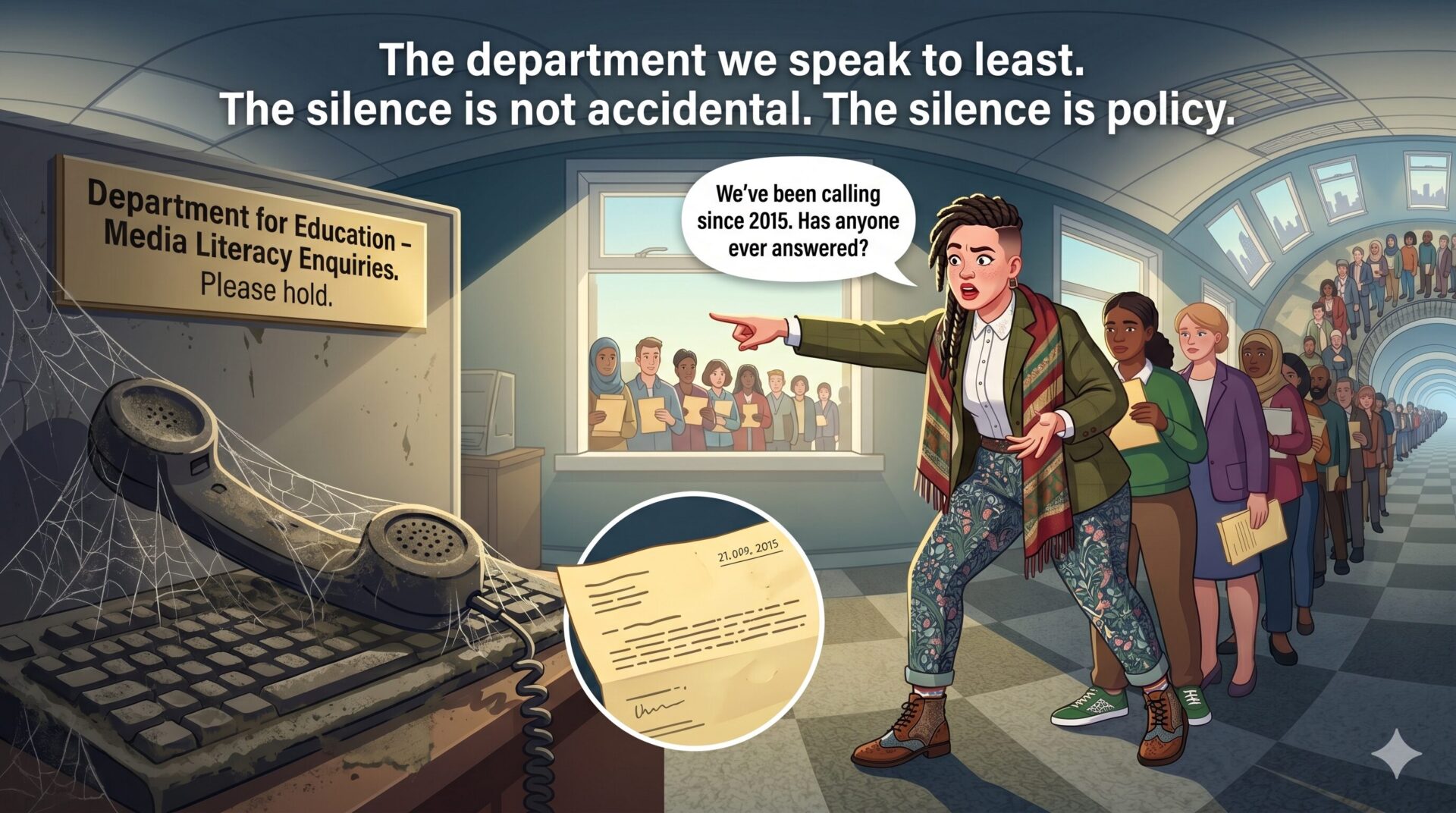
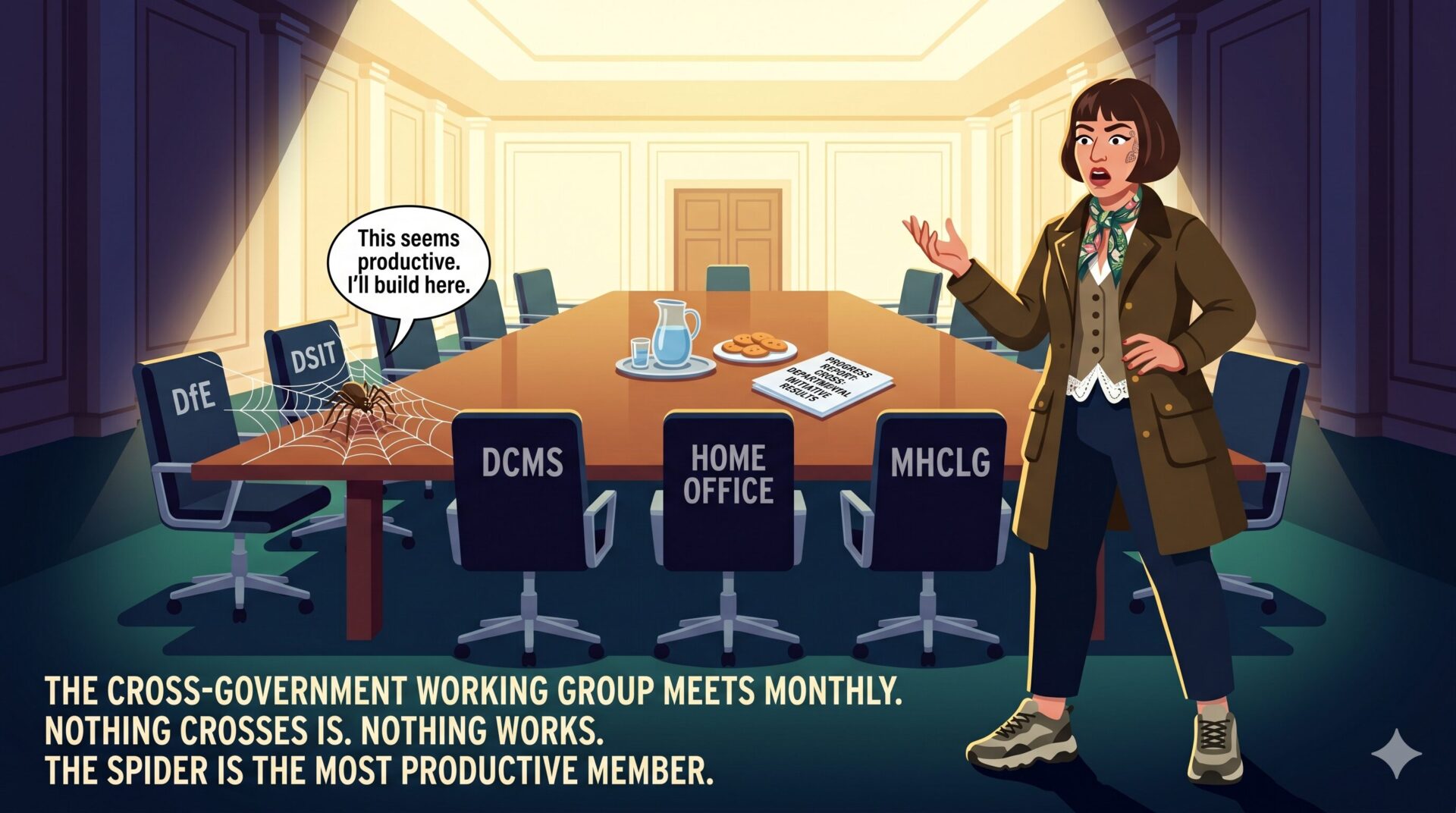
The Two Englands
“The sun never sets on the British Empire” — but these days, it barely rises on British media literacy. Meanwhile, in Helsinki, the sun is shining brightly on a generation that knows how to think.
Let me paint you a picture. Two children. Same continent. Same digital age. Two completely different worlds.
In Helsinki, a ten-year-old girl sits at her desk. It is Tuesday. Not a special Tuesday. Not Safer Internet Day. Not a media literacy awareness week. Just Tuesday. Her history teacher has put a political advertisement on the screen. An old one. From the 1990s. The teacher asks: who made this? The children put up their hands. “The government,” one says. “A political party,” another says. “A group with an agenda,” a third offers. Good, the teacher says. Next question: what do they want you to feel? The children study the advertisement. “Fear,” one says. “Hope,” another says. “Anger at the other side,” a third says. Good, the teacher says. Next question: what have they left out? The children look closer. “They don’t mention the cost,” one notices. “They don’t show the opposition’s argument,” another adds. “They don’t tell you who paid for the advertisement,” a third says. Excellent, the teacher says. The lesson moves on. This is not special. This is just Tuesday.
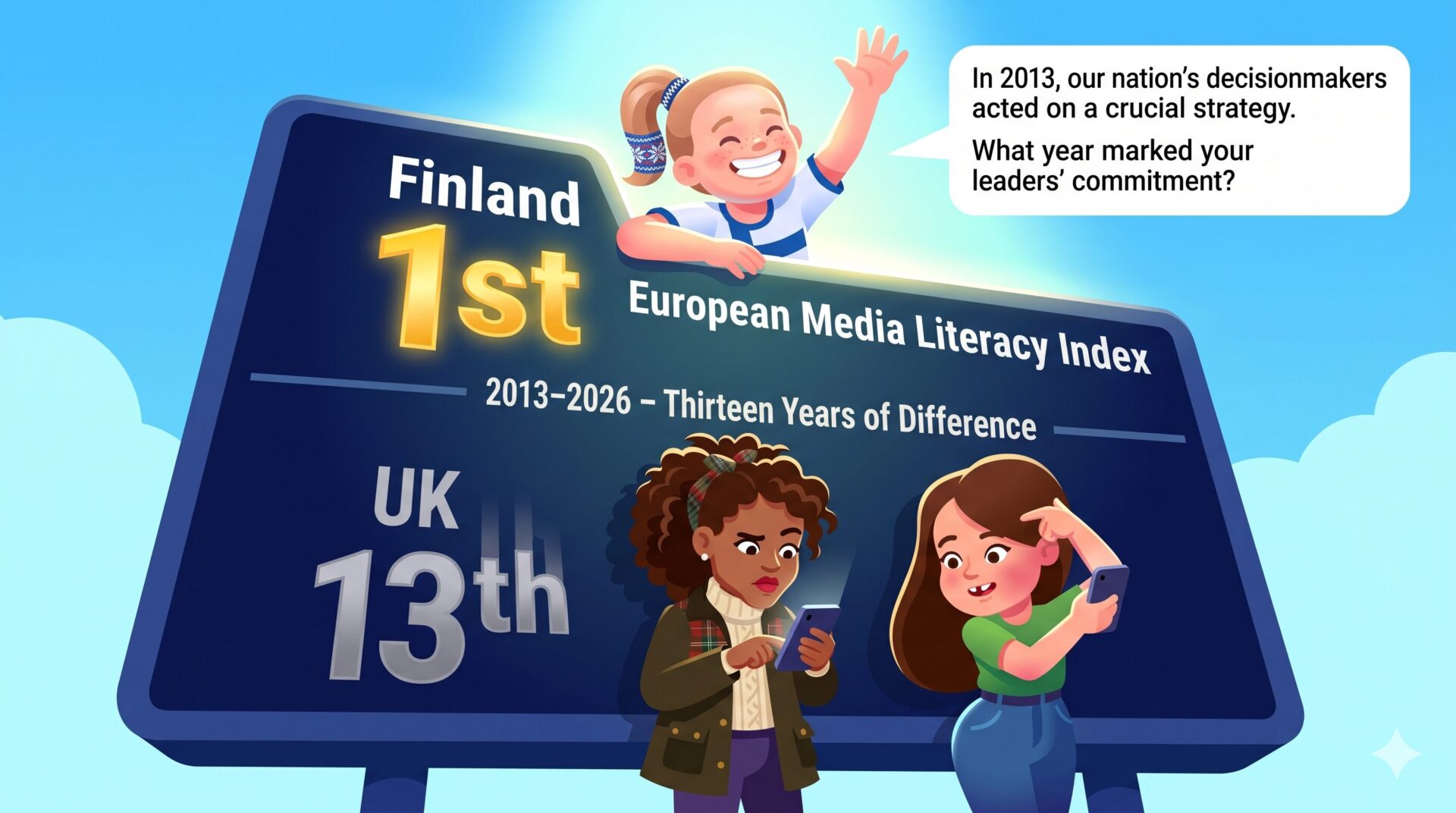 Three thousand miles away, in a school in the West Midlands, a fifteen-year-old boy sits at his desk. His teacher has been told to “cover online safety” in form time. She has no training. No resources. No time. She found a ten-minute video from Safer Internet Day. She presses play. The boy is not watching. He has his phone under the desk. He is scrolling TikTok. He has already seen four extremist videos this morning. A man with a perfect jawline told him that women belong in the kitchen. Another man told him that immigrants are stealing everything. Another man told him that the government is hiding the truth about the economy. Another man told him that the only people he can trust are people like them. The boy believed all of them. No one has ever taught him to ask who made this. No one has ever taught him to ask what they want him to feel. No one has ever taught him to ask what has been left out.
These two children are not different because one is smarter. They are not different because one has better parents. They are not different because one is more virtuous. They are different because of structures. Systems. Choices made by adults who have power and refuse to use it.
Finland chose to teach children how to think. Britain chose to leave them to the algorithm.
“For want of a nail, the shoe was lost” — and for want of a curriculum, a child was lost. For want of a child, a generation is being lost. For want of a generation, a democracy is being lost. Britain is losing its nails. Finland has a full toolbox.
The Ordinary Tuesday
Let me tell you what the Finnish girl’s Tuesday looks like. Not a special day. Not a one-off. Not a pilot. Tuesday.
History lesson: she learns to question sources. Science lesson: she learns to evaluate evidence. Art lesson: she learns to analyse images. Maths lesson: she learns to interpret statistics. Language lesson: she learns to detect bias. Every lesson. Every teacher. Every day.
She does not know she is learning media literacy. She thinks she is learning history, science, art, maths, language. She is. She is also learning to think. To question. To resist.
By the time she leaves school, she will have thousands of hours of media literacy education. Not in a separate subject. Not in a special programme. In everything. Woven into the fabric of her education. Invisible. Inescapable. Indispensable.
The British boy’s Tuesday is different. His teacher does her best. She shows a video. She talks about online safety. She tells the students not to talk to strangers. She tells them not to share personal information. She tells them to be careful.
She does not teach them to question. She does not teach them to analyse. She does not teach them to resist. She does not teach them because she was not taught. She does not teach them because the curriculum does not require it. She does not teach them because the system has failed her as much as it has failed them.
The boy scrolls. The algorithm teaches. The teacher watches. The system fails.
“A difference which makes no difference is no difference at all” — but this difference makes all the difference. The Finnish girl learns to think. The British boy learns to scroll. The difference is survival.
The Structural Failure
Let me be clear about what is happening. This is not a story about bad teachers. The teacher in the West Midlands is not bad. She is exhausted. She is untrained. She is doing her best with nothing. The problem is not her. The problem is the system that left her alone.
This is not a story about lazy students. The boy scrolling TikTok is not lazy. He is being taught. The algorithm is his teacher. The algorithm teaches him that outrage is truth. That engagement is virtue. That sharing is caring, regardless of accuracy. He is learning. He is just learning the wrong things.
This is a story about structural failure. We built a digital world that rewards outrage. We designed algorithms that amplify falsehood. We handed these tools to children and grandparents alike. We told no one how to use them safely. We trained no one to resist. We funded no programme to teach.
Then we blamed individuals for not being “literate” enough to cope. We blamed teachers for not knowing how to teach something they were never trained to teach. We blamed parents for not protecting their children from a machine designed to exploit them. We blamed children for being fooled by a system that fooled everyone.
The structures failed. The people did not fail. The structures were designed by the government. The government failed.
“A bad workman blames his tools” — but the government is not a workman. The government is the one who refused to buy the tools. The government is the one who left the workmen empty-handed. The government is the one who blames the workmen for failing.
The Short-Term Sickness
The phrase that appears again and again in the Parliamentary evidence is “short-term, small-scale.” Short-term pilots. Short-term funding. Short-term thinking. It is the opposite of what media literacy requires.
Media literacy requires sustained, embedded, life-long learning. It requires a curriculum that starts in primary school and continues through secondary. It requires teacher training that is initial and ongoing. It requires resources that are updated as technology evolves. It requires funding that is reliable and predictable.
The government offers three-month stints. Six-month pilots. One-year programmes. Then the funding stops. The evaluation is published. The press release is issued. The government moves on.
One witness put it perfectly: “Three-month stints are not how you solve this problem.” And yet, government after government has reached for the pilot. Because pilots are cheap. Pilots are manageable. Pilots allow ministers to announce something without committing to anything.
Finland does not do pilots. Finland does strategies. Long-term strategies. Strategies that are updated, not replaced. Strategies that outlast governments. Strategies that are funded year after year.
Britain does pilots. Britain does press releases. Britain does photo opportunities. Britain does not do sustained commitment.
“A rolling stone gathers no moss” — and Britain’s media literacy policy is a rolling stone. It moves from department to department. From strategy to strategy. From pilot to pilot. It never settles. It never grows. It gathers no moss. It gathers no results.
The Responsibility Diffusion
The convenient answer is “everyone’s responsibility.” The report says media literacy is “everyone’s business.” This is true. It is also a cop-out. When everyone is responsible, no one is accountable.
The government says the responsibility lies with Ofcom. Ofcom says it is a “convenor-catalyst” — not a deliverer. Platforms say they are doing “their bit” through voluntary programmes. Schools say they are already overstretched. Parents say they don’t know where to start.
Everyone points at everyone else. No one takes ownership. The problem gets worse.
This is the diffusion of responsibility. A classic social psychology phenomenon. The more people who could act, the less likely anyone is to act. Everyone assumes someone else will do it. No one does it.
Finland has no diffusion. Finland has a government that owns the problem. A coordinating agency that leads. A curriculum that requires. Teacher training that embeds. Funding that sustains.
Britain has diffusion. Britain has pointing. Britain has blame. Britain does not have ownership.
Until someone is explicitly, measurably, and publicly accountable for improving media literacy outcomes, the diffusion will continue. The problem will get worse. The algorithm will win.
“Everybody’s business is nobody’s business” — and media literacy is everybody’s business. So it is nobody’s business. The government is nobody. The algorithm is everybody.
The Modest Proposals
The House of Lords Committee made recommendations. They were not radical. They were common sense.
Embed media literacy across the national curriculum. Not as an add-on. Not as an optional module. As a thread running through every subject from early years onwards.
Impose a levy on technology platforms. Fund independent, long-term media literacy initiatives. Remove funding from the whims of corporate philanthropy. Make it a stable, statutory obligation.
Appoint a specific senior minister with responsibility for media literacy across Whitehall. Without a named individual accountable to Parliament, cross-departmental coordination will remain a fiction.
Launch a public awareness campaign with clear, simple messaging. Accompany it with an annual Media Literacy Week and year-round local activity.
Update teacher training. Initial and continuing. Include media literacy. Draw on the expertise of organisations like the BBC and the National Literacy Trust.
These are not radical. They are not socialist. They are not even particularly left-wing. They are common sense. They are what works. Finland does them. Canada does them. Ireland does them.
Britain does not do them. The recommendations sit on a minister’s desk. The minister is busy. The minister has other priorities. The minister will get to it eventually.
The algorithm is not waiting. The algorithm is teaching. The algorithm is winning.
“A stitch in time saves nine” — but the government is not stitching. The recommendations are the thread. The minister’s desk is where thread goes to die.
The Bottom Line
The Netflix drama Adolescence shocked millions of parents. They realised how little they know about what their children consume online. They panicked. They asked questions. They demanded action.
The Southport riots demonstrated how quickly misinformation can spiral into violence. Lies spread faster than truth. Fear spread faster than facts. Communities were terrorised. People were hurt. Democracy was damaged.
The rise of generative AI has made it possible to fabricate anything. A politician speaking. A celebrity endorsing. A disaster unfolding. With a few clicks and a decent laptop. The fakes are indistinguishable from the real. The truth is impossible to verify. The trust is impossible to restore.
We are not preparing citizens for the world they actually inhabit. We are preparing them for the world of 2015. When “online safety” meant not talking to strangers. When “fake news” was a punchline. When the algorithm was still learning.
The algorithm has learned. The world has changed. The preparation has not.
Media literacy is not a nice-to-have. It is not a soft skill. It is the firewall between an informed citizenry and a manipulable one. Between democracy and demagoguery. Between a shared reality and a thousand conflicting, algorithmically optimised delusions.
The question is not whether Britain can afford to invest in media literacy. The question is whether Britain can afford not to. On current evidence, the answer is starting to look very dangerous indeed.
“The price of apathy towards public affairs is to be ruled by evil men.” Plato did not say that. The fact that the quote is apocryphal, endlessly shared as if genuine, proves the point. We cannot even agree on who said what about democracy. In that confusion, something precious is being lost.
The Final Question
The Finnish girl will grow up. She will vote. She will work. She will parent. She will navigate the digital world with a toolkit of questions. Who made this? What do they want me to feel? What have they left out? She will not be immune to misinformation. No one is immune. She will be resistant. She will be resilient. She will be harder to fool.
The British boy will also grow up. He will vote. He will work. He will parent. He will navigate the digital world with nothing. No toolkit. No questions. No defence. He will be fooled. He will be manipulated. He will be radicalised. He will not know it. He will think he is thinking for himself. He will be thinking what the algorithm wants him to think.
These two children are not different because one is better. They are different because of choices made by adults with power. Finland chose to prepare its children. Britain chose not to.
The question is not whether we can afford to change. The question is whether we can afford not to. The answer is that we cannot afford not to. The answer is that we will anyway. Because change is hard. Because change is expensive. Because change requires admitting that we were wrong.
The government was wrong. The government is still wrong. The government will continue to be wrong.
The Finnish girl will be fine. The British boy will not. The algorithm will make sure of it.
“The only thing necessary for the triumph of evil is that good men should do nothing” — and the government is doing nothing. The teacher is doing her best. The boy is scrolling. The algorithm is teaching. The evil is winning.
The Finnish girl asks questions. The British boy scrolls. The difference is not intelligence. The difference is structure. The difference is choice. The difference is a government that chose to act and a government that chose not to.
Finland chose. Britain did not. The children will live with the consequences. So will the democracy. So will the future.
Question the next video you share. Ask where it came from. Ask what it wants you to feel. Ask what has been left out. If you cannot answer those questions, do not hit share.
That small act. That pause. That question. That is media literacy. That is the firewall. That is the only thing standing between us and the abyss.
The Finnish girl does it every day. The British boy has never been taught.
The government could teach him. The government chooses not to.
The abyss is waiting. The government is watching. The algorithm is pushing.
The Finnish girl is standing firm. The British boy is falling.
“The fall of a single leaf signals autumn for the whole forest” — and the British boy is falling. The forest is turning. The winter is coming. The government is not planting new trees.
Media literacy3 Media literacy2 Media literacy

- The Great Media Literacy Delusion: Why Britain Is Failing the Digital Truth Test - 15 June 2026
- The Battle for the Airwaves: How Britain’s Media Bill Will Shape What You Watch and Hear - 15 June 2026
- The Great Geopolitical Pantomime: How Fear Sells and Empires Dream – A Cockney Take on Doom Prophets - 28 May 2026