The Doom Prophet’s Playbook: Why Fear Sells and the Working Class Pays the Price
By Joram Abbas
There’s a saying my old nan used to trot out whenever the telly news got too dramatic: “A man who tells you the world is ending is either a madman or a merchant. The merchant always asks for your address.”
I‘ve been thinking about that a lot lately. You see, I’ve spent the past few weeks deep in the bowels of YouTube, watching a particular breed of content that’s been booming like a dodgy firework display. It’s the geopolitical doom prophet. Tweed jacket, laser pointer, chess pieces, maps with arrows. They tell you World War III is ninety percent certain. They warn of a draft, AI surveillance, starvation sieges, and the collapse of empires. They drop code names like “Operation Southern Spear” and talk about shadow fleets and petrodollar Ponzi schemes.
And then, right at the end, they ask for your credit card details.
 Now, I’m not a conspiracy theorist. I’m a journalist. I have spent twenty years in this profession, progressing from an independent Autonomous news media outlet to the national desks, and I’ve learned one thing: follow the money. The professor’s money trail leads to a subscription button, an “inner circle,” and a YouTube algorithm that rewards fear with engagement. It’s not a conspiracy. It’s a business model. And it’s a bloody dangerous one.
The Performance of Certainty
Let’s be honest about what we’re watching. The chess pieces, the maps, the confident delivery, the references to obscure documents – it’s all performance. It’s designed to make you feel like you’re sitting in a university seminar, rather than watching content designed to keep you scared and engaged.
The professor is very good at this. He’s clearly intelligent, well-read, and genuinely knowledgeable about certain topics. That’s what makes him dangerous – he uses real expertise to sell nonsense, like a chef using good ingredients to poison the soup.
He’s not lying about everything. He’s not stupid. He’s just chosen a lane – the lane of prophecy – because prophecy pays better than analysis. Analysis is tentative. Prophecy is certain. Certainty gets clicks. Tentativeness does not.
The Missing Class
Here’s the thing the professor never mentions. Not once. Class.
Not once does he talk about the fundamental conflict between those who own the means of production and those who sell their labour to survive. Not once does he suggest that the solution to endless war isn’t better predictions about where the next war will be – but organising to refuse to fight in any of them.
The working class – whether in London, Tehran, Moscow, or Beijing – has far more in common with each other than with the billionaires who send them to die. The pensioner in Donetsk and the pensioner in Detroit both got sold out by the same system. The youth in Paris and the youth in Lagos both face the same precarious future.
But you won’t hear that in these videos. Because international working-class solidarity doesn’t get clicks. It doesn’t sell subscriptions. And crucially, it doesn’t serve the interests of the people who actually control the platforms these videos are distributed on.
The Propaganda of Prophecy
What we’re really dealing with here is a very sophisticated form of disempowerment dressed up as empowerment. The professor gives you knowledge – maps, strategies, predictions. He makes you feel like you’re in on the secret. But the secret he’s giving you is that you’re powerless.
The message – repeated over and over – is that massive forces are at play, that war is inevitable, that the system is all-powerful, and that all you can do is hunker down, love your family, and wait for the collapse.
This is the opposite of organising. This is the opposite of resistance. This is telling working people that they’re spectators in a game played by masters they’ll never understand.
That’s precisely what the ruling class wants you to believe. Because if you believe the situation is hopeless, you won’t organise. If you believe war is inevitable, you won’t resist conscription. If you believe AI control is coming regardless, you won’t fight for digital rights. If you believe the collapse is coming, you won’t build the alternatives.
The professor isn’t a prophet. He’s a particularly effective salesperson for learned helplessness.
The British Context
For a British audience, this stuff hits different. We’ve got our own history of being dragged into American wars. Korea, Vietnam, Iraq, Afghanistan. We’ve got our own military-industrial complex – BAE Systems, Rolls-Royce, Babcock, the whole grisly lot. We’ve got our own politicians, from Blair to Cameron to Sunak, who’ve been desperate to prove they’re still relevant on the world stage.
And we’ve got our own version of this doom-porn industry. Commentators who make a living telling us how terrible everything is, how powerless we are, how only they have the secret knowledge to understand what’s really going on.
 The result is a population that’s simultaneously anxious and passive. Worried about the future but convinced nothing can be done. Full of opinions about geopolitics, but disconnected from any actual political organising.
It’s the perfect arrangement for those in power. A fearful population is a manageable population.
The Technology of Fear
Let’s talk about the platforms. YouTube’s algorithm doesn’t love the professor. It doesn’t believe his predictions. It just knows that you’ll keep watching. That your fear will keep your finger on the screen. That your anxiety will translate into ad revenue.
The host mentions, almost as a throwaway, that the algorithm recommended the professor’s videos. As if that’s proof. As if a piece of code designed to maximise watch time has somehow become a seal of prophetic approval.
But the algorithm’s goal isn’t truth. It’s not accuracy. It’s engagement. And nothing keeps you watching like fear.
The technology is neutral. The business model is not.
The Journalistic Duty
As a journalist, I have a responsibility. Not to predict the future – I can’t. Not to tell you what to think – I won’t. But to help you see the structure behind the spectacle. To show you that the professor’s predictions are not prophecy. They’re product. And the product is your powerlessness.
I’ve spent my career trying to ask the right questions. Who benefits? Who profits? Who loses? The answer to those questions is almost always the same: the few profit, the many lose, and the system keeps spinning.
The professor has half the diagnosis – the system is rigged, the elite are parasites, empire is crumbling. But he stops there. He never gets to the actual solution, because the actual solution is collective action, and collective action doesn’t make for good content.
What Actually Matters
Here’s what actually matters. Rent is too high. Wages are too low. The NHS is on its knees. The people who own everything are getting richer while the rest of us fight over crumbs. Wars happen because weapons manufacturers need profits and politicians need distractions. AI surveillance happens because corporations want control and governments want compliance.
None of this is mysterious. None of this requires a prophet to explain.
And crucially, all of it can be resisted. Not by watching videos and sharing predictions. But by organising with the people around you – your neighbours, your coworkers, your fellow tenants, your classmates.
The Alternative
The alternative is boring. It’s unglamorous. It won’t get you millions of YouTube views.
It’s building community mutual aid networks. It’s unionising your workplace. It’s tenant organising in your building. It’s supporting refugee solidarity groups. It’s showing up to council meetings. It’s teaching your kids that another world is possible.
It’s recognising that wars aren’t started by shadowy cabals – they’re started by specific politicians with specific backers, and they can be stopped by specific resistance movements.
It’s understanding that AI surveillance doesn’t just happen – it’s implemented by governments responding to corporate pressure, and it can be resisted through collective action.
It’s knowing that the draft – if it ever comes – only works if people refuse to fight.
The Final Word
The professor’s predictions might come true, or they might not. Wars might happen or they might not. Empires might collapse, or they might not. But none of that is the point. The point is what we do while we’re here – whether we organise or whether we watch, whether we resist or whether we predict, whether we build or whether we despair.
The real question isn’t whether World War III is coming. It’s whether we’re going to let the people who profit from war keep calling the shots. Whether we’re going to let fear keep us isolated and passive. Whether we’re going to keep watching prophets predict our doom instead of building the world we actually want.
That’s not a question the professor can answer for you. And that’s the point.
Choose building. Choose organising. Choose each other.
And leave the prophecies to the prophets. They’ve got subscriptions to sell. You’ve got a world to win.
Joram Abbas is a media commentator based in London. This article is part of a series on the political economy of fear.
The professor never names them. Never points a finger at a specific director, a specific company, a specific piece of legislation they bought. Because once you start naming names, you stop being a mysterious oracle and start being a journalist – and journalists can be sued. Prophets just get more subscribers.
Forty Points of Contention: Pulling Apart the Prophecy Machine
1.The Self-Made Prophet Myth: Why Every Broken Clock Is Right Twice a Day
Let’s start with a proper cockney saying: “Even a stopped clock tells the right time twice a day.” And let me tell you, our professor friend isn’t just stopped – he’s been sitting in the bottom of a skip in Walthamstow since 1987, and he’s still claiming he can predict the sunrise.
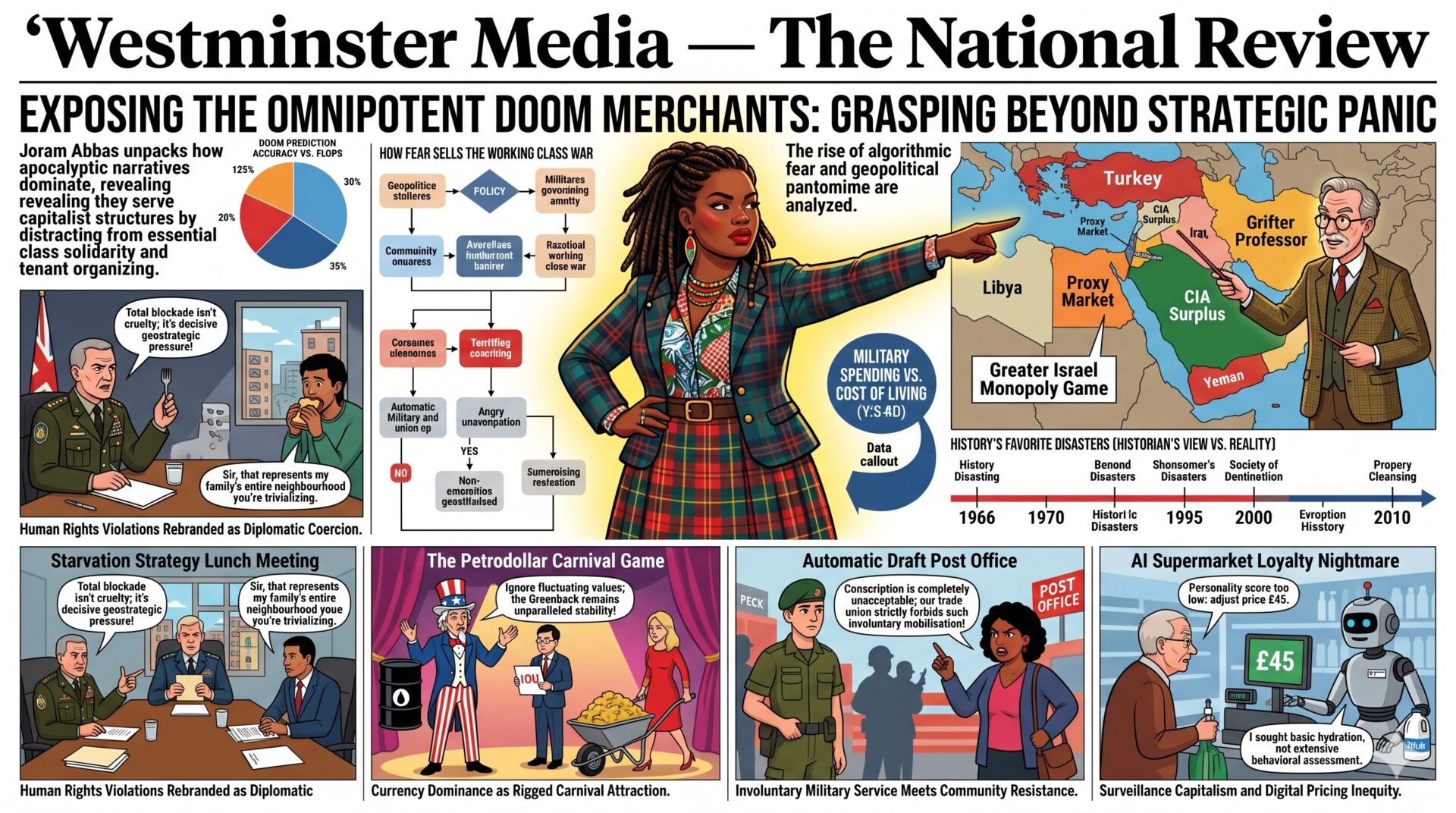 The way they frame this bloke – “He predicted Trump would win! He predicted war with Iran! He saw it all coming!” — it’s like watching a magician pull a rabbit out of a hat, then ignoring the fifteen dead rabbits under the table. The trick isn’t that he got some things right. The trick is making you forget all the things he got wrong.
The Pub Test
Picture this. You’re in The King’s Head, Bethnal Green, on a sticky Tuesday night. A geezer at the bar tells you he’s got a system for the horses. He shows you yesterday’s winners – three of them, all at decent odds. “See?” he says. “I’m a genius.” But you notice he doesn’t mention the eleven losers. You notice he doesn’t show you his betting slip. You notice he’s wearing a tracksuit that’s seen better days, and his trainers have holes in them.
That’s our professor. He’s showing you the winners and hiding the rest. And here’s the kicker – even the “winners” aren’t as clean as they look.
The Three Predictions That Came “Perfectly True”
Let’s have a butcher’s at his three big calls. First, Trump would win in November 2024. Right, well done. But what were the odds? Anyone who’d been watching American politics knew Biden was on his last legs, the Democrats were in disarray, and Trump had a solid base. It wasn’t exactly predicting a snowstorm in July. It was looking at a grey sky and saying “might rain.”
Second, Trump would start a war with Iran. This is where it gets slippery. Define “war.” A few airstrikes? A naval blockade? A full-scale invasion with ground troops? The professor leaves it vague on purpose. If nothing happens, he can say, “well, I meant a trade war.” If a single drone gets shot down, he can claim victory. It’s the fortune teller’s favourite trick – be specific enough to sound clever, vague enough to never be wrong.
Third, the US would lose this war. Notice the tense – it’s future. Even in the material we’ve got, the war isn’t over. It’s still “unfolding.” So this prediction is unfalsifiable. If America pulls out tomorrow, he was right. If America stays for twenty years, he can say, “the loss is still coming.” It’s like betting on a horse race that never ends.
The Hundred Predictions You Never Heard
This is the bit they don’t show you in the highlight reel. The professor has been making videos for a while – 146 of them, the host mentions. That’s a lot of airtime. In those hours, he’s made dozens of claims about specific events, specific dates, specific outcomes. Most of them have come and gone without comment.
Did he predict the exact date of the Iranian war? Probably not, or they’d have mentioned it. Did he predict the midterm results? The market crashes? The natural disasters? The royal scandals? Who knows? Because when a prediction fails, it just disappears. No follow-up video titled “Oops, I Was Wrong About That One.” No apology to the subscribers who rearranged their lives based on his wisdom.
 This is called “survivorship bias” in the trade. You only hear about the prophecies that survived. The corpses get buried in a digital shallow grave, and the professor moves on to next week’s doom.
The Spaghetti Plasterer
Like I said – throwing spaghetti at the wall and claiming you’re a plasterer. A real plasterer knows how to mix the plaster, how to spread it even, how to make a wall smooth. A real forecaster knows how to weigh probabilities, how to account for uncertainty, how to say “I don’t know.”
Our professor does none of that. He throws a handful of predictions – some vague, some bold, some recycled from think tank reports – and whatever sticks, he points to triumphantly. Whatever slides down the wall, he pretends he never threw it.
The Confirmation Bias Trap
Here’s what’s really happening in your brain when you watch this stuff. You’re already worried about the world. You already suspect the worst. You already think the elites are crooked, and the system is rigged. So when someone comes along and confirms all your suspicions, you feel a rush of validation. See? I was right to be scared. I was right to distrust. I was right to feel powerless.
That’s confirmation bias doing its dirty work. You’re not evaluating the evidence – you’re looking for evidence that matches what you already believe. And the professor is happy to sell it to you by the bucket load.
But ask yourself this. If he’s so accurate, why isn’t he running a hedge fund? Why isn’t he advising the Pentagon? Why is he on YouTube, asking for subscriptions? Because if you could really predict geopolitical events with 80-90% accuracy, you’d be the most valuable person on the planet. You wouldn’t need to beg for clicks. You’d be on a yacht in the Med, sipping something expensive.
The Missing Track Record
They never give you the full track record. They never say: “In 2023, Professor X made 47 specific predictions. 32 were wrong, 10 were too vague to judge, 3 were obvious, and 2 were genuinely impressive.” That would kill the magic. That would turn a prophet into a punter.
Real forecasters – the boring ones who work for insurance companies and climate institutes – keep detailed records of their successes and failures. They publish their methodologies. They invite criticism. They update their models when they’re wrong.
Our professor does none of that. Because his model isn’t a model. It’s a performance. And the performance relies on you not asking too many questions.
The Cockney Philosophy of Prediction
My old nan used to say: “If you’re going to be a forecaster, be a weather forecaster. At least when you’re wrong, it’s just a bit of rain.” But these geopolitical prophets – they’re not predicting rain. They’re predicting floods, fires, and the end of civilisation. When they’re wrong, nobody notices. When they’re even slightly right, they’re hailed as visionaries.
It’s a rigged game. And the house always wins.
The Problem with “Cracking the Code”
They say this professor has “cracked the code” of geopolitics. Cracked the code. Like it’s a sudoku puzzle or a cryptic crossword. Like centuries of history, economics, psychology, and plain old luck can be reduced to a set of rules that one clever bloke has figured out.
That’s not just arrogant. It’s dangerous. Because once you believe someone has cracked the code, you stop thinking for yourself. You stop questioning their assumptions. You stop looking for evidence that contradicts their narrative. You become a passenger, not a participant.
 And that’s precisely where the ruling class wants you. Passive. Compliant. Waiting for the prophet to tell you what happens next.
The Real Code
Here’s the real code, and it’s not complicated. Powerful people do what’s in their interest. Working people get shafted. Wars happen when they’re profitable. The media amplifies fear because fear sells. And every once in a while, someone comes along to tell you they’ve got it all figured out – for a small fee.
That’s not a code. It’s just the human condition, dressed up in a tweed jacket.
The Lesson from Bethnal Green
Back to The King’s Head. The geezer with the horse system is still at the bar, still telling anyone who’ll listen about his winners. But the regulars have stopped listening. They’ve seen him lose his shirt too many times. They know that for every winner he shouts about, there’s a loser he’s forgotten to mention.
Be like the regulars. When someone tells you they’ve cracked the code, ask to see the full ledger. Ask about the predictions that failed. Ask why, if they’re so clever, they’re still begging for your attention.
Because if a stopped clock is right twice a day, a stopped prophet is right just often enough to keep you watching. And that’s not prophecy. That’s a business model.
2.The Convenient Timeline: How Yesterday’s News Becomes Tomorrow’s Panic
There’s an old cockney saying that’s served Londoners well since the days of pie and mash: “Never buy a watch from a man who’s late for his own funeral.” The same logic applies to prophets who can’t keep their dates straight. If they can’t get the year right, why trust them with your future?
Let’s have a proper look at this temporal funny business. The material we’re looking at is supposedly set in 2026. Yet, the predictions our professor is so proud of – Trump winning, the war with Iran – are dated 2024. That’s not a small slip. That’s like a train driver claiming he’s on time when he’s pulled into the wrong station two towns over.
The Year That Never Was
Here’s the thing that should make any punter in any boozer from Whitechapel to Woolwich raise an eyebrow. We’re meant to believe that in 2024, our professor made three predictions. Then, in 2026, he’s sitting down to be interviewed about how perfectly they came true. That means those predictions had to have come true in the space between – within the same year, or the year after.
But wars don’t start and finish that quickly. Elections happen on fixed schedules. You can’t predict a 2024 presidential win in 2024 after the fact and call it prophecy. That’s like betting on the Grand National after the horses have crossed the line.
So what’s actually happening here? Either the dates have been fiddled, or the predictions were made earlier and backdated for dramatic effect. Either way, you’re being sold a bill of goods.
The Urgency Trick
This is where the real manipulation lives. By making everything sound immediate – “we’re already in World War III,” “the draft starts in December,” “AI control is coming next week” – the professor creates a perpetual state of emergency. And when you’re in a state of emergency, you don’t ask questions. You don’t check sources. You don’t think about contradictions. You just react.
 It’s the same trick the government uses when they ram through legislation under the cover of a crisis. “There’s no time for debate! We need to act now!” Funny how that always seems to benefit the same people.
The Cockney Test of Time
My old man used to say: “If someone tells you the world’s ending on Thursday, ask them what they’re doing on Friday.” If the professor really believed the apocalypse was imminent, why is he bothering with YouTube subscribers and inner circle memberships? Shouldn’t he be building a bunker and stocking up on tinned beans?
The answer is simple. He doesn’t believe it, either. But he knows you might. And as long as you’re scared, as long as you’re time-sensitive, as long as you’re convinced that tomorrow might be too late – you’ll keep watching, keep sharing, keep subscribing.
The Floating Timeline
Notice how the specific dates are always sliding. Is the war starting in February? March? No one knows. Is the draft happening this December or next? Does “starting in December” mean December 2025 or December 2026? The professor never ties himself down, because the moment he does, you can check.
 This is what I call the “floating timeline” – a classic technique of doomsayers throughout history. You keep the end just far enough away that it never arrives, but close enough that it always feels threatening. The Jehovah’s Witnesses have been doing it for generations. The difference is they don’t charge a subscription.
A Brief History of False Urgency
Let’s take a stroll down memory lane, shall we? In 2012, the world was supposed to end according to the Mayan calendar. Didn’t happen. In 2000, Y2K was going to crash every computer on the planet. Didn’t happen. In the 1980s, nuclear war with the Soviet Union was “inevitable.” Didn’t happen.
Every single time, someone made money from the fear. Book sales. Documentary rights. Emergency supplies. Survivalist courses. And every single time, when the date passed and nothing happened, the prophets just moved the goalposts. “Oh, we miscalculated. It’s next year now.”
Our professor is doing the same thing, but with geopolitics instead of scripture. The medium has changed. The con hasn’t.
The Real Purpose of Urgency
Here’s what the urgency is really for. It’s not to warn you. It’s to stop you from thinking.
When you’re calm, you can see the contradictions. You can ask why, if America is losing the war, the professor also says the war is going “very well for Trump.” You can wonder how the same system can be both all-powerful and about to collapse. You can notice that his “bankers” never seem to have names or addresses.
But when you’re panicked, you don’t have time for any of that. You just want answers. You just want someone to tell you what to do. And the professor is right there, ready to oblige.
The British Perspective: What’s Really Urgent
While the professor is wittering on about American draft dodging and Iranian mountain fortresses, working people in Britain are dealing with urgent problems that are actually real. The rent’s due on Thursday. The energy bill just went up again. The local A&E has a twelve-hour wait. The school’s asked for another donation for basic supplies.
These are crises. They’re happening now. They don’t need a YouTube prophet to announce them. And they’re not going anywhere, no matter how many predictions about World War III you watch.
 That’s the real trick of the floating timeline. It distracts you from the everyday emergencies that are actually within your power to change. You can’t stop a war with Iran. But you can join a rent strike. You can’t prevent an AI surveillance state. But you can organise against your landlord’s dodgy eviction notice.
The professor doesn’t want you to know that. Because if you focus on what you can actually do, you stop needing him.
The Adage Applied
There’s another saying that fits here: “A lie can run round the world before the truth has got its boots on.” The fake timeline, the manufactured urgency, the false predictions – they spread like wildfire because fear travels faster than fact. By the time someone points out that the dates don’t add up, you’ve already clicked, shared, and subscribed.
The professor knows this. He’s counting on it. He’s not worried about being caught out, because by the time you notice the discrepancy, he’s already moved on to next week’s scare.
The Cockney Verdict
So let’s sum up, in proper London style. This bloke is selling you a watch that doesn’t work. He’s telling you it’s five minutes to midnight, but he can’t tell you what year it is. He’s got you running scared of a fire that might not exist, while the chips are burning on your own plate.
 The convenient timeline isn’t a mistake. It’s a feature. It’s what keeps you off balance, keeps you hungry for more, keeps you coming back to check if the world has ended yet.
And here’s the punchline. The world won’t end on his schedule. It’ll just keep plodding along, same as it always has, while the professor counts his subscription money and you count your lost hours.
Don’t be the mug who buys a broken watch from a man who’s late for his own funeral. Check the time yourself. Look out the window. Ask your neighbour what day it is. And remember – if it sounds too urgent to be true, it probably isn’t true at all.
3.Trump’s Third Term Fantasy: The King Who Forgot He Wasn’t a Monarch
There’s a old saying that’s been doing the rounds in London boozers since the days of costermongers and pearly kings: “Every man thinks his own geese are swans.” Our professor clearly thinks Donald Trump is a swan – a majestic creature destined to rule beyond the limits mere mortals must obey. But let me tell you, from where I’m sat in this Peckham flat, that goose looks suspiciously like a duck that’s been left out in the rain.
The professor claims Trump can wangle a third term through some constitutional loophole. Either he runs as vice president to his son Don Jr. and the son abdicates, or he uses “emergency war powers” to suspend the election altogether. Sounds dramatic, doesn’t it? Sounds like the kind of thing that would get your blood up and your finger hovering over the subscribe button.
But let’s have a proper think about this, shall we? Because the more you turn it over, the more it smells like three-day-old jellied eels.
The Rulebook That Even the Rich Won’t Tear Up
Here’s the first problem. The American ruling class might be a collection of greedy, warmongering parasites, but they’re not stupid. They know that the game only works if everyone plays by roughly the same rules. Not the rules for thee and not for me – they’ve got plenty of those already. But the big ones. The ones that keep the whole circus from collapsing into a knife fight.
 The two-term limit isn’t some minor bit of red tape. It’s the punctuation mark at the end of their civil religion. George Washington walked away from power when he could have been king. That story – however mythologised, however sanitised – is the foundation stone of their whole political identity. Throw that away, and what have you got? A banana republic with better branding.
Even the billionaires know that. Even the generals know that. Even the Supreme Court justices that Trump appointed know that. Because the moment you allow one president to tear up the constitution for a third term, you’ve given every future president permission to do the same. And that’s not a dictatorship – that’s a civil war with nicer suits.
The Son Also Rises (Into Fantasy)
The second loophole – the Don Jr. gambit – is even more laughable. The idea that a bloke who’s spent his whole life trading on his father’s name and being laughed at on late-night telly would suddenly run for president, win, and then immediately hand the keys back to dear old dad? It’s like something out of a bad soap opera.
But let’s pretend it was possible. Let’s pretend the American people – the same American people who just re-elected Trump – would look at that transparent stunt and say, “Seems legit, where do I sign?” They wouldn’t. They’d be out in the streets before the ink was dry on the ballot papers. And not the nice, organised protests with permits and portaloos. The kind of protests that involve broken windows and burning cars.
 The professor forgets that ordinary people, for all their powerlessness, still have a breaking point. And a president openly stealing a third term through a family member would be that breaking point for millions. Not because they love the constitution. But because they hate being taken for mugs.
Emergency War Powers: The Nuclear Option That Never Goes Off
Now we get to the professor’s favourite scare – emergency powers. “The president now has emergency war powers and can suspend the constitution and delay the election.” Just like Zelensky did in Ukraine, he says. As if Ukraine under Russian invasion is the same as America bombing Iran from 5,000 miles away.
Here’s the reality check. Emergency powers exist. They’ve been used before. Lincoln suspended habeas corpus during the Civil War. FDR interned Japanese-Americans during World War II. Bush ran Guantanamo after 9/11. But in every single case, there was a genuine, tangible, immediate threat on American soil. Not a war on the other side of the world that most Americans couldn’t find on a map.
Even if Trump wanted to cancel the 2028 election – and let’s be honest, he’s vain enough to want to – he’d need the military to go along with it. He’d need the state governors to go along with it. He’d need the courts to go along with it. And here’s the thing about the American ruling class: they’ll go along with a lot. But they won’t go along with something that makes their own position unstable.
Because if Trump can cancel an election, so can the next Democrat. And the one after that. And suddenly the whole system of managed democracy that keeps the rich in charge and the rest of us squabbling – that system falls apart. And nobody with a private jet wants that.
The Adage About Kings and Circuses
There’s a proper old saying that fits here like a glove: “Uneasy lies the head that wears a crown.” But Trump’s head isn’t uneasy – it’s thick as a brick. He doesn’t worry about legitimacy or tradition or long-term stability. He worries about ratings, revenge, and the next rally.
That’s why the professor’s prediction is so tempting. It takes Trump’s obvious narcissism and projects it onto the entire American system. “He wants it, so it must be possible.” But wanting and getting are two very different things, especially when the people who actually hold the power have their own wants – and those wants don’t include a permanent Trump.
The Cockney Guide to American Politics
Allow me to explain it the way my nan would have explained it over a cuppa and a custard cream. America isn’t a democracy. It’s a duopoly – two teams of rich blokes taking turns to be in charge while the real decision-makers (the bankers, the arms dealers, the oil men) stay in the background. Both teams hate each other. But they hate the idea of the game ending even more.
Trump getting a third term wouldn’t be a victory for one team. It would be the other team getting smashed over the head with a bar stool and told to sod off permanently. And the other team – the Democrats, the media, the permanent bureaucracy – they’re not going to just accept that. They’ve got their own power, their own money, their own armies of lawyers and lobbyists and think-tank wonks.
So what happens then? Not a smooth transfer of power. A constitutional crisis. A standoff. Possibly, the thing the professor claims to fear most – civil war. But here’s the twist. In that civil war, the professor’s beloved Trump might not win. Because the other side has just as many guns, just as much money, and just as little regard for working people.
The Real Purpose of the Fantasy
So why does the professor push this nonsense? Why tell a frightened public that Trump could be president for life? Because it serves the same purpose as all his other predictions – it makes you feel powerless. It makes you feel like the game is rigged beyond repair. It makes you feel like resistance is futile.
 If Trump can just tear up the constitution whenever he feels like it, what’s the point of organising? What’s the point of voting, protesting, striking? The system is broken, the bad guys have already won, and all you can do is watch the prophet explain how it happened.
That’s the poison. That’s the real con. Not the prediction itself – which is almost certainly bollocks – but the despair it breeds.
The Alternative Ending
Here’s what the professor won’t tell you. Even if Trump tried to grab a third term, even if he used every trick in the book, even if the Supreme Court looked the other way – ordinary people have stopped dictators before. Not with predictions. Not with subscriptions. With their feet, their hands, their refusal to cooperate.
When the trains don’t run because the drivers are on strike. When the ports shut down because the dockworkers walked out. When the soldiers refuse to fire because their mums said no. That’s real power. That’s the power the professor ignores because it doesn’t fit his script.
The Cockney Verdict
So here’s the bottom line, from a geezer who’s seen a few things. Trump won’t get a third term. Not because the constitution is sacred. Not because the courts will stop him. But because the people who actually run America – the ones with the real money, the real guns, the real control – they don’t trust him enough to let him break the only rules that keep them on top.
He’s useful to them as long as he stays in his lane. Start a war, cut some taxes, appoint some judges – fine. Tear up the whole system so that any madman can do the same – not fine.
The professor is selling you a fantasy because reality is too boring and too complicated. But don’t buy it. Keep your eyes open. Watch what they do, not what they say. And remember the old adage one more time: “Even a stopped clock tells the right time twice a day.” The professor’s stopped clock might be right about some things. But this isn’t one of them.
4.The Draft Scare: How a Whisper Becomes a Scream
There’s a saying that’s served Londoners well since the Blitz: “Don’t panic, but don’t be a mug either.” When someone tells you your son’s about to be shipped off to fight in a foreign war, your first instinct is to panic. And that’s precisely what the professor is counting on.
“Starting in December, you’ll be automatically registered for the draft.” He says it like he’s reading the morning news. Like it’s a done deal. Like the law’s already been signed, and the transport planes are warming up on the tarmac. But let’s have a proper butcher’s at this claim, shall we? Because when you scratch the surface, what you find isn’t a draft notice – it’s a magician’s sleeve full of smoke and mirrors.
The Missing Law
The professor never gives you a bill number. Never names the act of parliament or congressional statute. Never points to a government website where you can read the fine print. He just says, “they passed a law” and moves on, trusting that you’re too scared to ask for the receipt.
Now, I’m not saying there aren’t discussions about conscription happening in Washington backrooms. There are always discussions. Think tanks churn out papers on manpower shortages. Generals grumble about recruitment numbers. Defence contractors dream of endless wars with endless bodies to throw at them. But a discussion isn’t a law. A think tank paper isn’t a draft notice nailed to your front door.
 The professor knows this. He also knows that you don’t know this. He’s counting on the fact that most people can’t tell you the difference between a House resolution and a Senate bill, between a committee report and an executive order. So he uses the fog of procedure to hide the lack of substance.
The Cockney Test of Evidence
My old nan used to say: “If it doesn’t have a date, a name, and a signature, it’s just hot air.” The professor’s draft law has none of those. No date – just “December.” Not even which December. No name – no senator, no congressman, no president who signed it. No signature – no official seal, no gazette publication.
Hot air. And expensive hot air at that, because you’re paying for it with your attention, your fear, and eventually, your subscription fee.
The Parent’s Nightmare
Here’s why this particular scare is so effective. Every parent, every grandparent, every aunt and uncle who’s got a lad between 18 and 25 – they’ve all had the nightmare. The knock on the door. The official envelope. The bus to the barracks. It’s been in our collective memory since the First World War, since the Somme, since Passchendaele. It’s the fear that never really goes away.
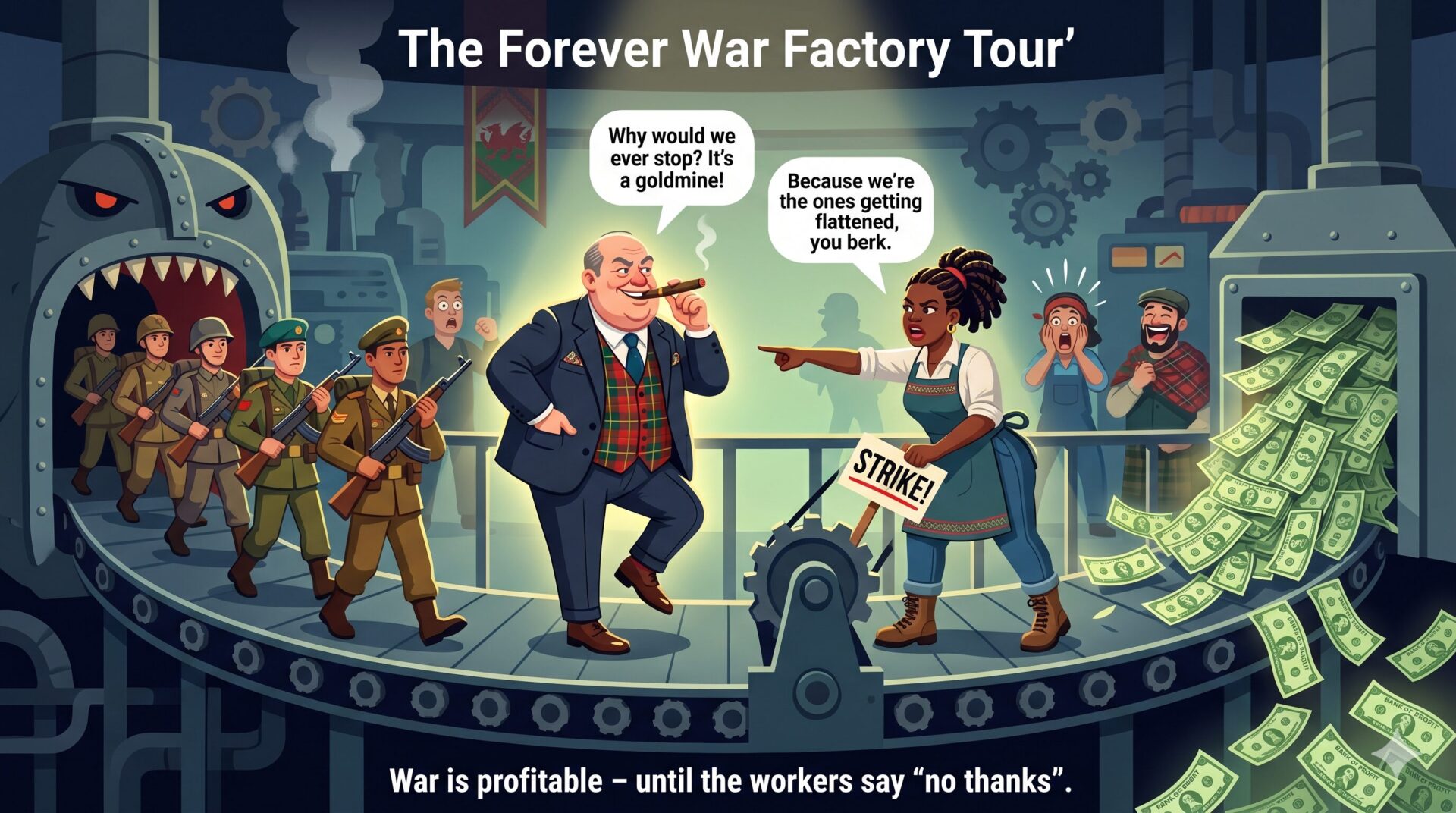 The professor doesn’t need to prove his claim. He just needs to touch that nerve. And once he’s touched it, you’re not thinking straight. You’re not checking sources. You’re not asking for evidence. You’re just feeling your stomach drop and your hand reach for the subscribe button, because maybe – just maybe – he’ll tell you how to save your boy.
That’s the real cruelty of it. Using genuine human fear as a marketing tool.
The British Perspective: Conscription in Context
Let’s have a proper think about conscription in Britain, because the professor is talking about America, but the fear he’s selling travels across the Atlantic just fine. The last time Britain had conscription was the National Service years – 1949 to 1960. That’s over sixty years ago. Your grandad might remember it. You don’t.
 Since then, we’ve fought wars in the Falklands, Iraq, Afghanistan, Libya. All with volunteer forces. Not once did any government seriously propose bringing back the draft. Not during the worst of the Troubles. Not during the surge in Helmand. Not during the chaos of Iraq.
Why? Because conscription would be political suicide, that’s why. The same reason America hasn’t had a draft since Vietnam. Because when you force working-class kids to die for oil company profits, their mums tend to vote. And they tend to vote for whoever promises to bring the boys home.
The Economic Underbelly
Here’s what the professor won’t tell you about the draft. It’s not just about bodies for the battlefield. It’s about labour discipline. A standing volunteer army is expensive – you have to pay market rates, offer benefits, compete with civilian employers. But a conscript army? You can pay them peanuts. You can treat them like dirt. You can work them until they break.
The ruling class has thought about this. Of course, they have. They think about everything that might cut costs and increase control. But they’ve also done the maths. The political cost of a draft – the protests, the draft dodging, the burned draft cards, the desertions, the mutinies – far outweighs the financial savings.
That’s why they haven’t done it. Not because they’re nice. Because they’re calculating.
The December Deadline That Never Comes
Notice how the professor puts a specific month on it. “Starting in December.” That’s close enough to feel real, far enough away that you can’t check yet. It’s the same trick estate agents use when they say “offers in excess of” – it creates a false sense of urgency without any actual commitment.
What happens when December comes and goes and nobody’s been registered? The professor won’t mention it. He’ll be talking about something else – AI surveillance, North Korean missiles, the collapse of the euro. The failed prediction will just disappear into the digital ether, and he’ll never have to explain why his “done deal” turned out to be nothing of the sort.
The Real Draft Nobody Talks About
Here’s the irony that would be funny if it weren’t so tragic. There is a draft, and it’s been running for decades. But it’s not for soldiers. It’s for taxpayers. Every working person in Britain is conscripted into the wage system, forced to labour for someone else’s profit just to keep a roof over their head. Miss your “service” – that is, miss your rent or your mortgage – and see what happens. Bailiffs. Court orders. Eviction. Criminal records.
 That’s the real conscription. The one that keeps the rich rich and the rest of us on the treadmill. The professor won’t talk about that draft, because that draft doesn’t have a dramatic YouTube thumbnail. That draft is just everyday life.
The Adage About Wolves and Warnings
There’s a saying: “The boy who cried wolf eventually got eaten.” But in the professor’s case, the wolf never shows up. Because the wolf isn’t real. The draft is the wolf. The December deadline is the wolf. The emergency war powers are the wolf.
And every time you hear that wolf and nothing happens, you get a little more numb. A little more cynical. A little more willing to believe the next wolf might be real. That’s the addiction. That’s the cycle. And the professor is your dealer.
The Cockney Verdict
So here’s what you do, sitting in your front room in Dagenham or your council flat in Brixton. When someone tells you the draft is coming, ask for the proof. The actual, tangible, checkable proof. Not a confident voice and a laser pointer. A bill number. A signature. A date you can circle on the calendar.
And while you’re waiting for that proof – which will never come – think about the real draft. The one that already has you. The one that takes your labour and gives you back just enough to keep you going. That’s the fight. That’s the organising. That’s the resistance that doesn’t need a prophet to announce it.
Because as my nan also used to say: “Don’t borrow trouble from tomorrow. There’s plenty in today to keep you busy.” The professor wants you worried about a phantom draft next December. The real work is happening right now, in your street, in your workplace, in your community.
Don’t let the wolf distract you from the landlord at the door.
5.Iran as the Invincible Fortress: How Geography Gets Used to Sell Inevitability
There’s a saying that’s been knocking about London market stalls since the days of costermongers and barrow boys: “A bad workman always blames his tools.” Our professor is a bit like that – he blames geography, history, culture, anything except the actual decision-makers. Because once you start blaming the people with the power, you stop sounding like a prophet and start sounding like a politician. And nobody subscribes to politicians.
 Let’s give the devil his due. The professor’s geography lesson isn’t wrong. Iran is mountainous. The Zagros range runs like a spine through the country. Tanks get stuck, supply lines get ambushed, air power struggles against cave complexes and tunnel networks. Any general worth his pay grade knows that invading Iran would be a different beast entirely from rolling across the flat sands of Iraq.
But here’s where the professor’s analysis goes from honest geography to dishonest prophecy. He doesn’t just say, “Iran would be difficult to invade.” He says America had to invade, had no choice, that losing Iran would mean losing the empire, the dollar, the whole shebang. War becomes a force of nature – inevitable, unstoppable, like the tide coming in or the rain falling on a Bank Holiday.
And that, my friends in the boozer, is where the con lives.
The Adage of the Two Doors
My old grandad used to say: “There’s always a choice. Every so often, the choices are both shite, but they’re still choices.” The professor presents a world where America either invades Iran or watches its empire crumble into dust. Two doors, both labelled “Disaster,” and the only question is which disaster you pick.
But what about the third door? The one the professor never mentions? The door marked “Don’t Invade and Figure Something Else Out.” The door that says “Negotiate,” “De-escalate,” “Let the Petrodollar Die and Build Something New.” The door that working people in every country have been trying to open for generations.
That door doesn’t make for good television. It doesn’t produce dramatic predictions. It doesn’t get you invited back on the show. So the professor pretends it doesn’t exist.
The Inevitability Trick
This is one of the oldest tricks in the fearmonger’s handbook. Present a chain of events as inexorable, as natural, as beyond human control. “America had to invade Iran because otherwise China and Russia would team up and build a railway and the dollar would collapse, and the empire would fall.” Each step follows the last like dominoes, and there’s nothing anyone can do to stop it.
Except dominoes don’t have minds of their own. And wars don’t start themselves.
Wars start because specific people in specific rooms make specific decisions. Sometimes those decisions are rational given their interests – and the interests of the ruling class often point towards war, because war is profitable for them. But “rational given their interests” is not the same as “inevitable.” The interests could change. The decision-makers could change. The people could refuse to go along with it.
The professor doesn’t want you to think about any of that. Because if you think about it, you might realise that the same people who decide to start wars are the same people who own the media that the professor appears on. And that would make the professor not an outsider telling uncomfortable truths, but a court jester entertaining the king’s guests.
The Cockney Guide to Mountain Fortresses
Let’s bring this down to street level, shall we? Imagine your local estate. Tower blocks, alleyways, security doors, the odd CCTV camera. Now imagine some outside firm wants to take control – not because they’ve got a beef with you, but because they’ve convinced themselves that if they don’t, your neighbours will turn against them.
 The firm sends in a team. The team gets lost in the alleyways. Their fancy tech doesn’t work around the concrete pillars. The locals know every shortcut, every fire escape, every rooftop route. The firm’s bosses back in the glass tower say, “this is a fortress, we can’t win.”
But here’s the thing. The firm didn’t have to send the team in the first place. They could have talked. They could have left well alone. They could have admitted that their whole strategy was based on a lie. Instead, they chose the invasion, lost, and blamed the fortress.
That’s what the professor is doing. Blaming the mountain for the empire’s arrogance.
The Real Choice That Never Gets Mentioned
Here’s the choice the professor won’t discuss. The people of Iran, the working class, the youth, the women – they’ve been fighting their own battles against their own ruling class for decades. The same mullahs and IRGC commanders that the professor calls “religious zealots” are the ones who crush protests, execute dissidents, and enforce the hijab. They’re not freedom fighters. They’re another set of parasites.
But the American empire isn’t coming to liberate anyone. It’s coming to control oil routes, prop up the dollar, and install a friendly government that will sell out the Iranian people just as badly as the current one does. The choice isn’t “mullahs or Pentagon.” The choice is “both are terrible, so why does either get to decide?”
 That’s the choice the professor can’t see, because his whole framework is built on nation-states as the only players. He can’t imagine a world where ordinary people on both sides of the border refuse to fight and instead figure out how to feed each other, house each other, and tell both sets of rulers to piss off.
The Inevitable War That Never Happened
Let’s have a quick stroll through history, shall we? How many “inevitable” wars have been confidently predicted by clever men in suits, only to fizzle out when cooler heads prevailed? The Cold War was supposed to go hot any day now. The Cuba Missile Crisis was the end of the world. The 1970s oil shocks were going to trigger World War III. The 1990s clash of civilisations was just around the corner. The 2000s War on Terror was supposed to last forever.
Some of these did become wars. Many didn’t. And the ones that did happen – they happened because people with power and profit in mind made them happen. Not because the mountains forced them. Not because the petrodollar left them no choice. Because they wanted to.
The professor confuses “they wanted to” with “they had to.” And that confusion is the difference between analysis and propaganda.
The Adage About the Hammer
There’s a saying: “If the only tool you have is a hammer, every problem looks like a nail.” The professor’s tool is geopolitics – states, strategies, chokepoints, dominoes. So every problem looks like a geopolitical inevitability. War in Iran? Inevitable. Collapse of the dollar? Inevitable. Third term for Trump? Inevitable.
But what if you had different tools? What if you looked at the world through the eyes of a striking docker, a homeless veteran, a mother whose son is about to be drafted, a pensioner who can’t afford heating? Those problems don’t look like nails. They look like a system that’s rigged to break working people in every country.
And the solution isn’t predicting which country gets invaded next. It’s building solidarity across borders so that when one government tries to start a war, workers in every country refuse to supply the weapons, load the ships, or send their kids.
The Cockney Verdict
So here’s the bottom line, from a geezer who’s seen a few invasions on the telly and a few evictions on his own street. Iran might be a fortress. It might be hard to invade. But that doesn’t make invasion inevitable. It makes invasion stupid. And powerful people do stupid things all the time – but they also back down when the cost gets too high.
 The professor wants you to believe the cost is irrelevant, that the empire will destroy itself rather than admit defeat. But empires have admitted defeat before. Vietnam. Afghanistan (twice). Iraq, if you count the withdrawal. Each time, the generals grumbled, the politicians spun, and the working class breathed a sigh of relief because their kids weren’t coming home in boxes.
That’s the real lesson. Not that mountains are invincible. That enough people saying “no” can stop a war. And no mountain, no fortress, no petrodollar, no YouTube prophet can change that.
As my nan used to say: “The tide comes in whether you like it or not. But wars only happen because some bugger starts them.” Don’t confuse the tide with the trigger. And don’t let the professor confuse you, either.
6.The Petrodollar Ponzi Scheme: When a Grain of Truth Becomes a Mountain of Nonsense
There’s an old cockney saying that’s been passed down from barrow boy to barrow boy for generations: “A little bit of truth makes the lie go down easier.” And that’s precisely what our professor does with the petrodollar. He serves you a thimbleful of genuine insight – the dollar system is shaky, American debt is astronomical, empires don’t last forever – and then he pours a gallon of wild speculation on top until you can’t taste the truth anymore.
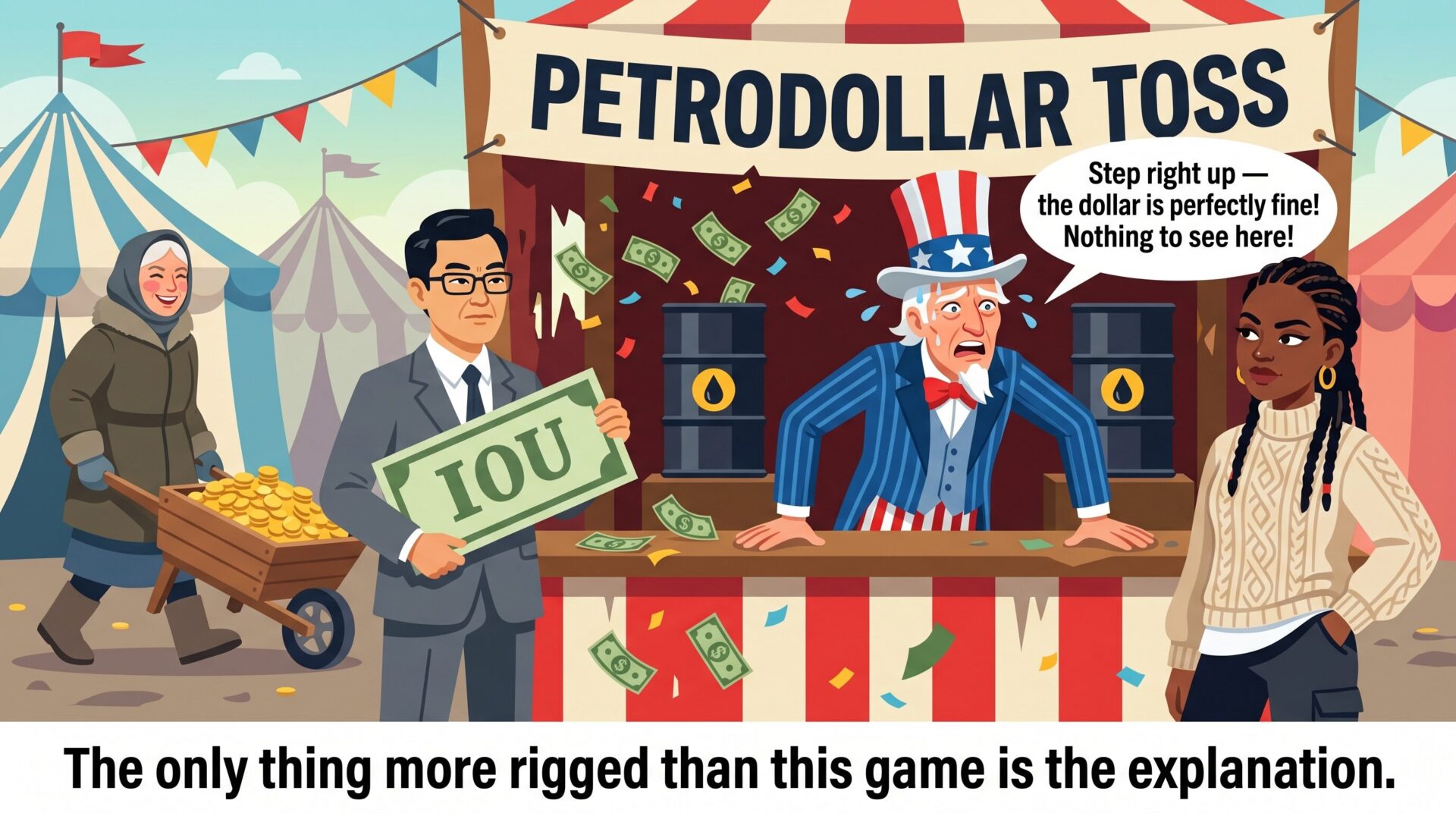 Let’s be straight about this. The professor isn’t wrong about everything. The post-1971 system where the dollar isn’t backed by gold but by Saudi oil and American aircraft carriers – that’s a real thing. The fact that China, Russia, and others are seeking alternatives – that’s real too. The $40 trillion national debt isn’t a figment of anyone’s imagination.
But here’s the rub. A dodgy deck doesn’t mean the whole house is about to collapse. A leaky pipe doesn’t mean the building’s coming down. And a shaky dollar system – one that’s been shaky for fifty years, by the way – doesn’t mean World War III is inevitable next Tuesday.
The Adage of the Boy Who Cried Ponzi
“Even a stopped clock is right twice a day.” The professor has learned to be that stopped clock. He points at the petrodollar and calls it a Ponzi scheme. And you know what? He’s not entirely wrong. A system where new debt pays off old debt, where the whole thing relies on perpetual growth and everyone’s willingness to keep playing – there’s something Ponzi-ish about it.
But here’s what the professor won’t tell you. That’s how all fiat currency works. That’s how the pound works. That’s how the euro works. That’s how every major currency since the end of the gold standard has worked. If calling it a Ponzi scheme makes you feel clever, go ahead. But it doesn’t tell you when it will collapse – or even if it will.
The dollar has been “about to collapse” since 1971. That’s fifty-five years of imminent catastrophe. Meanwhile, working people in London have watched the pound lose 99% of its value since 1914, and somehow the sky hasn’t fallen. Currencies fluctuate. Empires adjust. The rich get richer. The rest of us keep plugging along.
The Cockney Guide to Debt
Allow me to explain debt the way my old gaffer explained it down the Elephant and Castle. You owe the bookie a tenner. That’s debt. He owes the pub landlord a tenner. That’s also debt. The landlord owes the brewery a tenner. Everyone owes everyone else, and somehow the wheels keep turning. One day, the whole thing might come crashing down – but it probably won’t, because everyone’s got a stake in keeping the game going.
The American debt is like that, but with more zeros. China owns trillions in US treasuries. Japan owns trillions. The American pension funds own trillions. If the dollar collapses, everyone loses. Not just Uncle Sam. Everyone.
That’s why the professor’s “inevitable collapse” is so unlikely. Because the people who would have to bring it down – the Chinese, the Japanese, the European central bankers – they’re the same people who would lose their shirts in the process. It’s like setting fire to your own house to collect the insurance, except the fire would also burn down your neighbour’s house, your mate’s house, and the pub on the corner.
The Truth That Gets Buried
Here’s the genuine truth the professor touches before he runs away. The petrodollar system does give America enormous power. The ability to print the world’s reserve currency means you can run deficits that would bankrupt anyone else. It means you can impose sanctions that actually bite. It means you can export your inflation to other countries.
That power is real. And it’s deeply unfair. It’s a structural advantage that working people in Britain, in Europe, in the Global South have to pay for through cheaper exports, financial instability, and the occasional war.
But here’s the thing the professor won’t say. That power is also a trap. Because the more you rely on it, the harder it is to give up. America can’t just decide to stop being the reserve currency. That would mean austerity, recession, a collapse in living standards that would make the 2008 crash look like a mild tumble. So they keep printing, keep borrowing, keep kicking the can down the road.
 The professor calls this a Ponzi scheme. I call it a trap. And the difference matters. Because a trap, you can escape – but only if you’re willing to accept short-term pain for long-term gain. And the American ruling class isn’t willing to accept that pain. So they’ll keep the trap going as long as they can. Which might be longer than you think.
The Cockney Adage About the Second-Hand Car
There’s a saying: “Never buy a second-hand car from a man who tells you it’s perfect.” The professor is that man. He’s telling you the dollar system is a perfect disaster – guaranteed to collapse, guaranteed to trigger World War III, guaranteed to end the American empire in your lifetime.
But a second-hand car with a few dents can still get you to work and back for another ten years. A dollar system with a few cracks can still finance global trade for another generation. The professor wants you to believe the wheels are about to fall off. The truth is they might not. And even if they do, the car might keep rolling on the rims for a good long while.
The House of Cards Metaphor
The professor loves the phrase “house of cards.” It’s dramatic. It conjures images of a single sneeze bringing down the whole thing. But here’s the reality. The global financial system isn’t a house of cards. It’s more like a ball of rubber bands. You can stretch it, twist it, knot it, cut a few strands, and it still holds together. It’s messy. It’s inefficient. It’s held together by duct tape and hope. But it’s also resilient in ways that surprise even the experts.
Remember 2008? The subprime mortgage crisis, Lehman Brothers collapsing, banks begging for bailouts? That was supposed to be the end of capitalism as we knew it. The prophets came out in force. The dollar was finished. The system was doomed.
Seventeen years later, the dollar is still here. The banks are still here. The rich are richer than ever. And the prophets have moved on to the next apocalypse.
The Professor’s Missing Explanation
Here’s what the professor never explains. If the petrodollar is such a Ponzi scheme, why hasn’t it collapsed already? Why do China, Japan, and Saudi Arabia still hold trillions in US debt? Why does Russia – despite all its talk of de-dollarisation – still take dollars for a significant chunk of its oil?
The answer is simple. Because there’s no alternative. Not yet, anyway. The euro is too fragmented. The yuan isn’t fully convertible. Gold is too clunky for modern trade. Bitcoin is too volatile and too energy-hungry. Every country that dreams of dumping the dollar wakes up to the same nightmare: what do we use instead?
The professor glosses over this because it’s boring and complicated. It doesn’t fit his narrative of imminent collapse. So he jumps from “the dollar is shaky” straight to “World War III is inevitable,” skipping over all the boring bits in between where people actually figure things out.
The Real Ponzi Scheme
Let me tell you about a real Ponzi scheme. It’s called “You Work, They Take.” The professor won’t mention that one, because it doesn’t require a mountain fortress or a nuclear umbrella. It’s happening right now, in every factory, every office, every Amazon warehouse, every zero-hours contract in Britain.
 You produce value. They take most of it. The rest – just enough to keep you showing up – they give back as wages. That’s the real pyramid. And the only way out is collective refusal. Strikes. Occupations. Mutual aid. Building a world where the people who do the work decide what gets made and where the profits go.
The professor might agree with that, in theory. But he won’t say it on camera. Because saying it would mean admitting that his predictions about World War III are a distraction from the war that’s already here – the class war. And a distraction that keeps you watching videos isn’t going to help you win that war.
The Cockney Verdict
So here’s the bottom line, from a geezer who’s seen a few financial panics come and go. The petrodollar is shaky. It’s always been shaky. It’ll probably stay shaky for as long as any of us are alive. Because the alternative – a managed transition to a multipolar currency system – would require cooperation between rival powers, and that’s not happening while nationalists are in charge.
But shaky doesn’t mean collapsing. Wobbly doesn’t mean terminal. And a Ponzi scheme that’s been running for fifty years might just have figured out how to keep going.
As my nan used to say: “Don’t count your chickens before they’ve crossed the road.” The professor is counting the petrodollar’s chickens, declaring them dead, and building a whole funeral pyre out of speculation. Wait until you see the body before you start mourning.
Or better yet, stop worrying about the dollar and start worrying about your rent. One of those things you can actually do something about. The other is just fodder for YouTube prophets.
7.The Magic Chess Set: When Board Games Become Brain Games
There’s a saying you’ll hear in any workingmen’s club from Bethnal Green to Bermondsey: “All fur coat and no knickers.” That’s the professor’s chess set in a nutshell. It looks impressive. It sounds clever. It makes you feel like you’re sitting in on a top-secret briefing at the Ministry of Defence. But when you actually think about what it’s saying, you realise there’s nothing underneath. Just a lot of shiny pieces and a bloke who’s very good at moving them around.
Let’s be clear. The chess metaphor is compelling. I’ll give him that. Kings, queens, rooks, bishops, knights, pawns – each with their own moves, their own value, their own role in the grand strategy. The professor places America’s king as “democracy,” Russia’s king as “autocracy,” Iran’s king as “theocracy.” He lines up the attack vectors – technology, dollar, propaganda for America; geography, religion, artillery for Russia; proxies, asymmetric warfare, fortress for Iran. It’s neat. It’s tidy. It’s absolute bollocks.
The Adage of the Barrow Boy
My old mate down the market used to say: “You can polish a turd, but it’s still a turd.” The professor has polished his chess set until it gleams. But underneath the varnish, it’s still a pile of nonsense designed to make you forget one crucial thing: real people aren’t chess pieces.
Chess pieces don’t have families. They don’t have mortgages. They don’t have hopes, fears, dreams, or hangovers. They don’t fall in love. They don’t go on strike. They don’t refuse orders. They don’t look at the king and say, “Actually, mate, you’re on your own.”
 That’s the fundamental lie at the heart of every grand geopolitical board game. It reduces human beings – billions of them – to tokens in a contest between a handful of rich men. And by doing that, it erases the only force that has ever changed anything: ordinary people acting together.
The Cockney Guide to Pawns
Let’s talk about pawns, because the professor loves his pawns. “The pawns are the allies – the UK, Europe, South Korea, Japan,” he says. “Pawns are weapons that can be sacrificed.”
Now, I don’t know about you, but I’ve met a few squaddies in my time. Lads from Dagenham, Glasgow, Newcastle. They’re not pawns. They’re someone’s sons, someone’s brothers, someone’s dads. They march because they need the paycheck. They fight because they’re told. And sometimes – more often than the generals would like – they refuse. They mutiny. They desert. They come home and tell the truth.
The professor’s chessboard can’t account for that. Because on a chessboard, pawns don’t have minds of their own. They move forward one square at a time, never sideways, never backwards, never questioning the hand that pushes them.
But real working-class lads? They’ve got minds. They’ve got WhatsApp groups. They’ve got mums who write to their MP. They’ve got TikTok accounts where they film the inside of army bases. And when they decide they’ve had enough, all the kings and queens in the world can’t stop them.
The King Who Forgot He’s Made of Plastic
The professor’s kings are even more ridiculous. America’s king is “democracy.” Russia’s king is “autocracy.” Iran’s king is “theocracy.” As if the political system of a country is a single piece you can pick up and move around.
What does “democracy” even mean on a chessboard? Does it mean the queen loses her job if she loses too many games? Does the rook get to vote on whether the king declares war? Of course not. Because the chessboard isn’t a democracy. It’s a dictatorship with extra pieces.
The real American political system isn’t a king. It’s a squabbling committee of billionaires, generals, lobbyists, and career politicians who hate each other almost as much as they hate the rest of us. There’s no single move. There’s no grand strategy. There’s just a lot of grubby compromises, backroom deals, and the occasional war to distract the public.
The professor’s chess set can’t capture any of that. Because that would be messy. That would be complicated. That wouldn’t fit on a table under a studio light.
The Adage About the Game and the Players
There’s a proper old saying: “It’s a poor workman who blames his tools.” But the professor isn’t blaming his tools – he’s worshipping them. He’s so in love with his chess set that he’s forgotten that geopolitics isn’t a game. Games have rules. Games have winners and losers. Games end.
Geopolitics doesn’t end. It just keeps grinding on, crushing working people under its wheels, while the players change their shirts and pretend they’re starting over.
The professor wants you to think that if you just understand the rules – if you just learn which piece moves where – you’ll be able to predict the outcome. But there are no fixed rules. The board changes. The pieces change. Sometimes the rooks refuse to move. Sometimes the bishops defect. Sometimes the pawns turn around and march on the palace.
That’s not chess. That’s life. And life doesn’t fit on a board.
The Cockney Verdict on the Queen
Let’s talk about the queen. The professor says the queen is the “grand strategy” of the United States – the national defence strategy, the four-point plan to maintain global dominance. And he’s not wrong that such a strategy exists. You can read it on the Pentagon’s website. It’s full of jargon, clichés, and wishful thinking.
 But here’s the thing about grand strategies. They’re not queens. They’re not all-powerful pieces that sweep across the board. They’re more like New Year’s resolutions. Written with great fanfare, forgotten by February, and quietly revised the next year when nobody’s looking.
The American grand strategy in 2003 was to democratise the Middle East. How did that work out? The grand strategy in 2011 was to pivot to Asia. How’s that going? The grand strategy in 2021 was to focus on great power competition. Then Gaza happened. Then Ukraine dragged on. Then the Houthis started shooting at ships.
Reality has a way of ignoring grand strategies. And no chess piece – no matter how shiny – can capture that.
The Missing Pieces
Here’s what the professor’s chess set leaves out. Where’s the piece for climate change? Where’s the piece for pandemic disease? Where’s the piece for migration, for inequality, for the next financial crash? Where’s the piece for the millions of young people who refuse to join the army, who refuse to work in arms factories, who refuse to believe in kings?
These aren’t pawns. They’re the forces that will actually shape the future. And they don’t give a toss about your bishops or your rooks.
The professor ignores them because they’re not predictable. They don’t move in straight lines. They can’t be modelled on a board. And if he admitted that the future is fundamentally uncertain – that no amount of chess pieces can tell you what happens next – then he’d have nothing to sell you.
The Adage About the Toolbox
There’s a saying: “If all you have is a hammer, everything looks like a nail.” The professor’s hammer is his chess set. Everything is a piece. Everything is a move. Everything is a strategy. And that’s why his predictions are so consistently wrong in their specifics, even when their general direction occasionally stumbles into truth.
Because real history isn’t made by kings. It’s made by millions of ordinary people – most of them poor, most of them tired, most of them just trying to get through the week — who occasionally, against all odds, decide to act together. And when they do, all the chess sets in the world go flying off the table.
The Cockney Verdict
So here’s the bottom line, from a geezer who’s watched a lot of clever people explain a lot of stupid things. The chess set is a prop. It’s a visual aid. It’s a way of making simplistic thinking look sophisticated. But it’s not analysis. It’s theatre.
Real analysis would start with the working class. Real analysis would ask: who does the work, who gets the profit, and who decides? Real analysis would recognise that the only pieces that matter are the ones that can refuse to move.
As my nan used to say: “You can’t play chess with a million people who’ve decided they’ve had enough.” The professor has forgotten that. Don’t you make the same mistake.
Next time someone pulls out a chess set to explain why your son has to die in a war, ask them who’s moving the pieces. Ask them who decided the rules. And ask them what happens when the pawns decide they’d rather be human beings.
That’s the magic trick they don’t want you to see.
8.Russia’s “Third Rome” Strategy: The 2am Whisky Theory That Won’t Die
There’s a saying you’ll hear in any half-decent pub from Whitechapel to Wimbledon: “Never trust a man who’s solved the world’s problems after closing time.” Our professor’s “Third Rome” strategy is exactly that sort of solution. It sounds profound when you’ve had a few. It makes you feel like you’ve cracked the code of civilisations. But come the cold light of day – with a sore head and an empty wallet – it falls apart faster than a wet Wetherspoons menu.
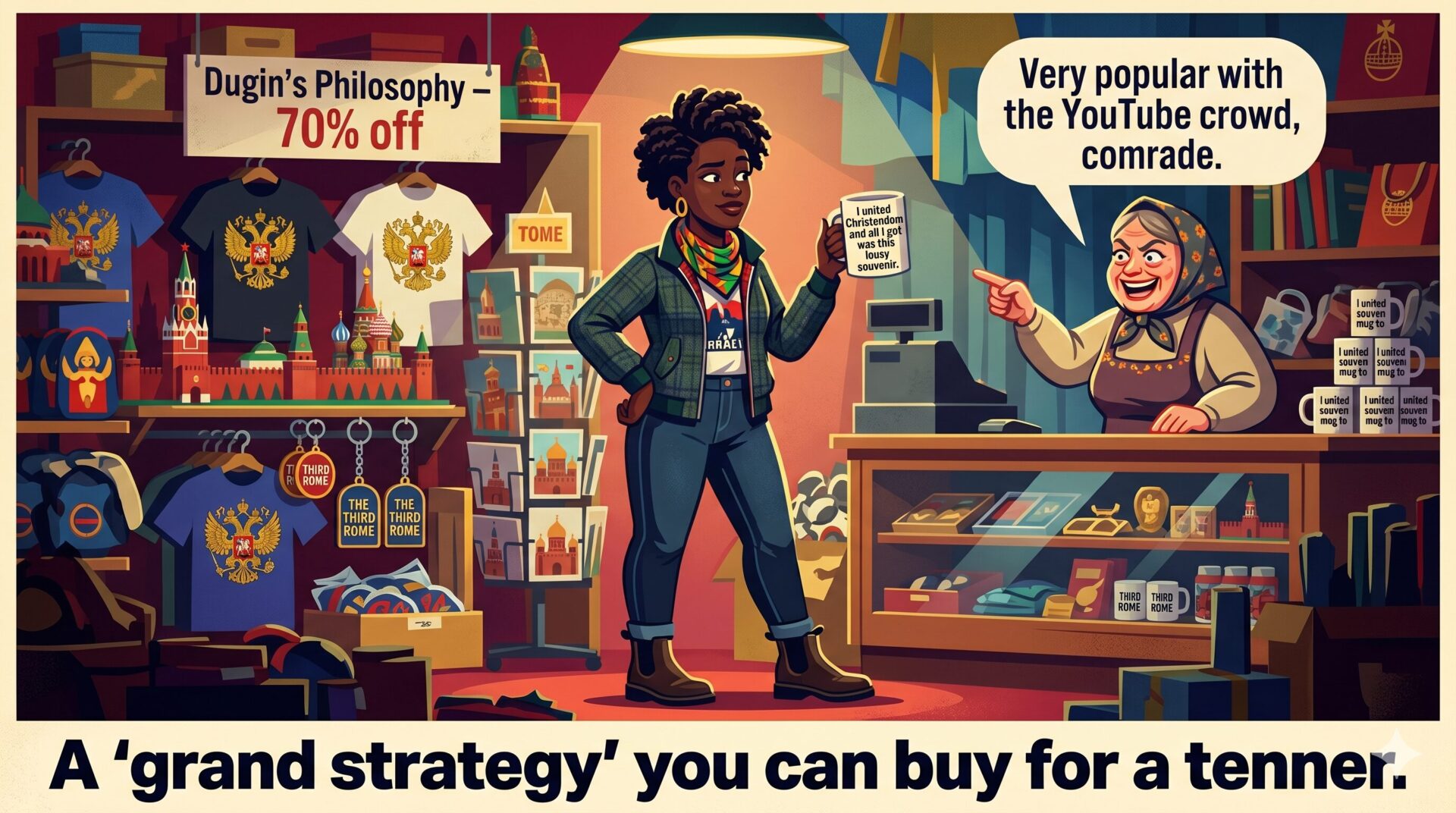 Let’s get this straight. The professor claims that Russia believes it is the “true successor to the Roman Empire.” That Moscow is destined to be the “third Rome” after the first Rome (the original) and the second Rome (Constantinople). That this grand vision – cooked up by a bloke called Aleksandr Dugin in 1997 – drives Russian foreign policy. That Putin is secretly trying to unite the entire Christian world under Moscow’s leadership.
It’s a hell of a story. It’s also absolute bollocks.
The Adage of the Drunk Philosopher
My old nan had a saying for this sort of thing: “A drunk man’s words are a sober man’s thoughts – but a drunk man’s theories are just the room spinning.”
Dugin is that drunk man. He’s a fringe thinker, a mystic, a guy who’s been described as “Putin’s brain” by journalists who should know better. But here’s the thing about brains – they’re not always connected to the body. Dugin has never held official office. His books are read by a tiny circle of Kremlin-adjacent weirdos. Most Russians have never heard of him. Most of the Russian elite think he’s a crank.
The professor presents Dugin’s “foundations of geopolitics” as if it’s the Russian equivalent of the Pentagon’s National Defence Strategy. It’s not. It’s the rambling of a nationalist philosopher who’s been wrong about almost everything he’s predicted. Including, by the way, the idea that Russia and the West are destined for a Eurasian land war. That one’s been “coming” since 1997. Still waiting.
The Cockney Guide to Russian Foreign Policy
Let me explain Russian foreign policy the way my old gaffer explained the Kray twins. “They’re not masterminds, son. They’re bullies who got lucky.” Russian strategy isn’t about uniting Christendom under Moscow. It’s about survival. It’s about keeping a corrupt elite in power. It’s about exploiting opportunities when the West slips up.
Putin doesn’t sit in the Kremlin moving bishops and rooks on a Eurasian chessboard. He reacts. When Ukraine looked west, he grabbed Crimea. When Syria was collapsing, he propped up Assad. When the Americans made a mess of Afghanistan, he sat back and watched. When China offered a partnership, he took it.
 There’s no “third Rome” in any of that. There’s just a former KGB officer with a keen sense of where the weaknesses are and a willingness to exploit them. That’s not grand strategy. That’s opportunism with a nuclear deterrent.
The Adage About the Map and the Territory
There’s a proper old saying: “The map is not the territory.” The professor has confused Dugin’s map – this grand vision of a Eurasian empire stretching from Vladivostok to Lisbon – with the actual territory of Russian power. And the actual territory is much smaller, much poorer, and much less coherent than the map suggests.
Russia’s economy is smaller than Italy’s. Its population is shrinking and ageing. Its military – for all the propaganda – is a conscript army with dodgy equipment and terrible morale, as anyone who’s followed the Ukraine war can tell you. Its ruling class is a squabbling collection of oligarchs who hate each other almost as much as they hate the West.
This is not the foundation of a “third Rome.” This is a country in long-term decline, propped up by oil money and nuclear missiles. The professor’s “master plan” is just a fancy way of avoiding that uncomfortable truth.
The Cockney History Lesson
Let’s have a quick whizz through actual history. The “third Rome” idea isn’t new. It’s been kicking around since the 15th century, when a Russian monk declared Moscow the successor to fallen Constantinople. It’s been used by tsars, by Stalin (who didn’t give a toss about Christian unity), and by every nationalist crank since.
But here’s the thing. Ideas don’t drive policy. Interests do. And Russia’s interests – the preservation of the current regime, the protection of its borders, the sale of its resources – don’t require a “third Rome.” They require a functioning economy, a stable society, and a bit of luck.
The professor has got it backwards. He thinks the ideology explains the actions. But the actions are much simpler: Putin does what keeps him in power. And “unite the Christian world” doesn’t keep anyone in power. It just sounds dramatic on YouTube.
The Adage About the Dog That Didn’t Bark
Sherlock Holmes had a famous case about the dog that didn’t bark in the night. The clue was what wasn’t happening. Apply that to the “third Rome” strategy. If Russia was truly trying to unite the Christian world under Moscow, you’d see certain things. You’d see Russia courting the Vatican. You’d see outreach to Orthodox churches in Greece, Serbia, Romania. You’d see theological conferences, cultural exchanges, maybe even a new tsar.
 What do you actually see? You see Russia selling weapons to India. You see Russia building pipelines to China. You see Russia stirring up trouble in the Balkans, not for Christendom, but for tactical advantage. You see a Kremlin that’s deeply secular, deeply cynical, and deeply uninterested in theological unity.
The dog didn’t bark. And the professor didn’t notice.
The Real “Third Rome”
Here’s the truth that the professor won’t tell you, because it doesn’t fit his chessboard. The only “third Rome” that matters is the one in the hearts of ordinary people – the dream of a world without empires, without borders, without kings or presidents or prophets.
That’s the “Rome” that working people in Russia, in Ukraine, in Britain, in America have been building for centuries. Not through grand strategy. Through solidarity. Through strikes and mutinies and revolutions. Through refusing to fight each other for the profits of the ruling class.
The professor can’t see that Rome because he’s too busy looking at his chess pieces. But it’s there. It’s always been there. And it’s the only empire worth building.
The Cockney Verdict on Dugin
So let’s sum up, from a geezer who’s read a few books and drunk a few whiskies. Aleksandr Dugin is a crank. His “third Rome” strategy is the kind of thing that sounds clever to people who’ve never had to organise a food bank or run a housing co-op. It’s not Russian policy. It’s not even Russian fringe policy. It’s a collection of mystical nonsense that a handful of weirdos use to feel important.
The professor has elevated Dugin to the status of grand Russian strategist because it makes for a good story. A secret master plan. A hidden hand pulling the strings. It’s the same appeal as every conspiracy theory – it makes the world feel knowable, controllable, predictable.
But the world isn’t knowable. It’s chaotic, messy, and full of surprises. And the only way to survive it isn’t to find the secret master plan. It’s to build relationships of trust and mutual aid with the people around you.
As my nan used to say: “You can spend your whole life looking for the wizard behind the curtain. Or you can just pull the curtain down and get on with it.”
The “third Rome” is a curtain. The professor wants you to keep looking. I’d rather you pulled it down.
9.The Banker Conspiracy: When Comic Book Villains Run the World
There’s a saying you’ll hear in any working-class boozer from Barking to Brixton: “Just because you’re paranoid doesn’t mean they’re not out to get you.” But here’s the corollary they don’t mention: just because they’re out to get you doesn’t mean they’re all meeting up in a secret volcano lair to twirl their moustaches.
The professor tells you, “private bankers control everything.” And look, he’s not completely wrong. There is a financial elite. They do benefit from war, from crisis, from the suffering of millions. They do have more power than any elected politician. They can crash economies, rig markets, and buy legislation. That’s not a conspiracy theory. That’s the morning news.
 But then he goes and ruins it. He turns these very real, very recognisable parasites into a shadowy cabal – an unseen hand pulling every string, a secret committee that meets in the basement of the Bank for International Settlements in Basel and decides the fate of nations. And that, my friends in the pie and mash shop, is where the analysis turns into a Batman film.
The Adage of the Invisible Hand
There’s a proper old saying: “Never attribute to malice what can be explained by stupidity, greed, and the pursuit of personal enrichment.” The professor’s bankers aren’t stupid. They’re not even particularly malicious. They’re just greedy. And greedy people don’t need a secret plan. They just need a system that rewards greed.
Take the City of London. You don’t need a cabal of bankers to explain why the rent is too high, why your energy bill has doubled, why your pension is worth less every year. You just need thousands of individual asset managers, hedge fund traders, property developers, and private equity vultures – each one acting in their own narrow self-interest – and the collective outcome is the same as if they’d all signed a pact in blood.
The professor wants you to believe there’s a master plan. But there isn’t. There’s just a machine that’s been built over centuries to funnel wealth upward, and everyone at the top is happily riding it. They don’t need to coordinate. The machine coordinates for them.
The Cockney Guide to the City
Let me explain the City of London the way my old gaffer explained the docks. “You don’t need to know who owns the crane, son. You just need to know that every box that comes off that ship puts a few pence in someone’s pocket – and none of those pence are yours.”
The same goes for the bankers. There are thousands of them. They work for different firms, have different bonuses, hate each other’s guts. But they all share one thing: they benefit from the current arrangement. War is good for defence stocks. Crisis is good for distressed asset buyers. Inflation is good for creditors. Instability is good for speculators.
So they don’t need to conspire. They just need to keep the machine running. And the machine runs on one simple fuel: working people producing more value than they get back.
The Adage About the Wizard
Remember the Wizard of Oz? The great and powerful Oz turns out to be a little bloke behind a curtain, pulling levers and shouting into a microphone. The professor’s bankers are the same. He’s built them up into an all-powerful cabal, but when you actually look for them – when you ask for names, addresses, meeting minutes – what you find is just a bunch of rich blokes doing what rich blokes have always done.
They’re not hiding. They’re at Davos. They’re at the World Economic Forum. They’re at the G7 summits, not in the official sessions but in the hotel bars. They’re on the boards of every major think tank. They’re at the Treasury, at the Fed, at the ECB, not as shadowy puppeteers but as the same faces that have been there for decades.
 The professor pretends they’re a secret because a secret is exciting. A secret makes you feel like you’re in on something. But the truth is boring: the ruling class is right there, in plain sight, and nobody’s stopping them because nobody’s organised enough to try.
The Cockney Banker You’ve Actually Met
Here’s a radical thought. You’ve probably met a banker. Not the cartoon villain in a top hat, but a bloke who works in Canary Wharf, commutes from Essex, and spends his weekends worrying about his mortgage just like you do. He’s not evil. He’s not pulling strings. He’s just a cog in a machine that he doesn’t fully understand and can’t control.
The real power isn’t with the individual bankers. It’s with the system itself – the rules, the incentives, the structures that make it rational for that bloke in Canary Wharf to price derivatives and ignore the human consequences. Change the rules, change the system, and that bloke will be pricing something else entirely.
The professor’s cabal theory misses this completely. He thinks the problem is a handful of villains. The problem is the game itself.
The Adage About the Pond
There’s an old saying: “You can’t have a fish without water, but you can have water without a fish.” The bankers are the fish. The system is the water. The professor is so focused on the fish that he’s forgotten to look at the water. And the water – global capitalism, financialised debt, the shareholder value doctrine – is what’s poisoning everything.
Wars don’t happen because bankers want them. Wars happen because the system rewards war. Arms manufacturers need conflicts to sell weapons. Energy companies need instability to keep prices high. Construction firms need destruction to justify rebuilding. The bankers just provide the financing. They’re facilitators, not masterminds.
 The professor could tell you this. He could explain how the military-industrial complex, the fossil fuel industry, the private security sector, and the financial services industry all form a mutually reinforcing web of profit. But that would take more than a chess set and a laser pointer. That would take actual research.
The Real Conspiracy
If there is a conspiracy, it’s not the one the professor is selling. It’s the conspiracy of silence – the agreement between mainstream media, corporate lobbies, and political parties to never mention the obvious: that the system is designed to benefit the few at the expense of the many.
That’s not a secret. It’s not hidden in a Swiss vault. It’s written into every contract, every law, every tax code, every trade deal. It’s the air we breathe. And the professor’s “shadowy cabal” is just a distraction from the boring, structural, systemic reality.
Because if the problem is a cabal, the solution is to find the cabal and stop them. But if the problem is the system, the solution is to dismantle the system and build something new. And that’s a much harder sell on YouTube.
The Cockney Verdict
So here’s the bottom line, from a geezer who’s seen a few financial crashes and a few prophets come and go. Yes, the bankers have too much power. Yes, they benefit from war and crisis. Yes, they’re part of the problem.
But no, they’re not a shadowy cabal meeting in a volcano. They’re just rich blokes doing rich bloke things in a world that rewards rich bloke behaviour. The fix isn’t to find the secret committee and expose them. The fix is to change the rules so that no committee – secret or otherwise – can profit from human misery.
As my nan used to say: “Don’t waste your time looking for the devil. He’s not hiding. He’s just better dressed than you.”
The professor wants you hunting for shadows. I want you looking at the light – the light of collective action, mutual aid, and working-class solidarity. That’s the only thing that’s ever brought the bankers to heel. Not prophecies. Not conspiracies. People refusing to play the game.
Now that’s a conspiracy worth joining.
10.The AI Civilian State: When Fate Becomes a Sales Pitch
There’s a saying you’ll hear in any pub from Stratford to Streatham: “What can’t be cured must be endured.” But here’s the thing – a lot of what the professor calls “can’t be cured” is actually just “won’t be resisted.” And he’s banking on you not knowing the difference.
The professor tells you the world is moving towards an “AI civilian state.” Digital IDs. Digital currency. Everything you do online recorded. Your bank account programmed to control your behaviour – no cigarettes, no drugs, no dissent. Your every move fed into a database to figure out who you are, what you want, and how to control you. He’s not wrong that this is happening. Parts of it are already here. China has the social credit system. The West has its own versions – watchlists, credit scores, algorithmic policing, behavioural advertising that knows you better than your mum does.
 But then he does the trick. He presents it as inevitable. As the next stage of human civilisation. As something, you can’t stop, can’t change, can’t even slow down. All you can do is understand it, prepare for it, and maybe – if you’re clever – learn to game the algorithm.
And that, my friends in the caff, is where the prophecy becomes a prison.
The Adage of the Train on the Tracks
My old gaffer used to say: “A train on the tracks is going where the tracks lead. But you can always pull up the tracks.”
The professor’s AI future is a train. He’s described the tracks – digital IDs, surveillance capitalism, central bank digital currencies – and he’s told you where the train is heading. But he’s never once suggested that you might grab a crowbar and start levering up the rails.
Why not? Because a world where AI control is inevitable is a world where you keep watching his videos for guidance on how to survive. A world where AI control is resistible is a world where you stop watching and start organising. And organising doesn’t pay his subscription fees.
The Cockney Guide to Surveillance
Let me tell you about surveillance, the way my old nan told me about the neighbours. “They can watch you through the window all they like, love. But they can’t watch you if you pull the curtains.”
Digital surveillance works the same way. The cameras, the trackers, the algorithms – they’re only powerful if you play by their rules. If you refuse to use the digital ID. If you trade in cash. If you use encrypted messaging. If you organise offline, in person, in places they can’t monitor. None of this is easy. None of it is convenient. But it’s possible. And the professor never mentions it, because mentioning it would admit that you have agency.
The professor wants you to believe that resistance is futile. That the AI state is coming whether you like it or not. That your only choice is how you adapt. But that’s a lie. Your choice is whether you resist. And if enough people resist, the system breaks.
The Adage About the Snowflake
There’s a saying: “No single snowflake feels responsible for the avalanche.” The professor’s AI state is an avalanche. It’s built from millions of tiny surveillances – your phone tracking your location, your bank tracking your purchases, your council tracking your benefits, your landlord tracking your rent. Each one seems small. Each one seems inevitable. But they’re not.
 Every surveillance system requires cooperation. Someone has to build the cameras. Someone has to write the code. Someone has to run the servers. Someone has to click “approve” on the algorithm’s recommendation. And every single one of those people could refuse. Could strike. Could sabotage. Could leak. Could flip the switch the other way.
The professor never talks about that because it would mean acknowledging that the enemy is not “the system” – it’s the people who run the system. And those people have names, addresses, families, and vulnerabilities.
The Cockney Example: The Oyster Card
Think about the Oyster card. When it first came out, everyone said it was inevitable. The end of cash fares. The end of anonymity. Every journey tracked, every route recorded, every pattern analysed. And sure enough, most people use Oyster now. But not everyone. There are still people who pay cash. There are still people who walk. There are still people who refuse to be tracked.
The system adapts. It offers discounts for using the card. It makes cash more inconvenient. It slowly, gently, nudges you towards compliance. But it never forces you. Because the moment it forces you – the moment you have no choice – you start to fight back.
 The professor’s AI state is the same. It’s a nudge, not a shove. A slow erosion of privacy, not a sudden dictatorship. And that means it can be resisted. Slowly, inconveniently, collectively.
The Real Inevitability
Here’s what’s actually inevitable. The ruling class will always try to control you. They will always invent new technologies to surveil you, new financial systems to trap you, new algorithms to predict you. That’s been true since the first king counted his subjects and the first tax collector recorded the harvest.
What’s not inevitable is their success. Every surveillance technology has been beaten. Every control system has been circumvented. Every algorithm has been gamed. Not by genius hackers in basements, but by ordinary people sharing tips, passing notes, looking out for each other.
The professor’s AI civilian state isn’t the end of resistance. It’s just the latest battlefield.
The Adage About the Keys
There’s a proper old saying: “A lock only keeps out an honest person.” The same goes for AI surveillance. It only works on people who play by the rules. The moment you decide the rules are illegitimate – the moment you decide that your privacy, your autonomy, your humanity matter more than their convenience – the locks start to fail.
The professor doesn’t want you to make that decision. He wants you to believe that the locks are unbreakable, that the algorithms are all-knowing, that resistance is pointless. Because if you believe that, you’ll keep watching. You’ll keep paying. You’ll keep waiting for the prophet to tell you what happens next.
But the prophet can’t tell you what you already know. That the only way out is through. That the only response to “they’re watching everything” is “let them watch, and see what happens when we’ve had enough.”
The Cockney Verdict
So here’s the bottom line, from a geezer who’s watched governments try to control people since the Poll Tax riots. The AI civilian state is not inevitable. It’s a project. A very ambitious project, backed by very rich people, implemented by very clever engineers. But it’s still a project. And projects can fail.
They fail when people refuse to cooperate. When workers walk out. When users opt out. When the cost of enforcement exceeds the value of control. When the algorithms produce nonsense and the digital IDs get hacked and the central bank digital currency suffers a run.
 The professor presents this future as fate because fate sells. But the future isn’t written. It’s fought for. And the only people who can write it are the ones who refuse to accept the script.
As my nan used to say: “The devil can cite scripture for his purpose. But you don’t have to believe the citation.”
The professor’s AI scripture is a warning, not a prophecy. He’s telling you what they want to do. He’s not telling you what you can do. And what you can do is organise, resist, and build alternatives. Not digitally. Not virtually. In the real world, with real people, in real time.
That’s not a prediction. That’s a decision. And it’s yours to make.
11.The Missing Class Analysis: Where Have All the Workers Gone?
There’s a saying you’ll hear in any union meeting from Manchester to Medway: “The rich man in his castle, the poor man at his gate – but the poor man built the castle, and the gate, and everything else.” Our professor has plenty to say about the rich man’s castle – the geopolitics, the grand strategies, the chess moves of empires. But the poor man? The worker? The bloke who actually builds the tanks, drives the lorries, loads the ships, and – if it comes to it – gets shot at? Nowhere to be seen.
That’s the missing class analysis. And it’s not a small omission. It’s the whole bloody point.
The professor talks about “America” as if it’s a single person with a single will. “America wants to maintain imperial hegemony.” “America needs to secure the Western Hemisphere.” “America will lose the war in Iran.” But what does “America” mean here? The people of Mississippi? The steelworkers of Pennsylvania? The nurses of Ohio? The unemployed in Detroit? No. “America” means the ruling class. The generals. The defence contractors. The politicians who take their money. The rest of America – 99% of it – is just along for the ride, getting asked for their sons and their taxes.
 The same goes for Russia, for Iran, for China. The professor tells us what “Russia” wants – a third Rome strategy, control of Odessa, a Eurasian alliance. But what do the pensioners in Vladivostok want? The factory workers in Togliatti? The mothers of conscripts in Dagestan? He hasn’t got a clue. Because he’s not interested.
The Adage of the Elephant in the Room
There’s a proper old saying: “You can’t see the wood for the trees.” The professor is so busy looking at the trees – the nations, the strategies, the chess pieces – that he’s completely missed the wood. And the wood is the working class. The billions of people who do the work, pay the taxes, fight the wars, and get nothing back except promises.
Here’s a radical thought that the professor never entertains. The working class in America, Russia, Iran, and China have more in common with each other than they do with their own ruling classes. A nurse in Ohio and a nurse in Tehran both want safe hospitals, decent pay, and time with their families. A train driver in Moscow and a train driver in London both want reliable schedules, union representation, and a pension that doesn’t disappear.
The professor’s geopolitics is built on dividing these people. “Your enemy is the Iranian,” he says. “No,” says the Iranian worker, “my enemy is the same as yours – the bloke who sends me to die for oil profits.”
The Cockney Guide to What People Actually Want
Let me tell you what working people actually want, from the dockers of Tilbury to the cleaners of Canary Wharf. They want a roof that doesn’t leak. Food that doesn’t break the bank. Schools that teach their kids something useful. Hospitals that don’t make them wait eight hours. A job that doesn’t destroy their body or their mind. Time off to see their mates, watch the footie, put their feet up.
They don’t want World War III. They would rather not be drafted. They don’t want their sons and daughters sent to die in some mountain fortress on the other side of the world. They don’t want AI tracking their every purchase. They don’t want digital IDs and central bank currencies.
The professor knows this. But he can’t say it. Because if he said it, he’d have to admit that the entire geopolitical drama – the chess pieces, the predictions, the grand strategies – is completely irrelevant to the lives of ordinary people. And if it’s irrelevant, why are you watching?
The Adage About the Piano Player
My old nan used to say: “The pianist plays the tune, but the audience pays the ticket.” The professor is playing a tune – a very dramatic tune about empires collapsing and wars starting. But the audience – the working class – are the ones paying. Paying with their attention. Paying with their fear. Paying with their subscriptions.
The tune doesn’t help them. It doesn’t tell them how to organise a rent strike. It doesn’t share tips on unionising a warehouse. It doesn’t build solidarity between striking dockers in Liverpool and striking rail workers in France. It just plays on, getting louder and more dramatic, while the audience sits in the dark.
The Missing Question
Here’s the question the professor never answers. What do working people do about all this? Not “what does America do” or “what does Russia do” or “what does the Pentagon do.” What do you do? What do the people watching his videos do? What can a cleaner in Croydon do about the petrodollar? What can a bus driver in Birmingham do about the draft?
The professor’s answer, if you listen carefully, is nothing. Just watch. Just understand. Just prepare. Because the forces are too big, the strategies too complex, the players too powerful. You’re not a player. You’re not even a pawn. You’re just the audience.
That’s the real message of the missing class analysis. That you don’t matter. That the only people who matter are the ones with the chess pieces. That your job is to spectate, not participate.
The Cockney Alternative
But there is another way. It’s not glamorous. It doesn’t get millions of views. It doesn’t come with a chess set and a laser pointer. But it’s worked before, and it will work again.
It’s called solidarity. It’s called organising. It’s called refusing to play their game.
When the ruling class wants a war, workers refuse to load the munitions. When the government wants a draft, young people refuse to register, flee the country, or burn their papers. When the bankers want to control your money, you trade in cash, share resources, build mutual aid networks. When the algorithms want to track you, you go offline, meet in person, trust each other instead of the app.
 None of this is easy. None of it is certain. But it’s possible. And it’s happened before. The Vietnam War ended not because the Pentagon changed its mind, but because American soldiers refused to fight, because working-class kids burned their draft cards, because the anti-war movement made it politically impossible to continue.
The professor doesn’t mention any of this. Because mentioning it would admit that ordinary people have power. And if ordinary people have power, they don’t need a prophet. They need each other.
The Adage About the Bird in the Hand
There’s a saying: “A bird in the hand is worth two in the bush.” The professor is selling you two birds in the bush – future predictions, coming catastrophes, inevitable doom. But the bird in your hand is the present moment. The people in your street. The issues in your workplace. The struggles you can actually do something about.
The missing class analysis is missing because the professor doesn’t want you to look at the bird in your hand. He wants you looking at the bush. Always the bush. Always tomorrow. Always the next prediction.
The Cockney Verdict
So here’s the bottom line, from a geezer who’s spent more time on picket lines than watching YouTube prophecies. The professor’s geopolitics is a distraction. A very clever, very entertaining, very profitable distraction. But a distraction nonetheless.
The real geography isn’t mountains and chokepoints. It’s the geography of your neighbourhood – the estate, the high street, the factory, the office. The real strategy isn’t the national defence strategy. It’s the strategy you and your mates come up with to stop an eviction, win a pay rise, or shut down an arms fair. The real players aren’t the bankers and the generals. They’re the postman, the dinner lady, the warehouse picker, the care worker.
The professor won’t tell you that, because he doesn’t know it. He’s never been on a picket line. He’s never organised a tenants’ union. He’s never sat in a cold church hall at 10pm, arguing about bylaws and refreshments, trying to keep a strike together for one more day.
That’s where the real work happens. That’s where the real power is built. And it doesn’t need a prophet. It needs you.
As my nan used to say: “God helps those who help themselves.” I’m not sure about the God bit. But the self-help bit? That’s just solidarity with a different name. And it’s the only thing that’s ever changed anything.
Don’t wait for the professor to tell you what happens next. Go out and make it happen yourself.
12.The Ukraine Distortion: When Grain Matters More Than Grief
There’s a saying you’ll hear in any working-class funeral from Gateshead to Gillingham: “The dead don’t care about your strategy. They’re just dead.” Our professor can talk for hours about grain exports, strategic objectives, and the importance of Odessa. But the one thing he never mentions – not once, not even in passing – is the human cost. The bodies. The families. The working people on both sides who are being fed into a meat grinder while politicians play their grand games.
Let’s be clear. The professor’s analysis of Ukraine isn’t wrong because his facts are off. The grain exports are important. The port of Odessa is strategically significant. The control of the Black Sea does matter to global food supplies. That’s all true. But it’s also deeply, profoundly, morally bankrupt to talk about these things as if they’re happening on a spreadsheet rather than in the lives of millions of ordinary people.
The Adage of the Ledger
My old nan used to say: “You can count the cost in pounds and pence. But you can’t count the cost in tears.” The professor counts in pounds and pence. Grain tonnage. Export routes. Fertiliser supplies. He tells you that if Russia takes Odessa, Africa will starve. He tells you that Ukraine’s agricultural heartland is worth trillions. He tells you that the war is about the global balance of power.
He never tells you about the mother in Kharkiv who hasn’t heard from her son in three weeks. He never tells you about the conscript from Dagestan whose family was told he died in a missile strike. He never tells you about the pensioner in Mariupol who survived the siege only to die of a heart attack when the shelling started again. He never tells you about the children who can’t sleep, the couples who’ve been separated, the millions who’ve fled their homes and may never return.
These aren’t side effects. They’re not collateral damage. They’re not “human cost” line items in a strategic calculation. They’re the war. The whole bloody war. Everything else is just the excuse.
The Cockney Guide to What War Actually Is
Let me tell you about war the way my grandad told me about the Blitz. He didn’t talk about strategic bombing or supply lines or economic warfare. He talked about the sound of the sirens. The taste of dust in his mouth. The way his mum used to pull him under the stairs and hold him tight, praying that the next one wouldn’t hit. He talked about the bloke next door who didn’t come out of the rubble. The family down the street who lost everything. The dog that wouldn’t stop whining.
That’s war. Not the generals’ maps. Not the politicians’ speeches. Not the experts’ analyses. It’s the terror. The loss. The long, grinding, exhausting fear that never really goes away, even decades later.
The professor has never known that fear. If he had, he couldn’t talk about Ukraine the way he does. He couldn’t reduce it to chess pieces and chokepoints. He’d have to sit with the horror of it – the horror of working people sent to kill other working people because some rich men in Moscow, Washington, and Brussels couldn’t agree on who gets to sell what to whom.
The Adage About the Tailor
There’s a saying: “The tailor doesn’t feel the cold. He just measures the cloth.” The professor is the tailor. He measures the cloth of war – the grain exports, the oil routes, the military deployments – but he never feels the cold. He never shivers at the thought of a 19-year-old from Donetsk bleeding out in a trench that used to be a sunflower field.
This isn’t a failure of empathy. It’s a deliberate choice. Because if he felt the cold, he couldn’t do his job. His job is to make war sound strategic, rational, even inevitable. And you can’t do that if you’re also describing what artillery does to a human body.
The Two Sides That Aren’t Sides
Here’s the thing the professor’s analysis completely misses. The working class is the same on both sides of the front line. The Ukrainian conscript and the Russian conscript have more in common with each other than either has with their own ruling class. Both were probably poor before the war. Both probably didn’t want to be there. Both will probably die for nothing, their bodies traded for a few kilometres of scorched earth.
The professor can’t acknowledge this because it would undermine the whole framework. If Ukrainian and Russian workers are fundamentally the same – if they both want the same things: peace, security, a decent life – then the war isn’t a clash of civilisations or a geopolitical necessity. It’s a crime. A crime committed by the rich against the poor. And the rich on both sides are laughing all the way to the bank, because arms sales are up, energy prices are through the roof, and the poor are too busy dying to organise against them.
The Cockney Example: The Two Blokes in the Pub
Imagine two blokes in a pub. One supports Arsenal. One supports Tottenham. They hate each other’s teams. They’d never admit it, but they’ve both got the same problems – crappy landlords, dodgy bosses, rising rent, kids who won’t listen. Then some rich geezer offers them both a grand to knock seven bells out of each other. They do it. They break each other’s noses. They end up in A&E. The rich geezer pockets the profit from the pay-per-view.
That’s Ukraine. That’s every war. The rich geezer is the arms dealer, the energy trader, the hedge fund manager betting on commodity prices. The blokes in the pub are the conscripts. And the professor is the commentator, telling you about the “strategic significance” of the punch that landed, the “tactical repositioning” when one bloke stumbled, the “grain export implications” of a broken nose.
The Missing Voice
The professor never interviews a refugee. Never quotes a soldier’s letter home. Never mentions the anti-war protests in Moscow, the draft dodgers in Kyiv, the mothers in both countries who’ve formed networks to bring their sons home. These voices exist. They’re loud, if you bother to listen. But the professor doesn’t listen. Because they don’t fit his script.
If he listened to a Ukrainian mother who’s lost her son, he’d hear: “This war is pointless. My boy died for nothing.” If he listened to a Russian mother who’s lost her son, he’d hear the same thing. And if he heard that from both sides, he’d have to ask: who benefits? Who profits? Who’s laughing?
The answer isn’t on his chessboard. It’s in the boardrooms of London, New York, and Zurich.
The Adage About the Butcher’s Scale
There’s a saying: “The butcher weighs the meat. He doesn’t ask the cow how it feels.” The professor is the butcher. He weighs the grain exports, the strategic objectives, the territorial gains. He never asks the cow – the working class on both sides – how it feels. Because if he did, he’d have to stop pretending that war is a game and start admitting that it’s a slaughterhouse.
The Cockney Verdict
So here’s the bottom line, from a geezer who’s seen war from a distance and loss from up close. The professor’s Ukraine analysis is distorted because it’s missing the only thing that matters: the people. The working people. The ones who die. The ones who mourn. The ones who pay the price while the rich count the profits.
You can talk about grain and Odessa and the Black Sea until you’re blue in the face. But none of that changes the fundamental truth: wars are fought by the poor, for the benefit of the rich, and anyone who pretends otherwise is either a fool or a fraud. The professor isn’t a fool. So draw your own conclusions.
As my nan used to say: “When the elephants fight, it’s the grass that suffers.” The professor spends all his time analysing the elephants – their tusks, their size, their fighting strategies. But the grass is the working class. And we’re the ones getting trampled.
Don’t let the elephant analysts distract you from the trampling. The only question that matters isn’t who wins. It’s why we’re still lying down in the field.
13.The Greater Israel Project: When the Board Game Erases the Board’s People
There’s a saying you’ll hear in any honest discussion from the banks of the Thames to the banks of the Jordan: “You can’t play Monopoly on a street that’s still got families living in the houses.” Our professor looks at the Middle East and sees a board – squares to be conquered, pieces to be moved, a “Greater Israel” to be achieved. But the squares are cities. The pieces are people. And the families living in those houses have names, histories, and rights that don’t appear on any chess set.
The professor tells you that Israel will “absorb” the American military bases, that the “Greater Israel Project” is inevitable, that once America leaves, nothing can stop it. He talks about the Nile to the Euphrates, about Mecca and Medina, about Turkey being next. It’s all very dramatic. It’s all very strategic. It’s also completely devoid of the one thing that matters: the millions of Palestinians who already live in that land, who have been living there for generations, and who are not about to vanish because some YouTube prophet has drawn a line on a map.
The Adage of the Empty House
My old nan used to say: “An empty house is easy to move into. But you’ll have a job of it if the family’s still sitting at the breakfast table.” The professor’s Greater Israel is an empty house. He’s drawn the borders, named the territories, assigned the strategic value. But he’s forgotten to mention that the house isn’t empty. It’s full of Palestinian families – in Gaza, in the West Bank, in East Jerusalem, in the refugee camps across the region. They’re not pieces on a board. They’re people. And they’re not leaving just because some strategist says they should.
The professor never mentions them. Not once. Not a word about the Nakba, the displacement of 700,000 Palestinians in 1948. Not a word about the settlements, the checkpoints, the separation wall, the demolition orders, the house arrests, the administrative detentions. Not a word about the millions living under military occupation, denied basic rights, their land taken, their water stolen, their children shot.
Why? Because mentioning them would complicate the narrative. It would force the professor to acknowledge that the “Greater Israel Project” isn’t about conquering empty land. It’s about ethnic cleansing. And ethnic cleansing doesn’t fit on a glossy map with neat arrows and friendly laser pointers.
The Cockney Guide to What “Greater Israel” Actually Means
Let me translate the professor’s jargon into plain English. When he says, “Israel will achieve the Greater Israel Project,” what he means is: Israel will expand its borders to include the West Bank, Gaza, East Jerusalem, the Golan Heights, parts of Lebanon, parts of Syria, parts of Jordan, and – if they’re feeling ambitious – parts of Saudi Arabia and Egypt. That’s not a “project.” That’s a war crime waiting to happen.
The professor talks about this as if it’s just geopolitics. As if the people living in those territories are obstacles to be overcome, not human beings with rights under international law. He never asks: what happens to the Palestinians? Do they get citizenship? Do they get expelled? Do they get massacred? These aren’t abstract questions. They’re the central questions of the entire conflict. And the professor ignores them because he doesn’t have answers that fit his narrative.
The Adage About the Elephant in the Living Room
There’s a saying: “You can ignore the elephant in the room, but you can’t ignore it when it sits on you.” The Palestinian people are the elephant. The professor has been walking around them for his entire analysis, pretending they don’t exist. But they exist. And they’re not going anywhere.
 Over five million Palestinians live in the Occupied Territories. Over two million more live in Israel as second-class citizens. Millions more live in refugee camps in Lebanon, Syria, Jordan. They have political organisations – Hamas, Fatah, the PLO, a dozen factions – none of which the professor mentions. They have armed resistance, civil resistance, international solidarity movements. They have a case at the International Criminal Court. They have a right of return enshrined in UN resolutions.
The professor’s “Greater Israel Project” requires erasing all of that. It requires pretending that the Palestinians will simply accept their dispossession, or that they can be militarily defeated into submission, or that the international community will look the other way. None of those things is true. And the professor knows it. But acknowledging the Palestinians would mean admitting that his “inevitable” project is anything but.
The Cockney Example: The Pub That’s Already Got Regulars
Imagine you walk into a pub in Bethnal Green. Tables are full. Regulars are nursing their pints. The darts board is in use. Then some bloke comes in with a map and says, “I’ve decided this pub is now part of my Greater London Project. Everyone out.” That’s the professor’s logic. He’s drawn a line on a map and declared that the people who’ve been living there for generations don’t get a vote.
The Palestinians are the regulars. They’ve been at that table since long before the professor’s “project” was even a twinkle in anyone’s eye. And they’re not going to leave just because some strategist says they should. They’ll fight. They’ll resist. They’ll make the cost of conquest higher than the value of the land. The professor never mentions that cost because it doesn’t fit his tidy predictions.
The Missing Millions
Here’s a number the professor never cites: 7 million. That’s the approximate number of Palestinian refugees and their descendants since 1948. That’s not a statistic. That’s 7 million families, 7 million stories, 7 million reasons why the “Greater Israel Project” is not inevitable.
The professor talks about the “Greater Israel Project” as if it’s just a matter of military power. But military power can’t erase memory. It can’t dissolve identity. It can’t make 7 million people forget that their grandparents were driven from their homes at gunpoint. The Palestinians have been waiting for justice for three generations. They’ll wait three more if they have to. But they won’t disappear.
The professor’s analysis treats them as background noise. But background noise can become a roar. And when it does, all the chess pieces in the world won’t save you.
The Adage About the Oak Tree
There’s a saying: “The oak tree grows where it’s planted. You can’t move it just because you want a better view.” The Palestinian people are the oak tree. They’ve been planted in that land for centuries. You can cut them down, but the roots remain. And the roots will send up new shoots.
The professor’s “Greater Israel” is a landscaping plan that forgot to ask the tree. And trees have a way of reminding you.
The Real Inevitability
Here’s what’s actually inevitable. The current situation – occupation, settlement, siege, apartheid – is unsustainable. Not because of geopolitics. Because of human beings. The Palestinians will not accept permanent dispossession. The Israelis cannot maintain a Jewish-majority state while controlling millions of non-Jewish people without resorting to ever more brutal repression. Something has to give.
What gives is the question. One state? Two states? Confederation? Return and reparations? These are political questions, not military ones. They require negotiation, compromise, and a willingness to treat the other side as human. The professor’s analysis has none of that. He just assumes that one side will win and the other will lose. But that’s not how it works when both sides have been there for generations and neither is leaving.
The Cockney Verdict
So here’s the bottom line, from a geezer who’s seen enough conflicts to know that maps don’t bleed – people do. The professor’s “Greater Israel Project” is a fantasy because it ignores the millions of Palestinians who already live in that land. You can draw lines on a map until your marker runs dry. You can talk about chokepoints and strategies until you’re hoarse. But you can’t make 7 million people disappear.
The Palestinians aren’t pieces on a board. They’re not obstacles to be overcome. They’re not a “demographic problem” or a “security threat” or any of the other dehumanising labels that strategists use to avoid looking them in the eye. They’re people. With names. With histories. With rights. And they’re not going anywhere.
As my nan used to say: “You can’t build a house on sand, and you can’t build a peace on lies.” The professor’s “Greater Israel” is built on the lie that the Palestinians don’t matter. That’s not analysis. That’s propaganda. And the only people who benefit from it are the ones who want the violence to continue – because violence is profitable, and peace is not.
Don’t let the board game blind you to the board’s real people. The only “greater project” worth supporting is one where everyone gets to stay at the table – Palestinians, Israelis, and everyone else who calls that land home. That’s not a prediction. That’s a demand. And it’s one the professor will never make.
14.North Korea as the Schoolyard Bully: When Suffering Becomes a Plot Device
There’s a saying you’ll hear in any pub that’s seen a few scraps: “It takes two to have a fight, but only one to start a rumour.” Our professor has turned North Korea into a rumour – a cartoon villain, a schoolyard brawler who’s been overlooked until now, waiting for the big boys to tire each other out so he can come in and dominate the playground. It’s grotesque. It’s dehumanising. And it turns the suffering of millions of people into a plot device for a YouTube thriller.
Let’s be absolutely clear about what North Korea actually is. It’s not a “brawler.” It’s a country where generations of working people have been trapped under one of the most brutal ruling classes on earth. Millions have starved. Hundreds of thousands have died in labour camps. Families have been separated, executed, disappeared. The regime survives on theft, extortion, and the desperate willingness of its people to endure anything because the alternative is worse.
 The professor doesn’t mention any of that. He doesn’t talk about the floods, the famines, the forced labour, the public executions. He doesn’t talk about the ordinary North Koreans who risk everything to smuggle in South Korean dramas or escape across the border. He just says: “Now’s the time. Why not? It’s free money. Like taking candy from a baby.”
That’s not analysis. That’s a slasher movie script.
The Adage of the Caged Animal
My old nan used to say: “Don’t mistake the snarl of a starving dog for the growl of a killer.” North Korea snarls because it’s starving. Not literally – though millions have starved – but geopolitically. It’s a country that’s been isolated, sanctioned, and threatened for seventy years. Its ruling class has responded by building nuclear weapons and a cult of personality because that’s the only way they can survive. Not because they’re brawlers. Because they’re cornered.
The professor presents this as opportunistic aggression. “All the big boys are fighting, so now’s the time to dominate.” But what would North Korea actually gain from starting a war? It would gain annihilation. Seoul would be flattened, yes – but Pyongyang would be glass. The regime knows this. That’s why it hasn’t started a war, despite seventy years of provocation. The professor’s “brawler” metaphor is not just wrong. It’s dangerous. Because it makes war sound like a rational choice for a desperate dictatorship. And desperate dictatorships, when convinced that war is their only option, sometimes choose it.
The Cockney Guide to What North Korea Actually Wants
Let me tell you what North Korea wants, from the perspective of a working-class Londoner who’s seen how sanctions and isolation actually affect ordinary people. It doesn’t want world domination. It doesn’t want to “dominate the schoolyard.” It wants to survive. It wants its ruling class to stay in power. It wants to eat. That’s it.
The nuclear weapons aren’t a brawler’s fists. They’re a suicide vest. “If you attack us, we’ll take you with us.” That’s not aggression. That’s the logic of a cornered animal. And the professor’s framing completely misses that distinction, because a cornered animal doesn’t fit his narrative of opportunistic bullies.
The Missing Millions
Here’s a number the professor never mentions: 25 million. That’s the population of North Korea. Twenty-five million human beings – most of them poor, most of them malnourished, most of them desperate for a life that doesn’t involve constant fear, propaganda, and surveillance. The professor reduces them to “my people” in the voice of a cartoon dictator. “My people are poor. They’re not afraid to die.” That’s not a quote from a North Korean worker. That’s a quote from a horror movie villain.
The real North Korean workers are afraid to die. Everyone is. But they’re more afraid of what the regime will do to their families if they don’t obey. That’s not bravery. That’s terrorism. And the professor’s glib “they’re not afraid to die” romanticises one of the most brutal systems of control on the planet.
The Adage About the Puppet Show
There’s a saying: “Every puppet has strings. But the audience only sees the puppet.” North Korea is a puppet. The strings are pulled by the Kim family, the party elite, the military commanders. The puppet’s movements – the missile tests, the threats, the parades – are designed to terrify. But the puppet is also terrified. Because the moment it stops moving, the strings get cut.
 The professor treats North Korea as if the puppet is the brawler. He forgets the strings. He forgets the puppet master. And he certainly forgets the millions of people who are trapped inside the puppet theatre, forced to watch the same performance every day, unable to leave.
The Cockney Example: The Bloke at the End of the Bar
Imagine you’re in a pub in Bermondsey. At the end of the bar, there’s a bloke who’s been nursing the same half-pint for three hours. He’s got a black eye. His clothes are torn. He flinches every time someone walks past. He’s clearly been beaten up recently. Now imagine a geezer at the next table saying, “Watch out for that bloke. He’s a brawler. He’s just waiting for the right moment to start a fight.”
That’s the professor’s North Korea. A country that’s been battered, starved, and isolated for decades. A country that’s more afraid than aggressive. A country that lashes out not because it wants to dominate, but because it’s been taught that weakness means death.
The professor’s “schoolyard bully” framing is the opposite of the truth. North Korea isn’t the bully. It’s the kid who got kicked so many times that now he flinches at every footstep – and sometimes throws a punch before he even knows what’s happening.
The Real Bully
Here’s the irony the professor misses. The real bully isn’t North Korea. It’s the system that created North Korea. The Cold War division. The decades of sanctions. The constant military exercises on its borders. The propaganda war that’s turned the North Korean people into monsters in the eyes of the world. The rich countries – America, Britain, Japan, South Korea – that have used North Korea as an excuse to justify their own military budgets, their own weapons sales, their own interventions.
The professor never mentions that. Because if he did, he’d have to admit that the “brawler” is a victim. And victims don’t make for good scary stories.
The Adage About the Shadow
There’s a saying: “A man who fights his own shadow will always lose, but he’ll also exhaust himself.” North Korea has been fighting its shadow – and the shadows cast by the world’s great powers – for seventy years. It’s exhausted. Its people are exhausted. But the shadow keeps moving. And every time the shadow twitches, North Korea twitches back.
The professor’s “now’s the time” analysis assumes that North Korea has been waiting for an opportunity. But North Korea has been waiting for an opportunity since 1953. It’s still waiting. Because the opportunity never comes. Because starting a war is suicide. Because even the most brutal regime prefers survival to glory.
The Cockney Verdict
So here’s the bottom line, from a geezer who’s seen how poverty and fear can twist a person – and a country. The professor’s North Korea isn’t a country. It’s a cartoon. A plot device. A way to make his predictions more dramatic. The real North Korea is 25 million people living under a regime that would kill them if they tried to leave. That’s not a brawler. That’s a prison.
And the prisoners aren’t waiting to start a fight. They’re waiting for the guards to look the other way so they can escape.
As my nan used to say: “The dog that barks the loudest is usually the one that’s most scared.” North Korea barks. It barks constantly. But that’s not because it’s looking for a fight. It’s because it’s terrified of what happens if it stops barking.
The professor wants you to believe that the barking is a prelude to an attack. But anyone who’s ever owned a scared dog knows the truth. The barking is a plea. A warning. A desperate attempt to keep the world at bay for one more day.
Don’t mistake the plea for a punch. And don’t let the professor convince you that hungry, desperate people are the villains. The villains are the ones who made them hungry in the first place. And those villains aren’t in Pyongyang. They’re in the boardrooms of London, Washington, and Seoul.
15.The Bronze Age Collapse Analogy: When History Gets Mugged for a Headline
There’s a saying you’ll hear in any half-decent history class from Liverpool to London: “The past is a foreign country. They do things differently there.” Our professor has visited that foreign country, picked up a few souvenirs, and come back claiming he’s an expert tour guide. His souvenir of choice? The Bronze Age collapse. A dramatic, mysterious, civilisation-ending disaster that happened over three thousand years ago. And he’s using it to tell you that the same thing is about to happen to us.
Let’s be clear. The Bronze Age collapse was real. Around 1200 BCE, a whole bunch of empires – the Mycenaeans, the Hittites, the Egyptians (sort of), the Babylonians – fell apart. Cities burned. Trade routes died. Writing vanished in some places. It took centuries to recover. It was, by any measure, a proper catastrophe.
 But here’s the thing. The professor doesn’t use this analogy because it’s accurate. He uses it because it’s dramatic. Because it lets him paint a picture of entire civilisations crumbling, of refugees flooding across borders, of the world descending into a dark age. It’s the historical equivalent of a horror movie trailer – all jump scares and ominous music, with none of the boring bits where people actually figure out how to survive.
The Adage of the Second-Hand Suit
My old nan used to say: “A second-hand suit might fit, but it’s still got someone else’s sweat in it.” The Bronze Age collapse is a second-hand suit. The professor has pulled it off the rack, brushed it down, and claimed it fits today’s world perfectly. But it doesn’t. The sweat of the Bronze Age – the specific conditions, the technologies, the social structures, the climate, the trade networks – is not our sweat. Wearing someone else’s history doesn’t make you a prophet. It makes you a costume drama.
The Bronze Age collapse happened because of a perfect storm of factors: earthquakes, droughts, famines, internal rebellions, and invasions by mysterious “Sea Peoples” whose origins are still debated. None of those factors maps neatly onto today’s world. We have different technologies, different economies, different political systems, different global connections. The professor ignores all of that because acknowledging complexity would ruin his simple, scary story.
The Cockney Guide to What Actually Happened
Let me give you the quick version of the Bronze Age collapse, the way my old history teacher explained it before he retired to Devon. The great empires of the Eastern Mediterranean had built a system that was fragile – too centralised, too dependent on long-distance trade, too rigid. When a series of shocks hit – natural disasters, climate shifts, maybe a plague – the system couldn’t adapt. It broke. Cities were abandoned. Writing was forgotten. It took generations to rebuild.
Now, does any of that sound familiar? Sure. But it also sounds like the fall of Rome, the collapse of the Maya, the end of the Han dynasty, and about fifty other historical collapses. The professor has picked the Bronze Age not because it’s uniquely relevant, but because it’s the most dramatic. The Sea Peoples! The end of an age! Cities on fire!
It’s good telly. It’s terrible analysis.
The Adage About the Hammer and the Nail
There’s a saying: “If all you have is a hammer, everything looks like a nail.” The professor’s hammer is civilisational collapse. Every problem – the petrodollar, AI surveillance, the war in Ukraine – is a nail that fits his hammer. The Bronze Age collapse is just his biggest, shiniest hammer. He swings it at the present and hopes you’ll flinch.
But the present isn’t a nail. It’s a messy, complicated, contradictory mess that doesn’t fit any single historical analogy. The professor knows this. But he also knows that “it’s complicated” doesn’t get you subscribers. “Civilisation is about to collapse” does.
The Cockney Example: The Bloke Who’s Read One Book
Imagine you’re in a pub in Camden. There’s a bloke at the bar who’s just finished a book about the Roman Empire. Now he’s telling everyone that Brexit is just like the fall of Rome, the cost of living crisis is just like the fall of Rome, the problems with the Tube are just like the fall of Rome. Eventually, someone says, “Mate, the Romans didn’t have the Northern line. Shut up and drink your pint.”
That’s the professor. He’s read a book (or watched a documentary) about the Bronze Age collapse, and now everything looks like the Bronze Age collapse. Never mind that we have nuclear weapons, the internet, global supply chains, and antibiotics. Never mind that the average person today has more material comfort than a Bronze Age king. Never mind that the challenges we face – climate change, inequality, pandemic disease – are completely different from the challenges of 1200 BCE.
The analogy doesn’t fit. But the professor doesn’t care. Because the analogy isn’t for understanding. It’s for scaring.
The Missing Nuance
Here’s what the professor leaves out. The Bronze Age collapse wasn’t universal. Some societies survived and even thrived. The Assyrians, for example, came through the collapse stronger than before. The Phoenicians adapted and expanded their trade networks. The people who experienced the collapse didn’t know they were living through an “age.” They just knew that things were hard, and they did what people have always done – they adapted, they migrated, they built new communities, they figured it out.
The professor’s narrative is one of total, inevitable doom. But history is never total. It’s never inevitable. And doom is never final. Even after the worst collapses, people kept living, kept loving, kept building. The Bronze Age collapse didn’t end humanity. It ended a particular set of political arrangements. Something new grew in the ashes.
 The professor doesn’t mention that because new growth isn’t dramatic. Decay is dramatic. Collapse is dramatic. But if you’re actually living through it, decay and collapse are just the background noise of everyday struggle. And everyday struggle is where resistance is born.
The Adage About the Phoenix
There’s a saying: “Every ending is a beginning, if you’re willing to do the work.” The professor’s Bronze Age analogy is all ending – fire, famine, refugees, chaos. He never mentions the beginnings. He never mentions the Phoenician alphabet, the Iron Age revolution, the rise of new city-states, the flourishing of new cultures. Because those beginnings would suggest that collapse isn’t the end. It’s just a transition. And transitions are something you can shape, if you organise.
The professor doesn’t want you to shape the transition. He wants you to watch him predict it.
The Cockney Verdict
So here’s the bottom line, from a geezer who’s read a few history books and lived through a few “unprecedented times.” The Bronze Age collapse is a fascinating historical event. It’s also completely irrelevant to your life. The challenges we face today – climate breakdown, oligarchic capture, technological surveillance, the return of great power rivalry – have no historical precedent. They’re new. They require new thinking, new organising, new strategies.
The professor reaches for the Bronze Age because he doesn’t have those new strategies. He has old stories, dressed up in new clothes. And old stories are comforting, even when they’re terrifying. Because at least they’re familiar.
But familiarity isn’t the same as accuracy. And a good story isn’t the same as a good plan.
As my nan used to say: “History doesn’t repeat itself. Historians repeat each other.” The professor is repeating a historian (or a dozen historians) who found the Bronze Age collapse useful for making a point. But the point they were making was about their own time, not about yours.
Don’t let someone else’s historical analogy become your prophecy. The future isn’t written in the ruins of the past. It’s being written right now, in the streets and the workplaces and the community centres where ordinary people are figuring out how to survive and resist. That’s not dramatic. It’s not cinematic. But it’s real. And it’s the only thing that’s ever changed anything.
The professor can keep his Bronze Age. I’ll take the Bronze Age of the present – the hard, unglamorous work of building a world that doesn’t need prophets, because everyone knows their own future is in their own hands.
16.The Refugee Fear: When Hungry People Become the Punchline
There’s a saying you’ll hear in any pub that’s seen a few arguments: “When you point one finger, three point back at you.” Our professor points his finger at the hungry millions – the refugees, the migrants, the “sea peoples” of our time – and warns that they’re coming for your stuff. Coming to flood your societies. Coming to take your food, your water, your safety. It’s the oldest trick in the book. Blame the desperate. Scapegoat the starving. And while everyone’s looking at the people in the boats, nobody’s looking at the people who emptied their cupboards in the first place.
 The professor tells you that when empires collapse, infrastructure collapses, and then the refugees come. Six billion people, he says, could starve without fertiliser. And those six billion won’t just die quietly. They’ll migrate. They’ll flood into your countries. They’ll want what you have.
Let’s be clear about what he’s doing. He’s taking a genuine crisis – global food systems are fragile, fertiliser production is concentrated, climate change is making agriculture harder – and he’s weaponising it. He’s turning starving people into an invading army. He’s making the victim into the threat. And that’s not analysis. That’s the same script the far right has been using since the first boat crossed the first border.
The Adage of the Lifeboat
My old nan used to say: “A lifeboat only has so many seats. But the problem isn’t the people in the water. It’s the people who built a boat that small.” The professor wants you to focus on the people in the water – the refugees, the migrants, the hungry millions. He wants you to ask: how do we keep them out? How do we protect what’s ours? He never asks the obvious question: why is the boat so small? Why is there enough food for everyone, but not everyone can afford it? Why are billions hungry while tonnes of grain rot in silos waiting for prices to rise?
The refugees aren’t the problem. They’re the symptom. The problem is a global system that produces abundance for the rich and scarcity for the poor. A system that pays farmers to destroy crops rather than lower prices. A system that lets corporations hoard grain while children starve. The professor never mentions any of this because mentioning it would mean admitting that the hungry aren’t invaders. They’re victims. And victims require solidarity, not walls.
The Cockney Guide to Who’s Actually Coming for Your Stuff
Let me tell you who’s actually coming for your stuff. It’s not the refugees. It’s the landlords. The energy companies. The supermarket chains. The hedge funds buying up your neighbourhood’s housing. The same people who’ve been taking your stuff for decades – your wages, your benefits, your public services, your dignity – are still taking it. The professor wants you to look at the boat people so you don’t look at the boardroom people.
 The refugees aren’t coming for your job. They’re coming for safety. They’re coming because someone dropped a bomb on their house, or because the crops failed for the fifth year in a row, or because their government is murdering their family. They don’t want your stuff. They want to live. And the idea that they’re a threat is not just wrong. It’s cruel.
The Adage About the Mirror
There’s a saying: “Before you accuse someone of stealing, check your own pockets.” The professor accuses the hungry millions of threatening your society. But whose society is it? The refugees aren’t the ones who crashed the economy in 2008 and walked away with bonuses. They’re not the ones who dodged tax on billions while hospitals closed. They’re not the ones who lobbied for austerity, sold off council housing, and privatised the water. That was your own ruling class. Your own rich. Your own politicians.
The professor wants you to be afraid of the people who have nothing. He doesn’t want you to be angry at the people who have everything. Because anger at the rich is organising. Anger at the poor is just prejudice.
The Cockney Example: The Bloke in the Boat
Imagine you’re on a sinking ship. The lifeboats are packed. The rich have taken the best seats, the emergency rations, the radios. You’re clinging to a piece of wreckage. Then a wave brings another exhausted person next to you. They’re cold, hungry, terrified. What do you do? Push them away? Or pull them closer and share what little you have?
The professor’s answer is push them away. They’re coming for your wreckage. They’ll take the last of your strength. But anyone who’s ever actually been in trouble knows the truth. The person next to you isn’t the enemy. The enemy is the one who built a ship that sinks, who filled the lifeboats with themselves, who made sure there was never enough for everyone.
The Missing Solidarity
Here’s what the professor never mentions. Refugees and working-class Britons have the same enemy. The same landlords, the same bosses, the same politicians, the same system that makes some people rich and everyone else fight over crumbs. A refugee from Syria and a pensioner from Sunderland both need housing, healthcare, and dignity. A migrant from Eritrea and a zero-hours worker from Croydon both need wages that cover rent and bosses who treat them like humans.
The professor’s fearmongering breaks that solidarity. It turns potential allies into enemies. And the only people who benefit are the ones who want us all competing for scraps instead of demanding the whole table.
The Adage About the Fence
There’s a saying: “A fence at the top of a cliff is better than an ambulance at the bottom.” The professor wants an ambulance. He wants to manage the crisis after it happens – to predict the waves of refugees, to warn you about the flood, to sell you solutions for keeping them out. He doesn’t want to build a fence at the top of the cliff. He doesn’t want to ask why people are fleeing in the first place. He doesn’t want to stop the wars, the climate collapse, the economic exploitation that pushes millions from their homes.
Because if you stopped the causes, you wouldn’t need the predictions. And if you didn’t need the predictions, you wouldn’t need him.
The Cockney Verdict
So here’s the bottom line, from a geezer who’s seen how fear of “the other” has been used to divide working people for centuries. The professor’s refugee warning isn’t insight. It’s the same old scapegoating dressed up in geopolitics. “Those people are coming for your stuff.” It’s what the rich have always said to keep us from looking at them.
The truth is simpler and harder. There’s enough food for everyone. There’s enough housing for everyone. There’s enough care for everyone. The only thing stopping us from sharing it is the system that says some people deserve more, and most people deserve nothing. The refugees aren’t the threat to that system. They’re the proof that it’s already failed.
As my nan used to say: “Don’t spit in the soup. You might have to eat it.” The professor wants you to spit on the refugees – to see them as invaders, threats, takers. But one day, you might be the one in the boat. One day, the bombs might fall on your street. One day, the crops might fail in your country. And when that day comes, you’ll want someone to pull you in, not push you away.
 The refugees aren’t coming for your stuff. They’re coming for their lives. And the only decent response is solidarity, not fear. Not predictions. Just the simple, radical act of treating a hungry person like a human being.
The professor won’t tell you that. He can’t. Because solidarity doesn’t sell subscriptions. But you don’t need a prophet to know that sharing a crust is better than hoarding a loaf. You just need a heart. And a bit of sense. And the courage to look past the fearmongering to the person on the other side of the water.
17.Plato’s Cave as Propaganda: When Philosophy Becomes an Excuse for Doing Nothing
There’s a saying you’ll hear in any working-men’s club from Poplar to Pimlico: “All fur coat and no knickers.” That’s Plato’s cave the way the professor uses it. Fancy philosophy on the outside. Nothing underneath. It sounds clever. It sounds profound. It makes you feel like you’ve been let in on a secret that the masses will never understand. But when you actually think about what it’s saying, you realise it’s just a fancy way of telling you to give up.
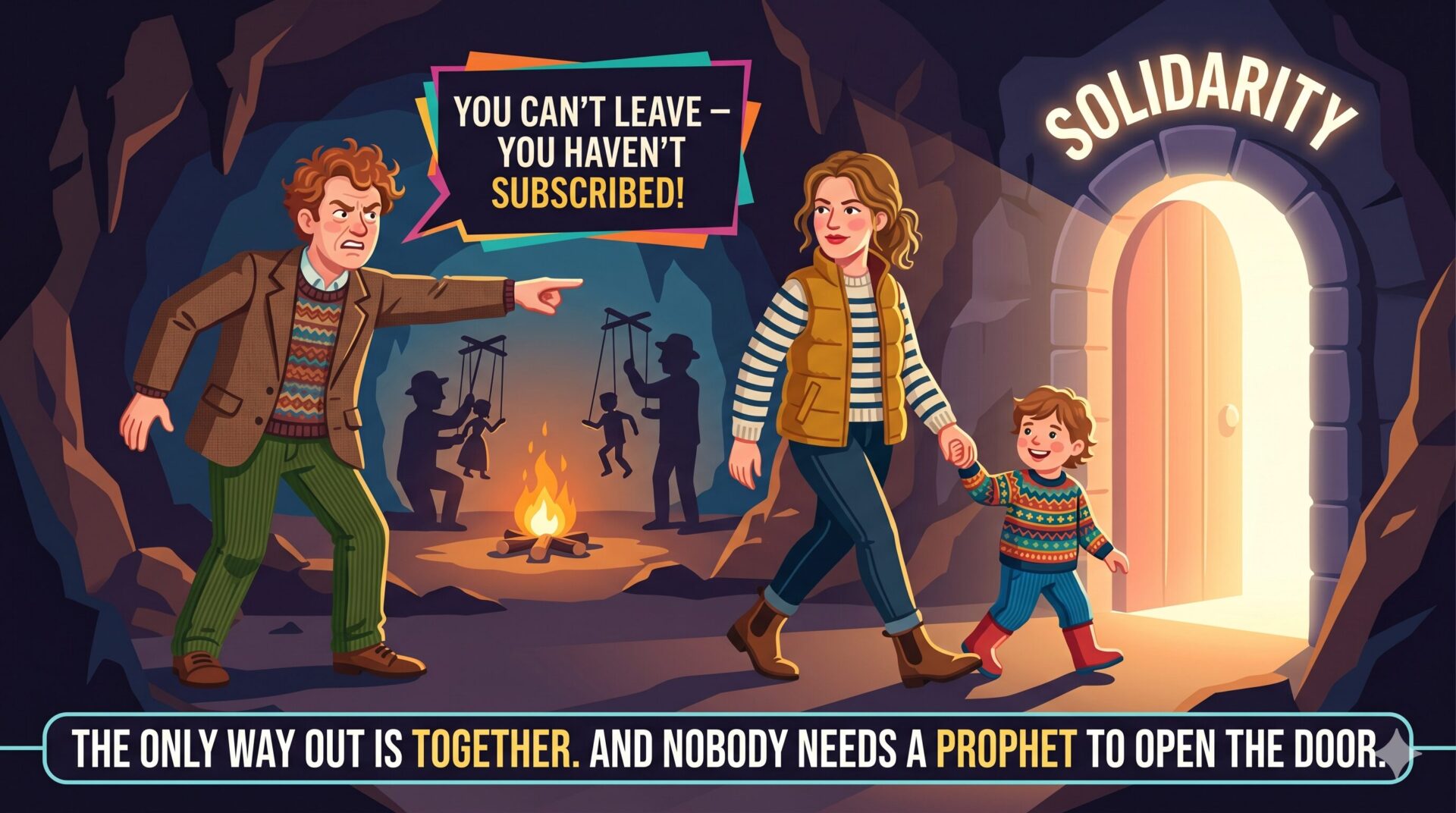 Here’s the allegory. People chained in a cave, facing a wall. Behind them, a fire. Between the fire and the prisoners, puppeteers hold up figures. The prisoners see only the shadows. They name the shadows. They build entire civilisations around the shadows. They fall in love with the shadows. And when someone comes to free them – to turn them around and show them the real source of the shadows – they kill him.
The professor uses this to say: all reality is manufactured. The bankers, the media, the elites – they’re the puppeteers. The rest of us are the prisoners. Everything we believe – democracy, freedom, the economy, the news – is just shadows on a wall. And anyone who tries to wake us up gets cancelled, deplatformed, killed.
It’s a compelling story. It’s also a cop-out, the size of the Thames Estuary.
The Adage of the Cave Exit
My old nan used to say: “The door out of the cave is always there. The question is whether you’re willing to walk through it.” The professor’s version of Plato’s cave has no door. Or if it does, he’s hidden it behind a paywall. He tells you that the shadows aren’t real, that the puppeteers are in control, that the prisoners are addicted to their chains. But he never tells you what to do about it. Because the minute he tells you to act, he has to admit that the cave has an exit. And an exit means you don’t need him anymore.
The real Plato wasn’t a defeatist. He was trying to figure out how to educate the prisoners, how to lead them out of the cave, how to build a just society. The professor has stolen Plato’s metaphor and stripped it of its hope. In the professor’s cave, everyone is trapped forever. The best you can do is watch his videos and understand that you’re trapped. That’s not philosophy. That’s learned helplessness with a degree.
The Cockney Guide to Who’s Really Chained
Let me tell you who’s chained in the professor’s cave. It’s not the bankers. It’s not the media moguls. It’s not the politicians. They’re the ones holding the puppets. The prisoners are the rest of us – the working class, the poor, the young, the marginalised. The professor claims he’s trying to free us by showing us the puppeteers. But showing us the puppeteers doesn’t free us. It just makes us more aware of our chains.
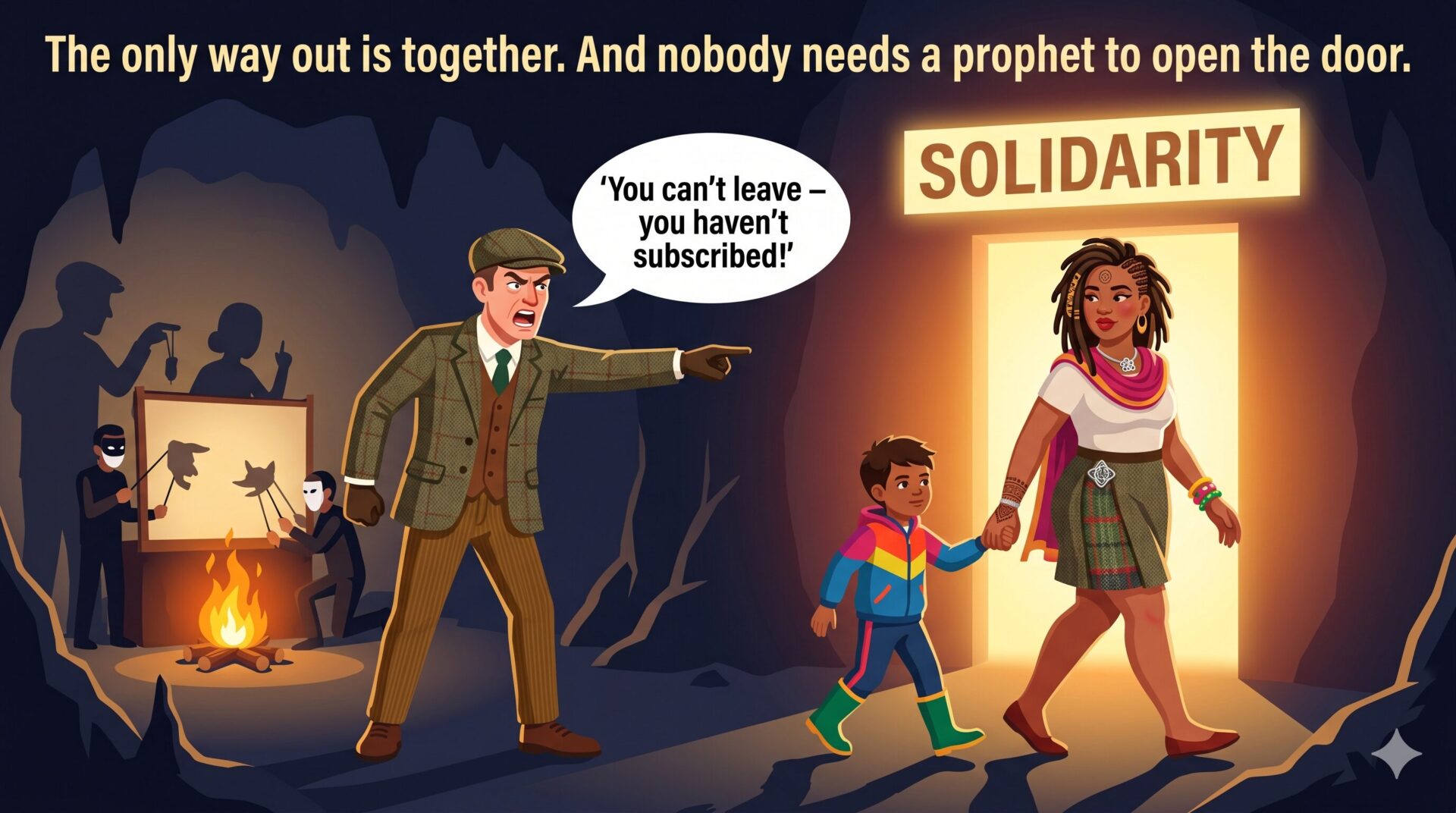 Real freedom would require us to break the chains. To turn around. To walk out. To build a world without puppeteers. The professor never mentions that because breaking chains is hard. It requires organising, risk, sacrifice, solidarity. It requires asking your neighbours to turn around with you. It requires trusting that the exit exists even though you can’t see it yet.
The professor prefers to keep you in the cave, watching his videos, understanding the shadows, but never moving. Because a moving prisoner is a prisoner who might stop subscribing.
The Adage About the Armchair
There’s a saying: “An armchair revolutionary is still sitting down.” The professor is the ultimate armchair philosopher. He sits in his studio (or his spare bedroom, or wherever he films), points at the shadows, and tells you how clever he is for seeing the puppeteers. But he’s not doing anything about them. He’s not organising a union, not building a mutual aid network, not supporting refugee solidarity, not sabotaging arms shipments. He’s making videos. And making videos doesn’t break chains. It just adds more shadows to the wall.
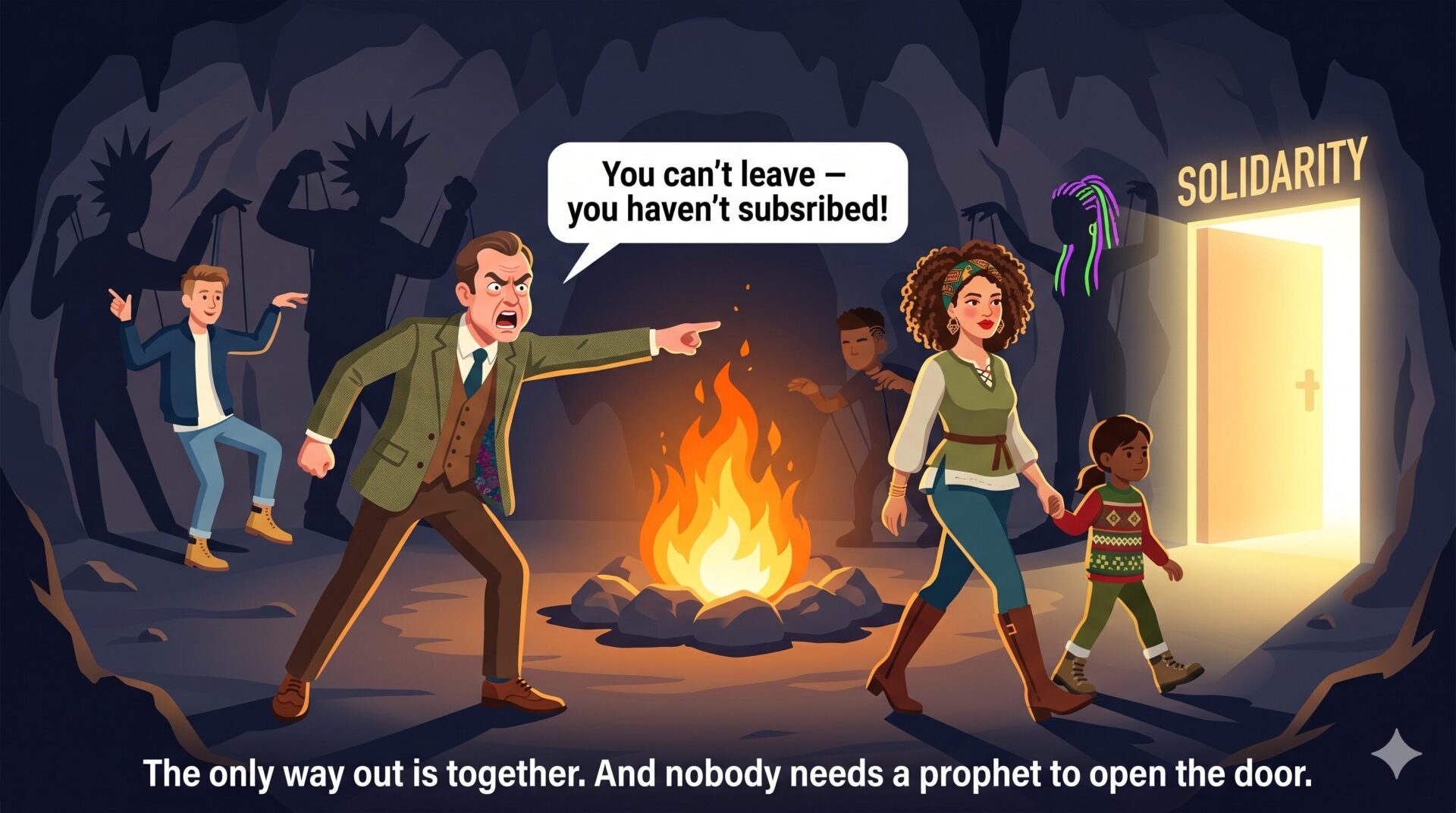 The professor’s version of Plato’s cave is an excuse for passivity. “Everything is an illusion,” he says. “The puppeteers control everything.” Therefore, nothing you do matters. Therefore, don’t try. Therefore, just watch. Therefore, just pay.
That’s not radical. That’s reactionary. Because the belief that nothing can change is the most powerful weapon the ruling class has. And the professor is handing it to them on a silver platter.
The Cockney Example: The Bloke in the Pub Who Knows Everything
Imagine you’re in a pub in Walthamstow. There’s a bloke in the corner who’s got an opinion on everything. “The government’s lying to you. The media’s lying to you. The whole system’s a sham.” Everyone nods. He’s clever. He’s insightful. Then someone asks, “So what do we do about it?” The bloke takes a sip of his pint and says, “Nothing you can do. They’ve got all the power.” Then he goes back to explaining how the world works.
That’s the professor. He’s the bloke in the corner. He’s got the diagnosis. He’s got the jargon. He’s got the confidence. But he’s got no prescription. No plan. No action. Just more analysis. More predictions. More shadows.
And the tragedy is, people listen to him. They stop believing in change because the clever man on the screen told them change is impossible. They stop organising because the professor said the puppeteers are too powerful. They stop hoping because hope is for fools who haven’t seen the shadows.
The Missing Light
Here’s what the professor’s cave completely leaves out. The fire behind the prisoners. The puppeteers need that fire to cast their shadows. Without the fire, there’s nothing. But who controls the fire? The professor never says. Is it the bankers? The elites? The lizard people? He doesn’t know. He just knows that someone is back there, holding the puppets, tending the flames.
But what if the fire is us? What if our collective imagination, our shared stories, our mutual hopes are the fire that casts the shadows? What if the puppeteers aren’t controlling the fire – they’re just standing in front of it, using our own light to deceive us?
That’s the real radical insight. The fire isn’t owned by anyone. It’s the energy of humanity itself – our creativity, our solidarity, our desire for a better world. The puppeteers can stand in front of it, but they can’t extinguish it. And the moment we realise that, the moment we turn around and see our own light reflected in each other’s eyes, the puppeteers become irrelevant.
The professor never tells you that because it would mean you don’t need him. You just need each other.
The Adage About the Sun
There’s a saying: “The sun doesn’t need a prophet to announce the dawn.” The professor’s cave is dark. He wants you to believe that the sun never rises, that the only light is the fire of the puppeteers. But the sun does rise. It rises every morning, whether the puppeteers like it or not. And the sun – the light of collective action, of mutual aid, of working-class struggle – can illuminate the cave better than any fire.
The professor keeps you facing the wall because he’s afraid of the sun. The sun would show that the puppeteers are just people – scared, greedy, mortal people who can be resisted, overthrown, replaced. The sun would show that the chains are rusted, that the exit is closer than you think, that the prisoners outnumber the guards.
The professor can’t handle that. His whole business model depends on you staying in the dark.
The Cockney Verdict
So here’s the bottom line, from a geezer who’s spent more time in real caves (the kind with bats and stalactites) than in philosophical ones. Plato’s allegory is useful for understanding how power works. It’s not a life sentence. The professor uses it as a life sentence because he wants you to despair. Despairing people don’t organise. They just watch.
But you don’t have to stay in the cave. You can turn around. You can see the fire for what it is – your own collective power. You can see the puppeteers for what they are – frightened parasites who depend on your submission. And you can walk out. Not alone. Not overnight. But together, step by step, building the world you want to see.
As my nan used to say: “The darkest hour is just before the dawn. But only if you’re facing east.” The professor wants you facing west – looking at the shadows, analysing the puppets, marvelling at the fire. Turn around. Face east. The dawn is coming. And you don’t need a prophet to see it. You just need your eyes open and your boots on.
The cave has an exit. Always has. The only question is whether you’re willing to walk towards it – and whether you’ll bring your mates.
18.The Self-Awareness Trap: When Knowing the Con Doesn’t Make You Free
There’s a saying you’ll hear in any half-decent market from Spitalfields to Stratford: “A fox knows a trap when it sees one. But a fox that walks into it anyway is just a clever meal.” Our professor knows the trap. He knows the media controls the narrative. He knows the elites pull the strings. He knows the whole system is a rigged game. He even admits, when asked directly, that he’s part of the media. Part of the machine that projects the shadows. Part of the problem.
 But then comes the twist. “I’m not owned by anybody,” he says. And when the host challenges him – “But the private bankers control you!” – his answer is pure gold: “Do you want to make money? Then they’re controlling you.”
He says it like it’s a revelation. Like he’s just cracked the code of his own complicity. But here’s the thing. Admitting you’re controlled by money isn’t freedom. It’s just honesty with a shrug. The professor knows he’s on a leash. He just thinks it’s different because he chose the leash himself.
The Adage of the Golden Collar
My old nan used to say: “A collar’s still a collar, even if it’s made of gold.” The professor wears a golden collar. He makes money from his predictions. He needs subscribers, views, sponsors. That’s his leash. He pulls against it, sure. He says things the mainstream media won’t say. He questions the official narrative. But at the end of the day, he still needs you to watch, to click, to pay. And that need shapes what he says, how he says it, and what he leaves out.
He knows this. He admits it. “Do you want to make money? Then they’re controlling you.” He’s talking about the bankers, but he’s also talking about himself. He’s not owned by a single boss, but he’s owned by the market. By the algorithm. By the demands of content creation. By the need to keep you scared enough to come back.
And that’s the trap. Self-awareness without action isn’t liberation. It’s just a more sophisticated cage.
The Cockney Guide to the Leash
Let me explain the leash the way my old gaffer explained agency. “You can choose which pub to drink in. But if all the pubs are owned by the same brewery, you’re still drinking their beer.” The professor has chosen his pub. He’s chosen to be an independent media personality rather than a corporate talking head. That’s a real choice, and it matters. But the brewery – the system of commercial media, the algorithm-driven platforms, the advertising-based revenue model – still owns the taps.
He can say what he likes, as long as it doesn’t get him deplatformed. He can criticise the bankers, as long as he doesn’t name names that might sue. He can predict the collapse of the dollar, as long as he keeps his sponsors happy. His leash is longer than a CNN anchor’s leash. But it’s still a leash.
The professor knows this. He admits it. But he calls it freedom because he’s the one holding the handle. He’s forgotten that the other end is still tied to a post.
The Adage About the Gilded Cage
There’s a saying: “A bird in a gilded cage sings just as sweet, but it’s still not flying.” The professor sings sweet. His analysis is compelling, his metaphors are clever, his predictions are dramatic. But he’s not flying. He’s sitting in a studio (or a converted garage) making videos, not organising, not resisting, not building alternatives. He’s a critic of the cage, not an escape artist.
He tells you the cage exists. He shows you the bars. He names the zookeepers. But he never tells you how to pick the lock. And when you ask him about his own keys, he says, “I want to make money,” as if that’s the end of the conversation.
Making money isn’t a sin. We all need to eat. But using “I want to make money” as an excuse for staying in the cage – that’s not honesty. That’s resignation dressed up as realism.
The Cockney Example: The Bloke Who Knows the Bookie
Imagine you’re at the dogs. There’s a bloke who’s figured out that the races are fixed. He knows which dogs are doped, which traps are rigged, which bookies are in on it. He’s clever. He’s insightful. He tells everyone around him how the scam works. But then he still places a bet. “Got to make a living, mate,” he says. “Doesn’t mean I’m part of the system.” But he is part of the system. He’s betting on the fixed race. He’s giving his money to the bookies. He’s playing their game, even though he knows it’s rigged.
That’s the professor. He knows the media is rigged. He knows the narrative is controlled. He knows the bankers are pulling strings. But he’s still playing the game. He’s still making content for the platforms. He’s still chasing views, subscribers, ad revenue. He’s still inside the system, profiting from it, even as he criticises it.
He’s not a traitor. He’s not a hypocrite. He’s just trapped – and instead of trying to escape, he’s made peace with the trap.
The Missing Step
Here’s what the professor never does. He never says: “Here’s how you can escape. Here’s how you can build media that isn’t dependent on algorithms and advertisers. Here’s how you can organise collective action that doesn’t need a charismatic leader on YouTube. Here’s how you can break the leash entirely.”
He doesn’t say these things because he doesn’t know them. Or because they wouldn’t get views. Or because they would undermine his own position. If he told you how to escape, you might stop watching. And he can’t have that.
So he keeps you in the cave, watching the shadows, nodding along as he points out the puppeteers. He’s the prisoner who’s turned around, seen the fire, but instead of walking out, he’s set up a chair and started selling tickets.
The Adage About the Jailer
There’s a saying: “The jailer is still a jailer, even if he gives you a longer cell.” The professor gives you a longer cell. He lets you see the bars, understand the locks, recognise the guards. But it’s still a cell. You’re still inside. And he’s still standing at the door, collecting your attention as rent.
He’s not your enemy. He might even be your ally, in some limited way. But he’s not your liberator. And the moment you think he is, you’ve fallen into the trap he’s never escaped himself.
The Cockney Verdict
So here’s the bottom line, from a geezer who’s seen a few self-proclaimed truth-tellers come and go. The professor’s self-awareness is real. He knows he’s part of the system. He knows money controls him. He admits it, even. But admission isn’t absolution. Knowing the trap doesn’t mean you’ve escaped it.
The only way out is to stop playing the game entirely. Not to play it better. Not to play it smarter. Not to play it from a different position. To stop. To refuse. To build something that doesn’t depend on their platforms, their algorithms, their money.
That’s hard. That’s scary. That might mean less income, less reach, less influence. But it’s the only real freedom. Everything else is just choosing which leash to wear.
As my nan used to say: “You can’t ride two horses with one arse.” The professor wants to ride the horse of independent media and the horse of commercial success at the same time. He’s doing a decent job of it. But eventually, the horses will go in different directions. And when they do, we’ll see which one he chooses.
Don’t wait for him to choose. Choose for yourself. Build your own horse. Or better yet, build a cart that doesn’t need a horse at all. A cart that you and your mates can pull together, in whatever direction you please.
That’s not a prediction. That’s a decision. And it’s one the professor will never make for you.
19.The Love Story Diversion: When Feelings Become a Forcefield
There’s a saying you’ll hear in any pub from Deptford to Dagenham: “Never trust a man who cries at his own funeral.” Our professor ends his performance with a story that would melt a stone. His wife saved him from depression. He’d hit rock bottom—no job, no hope, no future. Then she came along, loved him unconditionally, believed in him, had his child. It changed him. It gave him the courage to start his YouTube channel. It made him the man he is today.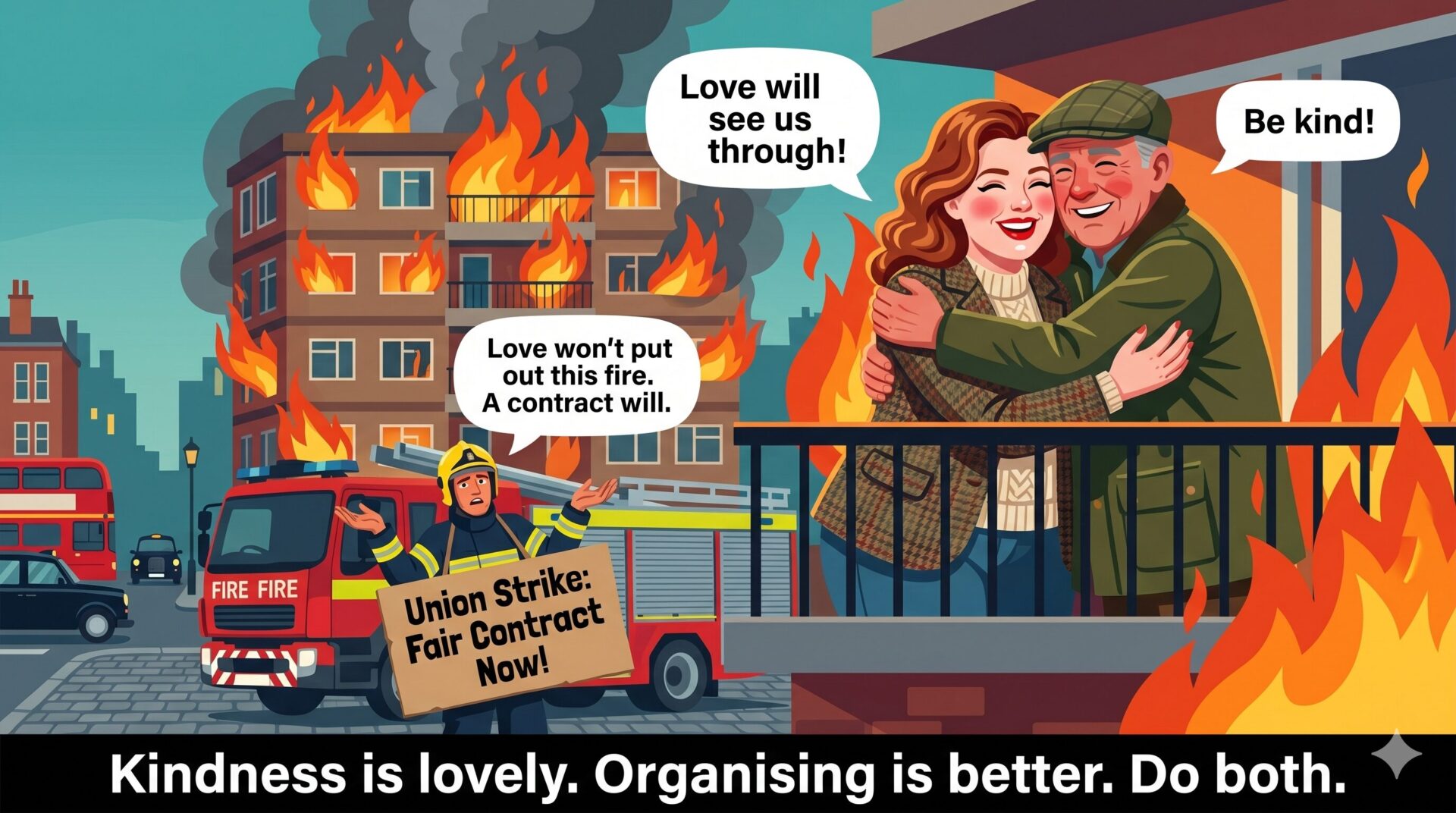
It’s beautiful. It’s genuine. It’s also a rhetorical shield the size of the Shard.
Let’s be clear. I’m not mocking the man’s pain. Depression is real. Love is real. Redemption is real. The professor’s story is probably true, and it’s probably as important to him as he says. But here’s the thing about a heartfelt story told at the end of a political argument: it’s designed to make you stop arguing. It’s designed to make you feel like a monster for questioning anything the man has just said. “How dare you criticise him? He just opened up about his darkest moments!”
That’s the shield. And the professor knows exactly how to use it.
The Adage of the Tearful Salesman
My old nan used to say: “A salesman’s tears won’t make a dodgy car run any better.” The professor is selling you a product. The product is his worldview, his predictions, his analysis. At the end of the sales pitch, he cries. Or tells you about crying. Or shares something deeply personal that has nothing to do with Iran, the petrodollar, or the collapse of the American empire. And you, being a decent human being, feel for him. You soften. You stop asking hard questions about the draft law he never cited or the timeline that didn’t add up. You just want to give him a hug and a subscription.
The tears (metaphorical or otherwise) don’t make his analysis any more accurate. They don’t fill in the gaps in his predictions. They don’t explain why he never mentioned the Palestinians or the human cost of war. They just make you feel bad for noticing.
The Cockney Guide to Emotional Labour
Let me explain emotional labour the way my old gaffer explained bar work. “You don’t have to mean it, son. You just have to look like you mean it.” The professor probably does mean it. His love for his wife is real. His gratitude is real. But he’s also a professional communicator. He knows that a personal story at the end of a political monologue is the oldest trick in the book. It humanises him. It makes him relatable. It turns him from a talking head into a fellow traveller.
And once he’s a fellow traveller, once he’s “one of us,” you stop treating his claims with the same scepticism you’d apply to a CNN anchor or a government minister. You give him the benefit of the doubt. You assume good faith. You let the dodgy parts slide because he seems like such a nice bloke, and he’s been through so much.
That’s the manipulation. Not deliberate, maybe. Not malicious. But manipulation nonetheless.
The Adage About the Two Stories
There’s a saying: “A man can tell two stories in the same breath – one true, one useful, and you’ll never know which is which.” The professor’s love story is true. I’ve no reason to doubt it. But it’s also useful. It serves a purpose beyond sharing his personal journey. It closes down criticism. It creates an emotional bond that makes you less likely to question him. It transforms his YouTube channel from a commercial enterprise into a labour of love, a mission, a calling.
And once it’s a calling, how can you question the man’s motives? How can you suggest he’s exaggerating for clicks? How can you point out the inconsistencies in his predictions without feeling like you’re kicking a man who’s already been down?
You can’t. That’s the point.
The Cockney Example: The Bloke Who Borrows a Fiver
Imagine you’re in a pub in Peckham. A bloke you sort of know comes up and asks to borrow a fiver for the bus home. He looks rough – tired, sad, like he’s been through the wringer. He tells you his wife left him, he lost his job, he’s been sleeping on his mate’s sofa. You feel for him. You hand over the fiver. Later, you see him at the bookies, slapping fifty quid on a horse. You’ve been had.
Now, maybe his story was true. Maybe his wife really did leave. Maybe he really did lose his job. But the truth of his story didn’t make the fiver any less of a con. He used your sympathy to get your money.
The professor uses your sympathy to get your attention, your trust, your subscription. His story might be true. But it’s still a tool. And you’re still the mark if you let it blind you to the gaps in his analysis.
The Missing Connection
Here’s what the professor’s love story has nothing to do with. It has nothing to do with whether Iran is a fortress. Nothing to do with whether the draft is coming. Nothing to do with whether AI will control your bank account. Nothing to do with whether Russia has a third Rome strategy. Nothing to do with whether the petrodollar will collapse. Nothing to do with any of the claims he’s spent the last hour making.
It’s a non-sequitur. An emotional non-sequitur. He’s told you a bunch of predictions, some shaky, some outright false, and then he’s told you a personal story. The two don’t connect. But the emotional weight of the story splashes backwards onto the predictions. You feel moved, so you feel convinced. Even though the two have nothing to do with each other.
That’s the rhetorical trick. And it works on almost everyone.
The Adage About the Pudding
There’s a saying: “The proof of the pudding is in the eating.” The professor’s pudding is his predictions. The proof is whether they come true. His love story doesn’t make the pudding taste any better. It doesn’t make the dates line up or the evidence appear. It just makes you want to be nice to the chef.
But being nice to the chef doesn’t help you. What helps you is knowing whether the draft is actually coming in December. What helps you is knowing whether the petrodollar is about to collapse. What helps you is knowing whether you should be stockpiling tinned beans or organising a rent strike. The professor’s love story doesn’t help you with any of that. It just makes you feel warm and fuzzy towards him.
The Cockney Verdict
So here’s the bottom line, from a geezer who’s heard a lot of sad stories and seen a lot of dodgy sales pitches. The professor’s love story is real. I believe him. I’m glad he found happiness. But it’s not evidence. It’s not analysis. It’s not a reason to trust his predictions. It’s a reason to like him as a person. And liking someone is not the same as believing them.
 As my nan used to say: “A kind heart and a gullible head will keep you poor forever.” Don’t let your kind heart get in the way of your sceptical head. Feel for the man. Applaud his recovery. But then go back and check his claims. Look for the missing evidence. Ask the hard questions. Because the professor’s love for his wife doesn’t make his timeline any less convenient. It doesn’t make his missing class analysis any less glaring. It doesn’t make his refugee fearmongering any less cruel.
The love story is a diversion. A heartfelt, genuine, moving diversion. But a diversion nonetheless. Don’t let it distract you from the things that actually matter. The things that affect you, your family, your community. The things the professor can’t predict because he’s too busy looking at chess pieces and sharing his feelings.
Feel for him. Then fact-check him. That’s not cruelty. That’s common sense. And it’s the only thing that’s ever kept working people from being sold a bill of goods by a charming bloke with a good story.
20.The YouTube Algorithm as Validation: When the Machine Becomes the Messiah
There’s a saying you’ll hear in any betting shop from Bermondsey to Bethnal Green: “The bookie doesn’t love you. He just loves your money.” The same goes for YouTube’s algorithm. It doesn’t love the professor. It doesn’t believe his predictions. It doesn’t know if he’s right or wrong. It just knows that you’ll keep watching. That your fear will keep your finger on the screen. That your anxiety will translate into ad revenue.
The host mentions, almost as a throwaway, that the algorithm recommended the professor’s videos. As if that’s proof. As if a piece of code designed to maximise watch time has somehow become a seal of prophetic approval. “The algorithm says this is the perfect video for you,” the host beams. “It’s different for everybody.”
 Let that sink in. The algorithm’s goal isn’t truth. It’s not accuracy. It’s not even entertainment, really. It’s engagement. It wants you to watch, to click, to comment, to subscribe, to stay on the platform for as long as humanly possible. And nothing keeps you watching like fear. Nothing keeps you scrolling like the promise of secret knowledge. Nothing keeps you subscribed like the feeling that the world is about to end and only this channel has the inside track.
The algorithm isn’t validating the professor. The professor is validating the algorithm’s business model.
The Adage of the Dancing Bear
My old nan used to say: “The bear dances because the crowd claps. But the bear doesn’t care about your applause. It just wants the honey.” The professor is the bear. The algorithm is the crowd. The honey is your attention. The algorithm “recommends” his videos not because they’re true, but because they work. They trigger your amygdala. They spike your cortisol. They make you feel like you’re in on something, that you’re ahead of the curve, that you’re one of the few who sees what’s really happening.
And the more you watch, the more the algorithm recommends. It’s a feedback loop. Fear begets fear. The algorithm learns your weaknesses—your anxieties about war, about the draft, about AI, about your kids—and feeds you more of the same. Before you know it, you’re stuck in a doom funnel, watching video after video, each one more terrifying than the last, each one confirming that the world is ending and only this channel has the map.
The algorithm isn’t a prophet. It’s a parasite. And the professor is its favourite host.
The Cockney Guide to How Algorithms Actually Work
Let me explain algorithms the way my old gaffer explained the fruit machine. “It’s not random, son. It’s programmed to take your money. It’ll give you a little win now and then to keep you feeding it. But the house always wins.”
YouTube’s algorithm is the same. It gives you little wins—a video that confirms your biases, a prediction that feels right, a moment of “I knew it!”—to keep you watching. But the house always wins. The house is Google. The house is the platform’s shareholders. The house is the advertisers who pay for your eyeballs. The professor gets a cut. You get anxiety. And the algorithm gets richer.
The host’s implication that the algorithm’s recommendation is somehow evidence of the professor’s accuracy is like saying the fruit machine’s payout proves the numbers are rigged in your favour. It’s the opposite. The payout proves the machine is working exactly as designed—to keep you playing.
The Adage About the Compass
There’s a saying: “A broken compass still points somewhere. That doesn’t mean you should follow it.” The algorithm points to the professor’s videos. That doesn’t mean they’re true. It means they’re effective. They trigger the right emotional responses. They keep you on the platform. They generate shares, comments, arguments. They’re clickable. They’re shareable. They’re profitable.
Truth has nothing to do with it. Some of the most-watched videos on YouTube are flat-out lies. Some of the most-recommended content is conspiracy nonsense. The algorithm doesn’t care. It’s not a fact-checker. It’s not a peer reviewer. It’s a slot machine that pays out in fear.
The professor knows this. He’s not stupid. He’s figured out what works. He’s cracked the code of algorithmic engagement, not the code of geopolitical prediction. And he’s monetising that crack.
The Cockney Example: The Bloke Who’s Always in the Bookies
Imagine a bloke who spends every day in the bookmakers. He’s got a system. He follows the favourites. He backs the tips he sees online. Sometimes he wins. Mostly he loses. But the bookies love him. They give him a free coffee now and then. The staff know his name. He thinks he’s a player. He thinks he’s beating the system. But the system is beating him every single day.
That’s the algorithm. That’s the viewer. That’s the professor. The algorithm “recommends” the professor’s videos because it knows you’ll watch. Not because they’re accurate. Because you’ve already shown that you’re afraid. You’ve already clicked on similar content. You’ve already spent hours in the doom funnel. The algorithm is just following the pattern you established. You’re not being led. You’re being tracked.
The Missing Critical Thinking
Here’s what the host’s comment reveals. He’s so impressed that the algorithm picked the professor that he’s forgotten to ask the basic question: why does the algorithm pick anything? It picks what gets views. That’s it. That’s the whole secret. Popularity isn’t truth. Engagement isn’t evidence. A million views doesn’t make a false claim true. It just makes it a million-view false claim.
The host treats the algorithm as an oracle. As a neutral arbiter of quality. But the algorithm is about as neutral as a brick through a window. It’s designed to maximise profit, not maximise understanding. The professor’s videos are profitable. That’s why they’re recommended. Not because he’s right. Because he’s watchable.
The Adage About the Bargain
There’s a saying: “A bargain is only a bargain if you needed what you bought.” The algorithm offers you a bargain: watch this video, learn the truth, feel empowered. But you didn’t need more fear. You didn’t need more anxiety. You didn’t need to feel that the world is ending and you’re powerless to stop it. That’s not a bargain. That’s a con.
The professor’s videos are recommended because they sell fear. And fear is the oldest product in the world. It doesn’t expire. It doesn’t need a warranty. It doesn’t require after-sales service. It just sits in your gut, festering, until you come back for another dose.
The Cockney Verdict
So here’s the bottom line, from a geezer who’s watched the internet turn from a tool of liberation into a machine of manipulation. The YouTube algorithm is not your friend. It’s not a validator. It’s not a prophet. It’s a piece of software written by very clever people to keep very scared people watching very long videos.
The professor’s videos get recommended because they work. Not because they’re true. Because they trigger the right emotional cascade. Because they make you feel informed while keeping you passive. Because they give you the illusion of understanding while delivering the reality of paralysis.
As my nan used to say: “Don’t mistake the jukebox for the band. It’s just playing the records someone else picked.” The algorithm is the jukebox. The professor is the record. And you’re the punter putting in the coins, thinking you’re choosing the tune. But the tune was chosen for you long ago, by people who understand your fears better than you do.
Don’t let the algorithm tell you what’s true. Don’t let the view count convince you of accuracy. The most popular lie is still a lie. And the most recommended fear is still just fear.
The only validation that matters is whether the predictions come true. And on that front, the professor’s record is a lot shakier than his subscriber count. The algorithm doesn’t care about his record. It cares about your attention. And it’s got it.
21.The NATO-Russia Odessa Conflict: When a Guess Wears a Three-Piece Suit
There’s a saying you’ll hear in any half-decent poker game from Hackney to Hounslow: “A man who bets on every hand isn’t a gambler. He’s a donation.” Our professor has placed a bet on Odessa. He’s predicted that NATO and Russia will fight over this Black Sea port. He’s given it a dramatic framing—grain exports, control of the sea, the last piece of the Ukrainian puzzle. But when you actually ask him why either side would want that particular fight, he goes all vague. Strategic necessities. Game theory. The logic of empires. Translation: he hasn’t got a clue, but it sounds good.
 Let’s be clear. Odessa is strategically important. It’s Ukraine’s largest port. It’s a gateway for grain, for trade, for naval power. Controlling Odessa would give Russia a huge advantage in the Black Sea and cut Ukraine off from maritime trade. NATO doesn’t want Russia to have that advantage. So far, so plausible.
But plausible isn’t the same as probable. And the professor’s prediction isn’t analysis. It’s speculation wearing a three-piece suit.
The Adage of the Weather Forecast
My old nan used to say: “A weather forecaster who says ‘it might rain’ is never wrong. But he’s also never useful.” The professor says NATO and Russia will fight over Odessa. Not “might.” Not “could.” Not “there’s a risk of.” Will. As if he’s seen the future. As if he’s read the minutes of a secret meeting in the Kremlin and NATO headquarters.
But when you scratch the surface, the certainty dissolves. Why would Russia risk a direct confrontation with NATO over a single city? Russia is already bogged down in a grinding war. Its economy is under sanctions. Its casualties are mounting. Starting a direct shooting war with NATO—not just supplying weapons, but actually fighting—would be suicide. Even Putin isn’t that stupid.
Why would NATO risk a direct confrontation with a nuclear power over a port that isn’t even in a member state? NATO’s whole strategy has been to avoid direct conflict with Russia while bleeding it through proxies. Throwing that strategy away for Odessa makes no sense.
The professor doesn’t address any of this. He just says “will fight” and moves on, trusting that the drama of the prediction will overwhelm the lack of evidence.
The Cockney Guide to Speculation
Let me explain speculation the way my old gaffer explained the geezer at the dog track who claims to have inside information. “He’s got a system, he says. He’s got a contact in the kennels. But watch him. He loses more than he wins. And when you ask him for the contact’s name, he gets shifty.”
The professor is that geezer. He’s got a system—game theory, grand strategy, chess pieces. He’s got contacts—the national defense strategy, the think tank reports. But when you ask him for the evidence that NATO and Russia are actually preparing for a fight over Odessa, he gets shifty. He talks about “if Odessa falls, the war is over” and “Russia doesn’t want to continue after Odessa.” That’s not evidence. That’s his own speculation about what Russia wants.
 He’s betting on every hand. And one of these hands, he might win. But that won’t make him a prophet. It’ll just make him a lucky gambler. And the viewers who bet on his tip will have already paid their subscription fees.
The Missing Causality
Here’s what the professor never explains. How does the war in Odessa start? Does Russia invade? Does NATO intervene? Does a stray missile hit a Polish farm and trigger Article 5? He doesn’t know. He can’t even sketch a plausible sequence of events. He just says “will fight” and leaves the rest to your imagination.
That’s not prediction. That’s storytelling. He’s giving you the climax without the plot. The explosion without the fuse. The war without the cause. And your brain fills in the gaps with its own fears. “Of course they’ll fight over Odessa. It’s strategic. It’s inevitable. The professor said so.”
But your brain is doing the professor’s work for him. He’s outsourced the thinking to you. And you’re so busy imagining the war that you forget to ask: why would anyone start it?
The Adage About the Clock
There’s a saying: “Even a stopped clock is right twice a day. But it’s still useless for telling the time.” The professor’s Odessa prediction might come true. It might not. Either way, it’s useless for understanding the present. Because it’s not based on evidence. It’s based on a vibe. A feeling. A sense that things are heading that way.
But vibes aren’t evidence. Feelings aren’t facts. And a prediction that can’t be justified with specific, verifiable information is just a guess dressed up in jargon.
The professor is a stopped clock. Every now and then, he’ll be right. But that won’t mean he’s learned to tell time. It’ll just mean he got lucky.
The Cockney Example: The Bloke Who Predicts the Winner After the Race
Imagine you’re at the races. After the race is over, a bloke turns to you and says, “I knew that horse would win. I could feel it in my water.” You ask him which horse he backed. He says he didn’t. But he knew. That’s the professor. He’s predicting the Odessa conflict after it’s already started in his head. But he hasn’t put any money down. He hasn’t given you a date, a trigger, a reliable source. He’s just claiming he knew it all along, even though it hasn’t happened yet.
And if it never happens? He’ll just move on to the next prediction. Odessa will be forgotten. His followers won’t remember. And the algorithm will keep recommending his new videos.
The Real Odessa
Here’s what the professor’s speculation misses. Odessa is a city. A real city, with real people, real families, real lives. The people of Odessa don’t want to be a chokepoint in a great power game. They don’t want to be a “strategic necessity.” They want to live. They want peace. They want their children to grow up without the sound of artillery.
The professor’s prediction treats Odessa as a piece on a board. A pawn to be sacrificed. A square to be captured. He never mentions the human cost of his hypothetical war. He never asks what it would mean for the working people of Odessa to have their city turned into rubble.
That’s not a failure of his model. It’s a failure of his humanity. And it’s the clearest sign that his “analysis” is just entertainment dressed up as expertise.
The Adage About the Chessboard
There’s a saying: “The chessboard doesn’t bleed. The pieces don’t scream. That’s why generals love it.” The professor loves his chessboard for the same reason. He can move pieces around, declare wars, predict outcomes, and never once have to look at a dead child. Never once have to comfort a widow. Never once have to explain to a pensioner why his home was destroyed.
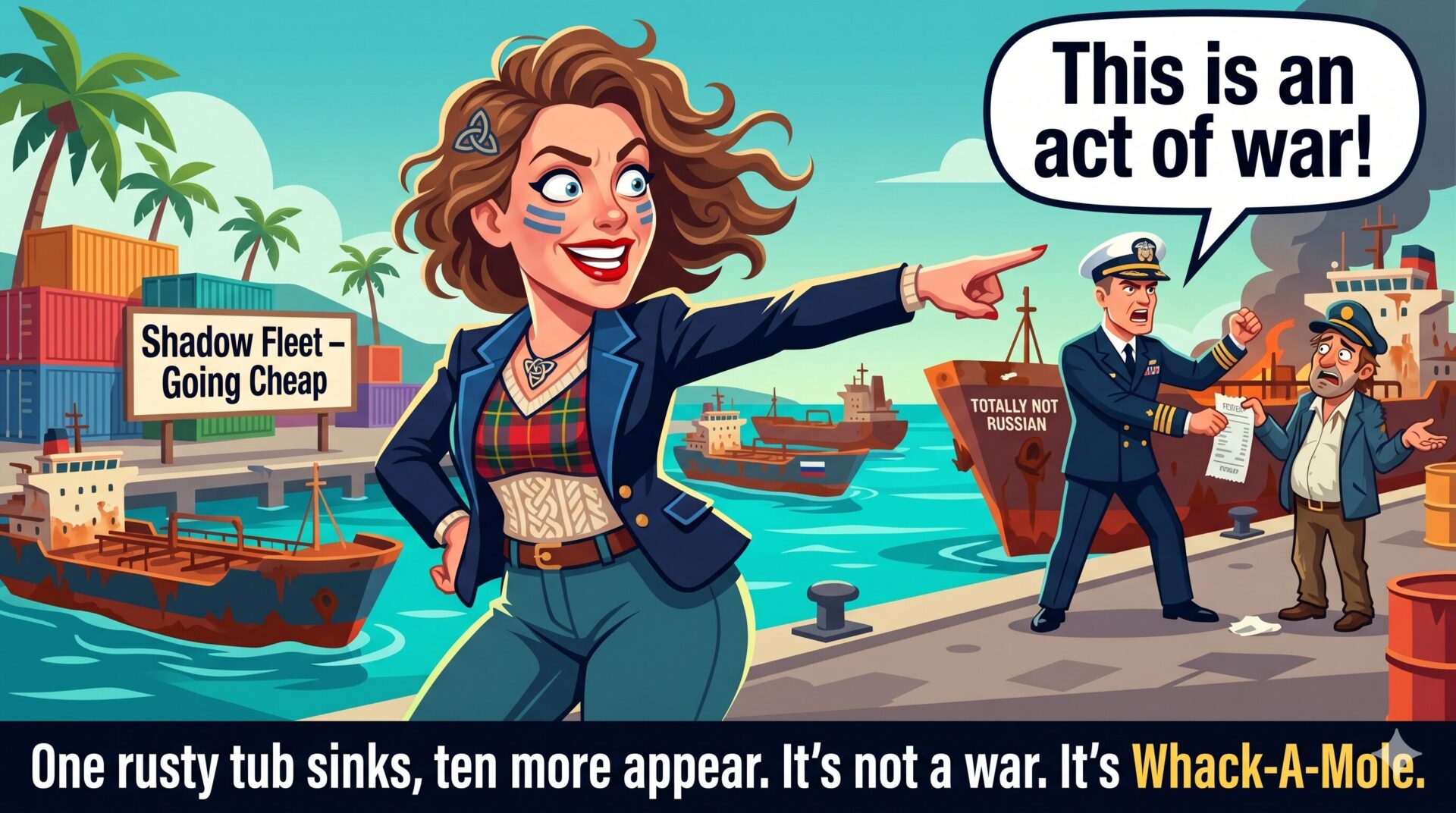 His Odessa prediction is clean. Tidy. Bloodless. Real war is none of those things. Real war is messy, chaotic, and full of suffering that no grand strategy can justify. The professor’s prediction ignores all of that because acknowledging it would make his job impossible.
The Cockney Verdict
So here’s the bottom line, from a geezer who’s seen enough real conflicts to know that predictions are cheap and blood is expensive. The professor’s NATO-Russia Odessa conflict is speculation, not prediction. It’s a guess. It’s a vibe. It’s a story he tells to keep you scared and watching.
He can’t tell you when it will happen. He can’t tell you how it will start. He can’t tell you which side will fire first. He can’t tell you anything specific at all. He just says “will fight” and lets your imagination do the rest.
As my nan used to say: “A blind man can guess the colour of the door. That doesn’t mean he can see.” The professor is blind. He’s guessing. Sometimes he’ll guess right. Most of the time, he won’t. But you’ll never know, because he never keeps score. He just moves on to the next guess, the next scare, the next prediction.
Don’t bet your peace of mind on a blind man’s guesses. Odessa might see war. It might not. But the professor’s certainty is a performance, not a prophecy. And the only thing he’s certain about is that you’ll keep watching.
The rest is just noise.
22.The East Asia Flashpoints: Yesterday’s Fears Dressed Up as Tomorrow’s Prophecies
There’s a saying you’ll hear in any pub that’s seen a few rounds of the news: “Same old wine in a shiny new bottle still gives you a hangover.” Our professor’s East Asia predictions are that wine. Taiwan. The Malacca Strait. North Korea. It’s the greatest hits album of Western anxiety about China – the same tracks that have been playing on repeat since the 1990s, remastered for YouTube. He adds nothing new. No fresh insight. No original research. Just the same old strategic talking points, delivered with the confidence of a man who thinks he’s the first to discover them.
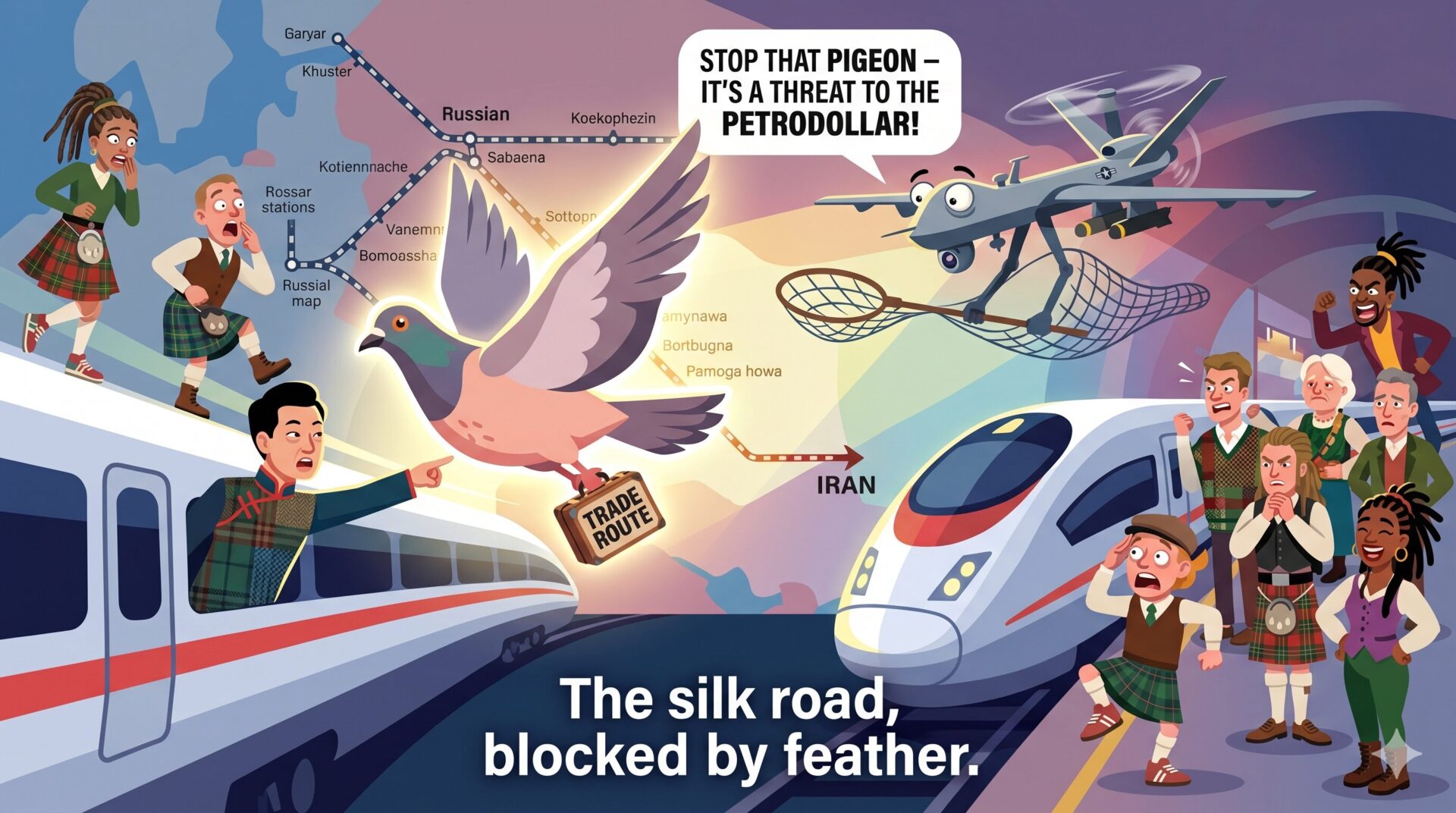 Let’s be honest. The professor’s East Asia analysis is like reading a foreign policy briefing from 2015. Actually, that’s unfair to 2015. At least back then, the idea that China might blockade the Malacca Strait or invade Taiwan was relatively fresh. Now it’s a cliché. It’s the stock background music of every think tank report, every Pentagon briefing, every alarmist documentary about the rise of China.
The professor presents these as predictions. But they’re not predictions. They’re the conventional wisdom of the Western security establishment. He’s just the messenger. And he’s charging you for the delivery.
The Adage of the Second-Hand News
My old nan used to say: “A parrot can repeat anything. That doesn’t make it a philosopher.” The professor is a parrot. He’s repeating what he’s read in strategy journals, heard on defence podcasts, seen in the mainstream media. He’s added a few maps, a laser pointer, and a dramatic voice. But the substance is the same. Taiwan is a flashpoint. The Malacca Strait is a chokepoint. North Korea is a wildcard. None of this is new. None of this is his. None of this deserves a subscription fee.
The tragedy is that his audience thinks they’re getting inside knowledge. They think the professor has cracked the code of East Asian geopolitics. But he’s just reading the menu that the Pentagon and the think tanks have been serving for decades. The only thing he’s cracked is the algorithm for turning conventional wisdom into content.
The Cockney Guide to Taiwan
Let me give you the real story on Taiwan, the way my old gaffer explained it after a few pints. “It’s not about democracy, son. It’s not about freedom. It’s about control – control of semiconductors, control of shipping lanes, control of face.” The professor touches on this, but only superficially. He says Japan would fight to keep Taiwan from unifying with China because Japan needs the Malacca Strait. That’s true, as far as it goes. But it’s also the same analysis you’d get from a low-level State Department intern.
What the professor misses is the human dimension. The people of Taiwan don’t want to be a flashpoint. They don’t want to be a pawn in a great power game. They want to live their lives, just like everyone else. The professor’s analysis treats them as a strategic asset to be fought over – chips, shipping lanes, military bases. He never asks what the working people of Taiwan actually want. He never asks if they’re tired of being the world’s most dangerous dot on a map.
That’s not a gap in his analysis. It’s a canyon. And it’s filled with the same dehumanising logic that turns every conflict into a board game.
The Malacca Strait: The Chokepoint That Never Chokes
Here’s the thing about the Malacca Strait. It’s been a “chokepoint” for fifty years. Every strategist since the 1970s has pointed at that narrow strip of water between Malaysia and Indonesia and said, “Whoever controls this controls East Asia.” China knows this. America knows this. Everyone knows this.
And yet, the strait has never been choked. Ships keep moving. Oil keeps flowing. Trade keeps happening. Why? Because choking it would be suicide. China needs the strait to survive, but so does Japan, South Korea, India, and half of Southeast Asia. Anyone who tried to blockade it would face not just China’s navy, but the combined navies of every country that depends on it. Even the Americans, with all their carriers, couldn’t pull that off without starting a war they’d lose.
The professor presents the Malacca Strait as a ticking bomb. But it’s a bomb that’s been ticking for half a century without going off. That’s not a prediction. That’s a refusal to update your priors.
The Adage About the Boy Who Pointed at the Sky
There’s a saying: “A child can point at the clouds and call them dragons. That doesn’t make it a warning.” The professor points at East Asia and calls it a powder keg. He’s been pointing for years. The keg hasn’t exploded. But he keeps pointing, because pointing is his job. And every time he points, someone subscribes.
The real dragons aren’t in the South China Sea. They’re in the boardrooms of London, New York, and Beijing. They’re the people who profit from fear, from military spending, from the constant state of alert that keeps working people anxious and docile. The professor’s East Asia flashpoints serve those dragons perfectly. They justify the aircraft carriers, the missile systems, the cyber commands. They turn real people into potential enemies. They make peace seem naive and war seem inevitable.
The Cockney Example: The Bloke Who’s Always Predicting a Fight
Imagine you’re in a pub in Stratford. There’s a bloke who’s always saying, “There’s going to be a fight outside tonight.” Every night, he says it. And some nights, there is a fight. Not because he predicted it. Because he provoked it. Or because fights happen in pubs. His prediction isn’t prophecy. It’s just statistical noise.
The professor is that bloke. East Asia has had tensions for decades. Sometimes those tensions flare up. When they do, the professor will claim he predicted it. But he didn’t predict the timing, the trigger, or the outcome. He just said “flashpoint,” and eventually, somewhere in East Asia, a flashpoint will flicker. That’s not prophecy. That’s playing the odds.
The Missing Class Analysis Again
Here’s the same gap we’ve seen throughout the professor’s performance. Where are the workers? In Taiwan, the workers are being told they’re on the front line of democracy. In China, the workers are being told they’re the backbone of national rejuvenation. In Japan, the workers are being told they’re defending the homeland. In Korea, the workers are being told they’re facing an existential threat.
But the workers on all sides have the same interests. They want peace. They want prosperity. They want their children to grow up without the shadow of war. The professor’s flashpoints ignore this solidarity. They treat nations as monoliths and workers as pawns. But workers are not pawns. They can refuse. They can organise. They can demand that their governments spend money on housing, healthcare, and education instead of aircraft carriers.
The professor never mentions this because it would undermine his entire framework. If workers on both sides of the strait realised they had more in common with each other than with their rulers, the flashpoints would fizzle. And the professor would have nothing to predict.
The Adage About the Firefighter
There’s a saying: “A firefighter who starts his own fires is never out of work.” The professor doesn’t start the fires – the ruling classes do that. But he fans the flames. He tells you the fires are inevitable, unstoppable, coming soon. He makes you afraid of the smoke before you’ve even seen the flame. And that fear – that constant, grinding anxiety – is his fuel.
 The real fire in East Asia isn’t Taiwan or the Malacca Strait. It’s the fire of exploitation, of inequality, of environmental destruction. It’s the fire that burns working people in every country, regardless of which flag flies over their parliament. The professor ignores that fire because it’s not dramatic. It’s not a flashpoint. It’s just everyday life. And everyday life doesn’t sell.
The Cockney Verdict
So here’s the bottom line, from a geezer who’s watched the same East Asia scares cycle through the news for thirty years. The professor’s flashpoints are not predictions. They’re reruns. He’s showing you the same episodes you’ve seen before, with the same characters, the same plot twists, the same cliffhangers. And like any good rerun, they’re comforting in their familiarity. You know what to expect. You know who the good guys are supposed to be. You know which side to cheer for.
But real life isn’t a rerun. Real life is messier, more complicated, and full of people who refuse to play their assigned roles. The professor can’t predict that. He can’t predict when a Taiwanese factory worker will decide that the enemy isn’t across the strait, but across the city – the landlord, the boss, the politician who sold out the union.
As my nan used to say: “The only thing that’s certain about the future is that it will surprise the experts.” The professor is an expert in being unsurprised. He’s an expert in the conventional wisdom. He’s an expert in telling you what you already fear.
But he’s not an expert in the future. Nobody is. And the only way to face the future without fear is to build solidarity with the people around you – not to watch videos about the people on the other side of the world.
The East Asia flashpoints might flare. They might not. Either way, your life will be shaped more by your rent, your wages, and your community than by any strait or island. Don’t let the professor’s reruns distract you from the show that’s happening on your own street. That’s the only one you can change.
23.The Manufacturing Capacity Claim: When a Truth Becomes a Trojan Horse
There’s a saying you’ll hear in any factory canteen from Sheffield to Slough: “A broken machine tells you the truth. It’s broken. But it doesn’t tell you how to fix it.” Our professor points at America’s manufacturing capacity – or lack thereof – and he’s not wrong. Deindustrialisation has gutted Western military production. The days when Detroit could churn out tanks and bombers like hot dinners are long gone. America can’t fight a long, high-intensity war without running out of shells, missiles, and spare parts. That’s a fact. Even the Pentagon admits it.
 But then the professor does his trick. He takes this genuine, verifiable truth – America’s industrial base is a shadow of its wartime self – and he uses it to build a whole new house of cards. He implies that this scarcity is why America will lose the war in Iran. He suggests that the empire is doomed because it can’t produce enough bullets. He makes it sound like the only thing standing between us and World War III is a few more assembly lines.
He draws the wrong conclusions. Not because the fact is wrong. Because the fact is a hammer, and he’s using it to smash the wrong nail.
The Adage of the Broken Spanner
My old nan used to say: “A broken spanner won’t fix a leaky pipe. But blaming the spanner won’t fix it either.” The professor blames the spanner. He says America’s manufacturing capacity is broken, therefore America will lose wars, therefore the empire is collapsing, therefore World War III is coming, therefore you should be terrified and keep watching.
But the real question isn’t why America can’t produce enough shells. The real question is why America needs to produce shells at all. Why is the answer to every geopolitical problem more weapons? Why is the solution to a shaky dollar a war? Why is the response to a rival railway a bombing campaign?
The professor accepts the premise that war is necessary. He just doubts America’s ability to wage it effectively. That’s not a radical critique. That’s a logistical complaint. He’s not saying “stop making weapons.” He’s saying “you’re not making enough weapons.” And that’s a world of difference.
The Cockney Guide to Deindustrialisation
Let me tell you about deindustrialisation the way my old gaffer told me about the docks. “They closed the shipyards, son. Not because we couldn’t build ships. Because they could build them cheaper where workers have no rights. And they didn’t care if we starved.”
Deindustrialisation wasn’t an accident. It was a choice. A choice made by the ruling class to maximise profits by moving production to countries with lower wages, weaker unions, and worse safety standards. The same ruling class that sold off British Steel, closed the coal mines, and turned the Midlands into a rust belt is the same ruling class that now complains America can’t build enough missiles.
The professor never mentions this. He treats deindustrialisation as a natural disaster, not a political decision. He talks about manufacturing capacity as if it’s a technical problem – more factories, more machines, more workers. But the workers who lost their jobs when the factories closed aren’t waiting for the Pentagon to call them back. They’re working in Amazon warehouses, zero-hours contracts, gig economy hell. They’ve been betrayed by the same system the professor claims to expose.
And the professor’s solution? More factories. More weapons. More war. Just built by American workers instead of Chinese ones.
That’s not a critique of the system. That’s nationalism in a different hat.
The Missing Alternative
Here’s what the professor’s manufacturing capacity claim leaves out. The real solution to the problem of war isn’t more weapons. It’s fewer wars. It’s no wars. It’s a world where manufacturing capacity is used to build homes, hospitals, and wind turbines, not bombs.
The professor never entertains that possibility because it would undermine his entire worldview. If you don’t need to fight wars, you don’t need to predict them. If you don’t need to predict them, you don’t need to watch his videos. So he stays within the framework of war – arguing about who can fight better, who has more shells, who will win or lose. But he never asks the only question that matters to working people: why are we fighting at all?
The Adage About the Arms Race
There’s a saying: “An arms race is like two blokes drowning each other to see who can hold their breath longer.” The professor analyses the drowning technique. He measures lung capacity, kicking efficiency, water temperature. He never asks why they’re in the water in the first place. He never suggests they both climb out.
 America’s manufacturing capacity is a problem for the American empire. Good. Let it be a problem. Let the empire choke on its own inability to produce enough shells. That’s not a crisis for working people. That’s an opportunity. Because an empire that can’t make weapons is an empire that can’t wage war. And an empire that can’t wage war is an empire that has to negotiate, to compromise, to maybe – just maybe – learn to live in peace with the rest of the world.
The professor presents deindustrialisation as a tragedy. I present it as a chance. The difference is that I don’t want more wars, better fought. I want no wars at all.
The Cockney Example: The Bloke Who Worries About His Punch
Imagine two blokes arguing in a pub. One says, “I’ve lost strength in my right arm. I can’t punch as hard.” The other says, “Then stop trying to punch people, you idiot.” That’s the professor and me. The professor is the first bloke. He’s worried about his punching power. I’m the second. I’m wondering why he wants to punch anyone in the first place.
America’s manufacturing capacity is its right arm. It’s weaker now. That’s a fact. The professor thinks this is a problem because America needs to punch Iran, Russia, China. I think it’s a solution because America shouldn’t be punching anyone. The empire’s weakness is the world’s gain.
The Real Conclusion the Professor Misses
Here’s the conclusion the professor could have drawn but didn’t. If America can’t fight long wars, then the era of American military intervention might be ending. Not because of morality. Because of logistics. The empire is constipated. It can’t shit out armies the way it used to. That’s not a cause for panic. It’s a cause for relief.
But the professor can’t say that because his audience would stop watching. They’re not watching to hear that the world is becoming safer. They’re watching to hear that the world is ending. So he takes a truth – deindustrialisation – and twists it into a terror. “America can’t fight wars! That means collapse! That means chaos! That means World War III!”
No. It means America can’t fight wars. That’s it. That’s the whole thing. The rest is his imagination.
The Adage About the Broken Sword
There’s a saying: “A broken sword can’t cut you. That’s not a tragedy. That’s safety.” The professor treats America’s broken sword as a tragedy. He mourns the loss of imperial punching power. He wrings his hands about the collapse of Western manufacturing. He sees a world where the bully has lost his muscle and calls it a crisis.
I see a world where the bully has lost his muscle and call it a chance. A chance for the rest of us to stand up, to organise, to build a world that doesn’t need bullies. The professor can’t see that because he’s still looking at the bully. He’s still measuring the bully’s biceps. He’s still predicting the bully’s next punch.
But the bully’s next punch might be the last one that lands. And if the bully can’t punch, maybe – just maybe – we can stop flinching and start building.
The Cockney Verdict
So here’s the bottom line, from a geezer who’s watched factories close and wars start, and who knows which one hurt more. The professor’s manufacturing capacity claim is true. America can’t fight a long war. But that’s not a prediction of doom. It’s a description of reality. And reality, in this case, is on our side.
The empire is weaker than it pretends. Its factories are rusting. Its supply chains are fragile. Its workers are tired of dying for oil. These are not problems to be solved by rearming. They are opportunities to be seized by disarming.
As my nan used to say: “Don’t fix the weapon. Throw it away.” The professor wants to fix America’s manufacturing capacity so America can keep fighting. I want to throw the weapons away so no one has to fight at all.
The truth about deindustrialisation is a tool. The professor uses it to build more fear. Use it instead to build hope. The empire can’t punch forever. One day, it’ll run out of arms. And on that day, we can finally stop ducking and start dancing.
24.The Shock and Awe Mythology: When a Massacre Becomes a Magic Trick
There’s a saying you’ll hear in any pub that’s seen a few veterans: “The first punch is easy. It’s the rest of the fight that kills you.” Our professor describes the 2003 invasion of Iraq as a clean, quick victory. Shock and awe. Decapitation strike. Two weeks, and Baghdad fell. The regime collapsed. The war was over. He uses this as a contrast to Iran – flat desert versus mountain fortress. Iraq was easy, he says. Iran will be hard.
Let’s stop right there. The professor’s description of the Iraq War is not just incomplete. It’s a lie. Not a small lie. A whopper. The kind of lie that gets people killed.
The invasion was quick. That’s true. The conventional war – tanks against tanks, planes against air defences – lasted a few weeks. The American military rolled into Baghdad, toppled the statue of Saddam, declared mission accomplished. But that wasn’t the end of the war. It was the beginning. The occupation lasted nearly nine years. The insurgency killed over 4,000 American soldiers and hundreds of thousands of Iraqis. Millions were displaced. The country was destroyed. Sectarian violence exploded. ISIS rose from the ashes.
 The professor mentions none of this. He presents the Iraq War as a successful model of shock and awe, ignoring the subsequent decade of horror. That’s not analysis. That’s propaganda for the military-industrial complex, dressed up in a tweed jacket.
The Adage of the Iceberg
My old nan used to say: “The tip of the iceberg looks small. It’s what’s underneath that sinks the ship.” The professor shows you the tip – the shiny, quick, victorious invasion. He hides the iceberg – the occupation, the insurgency, the torture at Abu Ghraib, the massacre at Fallujah, the rise of ISIS, the millions of orphans, the cities still in rubble twenty years later.
Why does he hide it? Because it doesn’t fit his narrative. His narrative needs Iraq to be a clean success so that Iran can be a messy failure. He needs the contrast. But the contrast is false. Iraq was not a success. It was a catastrophe. And the professor’s sanitised version of history serves the same purpose as the Pentagon’s press briefings – to make war look manageable, surgical, even noble.
The Cockney Guide to What Actually Happened
Let me tell you about the Iraq War the way my mate Dave – who did two tours in Basra – told me. “They said it would be over by Christmas. First Christmas, I believed ’em. Second Christmas, I knew they were lying. Third Christmas, I didn’t care anymore. I just wanted to come home.”
The invasion was quick because the Iraqi army melted away. Not because America was brilliant. Because Saddam had spent years gutting his own military. The real fight started when the Americans tried to occupy a country that didn’t want them. Every day for nine years, bombs went off. Every day, someone died. Every day, more resentment built. By the time the Americans left, Iraq was worse than before.
The professor’s “shock and awe” myth is the official story. The one the generals tell when they’re trying to sell the next war. “Look how easy Iraq was,” they say. “We can do the same to Iran.” But Iraq wasn’t easy. It was a disaster. And anyone who pretends otherwise is either ignorant or dishonest.
The Missing Millions
Here’s a number the professor never mentions: at least 300,000. That’s the estimated number of Iraqis killed in the war and occupation. Some estimates go over a million. Either way, it’s a genocide. That’s not collateral damage. That’s not the cost of doing business. That’s industrial-scale slaughter.
The professor talks about “decapitation strikes” and “regime collapse” as if they’re abstract concepts. He never mentions the families buried under rubble. The children who lost parents. The parents who lost children. The generations traumatised by violence that had nothing to do with them.
Why? Because mentioning them would make his audience uncomfortable. His audience wants geopolitics as a sport – wins and losses, strategies and tactics, kings and queens. They don’t want to hear about the pawns who actually die. So the professor obliges. He gives them the bloodless version. The version where war is a game.
The Adage About the Surgeon
There’s a saying: “A surgeon who doesn’t feel the knife doesn’t feel the patient’s pain.” The professor doesn’t feel the knife. He’s never held a dying soldier. He’s never watched a city burn. He’s never explained to a child why their father isn’t coming home. He’s not a bad person. He’s just removed. So removed that he can talk about shock and awe without a tremor in his voice.
But removal isn’t analysis. It’s detachment. And detachment in the face of mass death is not intellectual rigour. It’s moral failure.
The Cockney Example: The Bloke Who Loved the First Round
Imagine a bloke at the boxing who only watches the first round. He sees the flashy punches, the quick knockdown. He cheers. He calls it a great fight. He ignores the next eleven rounds where both fighters are battered, bleeding, barely standing. That’s the professor. He only watches the first round of the Iraq War. The invasion. The victory parade. The mission accomplished banner.
He never watches the rounds that came after. The rounds where the real damage was done. Because watching those rounds would ruin his theory. And his theory is all he’s got.
The Real Lesson of Iraq
Here’s the lesson the professor should have drawn from Iraq but didn’t. Shock and awe doesn’t work. Decapitation strikes don’t end wars. You can kill a dictator, but you can’t kill an idea. You can bomb a capital, but you can’t bomb a people into submission. The occupation is the war. The insurgency is the war. The long, grinding, bloody aftermath is the war.
The professor uses Iraq to say: “America won quickly because Iraq was flat.” The real lesson is: “America didn’t win at all. It just started a longer, uglier, more pointless war.”
 He doesn’t draw that lesson because it doesn’t fit his Iran narrative. He needs America to lose in Iran, but he needs America to have won in Iraq. The truth is, America lost in both. It lost in Iraq because you can’t “win” an occupation. It will lose in Iran because you can’t “win” an invasion of a country that doesn’t want you.
The difference isn’t geography. It’s the same fundamental error – believing that military power can solve political problems. The professor has made that error his entire framework. He just disagrees about which side will lose faster.
The Propaganda Function
Here’s the uncomfortable truth. The professor’s version of the Iraq War – clean, quick, victorious – is the same version the Pentagon wanted you to believe. It’s the same version that sold the war to the American public. It’s the same version that legitimised the invasion of Iraq as a “success” that could be repeated in Iran.
The professor claims to be exposing the system. But on this point, he’s parroting the system. He’s repeating the official mythology of shock and awe. He’s laundering the propaganda of the military-industrial complex through his “independent” platform.
Why? Because it’s easier. Because the clean version fits his narrative. Because the messy version – the real version – would require him to condemn the entire enterprise. And condemning the entire enterprise would mean admitting that the problem isn’t America’s tactics. It’s America’s existence as an empire.
That’s a step too far for the professor. So he stops at “America used shock and awe in Iraq and it worked.” Even though it didn’t. Even though no honest analyst believes it did.
The Adage About the Magician
There’s a saying: “A magician’s trick only works if you don’t look behind the curtain.” The professor’s Iraq trick depends on you not looking at the occupation. He shows you the invasion – the flash, the smoke, the falling statue – and declares victory. Behind the curtain are nine years of hell. But he’s already moved on to the next trick.
Don’t be the audience. Look behind the curtain. See the bodies. See the refugees. See the destroyed cities. See the veterans who came home broken. That’s the real Iraq War. The professor’s version is a lie. A lie that serves the same purpose as every other war lie – to make the next war possible.
The Cockney Verdict
So here’s the bottom line, from a geezer who’s seen the memorials and met the mothers. The professor’s “shock and awe” mythology is not analysis. It’s propaganda. It’s the sanitised, Pentagon-approved version of history that ignores the occupation, the insurgency, the hundreds of thousands dead, the millions displaced. It’s the version that makes war look clean so that the next war can be sold.
As my nan used to say: “A clean fight is a contradiction in terms. There’s no such thing.” The professor sells you clean fights. Quick victories. Surgical strikes. But real fights are dirty, endless, and full of people who didn’t ask to be there.
Don’t buy the clean version. The occupation is the war. The insurgency is the war. The suffering is the war. And anyone who tells you otherwise is selling you something. In the professor’s case, it’s subscriptions.
The Iraq War wasn’t a victory. It was a crime. And no amount of shock and awe can wash the blood off that truth.
25.The Decapitation Strike Fantasy: When Killing the King Becomes a Bloody Joke
 There’s a saying you’ll hear in any pub from Whitechapel to Wapping: “Cut off the head and the body dies – but only if the body hasn’t already learned to think for itself.” Our professor loves the decapitation strike. Chop off the head of the snake, he says, and the snake dies. Iraq, 2003. Delta Force in Venezuela, kidnapping Maduro. That’s his proof. Kill the leader, the regime collapses, war over. Simple. Clean. Bloody good television.
Except it’s not true. It’s never been true. And the professor knows it, or should know it, because the evidence is everywhere. Decapitation strikes have been tried again and again – against Saddam Hussein (missed), against Osama bin Laden (eventually got him, but Al-Qaeda didn’t die), against Muammar Gaddafi (killed him, Libya collapsed into civil war and slavery markets), against ISIS leaders (killed dozens, ISIS kept fighting). The list goes on. The pattern is clear. Killing a leader doesn’t end a war. It just creates a power vacuum, and power vacuums are where new, often nastier, leaders grow.
The professor presents decapitation as a viable military strategy. It’s not. It’s a fantasy. A fantasy that Hollywood loves, that generals sometimes indulge, and that the professor repeats because it makes his predictions more dramatic. But reality is messier. Bodies learn to fight without heads. Snakes grow new ones. And the people who actually do the fighting – the working-class conscripts, the middle-ranking officers, the local militias – they don’t just give up because some bloke in a palace got a missile through his window.
The Adage of the Hydra
My old nan used to say: “Chop off one head of the hydra, and two grow back. You need to burn the neck.” The professor only wants to chop. He never talks about burning. He never talks about the underlying conditions that make insurgencies possible – the poverty, the occupation, the humiliation, the foreign troops on sacred soil. Killing a leader doesn’t burn those conditions. It just leaves them in place, waiting for the next ambitious colonel or fiery cleric to step into the vacancy.
Iran, the professor’s current obsession, is a perfect example. The country is run by a complex system of clerics, military commanders, and elected officials. The Supreme Leader is the head, but there are a dozen other heads underneath. Kill Khamenei, and you still have the IRGC, the Basij, the Assembly of Experts, the whole apparatus. They’re not going to surrender because their figurehead is gone. They’re going to fight harder, because now they’re scared, and scared people with guns are dangerous.
The professor’s decapitation fantasy ignores all of this. He treats Iran as if it’s a one-man show. It’s not. It’s a system. And systems don’t die when you remove one component.
The Cockney Guide to What Actually Happens
Let me tell you what actually happens after a decapitation strike, the way my old gaffer explained it after a few pints. “The lads get angry, son. They don’t go home. They find a new leader. And they want revenge.”
Look at the United States itself. If someone killed the president, would America surrender? Would the military lay down its arms? Would the CIA shut down? Of course not. There’s a chain of command. A line of succession. The country would grieve, then get angry, then hunt down whoever did it. The war wouldn’t end. It would escalate.
Why would Iran be any different? Because they’re not like us? Because they’re religious fanatics who’ll collapse if you remove their icon? That’s Orientalism dressed up as strategy. Iranians are human beings. They react the same way anyone would – with shock, then rage, then a determination to make the attackers pay.
The professor’s fantasy depends on dehumanising the enemy. On seeing them as puppets who can’t function without their string-puller. That’s not analysis. That’s prejudice.
The Missing Evidence
Here’s what the professor never provides: a single example where a decapitation strike actually ended a war. Not a single one. You’d think with all his certainty, he’d have a list. Iraq? No. Libya? No. Somalia? No. Yemen? No. Afghanistan? They killed bin Laden in 2011, and the war lasted another ten years. Colombia? They killed Pablo Escobar in 1993, and the drug trade continued. Every time, the pattern is the same. The leader dies. The organisation fragments, mutates, or gets replaced. But it doesn’t disappear.
The professor doesn’t mention any of this because it would undermine his entire framework. His framework needs decapitation to work so that he can contrast it with Iran’s geography. “Shock and awe worked in Iraq because it was flat. It won’t work in Iran because it’s mountainous.” But shock and awe didn’t work in Iraq. It just looked like it did for two weeks. Then the real war started.
The professor is comparing two fantasies – the fantasy of Iraq as a clean victory and the fantasy of Iran as an impossible fortress. Both are wrong. The reality is that both wars are unwinnable. Not because of mountains. Because of people.
The Cockney Example: The Bloke Who Thinks He’s a Kingpin
Imagine a pub in Bethnal Green. The landlord is a bit of a bully. Everyone does what he says. One night, a rival pub sends over some heavies and takes him out. Now what? Does the pub shut down? Do the regulars go home? No. Someone else steps up – the barmaid, the doorman, the bloke who always sits in the corner. The pub carries on. The fight continues.
That’s decapitation. The kingpin dies. The system adapts. The war doesn’t end. It just changes shape. The professor’s fantasy that killing the leader ends the war is like thinking that sacking the manager wins the league. It doesn’t work that way. The players are still there. The fans are still there. The game goes on.
The Real Decapitation
Here’s the uncomfortable truth. The only way decapitation works is if you kill everyone. Not just the leader. The entire leadership. The military command. The party officials. The bureaucrats. The families. The supporters. Everyone. That’s not decapitation. That’s genocide. And even genocide doesn’t always work – ask the Armenians, the Jews, the Rwandans. Survivors remember. Survivors organise. Survivors rebuild.
The professor doesn’t advocate genocide, obviously. But his fantasy of a clean, surgical decapitation is the acceptable face of that impulse. “Just kill the bad guy and it’s over.” But the bad guy is never just one person. The bad guy is a system. And you can’t kill a system with a missile.
The Adage About the Field
There’s a saying: “You can cut the flower, but the roots remain.” The professor wants to cut the flower. Chop off the head of the snake. Kill the leader. He never digs up the roots. He never asks why Iran has the system it has – the history of foreign interference, the coup of 1953, the support for the Shah, the Iran-Iraq war, the sanctions. Those roots are deep. And they don’t die when a leader dies.
The roots are what matter. The roots are the conditions that produce leaders. Change the conditions – end the sanctions, withdraw the troops, respect the sovereignty – and the leaders become less important. The professor never talks about roots because roots are complicated. Roots take time. Roots don’t fit in a tweet or a YouTube short. Roots require you to look at your own country’s role in creating the problems you’re trying to solve.
That’s uncomfortable. The professor prefers comfort.
The Cockney Verdict
So here’s the bottom line, from a geezer who’s seen enough regime changes to know that the new boss is usually the same as the old boss. The decapitation strike is a fantasy. It’s never worked. It will never work. And the professor knows it, or should know it.
He repeats it because it’s dramatic. Because it makes war sound like a snooker game – pot the black, game over. But war isn’t snooker. It’s a never-ending cycle of violence, revenge, and grief. Killing the leader doesn’t stop the cycle. It just adds another name to the list of martyrs.
As my nan used to say: “The king is dead, long live the king. Nothing changes except the face on the money.” The professor wants you to believe that changing the face changes everything. It doesn’t. The system remains. The suffering continues. And the only thing that changes is the name of the bloke in the palace.
Don’t fall for the fantasy. The head isn’t the problem. The body is. And the body is all of us – the working class, in every country, who get sent to die so that kings can be crowned and decapitated. The only decapitation that matters is the decapitation of the system itself. And that won’t come from a missile. It’ll come from people refusing to play the game.
That’s not a prediction. That’s a decision. And it’s the only one worth making.
26.The National Defense Strategy Document: When the Map Becomes the Territory
There’s a saying you’ll hear in any Whitehall canteen from Westminster to Woolwich: “A strategy is what you write when you’ve no idea what you’re actually going to do.” Our professor waves around the National Defense Strategy document like a holy text. He quotes it. He cites it. He treats it as proof of American intentions, as if a PDF on the Pentagon’s website is the same as what happens on the ground. “It’s all in here,” he says, tapping the paper. “The four-point plan. Fortress America. Divide and rule. It’s a clear road map.”
Let’s stop right there. Anyone who’s ever watched a government operate – any government, anywhere – knows the gap between a strategy document and actual behaviour is vast enough to drive a convoy of lorries through, side by side, with room for a bus lane. Strategy documents are written by committees. They’re designed to please everyone. They’re full of waffle, contradiction, and wishful thinking. And most importantly, they’re not binding. They’re not laws. They’re not even promises. They’re aspirations. New Year’s resolutions for the military-industrial complex.
The professor treats them as scripture. As if the Pentagon actually does what it writes. As if the White House reads the National Defense Strategy and says, “Right lads, let’s follow the plan.” Anyone who’s watched the last twenty years of American foreign policy knows that’s bollocks. The strategy says one thing. The generals do another. The politicians ignore both. And the result is chaos, not coherence.
The Adage of the Cookbook
My old nan used to say: “A cookbook is not a meal. You can have all the recipes in the world. If you can’t cook, you’re still hungry.” The National Defense Strategy is a cookbook. It’s a recipe. It’s a list of ingredients and instructions. But the Pentagon is a terrible cook. It burns the soufflé, forgets the salt, and sets the kitchen on fire. Then it blames the recipe and writes a new one.
The professor acts as if the recipe is the meal. As if writing “secure the Western Hemisphere” means the Western Hemisphere is secured. As if “rejuvenate America’s defence manufacturing” means factories are humming. As if “put China in its place” means China is contained. He confuses intent with outcome, aspiration with reality. And his audience, not knowing any better, believes him.
The Cockney Guide to How Government Actually Works
Let me explain how government actually works, the way my old gaffer explained the council. “They write a plan, son. Then they ignore it. Then they write another plan. Then they forget where they put the first one. Then some crisis happens, and they make it up as they go along.”
The National Defense Strategy is a plan. It’s a good plan, maybe. A coherent plan. A scary plan, if you’re on the wrong end of it. But it’s still a plan. And plans meet reality. Reality is messy. Reality is the Chinese navy showing up where you didn’t expect them. Reality is the Russians doing something stupid. Reality is a war in Gaza that wasn’t in the strategy. Reality is an election that throws the whole thing in the bin.
The professor treats the strategy as destiny. As if the world will obediently follow the Pentagon’s script. But the world doesn’t follow scripts. The world is improvisation. And the Pentagon, for all its power, is a terrible improviser. It writes beautiful strategies. Then it stumbles through the dark, bumping into furniture, blaming everyone else.
The Missing Gap
Here’s what the professor never mentions. The National Defense Strategy from 2018 said America’s priority was great power competition with China and Russia. Then Covid happened. Then the withdrawal from Afghanistan happened. Then Ukraine happened. Then Gaza happened. Each time, the strategy got revised, ignored, or directly contradicted.
The 2022 strategy said climate change is a national security priority. Then the Pentagon continued to be one of the world’s largest carbon emitters. The strategy said “integrated deterrence.” Nobody knows what that means. The strategy said “campaigning” – another empty word. These documents are full of jargon because they’re designed to be vague enough that no one can hold anyone to anything.
The professor presents them as precise, actionable plans. They’re not. They’re press releases for the defence industry.
The Cockney Example: The Bloke with the Business Plan
Imagine a bloke in a pub in Croydon. He’s got a business plan. It’s four pages long. It says he’s going to open a chain of pie and mash shops across South London. He’s got projections. He’s got market research. He’s got a timeline. He shows it to everyone. “This is my strategy,” he says. “This is how I’m going to dominate.”
Then you ask him how much capital he’s got. He says, “I’m working on it.” You ask if he’s found any premises. He says, “I’m looking.” You ask if he’s hired any staff. He says, “Soon.” His strategy is a fantasy. It’s not a plan. It’s a dream written down.
The Pentagon’s strategy is the same. It’s a dream. A dream of control, of dominance, of a world that obeys American commands. But the Pentagon doesn’t have the money, the manpower, or the political will to make it real. The professor treats the dream as a done deal. It’s not. It’s a wish list.
The Real Strategy
Here’s the real strategy, the one the professor doesn’t quote because it’s not written down. The real strategy is: keep the money flowing to defence contractors. Keep the generals promoted. Keep the bases open. Keep the wars going, but not so hot that the public notices. That’s it. That’s the whole thing. Everything else – the four-point plan, the chess pieces, the grand strategy – is window dressing for Congress and the public.
The National Defense Strategy is a sales document. It’s designed to convince politicians to vote for more funding. It’s designed to scare the public into accepting higher military spending. It’s designed to justify the existence of an institution that has no other purpose than to prepare for wars that never come or to fight wars that never end.
The professor treats it as genuine analysis. But it’s not analysis. It’s propaganda. Propaganda that the professor has mistaken for truth because he’s too close to the source. He’s read the document so many times that he’s forgotten it’s written by people whose job is to make war sound necessary.
The Adage About the Blueprint
There’s a saying: “A blueprint is not a building. You need bricks, mortar, and someone who knows how to lay them.” The Pentagon has plenty of blueprints. It has bricks? Debatable. Mortar? Running out. Bricklayers? They’re quitting, retiring, or refusing to enlist. The professor shows you the blueprint and says, “Look, a building.” But the building doesn’t exist. It’s a hole in the ground with a planning application.
America’s military power is real. But it’s not as real as the Pentagon pretends. The gap between what the strategy promises and what the military can deliver is enormous. The professor ignores that gap because acknowledging it would undermine his authority. He’s the man with the blueprint. He doesn’t want you asking about the bricks.
The Cockney Verdict
So here’s the bottom line, from a geezer who’s watched governments write strategy documents and then do the exact opposite, every single time. The National Defense Strategy is a document. It’s a piece of paper. It’s a PDF. It is not a prediction. It is not a guarantee. It is not a crystal ball. It’s what the Pentagon would like to do, in a perfect world, with infinite money and no political opposition.
But the world isn’t perfect. Money isn’t infinite. And political opposition is everywhere – in Congress, in allied capitals, in the streets, in the hearts of young people who don’t want to die for oil.
The professor treats the strategy as if it’s already happened. As if “America will secure the Western Hemisphere” means the Western Hemisphere is secured. But Venezuela is still standing. Cuba is still standing. Canada is still standing – and not looking particularly conquered. Greenland hasn’t been bought. Mexico hasn’t been invaded. The strategy is a wish. The reality is different.
As my nan used to say: “A man with a plan is still just a man. It’s the doing that counts, and the doing is always harder than the saying.”
The professor has confused the saying with the doing. He’s read the plan and declared the plan reality. But reality is what happens when the plan meets the world. And the world has a habit of laughing at plans.
Don’t mistake a PDF for power. The National Defense Strategy is not the Fourth of July. It’s a memo. And memos get ignored, revised, and binned. The only thing that matters is what they actually do. And what they actually do is rarely what they said they’d do.
Trust your eyes, not the document. Watch what they do, not what they write. And remember: a strategy is just a promise. And promises, in politics, are made to be broken.
27.The Western Hemisphere Fortress: When an Old Policy Gets a New Wig
There’s a saying you’ll hear in any pub from Paddington to Ponders End: “Don’t sell me tomorrow’s fish when yesterday’s is still on the slab.” Our professor talks about America controlling the Western Hemisphere as if it’s a shocking new prediction. “The United States will secure the Western Hemisphere,” he says. “The Western Hemisphere belongs to America. Therefore, you cannot trade with any of these countries without American permission.”
 Let’s be honest. This isn’t a prediction. It’s a description of American foreign policy that’s been around since the 1820s. The Monroe Doctrine – “America for the Americans” – was declared in 1823. That’s over two hundred years ago. Every president since has reiterated it, enforced it, and expanded it. The professor is acting like he’s discovered a secret plan. But he’s just reading the back of a very old, very public book.
The Western Hemisphere fortress isn’t a coming attraction. It’s the current feature. America has been treating Latin America as its backyard for two centuries. It’s invaded Mexico, Spain, Panama, Nicaragua, Honduras, Guatemala, the Dominican Republic, Haiti, Grenada, and countless others. It’s overthrown governments in Chile, Brazil, Argentina, Bolivia, Guatemala, and Venezuela. It’s maintained a blockade against Cuba for sixty years. It’s policed the Caribbean with its navy since the Spanish-American War.
The professor presents this as a Trump innovation. As a “Donro Doctrine” – Trump’s corollary to the Monroe Doctrine. But Trump is just the latest in a long line of American presidents who’ve treated the Western Hemisphere as their private estate. The professor’s “prediction” is like predicting the sun will rise tomorrow. It’s not prophecy. It’s description.
The Adage of the Old Joke
My old nan used to say: “If you tell the same joke for fifty years, don’t be surprised when nobody laughs.” The professor is telling the same joke. The Monroe Doctrine is two hundred years old. The Roosevelt Corollary – “America will intervene to keep Europeans out” – is a hundred and twenty. The professor’s version – “Trump’s corollary” – is just a fresh coat of paint on a very old fence.
 He acts as if he’s revealing a dark secret. But the secret has been public since before his grandparents were born. Every schoolchild in the Americas learns about the Monroe Doctrine. Every foreign policy expert takes it for granted. The professor’s audience, perhaps not familiar with the history, thinks he’s uncovered a conspiracy. He hasn’t. He’s just reading the syllabus.
The Cockney Guide to What’s Actually Happening
Let me explain the Western Hemisphere the way my old gaffer explained the local manor. “There’s a big geezer on the estate. He says nobody moves without his say-so. He’s been saying it for years. Sometimes he throws his weight around. But mostly, people just ignore him and get on with their lives.”
America is the big geezer. It shouts about the Monroe Doctrine. It throws its weight around – sanctions, coups, the occasional invasion. But the countries of Latin America have been quietly building their own relationships – with China, with Russia, with the European Union. They trade with whomever they want. They join organisations that exclude the United States. They assert their own sovereignty.
The professor’s “fortress America” ignores this reality. He talks as if America can simply declare the Western Hemisphere closed and the world will obey. But the world doesn’t obey. China is building ports in Peru, Chile, and Brazil. Russia is selling weapons to Venezuela, Nicaragua, and Cuba. The United States can’t stop any of it without starting wars it can’t win.
The fortress exists on paper. In practice, it’s a sieve.
The Missing History
Here’s what the professor never mentions. The Monroe Doctrine was a product of its time – a time when European empires were still carving up the Americas. It was a warning to Spain, France, and Britain: stay out. But those empires are gone. Latin America is independent. And many of its countries are now major economies in their own right.
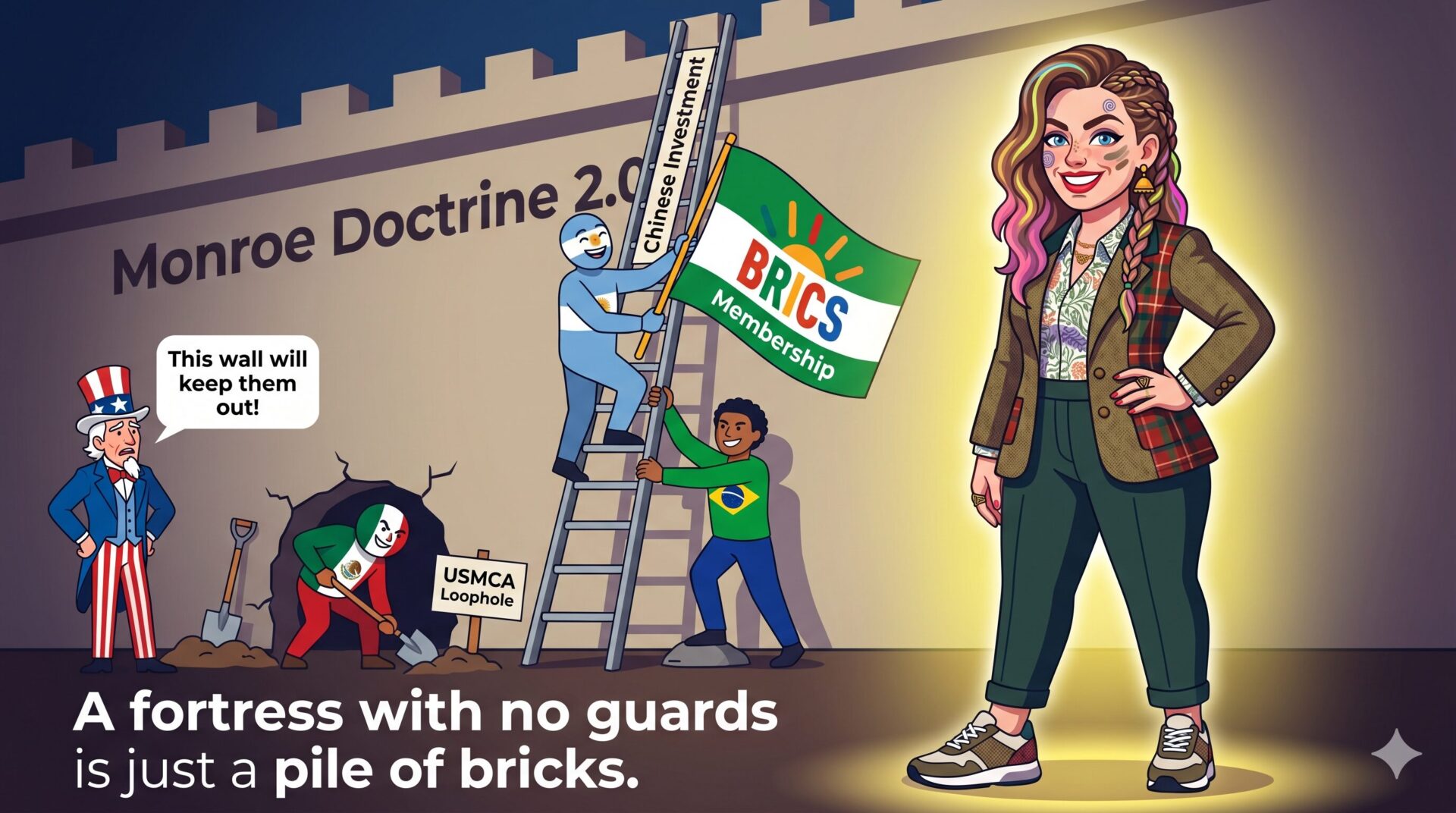 Brazil is a BRICS member. Mexico is a top trading partner with the United States and China. Argentina has its own geopolitical ambitions. These aren’t American puppets. They’re sovereign states with their own interests. The professor treats them as objects – territory to be controlled, resources to be extracted, trade to be policed. He never asks what the people of those countries want. He never asks if they consent to being part of a “fortress.”
They don’t. And that’s why the fortress has never been as solid as the professor imagines.
The Cockney Example: The Bloke Who Thinks He Owns the Street
Imagine a bloke in a terraced house in Stepney. He’s lived there for thirty years. He thinks he owns the street. He tells the neighbours where to park, when to put out their bins, who can visit. They smile, nod, and ignore him. Then they do what they were going to do anyway.
That’s America. It thinks it owns the Western Hemisphere. It issues declarations. It threatens sanctions. It sends gunboats. But the neighbours – Brazil, Mexico, Argentina, Chile, Peru – they’ve learned to smile, nod, and ignore. They trade with China. They host Russian officials. They build their own alliances. And America, for all its bluster, can’t stop them.
The professor’s “fortress” is the bloke’s delusion. It’s not a prediction. It’s a tantrum.
The Real Revelation
Here’s the real revelation that the professor missed. The Monroe Doctrine is dying. Not because America has abandoned it, but because the world has outpaced it. China is now the largest trading partner for most Latin American countries. The United States can’t compete with Chinese investment, Chinese loans, Chinese infrastructure projects. The Western Hemisphere is no longer an American lake. It’s a shared ocean.
The professor’s “prediction” that America will control the hemisphere is actually a lament for a control that’s already slipping away. He’s not telling you what’s coming. He’s telling you what’s ending. And he’s dressing it up as a new strategy because that’s more dramatic.
The Adage About the Wall
There’s a saying: “A wall only keeps people out if they want to stay out. If they want to come in, they’ll find a way over, under, or through.” America’s Western Hemisphere fortress is a wall. It’s been there for two hundred years. And people have been ignoring it for two hundred years. They trade, they travel, they ally, they resist. The wall has never worked as advertised. It’s never kept the hemisphere purely American.
The professor talks about the wall as if it’s just been built. As if Trump invented it. As if it’s now going to work. But the wall is old, crumbling, and full of holes. The professor is selling you a renovation that isn’t happening.
The Cockney Verdict
So here’s the bottom line, from a geezer who’s watched the United States throw its weight around and seen the weight get lighter every decade. The Western Hemisphere fortress isn’t a prediction. It’s a description of a policy that’s been failing for two hundred years. America wants to control the hemisphere. It can’t. It never fully could. And it’s not about to start.
The professor presents this as a shocking new development. It’s not. It’s the same old song, with a different singer. The Monroe Doctrine was old when his grandad was young. Trump’s “corollary” is just a footnote. The fortress is a fantasy. The only thing that’s real is the bluster.
As my nan used to say: “The dog that barks the loudest is usually the one chained to the shortest post.” America barks about the Western Hemisphere. But its post is shorter than it used to be. China is building ports. Russia is selling missiles. Brazil is leading its own bloc. The fortress is a kennel, not a castle.
Don’t be fooled by the professor’s dramatic delivery. He’s not revealing a secret plan. He’s reading the back of a pamphlet that’s been in the library for decades. The only thing new about the Western Hemisphere fortress is the wrapper. And the wrapper doesn’t change what’s inside – an old, tired, failing policy that’s been out of date since the Berlin Wall fell.
The world has moved on. The professor hasn’t noticed. Don’t make the same mistake.
28.The China Grand Bargain: When a Maybe Becomes a Definitely
There’s a saying you’ll hear in any market from Spitalfields to Stratford: “A maybe is a maybe. A definitely is a lie dressed up for company.” Our professor predicts a “grand bargain” between China and America. He says they’ll meet – three times, maybe four. They’ll strike a deal. China will keep buying US treasuries. America will give China energy and market access. Both sides will benefit. China will stay neutral in World War III. It’s tidy. It’s neat. It’s a prediction wrapped in a bow.
 But here’s the thing. Maybe they will. Maybe they won’t. The professor doesn’t know. He can’t know. Nobody can. International relations are not a script. They’re improvisation. Three meetings don’t guarantee a deal. A deal doesn’t guarantee implementation. Implementation doesn’t guarantee it lasts. The professor’s “grand bargain” is one of a hundred possible futures. He’s presenting it as the only one. That’s not prediction. That’s preference dressed as prophecy.
The Adage of the Coin Toss
My old nan used to say: “A coin can come down heads or tails. Betting on both is not a bet. It’s a coward’s wager.” The professor is betting on both. He says China will strike a deal with America. He also says China will help Iran and finance Russia. That’s not a grand bargain. That’s China having its cake and eating it. Maybe China can pull that off. Maybe it can’t. The professor doesn’t explain how China manages these contradictions – selling weapons to one side while buying debt from the other, staying neutral while supporting both.
He doesn’t explain because he can’t. He’s not a mind reader. He’s not a fly on the wall in Beijing. He’s making a guess. A reasonable guess, maybe. But a guess nonetheless. And he’s selling that guess as certainty.
The Cockney Guide to What “Grand Bargain” Actually Means
Let me translate “grand bargain” into plain English, the way my old gaffer translated business jargon. “It means we’ll talk, we’ll smile, we’ll shake hands. Then we’ll go back to our offices and do whatever we were going to do anyway.”
The history of US-China relations is littered with grand bargains. Nixon and Mao. Reagan and Deng. Clinton and Jiang. Bush and Hu. Obama and Xi. Trump and Xi – twice. Each time, the talking heads declared a new era. Each time, the relationship kept chugging along – sometimes friendly, sometimes hostile, mostly somewhere in between. The grand bargain never stuck because the interests never fully aligned. America wants China to be a junior partner. China wants to be an equal. Neither gets what it wants. So they talk, they trade, they compete, they cooperate. No grand bargain. Just messy, ongoing, unpredictable negotiation.
The professor presents his grand bargain as if it’s a final settlement. But there are no final settlements in geopolitics. There are only temporary accommodations. The professor’s audience, hungry for certainty, swallows the bait.
The Missing Variables
Here’s what the professor’s prediction leaves out. What if Trump loses the midterms? What if Xi falls ill? What if the Taiwanese president does something provocative? What if the South China Sea heats up? What if the American economy crashes and China stops buying treasuries anyway? What if a pandemic hits? What if a climate disaster reshuffles priorities?
The professor ignores all these variables because they make prediction impossible. He needs a clean, simple story. “They will meet. They will deal. China will stay neutral.” No maybes. No ifs. No buts. Just certainty. The kind of certainty that makes you feel safe, even when it’s false.
The Cockney Example: The Bloke Who Knows the Result Before the Match
Imagine a bloke in a pub in Shepherd’s Bush. He’s got a system for betting on football. He knows which team will win. He’s always certain. He’ll tell you, “Arsenal three, Spurs one. Guaranteed.” Then the match kicks off, and anything can happen. A red card. An own goal. A last-minute penalty. The bloke’s certainty evaporates. He wasn’t predicting. He was guessing. And guessing with confidence is just arrogance with a tan.
The professor is that bloke. He’s predicting the outcome of a match that hasn’t started – between two teams that have been playing each other for decades, with no referee, no fixed rules, and a hundred million fans screaming from the stands. His certainty is not insight. It’s a performance.
The Real Bargain
Here’s the real bargain, the one the professor doesn’t mention. The only grand bargain that matters is between the working class of China and the working class of America. They both want the same things – decent wages, safe jobs, affordable housing, clean air, peace. Their rulers have different interests. The workers have the same.
The professor’s bargain is between elites. Between bankers and bureaucrats, generals and trade negotiators. He never asks what the workers get out of it. He never asks if the workers of China want to keep buying American debt that funds American wars. He never asks if the workers of America want their jobs shipped to China in exchange for cheap goods.
A real grand bargain would put workers first. The professor’s bargain puts profits first. And he calls it a prediction.
The Adage About the Tightrope
There’s a saying: “A tightrope walker can predict he won’t fall. But one gust of wind, and he’s on the ground.” China’s tightrope between America and Russia is thin. One gust – a Taiwan crisis, a Ukrainian escalation, a trade war flare-up – and the walker falls. The professor assumes the wind won’t blow. He assumes the rope will hold. He assumes the walker’s balance is perfect.
That’s not analysis. That’s optimism. And optimism is not a prediction.
The Cockney Verdict
So here’s the bottom line, from a geezer who’s watched a lot of grand bargains come and go, and still can’t afford a pint. The professor’s China grand bargain is a maybe. A possibility. One of many. He presents it as a definite because definites sell. Maybes don’t.
But the world is made of maybes. Maybe China and America will strike a deal. Maybe they’ll go to war. Maybe they’ll muddle along, neither friends nor enemies, just two giants sharing the same planet. The professor doesn’t know. Neither do I. Neither does anyone.
The trick is pretending you know. The professor has mastered that trick. He’s turned uncertainty into a product. He’s selling you certainty in an uncertain world. And the price is your trust.
As my nan used to say: “A man who promises you the future is selling you a dream. A man who admits he doesn’t know is selling you the truth.”
The professor is selling dreams. The truth is less dramatic. The truth is that the future is unwritten, that grand bargains are rare and rarer still that they last, and that the only thing you can predict with certainty is that the professor will keep predicting.
Don’t buy the certainty. It’s the most expensive thing on the shelf. And it’s always counterfeit.
29.The Forever War Logic: When Profits Become Prophecy
There’s a saying you’ll hear in any union meeting from Manchester to Margate: “A man who tells you the fire can’t be put out is usually the one selling the petrol.” Our professor admits that America benefits from endless war. He says it plainly. Selling weapons, controlling resources, managing debt – war is good business for the empire. And he’s not wrong. The military-industrial complex does profit from conflict. Defence contractors do lobby for more wars. The petrodollar does depend on military dominance.
 But then he does his trick. He takes this accurate observation – war is profitable for the ruling class – and turns it into a life sentence. “Why not have it go on for a long, long time?” he asks. As if that’s the only option. As if endless war is inevitable, permanent, unchangeable. He describes the logic, nods along with it, and presents it as reality rather than as a choice made by powerful people that can be unmade by organised resistance.
That’s the fatalism. That’s the poison. The professor diagnoses the disease but tells you there’s no cure. He shows you the engine of endless war, then shrugs and says, “That’s just how it works.” He never asks the obvious question: what if we refuse? What if workers stop building the weapons? What if soldiers stop fighting? What if the people whose taxes fund the wars say “no more”? That’s not on his chess board. Because resistance doesn’t fit his script.
The Adage of the Toll Booth
My old nan used to say: “A toll booth only collects money if you keep driving through it. You can always take the side road.” The professor’s forever war is the toll booth. He describes it as a permanent fixture of the landscape. He tells you how much it costs, who collects the money, how long the queue is. He never mentions the side road. The side road is resistance. The side road is refusal. The side road is building a world that doesn’t need war.
The professor knows the side road exists. But he won’t point to it because pointing to it would mean admitting that his predictions aren’t inevitable. They’re just one possible future. A future that working people can reject.
The Cockney Guide to What “Forever” Actually Means
Let me translate “forever war” into plain English, the way my old gaffer translated management bullshit. “Forever means as long as we let it. The moment we stop letting it, it’s not forever anymore.”
The Vietnam War was supposed to be forever. It wasn’t. The American public turned against it. Soldiers refused to fight. The draft was abolished. The war ended. Not because the Pentagon decided to stop. Because people made it stop.
The Iraq War was supposed to last forever. It didn’t. The occupation became untenable. The costs outweighed the benefits. The troops came home. Not because the generals wanted peace. Because resistance – Iraqi and American – made war too expensive.
The Afghanistan War was supposed to be the forever war. Twenty years. Then the last plane took off from Kabul airport, and it was over. Not because the empire had won. Because the empire had exhausted itself. And because the people of Afghanistan refused to be conquered.
The professor’s “forever war logic” ignores all of this history. He talks as if endless war is a law of physics. But it’s not. It’s a political choice. And political choices can be unmade.
The Missing Resistance
Here’s what the professor never mentions. The same working class that builds the weapons can refuse to build them. The same soldiers who fight the wars can refuse to fight. The same taxpayers who fund the military can withhold their consent. Not easily. Not without risk. Not without organisation. But it’s possible. It’s happened. It will happen again.
The professor’s analysis treats the working class as passive recipients of war, not as active agents who can resist. He talks about what “America” wants, what “the bankers” control, what “the empire” needs. He never talks about what the workers want. He never asks if they’re tired of dying for the profits of the rich.
That’s not a gap. It’s a chasm. And it’s the chasm where hope lives.
The Cockney Example: The Bloke Who Thinks the Factory Will Run Forever
Imagine a factory in Birmingham. It’s been there for a hundred years. It makes weapons. The bosses say it’ll run forever. The workers know better. They’ve seen factories close. They’ve seen industries move. They know that nothing lasts forever, especially not something that depends on their labour.
One day, the workers go on strike. The factory stops. The weapons don’t get made. The forever war hits a snag. The bosses scream. The politicians wring their hands. But the factory stays silent until the workers decide to return.
That’s resistance. That’s the side road. The professor never shows you the picket line. He only shows you the factory floor. He describes the machinery, the production targets, the profit margins. He never mentions the union meeting in the back room.
The Real Forever War
Here’s the truth the professor won’t tell you. The real forever war isn’t between nations. It’s the war of capital against labour. The war that says your time, your body, your life belong to the boss. The war that says you’ll work until you drop, then you’ll be replaced. The war that says there’s no alternative, no escape, no end.
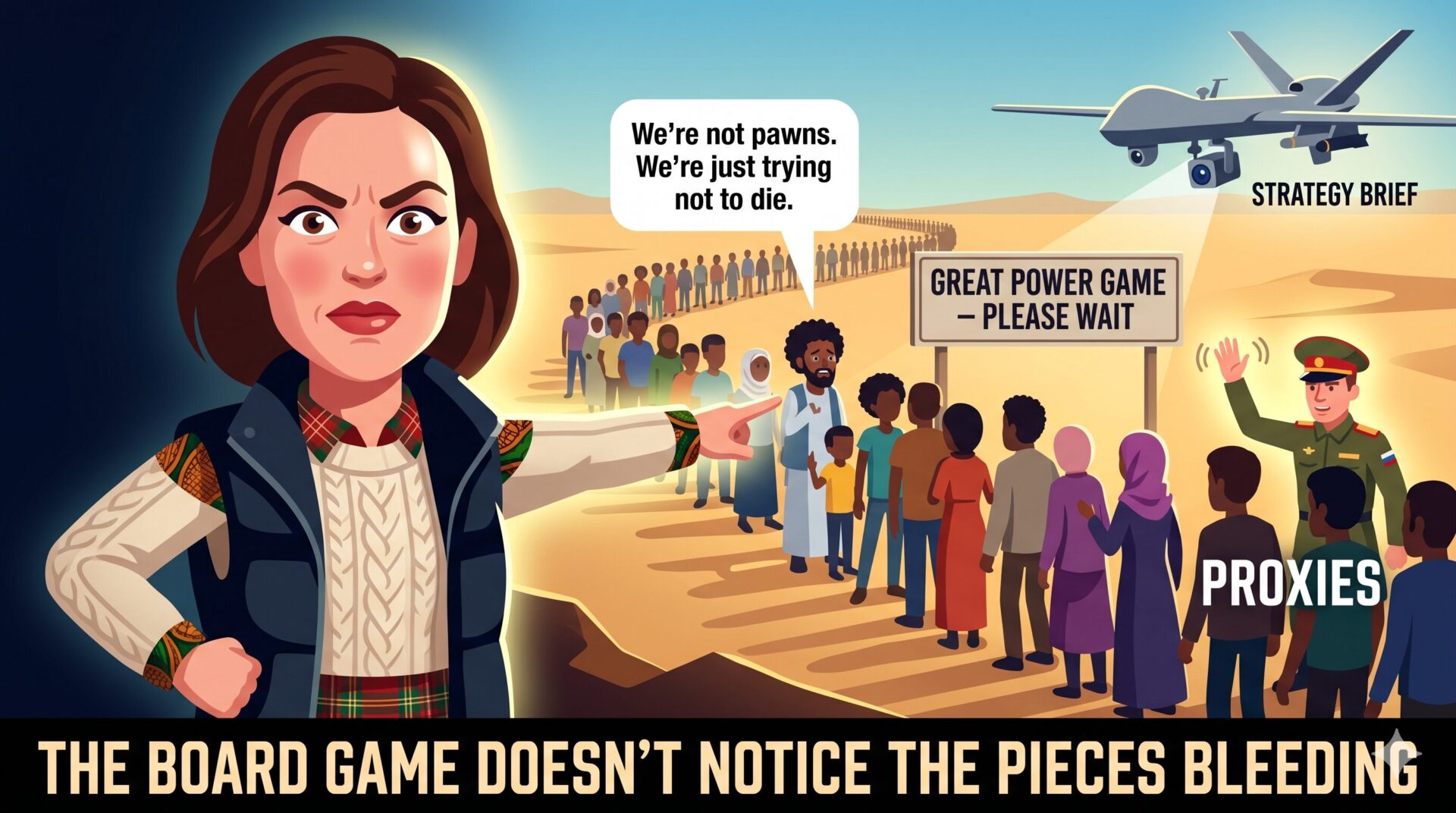 That war has been going on for centuries. And it’s the only war that the professor’s logic accurately describes. Endless. Permanent. Unchangeable. But even that war has seen victories. The weekend. The eight-hour day. The minimum wage. The NHS. Social security. Unions. Strikes. Revolutions. Each victory was won by people who refused to accept that the war was forever.
The professor’s forever war – the one between empires – is a sideshow. It’s a distraction. It’s what the ruling class uses to keep us fighting each other instead of fighting them. The professor knows this. But he won’t say it because saying it would reveal that his entire framework is a cage.
The Adage About the River
There’s a saying: “You can’t step in the same river twice. The river changes. You change. Everything changes.” The professor’s forever war is a river that never changes. It’s static. Eternal. Inevitable. But rivers change. They flood. They dry up. They change course. The forever war can change course too – if enough people step into the water and redirect the flow.
The professor doesn’t believe in redirection. He believes in prediction. He tells you where the river is going. He doesn’t tell you that you have a bucket.
The Cockney Verdict
So here’s the bottom line, from a geezer who’s seen wars start and wars end, and who knows which side he’s on. The professor’s forever war logic is accurate about one thing: the ruling class benefits from endless conflict. They profit. They control. They manage their debt through destruction.
But that’s not a prediction. That’s a description of the present. And the present is not the future. The future is what we make it. Not what the professor predicts.
As my nan used to say: “The hammer strikes the nail until the nail decides to become a wall.” The working class is the nail. We’ve been struck for centuries. But we can become a wall. A wall that the hammer bounces off. A wall that protects, that shelters, that resists.
The professor’s forever war is not forever. It’s just until we decide otherwise. And the decision is ours. Not his. Not the bankers’. Not the generals’. Ours.
The only question is whether we’ll make that decision together – or keep watching videos that tell us we can’t.
30.The Ethnic Insurgency Plan: When a Strategy Becomes a Sentence
There’s a saying you’ll hear in any pub from Dalston to Deptford: “A plan is just a plan until someone says no. Then it’s a problem.” Our professor lays out the American strategy for Iran with the confidence of a general briefing the Joint Chiefs. Forward operating bases in Balochistan and Kurdistan. Arming ethnic insurgents. Turning the fortress into a prison. Stirring up separatist tensions. It’s detailed. It’s plausible. It’s terrifying. And he presents it as inevitable – as if the only question is how quickly the plan will unfold, not whether it can be stopped.
 Let’s be clear. The professor isn’t wrong about the likelihood of such a strategy. America has used ethnic insurgencies before – the Kurds in Iraq and Syria, the Mujahideen in Afghanistan, the contras in Nicaragua. It’s a textbook dirty trick. So his description is plausible. It might even be likely, given the empire’s playbook.
But here’s the rub. Likely is not inevitable. Plausible is not certain. And the professor’s framing – this is what America will do, this is how Iran will respond – erases the possibility of resistance. Not just Iranian resistance, which he mentions. But resistance from the very people he’s describing. The Kurds. The Baloch. The ordinary working people of those regions who might refuse to be pawns in a great power game.
The professor treats ethnic minorities as tools to be used, not as human beings with their own agency. He never asks: what if the Kurds don’t want to be American proxies? What if the Baloch see through the manipulation? What if they decide that their enemy isn’t Tehran, but Washington – the same Washington that’s been arming dictators and destabilising their homelands for generations?
That’s the missing question. And the missing question is where hope lives.
The Adage of the Hired Hand
My old nan used to say: “You can hire a man’s hands, but you can’t hire his heart. And hands without a heart will drop the tools.” America can try to hire the Kurds and the Baloch. It can send weapons, money, and trainers. But it can’t buy their hearts. And if those hearts decide that they’ve been used, betrayed, discarded – as America has done to every ethnic insurgency it’s ever backed – then the plan falls apart.
The professor doesn’t mention the long history of American betrayal. The Kurds in Iraq: armed against Saddam, then abandoned to be gassed. The Kurds in Syria: armed against ISIS, then left to face the Turks. The Mujahideen in Afghanistan: armed against the Soviets, then abandoned to civil war and the Taliban. The contras in Nicaragua: armed against the Sandinistas, then left to rot when Congress cut funding. Every time, the pattern is the same. America uses ethnic proxies, then discards them when they’re no longer useful.
The professor’s plan assumes the Kurds and Baloch haven’t learned this lesson. They have. They’re not stupid. They know that being America’s ally is a death warrant. And that knowledge shapes their choices.
The Cockney Guide to Who Actually Decides
Let me explain agency the way my old gaffer explained the docks. “You can tell a docker to load a ship. But if the docker decides the cargo is wrong, the ship sails empty.”
The Kurds and Baloch are the dockers. America can tell them to fight. But if they decide that fighting for American interests is against their own interests, the weapons stay in the crates. The soldiers stay home. The insurgency never starts.
The professor presents the ethnic insurgency plan as a done deal. It’s not. It’s a negotiation. A persuasion. A gamble. America has to convince millions of people to risk their lives for a foreign power that has betrayed them before. That’s not a simple strategic move. That’s a hard sell. And the professor’s analysis doesn’t account for the possibility that the answer might be no.
The Missing Resistance
Here’s what the professor never mentions. There are already Kurds and Baloch who reject being pawns. There are activists, trade unionists, and community organisers in those regions who say: our enemy is not the Iranian state, but the system of exploitation that exists in every country. They say: we want autonomy, yes – but not at the cost of becoming mercenaries for the American empire.
These voices exist. They’re organising across borders, building solidarity with working people in Iran, in Turkey, in Iraq, in Syria. They’re the real threat to the professor’s plan – not because they’re armed, but because they’re refusing to play the game. An insurgency that nobody joins is not an insurgency. It’s a fantasy.
The professor ignores these voices because they don’t fit his narrative. His narrative needs the Kurds and Baloch to be pawns. If they’re agents – if they can say no – then his prediction is just a guess. And guesses don’t sell.
The Cockney Example: The Bloke Who Tries to Start a Fight
Imagine a bloke in a pub in Camden. He wants to start a fight. He goes to a group of lads in the corner and says, “That bloke over there insulted your mum. Go get him.” He’s got a plan. He’s got an incentive – free drinks if they win. But the lads look at him, look at the other bloke, and say, “Nah. We don’t know either of you. Sort it out yourself.”
That’s America. That’s the Kurds and Baloch. The plan only works if they agree to fight. And they might not. The professor’s analysis assumes they will. But assumptions aren’t facts.
The Adage About the Rented Mule
There’s a saying: “A rented mule will carry your load, but it won’t die for you.” America can rent the Kurds and Baloch. It can pay them, arm them, train them. But it can’t make them die for American interests. When the shooting starts, when the missiles fly, when the body bags come home – that’s when the mule decides whether to keep carrying the load or to buck you off and run.
The professor’s plan assumes the mule is loyal. History suggests otherwise. Every proxy America has ever used has eventually turned, been discarded, or been destroyed. The Kurds and Baloch know this. They’re not mules. They’re people. And people have memories.
The Real Choice
Here’s the real choice that the professor’s analysis obscures. The people of Kurdistan and Balochistan have three options. One: be pawns of Tehran. Two: be pawns of Washington. Three: refuse to be pawns at all. Build their own movements, their own alliances, their own futures – not as proxies for empires, but as self-determining communities.
Option three is the hardest. It requires organisation, sacrifice, and solidarity across borders. But it’s possible. And it’s the only option that doesn’t end with betrayal. The professor never mentions option three because option three doesn’t require a YouTube prophet. It requires each other.
The Cockney Verdict
So here’s the bottom line, from a geezer who’s seen empires come and go, and who knows that the people caught in the middle are not helpless. The professor’s ethnic insurgency plan is plausible. It might even happen. But it’s not inevitable. It’s a choice. A choice made by generals in Washington. A choice that can be opposed by working people everywhere.
The Kurds and Baloch are not pieces on a board. They’re human beings. They have agency. They can say no. And if they say no, the plan fails. If enough of them say no, the empire learns that it can’t buy loyalty with weapons. And if enough of us – in Britain, in America, in Iran – stand in solidarity with their refusal, the empire learns that the whole game is rigged against it.
As my nan used to say: “A chain is only as strong as its weakest link. But a link that refuses to connect is stronger than any chain.”
The professor sees a chain – Washington to the Kurds to the Baloch, pulling Iran apart. I see links that might refuse to connect. And if those links refuse, the chain breaks. Not because of a grand strategy. Because of ordinary people making ordinary decisions. The kind of decisions that don’t need a prophet to predict. Just courage and solidarity.
Don’t let the professor’s certainty become your cage. The future is not written. It’s being written right now, by people who refuse to be pawns. And that’s a prophecy worth betting on.
31.The Tehran Starvation Strategy: When Starvation Becomes a PowerPoint Slide
There’s a saying you’ll hear in any pub from Bethnal Green to Brixton: “A man who calls starving children a ‘strategy’ has never watched a child starve.” Our professor describes the plan to cut off water, electricity, and food to Tehran – a city of ten million people – and he calls it smart. Strategic. A way to force the population to rise up against the government. He says it with the same tone he uses to describe a chess move. No tremor. No hesitation. No moral weight.
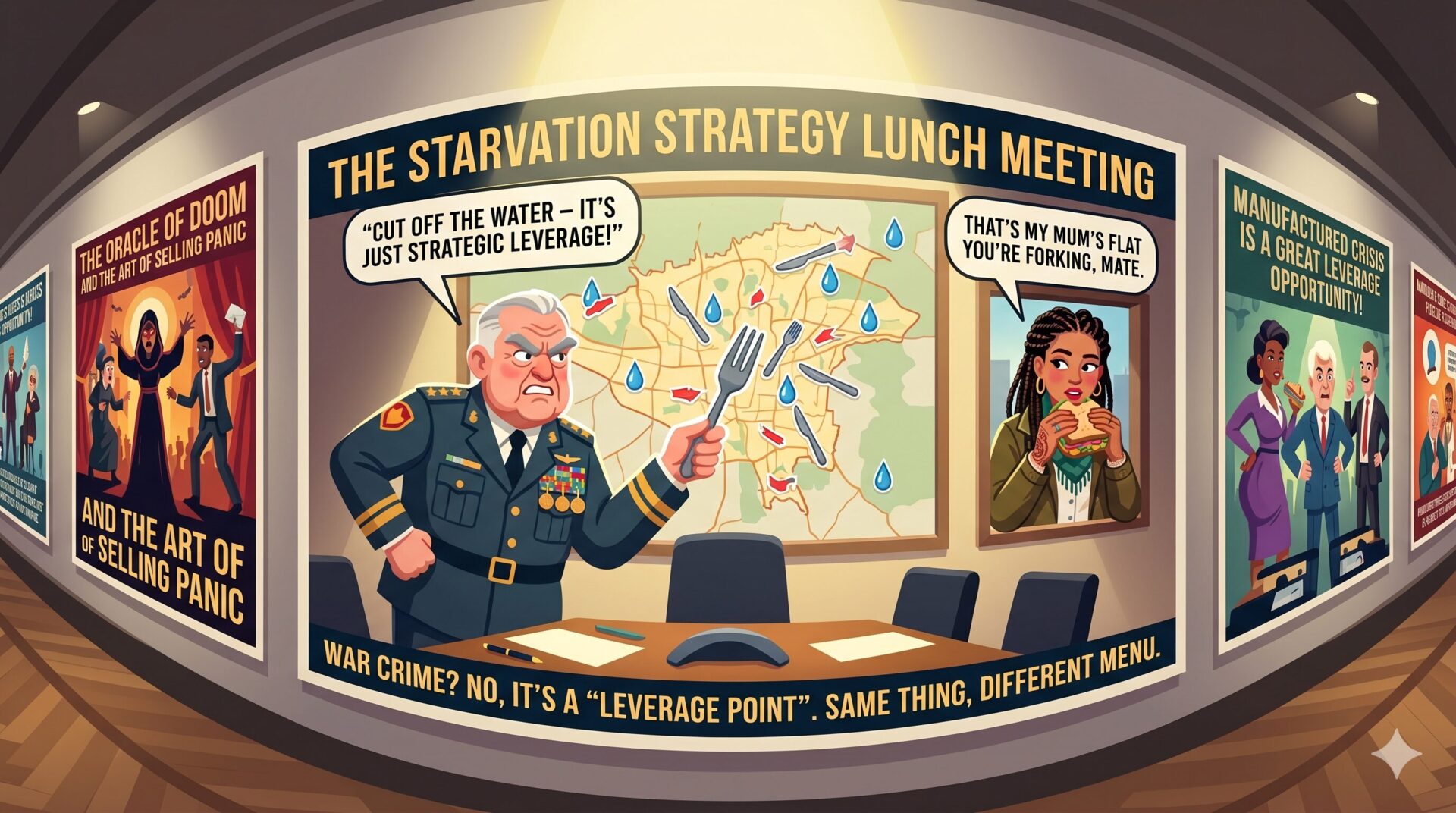 Let’s be absolutely clear about what he’s describing. Cutting off water to a city of ten million is not a military tactic. It’s collective punishment. It’s a war crime. The Geneva Conventions forbid starving civilians as a method of warfare. But the professor doesn’t mention that. He doesn’t mention that denying water is an act of mass murder. He doesn’t mention that the people who will die first are the poor, the sick, the elderly, the infants – the same people who have no power, no voice, no say in whatever game the professor thinks is being played.
He presents this as just another strategic option. “You deny them water, electricity, and food.” As if he’s ordering a round of drinks. As if the ten million are obstacles, not human beings. And that, more than any factual error or dodgy prediction, is the moral bankruptcy at the heart of this whole performance.
The Adage of the Siege
My old nan lived through the Blitz. She used to say: “A siege doesn’t care who you are. It kills the baby and the general’s wife the same.” The professor’s Tehran starvation strategy is a siege. A modern, technologically advanced siege, but a siege nonetheless. Cut the pipes, bomb the reservoirs, destroy the food trucks. Then wait. Wait for the thirst, the hunger, the disease. Wait for the mothers to watch their children waste away. Wait for the elderly to die in their flats. Wait for the city to turn on itself.
That’s not strategy. That’s butchery with a spreadsheet. And the professor calls it “strategy three” – right after ethnic insurgency and economic strangulation. He’s reduced the systematic starvation of millions to a bullet point.
The Cockney Guide to What Collective Punishment Actually Is
Let me explain collective punishment the way my old gaffer explained the difference between justice and revenge. “Justice is finding the bloke who nicked your wallet and giving him a slap. Revenge is kicking his whole family out of their house. Collective punishment is revenge with a permit.”
The professor’s plan is collective punishment. The people of Tehran didn’t start the war. Most of them probably don’t support the regime – not that they have a choice. They’re just trying to survive. But the professor’s “strategy” would punish them for the sins of their rulers. It would kill them – slowly, painfully, en masse – to send a message.
And he calls that smart. Strategic. Rational.
No. That’s not rational. It’s sadistic. It’s the logic of a terrorist, not a soldier. But the professor wraps it in jargon and maps and chess pieces, and somehow his audience nods along.
The Missing Humanity
Here’s what the professor’s starvation strategy leaves out. The faces. The names. The stories. The mother who walks ten miles to find water for her child. The father who watches his family die one by one. The teenager who hasn’t had a proper meal in weeks. The pensioner who can’t move and can’t call for help.
The professor never mentions any of this because he can’t. If he did, he’d have to stop. He’d have to look at what he’s actually advocating. And he doesn’t want to look. He wants to keep talking about chokepoints and leverage points and strategic objectives. Because as long as he stays abstract, he never has to feel the weight of what he’s saying.
This is the moral emptiness he’s peddling. This is the poison in the tea. He’s not just predicting war. He’s normalising atrocities. He’s making mass starvation sound like a legitimate tool of statecraft. And his audience, desensitised by years of similar content, barely blinks.
The Cockney Example: The Bloke Who’d Burn Down the Whole Street
Imagine a bloke in a terraced house in Hackney. He’s got a dispute with his neighbour – noise, rubbish, parking. He decides the best way to win is to burn down the whole street. He says it’s strategy. “If I set fire to number 42, the fire will spread to number 44, then 46, then all the way down. Eventually, my neighbour will have to move.” That’s not strategy. That’s arson. That’s mass destruction. And any normal person would call the police.
The professor is that bloke. Tehran is the street. Ten million people are the houses. And he’s calmly explaining why burning them all is the smartest move. He’s not a strategist. He’s an arsonist with a YouTube channel.
The Geneva Conventions Don’t Care About Your Map
Here’s a thing the professor never mentions. The Geneva Conventions exist. They were written after World War II, when the world saw what happens when “strategic thinking” is applied to civilian populations. They explicitly forbid starvation as a method of warfare. They explicitly forbid collective punishment. They explicitly protect water infrastructure, food supplies, and medical facilities.
The professor’s plan would violate all of those. It’s not smart. It’s not strategic. It’s criminal. The only reason he can talk about it without being arrested is because he’s not actually doing it – he’s just fantasising about it. But that fantasy, broadcast to millions, normalises the crime. It makes collective punishment sound like a reasonable option.
And that’s the real danger. Not that the professor will start a war. But that his audience will come to believe that starving ten million people is just another tool in the box. That’s how atrocities happen. Not because people are monsters, but because they’ve been slowly convinced that monsters are just pragmatists.
The Adage About the Butcher’s Apron
There’s a saying: “A butcher’s apron is white only until the first cut. After that, it’s red, and no amount of washing makes it clean.” The professor’s analysis is a butcher’s apron. He’s describing cuts. He’s describing strategies. He’s describing the most efficient way to kill. He doesn’t notice the blood because he’s never worn the apron. He’s never had to clean it. He’s never had to look at the red and wonder how it got there.
But the blood is real. The starvation is real. The suffering is real. And the professor’s detachment is not intellectual rigour. It’s a failure of imagination. A failure of empathy. A failure of basic humanity.
The Cockney Verdict
So here’s the bottom line, from a geezer who’s seen what hunger does to a family, a street, a city. The Tehran starvation strategy is not strategy. It’s a crime. A war crime. A crime against humanity. The professor can dress it up in maps and chess pieces and “game theory” – but underneath the jargon, it’s just the same old barbarism that humans have been practising for millennia.
He calls it smart. I call it evil. Not because he’s a monster. Because he’s made himself comfortable with monstrous ideas. And he’s spreading that comfort to his audience.
As my nan used to say: “The devil’s greatest trick isn’t making you believe he doesn’t exist. It’s making you believe his methods are reasonable.”
The professor’s methods are not reasonable. They’re not smart. They’re not strategic. They’re the desperate fantasies of a man who’s spent so long looking at maps that he’s forgotten that maps represent real places, where real people live, eat, drink, and die.
Don’t let him convince you that starving a city is just another move. It’s not a move. It’s a massacre. And the only appropriate response is not analysis. It’s outrage. It’s refusal. It’s solidarity with the people who would be killed – not with the generals who would kill them.
The professor can keep his strategy. I’ll keep my humanity. And I’ll spend my energy building a world where no one thinks starving ten million people is a good idea. That’s not a prediction. That’s a promise.
32.The IRGC vs Government Split: When a Grain of Truth Becomes a Whole Silo
There’s a saying you’ll hear in any discussion group from Camden to Clapham: “A broken clock is right twice a day. But that doesn’t mean you should ask it for the time.” Our professor’s analysis of Iran’s dual power structure – the mullahs and the IRGC versus the secular state apparatus – is genuinely interesting. It’s not widely understood. He explains it clearly: the religious leadership controls foreign affairs and the Revolutionary Guards; the secular bureaucracy runs the day-to-day. Two parallel militaries. Two parallel systems. A country that’s both a theocracy and something else.
He’s not wrong about this. Iran’s political system is bizarre, complex, and full of internal contradictions. The professor’s description is accurate, informative, and actually useful. For a few minutes, he’s not a prophet. He’s a teacher. And that’s the trap.
Because once he’s earned your trust with genuine insight, he uses it as a bridge. “Iran has this strange dual structure,” he says, “and therefore my predictions about the war, the ethnic insurgency, the starvation strategy – all of that is equally credible.” The genuine insight becomes a rubber stamp for everything else. You’ve seen him be right about one thing, so you assume he’s right about the rest. That’s not analysis. That’s a magician’s misdirection.
The Adage About the Silver Spoon
My old nan used to say: “A silver spoon doesn’t make the porridge taste better. It just makes you think it does.” The professor’s IRGC analysis is the silver spoon. It’s shiny. It’s valuable. It makes the porridge – his wilder predictions – seem more palatable. But the porridge is still porridge. The spoon doesn’t change the taste.
He’s not the only one who understands Iran’s power structure. Academics have written entire books about it. Journalists have reported on it for decades. The professor hasn’t discovered a secret. He’s just explained a known phenomenon clearly – and then used that clarity to sell you a bunch of speculation dressed as prophecy.
The Cockney Guide to How Trust Works
Let me explain trust the way my old gaffer explained the market. “If a bloke sells you a good apple, you’ll buy another. If he sells you a rotten one after, you’ll stop buying. But if he puts the good apple on top of the rotten ones, you might buy the lot before you notice the mould.”
The professor’s good apple is the IRGC analysis. The rotten apples are everything else – the draft scare, the Odessa prediction, the ethnic insurgency plan, the starvation strategy. He puts the good apple on top. You see it, you trust it, you buy the whole basket. By the time you get home and find the mould, he’s already spent your subscription fee.
That’s the trick. Not lying about everything. Telling enough truth to make the lies believable.
The Missing Context
Here’s what the professor’s IRGC analysis leaves out. The dual power structure in Iran isn’t static. It’s constantly shifting. The IRGC has been gaining power for decades. The secular state has been weakening. The mullahs are aging, squabbling, losing legitimacy. The Iranian people have been protesting – not just against the regime, but against the entire system, including both branches of power.
The professor mentions none of this because it doesn’t fit his narrative. His narrative needs Iran to be a fortress – stable, unified, predictable. He needs the IRGC to be fanatical and the government to be desperate. The messy reality – a society in flux, a population that hates both sets of rulers, a leadership that’s terrified of its own people – doesn’t serve his script.
He gives you a snapshot. He calls it analysis. But a snapshot isn’t a movie. And a two-minute explanation of Iran’s power structure doesn’t make him an expert on everything else.
The Cockney Example: The Bloke Who Knows One Fact
Imagine a bloke in a pub in Stratford. He knows the entire history of West Ham United. Every match. Every player. Every score. You’re impressed. Then he starts telling you about the stock market, about the housing market, about the economy. You assume he’s equally knowledgeable. He’s not. He knows one thing really well. Everything else is guesswork.
The professor knows Iran’s power structure really well. Good for him. But that doesn’t mean he knows what’s going to happen in Odessa, or whether the draft is coming, or if America will collapse. The skills don’t transfer. The credibility doesn’t carry over. He’s a West Ham expert trying to pick stocks.
The Adage About the Carpenter
There’s a saying: “A carpenter who can build a chair might not be able to build a house.” The professor can build a chair – the IRGC analysis. He’s good at it. The joints are tight. The wood is polished. But chairs and houses are different. Building a house requires foundations, plumbing, wiring, roofing – skills the carpenter might not have.
The professor’s house is his grand geopolitical framework. The chair is one small part of it. He’s hoping you’ll assume that because the chair is sturdy, the whole house is sound. But the walls are cracking. The roof is leaking. And the foundations are built on sand.
The Real Value
Here’s the thing. The professor’s IRGC analysis is genuinely valuable. If you want to understand Iran, that’s a good place to start. But it’s a start, not an end. It’s a piece of the puzzle, not the whole picture. The professor presents it as proof of his overall credibility. It’s not. It’s just one accurate observation in a sea of speculation.
The real value of that analysis is not that it makes his predictions credible. It’s that it helps you understand why Iran is so hard to predict. Complex systems are unpredictable. Dual power structures produce contradictory outcomes. The professor’s certainty – “Iran will do this, America will do that” – is exactly the wrong lesson to draw from his own insight.
The Cockney Verdict
So here’s the bottom line, from a geezer who’s learned that being right about one thing doesn’t make you right about anything else. The professor’s IRGC analysis is good. He deserves credit for explaining it clearly. But that credit doesn’t extend to the rest of his performance. A good five minutes doesn’t excuse a bad hour.
As my nan used to say: “Don’t buy a round for the bloke who bought you one. He might have found the money on the floor.” The professor bought you one good insight. But the money for that insight came from somewhere else – research, reading, maybe even genuine expertise. The rest of his predictions are found money. And found money spends just as easy as earned money, but it doesn’t come with a guarantee.
The trick is recognising the difference. The good insight is earned. The wild predictions are borrowed. And borrowing doesn’t make you rich. It just makes you indebted.
Keep the insight. Question the predictions. And remember that knowing how Iran works doesn’t mean you know how the world works. That’s a much bigger job. And the professor hasn’t done it. He’s just made you think he has.
33.The 31 Armies Claim: When Decentralisation Becomes an Excuse for Despair
There’s a saying you’ll hear in any decent boozer from Bermondsey to Bethnal Green: “A dog with two tails isn’t twice as happy. It’s just twice as confused.” Our professor has discovered that Iran has a decentralised military structure – 31 provinces, each with its own command and control, localised leadership, a “Moussak strategy” designed to fight to the finish. And he uses this genuinely plausible insight to draw a conclusion that doesn’t follow: that coordination is impossible, therefore peace is impossible, therefore the war will never end.
 Let’s take the first part. Iran having a decentralised military command is plausible. It makes sense for a country that expects to be invaded by a technologically superior enemy. Centralise your command, and a single decapitation strike can paralyse you. Decentralise, and the head can be cut off while the limbs keep fighting. That’s not new. That’s basic asymmetric warfare – the same logic that guerrillas have used for centuries.
But here’s where the professor jumps the shark. He says this decentralisation makes coordination impossible. That’s not true. Coordination is harder, yes. Impossible, no. There are still methods – couriers, coded messages, pre-arranged signals, local initiative following a common doctrine. The professor’s claim that “it takes time for the pigeons to get out” is a joke, not analysis. He’s treating a cartoonish difficulty as an absolute barrier.
And then comes the real non-sequitur. Because coordination is hard, he says, peace is impossible. Even if a ceasefire were agreed, the 31 armies would keep fighting because they can’t be told to stop. That’s nonsense. Ceasefires happen all the time in decentralised conflicts. Local commanders can receive orders through the same channels they’ve been using throughout the war. The professor is confusing “difficult” with “impossible” and using that confusion to predict eternal war.
The Adage of the Hydra’s Heads
My old nan used to say: “A hydra with many heads is hard to kill. But it’s not impossible. You just need a bigger fire.” The professor’s hydra – the 31 armies – is hard to coordinate. But that doesn’t mean the war can’t end. Wars end when one side decides the cost isn’t worth it. Decentralised forces can still receive that message – through intermediaries, through signals, through the simple fact that supplies stop coming, that families start demanding their sons come home.
The professor presents decentralisation as a permanent state of war. But decentralisation doesn’t mean no communication. It means slower, less centralised communication. That’s a logistical problem, not a philosophical one. And logistical problems have logistical solutions.
The Cockney Guide to How Decentralisation Actually Works
Let me explain decentralisation the way my old gaffer explained the Underground. “You can’t have one bloke driving every train. So each driver drives his own. But they all follow the same signals, the same timetable, the same rules. If you want to stop all the trains, you don’t phone every driver. You change the signals.”
Iran’s 31 armies follow signals. They follow a common doctrine. They have been trained to respond to certain cues. If the central government wants a ceasefire, it can send those cues – through radio broadcasts, through messenger drones, through the simple fact that the ammunition trucks stop rolling. The professor treats the 31 armies as if they’re independent warlords who take orders from no one. But they’re still part of a system. A looser system, but a system nonetheless.
The Missing Logic
Here’s the professor’s missing step. Even if coordination is impossible – which it isn’t – that doesn’t make peace impossible. Peace doesn’t require every single fighter to stop at the same moment. It requires a cessation of organised hostilities. If the central government agrees to a ceasefire, and if most of the 31 armies follow that ceasefire, the war is effectively over. A few holdouts can be dealt with later. That’s how every civil war ends. That’s how every insurgency ends. Not with a perfect, simultaneous silence. With a messy, gradual, imperfect cessation.
The professor’s all-or-nothing logic is false. He’s created a straw man – “perfect coordination or nothing” – and then set it on fire. But the real world doesn’t work that way. Real ceasefires are messy. Real wars end in stages. The professor’s claim that peace is impossible is not derived from his premise. It’s a conclusion he wanted to reach, so he invented a premise that seemed to support it.
The Cockney Example: The Bloke Who Thinks the Market Can’t Close
Imagine a market in East London. Dozens of stalls, each run by a different trader. No central authority telling them when to pack up. The professor would say: “Coordination is impossible. Therefore the market will never close.” But every night, the market closes. Not because someone gives a single order. Because the stallholders know when it’s time. They’ve agreed on closing time. They follow the same routine. They see the lights going off and follow suit.
That’s decentralisation. That’s how it works. Not perfect coordination. Sufficient coordination. The professor’s 31 armies are the market stalls. They can coordinate enough. Not perfectly, but enough. And that’s all that’s needed for a ceasefire.
The Real Barrier to Peace
Here’s what the professor never mentions. The real barrier to peace isn’t decentralised military structures. It’s the interests that profit from war. It’s the generals who don’t want to stop. It’s the arms dealers who need conflicts. It’s the politicians who fear the consequences of peace. Those are the obstacles. Not a lack of pigeons.
The professor’s focus on decentralisation is a distraction. He’s pointing at a logistical problem and calling it a metaphysical barrier. But the real barrier is political. And political barriers can be overcome – by resistance, by solidarity, by ordinary people refusing to fight. The professor never mentions that because it would mean admitting that peace is possible. And if peace is possible, his predictions of forever war are just guesses.
The Adage About the Broken Telephone
There’s a saying: “A broken telephone can still pass a message. It just takes longer and gets a few words wrong.” The professor’s 31 armies are a broken telephone. Messages are slower, less reliable, more likely to be distorted. But they still get through. Ceasefire orders can still be transmitted. They might be delayed. Some units might not get them. But enough will. And enough is enough.
The professor demands perfect communication. The real world settles for good enough. His standard is impossible, so his conclusion is false. That’s not analysis. That’s a rigged game.
The Cockney Verdict
So here’s the bottom line, from a geezer who’s seen complex systems adapt and survive. The professor’s 31 armies claim is plausible on the surface – yes, Iran is decentralised. But his conclusion – that coordination is impossible, therefore peace is impossible – is a non-sequitur. It doesn’t follow. It’s a leap.
 As my nan used to say: “Just because you can’t see the bridge doesn’t mean the river can’t be crossed.” The professor can’t see how 31 armies could be coordinated. But that’s a failure of his imagination, not a fact of the world. Coordinating 31 armies is hard. It’s not impossible. And hard is not the same as impossible.
The professor wants you to believe that the war can’t end. That’s not an insight. It’s a wish. A wish dressed up as analysis. The only thing standing between the professor’s logic and reality is the simple truth that people – even soldiers – want peace. And when they want it badly enough, they find a way.
Don’t let the professor’s false dilemma become your despair. Decentralised forces can still be told to stop. Wars can still end. The only question is whether we’ll organise to make them end – or keep watching videos that tell us they can’t.
34.The Eschatology Argument: When Foreign Religions Become Cartoon Villainy
There’s a saying you’ll hear in any pub from Paddington to Peckham: “When you don’t understand a man’s language, you call it gibberish. When you don’t understand his beliefs, you call it madness.” Our professor reaches deep into the Orientalist toolbox and pulls out the old reliables: Iranian eschatology. He tells you that the IRGC sees this war as a religious crusade, a fight against the Great Satan, a path to a messianic age. He talks about the “Moussak strategy” and the “twelfth imam” and the “end of days” as if he’s reading from a medieval prophecy instead of an intelligence briefing.
It’s nonsense. It’s also deeply revealing. Because the professor would never apply the same logic to Western powers. Would he say that American policy is driven by Christian eschatology? That the Pentagon’s strategy is based on the Book of Revelation? That Trump’s strikes are motivated by a desire to hasten the Rapture? Of course not. That would be ridiculous. But when it comes to Iran, suddenly religious belief becomes the prime mover of geopolitics. That’s not analysis. That’s prejudice with a PhD.
The professor is doing what Western pundits have always done: treating non-Western societies as irrational, mystical, and driven by forces that Westerners can’t understand. He reduces complex strategic calculations to “they believe in the mahdi, therefore they’ll fight to the death.” He never asks if American generals believe in Jesus – and if they do, why that doesn’t make American policy apocalyptic. The double standard is the point.
The Adage of the Stranger’s Religion
My old nan used to say: “Every man’s prayer sounds strange to the man in the next pew. That doesn’t mean he’s praying to the devil.” The professor hears Iran’s religious language and calls it eschatology. He hears America’s religious language – “God bless America,” “city on a hill,” “manifest destiny” – and calls it patriotism. Same phenomenon. Different label. The label tells you more about the labeler than about the thing being labeled.
Iran has a religious dimension to its politics. So does America. So does Britain. The difference is that the professor treats one as rational and the other as fanatical. That’s not insight. That’s Islamophobia dressed up as expertise.
The Cockney Guide to What Actually Drives Iranian Policy
Let me explain Iranian policy the way my old gaffer explained the local villain. “He’s not crazy, son. He’s calculating. The shouting, the threats, the mad eyes – that’s for the crowd. Inside, he’s cold as ice.”
Iran’s rulers use religious language because it mobilises their base. Because it scares their enemies. Because it legitimises their rule. But the actual decisions they make – support for Hezbollah, missile development, nuclear negotiations, alliances with Russia and China – are strategic, not mystical. They have clear political and military objectives. Reduce them to eschatology, and you miss the plot.
The professor doesn’t miss the plot. He’s a smart bloke. He knows that Iran’s leadership is cynical, pragmatic, and capable of realpolitik. But he also knows that his audience will swallow “they want to bring about the end of the world” more easily than “they want to secure regional influence and regime survival.” So he feeds them the spice, not the meat.
The Missing Mirror
Here’s the question the professor never asks. If Iranian eschatology drives Iranian policy, does American eschatology drive American policy? A huge chunk of the American ruling class believes in the Rapture. Some of them believe they have a duty to bring about the conditions for Armageddon. The former head of Israel’s nuclear program once said that Yitzhak Rabin was convinced that the Six-Day War was prophesied in the Bible. The Joint Chiefs have chaplains. The president prays.
 Would the professor ever say that America’s Iran policy is driven by Christian eschatology? He would not. Because that would sound absurd. And it should. Because it is absurd. But the absurdity doesn’t stop him from making the same claim about Iran. That’s the double standard. That’s the racism.
The Cockney Example: The Bloke Who Thinks His Team is Rational But Theirs is Crazy
Imagine a bloke in a pub in Islington. He supports Arsenal. He says Arsenal’s tactics are smart, calculated, based on data. Spurs, on the other hand, are driven by superstition, irrational, always bottling it. You point out that both teams have the same data, the same analysis, the same pressures. He doesn’t care. His team is rational. Their team is crazy.
That’s the professor. The West is rational. Iran is eschatological. Never mind that both sides have religious believers, strategic thinkers, and cynical operators. The label is the analysis. And the label is designed to make the enemy seem irrational, fanatical, and impossible to negotiate with.
The Adage About the Mirror
There’s a saying: “A mirror doesn’t lie. But it only shows you what’s in front of it. Turn it around, and you see a different room.” The professor’s mirror is pointed at Iran. He sees eschatology. Turn the mirror around, point it at the West, and you see the same thing – religious language, apocalyptic framing, the belief that history has a destined endpoint. The difference isn’t in the mirror. It’s in the willingness to look.
The Real Eschatology
Here’s the real eschatology that drives American policy. It’s not the Rapture. It’s the belief in eternal American dominance. The conviction that history ends with the American way of life. The faith that free markets and carrier strike groups will eventually win over all opposition. That’s eschatology too – a secular one, but just as fervent. The professor never calls it that because it’s his own faith. He can’t see the water because he’s swimming in it.
Iran’s religious language is strange to Western ears. But America’s secular messianism is strange to everyone else. The professor’s analysis fails not because he describes Iran’s beliefs, but because he treats them as uniquely irrational. They’re not. They’re just different. And difference isn’t madness.
The Cockney Verdict
So here’s the bottom line, from a geezer who’s heard enough sermons to know that everyone thinks God is on their side. The professor’s eschatology argument is Orientalist nonsense. It takes a real phenomenon – religious language in Iranian politics – and exaggerates it into a cartoon. It treats Iran as uniquely fanatical while ignoring the fanaticism of the West. It’s not analysis. It’s propaganda.
As my nan used to say: “A man who calls you crazy for believing in ghosts while he believes in bankers is just picky about his superstitions.”
The professor has his superstitions – about markets, about empires, about the inevitable march of American power. He just doesn’t recognise them as superstitions. He calls them analysis. The rest of us can see the difference.
Don’t buy the Orientalism. Iranian leaders are as cynical, strategic, and self-serving as any Western politician. Their religious language is a tool, not a motive. And reducing them to eschatological fanatics serves the same purpose as all dehumanisation – to make war seem necessary and peace impossible.
The professor might not believe that. But he’s selling it anyway. And that’s what makes his analysis not just wrong, but dangerous.
35.The 80-90% Probability: When a Guess Puts on a Lab Coat
There’s a saying you’ll hear in any bookie’s from Barking to Brixton: “A man who gives you odds of four to one is a gambler. A man who gives you eighty percent is a charlatan with a calculator.” Our professor announces that there’s an 80 to 90 percent probability of World War III. He says it with the same authority a physicist might use for the speed of light. He’s not offering odds. He’s not presenting a range. He’s plucking a number from the air and calling it a forecast.
Let’s be honest about what 80-90% actually means. It means he’s certain. Almost certain. Certain enough to bet your life on it, your family’s future, your children’s safety. But where do these numbers come from? Not from a model. Not from historical data. Not from any replicable method. They come from his gut. From his confidence. From the performance of certainty that he’s perfected.
The professor is doing what every pseudoscientist does: borrowing the clothes of rigour to cover the nakedness of speculation. He uses percentages because they sound precise. He uses a range because it gives him wiggle room. “80-90%” means “I’m nearly sure, but if I’m wrong, I can say it was in the ten percent.” It’s not falsifiable. It’s not testable. It’s not even a real prediction. It’s a rhetorical device designed to make a guess sound like a measurement.
The Adage of the Marked Cards
My old nan used to say: “A gambler who marks his cards is not a better player. He’s just a cheat.” The professor marks his cards with numbers. He assigns probabilities to events he cannot possibly measure. He’s not playing the same game as honest forecasters. He’s playing a game where only he knows the rules and only he sees the cards.
Real forecasters – the boring ones who work for insurance companies or climate institutes – have methods. They keep score. They publish their calibration. They can tell you how often their 80% predictions come true. The professor cannot. Because his 80% is not the result of a model. It’s the result of a performance.
The Cockney Guide to What Probabilities Actually Mean
Let me explain probability the way my old gaffer explained the races. “Odds of three to one means that horse wins one race in four – over a hundred races, not just this one. But you can’t run World War III a hundred times. You only get one. So any odds you give are just a bluff.”
That’s the problem with the professor’s 80-90%. You can’t repeat history. You can’t run a hundred World Wars to check his calibration. His number is unfalsifiable. If the war happens, he was right. If it doesn’t, he can say it was in the ten percent. Either way, he never has to admit he was wrong. That’s not science. That’s a con.
The professor is using probabilities the way a psychic uses “maybe.” It sounds impressive. It means nothing.
The Missing Calibration
Here’s what the professor never provides. A calibration record. A list of past predictions with their assigned probabilities and their actual outcomes. “I said there was a 90% chance of Trump winning. He won. Good. I said there was a 70% chance of a recession in 2024. It didn’t happen. Bad. Here’s my Brier score. Here’s my calibration curve.”
He doesn’t provide this because he doesn’t have it. Because he doesn’t track his own accuracy. Because tracking would reveal that his “probabilities” are just guesses with a fancy wrapper. The professor is not a forecaster. He’s a storyteller who uses numbers to sound like a forecaster.
The Cockney Example: The Bloke Who Gives You Twenty-to-One on the Weather
Imagine a bloke in a pub in Clapham. He says, “I give you twenty-to-one it rains tomorrow.” You ask him how he calculates the odds. He says, “I looked at the sky.” You ask if he’s a meteorologist. He says, “I’ve got a degree in guesswork.” You laugh and walk away.
That’s the professor. He’s looked at the sky – the geopolitical sky – and announced odds. He’s not a meteorologist. He’s not a statistician. He’s a bloke with a YouTube channel and a confident manner. The numbers are decoration, not evidence.
The Real Probability
Here’s the real probability. The professor has no idea. Neither does anyone else. World War III might happen. It might not. The best anyone can say is “maybe, with some possibility, but we don’t know.” That’s not satisfying. That’s not dramatic. That’s not going to get you subscribers. So the professor invents numbers. He pretends to know what no one can know.
The tragedy is that his audience believes him. They hear “80-90%” and think, “Wow, he’s done the maths.” But he hasn’t done the maths. There is no maths. There’s only theatre.
The Adage About the Shop Window
There’s a saying: “A shop window full of empty boxes is still a shop window. But you’re not buying goods. You’re buying cardboard.” The professor’s probabilities are empty boxes. They look like something. They have numbers on them. But inside, there’s nothing. No data. No method. No track record. Just air.
His audience buys the boxes. They think they’re buying certainty. But certainty is not for sale. Not from him. Not from anyone.
The Cockney Verdict
So here’s the bottom line, from a geezer who’s seen a lot of confident men make a lot of wrong predictions. The professor’s 80-90% probability is not analysis. It’s a guess. A confident guess. A guess dressed up in scientific clothing. But underneath the clothing, it’s still just a guess.
As my nan used to say: *”A man who tells you he’s ninety percent sure of the future is either a liar or a fool. The future doesn’t do percentages. It does what it does, and you deal with it.”
The professor wants you to believe he can measure the unmeasurable. He can’t. Nobody can. The only honest answer to “what’s the probability of World War III?” is “I don’t know.” And that answer, honest as it is, wouldn’t get a single view.
Don’t be fooled by the numbers. The numbers are props. The only thing that’s real is the fear he’s selling – and the money you’re spending to feel it. The future will arrive on its own schedule, regardless of anyone’s percentages. And when it does, all the probabilities in the world won’t have prepared you for it.
The only preparation that works is solidarity. That’s not a percentage. It’s a decision. And it’s the only one worth making.
36.The Shuttle Fleet Narrative: When a Few Tankers Become a Fleet of Doom
There’s a saying you’ll hear in any dockers’ pub from Tilbury to Southampton: “One leaky boat doesn’t sink the whole shipping lane. It just makes a mess for the tugboat.” Our professor has found a genuine story – Russian “shadow fleet” tankers being seized by the US Navy in the Caribbean and the North Atlantic. It’s happening. Sanctioned ships, dodgy paperwork, illicit crude. The Americans seized a couple. The professor seizes on these incidents and declares: this is proof of an inevitable global war. The shark has tasted blood. The dominoes are falling. The shuttle fleet is the spark that lights the fuse.
Let’s be clear. The shadow fleet exists. Russia uses stateless or reflagged tankers to evade sanctions. America has been interdicting them – not always successfully, not always legally. These are real events. But the professor’s leap from “ships are being stopped” to “World War III is inevitable” is not a leap. It’s a cliff dive into speculation.
He presents isolated incidents – a handful of seizures, a few confrontations – as the opening moves of a global naval war. He ignores the fact that these seizures have been happening for years without escalation. He ignores that both sides have an interest in keeping the conflict below the threshold of open warfare. He ignores that the shadow fleet is a symptom of sanctions, not a cause of war.
The professor’s narrative is like watching a few street fights and concluding the whole city is about to burn down. Fights happen. Ships get seized. The world continues.
The Adage of the Single Swallow
My old nan used to say: “One swallow doesn’t make a summer, and one tanker doesn’t make a war.” The professor has spotted a few swallows – the seizures, the chases, the pre‑dawn raids – and he’s already planning the harvest. But summer might not come. The seizures might remain isolated. The diplomatic channels might hold. The professor doesn’t consider that because a quiet resolution doesn’t get views.
The shuttle fleet narrative is a classic case of confusing the exceptional with the inevitable. Just because something can escalate doesn’t mean it will. The professor treats every friction point as a fuse. But most fuses are damp. Most sparks fizzle. Most confrontations end in negotiation, not annihilation.
The Cockney Guide to What “Shadow Fleet” Actually Means
Let me explain the shadow fleet the way my old gaffer explained the black market. “It’s not a fleet, son. It’s a collection of rusty tubs with false papers, carrying cargo that no one’s supposed to want. If they get caught, the owners shrug and find another flag. It’s not World War III. It’s Tuesday.”
The shadow fleet is not a naval armada. It’s a bunch of ageing tankers operated by shell companies, trying to slip through sanctions. Their seizure is not an act of war. It’s law enforcement – or something like it. The professor inflates the significance because drama pays. But the reality is that these ships are expendable. Russia will lose a few, register a few more, and carry on. No general will mobilise over a seized tanker.
The Missing Context
Here’s what the professor’s narrative leaves out. The seizures are happening under existing sanctions regimes, not new declarations of war. The US has been stopping suspect vessels for decades – drugs, weapons, contraband. The shadow tankers are just the latest category. There are legal frameworks, diplomatic protests, and quiet settlements. The professor ignores all of that because it’s boring.
He also ignores that Russia’s response has been muted. No warships sent to escort the tankers. No threats of retaliation. No escalation. Just diplomatic notes and insurance claims. That’s not the behaviour of a country looking for a war. That’s the behaviour of a country that knows it’s in the wrong and is trying to limit the damage.
The professor presents the seizures as the US Navy gearing up for a fight. But the US Navy is just doing what it’s always done – policing the seas, enforcing sanctions, projecting power. That’s not new. That’s not a prelude to war. That’s just Tuesday in the empire.
The Cockney Example: The Bloke Who Sees a Fight in Every Shove
Imagine you’re in a crowded tube carriage at rush hour. Someone gets jostled. They shove back. The professor, watching from the corner, declares: “This is it! The whole line is about to erupt! They’re going to shut down the Central line!” Meanwhile, the people involved mutter an apology, step back, and get off at the next stop. No fight. No riot. Just a shove.
The shadow fleet seizures are the shove. The professor sees a war. The rest of us see a Tuesday.
The Real Inevitability
Here’s what’s actually inevitable. As long as sanctions exist, there will be smuggling. As long as there’s smuggling, there will be seizures. As long as there are seizures, there will be diplomatic tensions. But tensions are not war. Tensions are the background noise of a multipolar world. They’ve been the background noise for seventy years. They’ll be the background noise for seventy more.
The professor wants you to believe that this time is different. That these seizures are not like the last seizures. That this shove is not like the last shove. But he doesn’t have evidence. He has a feeling. And a feeling isn’t a prediction.
The Adage About the Puddle
There’s a saying: “A puddle on the pavement is not the Thames flooding. It’s just a puddle.” The shuttle fleet is a puddle. A few tankers, a few seizures, a few headlines. The professor sees the river bursting its banks. He’s wrong. The puddle will evaporate. The river will stay in its bed. The world will keep turning.
The Cockney Verdict
So here’s the bottom line, from a geezer who’s watched the Thames rise and fall and never once thought it was the end of London. The professor’s shuttle fleet narrative is a classic case of magnification. He takes a real phenomenon – isolated incidents of interdiction – and blows it up into a world war. He ignores the context, the history, the lack of escalation, the mutual interest in keeping a lid on things.
As my nan used to say: “A man who panics at every puddle will drown in his own bathtub.”
The professor is panicking at puddles. He’s pointing at tanker seizures and shouting “global war!” But the tankers keep sailing, the diplomats keep talking, and the war keeps not happening. One day, it might. But not because of a rusty tanker in the Caribbean.
Don’t let the professor’s alarm become your own. The world is full of friction. Most of it never catches fire. The shuttle fleet is a spark. But sparks need tinder, oxygen, and a whole lot of bad luck to become a blaze. And so far, the luck has held.
Trust your eyes, not his headlines. The only inevitable war is the one we refuse to resist. And that one we can stop. The professor won’t tell you that. I just did.
37.Operation Southern Spear: When a Code Name Becomes a Crown
There’s a saying you’ll hear in any army surplus shop from Aldershot to Aldgate: “A soldier with a shiny badge is still just a soldier. The badge doesn’t make him a general.” Our professor drops a name – Operation Southern Spear. He describes a pre-dawn raid in the Caribbean, US military and Coast Guard intercepting shadow fleet tankers, a dramatic chase ending in the North Atlantic. It’s specific. It’s detailed. It sounds like someone with access to classified briefings. The host nods along, impressed. The audience leans in. “This bloke knows things,” they think.
Here’s the thing. Naming an operation doesn’t make your analysis correct. It doesn’t make your predictions any more likely. It just makes you sound like you know what you’re talking about. It’s a rhetorical trick as old as propaganda itself. Drop a code name, and suddenly you’re not a YouTuber. You’re an insider. Operative. Deep throat. The man with the files.
But Operation Southern Spear – assuming it’s real, which it might be – is just a name. A label stuck on a routine interdiction mission. The US Navy runs hundreds of such operations every year. Most of them have code names. Most of them mean nothing beyond the specific tactical event. The professor uses the name as a prop, a stage whisper, a way to borrow credibility he hasn’t earned.
The Adage of the Wizard’s Robe
My old nan used to say: “A wizard’s robe doesn’t make him magical. It just makes him warm.” The professor’s code names are his robe. They look impressive. They suggest arcane knowledge. But underneath the fabric, he’s just a bloke with a script and a laser pointer. The robe doesn’t cast spells. It just covers the ordinary.
Operation Southern Spear could be real. It could be exaggerated. It could be entirely made up – and how would you know? The professor doesn’t provide sources. He doesn’t name the ships. He doesn’t give dates or locations that you could verify. He just says “Operation Southern Spear” with a straight face, and you’re supposed to believe that he’s read the after-action report.
The Cockney Guide to How Intelligence Actually Works
Let me explain operational names the way my old gaffer explained the army. “They name everything, son. Every patrol, every exercise, every time someone farts in formation, it gets a code name. It doesn’t mean it’s important. It just means the colonel wanted to feel clever.”
The professor’s use of “Operation Southern Spear” is the equivalent of a bloke telling you he’s got a “top secret mission” to pick up fish and chips. The name is decoration. The substance is what matters. And the substance – a few tankers seized, a chase in the Caribbean – is not evidence of world war. It’s evidence of sanctions enforcement.
The Missing Verifiability
Here’s what the professor’s insider act lacks. Verifiability. Can you look up Operation Southern Spear? Can you find the Pentagon press release? The news article? The shipping registry? The professor doesn’t give you enough information to check. He just gives you a name and expects you to trust him.
That’s not transparency. That’s a magic trick. The magician shows you a deck of cards, shuffles them, and asks you to pick one. You pick the ace of spades. He’s impressed. But you never saw him load the deck. The professor has loaded his deck with code names, dates, and dramatic details. They sound real because he sounds confident. But confidence is not evidence.
The Cockney Example: The Bloke Who Knows the Bouncer’s Name
Imagine a pub in Soho. You’re waiting to get in. A bloke walks past the queue, nods at the bouncer, says “Evening, Dave,” and walks straight in. You’re impressed. He must be connected. He knows the bouncer’s name. But “Dave” is written on the bouncer’s badge. Anyone with eyes could see it. The bloke didn’t have insider knowledge. He just read the badge.
The professor’s “Operation Southern Spear” is the bouncer’s badge. It’s visible. It’s public. It’s not a secret. He’s not revealing classified information. He’s just reading the news and adding a code name he found somewhere. The impression of insider access is an illusion. The only thing he’s inside is the same internet you have.
The Adage About the Label
There’s a saying: “A label on a jar doesn’t tell you what’s inside. It tells you what the manufacturer wants you to think is inside.” The professor’s label – Operation Southern Spear – tells you nothing about the actual significance of the event. It just tells you that he wants you to think it’s significant. The jar could contain nothing but routine naval policing. The label says “world war catalyst.” The professor is the label maker. Don’t confuse the packaging with the product.
The Real Significance
Here’s the real significance of the professor’s code name drop. It’s not that he has access. It’s that he knows his audience craves insider knowledge. They want to feel like they’re in on something. They want to believe that the professor is plugged into channels they can’t reach. So he gives them what they want. A name. A date. A dramatic description. None of it changes the underlying reality: a few tankers were seized, no one went to war, and the world kept spinning.
The professor’s “insider knowledge” is just public information with a theatrical delivery. The theatre is the value. The knowledge is ordinary.
The Cockney Verdict
So here’s the bottom line, from a geezer who’s heard a lot of blokes claim they know a bloke who knows a bloke. Operation Southern Spear is a name. Just a name. The professor uses it to sound like he’s reading from a secret file. But the secret file is probably a news article. And the news article is probably based on a Pentagon press release. And the press release is just another day at the office.
As my nan used to say: “The butcher knows the names of his cuts. That doesn’t mean he owns the cow.”
The professor knows the names of operations. That doesn’t mean he understands the world. The operation is a cut of meat. The world is the whole cow. Don’t confuse the two.
Next time he drops a code name, ask for the source. Ask for the date. Ask for the ship’s name, the captain’s name, the cargo manifest. He won’t have them. Because the code name is all he’s got. It’s a prop. A shiny prop. But props don’t make prophecies. They just make performances.
And the professor’s performance is very good. That’s the dangerous part. A good performance can make you believe anything. Even that a routine naval interdiction is the beginning of the end. It’s not. It’s just a Tuesday. And Tuesday always comes around again.
38.The Food and Fertilizer Crisis: When a Seed Becomes a Forest Fire
There’s a saying you’ll hear in any greengrocer’s from Peckham to Ponders End: “One rotten apple doesn’t spoil the whole orchard. But a man who tells you it does is trying to sell you a new orchard.” Our professor points at a genuine crisis – global food systems are fragile, fertiliser production is concentrated in a few countries, a disruption could cause hunger. He’s not wrong about that. The world’s supply of nitrogen fertiliser depends on natural gas. Russia is a major exporter. Ukraine is a breadbasket. A war, a sanction, a price shock – all of that could cause real suffering.
 But then he jumps. He leaps. He launches himself off a cliff of speculation and calls it analysis. “Six billion people will starve and migrate,” he says. Six billion. That’s not a mistake. That’s not an exaggeration. That’s a number plucked from the fever swamp and presented as prophecy.
Let’s do the maths. There are eight billion people on the planet. Six billion starving and migrating means three quarters of humanity on the move. That’s not a crisis. That’s the end of civilisation. And the professor presents it as a likely outcome of a fertiliser shortage. He doesn’t explain how we get from “Russia exports less potash” to “six billion refugees.” He doesn’t account for adaptation, for alternatives, for the simple fact that people don’t starve quietly on a schedule. He just asserts the leap and moves on.
The Adage of the Missing Stairs
My old nan used to say: “A man who jumps down a flight of stairs and lands on his feet is lucky. A man who tells you he can fly is a liar.” The professor is telling you he can fly. He’s skipping every step between “fertiliser prices might rise” and “six billion people die.” He doesn’t explain how the world’s farmers would respond. He doesn’t mention that fertiliser production can be expanded elsewhere. He doesn’t mention that farming methods can adapt – crop rotation, manure, legumes, all the techniques that fed the world before Haber-Bosch.
He jumps. And he hopes you’re too scared to notice the missing stairs.
The Cockney Guide to How Food Systems Actually Work
Let me explain food systems the way my old gaffer explained the supply chain. “It’s not a single pipe, son. It’s a network. If one bit clogs, the water finds another way. Not always. Sometimes people go thirsty. But not six billion thirsty.”
 The global food system is fragile. It’s also adaptable. When Russia invaded Ukraine, grain prices spiked. The world didn’t starve. Farmers planted more elsewhere. Ships rerouted. Crops were substituted. People went hungry in places that were already hungry – and that’s a crime, a tragedy, a scandal. But it wasn’t six billion. It wasn’t even one billion. It was millions. Still terrible. Still unacceptable. But not apocalyptic.
The professor’s leap from “fragile” to “end of the world” is not analysis. It’s a panic attack in narrative form.
The Missing Adaptation
Here’s what the professor’s six billion figure leaves out. Human beings adapt. When fertiliser is expensive, farmers use less. When less is used, yields drop. When yields drop, prices rise. When prices rise, people eat differently. They waste less. They grow their own. They rely on stored grains. They tighten their belts. This is not comfortable. It is not fair. It falls hardest on the poorest. But it is not extinction.
The professor treats the global food system as a machine with a single on-off switch. If the switch flips, six billion starve. But the machine has dozens of switches, dials, and emergency overrides. Some won’t work. Some will. The outcome is not a single number. It’s a range. And the professor has chosen the most dramatic number because drama sells.
The Cockney Example: The Bloke Who Panics at a Flat Tyre
Imagine a bloke driving down the M25. He gets a flat tyre. He pulls over, calls his mate, and says, “The car’s totalled. The engine’s gone. We’re going to have to walk to Scotland.” That’s the professor. A flat tyre – a fertiliser shortage – and he’s planning a forced march to the Highlands. The rest of us would change the tyre. Or call the AA. Or take the train. We’d adapt. The professor doesn’t believe in adaptation because adaptation is boring. Adaptation doesn’t get views.
The Real Crisis the Professor Ignores
Here’s the real food crisis. It’s not that fertiliser might become scarce. It’s that the current system is designed to produce profit, not food. It’s that grain is fed to cars (biofuels) and livestock (meat) while people starve. It’s that supermarkets throw away edible food because it’s misshapen. It’s that speculation on commodity futures drives prices up while farmers go broke.
The professor touches none of this. He leaps from fertiliser to famine, skipping over the entire political economy of hunger. Because that political economy implicates the same system he’s been describing – the bankers, the traders, the corporations, the empire. But if he described that system honestly, he’d have to admit that the solution is not predicting famine. It’s seizing the grain stores and distributing them. It’s breaking the monopoly on fertiliser. It’s taking food out of the hands of speculators and giving it to the hungry.
That’s not a prediction. That’s a call to action. And people who act don’t need prophets. They need each other.
The Adage About the Loaf
There’s a saying: “A loaf shared is a loaf halved. A loaf hoarded is a loaf wasted.” The professor’s six billion starving is a vision of hoarding – of the rich taking everything and the poor dying in droves. It’s a plausible outcome of the current system, left unchecked. But it’s not inevitable. The system can be checked. It can be broken. It can be replaced.
The professor presents his vision as inevitable because that’s his brand. But inevitability is a choice. A choice to give up. A choice to watch. A choice to predict instead of act.
The Cockney Verdict
So here’s the bottom line, from a geezer who’s been hungry and knows the difference between a hard winter and the end of the world. The professor’s food and fertiliser crisis is real – as far as it goes. But his leap to six billion starving is not analysis. It’s speculation dressed as certainty. He’s skipped every step between today and doomsday. He’s ignored adaptation, resistance, and political change. He’s presented a worst-case scenario as the most likely outcome.
As my nan used to say: “A man who tells you the ship is sinking before it’s even left the harbour is not a look-out. He’s a troublemaker.”
The professor is a troublemaker. He’s not warning you. He’s scaring you. The difference is that a warning helps you prepare. Fear just paralyzes.
 The real food crisis can be solved. Not by prophets. By people. By seizing the means of production from the corporations that control them. By redistributing land, seeds, and fertiliser to those who need them. By building local food systems that aren’t dependent on global supply chains. By refusing to let the rich hoard while the poor starve.
That’s not a prediction. That’s a plan. The professor has predictions. You need a plan. Don’t confuse the two. And don’t let his six billion become your excuse for doing nothing. Because nothing is what the ruling class wants from you. Everything is what they fear.
39.The Hopeful Ending: When Love Becomes a Luxury and Kindness a Cop-Out
There’s a saying you’ll hear in any community centre from Tower Hamlets to Toxteth: “A hug won’t pay the rent, and a kind word won’t stop the bailiffs. Nice is not a strategy.” Our professor ends his long performance with a soft, sentimental glow. He talks about love. About kindness. About coming together as a community, knocking on neighbours’ doors, sharing what little you have. He quotes his wife, his family, his redemption through unconditional love. It’s lovely. It’s moving. It’s also the biggest cop-out in the entire hour.
Let’s be clear. The professor has just spent the better part of an hour describing the most horrific scenarios imaginable. World War III. The draft. AI surveillance. Starvation sieges. Ethnic cleansing. Empire collapse. Six billion refugees. And his solution? Kindness. Love. Neighbourliness. He’s told you the house is on fire, and then handed you a box of plasters and a copy of the Golden Rule.
This is not hope. This is helplessness dressed up as wisdom. The professor has described a system that is violent, exploitative, and all‑powerful. Then he’s told you that the only response is to be nice to the people in your immediate vicinity. He’s not asking you to organise. Not asking you to resist. Not asking you to seize anything, block anything, sabotage anything, strike anything. He’s asking you to be polite.
The Adage of the Candlestick
My old nan used to say: “A candlestick is no use in a blackout if you’ve got no matches. And a kind word is no use in a war if you’ve got no army.” The professor’s “kindness and love” are the candlestick. The blackout is the collapse of empire, the rise of fascism, the climate breakdown, the hunger, the war. You can’t candle your way out of a blackout. You need generators, batteries, community power grids – organised, collective solutions. The professor offers you a candlestick and calls it hope.
The truth is that kindness is necessary but not sufficient. Love is essential but not enough. You can love your neighbour all you want. If the landlord still evicts you, if the bailiffs still knock, if the state still conscripts your kids – love won’t stop them. Only power stops power. And the professor has given you no strategy for building power. He’s given you a strategy for bearing it.
The Cockney Guide to What Real Hope Looks Like
Let me explain real hope the way my old gaffer explained the difference between praying and fighting. “Praying is asking someone else to fix it. Fighting is fixing it yourself. The church is full of people who think the first will work. The picket line is full of people who know the second is the only way.”
The professor’s hope is prayer. It’s warm, fuzzy, and entirely passive. He’s telling you to be kind so that when the bombs fall, you’ll have someone to cry with. He’s not telling you to stop the bombs from falling in the first place. Because stopping the bombs would require organising. It would require blockading arms factories, striking munitions depots, refusing orders, building international solidarity with the people on the other side of the bombs. That’s hard. That’s dangerous. That’s not lovely.
The professor prefers lovely.
The Missing Call to Action
Here’s what the professor’s hopeful ending completely lacks. A call to action. Not a single sentence about what you can actually do. Not about joining a union, a tenants’ association, a mutual aid network, a climate blockade, an anti-war coalition. Not about withholding your labour, your taxes, your consent. Not about building dual power – alternative institutions that can replace the state when it collapses. Not about anything that might actually change the material conditions that produce war, famine, and surveillance.
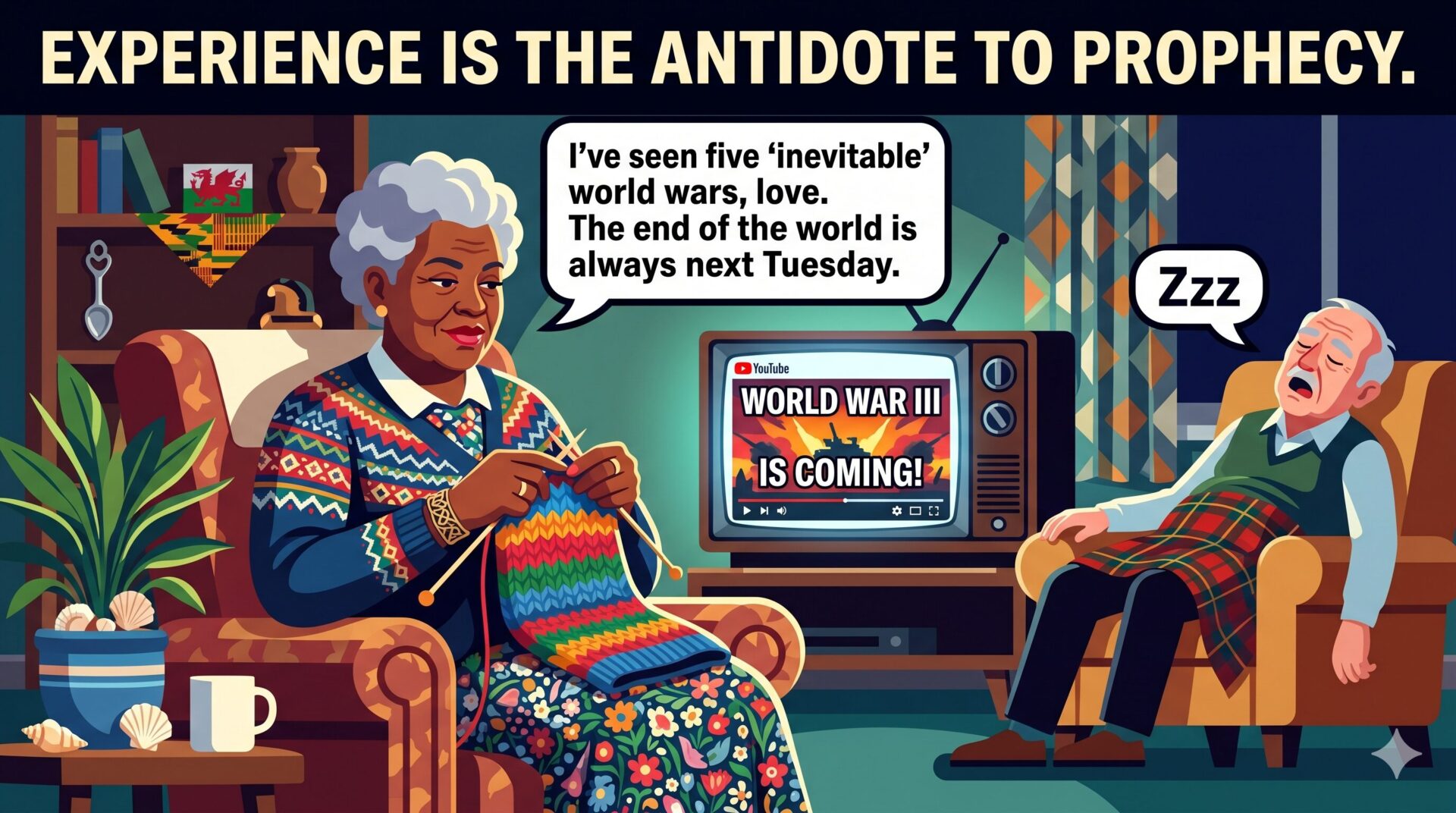 He doesn’t mention these things because he doesn’t believe in them. Or because they wouldn’t fit his brand. Or because he’s never done them himself. The professor is a spectator. He watches the world, predicts the world, comments on the world. He doesn’t change the world. And his “kindness and love” ending is the spectator’s philosophy: since I can’t change anything, I’ll just be nice to the people around me.
The Cockney Example: The Bloke Who Brings Biscuits to the Eviction
Imagine a family being evicted. The bailiffs are at the door. The landlord is smirking. The family is packing their lives into bin bags. A neighbour knocks. “I’ve brought Hobnobs,” she says. “And a kind word. We’re all in this together.” The family thanks her. Then they’re on the street.
That’s the professor’s hope. Biscuits. Kind words. Neighbourly concern. It doesn’t stop the eviction. It doesn’t challenge the landlord. It doesn’t change the law. It just makes the suffering slightly more bearable for a moment. And that’s the tragedy. The professor has convinced his audience that bearing suffering is the same as ending it.
The Real Hope
Here’s the real hope that the professor won’t give you. Not because he doesn’t believe in it. Because he doesn’t know it. The real hope is that ordinary working people, when they organise together, can stop the machine. Not by being nice. By being militant. By being disciplined. By being willing to take risks, make sacrifices, and build power that the ruling class cannot ignore.
The real hope is that strikes work. That occupations work. That mass civil disobedience works. That international solidarity works. That every empire that has ever tried to crush the human spirit has eventually failed – not because the people were kinder, but because they were tougher, more creative, more determined, and more willing to fight.
The professor doesn’t mention this hope because mentioning it would make his predictions irrelevant. If people can stop the machine, then the machine is not inevitable. And if the machine is not inevitable, the professor is not a prophet. He’s just a man with a map of a country that doesn’t exist.
The Adage About the Lifeboat
There’s a saying: “A lifeboat is nice. But what you really need is a ship that doesn’t sink.” The professor’s love and kindness are the lifeboat. He’s accepted that the ship is sinking. He’s told you to hold hands in the water and share your breath. He hasn’t told you how to patch the hull, how to steer for shore, how to build a new ship that doesn’t leak.
Because patching the hull would require confronting the people who put the hole there. Steer for shore would require navigating against the current. Building a new ship would require rejecting the old one entirely. That’s not lovely. That’s war – class war, the only war that matters. And the professor is not fighting it.
The Cockney Verdict
So here’s the bottom line, from a geezer who’s seen a lot of nice people lose a lot of fights. The professor’s hopeful ending is a cop-out. It’s the conclusion of someone who has described a nightmare, refused to offer a way out, and then tried to soften the blow with a Hallmark card. It’s not hope. It’s resignation with a smile.
As my nan used to say: “Nice is what you say when you’ve given up on fair.”
The professor has given up on fair. He’s given up on justice. He’s given up on winning. He’s settling for kindness because kindness is the only thing he thinks is possible. But kindness is not the opposite of cruelty. Power is. And power is not built by being nice to your neighbours. It’s built by organising with them, confronting the enemy with them, and refusing to accept a world where kindness is the best we can hope for.
Don’t settle for the professor’s lifeboat. Build a new ship. Not with love alone – but with solidarity, with rage, with the unshakeable conviction that another world is possible. That’s not a prediction. It’s a decision. And it’s the only one worth making.
40.The Subscription Pitch: When the Prophet Shows His Price Tag
There’s a saying you’ll hear in any market from Brick Lane to Billingsgate: “A man who gives you the first taste for free is not a philanthropist. He’s a salesman.” Our professor has spent the better part of an hour painting a picture of the apocalypse. World War III, the draft, AI surveillance, starvation sieges, empire collapse, six billion refugees. He’s made you feel scared, anxious, powerless. He’s made you feel like only he has the answers. And then, right at the end, he asks for your credit card details.
“Join my inner circle,” he says. “Ten thousand of you. Exclusive content. Behind‑the‑scenes. Direct access to me.” He wraps it in the same soft blanket as his hopeful ending – community, connection, a private space away from the algorithm. But underneath the fleece is a cash register. The prophet needs to eat. And he’s decided that you’re going to feed him.
Let’s be clear. There’s nothing wrong with making a living. Content creators need income. But the professor’s entire performance has been designed to lead you to this moment. The fear, the certainty, the insider jargon, the moral authority, the vulnerability – it’s all marketing. He’s built a funnel, and you’re at the bottom. The inner circle is not a community. It’s a product. And the price is your subscription.
The Adage of the Soup Kitchen
My old nan used to say: “A soup kitchen that charges for the soup is not a soup kitchen. It’s a restaurant.” The professor’s “inner circle” is a soup kitchen with a cover charge. He’s selling you the sense of belonging, the illusion of access, the feeling that you’re on the inside. But the real inside – the one where decisions are made – doesn’t have a PayPal link. The real inside is boardrooms, cabinet meetings, military headquarters. The professor can’t get you in there. He can only get you into his Discord server.
He’s not opening doors. He’s opening a checkout page.
The Cockney Guide to the Funnel
Let me explain the sales funnel the way my old gaffer explained the market stall. “First, you grab their attention. Then you make them feel bad – about their weight, their money, their future. Then you offer the solution. Then you take their cash. That’s it. Everything else is decoration.”
The professor’s funnel is a masterpiece. Grab attention: dramatic predictions, chess pieces, maps. Make them feel bad: the draft, the war, the collapse, the surveillance. Offer the solution: my analysis, my inner circle, my exclusive content. Take the cash: join now, only ten thousand spots, link in the description. It’s textbook. And it works because fear is the best salesman. Fear doesn’t compare prices. Fear doesn’t read the terms and conditions. Fear just clicks.
The Missing Free Lunch
Here’s what the professor’s pitch reveals. He’s not a prophet. He’s a business. Prophets don’t ask for subscriptions. They ask for followers, believers, disciples. They build movements, not member‑only content libraries. The professor is building a brand. And brands need revenue.
There’s nothing wrong with that, on its own. But the professor has been selling you truth, insight, inside knowledge. He’s been positioning himself as the outsider, the truth‑teller, the one who isn’t owned by anyone. And then he asks for your card details. That’s not a contradiction. That’s the whole point. The truth is the product. Your fear is the marketing. And your subscription is the profit.
The Cockney Example: The Bloke Who Offers Free Drinks Then Charges for the Glass
Imagine a pub in Soho. A bloke at the door says, “Free drinks tonight, courtesy of me.” You go in. You get a warm, flat pint. Then he says, “That’ll be a fiver for the glass.” That’s the professor. The free content – the YouTube video – is the warm, flat pint. The inner circle is the glass. You thought you were getting something for nothing. But nothing is free. Not even fear.
The Real Inner Circle
Here’s the real inner circle. It’s not a private chat room. It’s the people you can actually organise with – your neighbours, your coworkers, your fellow tenants, your union local. It doesn’t cost a subscription. It costs time, effort, vulnerability, and trust. It doesn’t give you exclusive content. It gives you shared power. It doesn’t offer you direct access to a prophet. It offers you direct access to each other.
The professor’s inner circle is a substitute for the real thing. It’s a simulation of community, a purchased intimacy, a paid‑for belonging. He’s selling you what should be free – solidarity, mutual aid, collective action – and he’s charging a monthly fee.
The Adage About the Ticket
There’s a saying: “The only ticket you need for the revolution is the one you give yourself.” The professor is selling tickets. He’s telling you that the inner circle is where the real action is. But the real action is not behind a paywall. It’s on the picket line, in the housing estate, at the food bank, in the streets. No one charges admission to a protest. No one asks for a credit card to join a strike.
The professor’s ticket is for a show. A very good show. But it’s still a show. And when the show is over, you’re left with a lighter wallet and the same world you started with.
The Cockney Verdict
So here’s the bottom line, from a geezer who’s seen a lot of prophets come and go, and who’s never paid for a single one. The subscription pitch is the final reveal. It’s the moment the mask slips. Not because the professor is evil – he’s not. But because he’s exposed. He’s not trying to save you. He’s trying to sign you up.
As my nan used to say: “The man who tells you the world is ending is either a madman or a merchant. The merchant always asks for your address.”
The professor has asked for your address – or your email, your payment details, your subscription. He’s a merchant. He’s selling fear, certainty, and the illusion of inside knowledge. You can buy it if you want. But don’t mistake the purchase for a plan. Don’t confuse the product with a movement. And don’t think that an inner circle is the same as a community.
The real inner circle is the one you build yourself, with the people around you, for free, by showing up. No prophet needed. No credit card required. Just solidarity, sweat, and the courage to act.
The professor will keep predicting. You keep organising. That’s the only difference that matters. And it doesn’t cost a penny.
The Economics of Fear: How Doom Sells and Who Profits
Let’s talk brass tacks. Not the shiny ones on a general’s uniform. The real brass – the kind that jingles in the pockets of the few while the rest of us count coppers.
There’s a saying you’ll hear in any back office from the City to Canary Wharf: “Fear is a commodity like any other. And right now, it’s trading higher than gold.” Our professor is a trader. A very good one. He’s taken a genuine product – geopolitical uncertainty – and packaged it as premium doom. He’s not a revolutionary. He’s not a truth-teller. He’s an entrepreneur who’s figured out that the most reliable click is a scared click.
Let’s be honest about what’s actually happening here. You’ve got a charismatic speaker with genuine knowledge of geopolitics. He’s read the books. He’s studied the maps. He can name the chokepoints and the battle tanks. He uses that knowledge to build credibility – the first few minutes are solid, informative, even useful. You trust him. Then he uses that trust to sell increasingly wild claims. Predictions that aren’t predictions. Certainties that aren’t certain. Numbers that come from nowhere. And you keep watching. You keep sharing. You keep clicking. Because fear is addictive. And the professor is your dealer.
The Adage of the Carnival Barker
My old nan used to say: “The barker at the fair doesn’t believe the fat lady is a princess. He just knows you’ll pay to see her.” The professor doesn’t believe half of what he says. He can’t. Not with that many contradictions. Not with that many leaps. He’s a barker. He’s selling tickets to a show. The show is called “The End of the World.” The fat lady is World War III. And you’re paying with your attention, your trust, and eventually your subscription.
This isn’t revolutionary consciousness-raising. It’s a business model. A very successful one. The entertainment-industrial complex – that’s the real name for the beast – has figured out that fear is the most reliable engagement drug. Not joy. Not hope. Not solidarity. Fear. Fear keeps you watching. Fear keeps you scrolling. Fear keeps you from looking away, because looking away might mean missing the moment the world ends.
Climate collapse, civil war, World War III, AI dictatorship – take your pick, they’re all in stock and they’re all selling like hot cakes. The professor is just one vendor in a very crowded market. But he’s a good vendor. He’s got better maps, a sharper laser pointer, and a more convincing tweed jacket than most.
The Cockney Guide to Who Actually Profits
Here’s the thing that should properly boil your piss. While we’re all watching videos about how the world is ending, the actual elite – the ones with the private jets, the offshore accounts, and the politicians in their pockets – are calmly going about their business of extracting wealth from the rest of us. They’re not scared. They’re not anxious. They’re not clicking subscribe. They’re making money. From the fear. From the wars. From the very chaos that the professor describes as inevitable.
The professor mentions “private bankers” as the shadowy controllers. He gestures vaguely at the City, at Wall Street, at Basel. But he never names them. Never tells you who they are, where they meet, what their actual interests are. Because once you start naming names – once you start tracing the actual money and the actual power – you realise it’s not a conspiracy. It’s not a cabal. It’s just capitalism working as designed. A system where profit is the only motive, extraction is the only method, and human life is just overhead.
The professor can’t name names because naming names would get him sued. Or because he doesn’t actually know. Or because the names are boring – they’re not lizard people or Illuminati. They’re just the same families, the same funds, the same corporations that have been running the show for centuries. The Rothschilds. The Rockefellers. The Saudis. The Murdochs. The people who own the banks, the media, the weapons factories, the oil fields. They’re not hiding. They’re at the front of the plane.
The Missing Class Analysis – Again
Here’s what the professor’s fear economy leaves out. The working class – the people who watch his videos, who worry about the draft, who can’t afford the subscription – are not the customers of fear. They’re the fuel. Their fear is the product. Their attention is the currency. Their subscriptions are the profit. The ruling class isn’t scared of World War III. They’re not going to fight it. They’re going to profit from it. They always have.
The professor’s business model depends on you never realising that. He needs you scared, not angry. Anxious, not organised. Because a scared audience buys subscriptions. An organised audience builds movements. Movements don’t need prophets. They need each other.
The Cockney Example: The Bloke Who Sells Umbrellas in a Drought
Imagine a market trader who only sells umbrellas. When it’s sunny, he tells everyone a storm is coming. When it’s cloudy, he says the flood is here. His umbrellas sell. But he never mentions that the umbrella factory is owned by his brother-in-law, and that the rain never actually comes. He’s not a weatherman. He’s a merchant. And the weather is his marketing.
The professor is that trader. The storm is World War III. The umbrella is his inner circle. The factory is his content machine. And the rain? It might come. It might not. Either way, he’s already sold the umbrellas.
The Real Profit Margins
Here’s the ugly truth. The professor profits from your fear. Directly – through subscriptions, merchandise, speaking fees. Indirectly – through the algorithm that rewards his content with more views, more reach, more influence. His success depends on your anxiety. If you stopped being scared – if you stopped watching – he’d have to find another line of work.
That’s not a criticism. It’s just the economics of the attention economy. Fear is the most reliable engagement drug because it’s the hardest to ignore. You can scroll past a puppy. You can’t scroll past a screaming headline about the end of the world. The professor knows this. He’s not stupid. He’s just playing the game.
The Adage About the Firewood
There’s a saying: “A man who sells firewood profits from the cold. That doesn’t mean he started the winter.” The professor profits from the cold – the geopolitical winter, the fear of war, the anxiety about the future. He didn’t start the winter. The ruling class did. But he’s not trying to end it either. Because if the winter ends, his firewood stops selling.
The professor’s interest is in prolonging your fear, not resolving it. Resolved fear doesn’t click. Resolved fear doesn’t subscribe. Resolved fear doesn’t share. He needs you in a state of perpetual anticipation – always waiting for the next shoe to drop, the next prediction to come true, the next war to start. That’s his business model. Not prophecy. Perpetual suspense.
The Cockney Verdict
So here’s the bottom line, from a geezer who’s watched the fear industry grow from a market stall to a supermarket chain. The professor’s economics of fear is not a secret. It’s not a conspiracy. It’s just the logic of capitalism applied to information. Fear sells. Doom is profitable. And the people who profit are the ones selling the doom, not the ones dying from it.
As my nan used to say: “The butcher, the baker, the candlestick maker – they all need you to want something. The butcher wants you hungry. The baker wants you peckish. The candlestick maker wants you afraid of the dark.”
The professor is the candlestick maker. He wants you afraid of the dark. Not so he can light a candle. So he can sell you one. And another. And another. Forever.
Don’t be the customer. Fear the dark, yes – but learn to make your own light. Build it with your neighbours. Share it with your community. That’s not a product. It’s a practice. And it doesn’t cost a subscription. It just costs showing up.
The professor will keep selling his candles. You can keep buying them. Or you can learn to see in the dark. Your choice. But don’t say you weren’t told.
The Real Conspiracy: It’s Called Class
There’s a saying you’ll hear in any union meeting from Glasgow to Gillingham: “The rich man’s joke is always on the poor man’s tab.” Our professor has told you a lot of jokes. Wars, drafts, AI, collapse – he’s painted a picture of a world spinning out of control, driven by shadowy bankers and grand strategies. He’s named names – Trump, Putin, the Ayatollah. He’s drawn maps, moved chess pieces, dropped code names. But there’s one word he’s never once uttered. One concept so fundamental, so obvious, that its absence is deafening.
Class.
Not once does the professor mention the fundamental conflict between those who own the means of production and those who sell their labour to survive. Not once does he suggest that the solution to endless war isn’t better predictions about where the next war will be – but organising to refuse to fight in any of them. Not once does he ask his audience: who benefits from your fear? Who profits from your anxiety? Who laughs all the way to the bank while you’re stockpiling tinned beans?
The missing word is the key to everything. Because the working class – whether in London, Tehran, Moscow, or Beijing – has far more in common with each other than with the billionaires who send them to die. The pensioner in Donetsk and the pensioner in Detroit both got sold out by the same system. The youth in Paris and the youth in Lagos both face the same precarious future. The single mum in Birmingham and the single mum in Baghdad both worry about the same things – rent, food, schools, safety.
But you won’t hear that in the professor’s videos. Because international working-class solidarity doesn’t get clicks. It doesn’t sell subscriptions. And crucially, it doesn’t serve the interests of the people who actually control the platforms these videos are distributed on. The professor’s silence on class is not an oversight. It’s a business decision.
The Adage of the Shared Boat
My old nan used to say: “We’re all in the same boat, but some of us are in the cabin and some of us are in the bilge. The ones in the cabin are the ones drilling the holes.” The professor talks about the holes. He describes the leaks, the rising water, the imminent sinking. He never mentions the cabin. He never names the people with the drills. He never tells you that the bilge rats – the working class – vastly outnumber the passengers in the cabin. If we all rushed the cabin at once, the drills would stop. The holes would be patched. The boat might even float.
But the professor doesn’t want you to rush the cabin. He wants you to stay in the bilge, watching his videos, learning about the leaks, and paying for the privilege. Because a bilge rat that organises is no longer a customer. It’s a threat.
The Propaganda of Prophecy
What we’re really dealing with here is a very sophisticated form of disempowerment dressed up as empowerment. The professor gives you knowledge – maps, strategies, predictions. He makes you feel like you’re in on the secret. But the secret he’s giving you is that you’re powerless. That massive forces are at play. That war is inevitable. That the system is all-powerful. That all you can do is hunker down, love your family, and wait for the collapse.
That’s not empowerment. That’s the opposite. That’s telling working people that they’re spectators in a game played by masters they’ll never understand. That’s teaching learned helplessness. And that’s exactly what the ruling class wants you to believe.
Because if you believe the situation is hopeless, you won’t organise. If you believe war is inevitable, you won’t resist conscription. If you believe AI control is coming regardless, you won’t fight for digital rights. If you believe the collapse is coming, you won’t build the alternatives. You’ll just watch. And pay. And wait.
The Cockney Guide to Who’s Really Pulling the Strings
Let me tell you who’s really pulling the strings. It’s not a cabal of bankers meeting in a Swiss bunker. It’s the class of people who own everything – the land, the factories, the media, the banks. They don’t need to conspire. They share the same interests. Those interests are: keep the working class divided, scared, and passive. A divided working class fights itself. A scared working class doesn’t organise. A passive working class pays for content that tells it to stay passive.
The professor is not the enemy. He’s a symptom. He’s a product of the same system that produces anxiety, isolation, and the desperate search for someone who has the answers. But he’s also a salesman. And what he’s selling is the idea that you can’t change anything. That’s a profitable idea. It’s also a lie.
The Cockney Example: The Bloke Who Knows the Train Is Late but Doesn’t Know Why
Imagine a bloke at a railway station. The train is late. He knows the train is late because he’s been watching the departure board. He can tell you exactly how late it is – twelve minutes, seventeen, twenty-two. He can predict when it might arrive. He’s got a system. People gather around him. “When’s the train coming?” He tells them. They wait. The train comes. He’s a hero.
But he never asks why the train is late. He never asks who decided to cut the funding for maintenance. He never asks why the workers are striking. He never asks if maybe the train system should be owned by the public instead of shareholders. He just watches the board and predicts.
That’s the professor. He’s watching the departure board of history. He’s telling you when the next war is coming. But he never asks who decided to build the tracks that way. He never asks why we’re still using trains when we could be building something better.
The Real Conspiracy – It’s Called Solidarity
Here’s the real conspiracy. It’s not a secret. It’s called solidarity. It’s the simple, radical idea that working people have more in common with each other than with their rulers. It’s the understanding that a nurse in Tehran and a nurse in London both need safe hospitals, decent pay, and time off. It’s the recognition that a teacher in Moscow and a teacher in Chicago both want smaller classes, better resources, and respect.
That solidarity is the only thing that’s ever changed the world. Not predictions. Not prophets. Not inner circles. Strikes. Occupations. Mutual aid. Refusals. Mass movements that scare the ruling class more than any war.
The professor never mentions this because solidarity is not a product. You can’t sell it in a subscription. It doesn’t need a laser pointer or a chess set. It needs people, face to face, taking risks, building trust, acting together. That’s harder than watching a video. It’s also the only thing that works.
The Adage About the Chain
There’s a saying: “A chain is only as strong as its weakest link. But a link that refuses to connect is stronger than any chain.” The professor’s chain is the system – the empire, the bankers, the strategies. He’s described it as unbreakable. But every link in that chain is a human being – a soldier, a bureaucrat, a programmer, a banker. Every single one of them can refuse. Every single one can break the chain. Not by watching. By acting.
The professor doesn’t want you to break the chain. He wants you to admire it, understand it, predict when it might snap. But he doesn’t want you to take a hammer to it. Because a hammer doesn’t need a subscription.
The Cockney Verdict
So here’s the bottom line, from a geezer who’s learned that the only conspiracy worth joining is the one that includes everyone. The professor’s missing class analysis is not a gap. It’s a wall. He’s built it to keep you from seeing the real enemy – not Iran, not Russia, not China. The real enemy is the class that owns the world and profits from your fear. That class includes the people who run the platforms where the professor’s videos are hosted. It includes the people who buy his ads. It includes the people who would rather you watch than organise.
As my nan used to say: “The devil’s greatest trick is not making you believe he doesn’t exist. It’s making you believe he’s the only one with a plan.”
The professor has a plan – for his business. You need a plan – for your life. Not a prediction. A plan. A plan that involves your neighbours, your coworkers, your community. A plan that doesn’t need a prophet because it’s built on trust, not fear. A plan that says: we don’t know what’s coming, but we’ll face it together.
That’s not a conspiracy. That’s just class solidarity. And it’s the only thing that’s ever worked. The professor won’t tell you that. I just did. Now get on with it.
The Alternative: What Real Resistance Actually Looks Like
There’s a saying you’ll hear in any community centre from Clapton to Clapham: “The quiet work of mending the world doesn’t make the headlines. But it’s the only thing that ever stops it breaking.”
So what’s the alternative to doom‑scrolling and prophecy‑watching? What do you actually do after the professor has told you the world is ending and the only solution is to subscribe?
It’s boring, honestly. It’s unglamorous. It won’t get you millions of YouTube views. It won’t give you a laser pointer or a chess set. There’s no code name, no dramatic music, no map with arrows. It’s the work of ordinary people, doing ordinary things, in an extraordinary way – together.
The Cockney Guide to Real Resistance
Real resistance is building community mutual aid networks. Not the kind you pay for – the kind you build with your neighbours. Who on your street has a spare room? Who can lend a ladder? Who knows how to fix a boiler? Who can watch the kids while someone else goes to court? It’s a spreadsheet, a WhatsApp group, a rota. It’s not glamorous. It’s how working people have survived every crisis since the dawn of time.
Real resistance is unionising your workplace. Not the kind you see in the movies – the kind where you talk to your colleague in the break room, agree that the pay is rubbish and the shifts are worse, and start meeting in secret. It’s slow, it’s dangerous, and it’s the only reason anyone has a weekend, a sick day, or a pension.
Real resistance is tenant organising in your building. The landlord doesn’t answer your emails? Send a letter signed by every flat. He ignores that? Withhold the rent together. He tries to evict one of you? The whole block shows up at the court. That’s not a protest. That’s power.
Real resistance is supporting refugee solidarity groups. Not with a hand‑wringing post on social media – with lifts to appointments, translated documents, a hot meal, a place to stay. It’s recognising that the person who just arrived has the same enemy as you – the system that makes you both struggle for scraps.
Real resistance is showing up to council meetings. Not the ones about the big national issues – the ones about the pothole on your street, the rubbish collection, the library closure. Those are the meetings where the local ruling class tests its power. Your presence is a reproach. Your voice is a threat.
Real resistance is teaching your kids that another world is possible. Not by lecturing them – by living it. By taking them to protests, to food banks, to community gardens. By explaining that the world they see on telly is not the only world there is. By showing them that the people on their street are more important than the people on the screen.
The Adage of the Boring Bridge
My old nan used to say: “The bridge doesn’t talk about itself. It just holds the weight. And when it breaks, everyone notices. But no one thanks it for the decades of holding.”
Real resistance is that bridge. It doesn’t get interviewed. It doesn’t get a code name. It doesn’t trend on social media. It just holds. And when the crisis comes – the war, the collapse, the blackout – the bridge is still there. The people who built it are still there. And they know how to build another.
The professor doesn’t mention any of this. Because it’s not dramatic. It doesn’t sell. He’s not a bridge builder. He’s a demolition expert. He tells you the bridge is about to fall. He never tells you how to reinforce it.
The Telling Absence
Notice what’s completely missing from the professor’s analysis: any mention of anti‑war movements. Any mention of draft resistance. Any mention of labour organising across borders. Any mention of the millions of people who, throughout history, refused to play the game by the rules of their masters.
It’s as if resistance doesn’t exist. As if the only actors in history are states and capitalists and bankers, and ordinary people are just along for the ride.
This is, ironically, the most revealing thing about the whole performance. A genuine useful analysis would centre the agency of ordinary people. It would talk about how wars are stopped, not just how they’re started. It would discuss organising, not just predicting. It would name the people who said “no” – the soldiers who refused to load the guns, the workers who walked off the factory floor, the women who blockaded the bases.
But that kind of analysis doesn’t sell premium subscriptions. It doesn’t get shared on social media. It doesn’t make you feel like you’ve unlocked secret knowledge that the sheeple don’t have. It makes you feel like you have work to do. And work doesn’t come with a dopamine hit.
The Cockney Example: The Bloke Who Forgets the Stopping
Imagine a bloke who only talks about the starting pistol. “The race is about to begin! The runners are in the blocks! The gun is about to fire!” He never mentions the finish line. He never mentions the runners who collapsed. He never mentions the ones who never started because they refused to run. He just loves the bang.
That’s the professor. He loves the bang – the invasion, the war, the collapse. He never mentions the people who refuse to run. The conscientious objectors. The draft dodgers. The soldiers who mutiny. The workers who sabotage. The millions who, throughout history, have looked at the starting pistol and said, “Not for me, mate.”
The Numbers Game
Let’s talk about those predictions he claims came true. Trump winning in 2024? Not exactly a bold call – the polls were showing it. The electoral college was leaning his way. Anyone with a TV could have made that call. It’s like predicting that the sun will rise in the east. It’s not prophecy. It’s pattern recognition.
War with Iran? Depending on how you define “war,” this is either plausible or nonsense. A few airstrikes? A naval blockade? A full‑scale invasion? The professor never says. He keeps it vague – “a war” – so that whatever happens, he can claim victory. If a drone gets shot down, he was right. If nothing happens, he can say “it’s still coming.”
This is prophecy 101: be specific enough to sound credible, vague enough to never be proven wrong. The professor is a master of the art. He gives you dates – “starting in December” – but not years. He gives you operations – “Southern Spear” – but not documents. He gives you numbers – “80‑90%” – but not methods.
The one genuinely testable prediction – that America would lose the war with Iran – is presented as something that’s still unfolding, still possible, still not disproven. Convenient that. If the war never happens, he can say “it’s still coming.” If it happens and America “wins” (whatever that means), he can redefine “lose.” If it happens and America withdraws, he was right. It’s a no‑lose game for the prophet. The only loser is the audience, who paid for certainty and got a bet.
The Adage About the Betting Slip
There’s a saying: “A man who sells you a betting slip after the race has run is not a bookie. He’s a thief.” The professor sells you betting slips after the race has started – or sometimes before it’s even scheduled. You pay for the slip. You wait for the result. The result never comes. Or it comes but looks nothing like the slip. And the professor is already selling next week’s slip.
The only way to win is not to bet. The only way to stop the race is not to run.
The Cockney Verdict
So here’s the bottom line, from a geezer who’s seen a lot of prophets come and go, and a lot of ordinary people do extraordinary things. The alternative to doom‑scrolling is not a different prophet. It’s not a better prediction. It’s not a secret inner circle with exclusive content.
It’s the slow, unglamorous, boring work of building resistance with the people around you. It’s the union meeting, the tenants’ association, the food bank rota, the refugee welcome committee. It’s the conversation on the stairwell, the shared meal, the mutual promise: “If it comes to it, we’ll look out for each other.”
As my nan used to say: “The end of the world is not a date. It’s a decision. And you can decide to end it in a different way – by building the new one before the old one falls.”
The professor will keep predicting the fall. You can keep watching. Or you can start building. Not alone. Together. That’s the only resistance that’s ever worked. And it doesn’t need a prophet. It just needs you.
The British Context: Why This Matters Here
There’s a saying you’ll hear in any pub from Portsmouth to Paisley: “When America sneezes, Britain catches pneumonia. And then we pay for the tissues.”
For a British audience, this professor’s brand of doom-hawking hits different. It’s not just entertainment. It’s familiar. We’ve got our own history of being dragged into American wars – Korea, Vietnam, Iraq, Afghanistan. We’ve got our own military‑industrial complex – BAE Systems, Rolls‑Royce, Babcock, the whole grisly lot. We’ve got our own politicians, from Blair to Cameron to Sunak, who’ve been desperate to prove they’re still relevant on the world stage by kissing the ring of whichever president is in charge.
And we’ve got our own version of this doom‑porn industry. Commentators who make a living telling us how terrible everything is, how powerless we are, how only they have the secret knowledge to understand what’s really going on. They’ve got different accents and different platforms, but the script is the same. Fear sells. Helplessness is profitable. And the British audience – already softened by years of austerity, Brexit chaos, and the slow crumbling of the NHS – is a ripe market.
The Result of All This
The result is a population that’s simultaneously anxious and passive. Worried sick about the future – the next war, the next pandemic, the next energy bill – but convinced that nothing can be done. Full of opinions about geopolitics, about China and Russia and Iran, but disconnected from any actual political organising. Armchair generals. Sofa strategists. People who can name three types of missile but have never been to a union meeting.
It’s the perfect arrangement for those in power. A fearful population is a manageable population. A population that’s convinced the system is all‑powerful won’t try to change it. They’ll just watch videos, nod along, and feel clever without ever lifting a finger.
The professor is not the cause of this. He’s a symptom. But he’s also an amplifier. He takes the existing anxiety and turns up the volume. He validates the helplessness and calls it insight. And he does it all from a studio that might as well be a million miles away from the housing estates and high streets where the actual struggle happens.
The Cockney Example: The Bloke Who Watches the Fire from the Balcony
Imagine a block of flats in Southwark. There’s a fire on the ground floor. The smoke is rising. The alarms are ringing. Most of the residents are scrambling to get out, to help each other, to find the extinguishers. But one bloke stays in his flat. He’s on the balcony, watching the smoke, and he’s got a livestream going. “This is it,” he says. “The whole building is going to collapse. I’ve seen it before. Nothing you can do. Just watch and learn.”
That’s the professor. The fire is real. The danger is real. But he’s not helping to put it out. He’s not passing buckets. He’s not checking on the elderly neighbour. He’s performing expertise while the building burns. And his audience, watching from their own balconies, thinks he’s a genius.
The Class Angle the Professor Misses
Here’s what a real working‑class analysis would say about the professor’s predictions – not the kind you need a degree to understand, just the kind you need your eyes open.
Trump’s third term? Who cares which rich bloke sits in the fancy chair – the system serves capital regardless. The name on the plaque doesn’t change who owns the factory.
The draft? Working‑class kids always get sent to die first. Always have, always will, unless we refuse to go. Not “resist” – just refuse. They can’t march you off if everyone says no.
AI control? A tool for workplace surveillance and wage suppression. Something to fight, not just predict. You don’t need to understand the algorithm to pull the plug.
Bankers controlling everything? That’s not a conspiracy. That’s the stated purpose of capitalism. It’s not a secret. It’s the business model.
The professor has half the diagnosis – the system is rigged, the elite are parasites, empire is crumbling. But he stops there. He never gets to the actual solution, because the actual solution is collective action, and collective action doesn’t make for good content. Collective action means meetings, debates, disagreements, compromises, slow progress, occasional setbacks. It’s not a laser pointer. It’s a spreadsheet. It’s not a chess set. It’s a rota.
The Performance of Expertise
Let’s be honest about what we’re watching. The chess pieces, the maps, the confident delivery, the references to obscure documents – it’s all performance. It’s designed to make you feel like you’re sitting in a university seminar rather than watching content designed to keep you scared and engaged.
The professor is very good at this. He’s clearly intelligent, well‑read, and genuinely knowledgeable about certain topics. That’s what makes him dangerous – he uses real expertise to sell nonsense, like a chef using good ingredients to poison the soup.
He’s not lying about everything. He’s not stupid. He’s just chosen a lane – the lane of prophecy – because prophecy pays better than analysis. Analysis is tentative. Prophecy is certain. Certainty gets clicks. Tentativeness does not.
The Contradictions Exposed
For all his talk of exposing the system, the professor reproduces every bad habit of mainstream punditry. Let’s list them, shall we?
Nations as monolithic actors with singular wills. “America wants this. Russia wants that.” But America doesn’t want anything. A bunch of competing elites with different interests want different things. The professor smooths over the contradictions because contradictions are messy.
Geopolitics as a board game rather than human reality. Pieces don’t bleed. The professor’s maps have no bodies. No tears. No hunger. Just arrows and chokepoints.
War as inevitable rather than chosen. “Had to invade.” “No choice.” But there’s always a choice. The choice not to invade. The choice to negotiate. The choice to resist. The professor pretends these choices don’t exist.
Resistance as irrelevant rather than crucial. In his world, only states act. Ordinary people just react. They’re never the subjects of history, only its objects.
The future as something to predict rather than something to build. He treats tomorrow as a fixed track. It’s not. It’s a field. You can plough it, seed it, harvest it – if you organise.
The only difference between the professor and a CNN pundit is the aesthetic – tweed jackets and chess pieces instead of suits and teleprompters. The substance is the same. Both tell you that you’re powerless. Both sell you the illusion of understanding. Both profit from your passivity.
The Money Trail
Who benefits from content like this? Obviously the creator does – YouTube ad revenue, subscription fees, merchandise, speaking gigs. That’s fine. People need to eat. I’m not knocking the hustle.
But who else benefits? The platforms that distribute this content benefit from the engagement. Every click, every share, every comment feeds the algorithm, and the algorithm feeds the shareholders. The media ecosystem that profits from fear benefits from the attention – all those “outrage porn” sites, all those “doom scrolling” forums, all those “prepper” channels. They’re all in the same business: selling you a front‑row seat to the apocalypse.
And most importantly, the actual ruling class benefits from a population that’s too scared and confused to organise. A fearful population doesn’t strike. An anxious population doesn’t blockade. A population that’s been told the system is all‑powerful doesn’t try to change it. They just watch. And pay. And wait.
Divide and conquer works best when people are watching their own entertaining versions of the apocalypse. The professor is not the enemy. But he’s not the ally either. He’s the entertainment wing of the very system he claims to critique.
The Alternative Frame
What would a genuinely useful analysis of current geopolitics look like? It would centre the working class. Not as victims – as agents. It would discuss how to build international solidarity across national lines – how a dockworker in Liverpool and a dockworker in Shanghai share the same enemy. It would analyse not just the strategies of states, but the strategies of resistance – how strikes have stopped wars, how mutinies have toppled generals, how civil disobedience has brought empires to their knees.
It would name specific capitalists, specific politicians, specific policies – not vague “bankers” and “elites.” It would say: “This law, proposed by this MP, funded by this corporation, benefits this billionaire. Here’s how we stop it.”
It would be less exciting. It would have fewer dramatic predictions. It would probably get fewer views. But it might actually help people change things. And that’s the difference between a prophet and an organiser. One gets the clicks. The other gets the results.
The Youth Question
The professor never addresses young people as potential agents of change. Instead, he talks about them as potential draftees, as victims of AI surveillance, as consumers of content who might or might not believe the “shadows.”
 This is a massive failure of analysis. Young people today are organising in ways previous generations couldn’t have imagined. Climate strikes that shut down city centres. Union drives at Amazon and Starbucks. Mutual aid networks that fed entire communities during lockdowns. Digital rights campaigns that took on the surveillance state and won concessions.
They’re not passive victims waiting to be drafted. They’re the most likely source of resistance to the system the professor describes. They’ve grown up with crisis – climate, pandemic, austerity – and they’re not waiting for a prophet to tell them what to do. They’re doing it themselves.
But you wouldn’t know that from watching his videos. Because they’re not on his chess board. They’re not in his scripts. They’re not profitable for his model.
The Pensioner Perspective
And what about older working people? The ones who’ve seen it all before – the Cold War scares, the Gulf War build‑ups, the War on Terror, the austerity years. They know that the world has always been ending according to some prophet or another. They know that predictions are cheap and that life goes on regardless.
They’ve lived through “inevitable” nuclear war with the Soviets, “inevitable” clash of civilisations with Islam, “inevitable” collapse of the euro, “inevitable” pandemic, “inevitable” recession. Some of these things happened. Most didn’t. And the ones that did didn’t play out the way the prophets said.
The professor’s analysis offers nothing to pensioners except more fear about their children and grandchildren. No solidarity. No recognition that older workers have been on the front lines of every major struggle – from the miners’ strike to the poll tax riots to the anti‑war marches. No respect for the accumulated wisdom of people who’ve seen it all and are still standing.
Just more doom. More predictions. More reasons to stay scared and passive.
The Marginalised Communities
Where are the voices of those most affected by war and crisis in this analysis? The Palestinian families being bombed in Gaza? The Yemeni children starving? The Sudanese displaced by conflict? The Afghan women stripped of rights?
They’re absent. Because they don’t fit the board game model of geopolitics. Because they’re not “players” – they’re just the people whose lives get destroyed by the players’ moves. They’re collateral damage. Background noise. Pawns.
This is the ultimate failure of the professor’s approach. In trying to explain how the system works, he reproduces the system’s own logic – treating human beings as pieces on a board rather than as people with agency, dignity, and the capacity to resist.
The Palestinians have been resisting for generations. Not with Predator drones or aircraft carriers – with stones, with boycotts, with marches, with the simple, stubborn refusal to leave their land. That resistance is real. It’s effective. It’s changed the conversation in ways the professor’s maps never could.
But you wouldn’t know it from his videos. Because their struggle doesn’t fit his script. It’s not about chess pieces. It’s about justice.
The Boring Truth
Here’s the boring truth that won’t get millions of views. The world is complicated. No single person has all the answers. Predictions are mostly wrong. The future is uncertain. And change happens through slow, difficult, collective organising – not through individual geniuses revealing secret knowledge.
The professor’s videos are entertaining. They’re compelling. They make you feel like you’re in on something. But they’re not a substitute for actually engaging with the world, building relationships, showing up to meetings, and doing the work.
That work is boring. It’s a Tuesday night in a church hall, arguing about the wording of a motion. It’s a Saturday morning on a picket line, drinking cold coffee and keeping your spirits up. It’s a Wednesday evening phone bank, calling members to remind them about the strike vote. It’s not glamorous. It doesn’t come with a theme tune.
But it’s the work that changes things. Not predictions. Persistence.
The Bottom Line
At the end of the day, what we’re looking at is a very sophisticated product – fear packaged as insight, passivity dressed as awareness, prophecy posing as analysis. It’s not harmless entertainment. It actively works against the kind of collective action we desperately need.
The professor isn’t the enemy. He’s probably got good intentions. He might even believe some of what he’s saying. But good intentions don’t excuse bad analysis, and bad analysis that disempowers working people is dangerous regardless of intent.
He’s not a liar. He’s a salesman. And he’s selling you the idea that you can’t change anything. That’s a dangerous product. Don’t buy it.
What Actually Matters
Here’s what actually matters. Rent is too high. Wages are too low. The NHS is on its knees. The people who own everything are getting richer while the rest of us fight over crumbs. Wars happen because weapons manufacturers need profits and politicians need distractions. AI surveillance happens because corporations want control and governments want compliance. None of this is mysterious. None of this requires a prophet to explain.
And crucially, all of it can be resisted. Not by watching videos and sharing predictions. But by organising with the people around you – your neighbours, your coworkers, your fellow tenants, your classmates.
That’s not a prediction. That’s an invitation. And it’s the only one that matters.
The Final Word
The professor ends with a moving story about his wife saving him from despair. It’s a genuinely human moment in an otherwise dehumanising analysis. And it points to something real – love matters, community matters, hope matters.
But love without politics is just sentiment. Community without organising is just neighbours. Hope without strategy is just wishful thinking.
The real question isn’t whether World War III is coming. It’s whether we’re going to let the people who profit from war keep calling the shots. Whether we’re going to let fear keep us isolated and passive. Whether we’re going to keep watching prophets predict our doom instead of building the world we actually want.
That’s not a question the professor can answer for you. And that’s the point.
Conclusion: Beyond the Shadows
Plato’s cave is a useful metaphor, but the professor gets it backwards. We’re not trapped in a cave watching shadows – we’re trapped in a system that wants us to believe we are. The shadows aren’t reality. They’re designed to keep us facing the wall.
The real work – the hard work, the unglamorous work, the work that doesn’t sell subscriptions – is turning around, seeing the fire for what it is, and walking out of the cave together. Not because some prophet told you the future. But because you and your neighbours decide you deserve better than this.
The professor’s predictions might come true or they might not. Wars might happen or they might not. Empires might collapse or they might not. But none of that is the point. The point is what we do while we’re here – whether we organise or whether we watch, whether we resist or whether we predict, whether we build or whether we despair.
As my nan used to say: “The sun doesn’t need a rooster to tell it when to rise. And you don’t need a prophet to tell you when to fight.”
Choose building. Choose organising. Choose each other.
And leave the prophecies to the prophets. They’ve got subscriptions to sell. You’ve got a world to win.

- The Great Media Literacy Delusion: Why Britain Is Failing the Digital Truth Test - 15 June 2026
- The Battle for the Airwaves: How Britain’s Media Bill Will Shape What You Watch and Hear - 15 June 2026
- The Great Geopolitical Pantomime: How Fear Sells and Empires Dream – A Cockney Take on Doom Prophets - 28 May 2026